



Abstract
This study is primarily focused on the fabrication of nanosilica-decorated graphene oxide (SiO2@GNs) and its role in improving the mechanical behavior of Jute fiber/epoxy laminates. To decorate the GNs surfaces with the silica nanoparticles, tetraethyl-orthosilicate (TEOS) was used, and the successful synthesis of the SiO2@GNs nanohybrid was confirmed by X-ray diffraction (XRD), atomic force microscopy (AFM), and energy dispersive X-ray analysis (EDX). Further, the influence of adding 0.1, 0.3, and 0.5 wt.% GNs or SiO2@GNs on the interlaminar shear strength (ILSS) and dry-sliding wear behavior of the jute fiber/epoxy composites were explored. The specimens were fabricated using the hand lay-up route. Resultantly, the 3 wt.% SiO2@GNs/jute fiber/epoxy sample showed the highest ILSS and wear resistance. The addition of 3 wt.% SiO2@GNs improved the ILSS of the jute fiber/epoxy by 62%. Besides, reductions of 50% and 78% in the wear rate and coefficient of friction, respectively, were obtained for the sample enhanced with 3 wt.% SiO2@GNs. Interestingly, the mechanical properties of the composites were found to improve significantly through the SiO2-decoration of the GNs. Finally, to find the dominant mechanisms, the fractured and worn surfaces of the composites were observed using scanning electron microscopy (SEM).
Introduction
Fiber-reinforced polymers (FRPs), due to enhanced physical and mechanical properties, are widely utilized in different industries like aerospace, automotive, defense, construction, marine, and sports goods. In recent years, natural fibers are substituting synthetic fibers (especially glass fibers) owing to their advantages like biodegradability, low density, environmental friendliness, low cost, and good mechanical properties.1-3
Some naturally available fibers are jute, 4 flax, 5 sisal, 6 ramie, 7 banana, 8 kenaf, 9 bagasse, 10 coconut, 11 coir, 12 hemp, 13 and cotton. 14 The composites based on natural fibers have been widely applied in different fields, such as construction, spacecraft, automobile internal linings, and sporting goods. 1
Among the natural fibers, jute fibers have gained increasing interest as reinforcement in green composites because it is commercially available and inexpensive.15,16 In recent years, extensive works have been conducted on the effects of jute fibers in FRPs in terms of mechanical or physical properties.17-21 Dilfi et al. 17 demonstrated the positive role of fiber surface modification on the mechanical behavior of jute fibers/epoxy composites. Pereira et al. 18 investigated the Charpy impact behavior of epoxy-matrix composites filled with up to 30 vol.% of continuous and aligned jute fibers. Abdellaoui et al. 19 studied the mechanical behavior of jute fibers/epoxy laminated samples. They found that the mechanical properties were enhanced by increasing layer number. Mishra et al. 20 explored the abrasive wear response of jute fiber/epoxy composites, and it is shown that the sample with 36 wt.% fiber content had the highest wear resistance.
The hydrophilic nature of jute fibers is their main drawback for usage as reinforcements in hydrophobic polymer matrices. To improve the mechanical behavior of jute fiber-reinforced composites, chemical or physical methods have been used to modify the fiber surface.21-23
The addition of nanofillers is considered one of the most promising methods to enhance the mechanical properties of fibrous composites. In this regard, two routes have been used: (i) dispersion of nanofillers in the matrix24,25,26 and (ii) growing or grafting of nanofillers onto the fiber surface. 27 Zaer-Miri et al. 26 demonstrated that the 3 wt.% silanized-TiO2 addition increased the ILSS of the jute fiber/epoxy composite by 43%. Wang et al. 27 explored the effect of nanoclay-grafted flax fibers on the ILSS of epoxy composites. It was shown that the modified flax fiber/epoxy samples increased the flexural and tensile strengths by 20% and 14%, respectively, in comparison with the neat flax fiber/epoxy ones. Kumar et al. 28 showed that the tensile and flexural strengths of bamboo/epoxy laminates having 3 wt.% nanoclay were enhanced by 40% and 27%, respectively, in comparison with neat composite.
Herein, a new SiO2@GNs nanohybrid filler has been introduced to improve the mechanical behavior of jute fibers/epoxy composites. One of the major advantages of the nanoparticles-decorated graphene is that the presence of nanoparticles can prevent the agglomeration of graphene within the matrix. In this work, specific amounts of the GNs or SiO2@GNs (0.1, 0.3, and 0.5 wt.%) were dispersed within the matrix of jute fiber/epoxy composites, and then the interlaminar shear strength (ILSS) and dry-sliding wear tests were done to assess the mechanical behaviors of the multiscale composites.
Experimental
Materials
Main characteristics of the raw materials Synthesis of SiO2@GNs.

For the preparation of the SiO2@GNs, the following procedure was employed. First, the 0.15 g GN was distributed in distilled water (250 mL) via magnetic stirring technique, and then 20 mL TEOS was incorporated. Subsequently, the mixture was refluxed at 80°C for 12 h. Finally, the particles were obtained via centrifugal separation and washed with distilled water three times. 29
Fabrication of the composites
Briefly, the composites were fabricated using the following procedure. First, specific amounts of the GNs or SiO2@GNs (0.1, 0.3, and 0.5 wt.%) were distributed within the epoxy resin via a mechanical stirrer for 20 min. Next, the suspension was ultrasonicated for 30 min in an ice and water bath. Afterward, the required amount of curing agent was added. The multiscale composites were prepared by the hand lay-up method with the aid of static pressing. All the samples were made with five plies, and the fiber volume fraction was around 0.48.
Composite testing
The interlaminar shear strength test was performed based on the ASTM D 2344 on a Hounsfield: H25K Universal Testing Machine at a cross-head speed of 1 mm/min. The dimension of each sample was 50×25×5 mm, and the span length was fixed at 30 mm.
The pin-on-disk wear tests were performed as per ASTM G-99. The dimension of the composites was 30×30×5 mm. The samples were tested under an applied load of 20 N at a sliding speed of 0.5 m/s. The total sliding distance of 1000 m was selected. For each type of the fabricated composite, three samples were tested and the average values were reported.
Characterization
The X-ray diffraction patterns of the GNs and SiO2@GNs were measured by a BRUKER-XRD (D8 ADVANCE) diffractometer at a generated voltage of 40 kV with a Kα1Cu wavelength of 1.54178 Å. An atomic force microscope (AFM) system (ARA Company, Iran) was used to study the morphology of the SiO2@GNs. An FEI Quanta 200 SEM equipped with an energy dispersive X-ray (EDX) spectroscopy was also utilized to characterize the powders. The fracture and worn surfaces of the composites were studied via a KYKY 3039M SEM.
Results and discussion
Characterization of the SiO2@GNs nanohybrid
Figure 1 represents the XRD curves of the GNs and SiO2@GNs. Based on Figure 1(a), an intense peak is observed at 2ϴ=11.3, which attributes to the diffraction peak of GNs. For the SiO2@GNs hybrid, however, a new peak at 2ϴ=22.5 is appeared, which originates from nano-SiO2 scattering. According to Bragg’s law, the interlayer spaces for the GNs and SiO2@GNs are 0.782 and 0.611 nm, respectively. The decrease in interlayer spacing for the SiO2@GNs hybrid is due to the departure of the oxygen groups and the formation of silica nanoparticles. X-ray diffraction patterns of the a) GNs and b) SiO2@GNs.
A typical AFM micrograph of the SiO2@GNs hybrid is shown in Figure 2. As it can be seen, the nano-sized SiO2 particles have uniformly decorated on the surface of the GNs. Figure 3 illustrates the EDX analysis of the GNs and SiO2@GNs. Comparing these curves, the Si peak originated from the SiO2 particles is presented in the EDX spectrum of the SiO2@GNs hybrid. Typical atomic force microscopy micrograph of the SiO2@GNs hybrid. Eenergy dispersive X-ray analysis of the a) GNs and b) SiO2@GNs.

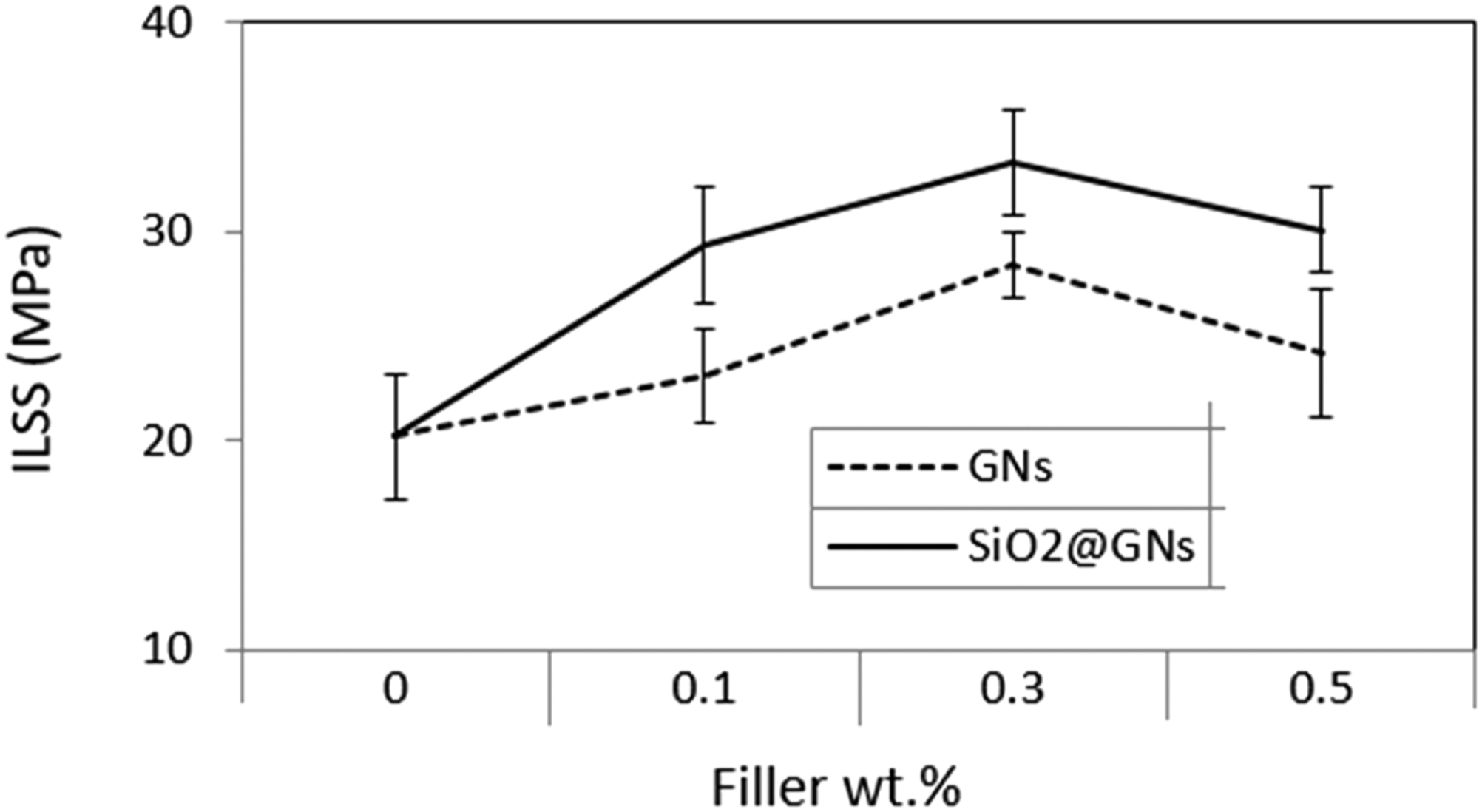
The ILSS of the composites is plotted versus filler loading (GNs or SiO2@GNs) in Figure 4. The ILSS values were obtained using equation (1), as follows
30
Interlaminar shear strength values of the composites versus filler loading (GNs or SiO2@GNs).
In this equation, P, b, and d show maximum load, sample width, and sample thickness, respectively.
One can recognize that the addition of 0.3 wt.% SiO2@GNs results in maximum increasing ILSS. It is revealed that the multiscale composites show an enhanced ILSS (40%, and 64% increment) in comparison with the neat sample for the 0.3 wt.% GNs and SiO2@GNs addition, respectively. The improvement in ILSS can be related to the enhanced matrix and matrix-fiber interfacial properties due to filler addition. Fillers act as a bonding agent between the fibers and the matrix . 31 Also, the addition of fillers in the matrix reduces the thermal stress in the matrix-fiber interface, and as a result, interfacial bonding is improved. The detrimental role of filler loading greater than 3 wt.% may arise from the formation of agglomerates .29,32 In fact, the agglomerates act as stress concentration regions which can facilitate crack nucleation and growth.
A critical conclusion to be drawn from Figure 4 is that the addition of SiO2@GNs hybrid is much more effective in improving the ILSS of jute fiber/epoxy composites than unmodified-GNs. These observations can be explained by the “barrier effect” mechanism. According to this mechanism, the spherical nano-SiO2 improves the GNs dispersion and helps separate the graphene layers. On the other hand, the SiO2@GNs hybrids can bear more load than the unmodified-GNs.
Figure 5 displays the fracture surfaces of the neat jute fiber/epoxy sample and multiscale composites having 0.3 wt.% GNs or SiO2@GNs. For the neat composite (Figure 5(a)), a weak fiber-matrix interfacial bonding is observable. Compared to the neat composite, the matrix residues on the surface of jute fibers for the multiscale composites (Figures 5(b) and (c)) demonstrate a good fiber/matrix adhesion. It is probably the main reason why the ILSS of the multiscale composites is greater than that of the neat sample. It is noticed from Figure 5(a) that the matrix fracture surface is smooth and flat, showing a brittle failure mode.
33
For the multiscale composites, however, the matrix shows an irregular and rugged fracture surface (Figures 5(b) and (c)) due to the crack deflection mechanism. Fracture surfaces of the samples after the ILSS test, a) neat sample, b) 0.3 wt.% GNs-loaded sample, and c) 0.3 wt.% SiO2@GNs-loaded sample.
Wear test results
The relationship between the wear rate and filler loading (GNs or SiO2@GNs) is depicted in Figure 6. The wear rate (K) was obtained using equation (2), as follows
34
Wear rate values of the multiscale composites versus filler loading (GNs or SiO2@GNs).

The friction coefficient (FC)-sliding distance relationship for the neat sample and multiscale composites having 0.3 wt.% GNs or SiO2@GNs is shown in Figure 7. For all samples, the values of the mean friction coefficients were extracted, and the results are presented in Figure 8. Friction coefficient (FC)-sliding distance relationship for the neat sample and multiscale composites having 0.3 wt.% GNs or SiO2@GNs. Mean friction coefficients for the multiscale composites versus filler loading (GNs or SiO2@GNs).

As it can be seen, the best wear behavior is observable for the 0.3 wt.% SiO2@GNs-loaded composite. For this sample, reductions of 50% and 78% in the wear rate and friction coefficient, respectively, were observed compared to the neat composite. Increasing the wear resistance of the multiscale composites compared to the neat sample can be attributed to the influential role of nanofillers in improving the fiber/matrix interfacial adhesion and matrix mechanical properties. The main reason for the decrease in wear properties at high percentages of nanofillers (i.e., 0.5 wt.%) can be attributed to the presence of agglomerates, which weaken the interface and matrix. Similar to the ILSS properties, the wear behavior of the multiscale samples containing SiO2@GNs hybrid filler is better than the similar composites filled with unmodified-GNs, probably due to the “barrier effect” mechanism. This mechanism is explained in the previous section.
The worn surfaces of the neat sample and multiscale composites having 0.3 wt.% GNs or SiO2@GNs are shown in Figure 9. The worn surface of the neat sample (Figure 9(a)) shows fiber breakage, interfacial debonding, and matrix cracking, which resulted in a high wear rate. It is also evident that the multiscale composites (Figures 9(b) and (c)) have lower damage than the neat sample. Contrary to unmodified GNs-filled composite (Figure 9(b)), the worn surface of the multiscale composite containing SiO2@GNs hybrid (Figure 9(c)) is smooth, and a good interfacial fiber/matrix bonding is observed, which corresponded to its enhanced wear behavior. Worn surfaces of the samples, a) neat sample, b) 0.3 wt.% GNs-loaded sample, and c) 0.3 wt.% SiO2@GNs-loaded sample.
Conclusions
In the present work, the effects of adding unmodified-GNs and SiO2@GNs hybrid on the interlaminar shear strength (ILSS) and wear properties of jute fiber/epoxy composites have been investigated. The successful synthesis of the SiO2@GNs nanohybrid was confirmed by X-ray diffraction (XRD), atomic force microscopy (AFM), and energy dispersive X-ray analysis (EDX). Based on the mechanical test results, the ILSS and wear resistance of the jute fiber/epoxy composites were increased by adding nanofillers (GNs or SiO2@GNs), and the best results were obtained when 0.3 wt.% SiO2@GNs was used. The ILSS value of the jute fiber/epoxy composite was increased by 62%, when 0.3 wt.% SiO2@GNs was added. On the contrary, the wear rate and friction coefficient of the jute fiber/epoxy composite were diminished by 50% and 78%, respectively, when 0.3 wt.% SiO2@GNs was added. Interestingly, the effect of adding SiO2@GNs hybrid on improving the mechanical properties of jute fiber/epoxy composite was more impressive compared to the unmodified-GNs. It can be remarked from the SEM micrographs that the multiscale composites exhibited an improved fiber/matrix interfacial bonding, as compared to the neat sample.
Footnotes
Declaration of conflicting interests
The author(s) declared no potential conflicts of interest with respect to the research, authorship, and/or publication of this article.
Funding
The author(s) received no financial support for the research, authorship, and/or publication of this article.
