




Abstract
Electric fabric heaters have demonstrated potential applications in a wide range of fields for medical electrothermal, human healthcare and athletic rehabilitation. Whereas, little attention has been paid to the resistance variations and the interface of electric heaters. Here, this paper focuses on the resistance temperature-sensitive behavior and interfacial electricity of reduced graphene oxide (RGO)/polyester (PET) fabrics, which are obatained through a facile and scalable dip-coating method. When a current of 0.055 ampere (A) is applied, the RGO/PET fabric can achieve an equilibrium temperature about 89 °C in 20 s, with a maximum heating rate of 11.78 °C/s. Besides, the relative resistance changes of RGO/PET fabric are linearly related to the temperature. When the RGO/PET fabric reaches its steady-state temperature of 89 °C, the value of ΔR/R0 drops by ∼30%, showing that the fabric is endowed with temperature sensitivity. These prominent results indicate that the RGO/PET fabric owns great promise in the field of wearable electric heaters. Notably, the contact resistance at the interface of RGO/PET fabric heater is investigated and the mechanism of the temperature in middle part of heater is higher than that of both ends is analyzed. This provides a qualitative decoupling analysis method for the study and analysis of interfacial electricity and electrothermal distribution of carbon materials.
Keywords
Introduction
Wearable electric heaters have attracted growing interest thanks to their wide applications such as medical electrothermal, human healthcare and athletic rehabilitation [1–3]. Electrothermal heating elements are the functional component of wearable heaters, which play an important role in their performance. Electric heating is the process of converting electrical energy into heat energy. As the most commonly used electrothermal materials, metal is cheap, but its high density and inflexibility make it unsuitable for wearable electric heaters [1,4,5]. Moreover, another electrothermal material, indium tin oxide, although it has a high electrical conductivity, is brittle and fragile, which cannot meet the requirements for wearable heaters [1,5,6].
Graphene, a two-dimensional carbon nanomaterial composed of honeycomb-like crystal lattice structure, has stimulated enormous attention since it was first obtained [7,8]. It has great potential in the field of flexible and wearable electronics because of its superior electrical conductivity, prominent mechanical properties and extremely high thermal conductivities (∼5000 W m−1 K−1) [9–12]. Therefore, graphene-based materials are considered as promising candidate materials for electrothermal heating elements [13,14]. On the one hand, textiles are the most promising substrates for wearable electronics due to their particular characteristics, including porous structure, lightweight, flexibility, comfort and deformability [15–17]. However, the vast majority of textiles are generally non-conductive. Reduced graphene oxide (RGO), a derivative of graphene, which can be simple coated on other materials on account of the oxygen-containing functional groups on its surface [18]. What is more, it can be tightly adhered to the textile surface via van der Waals interaction [19] and endows textiles with outstanding electrical conductivity and electrothermal properties [20,21]. Therefore, more and more researchers effectively combined RGO materials with textiles to prepare wearable and flexible heaters. Lai et al. [22] prepared copper/RGO-poly (p-phenylene benzobisoxazole) fibers that shows a steady temperature of 44 °C at an input voltage of 3 V. It can be used as wearable heater with corrosion resistance. Wang et al. [21] used suction filtration and reduction to obtain multifunctional RGO/polyester fabrics with great potential in personal healthcare applications, which can achieve an equilibrium temperature about 50 °C at a 6 V voltage. Abbas Ahmed et al. [23] employed a dip-coating approach to fabricate a smart cotton textile that can reach to a steady-state temperature around 70 °C under 30 V. However, up to now, little attention has been paid to the interface of electric heaters. The interface of electric heater will generate heat in practical application, which has a great impact on its performance. Besides, few reports have investigated the temperature changes of electric heaters under current and the resistance variations of heaters.
In consideration of the aforementioned perspectives, this paper focuses on the resistance temperature-sensitive behavior and interfacial electricity of electric heaters. A facile dip-coating method is adopted to prepare knitted polyester (PET) fabrics comprising RGO, exhibiting remarkable electrothermal properties. The RGO/PET fabric is capable of reaching a steady-state temperature of ∼89 °C within 20 s under a current of 0.055 A, with a maximum heating rate of 11.78 °C/s. Meanwhile, the value of ΔR/R0 drops by ∼30% when the RGO/PET fabric reaches its equilibrium temperature. The relative resistance changes of RGO/PET fabric are determinated during electric heating process, which reveal a linear relation with temperature. This presents the RGO/PET fabric owns outstanding temperature sensing performance. More importantly, the contact resistance at the interface of RGO/PET fabric is decoupled. And the reason why the temperature in middle part of RGO/PET fabric is higher than that of both ends is provided. Based on this work, some guidance is provided for the influence of interface on heater performance in future applications.
Experimental section
Preparation of RGO/PET fabric
GO was obtained by the modified Hummers method [24], as our prior work reported [25], the reddish-brown GO dispersion was prepared for standby and the concentration was 15.6%. A commercial weft-knit polyester (PET) fabric (0.016 g · cm−2, 22 wales × 19 course cm−1) was cut into squares with width by length of 5 × 5 cm2, followed by cleaning with ethanol and deionized water and then dried at 60 °C in oven. Meanwhile, the GO dispersion was taken in a beaker and sonicated for 10 mins to make GO nanosheets more evenly dispersed in deionized water. The pre-cleaned fabrics were immersed into GO solution for 10 mins at room temperature under sonication and then dried at 35 °C for 30 mins in oven. Subsequently, the fabrics were dipped into GO solution for 3 mins and dried at 35 °C for 30 mins in oven. Afterward, the above procedure was repeated to obtain GO/PET fabrics coated with different cycles (5 cycles, 10 cycles and 15 cycles).
After drying, the GO-coated fabrics were chemically reduced to RGO/PET fabrics using hydrazine hydrate. First, the GO-coated fabrics were placed on a steaming rack, which was placed in hydrazine hydrate solution, followed by sealing the opening completely with aluminum foil. Next, it was heated in an oven at 95 °C for 2 h, to reduce GO to RGO by enough hydrazine hydrate vapor in an airtight container. This steam reduction by hydrazine hydrate is to maintain RGO were well formed on the surface of the fabric. Then, the pre-reduced RGO fabrics were completely submerged in 200 mL of 4.4% hydrazine hydrate aqueous solution and kept for 1 h at 95 °C under closed conditions for complete reduction. This process may cause the thermal shrinkage behavior of PET fibers. But the thermal shrinkage of PET fabric is so small that it can be ignored [26]. Finally, the fabrics were soaked in deionized water for 6 h at room temperature under stirring and transferred to an oven for drying completely. The obtained RGO/PET fabrics coated with different cycles were named as RGO-5, RGO-10 and RGO-15, respectively. The contents of RGO coated on RGO-5, RGO-10 and RGO-15 are 9.05%, 16.35% and 22.19%, respectively.
Characterization of RGO/PET fabric
The surface morphology of RGO/PET fabrics was observed by a JCM-6000 desktop scanning electron microscope (JEOL, Japan). Energy spectrum (SEM-EDS) was characterized by a Gemini SEM 500 field emission scanning electron microscope (Zeiss, Germany). X-ray diffraction (XRD) pattern (A8 Advance, Bruker AXS, Germany) was employed to study the crystalline structure of RGO/PET fabric with a scanning speed of 2°/min in the angular range of 5–60°. Raman spectrum was measured by a Renishaw inVia Raman microscope system with a 532 nm laser. Thermal stability of fabrics was obtained using a Pyris thermogravimetric analyzer (Perkinelmer, USA) with a heating rate of 10 °C/min from room temperature to 600 °C in nitrogen atmosphere.
Characterization of electrothermal properties
The RGO/PET fabric was cut into rectangles with width by length of 3 × 2 cm2, then 0.5 × 2 cm2 copper foil was affixed to each end of the fabric. The electrothermal performance of RGO/PET fabric was evaluated on a sample powered by an IT6322 direct current power supply (ITECH, China), while the temperature was monitored and recorded by an infrared camera (InfraTec, Germany). The room temperature was kept at ∼27 °C.
Characterization of electrical properties
The resistance of RGO/PET fabric was measured by four-probe method. Both ends of the specimens were affixed with 0.5 × 2 cm2 copper foil. Then the copper foil was connected with a Keithley DMM6500 multimeter (Tektronis Co. Ltd., China) by wire. When measuring the resistance of RGO/PET fabrics, a pressure of 250 N was applied to the copper foil at each end.
Results and discussion
Fabrication and characterization of the RGO/PET fabric
Figure 1 depicts the process of preparing the RGO/PET fabric. Because of the interaction between graphene oxide (GO) and fibers, the PET fabric turns to brownish after dipping in GO dispersion. To prevent the GO coating structure from being destroyed, a two-step chemical reduction method is adopted. Firstly, GO is reduced to RGO by hydrazine hydrate vapor in order to form a protective graphene coating layer on the fabric surface. The graphene coating layer can alleviate the thermal shrinkage of PET fibers to a certain extent. Then the fabric is immersed in hydrazine hydrate solution to be completely reduced.

Schematic illustration showing the fabrication process of RGO/PET fabrics.
The characterizations of the RGO/PET fabric are shown in Figure 2. Morphological features of the pristine PET fabric and RGO-15 are observed by scanning electron microscope (SEM), as illustrated in Figure 2(a) and (b). It can be seen that there are no obvious impurities on the surface of the pristine PET fabric (Figure 2(a)). After the fabric is coated with RGO, the fibers still maintain a certain gap between the fibers and the pore structure of fabric is preserved (Figure 2(b)). It is worth noted that the RGO nanosheets do not form macro film on the surface of the fabric to bocking the voids between the yarns, which retains the remarkable air permeability of the original PET fabric. More importantly, RGO coating with laminar structures is tightly attached to the surface of fibers mainly thanks to van der Waals forces and the possible interaction of functional groups (Figure 2(c)). In order to further to analyze element contents of RGO-15, SEM-EDS images of fabric cross section are analyzed (Figure 2(d) to (f)). It can be found that the carbon content of fibers is 73.37%, compared to 81.50% of the RGO substances attached to fibers. Also, the oxygen content of the substances is 10.71% less than that of fibers. These results indicate that RGO nanosheets are successfully attached to the surface of PET fabric.

Characterization of RGO/PET fabric. (a, b) SEM images of pristine PET fabric and RGO-15, respectively. (c) Molecular formula of RGO/PET fabric. (d) SEM image of RGO-15 cross section. (e, f) SEM-EDS of RGO-15 cross section. (g, h) XRD pattern and Raman spectra of RGO-15. (i) TGA curves of pristine fabric and fabric coated with RGO after 51,015 cycles, respectively.
As shown in Figure 2(g), X-ray diffraction (XRD) is employed to analyze the crystalline structures of RGO-15. The pattern has three broad diffraction peaks at 2θ = 17.5°, 22.5° and 26.1°, which can be assigned to PET fibers [27,28]. It is well known that a characteristic peak of RGO is usually observed at about 2θ = 25° [29–32]. That is probably because the characteristic peak of RGO is overlapped with the strong peaks of PET. Furthermore, there is a weak peak of RGO/PET fabric at 44.1°, corresponding to an interlayer spacing of 2.05 Å. It shows that the molecules are restacked to produce a defective graphite-like material [33]. Therefore, XRD pattern of RGO-15 suggests that RGO is successfully adsorbed on the surface of PET fibers.
The Raman spectrum of RGO-15 presents two prominent graphene peaks around 1347 and 1580 cm−1 (Figure 2(h)), corresponding to the D-band and G-band, respectively. The D-band represents structural defects. The G band indicates the internal vibrations of the sp2 hybrid carbon atom [34]. The intensity ratio of the D-band to G-band (ID/IG) is 1.61, revealing the defective structure of RGO/PET fabric.
To investigate the thermal stability of RGO/PET fabric, TGA curves of pristine PET fabric and RGO/PET fabrics are presented in Figure 2(i). The thermo-decomposition process of pristine PET fabric and RGO/PET fabrics can be divided into three stages. There is a slight weight loss during the initial stage due to evaporation of water attached to the fabrics. Subsequently, some functional groups of PET fibers decompose at temperatures range of 350–500 °C, resulting in a significant weight loss. After thermal decomposition, the residual weight of pristine PET fabric, RGO-5, RGO-10 and RGO-15 are 9.3%, 14.5%, 18.7% and 21.0%, respectively. Besides, the residual weight of RGO/PET fabric increases with the increase of coating cycles due to the existence of RGO.
Electrothermal performances analysis of RGO/PET fabrics
Schematic diagram of RGO/PET fabric is investigated in Figure 3(a). The fabric is connected with a DC current source to form a circuit. Meanwhile, an infrared camera is adopted to monitor temperature changes of RGO/PET fabrics in real-time. When a current is applied, the temperature of fabric immediately rises because the current passing through the conductor generates heat. The infrared thermal images of RGO-5 under 0.055 A are shown in Figure 3(b). It can be seen that the temperature of RGO-5 rises rapidly in the first 15 s, and then remains relatively stable. When the current source is removed, the temperature of RGO-5 drops rapidly to the initial temperature. And the RGO-5 can be restored to its near original state within about 10 s.

(a) Schematic diagram of the RGO/PET fabric electrothermal heater. (b) Infrared thermal images of RGO-10 under an applied current of 0.055 A within 75 s. (c-e) Average temperature curves of RGO-5, RGO-10 and RGO-15 at different currents. (f) Temperature variation of RGO-5 under a current range of 0.030 A to 0.055 A, where the insets are infrared thermal images at the equilibrium temperature. (g) Plots of steady-state temperature verse current for different RGO/PET fabrics. (h) Schematic illustration for determining the average heating/cooling rate of RGO/PET fabric. (i) Maximum heating/cooling rate and (j) average heating/cooling rate of different RGO/PET fabrics under various currents.
To further study the electrothermal performance of RGO/PET fabrics and the effect of coating cycles on RGO/PET fabric, the real-time temperature of RGO/PET fabric under different current is analyzed (Figure 3(c) to (e)). All the curves present similar tendency and can be roughly divided into three stages: heating, equilibrium and cooling. When a current of 0.055 A is applied, the temperature of RGO-5 rises up rapidly and reaches an equilibrium temperature of 89 °C. Even under a low current of 0.030 A, RGO-5 can be heated to about 39 °C, demonstrating its prominent electrothermal property. Besides, at the applied current from 0.030 A to 0.055 A, the RGO-5 can reach a stable temperature higher than the average body temperature (∼37 °C). It reveals that RGO-5 is suitable for personal heating equipment. Compared with the RGO-5, RGO-10 and RGO-15 exhibit a lower stable temperature under the same applied current because of their relatively lower resistance. RGO-10 shows a steady-state temperature of 75 °C at a current of 0.055 A. RGO-15 can reach an equilibrium temperature of 68 °C when the applied current is 0.055 A. According to the equation P = I2R (where P is power, I is the applied current, and R is the resistance of heaters), this may be attributed to the low efficiency of converting electrical energy into heat energy. Therefore, less RGO coating is better in a certain range for electric heating applications.
For the fabric heater application, a successive actuation of heating is important to evaluate the electrical response of material. Evolution of the temperature of RGO-5 under a current range of 0.030 A to 0.055 A is shown in Figure 3(f). The surface temperature of RGO-5 increases with the increase of current. The consistency between the two indicates that the RGO-5 holds remarkable temperature controllability and electrothermal performance. As a result, the current can be controlled within a certain range to get the desired temperature.
Figure 3(g) presents the steady-state temperature of different RGO/PET fabrics under various currents. As expected, with the increasing current, the steady-state temperature of all fabrics presents almost the linear increase. Under the same current, the steady-state temperature of RGO/PET fabrics decreases with the increase of coating cycles.
Fabric is a complex and multistage structure, which causes its heating and cooling rate to fluctuate within a certain range. In order to evaluate the performance of RGO/PET fabrics, a new method based on the analysis mode mechanical properties of fabrics is proposed. As shown in Figure 3(h), in heating stage of the RGO/PET fabrics, the tangent line of starting heating and the tangent line of steady-state temperature are respectively made. The two tangent lines intersect at point A, which is defined as the temperature turning point of the heating process. Then draw the vertical line of point A and intersect the temperature curve of RGO/PET fabrics at point B. The slope of point B is defined as the average heating rate of heating process. The same method is used in cooling stage. The maximum heating/cooling rate and average heating/cooling rate of RGO/PET fabrics under 0.030–0.055 A are extracted in Figure 3(i) and (j). The maximum heating rate of RGO-5 can be up to 11.78 °C/s at 0.055 A, which is faster than 10.26 °C/s of RGO-10 and 9.18 °C/s of RGO-15. In cooling stage, the same trend is observed. In addition, the heating time to the desired temperature can be roughly judged according to the average heating rate of RGO/PET fabrics, which provides some data references and a comparable evaluation method for practical application.
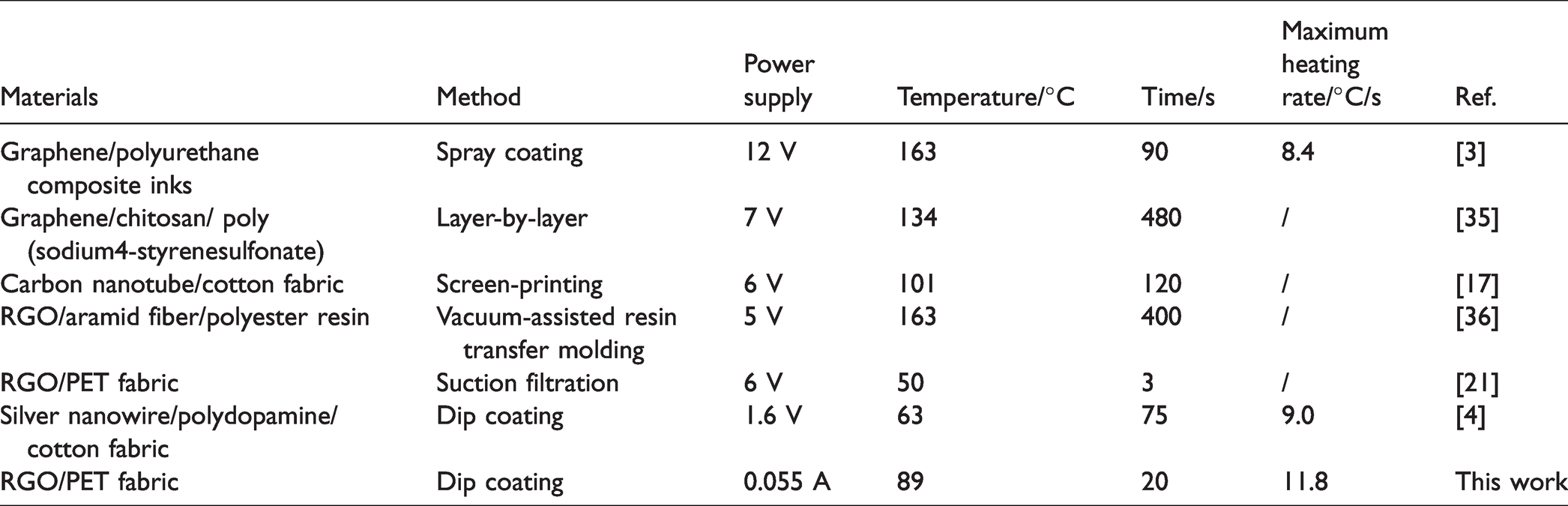
Table 1 presents electrothermal properties of various heaters in literature. It can be found that RGO/PET fabrics possess prominent electrothermal properties like most heaters. By applying applied current to RGO/PET fabrics, the same electric heating effect can be achieved as the applied voltage of heater in the literature. Notably, the maximum heating rate of RGO/PET fabric can be up to 11.8 °C/s. These results show that the RGO/PET fabric holds a wide application potential as a wearable electric heater.
Comparison of electrothermal properties of various heaters in literature.
Resistance temperature-sensitive behavior of RGO/PET fabric
To analyze the influence of temperature on the resistance of RGO/PET fabrics, the resistance temperature-sensing property is also monitored. The relative resistance changes and real-time temperature curves of RGO-5 with an applied current of 0.055 A are demonstrated in Figure 4(a). It can be found that trend of relative resistance variations is opposite to the trend of temperature variations, and the two curves present high consistency with each other. The resistance decreases with the increase of temperature. The value of ΔR/R0 drops by ∼30% when the equilibrium temperature reaches 89 °C. When the current source is removed, the resistance of RGO-5 increases rapidly without hysteresis. The relative resistance variations of RGO-5 under different applied currents are also test (Figure 4(b)). As expected, the greater the applied current, the more significant the changes of relative resistance, which may be on account of the different temperature variations. Figure 4(c) reveals relative resistance variations versus steady-state temperature curves of RGO-5 under currents of 0.030–0.055 A. The RGO-5 exhibits negative resistance variation with a temperature coefficient of resistance (TCR) of −0.372%/°C in a range of 38–89 °C. These results indicate that the RGO-5 is endowed with remarkable temperature sensitivity.

(a) Relative resistance changes and real-time temperature versus time curves of RGO-5 under 0.055 A. (b) Relative resistance variations of RGO-5 as a function of time under different applied currents. (c) Relative resistance variations versus steady-state temperature curves of RGO-5 under different currents. (d) Relative resistance variations of RGO-5 versus the oven temperature. (e) Potential applications of RGO/PET fabrics as electrical heaters and temperature sensors.
In order to further investigate the reason of resistance temperature-sensitive behavior of RGO/PET fabrics, the RGO-5 is put into an oven for testing its resistance variations. The relative resistance variations of RGO-5 are presented in Figure 4(d). The temperature is selected on the basis of the steady-state temperature of RGO-5 with different current. A thermometer is used to measure the actual temperature of fabric in the oven, which is equal to the temperature of RGO-5 on account of heat transfer. The relative resistance variations of RGO-5 are linearly related to the temperature, and TCR of RGO-5 is −0.369%/°C. This illustrates that the resistance changes of RGO-5 is caused by temperature rather than by electrical polarization. As the temperature rises, the charge carrier of electrons and conductive holes of RGO-5 will be excited and significantly increase, participating in the conduction, resulting in a decrease of resistance. Based on this, the conductive behavior of the RGO/PET fabric and even RGO is close to that of semiconductors rather than metals. These results display that the RGO/PET fabric has potential applications in both electric heaters and temperature sensors (Figure 4(e)). When the RGO/PET fabric is adopted as personal heating device, its temperature can be sensed through resistance variations, which can not only achieve the desired temperature of body, but also avoid being scalded.
Effect of interface on electrothermal behavior
In general, thermal accumulation occurs at the contact interface. But what's interesting is that does not happen here. Whether the RGO/PET fabrics are heated up or cooled down after the current source is removed, a common phenomenon can be observed. The phenomenon is that the temperature in the middle of the fabric is always higher than that in the area, in which the copper foil is attached to both ends of the fabric (Figure 5(a)). It is well known that the temperature of a fabric heater is closely related to its resistance. Based on these, the effects of interface on electrothermal behavior of RGO/PET fabrics are studied. As illustrated in Figure 5(b), the resistance of RGO/PET fabrics with different lengths is measured by sticking copper foil on both ends of the fabrics and connecting with DMM6500. Conductive copper foil serves as measuring electrode, therefore the contact interface (resulting in contact interface resistance) exists between the copper foil and RGO/PET fabrics. And all the measurements are performed involving the copper foil test electrodes. By measuring the resistance of samples at various lengths (at least three different lengths), the interface resistances and the volumetric resistance can be decoupled. The equivalent circuit model is shown in Figure 5(c). The resistance of contact interface is Ri, the resistance of ontology is Ra, and the resistance of interspace is Rb. Ra and Rb can be regarded as the resistance of RGO/PET fabric itself (R). The resistance of RGO/PET fabrics with different lengths is revealed in Figure 5(d). The resistance of RGO/PET fabrics decreases with the increase of coating cycles. This is because the resistance depends on the amount of RGO nanosheets deposited on the fiber surface. Besides, the measured resistance (RL) can be expressed using the following equation.
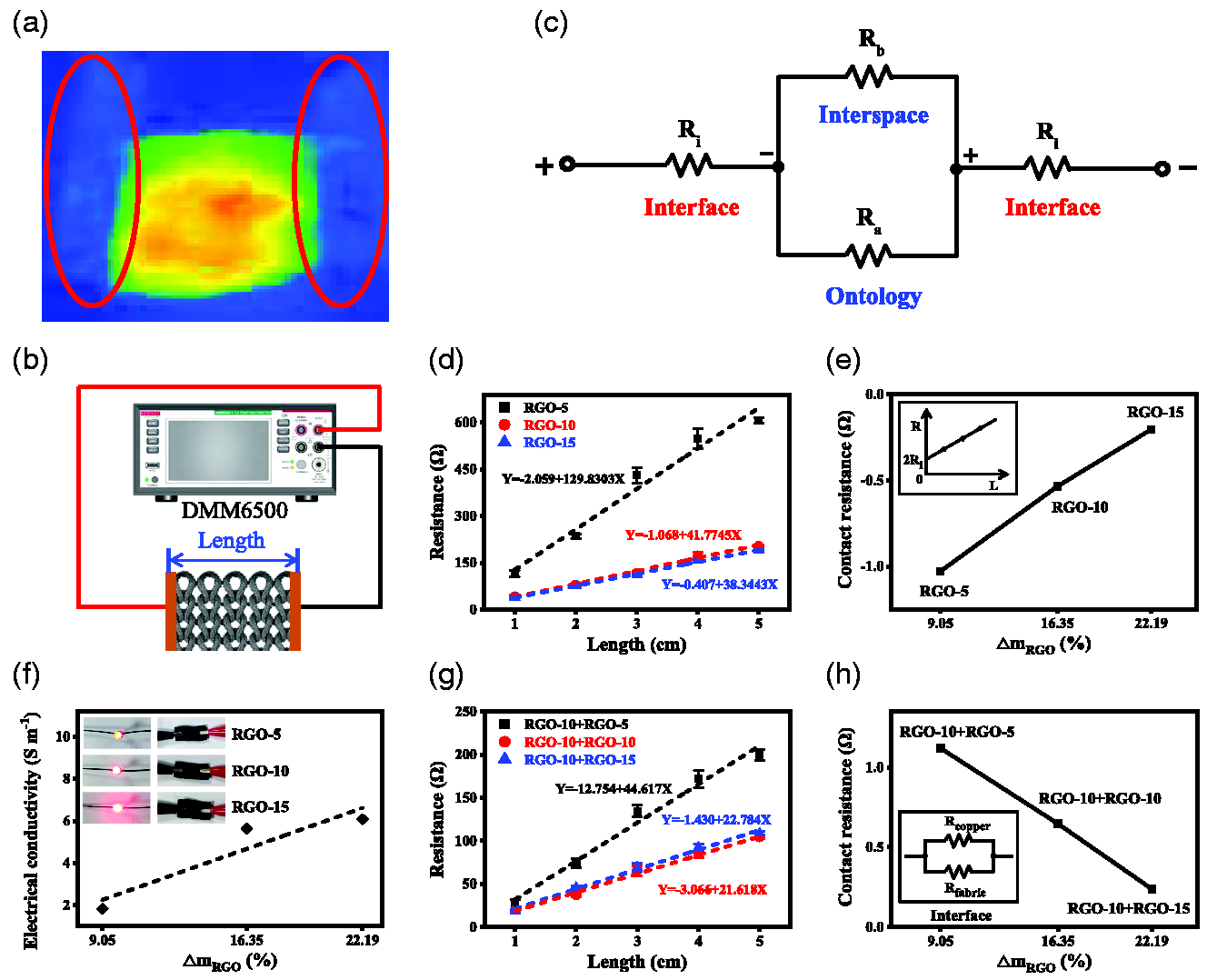
(a) Infrared thermal image of RGO-10 heated for 5 s under 0.055 A current. (b) Diagram of resistance measurement device for different lengths of RGO/PET fabrics. (c) Equivalent circuit model of the RGO/PET fabric heaters. (d) Resistance variation versus length of various RGO/PET fabrics. (e) Contact resistance curves between copper foil and different RGO/PET fabrics (RGO-5, RGO-10 and RGO-15). (f) Electrical conductivity of the RGO/PET fabrics. (g) Resistance curves of RGO-10 stack with RGO-5, RGO-10 and RGO-15, respectively. (h) Contact resistance curves between RGO-10 and different RGO/PET fabrics (RGO-5, RGO-10 and RGO-15).
Therefore, the measured resistance values are analyzed by linear fitting. The intercept of linear fitting curve is the contact resistance. It should be noted that both ends of the fabric are attached with copper foil. Based on the equivalent circuit model and fitting results, the contact interface resistance Ri between the RGO/PET fabrics and the copper foil can be extracted, as illustrated in Figure 5(e). The resistance of RGO-5, RGO-10 and RGO-15 in contact with copper foil is -1.030 Ω, -0.534 Ω and -0.204 Ω, respectively. It can be seen that Ri is negative (not refer to negative electron), indicating that Ri is less than the resistance of RGO/PET fabric ontology. Meanwhile, the slope of linear fitting can be also applied to calculate the electrical conductivity of RGO/PET fabrics with different coating cycles. The electrical conductivity (σ) can be described by the following equation


The slope (k) of linear fitting can be express by the following equation
So the electrical conductivity of RGO/PET fabrics can be demonstrated using the following equation
To further investigate the contact resistance of RGO/PET fabric ontology, RGO-10 is superimposed with different RGO/PET fabrics, and then the resistance changes with different lengths are measured (Figure 5(g)). When the RGO-10 is superimposed with RGO-10, its resistance is minimal because the equivalent circuit model can be viewed as a parallel circuit. According to the equivalent circuit model, the linear fitting results and the contact resistance values between RGO/PET fabrics and copper foil, the contact resistance between RGO-10 and different fabrics can be calculated (Figure 5(h)). The contact resistance between RGO-10 and various RGO/PET fabrics is positive, revealing that the contact resistance between RGO/PET fabrics is greater than that of fabric ontology. Based on these results, a qualitative decoupling analysis method is provided for the study and analysis of interfacial electricity and electrothermal distribution of carbon materials (e.g., the temperature in the middle of RGO/PET fabrics is higher than that of the copper foil on both ends during heating and cooling).
Conclusions
In summary, we have reported a flexible fabric heater based on RGO and knitted PET fabric, which can be prepared through a facile and scalable dip-coating method. The RGO/PET fabric exhibits outstanding electrical conductivity (6.08 S·m−1) and electrothermal properties. It can reach a steady-state temperature about 89 °C in 20 s at 0.055 A, with a maximum heating rate of 11.78 °C/s. In addition, resistance temperature-sensitive behavior of RGO/PET fabrics is investigated. The value of ΔR/R0 drops by around 30% when the RGO/PET fabric attains its equilibrium temperature of 89 °C. These prominent results, combined with the chemical stability of RGO and flexibility of PET fabric, indicate that the RGO/PET fabric owns great potential as wearable smart devices in the field of human healthcare. Furthermore, it is worth noted that the reason why the middle temperature of heater is higher than that of both ends is explained. And a qualitative decoupling analysis method is provided for the study and analysis of interfacial electricity and electrothermal distribution of carbon materials. This work holds some merit to reference for studying the interfacial electricity and resistance variations of electric heater in the future.
Footnotes
Declaration of conflicting interests
The author(s) declared no potential conflicts of interest with respect to the research, authorship, and/or publication of this article.
Funding
The author(s) disclosed receipt of the following financial support for the research, authorship, and/or publication of this article: This research was supported by the National Natural Science Foundation of China (NSFC 51803185), Public Welfare Project of Zhejiang Province (LGF21E030005), China Postdoctoral Science Foundation (2020M681917), Postdoctoral Foundation of Zhejiang Sci-tech University Tongxiang Research Institute (TYY202013), the Science Foundation of Zhejiang Sci-Tech University (No. 18012107-Y).
