




Abstract
Recently, researchers and scientists are trying to overcome the environmental burden by using biocomposites in engineering applications as far as possible. The main source of biocomposites is cellulosic fibres which is a class of natural fibres. Instead of many advantages of cellulosic fibres, they and their polymer composites suffer from some limitations as well. The environmental conditions are one of the most important issues to degradation behavior of the cellulosic fibres polymer composites (CFPCs). Among the environmental conditions, water absorption is an important ground to degradation in the mechanical performance of the CFPCs, which resists them to be used in outdoor applications. Several studies have been presented on water absorption characteristics of cellulosic fibres and its polymer-based biocomposites. Further, the consequence of water uptake on the mechanical performance of biocomposites was also reported in many studies. In most of the cases, a negative effect of water absorption was observed, whereas in a few cases a positive effect was also seen. In the present study, mechanics and kinetics of water absorption for CFPCs are discussed. Further, a detailed literature review on water absorption of cellulosic fibres and their different types of polymer-based biocomposites has also been carried out. Furthermore, studies reported on the effect of water absorption on the mechanical properties were also systematically presented. Moreover, all the possible remedies to lower the water absorption capacity were also discussed in the present review paper.
Keywords
Introduction
In past decades, man-made fibres (i.e. glass, carbon and aramid) reinforced polymer composites have been used in many applications. Among these composites, glass fibre reinforced polymer composites are the most utilized materials in several applications such as marine, automobile, helmet, aerospace, electronics, aviation, gas and oil piping so far, owing to the outstanding characteristic of glass fibres such as strong bonding with polymers due to its hydrophobic nature, high stiffness and strength, high flexibility, good environmental resistance, good resistance to chemical and better damage tolerance [1]. These composites are influencing our environment as these fibres are not renewable, eco-friendly and bio-degradable. In the current scenario, environmental issues are the main challenge to the researchers and manufacturing industries. Therefore, the rising concern towards environmental issues and new ecological regulation have forced to utilize the polymer composites materials filled with natural-organic fillers in place of man-made fibres as much as possible [2,3]. In the current decade, the usage of cellulosic fibres as reinforcement in polymer composites for producing low-cost engineering materials with lower environmental impact has gained a great deal of attention [4,5]. These cellulosic fibres offer many advantages such as availability in large amounts, lightweight, high specific strength and modulus, non-health hazards, biodegradable, high specific strengths and modulus, low cost and density, reduced tool wear and enhanced energy recovery [6–10].
Instead of many useful benefits of the biocomposites, they suffer from some remarkable limitations too. The poor interfacial bonding between cellulosic fibres and polymers is the most important limitation which occurs due to interaction between polar and hydrophilic natural fibres and non-polar and hydrophobic polymers [11]. The lower moisture resistance is the second most important limitation due to the polar and hydrophilic nature of cellulosic fibres [10,12–14]. Some other limitations are as such; moderate strength mainly impact, low durability, and poor compatibility and wettability [15–19]. Several surface modification methods were employed to improve the interfacial bonding between fibres and matrix thereby increase in mechanical performance [20–24]. Further, the surface modifications of cellulosic fibres using physical/chemical treatments were found to be the most suitable methods to lower the water uptake [25–28]. The chemical treatments significantly remove the hemicelluloses, lignin and amorphous region of cellulose which are the main source of water uptake. Apart from chemical treatment methods, the polymer coating on the cellulosic fibres [29–32], hybridization of cellulosic fibres with manmade fibres [33–39] and using the coupling agents [40,41] were also observed as a significant method to decrease the water absorption capacity.
A good number of research works were reported on the water absorption of cellulosic fibres and their polymer-based biocomposites. In addition, the effect of water absorption on the mechanical properties of the various types of biocomposites has also been reported. Further, researchers have attempted the many surface modifications methods to overcome these serious drawbacks. It was observed that a state-of-art on remedies of water absorption and its effect on the mechanical properties of the biocomposites is not summarized so far. This fact motivated to prepare a review on the effect of water absorption on the mechanical properties of CFPCs and its best possible remedies. The present review describes the water absorption behaviour and its consequences on the mechanical properties of CFPCs along with all the possible remedies.
Water absorption as a main limitation
Due to higher water absorption, CFPCs were not found suitable to be used in outdoor applications and the area where water medium is a concern. In general, when CFPCs are exposed to a humid environment or immersed in water then they show the high moisture absorption characteristic due to the presence of the cellulosic fibres. These cellulosic fibres have a hydrophilic nature because of the presence of hydroxyl groups and other polar groups. Water molecules present in CFPCs act as a plasticizer and influences the interfacial bonding resulting in poor stress transfer thereby decrease in mechanical properties [33]. The hydrophilic nature is associated with hydroxyl groups of hemicelluloses, cellulose and lignin which is the main constituent of cellulosic fibres, which hold the water molecule by hydrogen bonding. This fact shows that chemical compositions of cellulosic fibres are the main responsible factors for their water absorption. The different cellulosic fibres show different water absorption capacity due to their variations in chemical compositions. Hemicellulose is the main cause of water absorption in the cellulosic fibres followed by amorphous cellulose, lignin and crystalline cellulose. Apart from chemical compositions of cellulosic fibres, some other factors also appreciably affect the water absorption capacity, as such [33,42]; Volume fraction of the cellulosic fibres Properties of the cellulosic fibres Orientations of the cellulosic fibres Permeability of the cellulosic fibres Voids present in CFPCs Temperature of surroundings Types of media (different type of media such as humid environment, sea water, rain water, distilled water, and so on with different pH values) Humidity of air Reinforcement architecture Exposed surface area to water Viscosity of polymers Degree of cross-linking Degree of crystallinity Polarity of molecular structure Diffusivity Surface modifications Interfacial bonding between the cellulosic fibres and polymers
Usually, water absorption behavior of CFPCs was studied as per ASTM D 570. The increase in the percentage of water absorption was calculated by the equation (1) [34,43].

Mechanics of water absorption
One of the serious problems with the CFPCs is the degradation performance when composites are exposed to environmental circumstances such as humidity, sunlight and water. The cellulosic fibres show weak resistance to water absorption that may cause unwanted consequences on the mechanical characteristics and the dimensional stability of their composites. It is obvious that moisture uptake has a deleterious effect on the mechanical properties of CFPCs, so it is essential to understand the water absorption mechanism to improve the durability of their use. The water absorption leads to swelling of cellulosic fibres as a result of a reduction in stiffness of cellulosic fibres and development of shear stresses at an interface that causes degradation of the fibre-matrix interface region, and finally resulting in a reduction of mechanical properties along with a change in dimensions of the composites [33,36,42,44–47]. The sequences of loss in the structural integrity of the CFPCs by water absorption are presented in Figure 1 [1]. The main three distinct mechanisms for water molecules diffusion into CFPCs were reported, as follows [33,34,44,45,48]. The diffusion of water molecules into micro gaps of polymer chains. The movement of water molecules into the holes and defects through capillary action due to poor wettability and penetration at the interfaces. The transmission of water molecules into micro cracks in the polymer matrix owing to fibres swelling.

Loss in structural integrity of biocomposites by water absorption.
Azwa et al. [42] presented the mechanics for the effect of water absorption on the fibre matrix interface, as shown in Figure 2. It was reported that leaching of water-soluble substances from the surface of the fibre is responsible for the rising of osmotic pressure results in debonding between fibres and matrix.

Mechanics for fibre-matrix debonding by water absorption.
Kinetics of water absorption
In composite materials, several researchers had developed different models in order to study the moisture absorption behaviour, but the overall effect was modeled by considering the diffusion mechanism. The diffusion of water molecules into CFPCs could be explained based on Fick's diffusion law. Water absorption by CFPCs was found to be very similar to Fickian diffusion process at room temperature [33,42,44,49–52], whereas at higher temperature non-Fickian process was observed [42,53]. Diffusion is defined as the transfer of masses between two mediums by changing the positions of molecules under the impact of thermal energy and gradients of concentration, electrical, magnetic and stress. Following equations (2 & 3) describe the Fick’s first law under the steady-state condition and unidirectional flow, and second law under the non-steady state condition with the unidirectional flow of the matter, respectively [54];


In the case of one-dimensional moisture absorption and both sides having the same environment, the total moisture uptake can be expressed from equation 3 as follows:

At beginning moisture absorption increase linearly with square root of time. Hence equation (4) can be simplified as

Diffusion coefficient, is an important parameter of Fick's diffusion model, indicates the ability of water molecules to diffuse into CFPCs. Using Fick's diffusion model average diffusion coefficient was calculated using the following equation (6).

Using Fick’s law of diffusion, the experimental values of diffusion, sorption and permeability coefficient were calculated using equations [34,46,54];




The corrected diffusion coefficients is very useful the measure the edge effects. The combined effect of
The main three types of diffusion behaviour were seen in case of CFPCs, as depicted in Table 1 [8,33,42,53,55]. To identify the types of diffusion by analyzing the intercepts and slope of water absorption curve plotted using the following relations [33,53]:


Water diffusion mechanism of pure and modified sisal composites.

Water absorption behavior of cellulosic fibres
Since, a higher water absorption is a major drawback of the cellulosic fibres and is also a major cause of degradation in the mechanical performances of their composites. Cellulosic fibres absorb the moisture owing to its hydrophilic nature which is due to the presence of several H-bonds (-OH groups) between macromolecules of cell wall in fibres. When the fibres come in contact with moisture, H-bond breaks and -OH groups create new H-bonds with molecules of water. Thus, it can be concluded that hydrophilic -OH groups are the main source of water absorption in cellulosic fibres. The water absorption of cellulosic fibres can be overcome by eliminating these groups. The water absorption capacity of cellulosic fibres was successfully tried to overcome by surface modification methods and applying polymer coating on the surface of the fibres.
Punyamurthy et al. [56] investigated the impact of alkali treatment on water absorption of abaca fibre. Based on outcomes, it was noted that there was a 63.50% reduction in water absorption after removal of hemicellulose and lignin for alkali-treated fibre than that of untreated one. In another study, Punyamurthy et al. [57] studied the effect of the esterification on moisture absorption behaviour of single areca fibre and observed a significant reduction in moisture absorption after treatment. The moisture uptake behaviour of abaca fibre was studied by Baltazar-y-Jimenez and Bismarck [58]. The noticeable reduction in moisture absorption of single areca fibre owing to esterification impact was reported in literature [59]. Nayak and Mohanty [60] modified the areca sheath fibres using alkaline, acrylic acid, permanganate, sodium chlorite, and benzoylation to examine the mechanical, thermal and water absorption properties and better performance were reported by benzoylation. As compared to untreated banana fibre, the better water resistance was shown by treated banana fibre [61]. Nosbi et al. [62] conducted the water absorption test on kenaf fibre in different mediums like seawater, distilled water and acidic solution. It was observed that the fibres absorb the maximum water in seawater due to its higher pH value of 8.4, whereas the lowest was seen in acidic solution due to the lower pH value of 3.0. Sahu and Gupta [63] modified the sisal fibre using sodium bicarbonate treatment followed by poly lactic acid (PLA) coating in order to minimize its water absorption capacity and found a fruitful result of this treatment.
Water absorption behavior of CFPCs
As a higher water absorption behaviour is an important issue of the CFPCs, therefore many research works on the water absorption behaviour of the CFPCs have been reported. Water absorption behaviors of the CFPCs are discussed in the subsequent paragraphs.
The effect of different fibres wt. % on the water absorption characteristics of unidirectional sisal fibre reinforced epoxy composite was evaluated and stated that the water uptake percentage was determined to rise as an increase in fibres content, as shown in Figure 3 [64]. Similarly, Zhong et al. [65] also evaluated the water absorption behaviour of sisal/urea-formaldehyde composites with differing fibres wt. % (10, 20, 30, 40, 50, 60 and 70%). The lowest water uptake for composite with 30 wt% fibres was only 0.98 wt%, credited to strong bonding between the fibres and matrix. Water uptake was found directly proportional to fibres concentrations when water absorption behaviour of unidirectional jute/epoxy composites was studied [66]. Sapaun et al. [67] found that unidirectional sugar palm fibre/vinyl ester resin composite demonstrated the lowest value of water absorption as compared to bidirectional fibre composites. However, all the composites showed a high water absorption compared to neat vinyl ester, which might be attributed to incompatibility between fibre and matrix that led to micro-bubble and voids.

The effect of fibres wt.% on the water absorption of sisal composites.
Masoodi and Pillai [68] developed jute bio epoxy composites for water absorption measurement and stated that pristine epoxy absorbs less water as compared to jute bio epoxy composites. The reason was that jute fibre is polar thereby they attract more water. The impact of fibre's lengths on water absorption properties of pine needles fibres/phenol-formaldehyde composites was investigated and higher water absorption was seen in the case of long fibres composite compared to the short one [69]. Daramola et al. [70] studied the effect of variation in weight percentages of banana fibre on the water absorption properties of banana/polyester composites and a linear relationship of water uptake with fibres concentrations was observed. Water absorption of hemp fibre/unsaturated polyester was found to increase with an increase in weight percentages of hemp fibres [71]. According to Singh and Tiwari [72], the luffa cylindrica fibre was used as a reinforcing to fabricate the composite with epoxy resin. It was found that the values of moisture uptake increase with an increase in fibres loading. Further, a higher moisture uptake in the saline environment over distilled water was obtained. Santos et al. [73] studied the effect of ageing of autoclaved on water absorption, porosity and flexural behaviour of epoxy/flax composites, and concluded that water absorption levels increased with the ageing time. The effect of charcoal particles incorporation on the mechanical and water absorption behaviour of sisal composites was studied, and it was displayed that mechanical and water resistant performance was significantly improved due to charcoal particles loading up to 4 wt.% and then decreased [74].
Effect of water absorption on the mechanical properties of CFPCs
One of the most important concerns with the CFPCs is susceptibility to moisture uptake which highly influences their performance. Several studies have been performed to study the effect of water absorption on the mechanical properties of CFPCs. A detailed literature review on the effect of water absorption on the mechanical properties of CFPCs is provided in the following paragraphs.
The impact of fibre length and water absorption on the mechanical properties of sisal/epoxy composites was studied, as depicted in Figure 4 [75]. A significant reduction in the mechanical properties of the composites was observed due to water absorption. The water absorption leads to swelling of fibres and then the development of shear stress at the interface thereby finally debonding of fibres from the epoxy matrix results in a reduction in the mechanical properties. Due to water absorption, there was a reduction of (10–18) % in tensile strength, (10–21) % in flexural strength and (16–30)% in impact strength. A similar kind of work wherein impact of water absorption on the mechanical characteristics of epoxy and polyester based sisal and jute fibre composites was studied, and jute composites were found to be least affected by water absorption than sisal composites [76]. Singh et al. [77] examined the physical and mechanical properties of jute/phenolic composites under different aging environments and a drop in strength with the rising humidity was reported. Seki et al. [78] examined the behaviour of jute/polyester composite subjected to distilled water and saltwater. It was concluded that interlaminar shear strength was reduced owing to the water aging as increase immersion time.

The impact of water absorption on the mechanical properties: (a) tensile strength, (b) flexural strength and (c) impact strength.
JA et al. [79] developed the napier fibre/polyester composites and found that the tensile and flexural strength of prepared composite tends to reduce with the increased immersion time. The impact of fibre loading and water absorption behaviour on the mechanical properties of flax/epoxy composites was investigated by Huner [80]. As the fibre volume fraction of fibres increased, the percentage of moisture uptake increased because of the great quantity of cellulose content. Further, the tensile and flexural properties of the composites were affirmed to reduce due to water absorption. Osman et al. [81] analyzed the impact of water absorption on the flexural properties of kenaf/unsaturated polyester composites. The flexural properties of the composites reduced significantly owing to the degradation of the fibre-matrix interface. A decline in tensile and flexural strength of neat PLA and ramie/PLA composites was seen with immersion time owing to the presence of voids and micro-cracks which leads to the debonding of ramie and PLA [82]. Assarar et al. [83] investigated the impact of water aging on the mechanical properties of flax and glass composites. Water absorption of flax composite was 12 times higher than that of glass composites. Further, lowering in tensile properties of flax composite was seemed to low than glass composites. Tensile and flexural properties of Lantana camara/epoxy composites were seen reduced by water absorption when tested in steam, saline water and sub-zero temperature [84]. Bharath Naik et al. [85] prepared wood plastic composites by reinforcing wood sawdust into polypropylene resin subjected to study the outcome of moisture absorption on their mechanical properties. It was noticed that the water immersed sample offered a low value of tensile and flexural strength than dry samples; shows again a negative impact of water absorption. Deng et al. [86] reported significant degradation in the mechanical properties of woven co-extruded all-polypropylene composites by water absorption. Shahzad [87] investigated the impacts of water uptake on the mechanical properties of hemp fibre composites. A huge drop in tensile properties and an immediate drop in flexural properties in hemp composites were observed due to water absorption. Due to immersion in water for 2000 hrs, hemp composites lost around 30% and 65% of their intrinsic strength and modulus.
An opposite to above mention results on the impact of water absorption on the mechanical properties of CFPCs was also reported, as follows. Dhakal et al. [44] prepared the hemp/polyester composites to analyze the consequences of water absorption on their mechanical characteristics. The tensile strength was increased by 22% after submersion in water for 2 layer hemp reinforced composite owing to the occurrence of cross-linking. On the other hand, flexural strength and strain were decreased by the moisture absorption might be due to the formation of hydrogen bond between fibre and water molecules. Further, the tensile modulus was declined and the flexural modulus was raised as a result of water absorption. Munoz et al. [52] produced flax fibre reinforced bio epoxy composites to examine the influence of water absorption on their mechanical properties. After immersion, the tensile strength of the composite was increased up to 35% as a result of much swelling of fibres which fill the gaps in the composites created during the fabrication process. Further, there was an increase of 51% in strain for wet samples over dry samples due to the plasticization of the composites. Furthermore, the value of flexural strength of dry samples was seen higher and lower for 40% and 55% fibres loaded composites, respectively. In another study, a positive impact of water uptake on the mechanical properties of jute/polypropylene composites was found due to swelling of the fibers [88].
Apart from thermosets and thermoplastic based biocomposites, the effect of water absorption on the mechanical properties of green composites was also discussed. The incorporation of cellulosic fibres into biopolymers leads to the development of green composites. These composites are eco-friendly, completely biodegradable and has no impact on our environment. Bakare et al. [89] fabricated the composites utilizing sisal fibre and rubber seed oil-based polyurethane to interpret the consequences of 30 days water immersion on their mechanical properties. The small deterioration in the mechanical properties after disclosure to moisture was attributed to the creation of hydrogen bonding between the water molecules and the hydroxyl groups of the fibres. Mehanny et al. [90] prepared six types of high-content cellulosic fibre-reinforced starch-based composites by compression molding. The decline in the mechanical properties was credited to the swelling of the fibres. Owing to this swelling, the growth of shear stress at the fibre/matrix interface occurs. Consequently, this leads to debonding of the fibres and finally loss in the structural integrity. Ma et al. [91] fabricated micro winceyette fibre thermoplastic starch biocomposites and reported a reduced mechanical strength of the composites after water absorption.
Remedies to water absorption of CFPCs
A high moisture uptake in the biocomposites has a vicious impact on their mechanical performance which makes them weak for outdoor applications. In order to minimize these serious negative aspect, surface modifications of the fibres using chemical and physical treatments have been applied by the researchers. To minimize the water absorption of CFPCs, many remedies such as chemical treatments of cellulosic fibres, use of compatibilizer, addition of filler materials, polymer coating, hybridization and so far have been discussed. A detailed description of these remedies is provided in the following several paragraphs.
Chemical treatments
The chemical treatments were employed for surface modifications of the fibres by the researchers to overcome this serious drawback. Owing to the presence of hydroxyl and other polar groups in various constituents of cellulosic fibres leads to poor interfacial bonding with hydrophobic polymer matrices. Poor interfacial bonding is one of the main cause to absorb a large amount of water in CFPCs. Using these treatments, interfacial bonding can be improved resulting in improved water resistance capacity of CFPCs. Other main sources of water absorption in CFPCs are hemicelluloses, lignin and amorphous parts of cellulose, which were found to be removed after chemical treatments which result in a decrease in water absorption. A detailed discussion to minimize the water uptake of CFPCs is presented in the following paragraphs.
Alkali treatment
Alkali treatment/mercerization, commonly uses NaOH, is one of the most used chemical treatment for several cellulosic fibres. It breaks the -OH group present in molecules and then reacts with water molecules and removes them from fibre structure. It increases the surface roughness thereby increase in fibre-matrix bonding. It eliminates a certain amount hemicellulose, lignin, wax and oils covering the external surface of fiber cell wall [18]. Therefore, a reduction in water absorption of cellulosic fibres and its biocomposites by alkali treatment can be expected. A reaction of NaOH with cellulosic fibre is provided in the following Scheme 1. Several works were carried out to minimize the water uptake of the biocomposites. Some of them are provided in subsequent paragraphs.

A reaction of NaOH with cellulosic fibre.
Rahman et al. [92] analyzed the positive outcomes of alkali treatment as untreated coir fibre composite offered the maximum water uptake of 61% whereas the alkali-treated composite offered only 26% of water absorption. Naguib et al. [93] studied the effect of alkali treatment on water absorption behaviour of bagasse fibre/polyester composite at room temperature and boiling immersion conditions. It was noted that after alkali treatment the percentage of water absorption of bagasse fibre composite was enhanced owing to exposure of more surface area with more hydroxyl groups to absorb more moisture. On comparing with untreated composite, the improved water uptake resistance of alkali treated cotton fabric/low-density polyethylene composites were reported by Bakkal et al. [94]. Ja et al. [79] reported a lower degradation in the mechanical properties of napier grass/polyester composites after 10 wt.% NaOH treatment. Boussehel et al. [95] treated olive stone flour using varying concentrations of NaOH and concluded that 4% of NaOH treated fibre composite offered the lowest water uptake; presented a positive impact of alkali treatment. According to Gunti et al. [96], polylactic acid-based composites were prepared using elephant grass, sisal and jute fibres as reinforcement. The water absorption rate increased in all the composites as the fibre content increased and the absorption rate reduced with successive alkali treatment on the fibres. In another study, the water resistance capacity of kenaf/polyester composite was also found to increase after alkali treatment [97]. A drop in water absorption of short sisal fibre/polylactic acid after alkali treatment was analyzed [98]. Razera and Frollini [99] studied the consequences of alkali treatment on the water absorption capacity of jute phenolic composite and a little water uptake was noted for alkali-treated fibres composites. A significant reduction in water absorption capacity for hemp/polyester composite was seen after alkali treatment [27].
Benzoylation treatment
In benzoylation treatment, benzoyl chloride was used to depreciate hydrophilicity of fibres and strengthen the adhesion bonding at the interaction between the fibres and matrix. Hydroxyl groups are attached to cellulose by the exclusion of constituents like waxes and lignin from the surface of the fibre. Next, OH groups of the fibres are displaced by the benzoyl group and it joins to the cellulose. The results explained that hydrophobicity creates on the surface of the fibres and grows bonding with the matrix. The chemical reaction with fibre involved in benzoylation treatment is described in Scheme 2. This treatment was applied on flax fibre and its flax/low-density polyethylene based composites were developed. From findings, it was concluded that flax/low-density polyethylene composites offered a better moisture resistance properties because of superior interlocking between fibres and matrices provide by benzoylation treatment [100]. A similar process was also carried out by Wang et al. [22] to minimize the water uptake capability of flax fibre/polyethylene by boosting the interfacial adhesion through benzoylation treatment. The effect of treatments including benzoylation on the mechanical and water absorption characteristics of sisal/polyester composites was analyzed by Sreekumar et al. [101], and concluded a lower water uptake for treated composites over untreated one at different temperatures. Gupta et al. [27] investigate the effect of benzoylation treatment on the water absorption of hemp/polyester composite and experienced a significant reduction in water uptake after the treatment.

A reaction of benzoyl chloride with cellulosic fibre.
Silane treatment
To modify the surface of the fibres, silane is used as a coupling agent. Chemical link is formed by silane molecules between the fibres and resin in the course of siloxane bridge. During the treatment process of the fibres, three stages consisting of hydrolysis, condensation and bond formation take place. In the hydrolysis process, silanol is formed by silane in the existence of fibre moisture. For the duration of the condensation process, one end of silanol reacts with the matrix functional group and the other end reacts with the cellulose hydroxyl group. This process provides the hydrocarbon chain that opposes the fibres swelling into the matrix leads to molecular continuity occurs across the interface of the composite and finally fibre matrix adhesion improves. A silane reaction with fibre is given in Scheme 3.

The reactions with cellulosic fibre during saline treatment.
Silane coupling agent is found to be an effective method to boost the cellulosic fibre-matrix interface bonding which results in a decrease in water uptake capacity. The water absorption of flax/tannin composites was remarkable declined after saline treatment [102]. The reduced water absorption of polypropylene/ijuk fibre composites due to the impact of surface treatment was reported by Zahari et al. [103]. Pothan and Thomas observed a lowering in water absorption by treatments [37]. Dayo et al. [104] evaluated the effect of silane treatment on water uptake of hemp/poly benzoxazine green composites. The silane treated composite provided the lowest water absorption due to strong fibre-matrix adhesion, which was confirmed by the morphological analysis. There was a drop-in water absorption of bamboo/polyester composite by an increase in hydrophobicity via saline treatment [105]. Santiagoo et al. [106] prepared the biocomposites using rice husk as filler into recycled polypropylene/acrylonitrile butadiene to examine the outcome of saline treatment on their water absorption properties. Treatment enhanced the adhesion between rusk husk and matrix resulting in less water uptake. Sreekala et al. [107] modified oil palm fibres by this treatment to determine its water uptake behaviour, and suggested a reduced water uptake and hydrophilicity of fibres after the treatment. Alix et al. [108] applied silane and styrene treatments on flax fibres and moisture resistance of its polyester resin composites was found to increase. In another, a diminished the water uptake capacity of flax fibre polyurethane composite by saline treatment was seen [109]. The effect of chemical treatments (i.e. silane, alkali, and alkali with silane) on the water absorption behavior, mechanical and thermal properties of woven fan palm fibers (WFP)-reinforced unsaturated polyester composites was studied and water resistance and mechanical performance was improved owing to these treatments [110].
Maleated coupling agents
An improved interface between the fibres and matrix can be found using the maleated coupling agents. The reaction of maleic anhydride occurs with -OH groups present in the amorphous region of cell wall and eliminates it (-OH) from fibre. It reduces the hydrophilicity of fibres by creating a long polymer chain coating on the surface of fibres [18]. The reaction of maleic anhydride, polypropylene and the cellulosic fibre is presented in Scheme 4.

The reaction of maleic anhydride with cellulosic fibre.
Demir et al. [111] prepared the composites with luffa fibres and polypropylene subjected to maleic anhydride grafted polypropylene (MAPP) treatment. Results based on water absorption test reveals that the water absorption capability was declined after MAPP treatment by cause of enhanced interfacial interaction that restricts the diffusion of water molecules. Adhikary et al. [112] made the biocomposites utilizing wood flour, and recycled and virgin polymers. After the integration of 3–5 wt.% coupling agent to the composite, water uptake was reduced notably. Chemical bonds and hydrogen bonds were built up using the MAPP compatibilizer that diminishes the moisture uptake of the composite [113]. A similar type of study was done by Fang et al. [114] and it was concluded that the introduction of the coupling agent decreased effectively the moisture uptake of hemp fibre/polyethylene composites. This might be owing to better interfacial bonding between the fibres and resin. The percentage water uptakes of composites; recycled newspaper filled polypropylene/natural rubber [115], PP/wood flour foamed [116] and sisal fibre and low-density polypropylene [53] was diminished by using of MAPP as a coupling agent.
Karmaker et al. [117] observed a better Izod impact energy of jute/polypropylene composites with the addition of a coupling agent. Ashori and Sheshmani [118] reinforced recycled newspaper fibre and poplar wood flour into recycled polypropylene to prepare hybrid composite. Effect of maleated polypropylene as a coupling agent on water absorption was considered and found that treated composites offered less moisture uptake compared to untreated one. Penjumras et al. [119] used a coupling agent to diminish the gaps by means of increased interfacial bonding which results in decrease in water uptake of durian rind cellulose/poly (lactic acid) biocomposites. Cui et al. [120] evaluated the effects of coupling agents on the water absorption of wood fibre/recycled polypropylene composites and reported a decreased water uptake.
Permanganate treatment
Permanganate treatment of the cellulosic fibres was carried by potassium permanganate (KMnO4) in an acetone solution. It creates a highly reactive permanganate (Mn3+) ions to reacts with the cellulose -OH groups and forms cellulose–manganate to boost interlocking thereby improved adhesion is formed [18]. The reaction between fibre–OH group and potassium permanganate are specified in Scheme 5. Sreekumar et al. [101] fabricated composite using treated sisal fibres as reinforcement and polyester as a matrix. It was concluded that permanganate treated composite had a higher water resistance properties than untreated composite. The reason for this was the better interaction between fibre and resin. Paul et al. [121] used potassium permanganate treatment on banana fibres and found an improved water resistance properties for their composites. Datta and Kopczynska [122] prepared a solution of 0.5 wt. % KMnO4 in acetone to modify the kenaf fibres for preparing kenaf/polyurethane composites. It was observed that the treated fibre showed a lower water uptake for composites with 10% fibre loading. Tayfun et al. [109] applied permanganate treatment on flax fibres and found a lower water uptake for their polyurethane-based eco-composites. The mechanical and water resistant properties of plantain(Musa Paradisiacal) fibre/epoxy bio-composites were found to be enhanced by KMnO4 treatment, because of the elimination of regular and non-natural impurities [123].

The reaction of KMnO4 with cellulosic fibre.
Acetyl treatment
It is used to modify the structure of cellulosic fibres and is also known as esterification method. In acetyl treatment, reaction occurs between the acetyl group (CH3CO−) and hydroxyl groups (-OH) of the fibre to exclude the moisture, hence reduction in the hydrophilic nature of the fibre takes place. Additionally, after treatment better mechanical interlocking of fibres with the matrix is observed due to the generation of the rough surface [18]. Acetylation is carried out on pre-alkali-treated fibres. A reaction of acetylation with and without acid catalyst on fibre is illustrated in Scheme 6.
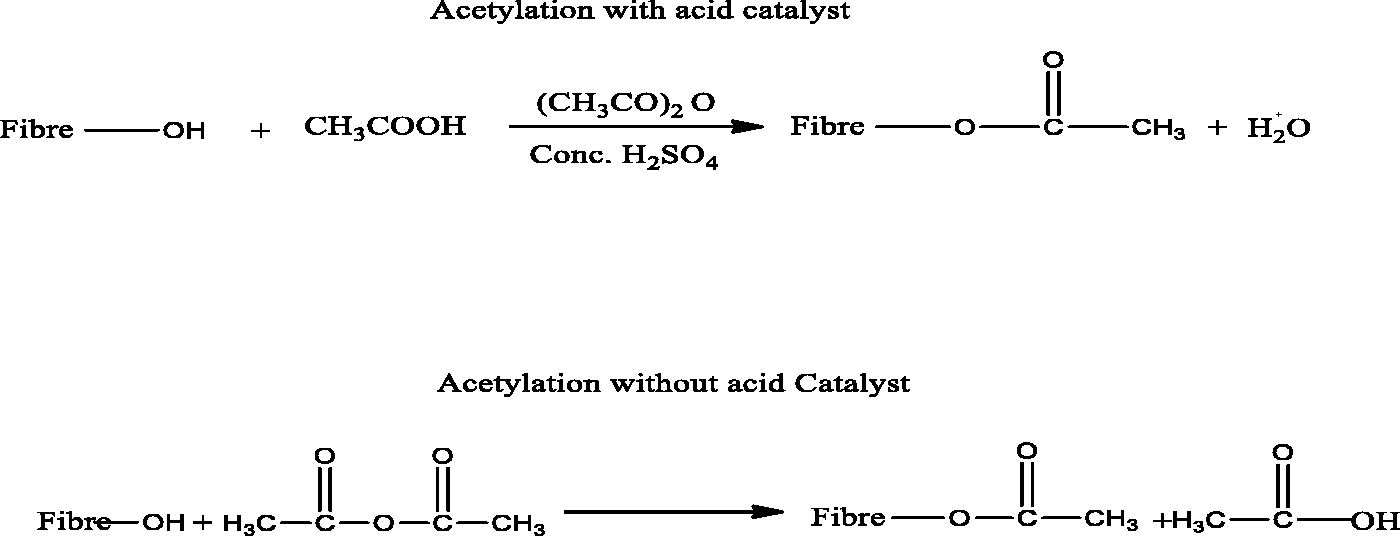
A reaction of acetylation with cellulosic fibre.
Rowell et al. [124] reported in their work that alkali treated followed by acetic anhydride treated sisal composites revealed a higher moisture resistance owing to the exclusion of hemicellulose and lignin constituents from the surface of the treated fibres. Bledzki et al. [24] investigated the effect of acetylation on fibre-matrix adhesion of the flax/polypropylene composites and reported an enhanced moisture resistance after treatment. As an effect of treatment, a declined water absorption property of sisal and pineapple leaf composites was noted, credited to greater interlocking between the fibres and matrix [12]. Alvarez and Vazquez [125] also fruitfully reduced the water uptake of MaterBi-Y/sisal fibre composites through this surface modification method. Sreekala and Thomas [48] reduced the hydrophilicity and thereby reduced sorption characteristics of oil palm empty fruit bunch fibre composite using different kind of treatments including acetylation also.
Sodium bicarbonate treatment
Above mentioned chemical treatments use dangerous chemicals which are detrimental to health as well as to the atmosphere. In recent times, researchers have shown their interest in non-hazardous eco-friendly treatment like sodium bicarbonate treatment. The United States Environmental Protection Agency (USEPA) has already declared that sodium bicarbonate is an eco/environment friendly, and it has no any harm to environment [126]. The reaction of sisal fibres with NaHCO3 is depicted in Scheme 7. Due to its alkaline nature, the formation of a hydroxide ion and carbonic acid takes place, as shown in Scheme 7 (a) and (b). Sahu and Gupta [127] lowered the water absorption capacity of sisal/epoxy biocomposite using sodium bicarbonate treatment with 10% w/v concentration of NaHCO3 for 96 h immersion time. Roy et al. [128] fabricated the short jute fibres polypropylene composites to examine the influence the sodium bicarbonate treatment on their water uptake and found lowering in water uptake owing to treatment. Pang et al. [129] also carried out the sodium bicarbonate treatment on kenaf fibres and develop its biocomposite using polyethylene/poly(vinyl alcohol) matrix. The capability of water absorption by the treated composites was appeared to reduce. Gupta [27] successfully reduced the percentage of water uptake of hemp/polyester composite using the sodium bicarbonate treatment. There was a reduction of 16.33% in saturated water uptake of treated composite over untreated composite.
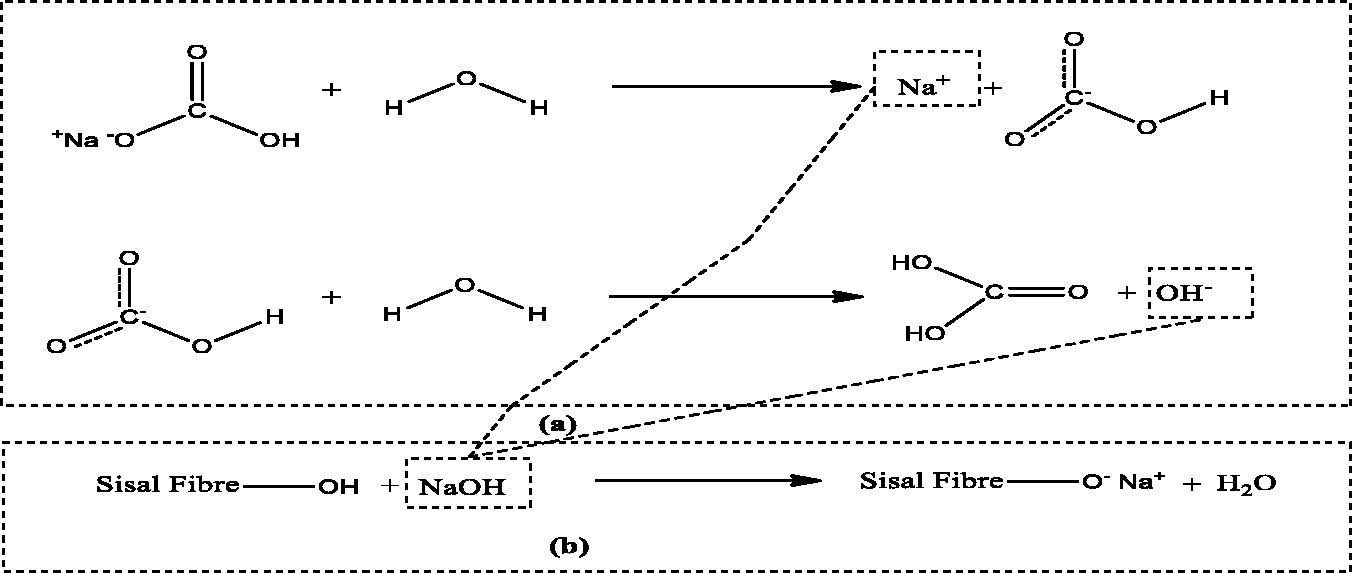
A reaction of NaHCO3 with cellulosic fibre.
Polymers coating
Recently, polymer coating on treated fibres has been the most proficient way for enhancing the compatibility with the polymer matrix. The polymer coating on treated fibre makes them more hydrophobic, stiff and strong. Polymer coating offers a better interfacial bonding and acts as a protective layer which oppose to moisture absorption. Some researchers have attempted the polymer coating on cellulosic fibres in order to increase their hydrophobicity which results in an increase in interfacial bonding thereby decrease in water absorption behaviour of CFPCs.
Rodriguez and Francucci [29] analyzed the joint effect of alkali treatment and polyhydroxybutyrate (PHB) coating on jute fibres and revealed that treated and coated jute composites offered the greatest mechanical and water resistance performance. It was tried to overcome the limitations of jute composites using modified jute fibres by alkali treatment and PLA coating. A positive outcome of this novel approach was seen in form of increased water resistance properties for treated and coated jute composite. The lowest water uptake was offered by treated and coated fibres composite (JT3), which was 42%, 30% and 20% lower than those of untreated composite (JC), alkali treated fibres composite (JT1), and coated fibres composite (JT2), respectively, as shown in Figure 5 [31]. Sahu and Gupta [127] evaluated the effect of eco-friendly treatment (using sodium bicarbonate) and eco-friendly coating (using PLA) to lower the water uptake of sisal/epoxy composites. In compared to untreated sisal composite, a significant deduction of 30.26% in water absorption capacity of treated and coated sisal composite was seen. Further, lower mechanical degradation was also shown by treated and coated sisal composite as compared to untreated composite. Gupta and Singh [30] applied PLA coating on alkali treated sisal fibres and found a reduction of 33% in water absorption of its composites than untreated sisal composite. The water absorption behaviour polyester based composite reinforced by PLA coated sisal fibres was found to be considerably reduced [130]. Moreover, moisture absorption of the biocomposites was overcome using polymer coating of polyfurfuryl alcohol resin (PFA), polyurethane (PU) and acrylonitrile-butadiene (NBR) latex on jute nonwoven fabric and woven flax fabrics by Mokhothu and John [32], and Satheesh Kumar and Siddaramaiah [131], respectively.

The effect of treatment and coating on water absorption of jute composites.
Hybridization techniques
The hybridization technique was also found to be an effective method to overcome the higher water absorption capacity of CFPCs. It has been concluded that hydrophilic cellulosic fibres tend to absorb more moisture than hydrophobic manmade fibres in water. Incorporation of manmade fibres into cellulosic fibres offered a better water resistance capacity. Therefore, manmade fibres (like glass, carbon and aramid) were incorporated with CFPCs to reduce their higher water absorption. On the other hand, hybridization of two types of cellulosic fibres were also used to diminish the higher water absorption by increasing the fibres-matrix bonding. The effect of hybridization on the water absorption behaviour of CFPCs is presented in the following paragraphs.
Akil et al. [33] evaluated the environmental impact on the mechanical properties of hybrid jute/glass polyester composites. It was concluded that hybrid composite exhibited a lower water absorption than unhybridized one because in hybrid composites fibres were arranged in a tightly packed manner and hydrophobic glass fibre acts as a barrier that opposes the interaction of water molecules with hydrophilic jute fibres also. A similar type of work was presented by Gupta and Deep [35] wherein they observed a significant reduction in water absorption of sisal/polyester composite by incorporation of glass fibres. Further, water absorption was highly affected by the change in stacking sequences of the fibres. A better water resistance was offered by hybrid sisal/glass epoxy composite, as reported by Gupta et.al [132]. Silva et al.[133] also observed a good impact of glass fibre hybridization on water resistance of sisal composites. As compared single fibre reinforced composites, lower water absorption was shown by epoxy based hybrid kenaf-kevlar and jute-kevlar composites [134]. Panthapulakkal and Sain [47] investigated the water absorption characteristics at different temperatures, 40, 60 and 80°C and its impact on the tensile properties of hemp and hemp/glass fibre hybrid polypropylene composites. The hybridization of cellulosic fibres with glass fibre significantly decreased its water absorption. On the other hand, the absorbed moisture had a deleterious influence on the tensile strength and modulus of both hemp fibre and hemp/glass fibre hybrid composites.
A positive impact of glass fibre hybridization in form of reduction in water absorption capacity of composites; coconut coir/epoxy composite [135], banana/polyester [136] and lyocell fibre/soybean oil resin [137] was reported. Zulkafli et al. [138] fabricated the hybrid banana/glass polypropylene composites to explore the impact of water absorption on their tensile and flexural properties. The positive effect of hybridization as a lowering in water absorption behaviour of sisal composites was noted when glass fibre was incorporated. Further, it was observed that unaged specimens performed well and provided a better tensile properties than those of the wetted specimens owing to fibres swelling. The effect of hybridization of carbon fibres on the water absorption of epoxy based banana composite was reported by Ramesh et al. [139]. From results, it was confirmed that hybrid composite revealed a better water resistance as compared to a single banana composite.
There were 50.44% and 25.79% reduction in water absorption for hybrid jute/sisal composites than those of pure jute and sisal composite, respectively [34]. This fact indicates a positive outcome of hybridization on water resistance behaviour. The influence of temperature on water absorption behaviour of hybrid sisal/coconut coir epoxy composites was investigated by Girisha et al. [140]. Salleh et al. [141] reported the consequence of the various environment on the mechanical properties of kenaf and kenaf hybrid polyester composites, and reported better performance by hybrid composites in all the conditions. Dixit and Verma [142] manufactured three kinds of hybrid composites utilizing coir, jute and sisal fibres into polyester resin to examine the consequence of hybridization on their water absorption. Hybrid composites offered a superior resistance to water absorption. The impact of water absorption on the flexural properties of kenaf composites and hybrid composites was investigated by Osman et al. [143]. Based on the results, kenaf/recycled jute composites offered noticeably lesser water absorption and thickness swelling. The influence of fibre length on water absorption behaviour of hybrid roselle/sisal polyester composites was also investigated by Athijayamani et al. [2]. Venkateshwaran and Perumal [144] reduced the moisture uptake behaviour of single reinforced composites by hybridization of jute with banana fibres credited to strong interfacial bonding. Upadhyaya et al. [145] investigated the influence of water absorption on the mechanical properties of wood/wheat husk polypropylene composites. Naveen et al. [146] studied the effect of water absorption on the properties of hybrid sisal/cotton composites and found lower mechanical degradation by dry samples than wet samples. There were 21.07% and 36.22% reduction in water absorption of hybrid mango/sal wood composites than those of mango and sal wood composites respectively [43]. A higher value of sorption coefficient and lower values of diffusion and permeability coefficients were seen for hybrid wood composites. The decrease in water absorption of hybrid teak/sal wood composite [147] and shorea robusta/pinus wood composite [148] as compared to their respective single wood composites was obtained. As compared to single wood composites, hybrid composites revealed the higher values of sorption coefficients, and lower values of diffusion and permeability coefficients.
Conclusions
Need for biocomposites as eco-friendly materials are being targeted in different fields owing to both environmental and economic benefits. The major issue with the biocomposites and their reinforcements (i.e. cellulosic fibres) is higher water uptake. In the present study, a review on water absorption behaviour of biocomposites is presented, and the subsequent outcomes are outlined: Water absorption in cellulosic fibre polymer composites depends upon several parameters such as volume fraction of the cellulosic fibres, properties of the cellulosic fibres, orientations of the cellulosic fibres, permeability of the cellulosic fibres, voids present in the composites, temperature of surroundings and so on. Moisture uptake and diffusion coefficients of the biocomposites were found to increase with the increase in fibres loading. Normally, degradation in mechanical properties of the biocomposites due to water absorption is expected but in some cases its positive effect was seen in the form of an increase in mechanical performance credited to filling of gaps due to swelling of fibres. To overcome the higher water uptake, many remedies such as chemical treatments, use of coupling agents and compatibilizer, the addition of fillers, coating on fibres, and hybridization so far were reported by the researchers. The present paper will be very useful to understand the mechanism of water absorption in cellulosic fibre polymer composites, and its remedies. Thus, researchers can explore the application area of the composites from traditional applications to advanced applications. There are very limited research works wherein eco-friendly treatments were employed to reduce the water absorption capacity. Further, polymers coating on the cellulosic fibres is also a good approach to significantly overcome the water absorption capacity. Hence, there are good scope for researchers to reduce the water absorption capacity by means of polymer coating and eco-friendly treatments. To develop the new models except diffusion model to analyze the water absorption behavior of biocomposites is good scope for researchers.
Footnotes
Declaration of conflicting interests
The author(s) declared no potential conflicts of interest with respect to the research, authorship, and/or publication of this article.
Funding
The author(s) received no financial support for the research, authorship, and/or publication of this article.
