




Abstract
Materials Fatigue life assessment is known to be a time consuming test with high cost and large sample size. To overcome these issues, non-destructive methods provide the possibility for fast determination of material fatigue limit. In the current study the high cyclic fatigue limits of jute/glass reinforced hybrid composites is determined using IR-thermography method by adopting Risitano’s thermographic approach which has not tested yet on natural fiber composites. Also, the effect of jute fiber ratio on fatigue strength of hybrid composites is investigated through three sets of hybrid. In order to validate the determined fatigue limits, the obtained results of thermography were compared with previous conventional fatigue results, also compared with the results of energy loss measurements which effectively predicted the fatigue limit of hybrid composites. Based on the achieved observation and comparisons, the accuracy of measured fatigue limits using thermography method was ranging from 92 - 98% for all composites when compared with corresponded conventional results. In addition, energy loss method has effectively predicted the fatigue limit of hybrid composites that almost matches thermography method results. Lastly, found that there is no significant influence of jute fiber content on fatigue limit detection, as all hybrid composites were almost have similar fatigue strength. According to the results obtained in this work, the reliability of thermographic technique is confirmed to measure fatigue limits of natural fiber composites.
Keywords
Introduction
One of the major techniques that can be employed continuously to monitor fatigue damage development is IR Thermography (IRT) [1]. IRT is a measurement system that depends on an infrared (IR) camera to offer a thermal profile of the specimen temperature (i.e., thermography) of the material under investigation. This technique includes decoding temperature information that results from the IR radiation emitted by an object. Post-processing software is typically used to process the captured images [2]. In general, there are two main types of IR techniques regularly employed for assessing composite materials; active thermography and passive thermography [3]. Active thermography involves actively heating the specimen to monitor the temperature gradients during heating or cooling using an IR camera [4,5]. Damage initiation and crack propagation events occur during both static and cyclic loading are associated with the release of energy in the form of heat [6]. Briefly, this testing method is not limited for polymeric composites [7] only, but also has been applied to metal [8] and even for pure fabric [9]. While passive thermography, is an alternative approach that has gained considerable attention for damage detection of composites subjected to cyclic loading [2,10–12], and found to be an effective tool for indirectly monitoring damage development in real time over a large surface area [13]. As the system relies on the difference in the thermal properties due to deterioration, it is therefore, appropriate to interior defects in composites such as delamination, de-bonding, or heterogeneous objects found within composites [14]. The passive method is suitable to assess fatigue cyclic loading since the resulting hysteretic heating allows for a time-dependent temperature fluctuation, which can be observed by the IR camera. The saved images can be analyzed to define the thermal profile that correlated with stepwise applied load to determine the material fatigue strength [13,15]. Analyzing thermographic images can be a challenge, since the detected temperature may be due to a various factors especially for composites subjected to cyclic loading, intrinsic energy dissipation caused by irreversible internal mechanisms. Traditional or conventional fatigue life assessment of materials is known to be a time consuming test with high cost, as the test takes on average 27 hours in case of the test conducted at 10 Hz of frequency to reach only one million cycles, which is the zone of high cyclic fatigue strength (HCFS). Therefore, many researchers started to focus on non-destructive techniques to save time and cost, also can be utilized for in-situ evaluation [16].
A several studies have investigated and successfully utilized IRT techniques to monitor damage development in synthetic fiber based composites [2,10–12]. In the last decade, despite of the high concern gained towards natural fiber in the composite field, it can be noticed that few works reported IRT technique of natural fiber based composites. Suriani et al. [17] have applied active IR thermal imaging using an external heat source to detect the defects of the unidirectional kenaf fiber composite. It was concluded that the defective area exhibits higher temperatures than the non-defective area. Zhang et al. [18] have evaluated and characterized impact damage, delamination, and resin abnormalities defects of many types of natural fibers composite using multi inspection techniques including thermographic. Generally, IRT offers clearer and better results than other utilized techniques. Jeannin et al. [19] have estimated the low cyclic fatigue performance of flax fiber composite using thermographic analysis, the results revealed that the fatigue life was from 50-55% of UTS, which was confirmed by thermographic method with up to 94% of accuracy. Finally, Katunin et al. [20] investigated the fatigue limit of unidirectional E-glass composites under fully reversed bending condition, by adopting Risitano’s approach using the self-heating effect through test. The results concluded that “this approach provides the possibility of fast estimation of fatigue limit without the necessity of performing time-consuming high cycle fatigue tests”.
The conventional fatigue results of hybrid composites that similar to current study, imply that there is a high cyclic fatigue strength or a fatigue limit for the composites beyond 1 million cycles, this may exist within the range of 30-40% of static ultimate tensile strength [21]. Therefore, to confirm the existence of high cyclic fatigue strength of hybrid composites under tensile fatigue loading condition, Risitano’s thermographic approach was adopted to determine the fatigue limit of hybrid composites [1]. This approach was applied to evaluate the fatigue strength for different kinds of polymer composites like woven carbon fiber composite [22], glass fabric composites [23], and tri-axial braided carbon composite [24] using similar test frequency and loading mode of present study. Moreover, it can be notice from literature that Risitano’s approach is not applied and confirmed its applicability and accuracy yet with natural fiber composites, which possess totally different microstructure, chemical compositions, and thermal properties compared to synthetic ones [25].
The aim of this study is to detect the high cyclic fatigue limit via thermographic method and the effect of jute fiber ratio on fatigue limit of Jute/Glass hybrid composites. Five composites combination were fabricated and tested, three hybrid composites with different fiber ratios (30:70), (50:50), and (70:30) of glass and jute respectively. A tensile test was conducted to determine the ultimate tensile stress for all composites. Thermographic technique was adopted as a nondestructive method for rapid determination of the fatigue limit. The test specimens were subjected to fatigue loads with maximum stresses ranging from 30% to 75% of Ultimate Tensile Stress (UTS), with 5% step. Thermographic results were compared with conventional fatigue results, also further valdiation and comparsion of thermographic findings were made with energy loss method.
Materials and method
Materials
The materials used in this work were woven jute and E-glass woven roving EWR400 reinforced unsaturated polyester hybrid composites. All materials used in this work were supplied by ZKK Sdn Bhd, Malaysia, moreover, raw jute and glass fabrics are shown in Figure 1 and their specifications are tabulated in Table 1. Five composites combination were fabricated by hand lay-up technique according to the procedure reported by [26].

Raw materials used to fabricate composites: (a) jute, and (b) glass fabrics.
Fabrics specifications.

Three hybrid composites were fabricated with different weight fibers ratio namely GJ1, GJ2 and GJ3 (30:70), (50:50), and (70:30) of glass and jute respectively, in addition pure glass and jute composites for comparison purposes.
Tensile and fatigue tests
Tensile test was applied to all composites according to ASTM 3039. Five tensile samples were cut for each composite by dimensions of 250 mm length and 25 mm width with gauge length of 170 mm. Tensile test was conducted at crosshead speed of 2 mm/min for all samples and the average value of UTS was taken. The volume fraction of hybrid composites was determined according to equation below.
Table 2 shows the designation and specifications, volume fraction and ultimate tensile stress (UTS) of all composites tested in this study.
Composites specifications.

Regarding the fatigue test, specimens were subjected to loads with maximum stress ranging from 30% to 75% UTS, with a 5% step, each for a period of 10,000 cycles or taken the last recorded temperature before complete failure occurred. All fatigue test was conducted at recommended frequency of 2 Hz according to ISO13003 standard testing [27] to avoid an excessive rise in sample temperature. The main aim was to determine the fatigue limit of composites, by collecting temperature profile under fatigue loading in order to establish a correlation with conventional fatigue results.
A 20 mm lens of 160 × 120 detector resolution IR camera (model Flex-Cam model Ti45, US) was employed to detect the composite heat through fatigue test. Figure 2 shows the fatigue test setup for this work.

Fatigue test setup.
Non-destructive technique procedure (thermographic method)
The hypothesis of this method assumes that the temperature shift generated from a specimen due to cyclic loading is equal to the heat dissipation due to natural energy dissipative mechanisms [1]. As the Damage initiation and crack propagation events occur during both static and cyclic loading are associated with the release of energy in the form of heat [3]. The composite is tested at a certain level of stress for a particular cycle number until reached surface heat stabilizing that caused by heat dissipation. A similar procedure is conducted for various amplitude of stress at fixed frequency of 2 Hz, the diagram of heat difference versus number of cycles for various stress is demonstrated in Figure 3(a). At every level of stress, identical heat rise from the first cycle to stabilized temperature (Tstab) could be illustrated against maximum stress as schemed in Figure 3(b). Next, according to the relation, high cyclic fatigue strength can be observed when the heat rise by higher than the normal range [1].
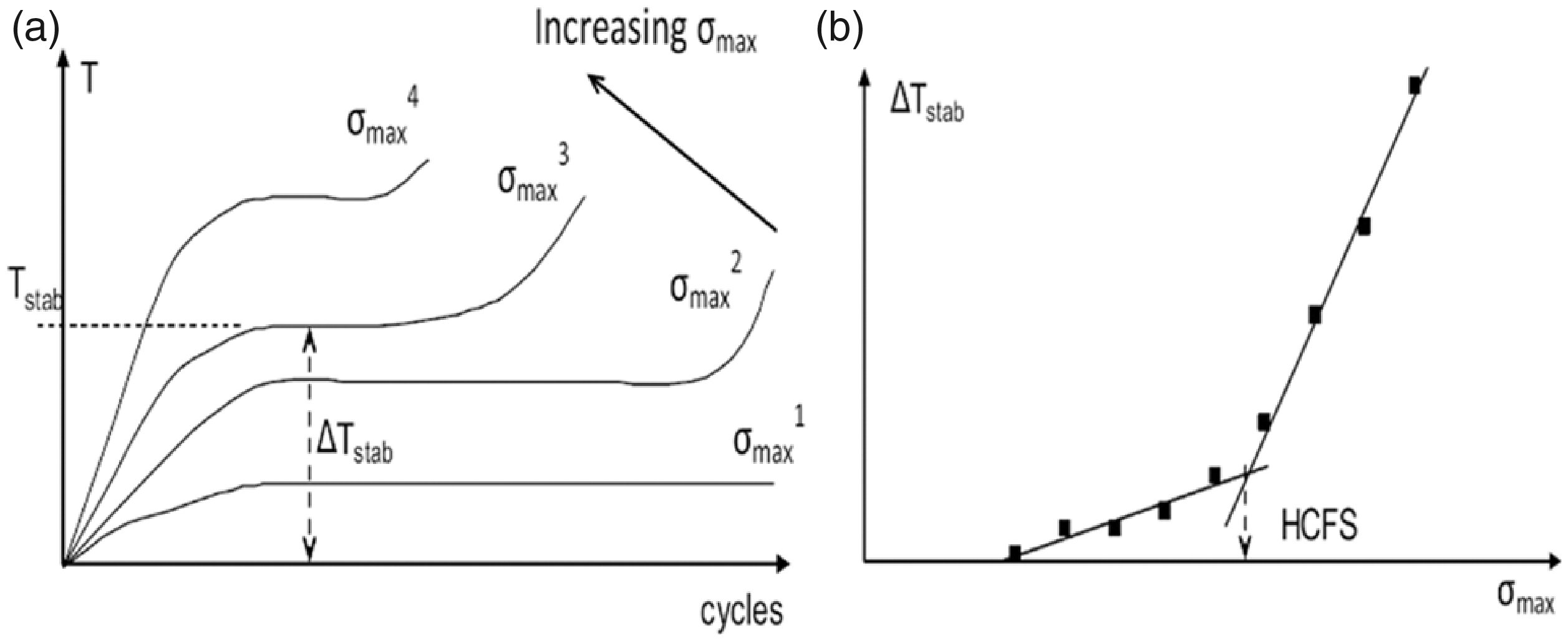
Thermographic method (a) temperature profiles, (b) temperature rise maximum stress plot [3].
From the available data of previous studies, it was noticed that there is no typical fatigue limit for conventional polymer composites, but it shows a damage developments through material life that may cause failure although at low stress [28]. On the other hand, it has been recently reported exhibition of high cyclic fatigue strength or fatigue threshold for some polymeric composites, this perhaps due to a damage saturation level at low applied stresses resulting to stop crack propagation and failure [23]. As in fact, a characteristic the fatigue behavior of the jute/glass hybrid composite is under investigation.
The thermographic technique was used as a nondestructive method to address the fatigue strength of materials with minimum experimental work. Also, a thermographic approach which works according to thermo-elastic stress measurements that occur due to a tiny temperature variation i.e. the fatigue strength can be determined when the material within elastic zone. In addition, this approach is applicable for wide range of materials such hybrid composites [1,15].
The overall thermal profile of all composites tested in this study through the10000 cycle’s block of fatigue loading. Moreover, it was stated that 7000 cycles would be enough to reach it [29] but, other work suggested 10000 cycles for temperature stabilizing [13]. The sample heat rises due to stiffness loss within elastic zone and friction, later the temperature starts to stabilize at a certain cycle number [29]. Stabilizing time is depended on numerous factors which also influence on damge propegation such as type and orientation of fiber and applied stress [24].
Results and discussion
Using a thermographic camera, the corresponding temperature variations for every stress level was recorded and illustrated as a number of cycles function as shown in Figure 4. Regarding the hybridization effect it shows minor variations in temperature stabilizing through all composites. The temperatures change were within 1 °C which might be due to the test ambient temperature variation. In addition, the same location on the sample was monitored for each loading step until the ultimate failure was occurred to locate the failure zone.

Change in composites’ surface temperature during fatigue loading.
The temperature distribution map for every stress applied was determined once the sample temperature stabilized. Noting that 10000 loading cycles were conducted at each stress level, which was more than sufficient to achieve temperature stabilizing. As all composites offered similar trend of heat profile, therefore, GJ1 was selected as a model result for temperature stabilizing as shown in Figure 5. In literature found there two loading cycles were reported to reach the temperature stabilizing which were 7000 cycles [24] and 10000 cycles [29], this could be related to fiber and polymer type utilized due to the shifts in their thermal properties. In Figure 6 illustrates an example of the specimen heat profile under different applied loads through a block of 10000 cycles, it can be noticed that the heat growth constantly as the applied load increased until 50%UTS, suddenly a drastic rise occurred at 55%UTS and continued to increase at each step. The reason of this behavior is the heat rises due to the material stiffness loss occurred within elastic zone also, to the friction heat generated. Similar pattern of heat profile was observed for the rest of composites tested, this implies that hybridization process has no major effect on the composite heat under fatigue loading.

Thermal profile of GJ1 hybrid composites under different life cycles under 45% of UTS.

Thermal profile of GJ1 hybrid composites under different stress levels of UTS.
The samples surface heat range was uniform for stress amplitude of 30-45% of ultimate tensile stress. Nevertheless, for stress beyond 45% of ultimate stress the heat was noticed to be non-uniform anymore with obvious hot spots that were the same eventual failure zones of the sample. Figure 7 depicts the thermal profile versus stress amplitude steps applied on each of composites, also shows the linear fitting equations and their confidence levels. According to Risitano’s thermographic approach, the data has a bilinear manner, which means that the slope of temperature data changed drastically at exact stress level; all the slopes have excellent confidence values of R2 above 0.97.

Temperature rise with ultimate tensile stress (UTS) applied for (a) glass, (b) GJ1, (c) GJ2, (d) GJ3, and (e) jute composites.
Furthermore, to find the intersection point between the two linear fit, both equations were equalized and the (x) value was determined which represents the high cyclic fatigue strength as percentage of UTS, the calculation results of Figure 7 were summarized in Table 3.
Results of high cyclic fatigue strength (HCFS) and corresponding temperature of composites.

As one of the objective for this study is to investigate the influence of jute fiber ratio on the high cyclic fatigue strength of hybrid composites. Figure 8 demonstrates the effect jute fiber on HCFS. It can clearly found that there is no significant influence of jute content on fatigue limit as GJ1, GJ2, and GJ3 almost have similar fatigue limits. In addition, when compare these results with the conventional ones reported by Sharba et al. [21], a minor variation was noticed through hybridization process. On the other hand, pure jute composite offers better fatigue limit when compared with hybrid ones, this may be due to high fatigue resistance of natural fiber composites [26,30].

Effect of jute fiber ratio on HCFS of hybrid composites.
The determined high cyclic fatigue strengths for composite groups are within the range reported in literature [21,31,32]. This confirms that fatigue limits for the composite materials exists, and have been accurately determined using thermography.
Conventional and thermographic results comparison
Conventional fatigue test depends on pure experimental methodology to determine the fatigue limit or high cyclic fatigue strength of material, which takes lots of sample test and long period of time. Due to the fact that there were a few studies available in the open literature which dealt and investigated fatigue life of natural/synthetic hybrid composites. Furthermore, it was found two studies were reported this topic which have used comparable fabrics properties with almost similar fiber ratios of hybrid composites tested in current study. Firstly, Sharba et al. [21] reported the fatigue behavior of three set of kenaf/glass hybrid composites with various fabric ratios, which were similar to current study. Secondly, Mostafa [32] has investigated the hybridization effect of jute/glass hybrid composites under fatigue loading conditions, however only two set of hybrid composites were reported that comparable with current work.
Table 4 summarized and compared the main findings of current work by thermographic method with conventional ones from previous studies on terms of UTS %, also categorized according to fabric ratio. It can clearly be noticed that the accuracy of measured fatigue limit using thermography method ranging from 92 - 98% for all composites when compared with corresponded conventional results reported previously, which is very acceptable also, supported and confirmed by literature [15]. In a nutshell, the adopted approach has been proven its applicability to determine the high cyclic fatigue strength of hybrid composites.
Comparison results of high cyclic fatigue strength of conventional and thermography results.

In order to validate the results attained by thermographic method, energy dissipated of sample test was recorded simultaneously through a set of Instron machine sensors and software.
Energy loss and thermographic results comparison
It was recognized that inherent dissipated energy in polymer composite through fatigue loading might due to various modes of matrix damage or cracking, leads in a similar dissipation of heat each cycle [33]. Interestingly, if the energy dissipated at each cycle is considered, temperature rise and energy dissipation comparison can be made. The dissipation energy for each unit volume of specimen tested during each cycle can be obtained from the hysteresis loop by calculating the area under loading and unloading stress-strain curves [24]. A correlation of energy dissipated versus applied stress level was plotted as shown in Figure 9. Moreover, it was found a similar bilinear behavior as the results determined using thermographic, precisely, thremographic method predicted HCFC for GJ1 by 37.8% of UTS, while energy dissipation method predicted it by 38.5% of UTS with coefficient of determination (R2) up to 0.97 for the same hybrid composites which confirms the reliability of thermographic technique.
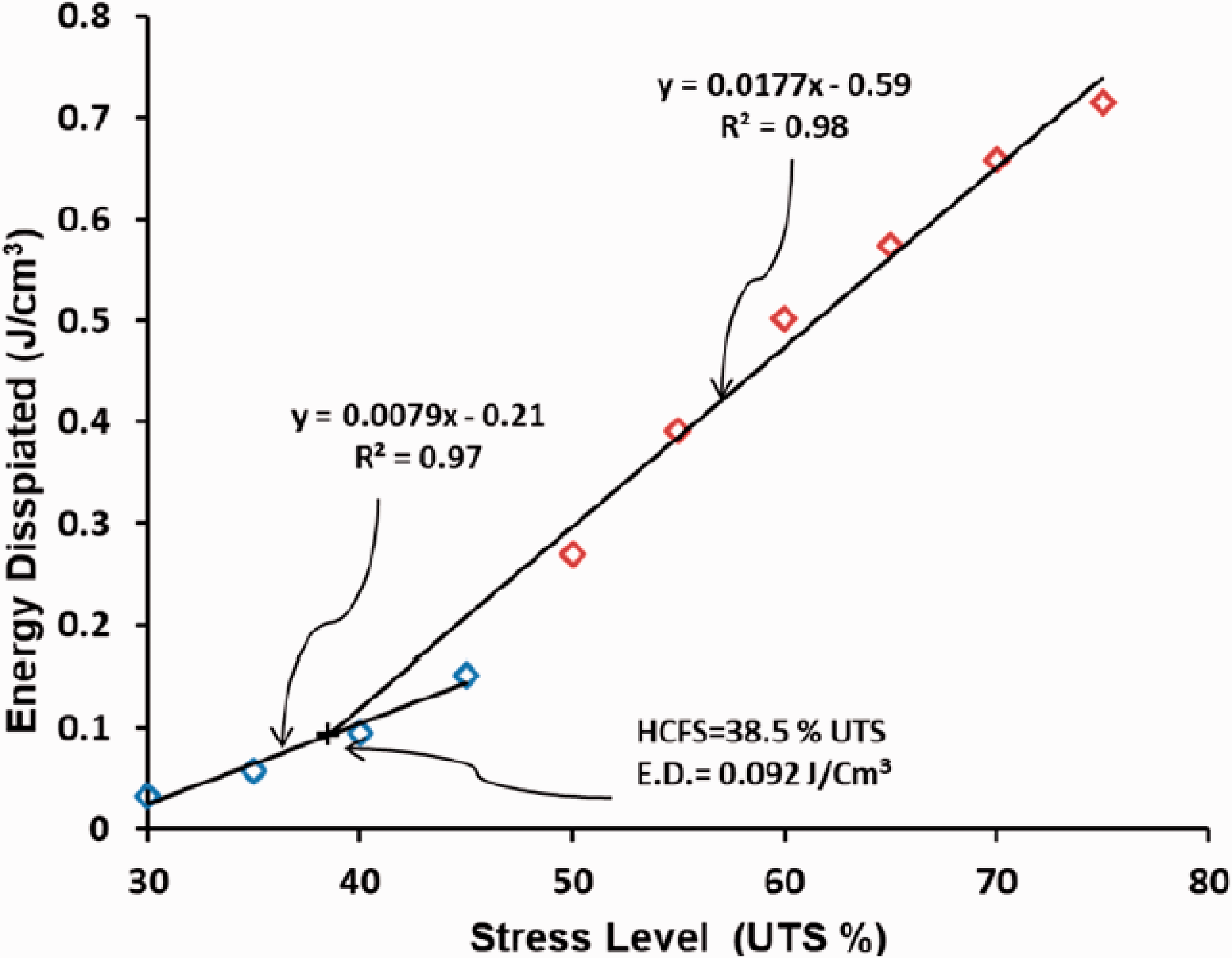
Energy dissipated and with maximum stress plot for GJ1 composite.
Another comparison was established of thermographic technique and the energy method for each stress level applied should be mentioned. Consequently a correlation between energy dissipated and final sample surface temperatures was plotted, it was found a linear relation with a confidence level with R2 value of 0.99 as illustrated in Figure 10. In other word, this proves that the heat variation dissipated from hybrid composites specimen during cyclic loading and recorded by IR camera in fact was due to energy dissipation of composite.

Temperature profile and the corresponding energy dissipated relation for GJ1 composite.
Figure 11 illustrates a dual comparison of temperatures profile obtained by IR camera and energy dissipated calculated from hysteresis loop at specific cycle beyond heat stabilizing, which was the last cycle for every stress applied and found an excellent matching with a very low deviation, the deviation could be due heat convection to specimen’s medium, which depends on the thermal expansion of the material. Also, this supports and confirms the hypothesis, which also applied to tri-axial braided carbon fiber composites [24], and confirms that IR thermographic approach is a reliable tool that can be used to predict the fatigue limit of natural fiber composites as well as hybrid composites.

Comparison of temperature profile and energy dissipated with maximum stress for GJ1 composite.
Conclusions
In this work, the adaptation of Ristano’s approach for predicting the fatigue limits of hybrid composites in tensile fatigue loading condition is investigated and verified in energy loss method experiments. Also, the effect of jute fiber ratio on fatigue life of hybrid composites was evaluated. Based on the achieved observation and comparisons, the accuracy of measured fatigue limits using thermography method was ranging from (92-98%) for all composites. In addition, energy loss method has effectively predicted the fatigue limit of hybrid composites that almost matches thermography method results. Finally, found that there is no significant influence of jute fiber content on fatigue limit detection, as all hybrid composites were almost have similar fatigue strength.
Footnotes
Acknowledgement
The author would like to express his gratitude and sincere appreciation to Dr. Bahaa Aldin A Hasan for his assistance in language editing and proofreading, also to the Ministry of Higher Education & Scientific Research of Iraq and Middle Technical University.
Declaration of conflicting interests
The author(s) declared no potential conflicts of interest with respect to the research, authorship, and/or publication of this article.
Funding
The author(s) received no financial support for the research, authorship, and/or publication of this article.
