




Abstract
Various fibers have been used to reinforce concrete to enhance properties of cement. This review critically analyses the use of different natural and synthetic fibers, the treatments done on some of them to be used in concrete, their strength and weaknesses to be used for such applications. In natural fibers, bamboo coir and jute which have been extensively used have been discussed. Also, the effect of alkali present in cement mixture on the degradation of natural fibers has been detailed. Critical observations such as change in crack pattern, effect of nature of fibers, and the environment in which they are reinforced have been discussed. Effect of use of different sealing materials for the hydrophobic fibers on the ultimate property of the reinforced concrete has been reviewed for various fibers. A comprehensive review of the synthetic fibers predominantly used in such reinforcements—PP, PE, and nylon—has been given along with a critical comparative study of recent developments in the field. The fiber–matrix interface studies have been discussed and further research areas have been suggested.
Introduction
Sustainability is a topic of concern in every industry nowadays and is one of the biggest challenges for the construction industry. The best way to achieve this is by using sustainable materials with their best properties. Cementitious materials that are not reinforced have low tensile strength, fracture toughness, and tensile strain capacities which can be overcome by addition of short discrete fiber. The main properties that are enhanced with the inclusion of these short fibers are tensile strength, flexural strength, fracture toughness, resistance to fatigue, impact, and thermal shock.
Natural fibers are gaining importance in this application due to various advantages over synthetic fibers such as low cost due to availability in abundance, biodegradability, flexibility, low density, relatively high tensile and flexural modulus, minimum health hazards, etc. Thus, natural fibers can be used economically, effectively, and in abundance to produce good quality fiber-reinforced cementitious composite with low cost.
Though most of the developments with FRC involve use of ordinary Portland cements (PCs), high alumina cement, gypsum, and a variety of special cements have also been used. Developments also include specially formulated mortar and concrete matrices with controlled particle size distributions. Plain, unreinforced cementitious materials are characterized by low tensile strengths and low tensile strain capacities; that is, they are brittle materials. They thus require reinforcement before they can be used extensively as construction materials. Reinforcements have been in the form of continuous reinforcing bars, which could be placed in the structure at the appropriate locations to withstand the imposed tensile and shear stresses. Fibers, on the other hand, are discontinuous, and are most commonly randomly distributed throughout the cementitious matrix. It is important to note that they are not as efficient in withstanding the tensile stresses. Their main purpose is to control cracking. Conventional reinforcing bars are used to increase the load-bearing capacity of concrete while the fibers are used to achieve better crack control [1].
Fiber-reinforced cement-based materials differ, both in their production processes and in their behavior from the other groups, where the matrix is ductile. Short discrete fibers of glass and steel have been extensively used in cement mortar and concrete to obtain certain properties in composite. Such fibers generally result in higher impact and fracture toughness, improved ductility, increased in crack-inhibiting effect, and wear resistance properties (durability) of the composite.
The properties of fiber-reinforced cementitious materials are controlled by a number of factors, of which some can be enlisted as follow [2]:
Magnitudes of both the fiber and the matrix modulus of elasticity; The ratio of modulus of elasticity of the fiber to that of the matrix; Type and properties of the matrix (ductile or brittle); Fiber content, fiber length, and orientation and Interfacial bond strength between the fibers and the matrix.
Natural fibers
Investigations into the use of natural fiber reinforcement in cement composite started when low cost building material replacements for commercial asbestos reinforced cement composites were being looked for. Natural fibers extracted from fast growing, locally available, cheap agricultural crops and crop residues such as coconut husk [3–5], sisal [6], sugarcane [7], baggase [8], bamboo [9], awkara, plantain, and musamba [10], etc. have been studied in detail and were found to impart favorable properties to composite mixtures. Natural fibers can prove to be very successful for applications where lightweight composites are being required. They can also be used for reinforcements in thermal and acoustic insulators. Among various natural fibers, cement composites reinforced with bamboo fibers, coir fibers, and jute fibers have been discussed here as these have been found to have high impact strength besides having moderate tensile and flexural properties compared to other lignocellulosic fibers.
Natural fibers for low cost cementitious composites
Much of the research on the use of natural FRC materials has been motivated by the ready availability of such fibers, which are high in strength. They have simple production processes and are potentially suitable for low cost housing application. This topic has been reviewed in several references [11–13]. The fiber content is usually less than 5% when applying mixing technologies, but it may be greater when using the technologies of hand lay up of long fiber rovings which can be obtained by tying together. In hand laying technique, a thin mortar layer is applied on a mould, followed by alternate layers of fibers and mortar matrix. The fibers can be rolled into the matrix or worked into it manually [10]. It is important to note that in mixing technique, there is a limit to the content and length of fibers that can be incorporated, due to the question of fiber workability. The author and their group worked with fibers from banana pseudostem and found that beyond 0.6% of fiber addition, mechanical properties deteriorated. However, many of the natural FRC composites are intended for the production of thin components such as corrugated sheets which have a typical thickness of about 10 mm. The matrix is a cement mortar, and the mix with fibers, or with hand laid fibers, is spread on a mould surface and then shaped. Corrugation can be achieved by pressing between two corrugated sheets [14]. A comparative study has been done by Ramakrishna and Sundararajan [15]. Cement mortar was reinforced with coir, sisal, jute and hibiscus cannabinus. They were further subjected to impact loading using a simple projectile test. Four different fiber contents viz. 0.5%, 1.0%, 1.5%, and 2.5%—by weight of cement and three fiber lengths (20 mm, 30 mm, and 40 mm)—were considered. The results obtained have shown that the addition of the above natural fibers has increased the impact resistance by 3–18 times than that of the reference mortar slab. Of the four fibers, coir fiber reinforced mortar slab specimens have shown the best performance based on the set of chosen indicators, i.e. the impact resistance, residual impact strength ratio, impact crack-resistance ratio, and the condition of fiber at ultimate failure. They have even reported a change in the crack pattern (Figure 1).
(a) Typical crack pattern of plain Mortar slab Specimen (assembled after impact). (b) Typical crack pattern of coir Reinforced slabs (assembled after impact). (After Ramakrishna and Sundararajan [15]).
Reinforcements with some specific fibers are dealt with in detail further in the text.
Bamboo
Being available abundantly in tropical and subtropical climatic regions, bamboo has tremendous economic advantage as it has elevated mechanical strength, low specific weight. Its low cost presents good prospects for its future markets [16]. Due to its high strength to weight ratio, the reformed bamboo can remarkably strengthen the mortar and reduce the total weight of the laminate. Bamboo is a natural perennial grass-like composite and contains ligno-cellulosic-based natural fibers. Due to its superior properties such as high strength to weight ratio, high tensile strength, and other factors such as low cost, easy availability, and harmless to the environment during service, bamboo has constantly attracted the attention of scientists and engineers for use as reinforcement in cementitious composites. Recently, many researchers have tried to use bamboo as substitute of steel in reinforced concrete.
Although bamboo has also been used in various forms in the construction industry, there is limited information in the scientific literature concerning the use of bamboo pulp fiber. Sinha et al. [17] and Pakotiprapha et al. [18] investigated the flexural strength of air-cured bamboo fiber reinforced cement (BFRC) composites; Coutts et al. [19] reported air-cured BFRC composites’ properties for both flexural strength and fracture toughness. Wu yao et al. [9] conducted experiments on a sandwich plate combined with reformed bamboo plate and extruded fiber-reinforced mortar sheet to study its flexural behavior.
Though bamboo is remarkably strong in tension, previous investigations showed little promise of the possible replacement of steel by bamboo mainly due to its low elastic modulus, poor bond with concrete, high water absorption potential, low modulus of elasticity, low durability, and low resistance to fire. Untreated bamboo absorbs a significant amount of water from wet concrete resulting in swelling, and it subsequently shrinks as the concrete dries out. This problem was tackled by Mansur et al. [20] by use of water sealing agents which could lower the absorption capacity of bamboo. Nowadays, many of the other shortcomings can be significantly improved by subjecting the bamboo to appropriate treatments. In addition, when bamboo is reformed to a plate form, its performance can be improved further.
Bamboo occurs in the natural vegetation of many parts of tropical, subtropical, and mild temperature regions, with about 1250 species identified throughout the world. Ghavami [21] classified seven bamboos and studied them in accordance to their physical and mechanical properties, the type and method of application of water repellent treatment of bamboo splints and the bond strength between bamboo and light-weight concrete. The results of the experimental analysis of two simply supported bamboo-reinforced lightweight concrete beams, subjected to two point loads up to collapse, have been presented. One beam of the same dimensions and concrete mix reinforced with steel was also tested for comparison of the results. It was confirmed that by applying water repellent treatment, there was a significant increase in the ultimate tensile load.
Bamboo mesh has been shown to impart considerable ductility and toughness to the mortar and increase its tensile and impact strengths. An experimental investigation was conducted on cement mortar reinforced with woven bamboo mesh in a manner similar to ferrocement. The main parameter of the study was the volume fraction of bamboo and its surface treatment. However, wide cracking was observed for such samples owing to poor bond strength between bamboo and mortar (due to volume changes of bamboo in wet and dry matrix) and low elastic modulus of bamboo. Problem of poor bond strength has been tackled by the use of some cheap water sealing agent which could reduce the water absorption potential of bamboo. Also, application of a small amount of casting pressure (say 2.0 N/mm2) improves composite action [14].
The impact of fiber content on various properties of bamboo fiber-reinforced composites has been studied in detail [22]. As the fiber content is increased, density of composite decreases and the water absorption increases. This is because bamboo fibers have low density and are hydrophilic. Also, packing of fibers and matrix becomes less efficient and void volume increases on increasing fiber content leading to the above results. Numerous attempts have been made in order to improve the composite properties. Addition of chemical admixtures was found to be necessary to counteract the adverse effect of sugars present in bamboo flakes on setting and strength development of PC matrix [23].
It may be noted that bamboo is a cheap and replenish able agricultural resource and abundantly available in some countries such as China, India, and within the Southeast Asia region. Thus, it would be expected that the low-cost bamboo-reinforced constructional and housing products have a wide market in present and future time in Asia. The problem that this fiber poses is the probability of decomposition due to biological attack which has not been discussed in the literature. Future studies could be conducted in this direction.
Coir
Coir is the name given to the fiber that constitutes the thick mesocarp or husk of the coconut (Cocos nucifera). Coir is extracted by beating it manually using a mechanical extractor machine. It is an abundant, versatile, biodegradable, cheap lignocellulosic material. Coir fibers are highly ductile, strong, and light and can easily withstand heat and salt water. Inclusion of coir fibers into cement matrix has resulted in better tensile strength (Splitting tensile strength and modulus of rupture) but lesser compressive strength. Even in composites with multiple fiber inclusions, coir fiber inclusions were found to further increase the strength and ductility of the composite member [24].
Different pretreatment conditions have been given to coconut coir to enhance its in-use properties such as:
Raw coir fibers: The coir used in this condition is received directly from the factory. Washed coir fibers: The raw coir fibers can be washed a number of times with tap water till the pH value of water reaches 7. Boiled and washed coconut coir: about 2 h of boiling in water is sufficient to reduce water-soluble chemicals such as sugar, starch, fat, tannins, resin, quinines, and phenols. Then coir fibers must be washed with abundant tap water until the color of water becomes clear.
Boiled and washed coir fibers contain high lignin and holocellulose. Lignin acts as the cementing agent in fiber, binding the cellulose fibers together. Cellulose is the primary constituent of fiber. Boiled and washed coir fiber is stiffer and tougher. The stiff and tough fibers are difficult to beat, do not conform and collapse against each other so well.
A number of studies have been conducted to study the effect of fiber volume fraction on the properties of fiber-reinforced coir composites. The results have been quite dissimilar due to varying factors such as fiber origin, length, design and cement properties, and so on. Baruah et al. [25] concluded that compressive strength, splitting tensile strength, modulus of rupture and shear strength, all strength values for composites with coir reinforcements increased with increasing volume fraction and that those composites had higher strength as compared to plain cement composites. Only compressive strength was found to show an opposite trend. For higher fiber contents, pullout of fibers was also observed. However, this could be avoided by using chemical coating on fiber which also leads to an increase in modulus of rupture. The effect of various other parameters on coir fiber reinforced composites has been studied in detail such as casting pressure by Cook et al.2 and fiber length on bond strength by Aggarwal et al. [26].
With regard to durability of coir fibers in cement composites, it was concluded that these fibers remained undamaged even for 12-year-old house panels [14]. For durability, it is required that water or any other fluid does not seep into the matrix. Being organic fiber, coir fiber does not rot or disintegrate under high moisture content conditions and shrinkage has been found to be negligible for coir-reinforced composites. This makes it a very durable option in construction industry.
Not only structural applications, fiber reinforced cementitious materials find numerous applications in other fields such as insulating boards for energy conservation, etc. Asasutjarit et al. [27] conducted experiments for the development of coconut coir-based lightweight cement boards (CCB) (Figure 2). These boards were made from coconut coir, cement, and water.
Specimen made for the different fiber length and not washed pretreatment condition. (After Asasutjarit et al. [27]).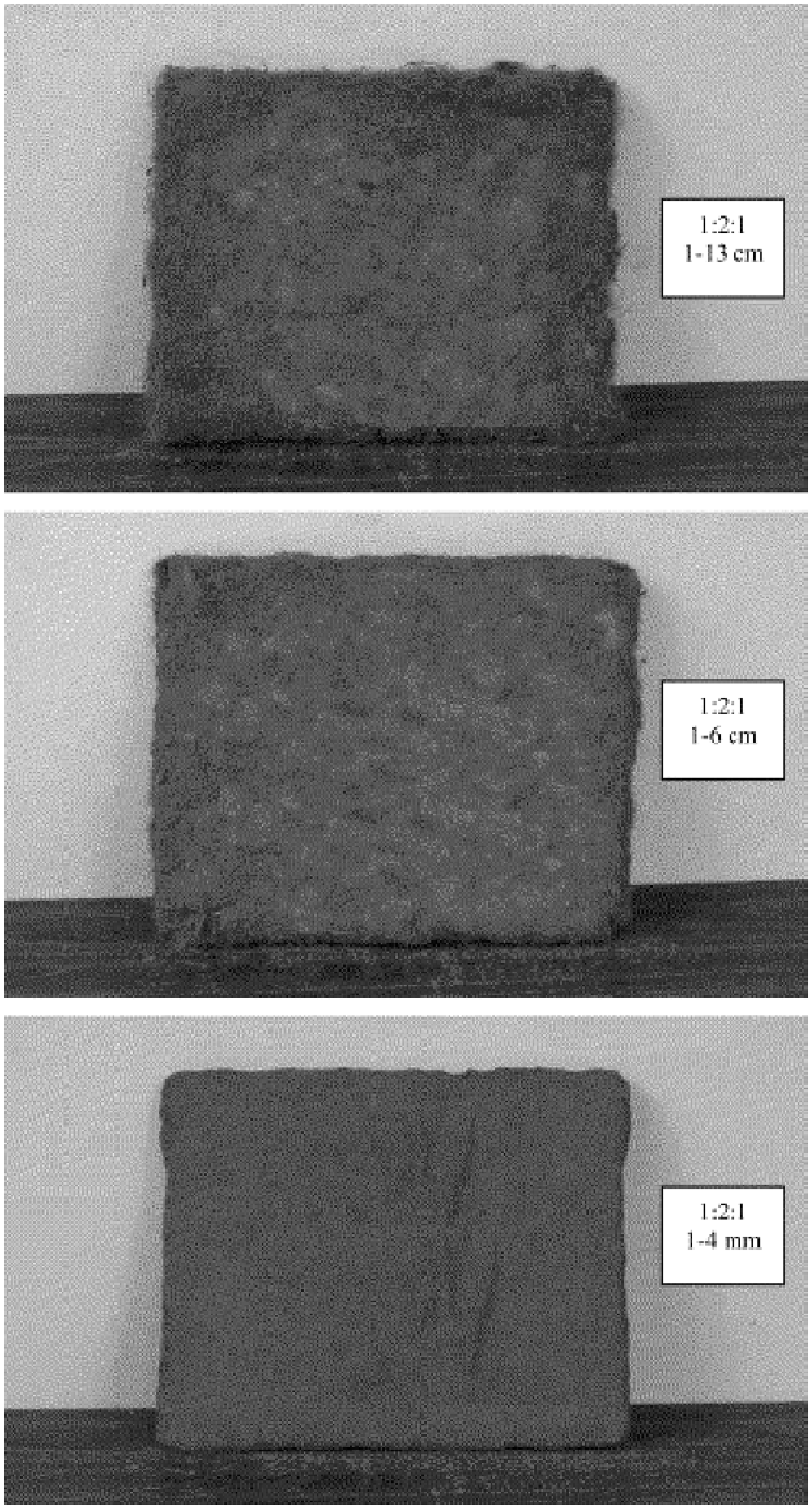
They are intended to be used as building components for energy conservation. The investigations focused on parameters, mainly, fiber length, coir pretreatment, and mixture ratio that affect the properties of boards. The physical, mechanical, and thermal properties of the specimens were determined after 28 days of hydration. Results of the study indicated that the best pretreatment of coir fibers was to boil and wash them as it can enhance some of the mechanical properties of coir fiber. The produced CCBs satisfied most recommended mechanical standards. In addition, investigation on thermal property of specimens revealed that coconut coir-based lightweight cement board has lower thermal conductivity than commercial flake board composite. That is an important feature to promote the use of CCBs as energy saving material in buildings.
Jute
Jute is abundantly available in many developing nations and is a suitable low-cost, strong and durable building material. Jute fibers, as a natural reinforcing agent, are about seven times lighter than steel with reasonably high tensile strength values (in the range of 250–300 MPa). Although many studies have been conducted to study the mechanical properties of cement composites reinforced with jute fiber, they have still not been put into much use practically.
The inclusion of jute fiber has proved to be instrumental in increasing physical characteristics and mechanical strengths of cement composites. Test studies conducted by Mansur et al. [14] have shown a huge amount of increase in tensile, flexural, and impact strength. Optimal quantity of jute reinforcement (1 wt. % with respect to cement) has been found to increase the cold crushing strength and toughness index as well [28]. To reduce the high alkali environment in PC, pozzolanic materials has been employed to wholly or partially replace PC. These pozzolanic materials include high alumina cement, silica fume, pulverized fly ash (PFA), and ground granulated blast furnace slag (GGBS). Study on the fracture and impact properties of short discrete jute fiber-reinforced cementitious composites by Zhou et al. [29] confirmed that such composites can be effectively used for high strength applications or where higher impact resistance is required. But as far as Young's modulus in tension and compression is concerned, the fiber only has a little influence, as is with compressive strength (Figure 3).
Compressive strength of JFRCC concretes at various ages. (After Zhou et al. [29]).
Attempts have also been made to improve the properties of such composites through chemical modifications. Fibers treated with alkali and chemically modified by carboxylated styrene butadiene polymer latex for homogeneous dispersion of jute fiber in cement matrix have demonstrated significant improvement in compressive and flexural strength [30]. The usefulness of the modified concretes was evaluated through the fabrication and testing of NP3 type concrete sewage pipes. The mechanical properties of these pipes were evaluated in terms of their three-edge bearing and hydrostatic strength.
Although these fiber reinforcements have an immense potential, standardization and definition of correct construction practices still present some difficulties. Since the quality and production efficiency of these fibers depend on natural conditions, it becomes difficult to predict their exact behavior sometimes. Also the heterogeneity of the properties of these fibers subject to different extraction, production, and processing techniques poses a problem. Another problem is the hydrophilic behavior of these fibers which creates problem due to water absorption in the composite systems. These are some of the issues that have not been addressed and can be the subject of further studies.
Degradation of fibers in alkaline environment
Natural fibers suffer from various degrees of degradation when exposed to an alkaline environment. It is interesting that the extent of the attack, as determined by loss in mechanical properties of different fibers, may vary, ranging from rapid strength decline to hardly any strength reduction, depending on the type of fibers [31]. Singh et al. [32] found a small drop in strength in coir fibers and a sharp drop in the strength of sisal, hemp, and jute. Coir fibers which are used in alkaline environments generally fare better amongst the natural fibers. Castro and Naaman [33] also reported strength reduction in natural fibers immersed in various solutions. The mechanisms of the alkaline degradation of natural fibers were discussed extensively by Gram [34] with particular reference to sisal fibers. The two mechanisms considered were:
A “peeling off” effect, in which the end of the molecular chain in unhooked and end groups are continuously liberated. This is the result of the reaction between the reducing end group and OH− ions. Alkaline hydrolysis, which causes the molecular chain to divide, and the degree of polymerization to be reduced significantly. Hemicellulose and lignin are particularly sensitive to this degradation effect.
It is important to note that synthetic fibers such as polyethylene and polypropylene are much immune in the alkaline environment and fare better than their natural counterparts.
Synthetic fibers
Unlike natural fibers, synthetic fibers are often used in combination of more than one fiber in matrix at a time. The concrete-reinforcing fibers include metal, polymer, and various others. Among the polymeric fibers, polypropylene fibers enjoy popularity in the domain of concrete and nylon fibers show a rising acceptance. The polypropylene fibers claim contribution to the concrete performance subjected to crack opening and slippage. Furthermore, the fibers reinforce the performance under not only compression, flexure, and tension, but also under impact blows and plastic shrinkage cracking. On the other hand, nylon fibers stepped up the performance after the presence of cracks and sustained high stresses. However, the establishment is awaiting as to how the polypropylene fibers compete with nylon rivals in advancing the performance of concrete under compression, tension, flexure, etc., and in shrinkage cracking control.
Even though polymer fibers do improve the impact strength of a cementitious matrix very effectively, because of their low modulus of elasticity accompanied by large extensibilities under stress, it is doubtful whether they can make a significant contribution towards an increase in the tensile strength of the material. It is necessary, therefore, to consider the possibilities that might result from the addition of a suitable second fiber to the polymer fiber, for applications where improvements in both tensile strength and resistance against impact are desired. Organic polymer fibers such as nylon and polypropylene, when added to cement or concrete even in very small proportions, substantially improve the impact resistance of the matrix but have very little effect on its tensile or bending strength. For the latter, the addition of a second fiber such as glass, asbestos, or carbon is beneficial.
Based on the experimental results, it was concluded that the addition of PP and nylon fibers enhanced the mechanical properties of concrete in combination. The enhancement is mainly attributed to the fiber bridging process that allowed additional stress to develop for the cracks to propagate. The density reduction of about 10% and 30%, compared to the control and normal weight concretes, respectively, is likely to decrease the dead load. The fibrillated fibers also enhance the splitting tensile and flexural strengths up to 19% and 45%, respectively, compared to the control concrete. Cement composites reinforced with polypropylene, polyethylene, and nylon composites have been discussed here.
Polypropylene
Polypropylene cement matrix has a different physico-chemical nature due to which revelations were made earlier questioning whether effective bonding is possible at all for such matrix. Since the fiber is low modulus, it was argued that Poisson effect could prevent development of sufficient bond with the matrix unless some shrinkage also occurred [35, 36]. However, microstructural characterization of the polypropylene–concrete interface in a composite produced by conventional mixing revealed a dense microstructure around the fibers leading to strong interfacial adhesion and mechanical anchoring with matrix [37]. Polypropylene-reinforced cement was found to sustain uniformly distributed loads recommended in International Standards without reaching a limit state of serviceability. The sheets exhibited good recovery even when loads were removed [38].
The feasibility was thus confirmed as even mixtures with short fibers (<50 mm long) (Figure 4) and low fiber contents (of 0.3% by volume or less) could show a significant increase in toughness of matrix (by a factor of 3) [39].
(a) Fibrillated PP before mixing, (b) Open bundle of fibrillated fibers, (c) Multi-strand filament fibers. (After Mindess and Vondran [39]).
Addition of polypropylene fibers have resulted in increased mechanical resistance and decrease in compressive strength [40].
Polypropylene networks have been found to increase the strain at which the glass fibers maintain their maximum stress leading to a much higher load capacity in cement-based composites reinforced with glass fibers and polypropylene network. The effect of polypropylene was to increase toughness which was considerably higher than glass-reinforced cement alone [41].
The effect of these fibers in matrix has been to increase tensile and flexural strengths, impact resistance, and toughness. High modulus polyethylene fiber was particularly effective in improving the toughness and ductility. Fibrillated polyethylene pulp was more effective in controlling micro-cracks. Excessive amounts of fiber can degrade the flexural performance [42]. In terms of durability, polypropylene-reinforced composites have been found to be quite stable and reported no loss in strength even when exposed to rays equivalent to 17 years of natural sunlight. They also remained unchanged in terms of tensile and flexural properties when immersed in water for up to one year at 20℃ [43].
For the enhancement of composite properties, acid, detergent, and rubbing treatments were given to composites. First, crack stress could be enhanced through acid and detergent treatments, whereas post cracking behavior was enhanced by the rubbing treatment [44]. Impact of such treatments on other properties has not been demonstrated though, which is an area where further work could be done. Trottier and Mahoney [45] developed a high tensile strength fiber that partially fibrillates during mixing with concrete. This increases the bonding capacity with the matrix. The fiber is produced by extruding a mixture of polypropylene and polyethylene.
In another research [46], polypropylene fiber-reinforced concrete properties have been presented. The compressive strength, permeability, and electric resistivity of concrete samples were studied. The concrete samples were made with different fibers amounts from 0 to 2 kg m−3. The fibers were found to arrest failure by bridging the gap between cracks (Figure 5).
Graphical schematic of the prevention of the crack propagation by forming connection bridge by fiber. [After Ref 46].
Polyethylene
There is considerable interest in the use of polyethylene fibers in FRC [47, 48]. These fibers can be readily mixed into the concrete using conventional batching and mixing techniques at fiber volumes up to 4%. Polyethylene fibers currently used for concrete have tensile strengths in the range of 80–590 MPa, and an elastic modulus of about 5 GPa, but others have been reported to have elastic moduli in the range of about 15.4–31.5 GPa, similar to those of the concrete matrix [49].
Polyethylene fibers have been evaluated using either short, dispersed fibers mixed with concrete at volumes up to about 4% [40], or a continuous network of fibrillated fibers (polyethylene in pulp form) to produce a composite with about 10% by volume of fibers. In pulp form, they are intended for use as asbestos replacement. For polyethylene fiber-reinforced concrete, flexural load-deflection curve proved that first crack strength decreases with increase in fiber content [50]. PE fibers have been found to influence the tensile strain capacity of hybrid fiber composites of cement. Polyethylene has been used in combination with other fibers such as steel fibers to obtain concrete of superior toughness [51]. Increase in PE fiber content was found to increase the ultimate tensile strain capacity at peak load up to a certain content after which it decreases. Increase in length of PE fiber significantly improved the strain hardening and multiple cracking behavior as well as the strain capacity of composites [52].
Studies on hybrid steel–PE fiber composites have shown lower ultimate strength but higher deflection capacity at the peak load than that of hybrid steel–PVA fiber composites. Also, strain-hardening behavior accompanied by multiple cracking was achieved in all hybrid steel–PE fiber composites. PE has also been found to exhibit highest deflection and energy absorption capacities. Rate of strength loss after peak load in hybrid steel–PE composites was found to be lower than that of steel–PVA hybrid composites [53] (Figure 6).
Flexural stress–mid-span deflection curves for hybrid steel–PE fiber composites. (After Ahmed et al. [53]).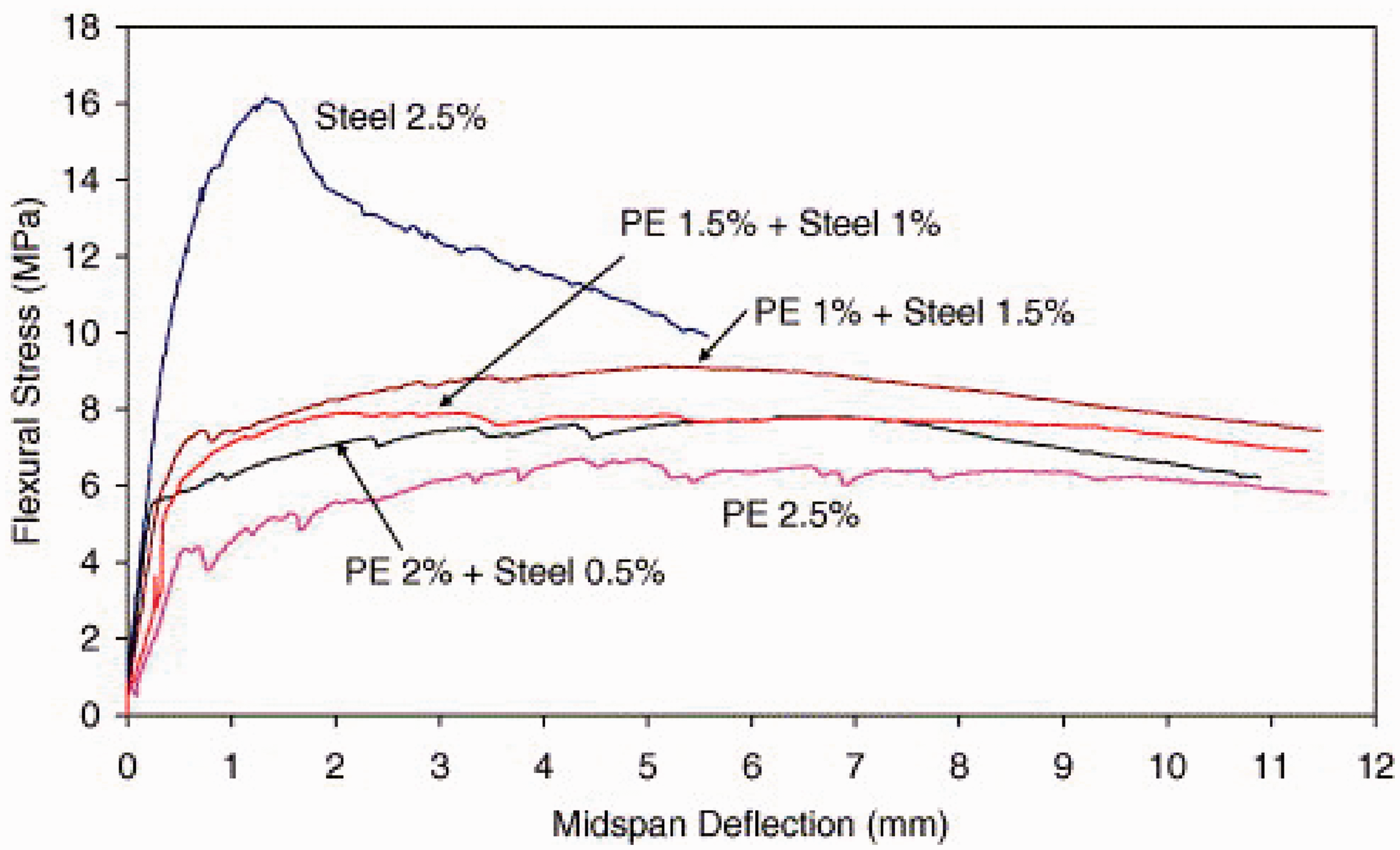
The composite with 2.5% steel (ST) fibers shows high flexural strength, but low deflection capacity. On the other hand, the composites with 2.5% PE or PVA fibers show lower flexural strength but higher deflection capacity than that of steel fiber composites. The highest flexural strength provided by the composite with steel fiber is due to its high modulus. In contrast, the high deflection capacity provided by the composite with PE or PVA fiber is due to their low stiffness.
Nylon
Nylon fibers have been used to produce high-performance concrete thermal storage material using Portland limestone cement and dolomite aggregates as composite matrix. This kind of composite has been found suitable for the production of large thermal energy storage (TES) devices for large-scale applications. The composite also showed less drying shrinkage than the plain concrete which helps to limit the formation of micro-cracks and form a durable material.
The results of mechanical analyses showed that added fibers did not significantly affect the concrete’s compressive strength or elastic modulus, nor did they have any negative fallout on other properties. The behavior of the nylon-reinforced composite appeared to be slightly more ductile than the plain concrete, due to debonding and pull-out at the fiber–matrix interface lying on the path of crack propagation. They also exhibited a good thermal stability up to 450℃, with no signs of spalling (observable to some degree in the plain concrete). The porosity left by the fibers’ melting seems to help prevent the propagation of thermal cracks.
The fracture behavior of MDF cement materials could be improved significantly by the method of nylon fiber mats-laminated technology. The impact energy increases 10 times, the fracture energy and toughness index could be 10 times compared to MDF cement matrix and the flexural strength reaches to 57–100 MPa when fiber volume fraction is as low as 2–6%. The impact energy of nylon fiber mats-laminated MDF cement composites was found to increase with the increase of fiber volume fraction and fiber diameter [54].
Comparative analysis of synthetic fibers
There have been research efforts where nylon and polypropylene have been compared for their performance in reinforced concretes. Song et al. indicated that compared to polypropylene fibers, nylon fibers claimed a slightly increased ability to distribute themselves throughout the concrete, thus distributing the unfavorable stresses within a greater volume of concrete and improving the concrete’s properties in the plastic and hardened state. The volume of the nylon fiber containing suspension was found to be about 25% of the capacity of the glass measure, which was a 5% increase over that of the polypropylene fibers containing suspension.
The compressive strength of the nylon fiber reinforced concrete topped that of the polypropylene fiber concrete by a 6.3% increase. The increase stemmed from nylon fibers recording a higher tensile strength, which resulted in greater tensile stresses being transferred from a cracked matrix to the nylon fibers than to the polypropylene fibers, thus leading to an increase in compressive strength of nylon fiber concrete. Additionally, the nylon fibers carried a more marked dispersion in the mixing water, implying that the nylon fibers distributed themselves more thoroughly throughout the concrete, which also backed the increase. The workability of Nylon mix was also found to be lower than PP fibers according to the experiments conducted by Yap et al. [55] who showed that density of concrete depends on the mixture design, fiber volume, and geometry of the fibers. The experimental results showed that the type and geometry of fibers caused notable changes on the oven dry density (ODD). The addition of PP fibers resulted in the density reduction while addition of PP fibers caused a considerable drop in density. In contrast, nylon fibers produced an increment in the ODD (Figure 7).
Oven dry density versus volume fraction. (After Yap et al. [55]).
Because of the slightly increased dispersion in mixing water, a greater number of nylon fibers intersected split sections, accordingly resulting in the splitting tensile strength to be 6.7% higher for nylon fiber concrete than for the polypropylene fiber concrete. This declaration was consistent with the statement that splitting tensile strength of fiber-reinforced concrete behaved in proportion to the number of fibers intersecting the fracture surfaces. As with compressive strength, the declaration came partially from the nylon fiber carrying the higher tensile strength.
The modulus of rupture (MOR) of nylon fiber concrete showed a 5.9% increase over the nonfibrous control concrete, with the polypropylene fiber concrete registering 1.5%. The increase resulted primarily from the fibers intersecting the cracks in the tension half of the reinforced beam. These fibers accommodated the crack face separation by stretching themselves, thus providing an additional energy-absorbing mechanism and also stress relaxing the micro-cracked region neighboring the crack-tip. Apart from the fiber–crack intersection, the nylon fibers topped the polypropylene fibers in the in-concrete fiber dispersion and the tensile strength. The topping also led the MOR of the nylon fiber concrete to a 4.3% increase over the polypropylene fiber concrete.
Thus, the nylon fiber-reinforced concrete outperformed its polypropylene companion in the upgrading of compressive and splitting tensile strengths, MOR, and impact resistance. The outperforming arose from the higher tensile strength of nylon fibers and probably the better distribution of the fibers through the concrete mass.
Fiber-reinforced composites were fabricated by Pena et al. [56] with significant post-peak toughness by using PP fiber contents of 1% or higher (1.12 and 1.48%). Combination of glass mesh/AR glass fiber increased matrix cracking strength and loading capacity compared to composites without fibers. Combinations of PP mesh/AR glass show an increase in first cracking strength and toughness values with no improvement in the matrix ultimate strength. Increased fiber surface area in composites with a combination of glass mesh/nylon fibers resulted in improved post-peak response.
The addition of PP and nylon fibers improved the post-failure toughness of OPSC (oil palm shell concrete) in terms of post-failure compressive strength (PFCS). The fiber–matrix bond enhanced the PFCS values in the oil palm shell fiber-reinforced concrete (OPSFRC), which is a sign of ductility.
The strength of the bond between polymer fibers and cement or concrete is likely to be poor. A value of the order of 1 MN/m2 has been obtained with polypropylene monofilament. This poor interfacial bond is largely responsible for the excellent impact strength of polypropylene fiber cement composites. However, for these composites to be of practical value, their tensile and bending properties must be improved. This was accomplished by adding a second fiber such as glass or asbestos to these composites [57].
A comparative study of different fibers was done by Kim et al. [58]. Flexural behavior of fiber reinforced cementitious composites with four different types of fibers and two volume fraction contents (0.4% and 1.2%). The four fibers are high strength steel twisted (T-), high strength steel hooked (H-), high molecular weight polyethylene spectra (SP), and PVA-fibers (Figure 8).
Different fibers used for reinforcement. (After Kim et al. [58]).
The T-fiber specimens showed best performance in almost all aspects of behavior, including load-carrying capacity, energy absorption capacity, and multiple cracking behavior. The only category in which SP-fiber specimens outperformed T-fiber specimens was deflection capacity, where SP-specimens exhibited the highest deflection at maximum load.
The structure of the fiber–matrix interface
The interface in any composite materials plays a very important role during stress transfer and effective functioning as a composite material. Just like fiber-reinforced composites, cementitious composites are characterized by an interfacial transition zone (ITZ) in the vicinity of the reinforcing inclusion. The microstructure in this zone is considerably different from that of the bulk paste, away from the interface. The characteristics of the fiber matrix interface exert several effects which should be taken into consideration, especially with respect to the fiber–matrix bond, and the debonding process across the interface. The particulate nature of the matrix influences the special microstructure of the transition zone in cementitious composites. There has been research on analyses of the interface [59] and modeling [60].
The particulate nature of the fresh mix exerts an important influence on the transition zone, since it leads to the formation of water-filled spaces around the fibers due to two related effects, as summarized by Bentur et al. [1]:
Bleeding and entrapment of water around the reinforcing inclusion and Inefficient packing of the ∼10 µm cement grains in the 20–40 µm zone around the fiber surface.
Thus, the matrix in the vicinity of the fiber is much more porous than the bulk paste matrix, and this is reflected in the development of the microstructure as hydration advances: the initially water-filled transition zone does not develop the dense microstructure typical of the bulk matrix, and it contains a considerable volume of CH crystals, which tend to deposit in large cavities.
Recent developments
Addition of cellulosic pulp in low alkalinity cement composites was carried out by Mármol et al. [61] and its mechanical behavior under bending stresses before and after accelerated aging cycles was studied. The low alkaline cement composites prepared presented average values of modulus of rupture after the aging cycles, indicating that its flexural strength was not significantly affected by the degradation tests. In addition, the average values of specific energy of the composites were also acceptable after 100 soak and dry cycles, thus suggesting that the use of low alkalinity ternary binder system can be an effective contribution in order to avoid the severe damage on cellulosic fibers which occurs when traditional pure PC matrix is applied.
The fiber–cement interface adherence is affected by the surface behavior of the fibers. In respect to this factor, a work has been done in which modification of cellulosic fibers has been carried out by grafting with various monomers to evaluate the impact of the surface grafting of cellulose fibers on the processing, dimensional stability, and mechanical performance of fiber–cement composites. The surface modification of the pulps was performed with methacryloxypropyltri-methoxysilane (MPTS) and n-octadecyl isocyanate, an aliphatic isocyanate (AI) which led to lower hydrophilic character of the fiber than untreated fibers, whereas treatment with aminopropyltri-ethoxysilane (APTS) increased the water retention value of the pulp. Fiber–cement strength was little influenced by fiber treatment, whereas AI-treated fibers contributed to higher specific energy (SE), and the lower SE value for APTS-treated fibers is an indication of the improvement on fiber to cement adherence. Thus, modification of the fibers can lead to strategic improvement in the processing and stability of natural fiber-reinforced cement products as observed by Tonoli et al. [62]. They showed a difference of surface energy for the differently treated fibers (Figure 9).
Surface energy components (polar and dispersive) of the untreated and treated cellulose sheet fibers. (After Tonoli et al. [62]).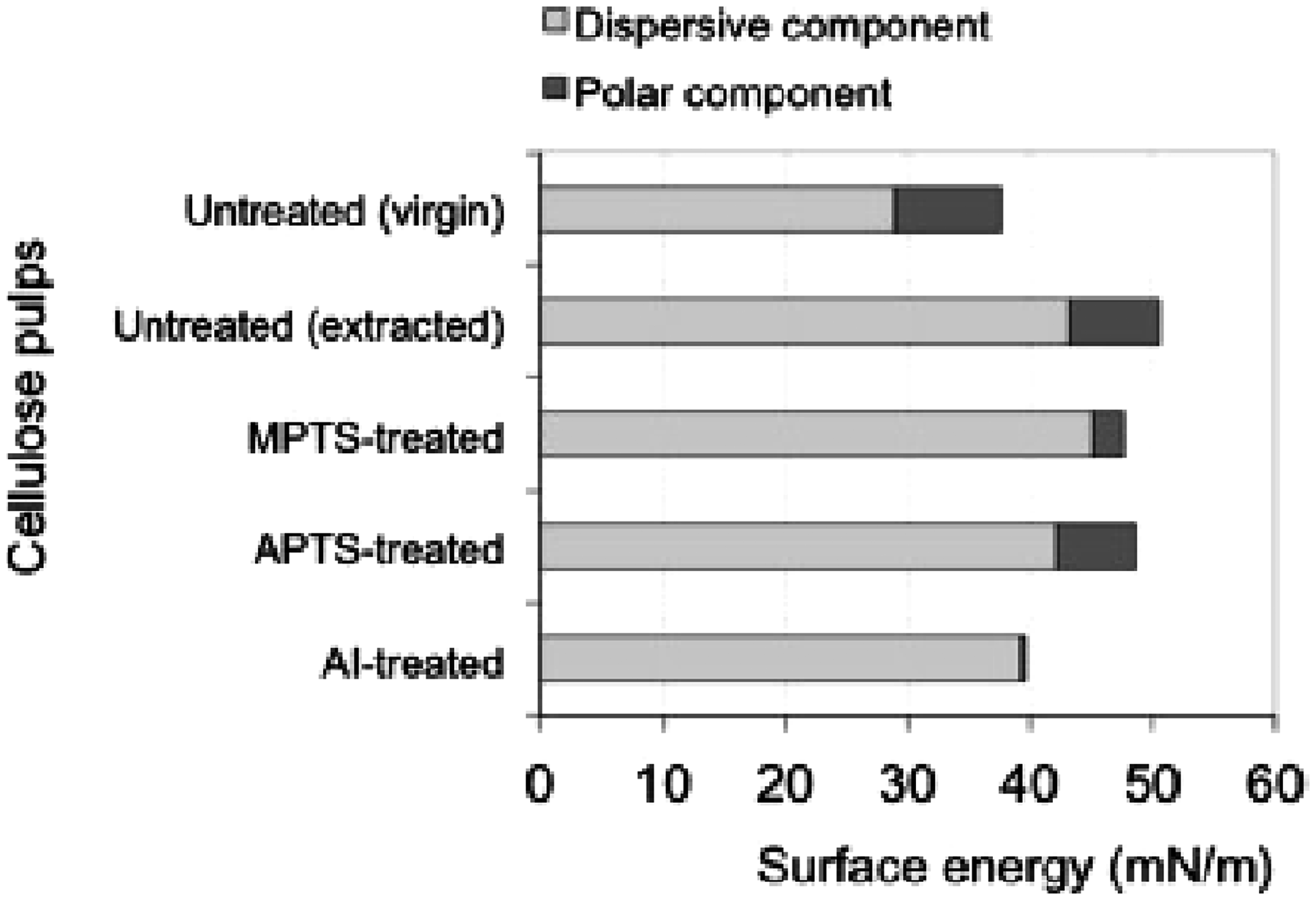
When jute fiber-reinforced cementitious concrete (JFRCC) is prepared with GGBS and PC as matrix, it gives higher compressive strength, splitting tensile strength, and flexural strength than the cementitious concrete prepared with PFA and PC matrix. It also showed higher fracture toughness, critical strain energy rate, and critical stress intensity factor. However, jute fibers exhibit less deterioration in PFA/PC matrix than in GGBS/PC one. Fiber pull-out was observed in JFRCC mortar panels with PFA/PC matrix while fiber fracture was observed in those with GGBS/PC matrix upon impact failure as per the work carried out by Zhou et al. [63].
Coconut fibers having highest toughness amongst all natural fibers can also be used to develop fiber-reinforced concrete. Ali et al. [64] in their work used coconut fibers with various concentrations and varying fiber lengths to develop coconut fiber-reinforced concrete and studied their mechanical as well as dynamic properties. It was observed that the reinforced concrete with higher fiber content has a higher damping but lower dynamic and static modulus of elasticity, and the best propertied were observed with fiber length of 5 cm and a fiber content of 5%. In another study by John et al. [65], a comparative study on the microstructure of new as well as aged blast furnace slag cement coir reinforced composite was performed wherein aged samples were taken from internal and external walls of a 12-year-old house. It was observed that the lignin content of the samples from the external wall and the internal wall had been leached from the fiber. However, the eventual leaching of lignin did not have any effect on the walls in use performance. SEM study also confirms impregnation of fiber walls with calcium and to some extent with silicon.
The concept of using hybrid-fiber engineered cementitious composite has recently developed wherein in a work by Soe et al. [66] polyvinyl alcohol fibers and steel fibers were reinforced onto cement. It was observed that the new hybrid-fiber ECC considerably increased impact resistance and energy absorption capability than the plain concrete. There was evidence of fibers bridging the cracks during failure (Figure 10).
Fiber bridging behavior of the ECC panels after the impact. (After Soe et al. [66]).
Engineered cementitious composites (ECC) have a potential of self-healing of micro-cracked ECC material which has been studied in detail by Sahmaran et al. [67]. In the study, investigation of the durability of ECC material with regard to cracking and healing under combined mechanical loading and environmental loading conditions was carried out wherein ECC specimens were firstly pre-loaded under uniaxial tension, exposed to an alkaline environment and reloaded up to failure. The test results indicated strong evidence of self-healing of the micro-cracked ECC material, which can still carry considerable tensile stress and strain and restore nearly the original stiffness. Therefore, it can be said that ECC both virgin and micro-cracked are highly durable despite exposure to alkaline environment.
There has been research on use of more than one fiber for reinforcement. A new high-performance hybrid material has been developed by the combination of textile reinforced concrete (TRC) and glass-fiber reinforced plastic (GFRP). As the authors claim [68], advantages of both materials, namely high strength, durability, surface quality, and cost-efficient production, can be implemented in one hybrid materials. For the composite of GFRP and TRC, the integration of an interlayer for the mechanical and thermal decoupling was indispensable. The developed interlayer, consisting of an epoxy resin and a polyester nonwoven, guarantees a high and sustainable detention compound between GFRP and TRC.
In another research [69], the effect of hybrid fiber reinforcement has been investigated under flexure and direct shear. Along with a reference plain concrete mix, several single-fiber-reinforced concrete mixes and two-fiber-reinforced hybrid composite mixes were cast using diverse fiber combinations. Two types of macro-steel fibers and a micro-cellulose fiber were examined. For those hybrid composites examined under flexure, there was a positive synergy between steel and cellulose fibers in all instances. Interestingly, the cellulose fiber, which by itself did not change the toughness of plain concrete, was an effective contributor to toughness in the presence of a steel fiber. The synergy was seen to diminish with an increase in the deflection, presumably owing to the loss of cellulose fiber efficiency at larger crack openings.
In another work [70], effects of individual and combined additions of polypropylene (PP) and polyvinyl-alcohol (PVA) fibers (PP/PVA fiber ratios: 3/0%, 2/1%, 1.5/1.5%, 1/2% and 0/3%) on the flexural behavior of cement-based composites have been investigated. For this purpose, matrices at different strength grades have been used. The binder composition of high strength matrix (MI) was solely cement and 50% of cement was replaced with fly ash to prepare a comparatively low strength matrix (MII). Thirty prismatic samples are subjected to four-point flexural loading after 28 days of standard curing. The load–mid-span deflection curves were plotted and simultaneously cracking patterns of composites photographed at definite deflection values. First, cracking and flexural strength, and deflection and relative toughness values have been determined for all samples. Test results showed that the effects of PP and PVA fibers on load–deflection curves of cement-based composites are significantly different (Figure 11).
Flexural load–mid-span deflection curves of composites (MI matrix). (After Tosun-Felekoglu and Felekoglu [70]).
Conclusion
Fiber-reinforced concrete (FRC) is a concrete containing fibrous material which increases its structural integrity. It contains short discrete fibers that are supposed to be uniformly distributed and randomly oriented. This paper reviews the various natural as well as synthetic fibers that have been used for making fiber-reinforced concrete composite. Issues of reinforcement and a comparison of the use of different fibers as reinforcement have also been discussed. Based on the literature, further research can be directed towards studying effects of strain hardening of fibers, effect of hybridization of fibers in concrete, long-term behavior of fibers under stressed conditions, modifications of fibers modeling of reinforced concrete, and testing of such materials.
Footnotes
Funding
This research received no specific grant from any funding agency in the public, commercial, or not-for-profit sectors.