




Abstract
This work has focused on the improvement of the sound absorption properties of multilayered structure. Nonwoven fabrics with three different thickness were used to fabricate multilayered absorber. Polyethylene membrane was then incorporated into the multilayered structure with different combinations. The acoustic measurement indicated that polyethylene membrane can improve the sound absorption properties when the thickness of nonwoven fabric is 1.01 mm and 2.38 mm respectively. However, the incorporation of polyethylene membrane will decrease the sound absorption coefficients when the thickness of nonwoven fabric is 3.41 mm. This study has indicated that the thickness of nonwoven fabric and the layer stacking sequence should be focused on consideration to prepare multilayered sound absorber.
Introduction
Fibrous materials have been widely used for noise control and reduction in various industries, such as automotive, construction, and equipment manufacture[1–4]. It has been reported that multilayered structures consist of several textile layers with different acoustic characteristics is a potential candidate for noise control applications [5–10]. Among various structures, multilayer nonwoven composite has attracted a great deal of attention due to its high efficiency in noise reduction and economic cost. For instance, Fouladi and coworkers [11] have investigated the utilization of polypropylene fiber for increased low frequency absorption coefficients in multilayer coir fiber based composites. Rabbi and coworkers [12] have reported the incorporation of nanofiber layers into layered nonwoven fabrics for improved sound absorption at low and middle frequencies. Recently, polyolefin foam/film alternating multilayer structure was fabricated via co-extrusion method, which showed dramatically enhanced sound absorption properties in comparison with conventional single layer absorber [13]. In addition, the incorporation of cotton layer can obviously improve the sound absorption of multilayer composites consist of glass fiber cloth reinforced polylactic acid inter-layers [14]. Therefore, it can be seen that it is a hot spot concerning the modification of multilayer structure for enhanced acoustics properties.
However, it should be pointed out that most of the reported multilayer fibrous structures have relatively thick thickness. For example, the thickness of bilayered nonwoven for low frequency noise reduction is 12∼36 mm, with the average mass per area of 1300∼1500 g/m2 [15]. In addition, the thickness of bi-layer composites consist of carbonized and activated nonwovens is 38 mm [16], the thickness of sandwich laminates reinforced hybrid composites is about 20 mm [17], and the thickness of sandwich glass fiber felts is 60 mm [18]. Nanofiber composite made of fine and random orientated fibers is also beneficial to the attenuation of acoustic waves, and nanofiber can obviously increase the sound absorption coefficient at low frequency with light weight and thin thickness [7]. However, the high cost and complicated production process has limited the wide application of nanofibers in noise reduction. Compared with nanofibers, plastic membrane is cheap, and it is also effective to reduce low frequency noise due to the resonant effect [19]. A typical resonant absorber is composed of a membrane placed in front of rigid wall, and there is an air gap between the two elements. However, the absorption bandwidth of membrane absorber is narrow, thus membrane absorber is usually combined with porous materials to expand the absorption bandwidth for better practical applications. According to reported studies[20,21], polyethylene membrane is promising for potential multi-layer sound absorption materials. The PE film multilayered composite showed that at low frequency the more layers of PE film inserted the better sound absorption property. Polyethylene membrane is cost effective and exhibits good mechanical properties, and it is feasible to incorporate polyethylene membrane into multilayer nonwoven composites for engineering noise reduction and control. The vibration effect of polyethylene membrane is also effective to contribute to the sound absorption improvement at the low frequency range.
A summary of multilayer nonwoven fabric composites for sound absorption applications is listed in Table 1. The purpose of the present work is to study the role of polyethylene membrane thickness and position for the sound absorption of multilayer composites. In this work, we have investigated the sound absorption properties of multilayer nonwoven fabric incorporated with polyethylene membrane. The effects of different thickness of both polyethylene membrane and nonwoven fabric were also studied. Furthermore, the effects of polyethylene membrane layering sequence in the multilayer structure was also investigated. The mechanism of polyethylene resonance sound absorption and nonwoven porous sound absorption in the multilayer structure have also been discussed. The purpose of this paper is to explore the possibility of efficient multi-layer composites consist of nonwoven and polyethylene membrane for enhanced sound absorption properties.
List of reported studies on different multilayered sound absorption composites.

Materials and methods
The detailed parameters of nonwoven fabrics are listed in Table 2. Nonwoven fabric was made of polyester fibers. The density of polyethylene membrane is 0.94 g/cm3, and the modulus of elasticity is 0.72 GPa, and it is impermeable. To study the effects of the membrane thickness on sound absorption, various thickness including 40, 80, and 120 μm were used to fabricate multilayered sound absorption structures. Generally, porosity is an important factor to determine the sound absorption of porous absorber, nonwoven fabric with high porosity exhibits good sound absorption properties. In this work, the porosity of all the specimens is higher than 86%. As shown in Figure 1, the samples were marked as AF, BF and CF when the polyethylene thin film was placed near to acoustic source. The details of nonwoven fabric and polyethylene are shown in Table 3. According to different thickness of polyethylene membrane, the specimens are labeled as AF-40, AF-80 and CF-120. As for AL, BL and CL, the polyethylene membrane is away from the acoustic source. Especially, when two layer of polyethylene thin film were incorporated into the multilayer structure, the samples are marked as AM, BM and CM. For comparison test, control sample without polyethylene thin film was prepared and labeled as AAA, BBB, and CCC, respectively.
Physical properties of single layer nonwoven fabric.


Different configurations of multilayer nonwoven fabric structures.
A description of 30 measured samples with different thickness of nonwoven fabric and polyethylene membrane.

The schematic diagram of sound absorption measurement system has been illustrated in Figure 2. The test and analysis process of sound absorption coefficients was based on the method of ISO 10534-2 (ISO 10534-2: 1998. Acoustics–Determination sound absorption coefficient and impedance in impedance tubes. Part 2: Transfer function method.). The acoustic source is fixed at one end of the impedance tube which generates broadband acoustic waves within the frequency of 100 to 6300 Hz, and the multilayer nonwoven fabric is fixed at the end of the opposite side. These incident acoustic signals propagate as plane waves in the impedance tube, both incident and reflected acoustical signals are picked up and analyzed. The acoustic pressure in Mic. 1 and Mic. 2 are indicated as p1 and p2 respectively. The toward acoustic pressure is Pi(t)=P+ejωt, while the back propagation acoustic pressure is Pr(t)=R × P+e−jωt, and R is reflection coefficient. Therefore, the acoustic pressure at the point of Mic.1 and Mic.2 are described as follows:


Schematic diagram of sound absorption measurement system based on transfer function method.
In this study, multilayered nonwoven fabrics were self-supported and closely combined with each other in the impedance tube without any adhesion agent bonding. In practical applications, the compaction of multilayer absorber is generally fixed with rivet, and this self-compacted structure was widely used in the measurement of sound absorption properties by impedance tube. According to reported studies [31–33], multi-layer knitted spacer fabric was conjoined together, and woven fabric was closely attached as the upstream layer of porous materials, thus for the measurements of sound absorption coefficients.
Results and discussions
Sound absorption coefficients of multilayer structures
For better explain the reason of polyethylene membrane placed between A, B, and C, the mechanism diagram of acoustic waves attenuation in multilayer composite is shown in Figure 3. It can be seen that partial incident acoustic waves are reflected or transmitted, while the residual incident acoustic waves are absorbed by the nonwoven fabric and polyethylene membrane layer. The reflection of acoustic waves at the interface can be attributed to the acoustics characteristic mismatch between these two layers, thus increase the propagation path of sound waves in the multilayer composite. For AM, BM, and CM structures in Figure 1, the incident acoustic waves can be reflected for two times due to the incorporated polyethylene membrane. Therefore, the acoustic energy was effectively dissipated through the multiple reflection and extended propagation of sound waves inside the multilayer structure. For nonwoven fabrics, the sound absorption coefficient was closely related to air permeability. A lower air permeability generally exhibits better sound absorption properties. Therefore, Fabric C has the highest sound absorption coefficients among there three specimens. In addition, air permeability exhibits different influence on the sound absorption at varied frequencies range. At higher frequencies, the effect of air permeability on sound absorption is reduced.

Diagrammatic sketch of acoustic wave attenuation in multilayer structure.
The average absorption coefficients of all the samples used in this study are listed in Figures 4 to 6. The tested acoustic frequency by impedance tube was ranged from 100 Hz to 6300 Hz. It could be seen from Figure 4 that the sound absorption coefficients were increased after the incorporation of polyethylene membrane. The sound absorption coefficient of AAA without polyethylene membrane is 0.34. After the incorporation of polyethylene membrane, the absorption coefficients of all the samples are higher than 0.4. For AF structures, the coefficients are higher than 0.5. All the specimens incorporated with polyethylene membrane exhibited better acoustical properties than AAA. Moreover, it could be seen from Figure 4 that AF samples have better sound absorption properties than AL and AM. Figure 5 report the sound absorption properties of multilayer composites based on Sample B. Similar with Sample A, the sound absorption properties of Sample B based composites were also improved with the incorporation of polyethylene membrane. In addition, it could be observed from Figure 5 that BF, BL and BM have similar average sound absorption coefficients. The sound absorption coefficients of BF-80 and BF-120 is higher than BF-40, which has similar tendency with BL and BM structures. Moreover, the sound absorption properties at medium frequency range were improved due to the incorporation of polyethylene membrane.

Sound absorption coefficients of Sample A nonwoven fabrics based multilayer composites.
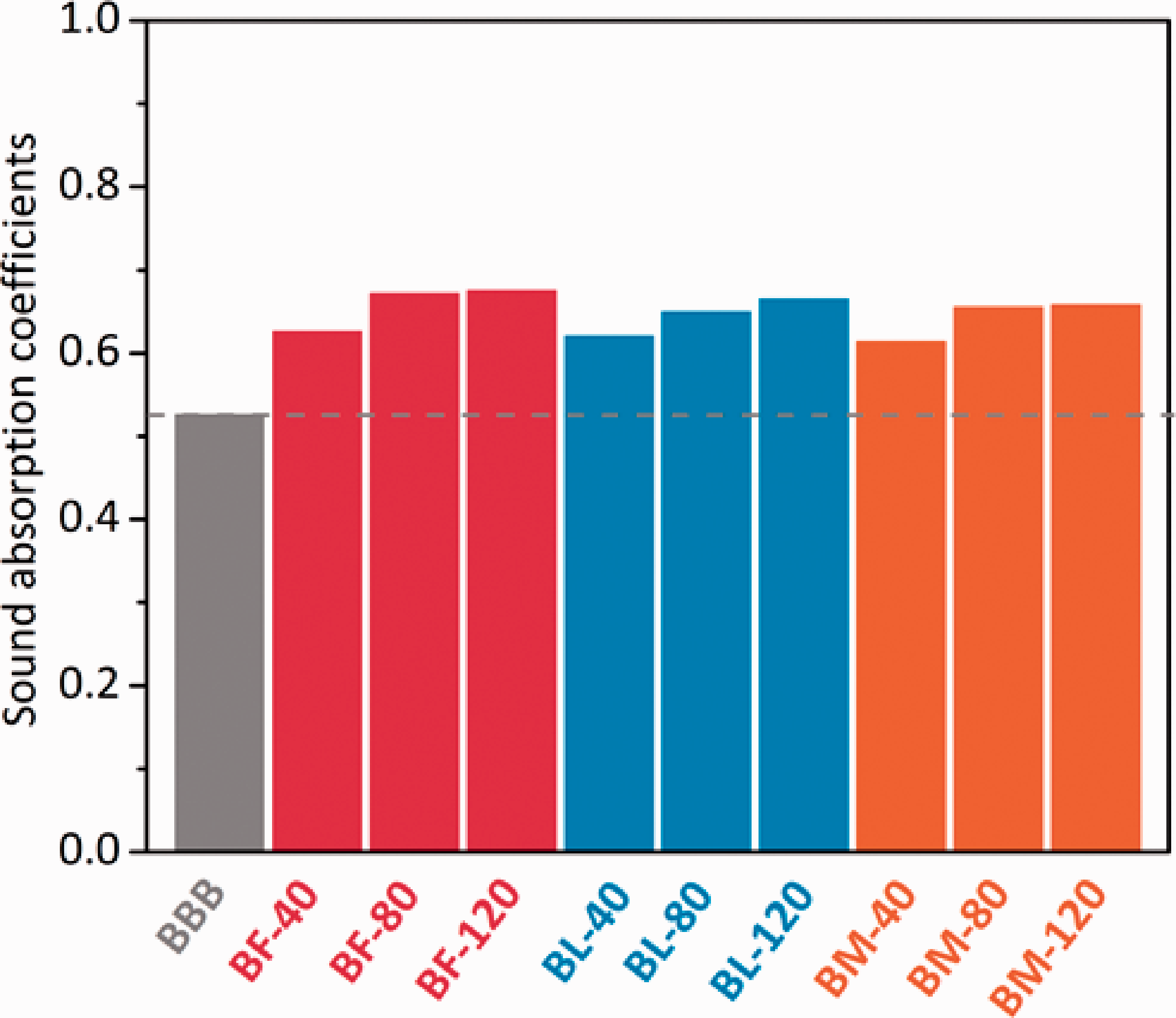
Sound absorption coefficients of Sample B nonwoven fabrics based multilayer composites.
However, the sound absorption properties were decreased with the incorporation of polyethylene membrane for Sample C based composites. For better comparison, the average sound absorption coefficients were calculated by the formula of

Sound absorption coefficients of Sample C nonwoven fabrics based multilayer composites.
Effects of fabric thickness and layering sequence
In this section, the sound absorption properties of multilayer composites are further studied, thus to investigate the effects of fabric thickness and layering sequence. For the multilayer composites without polyethylene membrane, the measured absorption curves are shown in Figure 7. It could be seen that the sound absorption coefficients are gradually increased with the increasing of nonwoven thickness at the frequency from 100 Hz to 6300 Hz. As for porous nonwoven fabrics, the thicker it is, the higher sound absorption coefficient is. According to the semi-phenomenological model of Allard and Atalla [34,35], where complex effective density and bulk modulus are used to describe the equivalent fluid behavior of porous materials. The surface impedance is determined by complex effective density, bulk modulus and materials thickness. As shown in Figure 7, it is obvious that the absorption coefficients of CCC sample are higher than 0.5 at a broad bandwidth above 1200 Hz, and it is valuable for practical applications. Furthermore, the sound absorption of polyethylene membrane (80 μm for an example) is very weak, and the acoustic waves attenuation inside the membrane can be negligible.

Sound absorption properties of different multilayer composites and polyethylene membrane.
The sound absorption coefficients of multilayer nonwoven fabric composites incorporated with polyethylene membrane are presented in Figures 8 to 10. For 40 μm thickness polyethylene membrane, the results of measured sound absorption coefficients are shown in Figure 8. It can be observed from Figure 8(a) that the sound absorption curves of BM-40 and CM-40 are similar, and both of them are better than AM-40. The thickness of nonwoven fabric A, B, and C is 1.01 mm, 2.38 mm, and 3.41 mm, respectively. The comparison between A and B shows the increasing of thickness of effective to improve sound absorption properties. Therefore, fabric B was recommended to prepare multilayer nonwoven fabrics. It has exhibited similar sound absorption properties with fabric C, and the thickness is significant reduced in comparison with fabric C, thus better meet practical applications. It can be seen that the increasing of thickness can not always improve the sound absorption properties. For typical porous absorber, the increasing of nonwoven fabric thickness can effectively improve the sound absorption at thin thickness. It can be attributed to the increased attenuation path of incident acoustic waves. However, as thickness increases to a certain extent, the sound absorption is not sensitive to the increased attenuation path. In this study, it has been found that when the thickness is as high as 3.41 mm, thickness has negligible effects on the improvement of sound absorption. As for the L configuration of AL-40, BL-40 and CL-40 samples, in Figure 8(b), the sound absorption coefficients are gradually increased with the increasing of nonwoven fabric thickness. It can be attributed that the fixed polyethylene membrane is farther away from the acoustic source than F configuration, and F configuration has similar acoustics behavior to M configuration, as shown in Figure 8(c). The thickness of both AF, BF, and CF is 3.05 mm, 7.16 mm, and 10.25 mm, while the thickness of AM, BM, and CM is 3.07 mm, 7.18 mm, and 10.26 mm, respectively. In summary, these structures exhibited the advantages of reduced thickness for sound absorption applications.

Sound absorption properties of multilayer composites of (a) AM-40, BM-40 and CM-40; (b) AL-40, BL-40 and CL-40; (c) AF-40, BF-40 and CF-40.
Furthermore, the effects of composites structures on sound absorption for 40 μm polyethylene membrane is also consistent when the thickness is 80 μm and 120 μm respectively, as shown in Figures 9 and 10. Therefore, the membrane thickness has negligible effects on the sound absorption of multilayered structures, which has not been considered as a key factor in the fabrication of multilayer nonwoven absorber. It could be concluded that when the polyethylene membrane was placed at the later position of the multilayer composites, the sound absorption coefficients were gradually increased with the increasing of nonwoven fabric thickness. Furthermore, polyethylene membrane is effective to enhance the sound absorption properties with optimal thickness and position.

Sound absorption properties of multilayer composites of (a) AM-80, BM-80 and CM-80; (b) AL-80, BL-80 and CL-80; (c) AF-80, BF-80 and CF-80.

Sound absorption properties of multilayer composites of (a) AM-120, BM-120 and CM-120; (b) AL-120, BL-120 and CL-120; (c) AF-120, BF-120 and CF-120.
Conclusions
This work has studied the effects of nonwoven fabric thickness, polyethylene membrane and layering sequence on the sound absorption of multilayer composites. It has been found that the optimized configuration is effective to improve the sound absorption properties within the audible frequency range. The incorporation of polyethylene membrane can also increase the absorption coefficients at low frequencies, where the thickness of polyethylene membrane is 40 μm, 80 μm, and 120 μm respectively. The increasing thickness of polyethylene membrane is benefit to improve the sound absorption at low frequency range. Among various configurations, M and F are recommended for practical applications, where 2.38 mm thickness nonwoven fabric has similar sound absorption behavior with the thickness of 3.41 mm. Multilayer composites consist of nonwoven fabric and polyethylene membrane are promising for the applications in noise reduction. For future research, it is suggested to investigate the mathematical model of multilayer absorber with both porous absorption and resonant absorption mechanism.
Footnotes
Declaration of conflicting interests
The author(s) declared no potential conflicts of interest with respect to the research, authorship, and/or publication of this article.
Funding
The author(s) received no financial support for the research, authorship, and/or publication of this article.
