




Abstract
Blend films based on polyvinyl alcohol/polyethylene oxide (70/30 wt%) undoped and doped with different concentration of graphene oxide were prepared by spiral vane electrospinning. Characteristic properties of the blend films were investigated by using X-ray diffraction and scanning electron microscopy. The sound absorption performance of the compositions (nanofiber membranes and needle punched non-woven fabric) was tested by an impedance tube. The sound absorption performance of non-woven fabric has greatly improved after combining with thin nanofiber membranes. With addition of graphene oxide, the fibers were intertwined in a loop and form a network, the areal density and surface roughness of the nanofiber membrane are reduced. Composites containing polyvinyl alcohol/polyethylene oxide nanofiber membranes and composites containing polyvinyl alcohol/polyethylene oxide/graphene oxide nanofiber membranes exhibited different sound absorption properties in different frequency bands. When the fiber coefficient of variation was small, the average sound absorption coefficient of the composite material was high. However, composites containing both polyvinyl alcohol/polyethylene oxide and polyvinyl alcohol/polyethylene oxide/graphene oxide nanofiber membranes had similar sound absorption properties, and the average sound absorption coefficient was greater than that of polyvinyl alcohol/polyethylene oxide composites.
Keywords
Introduction
Noise pollution has become a rigorous issue in the world [1,2], which does harm to working conditions and human health [3–5]. It is feasible to control the noise by using sound-absorbing materials reasonably [6,7]. Many porous materials show low sound absorption over a wide frequency range [8]. Compared to porous fibrous materials, the thin nanofibrous layer performed different properties in the field of sound absorption [9]. It is reported that sound absorption properties increased in low-middle frequency, when traditional non-woven materials were combined with electrospun nanofiber membranes [10].
Polyvinyl alcohol (PVA) is usually used for electrospinning, because it can completely dissolve in water and film easily [11,12]. Researchers found that the morphology and microscopic structure of nanofiber have an impact on sound absorption properties. The presence of smooth fibers and amount of partly merged fibers in the thin PVA nanofibrous layer structure had different effects on sound absorption [9]. Researchers also found that the morphology and microscopic structure of nanofiber have an impact on sound absorption properties [13,14]. Polyethylene oxide (PEO) has high thermal stability and strength [15–18]. The addition of PEO with high molecular weight and high crystallinity results in the formation of porous structure in PVA hydrogel structure [19]. PEO improves the conductivity of PVA solution and reduces the crystallinity of PVA, and three-dimension network structure are formed in PVA/PEO membrane [20,21]. PEO increases the viscosity of the mixed solution and makes the crystal size of the PVA smaller [22]. PVA/PEO nanofiber membranes with uneven surface could be obtained by spiral electrospinning machine, and the sound absorption performance is greatly improved compared with pure PVA nanofiber membrane [23]. The dressings made from PVA/PEO/CMC (carboxymethyl cellulose) were highly porous with three-dimensional interconnected porous morphology [24]. When MnCl2 was added to the PVA/PEO solution, the film exhibited a rough surface, which had some small aggregates [25].
Graphene oxide (GO) is one of the most important graphene derivatives, which has a bust of hydrophilic groups on its surface such as hydroxyl, epoxy and carboxyl [26,27]. The addition of GO or MWNTs to the spinning solution makes an effect to the diameter distribution and strength of the fibers [28–31]. Because of its strongly oxidizing and highly hydrophilic behaviour, GO plays an important role in environmental protection [32,33]. PVA/GO hydrogel exhibits a promising cycling absorption performance on methylene blue (MB), being 4.1 times higher than that of pure PVA hydrogel [34]. Excellent interfacial interaction is formed between the PVA/GO films, and have good microwave absorption properties because of the specific surface area of GO [35]. Some innovative sound absorbers are designed based on carbon nanotubes and graphene derivatives; because of their good chemical and intrinsic mechanical properties, sound absorbing materials were more efficient [36]. Adding a layer of GO sheet to the melamine foam skeleton significantly enhance the sound absorption performance in the frequency range of 128–4000 Hz [37]. The doping of GO in the spinning solution increases the sound absorption coefficient in the frequency range of 700–1600 Hz, especially at 1500 Hz, the sound absorption coefficient increases by 40% [38]. We studied the effects of GO on morphology of fibers and pore size, and the influence of composite structures on sound absorption performance were investigated.
Materials and methods
Graphene oxide, polyvinyl alcohol (1788) and polyethylene oxide (Mw = 1,000,000) were purchased from Shenzhen Turing Evolution Technology Co., Ltd., Changzhou Fengyuan Textile Assistant Co. Ltd. and Shanghai Liansheng Chemical Co. Ltd., respectively. Firstly, the GO was dissolved in the same volume deionized water with the mass fraction of 0 wt%, 0.5 wt%, 1.0 wt% and 1.5 wt%, respectively. The solutions containing GO were placed in an ultrasonic cleaner, kept in ultrasonic oscillation for 2 h at room temperature. Then, the deionized water was used to prepare 10 wt% concentration PVA solution and 3 wt% concentration PEO solution. Finally, the two solutions were mixed with a mass ratio of 70/30. We took PVA/PEO/GO (1.5 wt%) as an example. As shown in Figure 1, the solution remained with good dispersibility after being placed for 30 min, 1 h, 2 h, 4 h, 6 h, 12 h and 24 h, respectively.
Dispersion of solution with different placed times.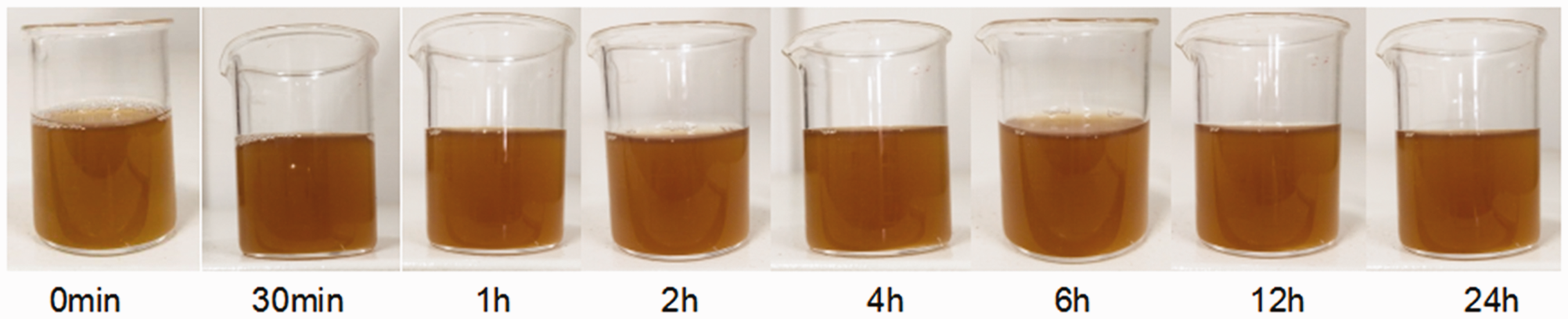
Nanofiber membranes were prepared by spiral vane electrospun machine (Kunshan Tongray) (Figure 2). Electro-spinning parameters: spinning voltage 65 KV, receiving distance 190 mm, temperature 25–35℃, humidity 60–65%. Then the nanofiber membrane (2 mm) was composited with needle-punched nonwoven (DNC33T23, 6.9 mm, 345 g/m2, Shenzhen Dongfang Nonwove Co. Ltd.). Polyamide mesh adhesive (Shanghai Yuanzhi Hot Melt Adhesive Co. Ltd.) was placed between the nanofiber film and the needle-punched nonwoven material, and they were placed between the two glass plates. Then, the oven was turned on, and when the temperature reached 135℃, the glass plates were carefully placed in oven. The polyamide mesh melted at high temperature to compound the two materials together. After 2 min, they were taken out, naturally cooled to room temperature and finally the desired composite material was obtained (Figure 3).
Schematic diagram of spiral vane electrostatic spinning machine. Physical pictures of composite samples.

The sound absorption of composites was tested by SW477 and SW422 impedance tube (BSWA Technique Company, Beijing, China) in the range of 80–6300 Hz. Testing conditions: relative temperature 20 ± 1℃, relative humidity 65 ± 2%. The structure of impedance tube is shown in Figure 4. The impedance tube method is on the basis of the two-microphone transfer-function method. There are sample materials and loudspeakers at both ends of the impedance tube, which is airtight, rigid and straight. Different frequencies of sound waves are generated by the sound source along the plane to the material direction, the two sound pressure measuring devices near the sample obtain the acoustic transfer function of the signal, then the sample’s normal incident absorption coefficient is calculated, the sound absorption coefficient spectrum displayed on the computer screen finally.
The structure of impedance tube.
The morphology of the fiber was measured by electron microscopy (SEM) (S4800, Hitachi, Tokyo, Japan). X-ray diffraction (XRD) scans of diffraction angle 5°–50° was obtained by using PAN alytical X-Pert Pro MPD XRD system (Chemplex, Palm, Florida, USA). Pore size was tested by a Through-pore size analyzer (POROMETWR 3 G, Conta USA) and Image-Pro Plus 6.0 was used to calculate fiber diameter.
Results and discussion
Morphological analysis
The samples were attached to the surface of the electron microscope and were sprayed gold for 90 s. The fiber morphology was observed by Hitachi S4800 scanning electron microscope (SEM). The SEM images of the nanofibers are shown in Figure 5. It can be found in Figure 5(e) that the surface of GO is wrinkled. Figure5(f) shows SEM image of needle-punched nonwoven fabric with smooth fiber surface, coarse fibers and large pores. In Figure 3 we can also clearly see that the non-woven fabric was fluffy.
SEM of nanofiber membranes: (a) PVA/PEO; (b) PVA/PEO/GO (0.5 wt%); (c) PVA/PEO/GO (1.0 wt%); (d) PVA/PEO/GO (1.5 wt%); (e) Graphene oxide; (f) non-woven fabric. PVA: polyvinyl alcohol; PVO: polyethylene oxide; GO: graphene oxide.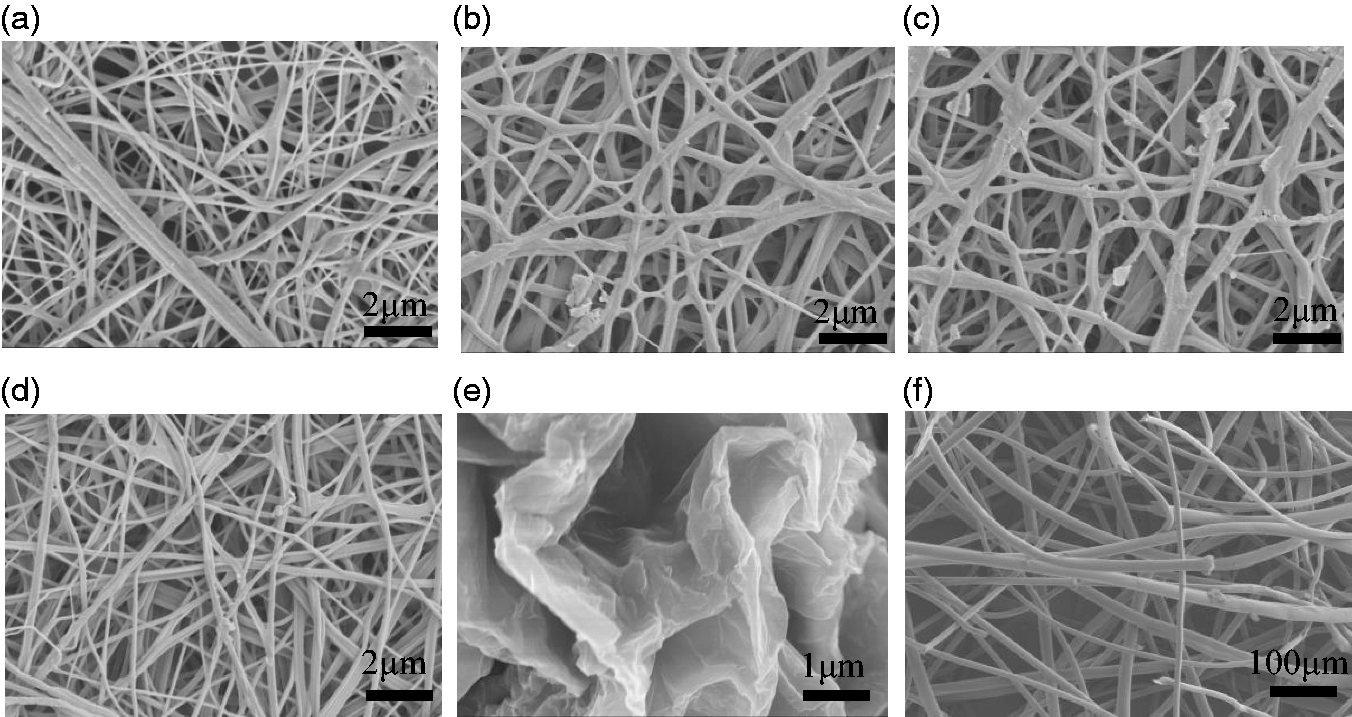
As shown in Figure 5(a), the fibers of PVA/PEO were spun and interlaced randomly. In Figure 5(b) to (d), fibers connect to each other at nodes and crossover form fiber layer, which looks like a net. In Figure 5(b) and (c), the number of fiber branches and coarseness increased, in Figure 5(d), the phenomenon of parallel kink between fibers was more obvious. In Figure 5(b) to (d), a small amount of GO agglomerates exhibited a state of flakes and adhered to the surface of the fibers. As a hydrophilic material, GO may delay the volatilization of the solvent at the fiber nodes [39]. This peculiar structure may be related to the hydrophilicity of GO. As shown in Figure 6, the diffraction peaks of GO were observed at 2θ = 9.55°, the characteristic peak shifted to 6.95° (Figure 6(c) and (d)). In Figure 7, we can find that the PVA/PEO nanofiber membrane was uneven, the surface rough and the surface of the PVA/PEO/GO nanofiber membrane was flat.
X-ray diffraction of nanofiber membranes. (a) PVA/PEO; (b)PVA/PEO/GO (0.5 wt%); (c) PVA/PEO/GO (1.0 wt%); (d) PVA/PEO/GO (1.5 wt%); (e) Graphene oxide. Surface morphology of nanofiber membranes: (a) PVA/PEO; (b) PVA/PEO/GO (0.5 wt%); (c) PVA/PEO/GO (1.0 wt%); (d) PVA/PEO/GO (1.5 wt%).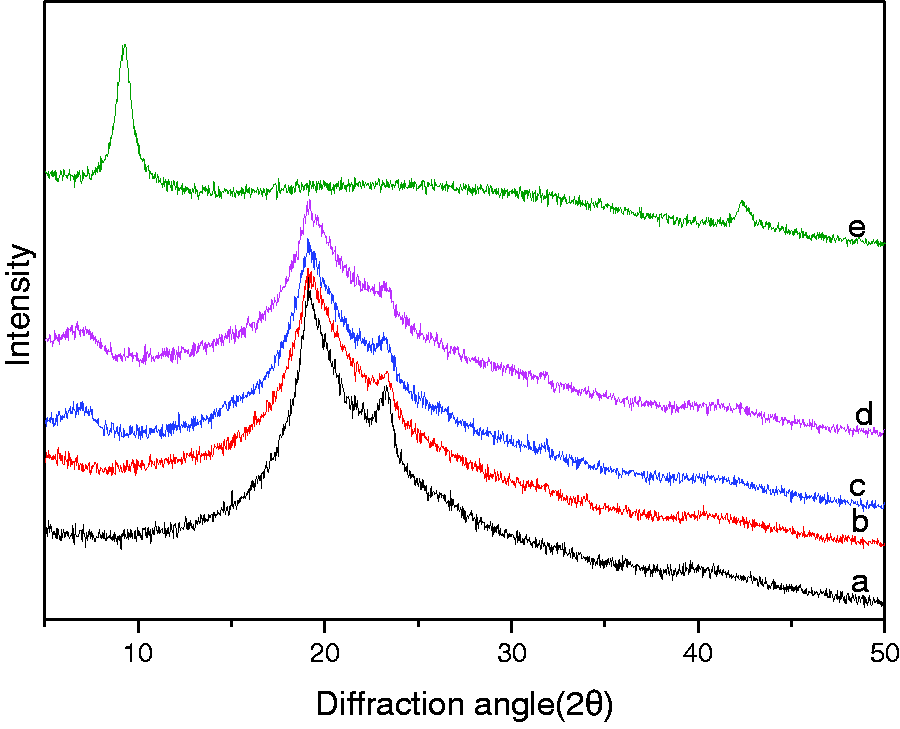

Fiber diameter, average pore size and areal density of membranes.

Sound absorption properties of nanofiber membranes
It was called sound absorbing material whose average sound absorption coefficient was greater than 0.2 [40]. In this paper, the materials hardly had sound absorption properties in the range of 80–500 Hz, so we mainly discussed the sound absorption properties at the range of 500–6300 Hz.
Due to its ease-made and light weight electrospun nanofiber membranes were widely used as sound absorption material [41–44]. Figure 8 showed that the sound absorption performance of non-woven fabric has greatly improved after combining with thin nanofiber membranes. For one thing, as thickness increased the spread path of sound waves extended, rendering more sound energy converted into heat [45]. For another, as shown in Table 1, the nanofiber membranes, pore size was small. When sound waves entered nanofiber membranes, the sound waves are more likely to make multiple collisions with pore walls. Thus, the friction and viscous forces between the fibers and sound waves increased, more sound energy was consumed [46,47].
Sound absorption property of composite structure: (a) PVA/PEO and non-woven; (b) PVA/PEO/GO (0.5 wt%) and non-woven; (c) PVA/PEO/GO (1.0 wt%) and non-woven; (d) PVA/PEO/GO (1.5 wt%) and non-woven.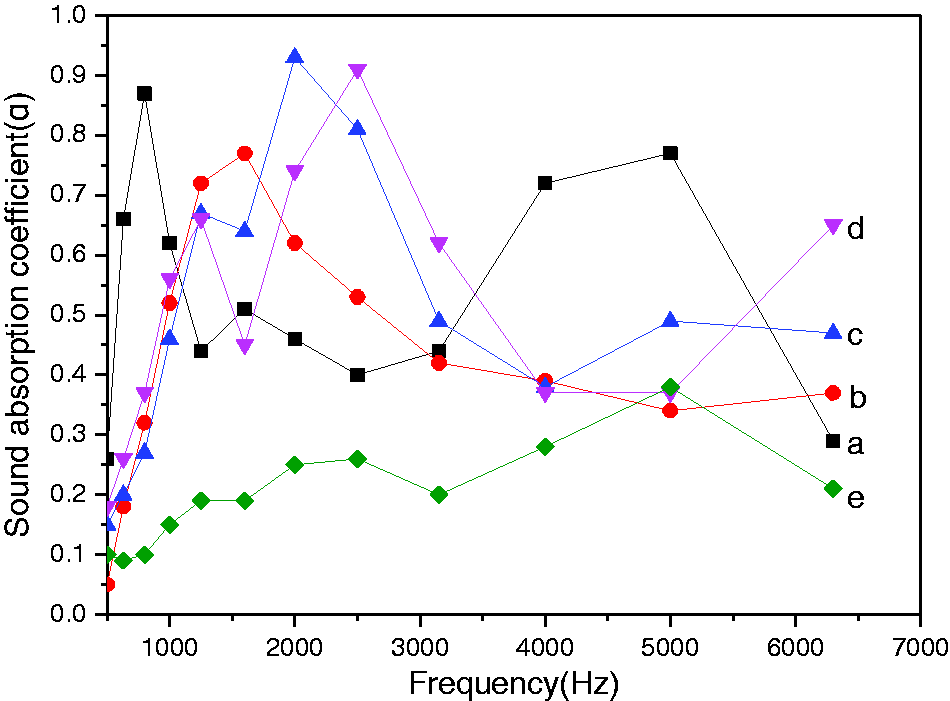
It can be clearly seen from Figure 8 that curve a was significantly different from curves b, c and d. They seemed to be complementary. Curve a has two absorption peaks at the mid-low frequency and high frequency, while curve b, c and d had only one absorption peak at the middle frequency. As the GO content increased, the optimal acoustic frequency shifted from 800 Hz to 1600 Hz, 2000 Hz and 2500 Hz. The peaks of curves c and d were as high as 0.93 and 0.91. This may be related to changes in the crystalline state of the fiber [48]. From Figure 6 we can see that when the GO content was 1.0 wt% and 1.5 wt%, a new diffraction peak appeared at 6.95°. GO can change the crystallinity of PVA fibers [29]. So, the original vibration mode of the fiber was changed with increase of the crystallization. When the fiber returns to its original shape, the phase difference between the acoustic wave and the fiber changed, thereby causing a change in the sound absorption performance.
Another reason for this phenomenon was the surface structure of the nanofiber membranes. The PVA/PEO nanofiber membrane with a rough surface was prone to cause acoustic energy loss in the low frequency [23]. More ores and holes were formed inside the material, which increased the friction between fibers and sound waves, and more sound energy was converted into mechanical energy and heat.
The areal density of the nanofiber membrane decreased after the addition of GO, but both were higher than the areal density of the non-woven fabric. PVA/PEO/GO (1.0 wt%) nanofiber membrane had largest areal density 416.85 g/m2 (Table 2). In Figure 9, the results showed that the average sound absorption coefficient increased with the increase of areal density at the two acoustic wave bands (500–1000 Hz and 3150–6300 Hz). PVA/PEO/GO nanofiber membranes performed best absorption in the 1000–3150 Hz band, it was caused by the large friction of the GO in the sound wave of this frequency band [38].
Effect of areal density on sound absorption performance. (a) PVA/PEO; (b) PVA/PEO/GO (0.5 wt%); (c) PVA/PEO/GO (1.0 wt%); (d) PVA/PEO/GO (1.5 wt%); (e) non-woven fabric. PVA: polyvinyl alcohol; PVO: polyethylene oxide; GO: graphene oxide. Fiber diameter, average aperture, coefficient of variation and average sound absorption coefficient of nanofiber membranes with different graphene oxide content. Areal density and average sound absorption coefficient of samples.
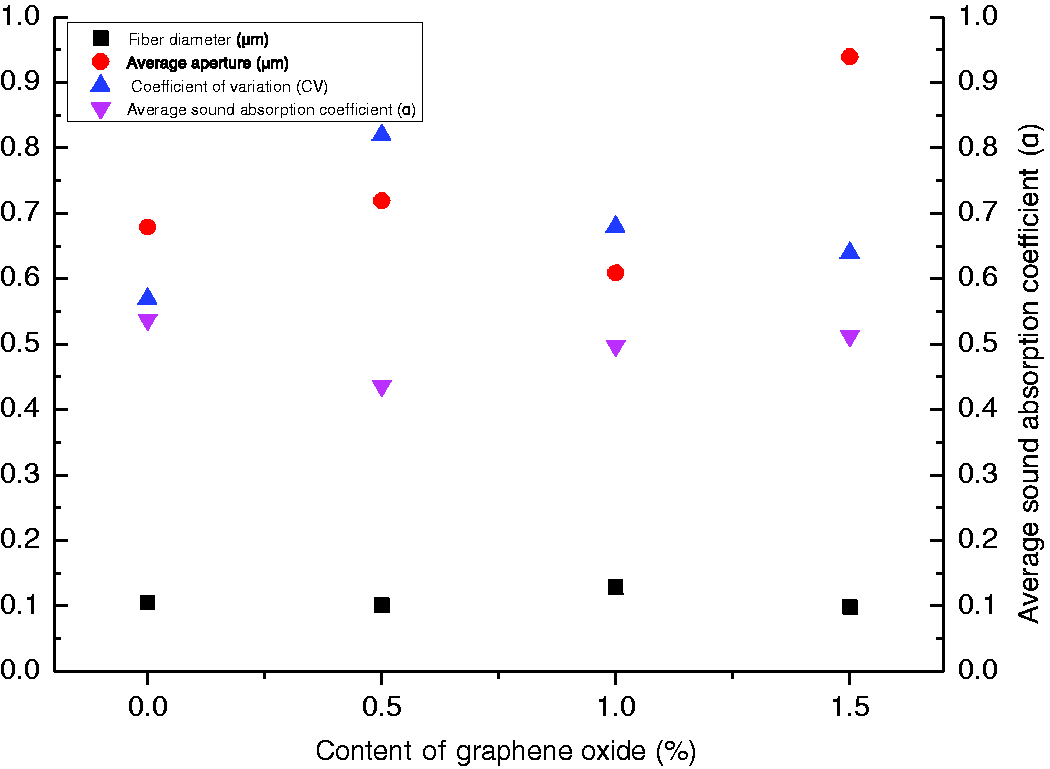

As shown in Figure 10, the fiber diameter and pore size did not change much after the addition of GO. When the content was 1.5%, the pore size was at most 0.94 µm. The coefficient of variation and the average sound absorption coefficient of sound absorbing material without GO were close. Interestingly, after the addition of GO, the fiber coefficient of variation and the average sound absorption coefficient of the sound absorb material are symmetric. As the content of GO increased, the coefficient of variation gradually decreased, and the average sound absorption coefficient gradually increased. Lastly, their number were getting closer. From the perspective of overall sound absorption performance, the coefficient of variation had a greater impact on sound absorption performance. The uniform distribution of fiber diameter and small fiber coefficient of variation were beneficial to improve the overall sound absorption performance.
What was the effect if half of the PVA/PEO nanofiber membranes was replaced by PVA/PEO/GO nanofiber membrane? The curves of samples b, c and d in Figure 11 were quite different from that in Figure 9. Interestingly, they also have two absorption peaks.
Sound absorption property of composite structure: (a) PVA/PEO and non-woven; (b) (1/2) PVA/PEO and (1/2) PVA/PEO/GO (0.5 wt%) and non-woven; (c) (1/2) PVA/PEO and (1/2) PVA/PEO/GO (1.0 wt%) and non-woven; (d) (1/2) PVA/PEO and (1/2) PVA/PEO/GO (1.5 wt%) and non-woven.
However, the frequency of the sound waves corresponding to their absorption peaks seemed to increase with the increase of graphene content. Maybe the addition of GO shifted the vibration frequency of the nanofiber membrane backwards. Due to the two kinds of nanofiber membranes, vibration frequencies were different, they played different roles in the process of sound absorption to achieve good sound absorption performance.
On the one hand, PVA/PEO nanofiber membranes existed in the composite material, which increased the roughness of the surface and increased the sound absorption performance of the low frequency and the high frequency. It was PVA/PEO nanofiber membranes that rendered the curves b, c and d similar to curve a. On the other hand, as shown in Table 2, the surface density of PVA/PEO/GO nanofiber membranes were increased after compounding with PVA/PEO nanofiber membranes. Then the friction probability of fiber and acoustic wave was increased. The sound absorption performance of the composite of two nanofiber membranes is better than one of them.
The 1 mm PVA/PEO nanofiber membrane was placed by 1 mm PVA/PEO/GO nanofiber membrane, the sound absorption performance of the composite materials emerged regularly at different acoustic wave bands. From Figure 12 we can find that as the GO content of the composite material increased the average sound absorption coefficient decreased in two frequency bands (500–1000 Hz and 3150–6300 Hz), while the average sound absorption coefficient increased linearly at the range of 1000–3150 Hz. The average sound absorption coefficients of sample c were very close in three frequency bands. As shown in Table 2, the average sound absorption coefficients of samples b, c and d were higher than that of sample a. Sample c had the highest average sound absorption coefficient of 0.563 in range of 500–6300 Hz.
Average sound absorption coefficient of different acoustic frequency. (a) PVA/PEO and non-woven; (b) (1/2) PVA/PEO and (1/2) PVA/PEO/GO (0.5 wt%) and non-woven; (c) (1/2) PVA/PEO and (1/2) PVA/PEO/GO (1.0 wt%) and non-woven; (d) (1/2) PVA/PEO and (1/2) PVA/PEO/GO (1.5 wt%) and non-woven.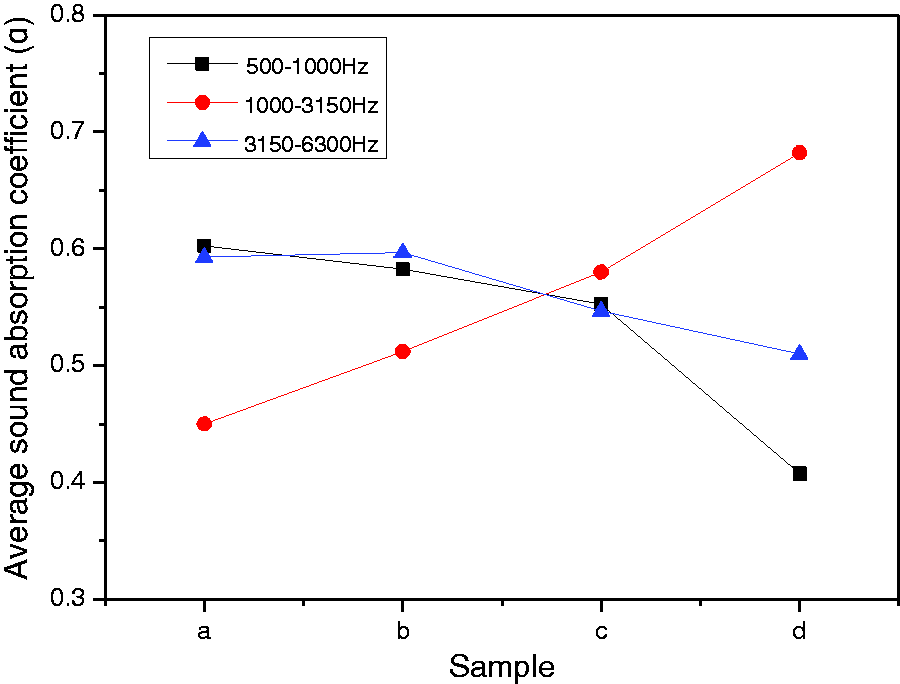
Conclusions
The sound absorption performance of non-woven fabric has greatly improved after combining with thin nanofiber membranes. The addition of GO changed the morphology of the membranes, fiber diameter, pore size and areal density. The fibers of PVA/PEO/GO nanofiber membrane were intertwined in a loop and finally formed a network. The areal density and surface roughness of the nanofiber membrane were reduced after the addition of GO. Therefore, the PVA/PEO nanofiber membrane composite sound absorbing material showed excellent sound absorption in the two frequency bands of 500–1000 Hz and 3150–6300 Hz, and the PVA/PEO/GO nanofiber membrane composite sound absorbing material had good sound absorption at 1000–3150 Hz. When the fiber coefficient of variation was small, the average sound absorption coefficient of the composite material was high. When 1 mm PVA/PEO nanofiber membrane was placed by 1 mm PVA/PEO/GO nanofiber membrane, composite material behaved with similar sound absorption property. The average sound absorption coefficient of PVA/PEO/GO composite material were higher than PVA/PEO composite material in range of 500–6300 Hz.
Footnotes
Declaration of conflicting interests
The author(s) declared no potential conflicts of interest with respect to the research, authorship, and/or publication of this article.
Funding
The author(s) disclosed receipt of the following financial support for the research, authorship, and/or publication of this article: This work was supported primarily by the Second Phase of Jiangsu Universities, Distinctive Discipline Development Program for Textile Science and Engineering of Soochow University.