




Abstract
In this work, the influence of weathering on the creep behavior of the sisal (SSSS), hemp (HHHH), and their hybrid composites (HSSH, and HSHS) was investigated. Composites were exposed to accelerated weathering for 2222 h, which replicates conditions equivalent to 1 year of outdoor exposure. Bio-epoxy based composites were fabricated by the hot press technique. Creep study was performed in a dynamic mechanical analyzer under the dual cantilever creep mode at 30 °C and 50 °C testing temperature under a load of 5 N. The creep-recovery behavior of the weathered composite specimens was evaluated and compared with the unweathered specimens. The investigation revealed that creep strain decreased with the incorporation of the sisal and hemp fibres into the bio-epoxy matrix. The experimental creep response of the composites was also in good agreement with the analytical results from Burger’s model. Both the weathering and testing conditions at elevated temperature (50 °C) had a significant impact on the creep resistance of the composites. The creep resistance of the hybrid composites was found to be dependent on the layering sequence. HSHS configuration almost displayed similar creep properties before and after weathering. HSSH configuration was found to have lower creep resistance after weathering. Scanning electron microscopy was used out to examine the fibre-matrix interface of the composites.
Keywords
Introduction
Natural fibre reinforced polymer composites have emerged as potential material for industrial applications, building and construction due to their advantages such as biodegradability, low density, low cost, easy availability, good mechanical properties, convenient to recycle and good resistance to corrosion and fatigue [1–5]. Fibres such as sisal, hemp, bamboo, coir, banana, kenaf, ramie, etc., extracted from different parts of the plants or trees are widely used as reinforcement in the polymeric composites. Amongst the various natural fibres, sisal has a higher percentage of cellulose content, which is responsible for better tensile properties and moistures resistance in the ensuing composites. It is also used in the construction industries owing to their good acoustic insulation, superior thermal properties, and higher toughness [6]. Hemp fibre also has similar characteristics as sisal fibre [7]. This is the motivation behind the selection of sisal and the hemp fibre as the reinforcements. SR GreenPoxy 56 resin was selected as a matrix. According to the resin manufacturer [8], GreenPoxy 56 contains 56% extracts from the plant as well as vegetable matter and 44% of Bisphenol-A-epichlorohydrin, which is commonly used to form the epoxy polymer.
In general, epoxy resin subjected to weathering undergoes photodegradation and displays inferior mechanical properties under the weathering [9]. In a recent study, it was highlighted GreenPoxy 56 resin exposed to accelerated weathering showed a significant decline in the tensile strength, impact strength, and elongation at break than the composite reinforced with kenaf and sisal fibre [10]. Hence, it is clear that fibre reinforcement into the GreenPoxy 56 could help to retain the mechanical properties to a considerable extent compared to the neat resin. On a similar note, creep resistance of the weathered sisal/hemp/GreenPoxy 56 composites are expected to be better than the neat resin.
An essential characteristic of engineering applications is the dimensional stability of composites throughout their expected life span. It is usually determined from the creep and recovery experiments. In the creep test, a constant load or stress is applied to a composite material under isothermal conditions, and the resulting strain is plotted against the time. The total strain in the composite material comprises the elastic strain (recoverable), time-dependent viscoelastic strain, and inelastic viscous strain [11,12]. Initially, the composite material undergoes an elastic deformation due to the applied load. This is followed by viscous and viscoelastic flow in a decreasing rate before a steady state of deformation. On removal of the applied load, a sharp decrease in strain occurs (i.e., elastic recovery). Then the elastic recovery continues at a slower rate. At the end of the creep-recovery test, the strain remains accumulated in the composite. This condition is called the permanent strain or unrecovered creep [13–15].
The possible ways of reducing the creep deformation, for example, researchers modified the type of fabrication processes, blended fillers with fibres, hybridization, etc. Some studies are available to show the reduction in creep sensitivity by way of introducing a woven type of fibres [16]. However, the studies on investigating the creep behavior using plant fibres are quite less due to their (i) geometrical differences and (ii) density of the fibres. According to Santulli [17], flax, sisal, and hemp fibres exhibit better creep-resisting behavior than the other natural fibres. Based on these considerations, the selection of woven sisal mat and woven hemp mat can be justified in studying the creep behavior of plant fibre composites.
Biocomposites based on natural fibre and bio-epoxy resin are prone to degradation due to the conditions prevailing in the environment, such as (i) moisture (ii) temperature and (iii) ultraviolet (UV) radiation. Therefore, the biocomposites may experience loss in thermal, mechanical properties, and physical changes such as rougher surface, discoloration, etc. due to the weather conditions [18]. Degradation in natural fibres occurs due to the absorption of the UV rays by (i) the lignin content (ii) formation of quinoid structures (iii) Norrish reactions and (iv) photo yellowing which occur in lignin [19–21]. The influence of the accelerated weathering and testing temperature on the creep behavior of various natural fibre reinforced composites exist in the literature. Xu et al. [22] analyzed the creep resistance behavior of bagasse fibre reinforced polymer composites using Burger’s model, two-parameter power law, and Findley’s power-law model. They reported that bagasse fibre/recycled polyvinyl chloride composites exhibited better creep resistance than the bagasse/high-density polyethylene composites. In another study, Chandekar and Chaudhari [23] investigated the creep response of jute/polypropylene reinforced composites at different temperatures such as 30 °C, 50 °C, 70 °C and 90 °C and the four elements Burger’s model was used for analysis. Results revealed that the creep resistance decreased with the increased temperature. Miller [24] fabricated bio-based poly(β-hydroxybutyrate)-co-(β-hydroxy valerate) (PHBV) composites reinforced with hemp linen, jute burlap, and hemp burlap textiles (i.e., three different types bidirectional woven). It was reported that the creep resistance of the composites was dependent on the type of fibre orientation and stress levels. Jain et al. [25] analyzed the creep resistance of cotton/cross-linked polyvinyl alcohol composites with different stresses such as 4 MPa, 6 MPa, and 8 MPa under 20 °C and 40 °C, respectively. Besides, the authors have varied the cotton fibre wt.% from 0–97wt.%. They reported that the creep resistance was found to be reduced with increasing the cotton fibre wt.% at higher stresses and temperatures.
It is clear from the studies mentioned above that both the accelerated weathering and testing temperatures can affect the creep resistance of the composites. The creep response of the sisal and hemp-based bio-epoxy composites have to be quantified under the elevated temperature and accelerated aging conditions. In addition to the parameters mentioned above, the influence of the fibre layering sequence on the creep properties of the hybrid composites was also investigated. This work also reported the correlation between the experimental creep result and the solution from a widely used mathematical model (i.e., Burger’s model).
Materials and methods
Bidirectional sisal mat (yarn diameter = 504.496 ± 3.07 µm; grams per square metre (GSM) = 210) and hemp fibre mat (yarn diameter = 486.333 ± 11.96 µm; GSM = 200) were purchased from Nirmala Industries, Telangana, India. The green epoxy (SR GreenPoxy 56), which has up to 56% of its molecular structure coming from the plant origin, was used as the matrix material, SD surf clear was used as a curing agent. Both the green epoxy matrix and the curing agent were purchased from Sicomin, France. Tables 1 and 2 present the salient properties of sisal fibre, hemp fibre, and the green epoxy matrix, respectively.

Properties of green epoxy matrix (SR GreenPoxy 56) and curing agent (SD surf clear).

Fabrication of composites
The matrix solution was prepared with Bisphenol-A-(epichlorohydrin) epoxy, which is termed as SR Greenpoxy 56® resin and the hardener blend of Isophorone diamine and Benzyl Alcohol (SD Surf Clear®) in the weight ratio of 100:37. For pure epoxy matrix, this solution was poured in the mold (20 cm × 20cm) and was left to cure at room temperature overnight, and post-curing was done at 100 °C in an oven. Similarly, the pure composites (HHHH, SSSS) and the hybrid composites (HSSH, HSHS) were prepared by placing the fibre mats according to the layering sequence in the mold and were impregnated with the matrix solution. The mold was then placed in a hot press at 100 °C with a pressure of 275 bar and was left for 1 hour. After this, the mold was removed, and post-curing was performed at 100 °C for about 10 minutes. Thus, the matrix, composites, and the hybrid composites were fabricated and were cut to the required sizes for testing as per standards [29,30].
Accelerated weathering
The accelerated weathering test was conducted according to the ASTM G155-13 (Cycle-1) [31] using Q-Sun Xenon equipment. During the test, the composite samples were placed inside the chamber, which was subjected to ultraviolet radiation (for 1.42 h) followed by ultraviolet radiation with water spray (for 0.18 h). The air and the black panel temperatures were set at 48 °C and 63 °C, respectively. The Q-Sun Xenon test chambers equipped with the solar eye irradiance control system, and the control point was selected as 0.35 Wm−2 at 340 nm. The accelerated weathering was carried out without any interruption for a total exposure period of 2222 h. This could be analogous to testing the composite materials equivalent to one year of natural exposure. The samples were removed from the weathering chamber after 2222 h of the exposure period and analyzed.
Creep and recovery analysis
Before the creep test, the applied load was determined by using the Force (N) vs. Extension (mm) plot obtained from the flexural test. At an applied load of 5 N, the creep measurements remained in the linear viscoelastic region (LVR). Hence, the loading was fixed at 5 N.
The creep-recovery test was conducted in dual cantilever mode (Figure 1) under two different temperatures, such as 30 °C and 50 °C, respectively, using DMA-1 (Mettler Toledo). The specimens were prepared with the dimension 7 × 35 × 3 mm3 (width × length × thickness). The creep was measured as a function of time for 30 min, and the recovery was measured for 60 min, respectively. Before starting the creep test, each composite sample was equilibrated for 5 min. For each test, a new sample was used. Two replicate samples were tested from each category, and average values were reported [32,33]. The tested sample and the DMA-1 instrument is presented in Figure 1.

(a) creep sample, (b) sample clamped on dual cantilever mode, and (c) DMA-1 instrument.
Scanning electron microscope (SEM)
Fractographic studies of failed composite laminates were carried out using scanning electron microscopy in FEI ESEM Quanta instrument.
Results and discussion
Creep behavior
The value of constant stress is an essential consideration for the creep test. The magnitude of the stress should lie within the viscoelastic region of the sisal/hemp fibre reinforced green epoxy hybrid biocomposites. Therefore, the limiting load was determined by using the flexural force-extension plot. Since the creep-recovery test was conducted in a dual cantilever approach, the composite samples were subjected to the flexural test. Figure 2 shows the flexural force vs. extension plot of pure hemp fibre reinforced (HHHH) composites.

Linear viscoelastic region curve obtained from pure hemp fibre (HHHH) reinforced biocomposites.
From this graph, the limiting load was safely selected as 5 N, where the pure hemp fibre composites showed a good linear viscoelastic region. Therefore, the applied load of 5 N was used in the creep-recovery tests for sisal/hemp fibre reinforced composites; hence the creep deformations of these composites were within the linear viscoelastic region.
Figure 3 shows the traces of the creep and recovered strain as a function of time for unweathered and weathered samples of sisal/hemp fibre reinforced hybrid bioepoxy composites. The constant load (5 N) was applied for a duration of 1800 sec while the recovery was observed for about 3600 sec for all the composites, i.e., HHHH, SSSS, HSSH, and HSHS. The Figure also shows the various creep stages such as (i) instantaneous deformation (i.e., initial deformation) (ii) primary creep and (iii) secondary creep. Nevertheless, there was no evidence of showing a creep rupture, thus emphasizing the test was done within the material’s linear viscoelastic region (LVR). For obtaining the creep rupture, the samples would be subjected to large stresses with a longer time, which might lead to structural failure beyond the LVR [34].
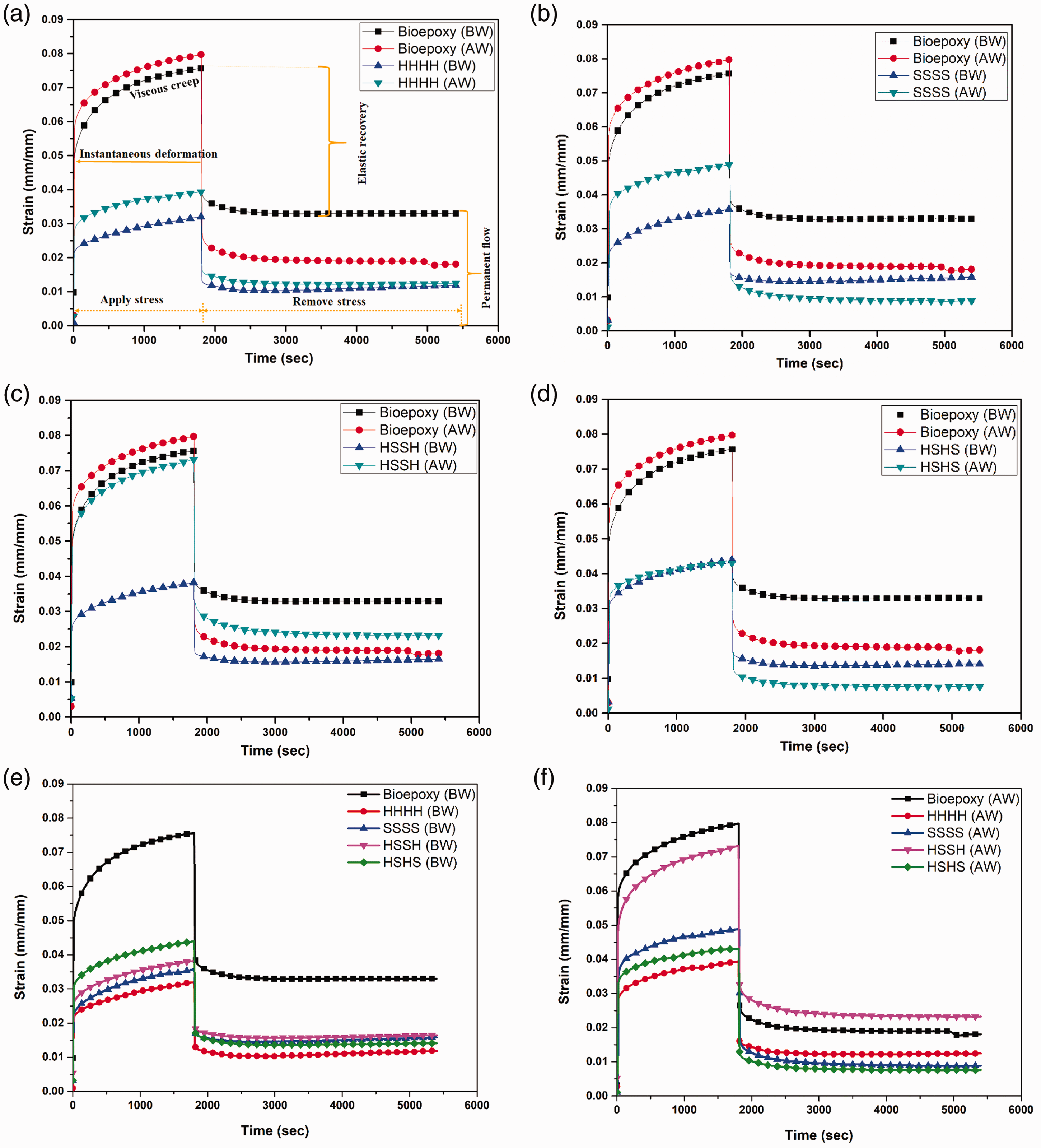
Creep behavior of sisal/hemp fibre reinforced composites: (a) HHHH; (b) SSSS; (c) HSSH; (d) HSHS; (e) all configurations BW; (f) all configurations AW. Test conditions: room temperature, 5N load. BW: before weathering; AW: after weathering.
The instantaneous deformation was increased rapidly by the application of 5 N load due to the elastic response of the bioepoxy composites; this is followed by the viscoelastic response (Figure 3). The viscous flow was observed towards the end of the load application period. Then, a significant drop of strain was noticed from all the curves (Figure 3) due to the removal of the applied load (5 N). However, the full recovery of the bioepoxy composites was not possible since the bioepoxy matrix experienced a viscous flow; this caused permanent deformation.
From Figure 3, it is observed that the weathered composites exhibited higher instantaneous deformation than the unweathered composites. Moreover, with changing the fibres (HHHH, SSSS) and varying the fibre layer sequences (HSSH, HSHS), the instantaneous deformation varied significantly. Hence it is suggested that the creep behavior would be sensitive towards (i) the weathering and unweathering conditions and (ii) the fibre hybridization. The instantaneous deformation decreased in the order of bioepoxy>HSHS>HSSH>SSSS>HHHH for unweathered composites, as shown in Figure 3. These observations were in good agreement with the flexural modulus of sisal/hemp fibre reinforced composites [30]. Among the composites, the HHHH showed lesser instantaneous deformation. It was attributed to the higher stiffness of HHHH composites when compared to the rest of the composites. The stiffness of the HHHH composites is due to the good interfacial bonding between the fibre and the polymer. The interfacial bonding characteristics of tensile fractured specimens (i.e., cross-sectional surface) of before weathered composites of pure hemp fibre composites (HHHH), pure sisal fibre composites (SSSS), and the hybrid composites (HSSH, HSHS) were morphologically studied, and their corresponding scanning electron microscope images are shown in Figures 4(a) to (d). Among the studied composite laminates, the pure hemp fibre composites showed a strong fibre matrix bonding in Figure 4(a). Hence it could be facilitated to transfer the loads effectively at the interface; also, higher modulus is expected. In contrast, the hybrid composites (Figure 4(c) and (d)) experienced weak fibre matrix bonding and fibre-pullouts. This means that the instantaneous deformation was higher owing to the poor transfer of stresses. The pure sisal fibre composites also showed a good fibre/matrix bonding in Figure 4(b); however, the stress transfer in this composite was lower than the pure hemp fibre composites.

SEM micrographs of (a) HHHH, (b) SSSS, (c) HSSH and (d)HSHS composites.
The changes in creep strain of the sisal/hemp fibre-reinforced composites for both unweathered and weathered conditions are clearly observed in Figure 3(a) to (f). Incorporation of fibres into the biepoxy matrix decreased the creep strains in both unweathered and weathered composites. For instance, the creep strain of the before weathered composites ranged between 0.032 (mm/mm) to 0.044 (mm/mm), while the green epoxy had a creep strain value of 0.076 (mm/mm). From these results, it can be implied that with the introduction of the sisal and/or hemp fibres in the green epoxy matrix, the creep behavior of the ensuing composites is significantly improved. Among the pure and hybrid fibre reinforced composites, HHHH exhibited the lowest creep deformation (0.032 (mm/mm)). This confirms our previous observation [29] on the improvement of Young’s modulus with the addition of hemp fibre in the green epoxy matrix. It can be ascribed to strong fibre matrix interaction that improved the load transferability through their strong interfacial bonding with the matrix (as shown in Figure 4(a)).
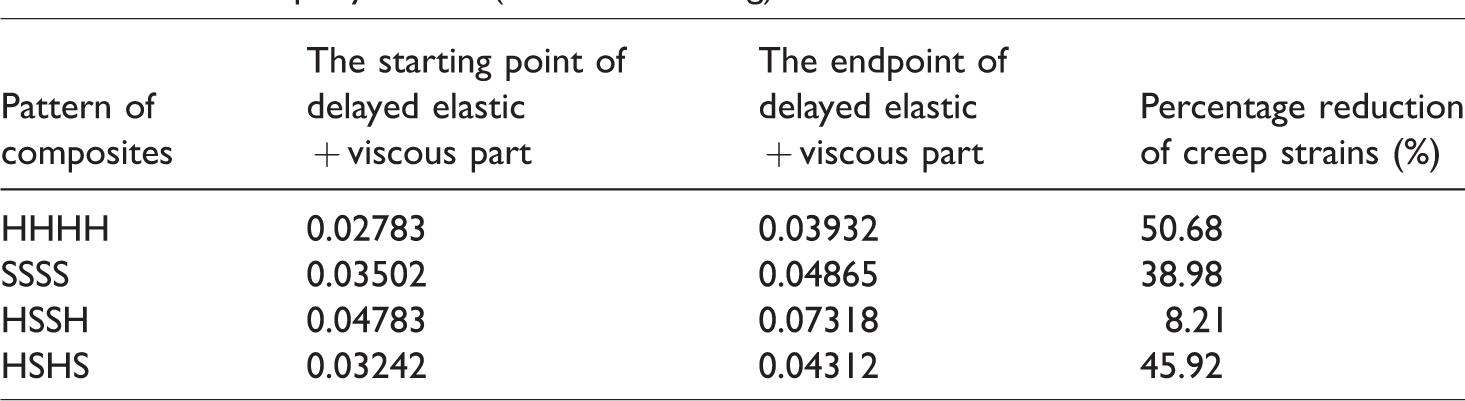
Tables 3 and 4 show the percentage of reduction of creep strains of HHHH, SSSS, HSSH, and HSHS composites when compared with the neat bioepoxy matrix. A significant percentage of reduction of creep strains of 57.72, 52.83, 49.52, 41.91 was observed for HHHH, SSSS, HSSH, and HSHS composites, respectively, for before weathering samples (Table 3). Correspondingly, for the weathered composites, the creep strain values of HHHH, SSSS, HSSH, and HSHS were reduced by 51%, 39%, 8%, and 46%, respectively (Table 4). Interestingly, after weathering, HSSH composites gave higher instantaneous deformation and higher creep strain. This could be associated with slippage or reorientation of the fibres and polymer chains during the accelerated weathering test.
Creep strain values reduced for sisal/hemp fibre reinforced bioepoxy hybrid composites from the bioepoxy matrix (Before weathering).

Creep strain values reduced for sisal/hemp fibre reinforced bioepoxy hybrid composites from the bioepoxy matrix (After weathering).
Similarly, the improvements of creep resistance offered by introducing jute fabric in polypropylene [23], and pulverized jute fibre in epoxy composites [35] were reported. Figure 3 presents the recovered strain of sisal/hemp fibre reinforced composites. From the Figure, it can be observed that the composites showed improved elastic recovery than the bioepoxy matrix. For instance, the improved elastic recovery of before weathered composites was found in the order, green epoxy < HSHS < HSSH < SSSS < HHHH. Figure 5 shows the elasticity recovery of sisal/hemp fibre-reinforced composites. It was observed that adding fibres in bioepoxy matrix, improved the elastic recovery of the biocomposites. For example, the HSHS composites from the unweathered conditions showed a 13% improvement in elastic recovery in comparison with the bioepoxy matrix. Likewise, the HSHS (AW) composites exhibited an improvement of 5.25%.

Elasticity recovered (%) of sisal/hemp fibre reinforced composites.
Furthermore, introducing the sisal and hemp fibres in a green epoxy matrix resulted in decreasing the permanent deformation remarkably. Hence it could be concluded that the permanent deformation was predominantly decreased by the addition of sisal and hemp fibres in bioepoxy matrix for both unweathered and weathered composites. The hemp/sisal hybrid composites showed good creep resistance, lower strain rate, good elastic recovery, and permanent flow from both of before and after weathering test and therefore are recommended to use for low load exterior applications. Also, these observations suggest that the creep and recovery studies could be a suitable indicator for the benefit of fibre hybridization and the fibre combinations.
The creep strain rate of both before and after weathered composites of sisal/hemp fibre-reinforced composites are shown in Figures 6(a) and (b). The creep strain rates were decreased in the order bioepoxy>HSHS>SSSS>HSSH>HHHH for before weathered composites (Figure 6(a)). But the differences between the bioepoxy matrix and the HSSH composites were very less in case of after weathered composites. This behavior was associated with the reduced creep strain value (8.21%), as reported in Table 4. Nevertheless, the sisal/hemp fibre-reinforced composites showed improved creep behavior by exhibiting the lesser creep strain rates when compared to the bioepoxy matrix. According to the previously reported work by Jia et al.[14], a strong correlation was found between the creep strain rate and creep behavior. Their study proved enhanced creep resistance with a lesser creep strain rate in polypropylene/carbon nanotube composites.

Creep rates of sisal/hemp fibre-reinforced composites: (a) before weathering (BW) and (b) after weathering (AW). Test conditions: room temperature, 5 N load.
Many mathematical models can be used to simulate the behavior of the creep response of polymer matrix composites [36–40]. Burger’s model, i.e., a combination of Maxwell and Kelvin-Voigt models were used to understand the creep component [13]. In general, the total strain of linear viscoelastic material has three essential parts, such as immediate elastic deformation, i.e., immediately the strain returns to zero (εsm), delayed elastic deformation (εkv) and Newtonian flow (ε∞).

x = time (sec)
l and m = modulus and viscosity of the Maxwell spring and dashpot, respectively.
k and n = modulus and viscosity of the Kelvin spring and dashpot, respectively.
Figures 7 and 8 show the experimental creep curves of before weathered green epoxy hybrid composites (30 °C and 50 °C) fitted by Burger’s model. These Figures showed a satisfactory agreement of the Burger’s model with the experimental creep phase; hence these observations demonstrated that the parameters l, m, n, and k used in the Burger’s model were applicable to the characterization of the composite creep properties.

Comparison of the experimental and Burger’s model of creep curves of sisal/hemp fibre reinforced green epoxy hybrid biocomposites. (Test conditions: load 5 N, temperature 30 °C).

Comparison of the experimental and Burger’s model of creep curves of sisal/hemp fibre reinforced green epoxy hybrid biocomposites. (Test conditions: load 5 N, temperature 50 °C).
Curve Expert Professional 2.6.5 was used to extract the Burger’s model parameters of sisal/hemp fibre reinforced biocomposites (shown in Table 5).
Parameters of the Burger’s model for 30-min creep of the sisal/hemp fibre reinforced hybrid composites.

SS: the sum of squares.
The HHHH composite presented the highest ‘l’ value (at 30 °C), indicating that the lowest instantaneous deformation under the applied load, whereas the green epoxy showed the lowest ‘l’ value (316 MPa). The results (value of ‘l’) showed an improved elasticity with the addition of sisal and/or hemp fibre in the green epoxy matrix. These results were consistent with their modulus values, as reported in the reference [29]. Furthermore, the HHHH showed the highest ‘k’ value (207.4 MPa), indicating the lowest viscoelastic deformation while the lowest ‘k’ value (143.3 MPa) exhibited by the HSHS hybrid composite. Table 5 also shows that the value of ‘m’, which represents the permanent deformation of sisal/hemp fibre reinforced composites, and the ‘m’ values were higher than the values of ‘n’. The HHHH composite exhibited the reduced permanent deformation (Figure 7) indicated by the high value of ‘m’ (34.2E + 9 MPa), i.e., lower flow arose in dashpot and permanent deformation reduced. Henceforth, the HHHH composite is likely to be dimensionally stable than the rest of the composites under the applied load, whereas the green epoxy was subjected to high permanent deformation by presenting the lowest value of ‘m’ (316 MPa).
Figure 8 shows the creep strain (both experimental and Burger’s model) of green epoxy composites tested at 50 °C. It was observed that the creep strain of all these composites was found to be higher than the composites tested at 30 °C, which could be due to the increased mobility of molecular chains. For example, the creep strain of composites at 50 °C ranged between 0.2274 (mm/mm) to 0.3140 (mm/mm), while the 30 °C tested composites were between 0.032 (mm/mm) to 0.044 (mm/mm). As expected, the creep strain of sisal/hemp fibre composites was susceptible to increased temperature.
Amongst the composites, the pure hemp fibre reinforced composites (HHHH) showed the lowest instantaneous deformation. This observation was agreed by showing the highest values of ‘l’ (199.3 MPa) in Table 5. Furthermore, the pure hemp fibre composites showed the lowest permanent deformation (i.e., experimentally), which was agreed by showing the higher value of ‘m’ (2.359E18 Pa s). Hence, the HHHH composite was found to be dimensionally stable at the increased temperature.
Conclusions
The present work investigated the effect of accelerated weathering on the creep-recovery behavior of sisal/hemp fibre reinforced bioepoxy hybrid composites. The key findings from this research work are given below. Instantaneous deformation of bioepoxy composites was reduced by incorporating the sisal and/or hemp fibre in both the unweathered and weathered composites. This observation was clearly corroborated by the SEM images. The SEM was used to spot the fibre-matrix interfacial bonding of pure fibre and hybrid fibre composites. However, the hybrid fibre composites showed more fibre pull-outs, as a result of which the instantaneous deformation was found to be increased. The creep behavior of unweathered and weathered composites was improved by showing lesser creep rates than the bioepoxy matrix. The permanent deformation of sisal/hemp fibre reinforced composites were decreased by incorporating the fibres, which was confirmed by showing the increased elastic recovery behavior. The creep strain is more at a higher temperature. The composite also shows a good fit with Burger’s model.
Footnotes
Acknowledgements
The authors would like to thank Mettler-Toledo (Thailand) Limited for their support for providing the experimental facility to complete the test.
Declaration of conflicting interests
The author(s) declared no potential conflicts of interest with respect to the research, authorship, and/or publication of this article.
Funding
The author(s) disclosed receipt of the following financial support for the research, authorship, and/or publication of this article: This research was entirely supported by King Mongkut’s University of Technology North Bangkok (KMUTNB), Thailand through Grant No. KMUTNB-64-KNOW-01.
