




Abstract
Good dispersion of the nanoparticles into the polymer is considered a critical issue, as it can provide higher strength and stiffness while poor dispersion is seen to decrease those properties. In the present work, the effect of three ultrasonic parameters (amplitude, time and cycle of sonication) on sonication technique for dispersing 1 wt.% nano-clay in polyester matrix was investigated. To disperse the nano-clay into the polyester matrix, sonication frequencies of 40% and 80%, sonication times of 0.5, 1 and 2 hours and pulse of 0.5 and 1 cycle were used. The effect of these ultrasonication parameters on water barrier and impact behavior of unfilled and filled glass fiber (GF)/polyester with nano-clay under dry, distilled and seawater conditions was studied. Results showed that, water absorption of nano-filled composites dispersed with all sonication parameters is lower than that of unfilled glass fiber/polyester composites immersed in distilled and seawater. Nano-clay filled GF/polyester composites showed an improvement in impact resistance under dry, distilled and seawater conditions with all sonication parameters. Among the used sonication parameters; time of 2 hours, amplitude of 40% and 0.5 cycle was found as the best parameter which resulted in the maximum enhancement in impact resistance, due to the addition of nano-clay to GF/polyester, of 8.2%, 14% and 19.6% under dry, distilled water and seawater conditions, respectively. Nonlinear minimization approach was exploited using MAPLE commercial software in order to find the suitable fit to the models of Fick and Langmuir. Diffusion coefficients for different sonication times were computed.
Keywords
Introduction
Nanotechnology is one of the most common areas for current research in all technical disciplines [1]. Owing to the enhancement of various properties as mechanical strength, permeability and heat resistance, nanocomposites have been considered as a new alternative to polymers and conventional composites [2–4]. However, the main problem with the addition of nanoparticles is its tendency to agglomerate between them. This problem is attained due to the high surface free energy of nanoparticles, that results from the nanoparticle geometry and the molecular configuration [5]. Consequently, the dispersion of nanoparticles homogeneously in a polymer is considered a great problem. Good properties can be achieved when good dispersion and distribution of nanofillers are attained in the polymeric composites [6]. When large clusters (agglomerates and aggregates) are performed in the blending process, it is very difficult to break these agglomerations back into primary particles. Aggregates are condensed structures of primary nanoparticles. Particle adhesion especially van der Waals forces increases as the particle size decreases. The utilization of ultrasound for synthesis of materials has been widely used over many years as it is considered as one of the most powerful means in nanostructured materials blending [7]. Ultrasonic dispersion mechanism involves acoustic cavitations and acoustic streaming [2]. Ultrasound induces the cavitation of the bubbles that trapped in polymer matrix and nanofillers. Cavitation occurs inside and outside of the aggregates and can help to peel off or break up these aggregates and thus improves the dispersion of nanofillers [8,9].
Polar polymers are well known to have low resistance to moisture uptake and low mechanical properties as compared to other engineering materials. Thus, this challenge attracted the attention of researchers to improve the performance of polymers by fabricating polymer composites and nanocomposites [10]. Glass fiber reinforced unsaturated polyester is widely applied composites used in the vehicles, aerospace, marines, and aircraft [11]. Actually, the properties of glass fiber-reinforced polymer composites may be enhanced by incorporation of nanofillers as nano-clay, that may widen their use to be multifunctional composites due to the outstanding barrier, thermal, and flammability properties of these nano-clays [12]. Less expensive organic nanofillers like nano-clays are popular for reinforcing composite materials. Nano-clay creates tortuous or labyrinth path for moisture absorption that effectively improves the barrier properties of polymeric nanocomposites [13,14]. Among the clay minerals of the smectite group, montmorillonite nano-clay has been most widely used for the preparation of polymer clay nanocomposites [14]. Incorporation of small weight percentages of nanofiller particles has shown substantial improvement in properties [15]. The most beneficial effect is commonly achieved with addition of a small amount of clay (less than 5 wt.%) in which mechanical strength, barrier and thermal stability properties are generally enhanced [16]. Rull et al. [17] concluded that nano-clay reinforcement particles reduced water absorption of glass fiber/unsaturated polyester resin composites and increased its performance in humid environments. Bagherzadeh et al. [18] found that increasing barrier properties with 70% reduction in water uptake at 1 wt.% clay loading. A series of polyurethane reinforced with modified clay nanocomposites were fabricated by Heidarian et al. [19] using in situ polymerization process through an ultrasonication with different processing times. Their results showed an enhancement in interlayer spacing using sonication process with increasing its duration. By increasing the sonication processing duration, an enhancement in transport properties against diffusion of water molecules was observed [19].
The influence of sonication and clay content on the mechanical properties of nano-clay reinforced unsaturated polyester nanocomposites was investigated [16]. The improvement in flexural strength was more pronounced for ultrasonic amplitude of 20% and at 3 wt.% clay. Modulus increased slightly with clay addition, however, impact strength decreased. Moreover, the effect of ultrasonic time, power and irradiation modes on the cluster size of aluminum oxide nanoparticles was studied by Nguyen et al. [2]. Their results showed an optimal break-up efficiency at vibration amplitude of 30%. Higher ultrasonic amplitude showed no enhancement in the breakage process. Prolonged ultrasonication resulted in the agglomeration of nanoparticles. Moreover, the influence of sonication output powers and time on the tensile and viscoelastic properties of Multiple walled carbon nanotube (MWCNT)/epoxy nanocomposites was investigated by Montazeri and Chitsazzadeh [20]. In their attempt to disperse MWCNT in the epoxy matrix, sonication powers of 25, 50 and 100 W and sonication times of 15, 45 and 135 min were applied. They found that, the highest tensile strength was attained for the sonication power of 25 W with sonication time of 45 min. In addition, sonication at 50 W for 15 min was the most effective parameter for achieving the highest glass transition temperature.
The researches who studied the effects of main parameters of ultrasonic process on impact and water barrier properties of nanocomposites are limited. The effect of ultrasonic amplitude, time and nanofiller content on the mechanical properties were studied but the effect of irradiation mode was not studied [16,20]. Furthermore, the effects of ultrasonic parameters on the mechanical properties of nanocomposites were studied without adding glass fiber as a reinforcement [2,16]. Moreover, studying the effect of ultrasonic processor on the water barrier properties was not studied. So, the objective of the current work is to investigate the effects of ultrasonic vibration amplitude, duration, and cycle of sonication on the impact and water barrier properties of nano-clay/glass fiber/polyester composites under dry, distilled and seawater conditions. Water absorption tests were performed on nano-clay/polyester nanocomposites fabricated with different sonication parameters, after immersion in distilled water and seawater. Besides, the impact strengths for the manufactured nanocomposites under dry, distilled water and seawater conditions were investigated.
Experimental work
Materials and manufacturing
The primary reinforcement used in this study was commercially chopped E-glass fiber. The fiber volume fraction was 25%. The Fiber volume fraction (Vf) was determined experimentally by removing the polyester matrix using the ignition technique according to ASTM D3171-99 [21–23]. The used resin in this work was commercially unsaturated polyester resin with a with a molecular weight of 3560 (mol g−1), density of 1.09 g/cm3, tensile strength of 35 MPa, and Young’s modulus of 2.5 GPa. The hardener was Methyl ethyl ketone peroxide (C8H18O6). The secondary nano reinforcement for the manufactured hybrid composites was Montmorillonite nano-clay (Nanomer® I.31 PS). This nano-clay (NC) was supplied by Sigma-Aldrich. The mixing of 1 wt.% nano-clay into the polyester resin was carried out by sonication using a Hielscher ultrasonic processor UP 200S (200 watts, frequency 24 kHz). Sonication was carried out with different sonication amplitudes of 40% and 80%, sonication times of 0.5, 1 and 2 hours and pulse of 0.5 and 1 cycle (pulsed and continuous ultrasonication). Pulsed irradiation with the pulse ratio 0.5 s on/0.5 s off was performed. To prevent resin degradation, the mixture was cooled by adapting of an ice water bath during sonication [24]. The hardener was mixed for 5 minutes. The layers were prepared by hand lamination technique. The laminated glass fiber reinforced polyester was laid up from five layers of chopped E-glass fiber mat. The mold was left for room temperature curing for about 24 hours under normal conditions. Designation of each laminated specimen under the different ultrasonication parameters is listed in Table 1, where N refers to neat (unfilled) glass fiber/polyester composite.
Designation of each laminated specimen under different ultrasonic parameters.

Mechanical properties
Water absorption test
Water absorption tests were performed according to ASTM D5229/D5229M-14 specifications. Specimens with dimensions of 40 mm length and 10 mm width were immersed in distilled and seawater at ambient temperature. The nanocomposite specimens were periodically drawn from water then wiped to remove water droplets. Afterward, the wiped specimens weighed using an analytical balance of 10−4 g resolution to examine the weight change during the water absorption process. The water absorption content M(t) absorbed by each nanocomposite specimen was calculated as the weight gain percent relative to its initial weight (w0) as follows [25]:
Impact test
The impact strengths of the manufactured nanocomposites were measured by the Izod test according to ASTM 256. Impact tests were performed on the impact machine type AVERY Denison. The pendulum has a falling velocity of 3.8 m/s and impact energy of 5 Joule. Impact strength is calculated by dividing the absorbed energy by the initial cross section area of nanocomposite sample [26].
Moisture diffusion models
Composite materials absorb water in any wet environment. The moisture uptake (weight gain by the composite martial) follows the commonly known and used diffusion models of Fick and Langmuir.
The law of Fick predicts that the imbibed amount of water increases with the square root of time, and after that the mass of water absorbed slows down to an equilibrium condition. The Fick’s model for the diffusion of water in a composite material is applied by the following equation;

In order to determine the value of diffusivity (D), equation (3) is then differentiated with respect to diffusion coefficient D, such that the necessary condition is presented as:
The Langmuir diffusion approach (LMD) assumes that the water molecules absorbed consist of both phases, namely mobile and bound. The relative moisture uptake, according to LMD model, may be introduced by the equation;



Thus, the fitting coefficients D, α and γ require the solution of the three simultaneous nonlinear equations (equations (7) to (9)). A symbolic MAPLE code has been used in this study so as to resolve the set of equations (2) to (4) for Fick’s approach, and the set of equations (5) to (9) for the LMD approach.
Results and discussions
Figures 1 and 2 show the water absorption of GF/polyester composites reinforced with nano-clay under distilled water condition at amplitudes of 40% and 80%, respectively. However, Figures 3 and 4 show the water absorption of GF/polyester composites reinforced with nano-clay under seawater condition at amplitudes of 40% and 80%, respectively. It can be seen from Figures 1 to 4 that, the curves commonly display two phases. The first phase is the high water absorption rate up followed by a second phase which is the slow water absorption rate thereafter. The water absorption content increases as the immersion time increases till the equilibrium saturation is reached. Similar behavior has also been reported by [24,25,27]. Rull et al. [17] reported that, water absorption mechanisms in fiber reinforced polymeric composites are the diffusion of water molecules into the micro gaps located between the polymer chains, and transfer into microcracks and imperfections occurred between glass fiber and polymeric matrix. As the water ingresses within the polyester matrix, plasticization through the interaction of the polar molecules of the water absorbed occurs with polar groups in polyester. Absorbed water molecules push polyester chains away, increase the free volume, and lubricate the sliding movement of polyester chains making the polymer matrix more ductile [28,29].

Water absorption of GF/polyester composites reinforced with nano-clay under distilled water condition at amplitude of 40%.

Water absorption of GF/polyester composites reinforced with nano-clay under distilled water condition at amplitude of 80%.

Water absorption of GF/polyester composites reinforced with nano-clay under seawater at amplitude of 40%.

Water absorption of GF/polyester composites reinforced with nano-clay under seawater at amplitude of 80%.
From Figures 1 to 4 it is observed that, incorporation of nano-clay to polyester reduces the water absorption content in both distilled water and seawater as compared to neat polyester. This can be attributed to the nano-sized addition which reduces the rate of absorption of water due to the barrier properties of these nanofillers thus enhancing the properties of these plasticized nanocomposites [30]. Moreover, the inclusion of nano-clay can reduce water permeability in composites filled with nanofillers by retarding the relaxation of the polymeric chains surrounding the nanofiller [31]. Incorporation of nano-clay to glass fiber/polyester composites reduces the water uptake due to the hydrophobicity of nano-clay and in contrast to the hydrophilic behavior of unsaturated polyester. Unsaturated polyester is known to contain hydrophilic functional groups as hydroxyl and amino-methyl that have affinity to water. The improvement in water absorption resistance either distilled water or seawater is attributed to the high aspect ratio of nano-clay creating tortious paths for the water molecules [32]. Nanoparticles close the pores inside the polymer matrix, permitting interconnecting with molecule chains, hence increasing the density of polymer cross-linking and reducing the free volume [25]. Uniform dispersion of the nanofillers in the polymeric matrix with proper curing can decrease the segmental movement of the polymeric chain [31]. Similarly, reducing water absorption by adding nanoparticles to polymer was attained by [31,33–35].
In Figure 1, for sonication with 0.5 cycle, under distilled water condition and amplitude of 40%, water absorption decreases with increasing the ultrasonic time as the low cycle permits good dispersion of nano-clay in polyester matrix with increasing the sonication time. As the time and cycles increase, voids and agglomeration may be existing which in turn lead to more water absorption than that caused with sonication at time 1 hour. As shown in Figure 4, under seawater and amplitude of 80%, at sonication time of 0.5 hour, as the cycle increases the water absorption decreases. This may be attributed to the little time of sonication which is not sufficient to possess bubbles during the vibration of the sonotrode inside the polyester resin. However, as the time and the cycle increase, water absorption increases. This is due to the cavities that may be formed in the nanophase polyester with the high cycles and the high amplitude at time of 2 hours, these cavities promote the path of water molecules into the specimens thus the water absorption increases. During sonication with 0.5 cycle, seawater absorption decreases with time. As at low sonication cycle with increasing the time, a good dispersion of nano-clay in polyester resin is attained. However, in sonication with 1 cycle the trend is opposite as water absorption increases with time. This may be attributed to the severe vibrations induced from the sonotrode of the ultrasonic processor at high irradiation modes. These vibrations lead to the formation of aggregations of nano-clay particles in the polyester resin. As the time increases, the opportunity to get aggregations and voids increases thus enhances the water absorption.
The least water absorption content in both distilled and seawater at amplitudes of 40% and 80% is attained with nano-clay/GF/polyester composites with sonication process of time 2 hours and cycle 0.5. Moreover, nano-clay/GF/polyester composites which were manufactured by sonicatation at amplitude of 80% and immersed in distilled water and seawater slightly showed a reduction in the water absorption content as compared to the nanocomposites sonicated at amplitude of 40%, Figures 1 to 4.
The equilibrium moisture content was slightly greater in case of distilled water exposed samples than seawater exposed samples. Seawater immersion of composites produced less amount of water absorption due to its density and salinity [32]. As seawater includes salt and number of minerals, these minerals are absorbed by the fabricated specimens, though distilled water contains a smaller number of contaminants. The pores exist on the specimen surface get blocked owing to further accumulation of salt in seawater and the other minerals on the entrance of the pore that can inhibit the water uptake. Consequently, the variation in concentration of salt particles exists inside the fabricated specimens and in seawater generates an osmotic pressure that hinders the fabricated specimen to absorb further water [31,36,37]. So, immersion in seawater exhibited lower equilibrium moisture content.
Figure 5(a) and (b) indicates the impact strengths of GF/polyester composites filled with nano-clay under dry condition at different sonication parameters at amplitudes of 40% and 80%, respectively. From the figures it is observed that, the incorporation of nano-clay to GF/polyester composites under all sonication parameters leads to enhancement in impact strengths as compared to unfilled GF/polyester composites. Many researchers [26,38–43] reported an increase in impact strengths results from inclusion of nanofillers to polymeric composites. Owing to nanometer size of these fillers, nanofillers show considerable properties due to their large surface area per unit volume [44]. Alamri and Low [44] reported that the inclusion of nanofillers into epoxy resin decreases both water absorption and diffusivity as compared to neat epoxy. The inclusion of nanofillers enhances the impact strengths of all nanocomposites after exposing to water.

Impact strength of GF/polyester composites reinforced with nano-clay under dry condition at different sonication parameters; (a) amplitude of 40% and (b) amplitude of 80%.
For sonication with pulsed cycle, as the sonication time increases the impact strength of N composites increases for both amplitudes of 40% and 80%. A maximum enhancement of 8.2% in impact strength is observed with the addition of nano-clay to GF/polyester and sonicating for time of 2 hours using an amplitude of 40% and pulse cycle. An improvement of 6.1% in impact strength is also obtained with N composites sonicated using time of 2 hours, amplitude of 80% and pulse cycle. In the case of sonication using continuous cycle, as the sonication time increases deterioration in impact strength of N composites is occurred for both amplitudes of 40% and 80%, until the impact strength reaches its minimum value at sonication time of 2 hours which approximately equals to that of unfilled (neat) GF/polyester composites, Figure 5(a) and (b).
Figures 6 and 7 indicate the impact strengths of GF/polyester composites reinforced with nano-clay immersed in distilled water and seawater, respectively, at different sonication parameters at amplitude of 40% and amplitude of 80%. From these results it is observed that, impact strengths increase with the inclusion of nano-clay to GF/polyester composites sonicated with almost all sonication parameters under distilled and seawater conditions as compared to neat GF/polyester composites. Furthermore, it is clear that due to distilled water and seawater absorption, neat and NC filled GF/polyester composites demonstrate better impact strengths than the same composites tested in dry condition. Similar results were obtained by [45–47]. Sombatsompop and Chaochanchaikul [46] reported that, the adsorption of water causes the formation of hydrogen bonding between fibers and water molecules which in turn increases the flexibility of polymeric matrix chain resulting in enhancement of impact strength. Furthermore, water absorption leads to swelling of glass fiber which results in increasing the glass fiber resistance to the impact energy [47]. The impact strengths reach its maximum enhancement of 14% under distilled water condition with both T2A40C0.5 and T2A80C0.5 nanocomposites. However, the impact strength reaches its maximum enhancement of 19.6% under seawater condition with T2A40C0.5 nanocomposite. In wet conditions, as the time increases with continuous cycle, deterioration in impact strengths is occurred as compared to neat GF/polyester composites for both amplitudes of 40% and 80%. Altering irradiation mode from 0.5 cycle to 1 cycle had a considerable effect on increasing the temperature of nanophase polyester blend. Also, the formation of a lot of bubbles and cavities formed with larger radii may be attained [48,49]. While, increasing time with pulse cycle leads to an increase in impact strength of nanocomposites at both amplitudes of 40% and 80%, Figures 6 and 7.

Impact strength of GF/polyester composites reinforced with nano-clay immersed in distilled water at different sonication parameters; (a) amplitude of 40% and (b) amplitude of 80%.
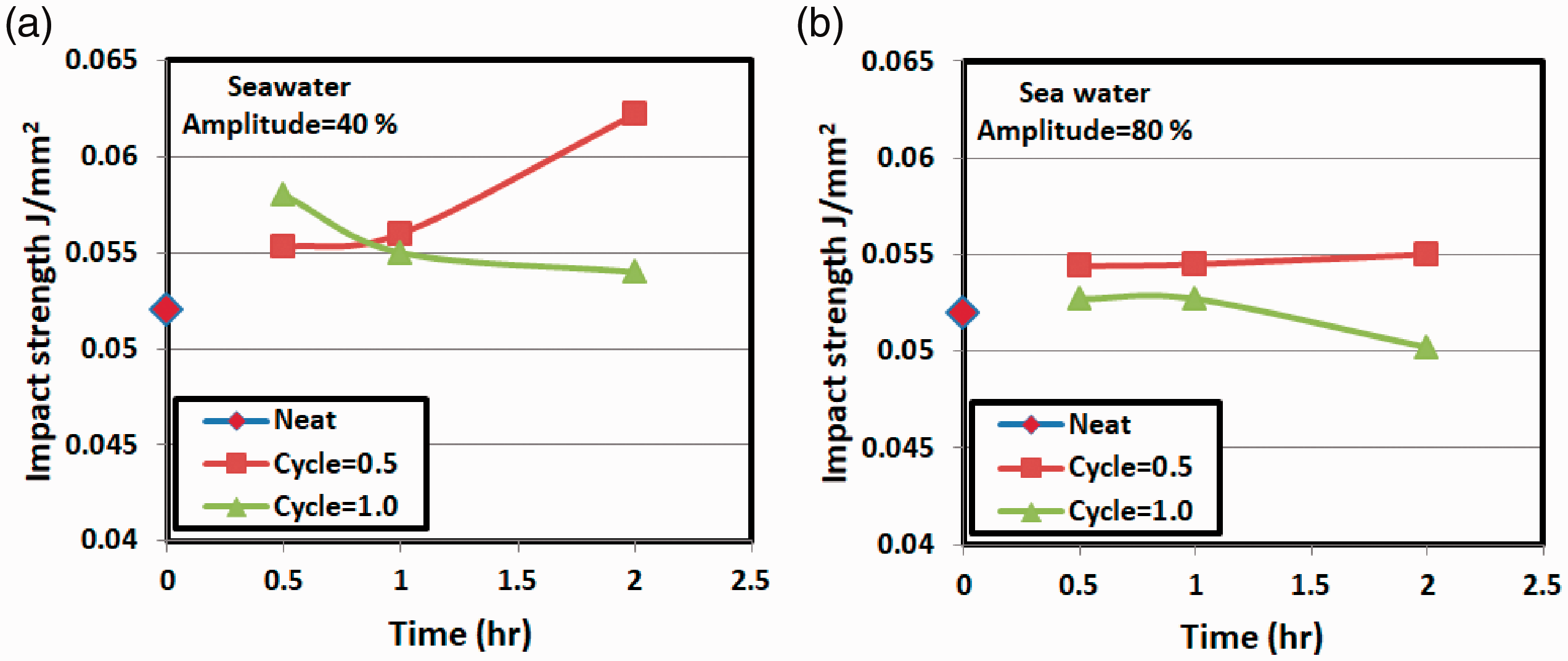
Impact strength of GF/polyester composites reinforced with nano-clay immersed in seawater at different sonication parameters; (a) amplitude of 40% and (b) amplitude of 80%.
The decrease in impact strength which is occurred when sonicating using continuous cycle for a long time (2 hrs.) in both dry and wet conditions is attributed to the agglomeration of nano-clay as indicated by the scanning electron microscope (SEM) image, Figure 8(a). Aggregation gives rise to lower surface interactions of clay-polymer and higher stress concentrations. Both factors lead to lower the mechanical properties of the composites filled with nanofillers. While, smaller aggregate size and exfoliation of the nano-clay result in highly improved mechanical properties [50]. This is indicated by SEM image of Figure 8(b), where a relatively better dispersion of nano-clay in polyester is obtained as a result of sonication with time of 1 hour, amplitude of 40% and pulse cycle under dry condition.

SEM showing the dispersion of nano-clay as a result of sonication parameters: (a) agglomeration due to sonication for long time (2 hours) with continuous cycle, (b) relatively better dispersion results from sonication with time of 1 hour, amplitude of 40% and pulse cycle.
It is also observed from Figures 5 and 6 that, in dry and distilled water conditions, changing the amplitude of sonication has no significant influence on impact strength of nanocomposites. While, in seawater condition, an increase in impact strength is occurred for nanocomposite specimens manufactured by sonication at an amplitude of 40% as compared with specimens that were manufactured by sonication at an amplitude of 80%, Figure 7.
Figures 9 and 10 show the diffusivity (D) for distilled and seawater, respectively, with sonication time using both Fickian and LMD models. For all studied cases, the obtained diffusivities by both Fickian and LMD are close to each other except for neat specimen. However, for all nanocomposites, both Fickian and LMD models for distilled and seawater, the water diffusion coefficient (D) remained lower than that of the neat GF/polyester at all sonication times. In Tables 2 and 3, the numerical values of diffusion coefficient (D) correspond to Figures 9 and 10 are reported. The percentage reduction in diffusivity with respect to neat specimen for all studied cases is shown in Tables 2 and 3. The minimum diffusion coefficient corresponds to T0.5A80C1 for distilled and seawater using both Fickian and LMD models. The values calculated for probabilities of binding γ and that for unbinding α calculated with LMD are also listed in Tables 2 and 3.
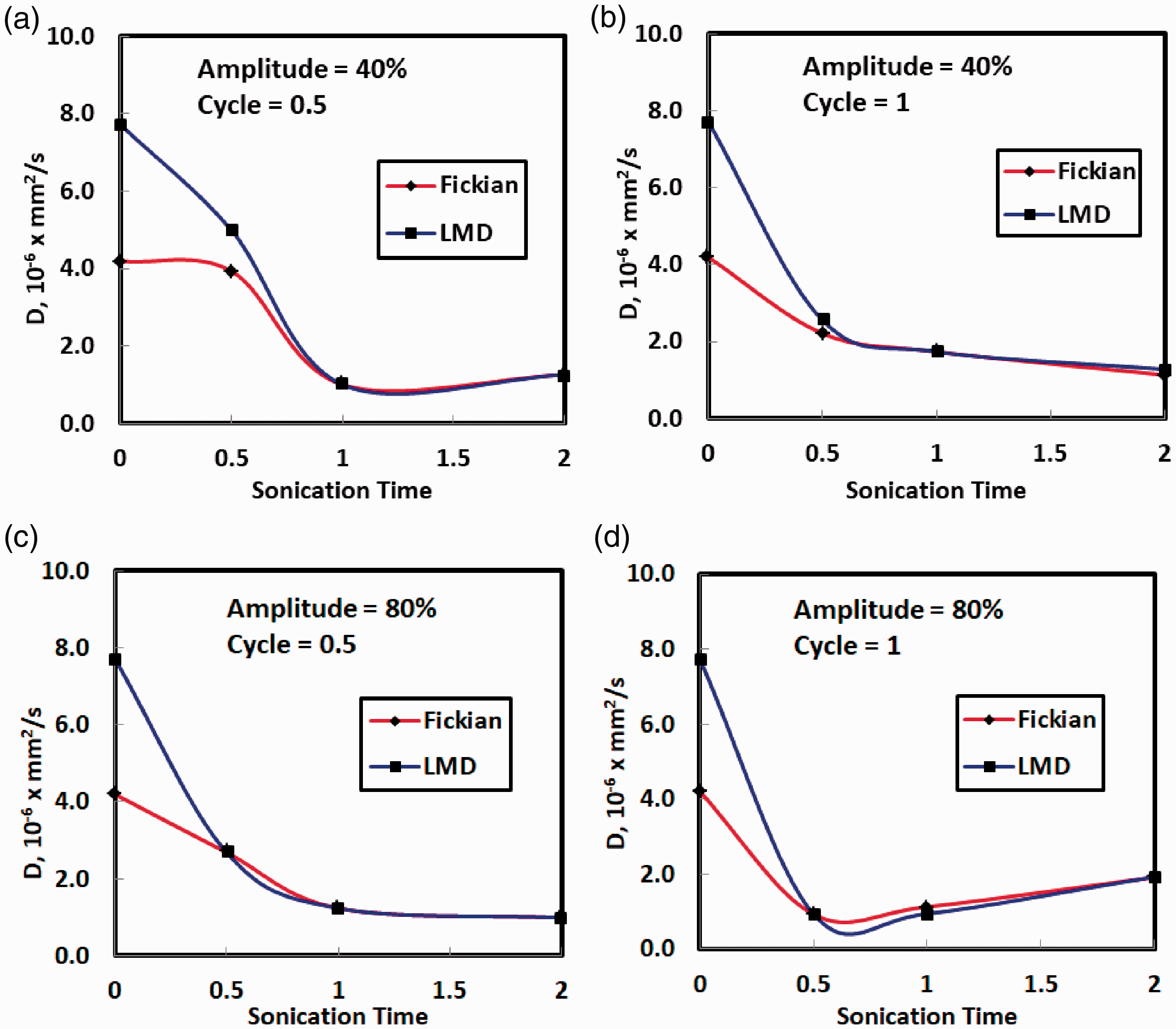
Diffusivity (D) with sonication time for distilled water; (a) Amplitude = 40%, cycle = 0.5, (b) Amplitude = 40%, cycle = 1, (c) Amplitude = 80%, cycle = 0.5, (d) Amplitude = 80%, cycle = 1.
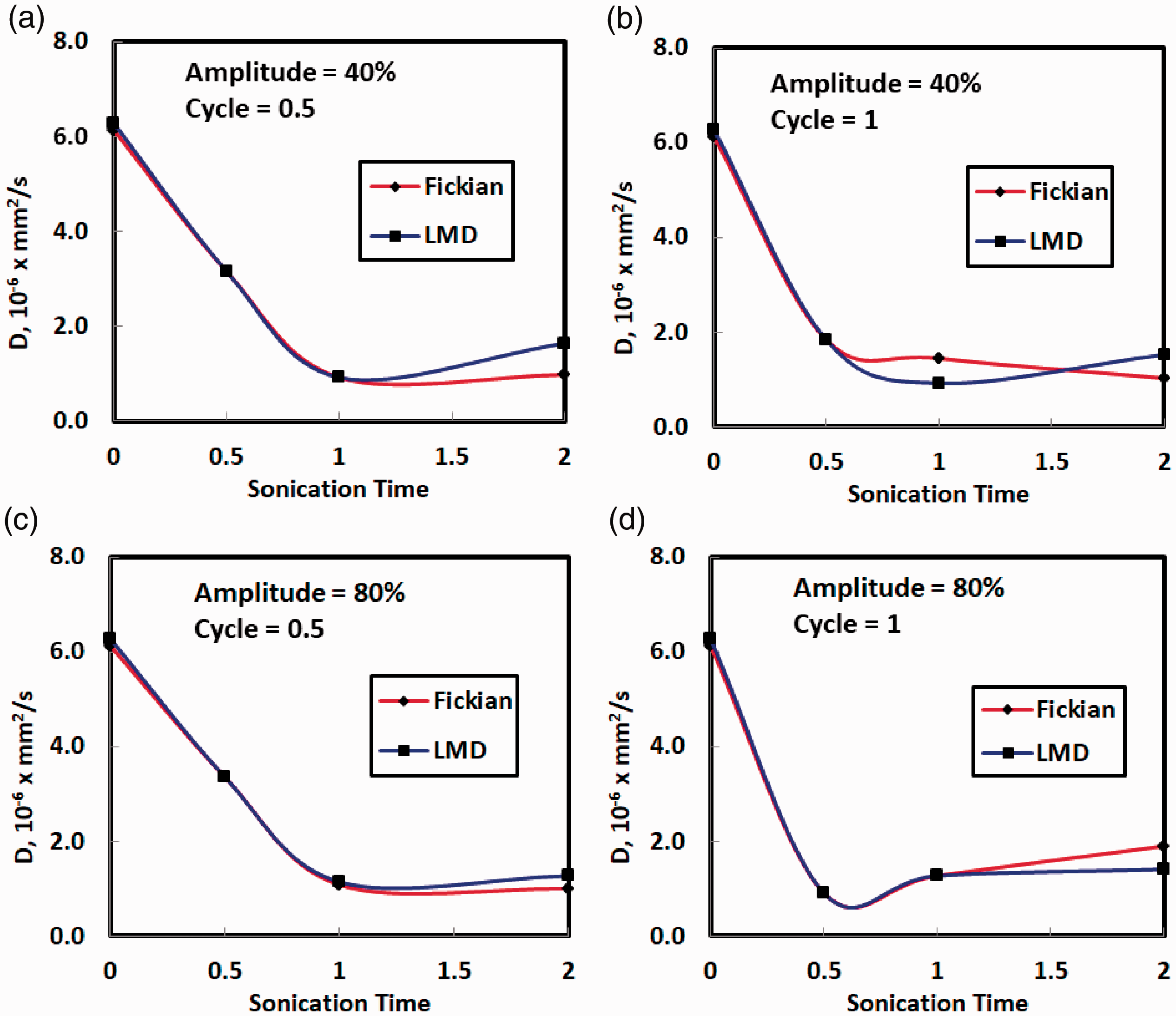
Diffusivity (D) with sonication time for seawater; (a) Amplitude = 40%, cycle = 0.5, (b) Amplitude = 40%, cycle = 1, (c) Amplitude = 80%, cycle = 0.5, (d) Amplitude = 80%, cycle = 1.
Modeled distilled water uptake parameters.

Modeled seawater uptake parameters.

As probability of binding (γ) of a mobile molecule will change to be bound approaches zero (γ→0), the absorption manner of the Langmuir diffusion model should reduce to Fickian approach. Zero probability of a mobile molecule to be bound prevents the existence of molecules in bound phase, so the diffusion of mobile molecules is considered as Fickian in nature and unhindered. This reduction to Fickian approach and consequently to the ability to capture Fickian model is the argument for the use of Langmuir diffusion model for modeling of polymer moisture absorption. This model managed to accurately predict the moisture gain of polymers for both Fickian and non-Fickian behaviors. Probabilities of binding and unbinding determined from moisture absorption experimental data for a polymer that follows Fickian diffusion approach should yield a probability of binding near zero. Thus, the Langmuir diffusion model is applicable to diffusion manners range from merely Fickian to non Fickian. As the probability of unbinding (α) of bound molecule will change to be mobile becomes much larger than probability of binding (γ), the total number of mobile molecules that will change to be bound and remain bound become very small.
Conclusions
A study of the influence of sonication parameters on water barrier and impact strength properties of nano-clay/glass fiber/polyester composites was carried out. Impact tests were performed under dry, distilled and seawater conditions. Nonlinear minimization approach was exploited using MAPLE commercial software in order to find the suitable fit to the models of Fick and LMD. Diffusion coefficients for different sonication times were computed using Fick and Langmuir models. Based on the obtained results, the following conclusions may be drawn: Adding 1 wt.% nano-clay reduced the water absorption in both distilled water and seawater as compared to unfilled (neat) glass fiber/polyester composites with all sonication process. An enhancement in impact strength was attained with nanocomposites produced under all sonication parameters under dry, distilled and seawater conditions. Exposure to the humid and seawater environment increased the impact strengths of unfilled and filled glass fiber/polyester composites. Among the used sonication parameters, time of 2 hours, amplitude of 40% and 0.5 cycle was found as the best sonication condition which resulted in the maximum enhancement in impact resistance, due to the addition of nano-clay to GF/polyester, of 8.2%, 14% and 19.6% under dry, distilled water and seawater conditions, respectively. In dry and wet conditions, as the time increased with continuous cycle, deterioration in impact strength is occurred as compared to neat GF/polyester composites for both amplitudes of 40% and 80%. While, increasing time with pulse cycle led to an increase in impact strength of nanocomposites at both amplitudes of 40% and 80%. In dry and distilled water conditions, changing the amplitude of sonication has insignificant effect on impact strength of nanocomposites. However, in seawater condition, an increase in impact strength is occurred for nanocomposite specimens manufactured by sonication at an amplitude of 40% as compared with specimens that were manufactured by sonication at an amplitude of 80%. For all studied cases, the obtained diffusivities by both Fickian and LMD are close to each other except for neat GF/polyester composites. The water diffusion coefficient (D) remained lower than that of the neat GF/polyester at all sonication times for all nanocomposites and for distilled and seawater using both Fickian and LMD models. The minimum diffusion coefficient corresponds to specimen manufactured with sonication parameters of 0.5-hour time, amplitude of 80% and 1 cycle for distilled and seawater using both Fickian and LMD models.
Footnotes
Declaration of conflicting interests
The author(s) declared no potential conflicts of interest with respect to the research, authorship, and/or publication of this article.
Funding
The author(s) received no financial support for the research, authorship, and/or publication of this article.
