




Abstract
The main focus of automotive industry is on developing and applying new materials and technologies for enhancing the comfort and security levels in the vehicles. To fulfill this requirement high strength and high modulus fiber reinforced composite structures play an important role in the automotive industry. The novelty in this research work is that the composite panel made by 2 D woven fabrics by using Glass and Basalt fabric material composite structure by suitable incorporation of panel design which enhanced the mechanical properties. The blend proportion of Glass and Basalt fabric reinforcement was 100% Glass, 100% Basalt and 50:50 Glass/Basalt fabrics. Hand lay-up process was adopted to fabricate the composite panels. Different sets of panel were produce by varying the curing time, pressure. The resultant panels were analyzed for the mechanical properties such as Tensile strength, Flexural strength and Impact strength tests. From the analysis of results the panel made by using 100% Basalt fabric with 20 bar pressure and 15 minutes curing time showed a better tensile strength of 95 MPa, flexural strength of 29.91 MPa and impact strength of 12.50 MPa. Similarly, the results of 50:50 Glass/Basalt fibre with 30 bar pressure and 15 minutes curing time showed a better tensile strength of 94.83 MPa, flexural strength of 29.51 MPa and impact strength of 12.30 MPa. The outcome of the findings is that the mechanical properties of panel are directly proportional to pressure and time and blend type.
Introduction
There is a significant growth in the automobile sector since 1953 due to the usage of composite materials. Composite materials possess the desired properties like light weight, higher fatigue resistance, formability and higher strength that are suitable for replacing metals which were used earlier [1]. Though composite materials have certain drawbacks like relatively higher raw material cost, longer processing time, less surface finish quality, these materials are widely used because of during collusion between two vehicles to preventing the impact energy from being transferred to the automobile and passengers [2]. Safe and abundant, basalt rock has long been known for its thermal properties, strength and durability. Cost of extraction of basalt raw material is very low. Basalt (solidified volcanic lava) is known for its resistance to high temperatures, strength and durability, also Basalt woven fabrics and mats ideally suited for heat and sound insulation of car interior and engine parts. This study describes the basalt fiber and jute fibre reinforced hybrid composites with poly ester resin with different stacking sequence. It is found that pure basalt fibre combination maintains higher values in both flexural and tensile test. But for impact test basalt fibre is slightly lower than jute fibre reinforced composite [3]. The materials used for automobile car panels were made up of steel, aluminum, rubber, or plastic that is mounted on the side, front and rear of a passenger car. In case of any low speed collision, the car panels absorb the sudden impact to prevent or reduce the damage to the car and the personal [4]. In another study, the objective was to compare the stress, weight, and cost savings of the panels in a safety system and is used to observe the low speed collision. The panels are not a safety feature that is used to prevent occupant from injury during collisions in the passenger cars. The car panel is designed to prevent or reduce physical damage to the front and rear ends of passenger motor vehicles in low-speed collisions [5]. The structural components in automobile car panels are not typically designed so that it would significantly contribute to vehicle crash worthiness or occupant protection during side, front or rear collisions [6]. Metallic car panels which are in long existence possess heavy weight thereby increase in fuel consumption. So, it is highly needed to reduce the weight of the car panel material which has light weight and prevent the car and person from sudden impact [7]. The advantage of steel and aluminum car panels is that they have good load carrying capacity but stays back in low strength to weight ratio. Conventional steel and aluminum car panels are replaced by composites with weight reduction and adequate improvement of mechanical properties [8]. In the current scenario, the automobile manufacturers are focusing to develop materials which have less fuel consumption, less weight, effective utilization of natural resources by introducing better design concept, selection of better material and effective manufacturing process [9]. Light-weight polymers with high strength and high modulus fibers provides good combination of mechanical and technological properties to composites and these properties enables them to find numerous applications in automotive sector [10]. Cahyono et al., studied the flexural rigidity of light weight sandwich panel honeycomb core with carbon-glass reinforced composites and suggested to use the same for engine hood of body electric vehicle [11]. In a study conducted by Nayan Patel et al., the basalt/glass/polyester resin hybrid composites were made with difference in stacking procedure of the composite and observed that the number of stacking improves the mechanical property of the composite [12]. Glass-fiber-reinforced composites have proven to meet the structural and durability demands of automobile interior and exterior parts [13]. The hybrid glass/carbon composite bumper beam was designed and manufactured via the design optimization process combined with the impact analysis. The glass/carbon mat thermoplastic (GCMT) composite was devised to substitute for the conventional glass mat thermoplastic (GMT) for reducing the weight of bumper beam. It was found that the optimally designed GCMT bumper beam had 33% less weight compared to the conventional GMT bumper beam while having the improved impact performances [14]. In this research work the panel is produced using 100% glass fabric, 100% basalt fabric and 50:50 combinations with basalt and glass fabric.
Experimental method
Materials
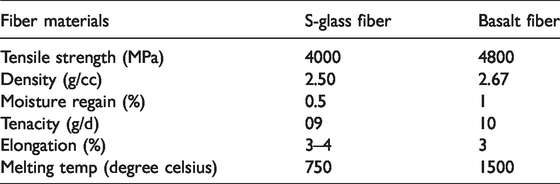
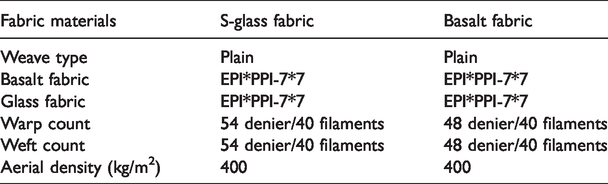
The panel is made with using of high performance fabrics like glass fabric, basalt fabric and the epoxy resin is used as binder. The woven fabric is constructed using plain weave structure. The fiber and fabric particulars were given in Tables 1 and 2 respectively.
Fiber properties.
Fabric parameters.
Fabrication of composites
There are several methods of fabrication of composites and out of which hand lay-up process is chosen for this research. The composites were made using compression moulding technique. Three types of combination are used to produce the panel.
1. 100% Glass fabric, 2. 50% Glass and 50% Basalt fabric, 3. 100% Basalt fabric. During the manufacturing process of panel the fabric is used as reinforcement material and epoxy resin as the matrix which in turn act as binder.
In 50% Glass fabric and 50% Basalt fabric composites, totally 16 layers used for prepare composite material. Layers were arrangement alternate of glass and basalt fabric. The lay-up of the fabric layer is in the manner of two layers of glass fabric over which two layers of Basalt fabric. The final lay consists of 8 layers of glass fabric and 8 layers of Basalt fabric.
The excess amount of resin was squeezed using a roller and it helped to create a uniform distribution of the resin. The hand lay-up process is schematically represented in Figure 1 The laid fabric reinforced matrix is then compressed and cured using a compression moulding machine.

Hand lay-up process.
Experimental design and evaluation
To optimize the process conditions, statistical tools are of great importance and in this research, response surface method is used to analyze the importance of three input factors. Response surface, a three-dimensional surface where the variation in output can be analyzed with respect to two input variables. The output responses could be predicted using quadratic equation from known input factors. A general second order response equation is given by equation (1)
Where Y represents output factor, X1, X2, and X3 represents input factors and A0, A1, A2 etc., are constants. Central composite design or Box-Behnken design is effective in minimizing the number of trial runs of an experiment without reducing the accuracy and is based on second order rotatable or nearly rotatable design with three level factorial designs for fitting the response surface methodology. A total of 15 trials were obtained by varying the factors using the design of experiments. As shown in Table 3, the three factors chosen for this study were designated as Material blend as X1, Pressure as X2, and Dosage time as X3 and prescribed into three levels of coding namely, +1, 0, −1 for high, intermediate, and low values, respectively. Factors and levels of experimental design.
Testing methods
Tensile and flexural strength test
Universal Testing Machine is used to test the tensile and flexural strength testing with Constant Rate of Loading (CRL) principle. Fix the Sample in between two jaws and bottom jaw is movable one. After the sample is fixed the bottom jaw is moving at the principle of constant rate of loading (CRL). At one point the sample is break show the result in instrument dial. The test is repeated in 10 times and takes the average reading.
Sample Size:
The sample size for testing the tensile and flexural strength is following, Length - 150 mm Width - 25 mm
Impact strength test
Charpy Impact tester is used to test the impact strength testing with the principle of amount of energy absorbed by the specimen during fracture. According to the impact strength procedure, the sample is placed on the sample holder and hammer will be swinged by our hand. The hammer strikes and breaks the specimen and the amount of energy required to break the sample is read from the dial in the instrument. The test is repeated in 10 times and takes the average reading.
Sample size
The samples required for performing impact strength must have the following dimensions: Length - 55 mm Width - 10 mm
The trial run samples are evaluated for their mechanical performance like Tensile strength (ASTM D638), Flexural strength (ASTM D790-98), Impact strength (ASTM STP 936 1985-08) in the charpy impact strength tester.
Samples made from different fabrics
Automotive panels were made from 100% Glass, 100% Basalt and 50/50 Glass and Basalt fabric. In Figure 2 shows the panel made on 100% Glass fabric composite material, in Figure 3 shows panel made on 100% Basalt fabric composite material and Figure 4 shows the panel made on 50:50 Glass fabric composite materials.

100% Glass fabric composite material.

100% Basalt fabric composite material.

50:50 Glass basalt fabric composite materials.
Results and discussion
Mechanical properties of composite materials
The average mechanical properties of developed samples were tabulated in Table 4.
Mechanical properties of composite materials.

Tensile strength
The tensile test was carried out for the composites and the tensile strength was obtained for each composite influencing the blend proportion, pressure and time is given in equation (2).
Where X1 represents material blend, X2 represents pressure and X3 represents dosage time. The Predicted R2 of 0.8105 is in reasonable agreement with the adjusted R2 of 0.9570; i.e. the difference is less than 0.2.
Effect of pressure vs blend ratio (%) on strength of composite material
The effect of pressure on the outcome of tensile strength with respect to blend ratio is interpreted by using the contour plot from the Figure 5.

Effect of pressure and blend ratio of material (%) on Tensile strength.
We found that blend ratio plays an important role in influencing the tensile strength of the panel. With reference to the Table 4 the maximum tensile strength of 95 MPa occurs with the panel produced using 100% basalt fabric with a dosage or curing time of 15 minutes and with a pressure of 20 bars. Similarly, the increase in pressure and keeping the lower curing time also give the better tensile behavior of the panel. From the contour plot we can come to a conclusion that the panel tensile strength attains maximum if it is produced by using basalt fabric with an applied pressure of 20 bar and curing time 15 minutes. The reason for increased tensile strength of the panel produced using 100% basalt fabric is, the strength of basalt fabric is higher compared to glass fabric. Also, the material intermingles with binder firmly during curing with the applied pressure makes the panel of higher tensile strength.
Effect of time and blend ratio of material on tensile strength of composite material
The significance and importance of curing time on the tensile strength of the panel in relation to blend ratio is discussed using contour plot which is shown in Figure 6.
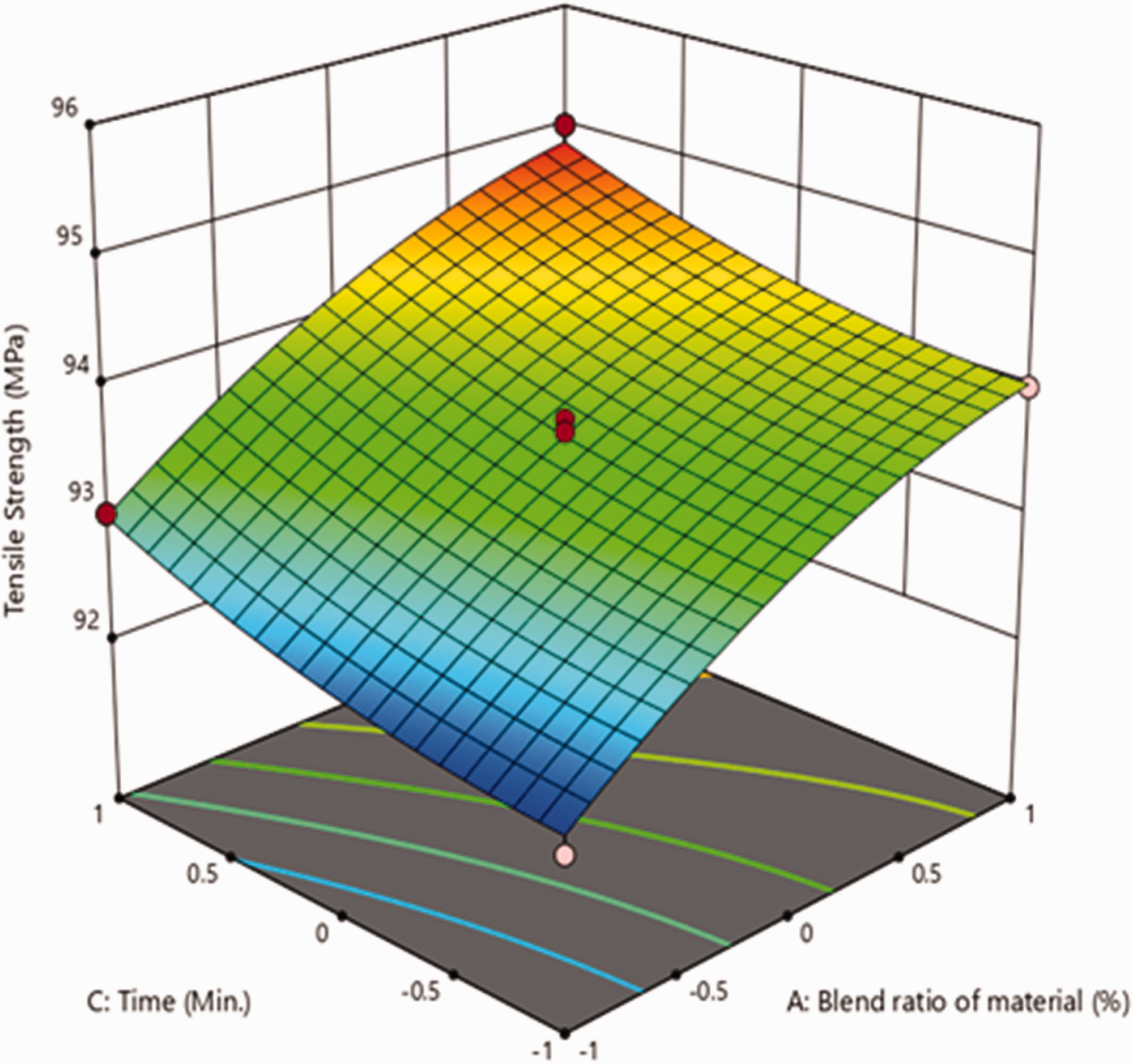
Effect of time and blend ratio of material (%) on tensile strength.
The panel were produced with the curing time of 51,015 minutes in accordance with the applied pressure combination of 10, 20 and 30 bar. The tensile strength of 95 MPa obtained for the panel produced using 100% basalt fabric with the curing time of 15 minutes with applied pressure of 20 bars. If the applied pressure for that same panel increased to 30 bars then we have to keep the curing time to 10 minutes to get the 94.80 MPa tensile strength of the panel which is produced using 100% basalt fabric. From the findings we can conclude that the curing time plays a significant role in deciding the tensile strength of the panel. In case of panel produced using 100% basalt fabric if we increase the curing time by keeping the applied pressure constant it will increases the panel strength significantly. The curing time and applied pressure has indirectly proportional relationship in deciding the tensile behavior of the panel irrespective of blend proportion. It has been observed that if the curing time allowed to a maximum by keeping the applied pressure constant, it makes the fibre component in the fabric more brittle which in turn reduces the panel tensile strength.
Effect of time and pressure of material on tensile strength of composite material
The effect of time and pressure of material on tensile strength of composite material is discussed with the aid of Figure 7.
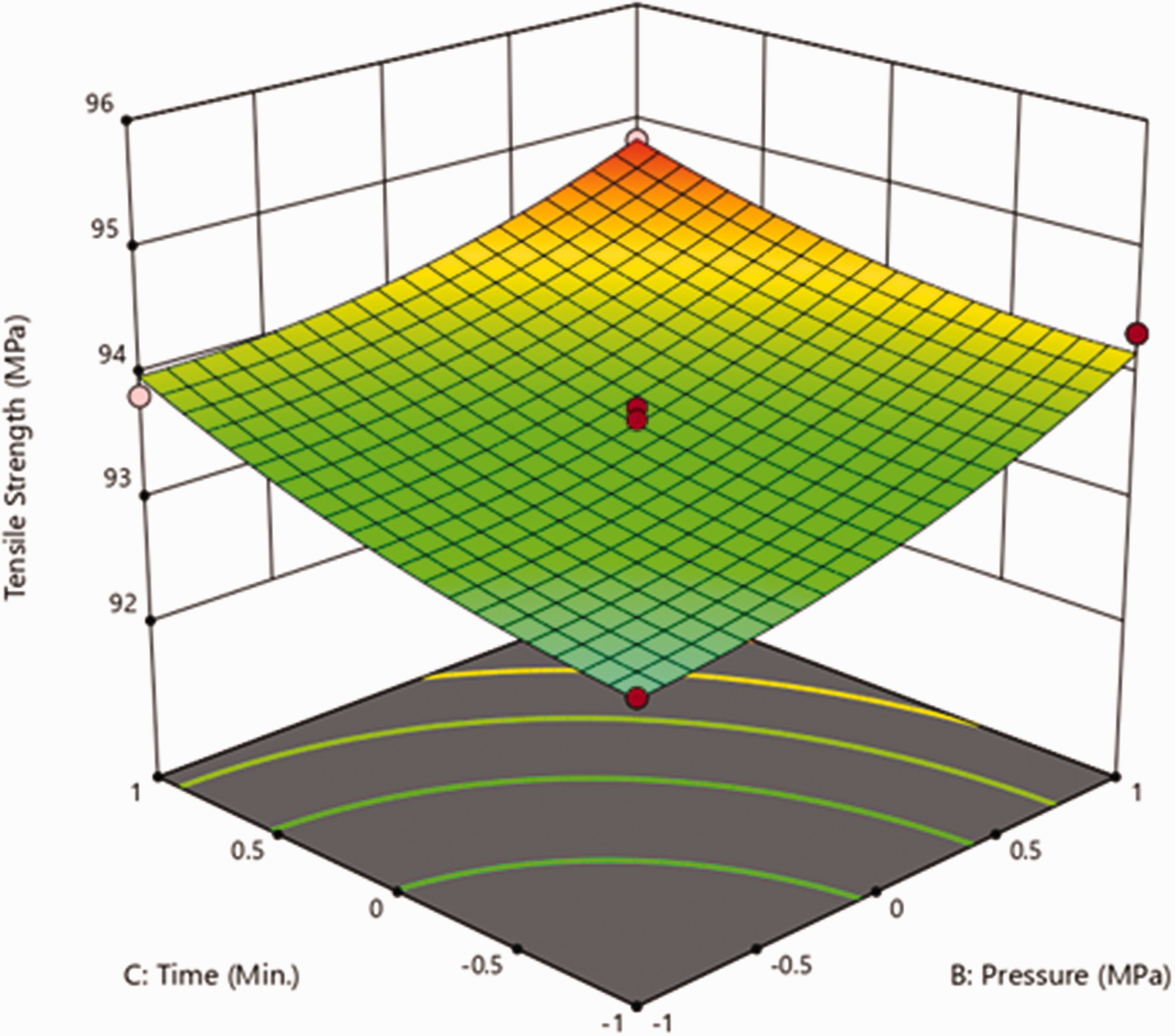
Effect of time and pressure on tensile strength.
It has been observed that there is a positive relation between the curing time and tensile strength of the panel. The increase in the curing time increases the tensile strength of the panel. Also the combined effect of increase in pressure and curing time simultaneously increases the panel strength to a considerable extent. From the Table 4, it can be noted that in case of panel made from 100% basalt fabric, if the applied pressure is 20 bars and the curing time is 15 minutes, the tensile strength of the panel is 95 MPa. Whereas for the panel made from 100% basalt fabric, produced by using the applied pressure of 10 bars and curing time of 10 minutes shows the tensile strength of 93.85 MPa. A strength reduction of 1.21% occurs. The reason for increase in tensile strength is due to the fixation of fabric material with the resin that takes place firmly due to increase in applied pressure and the increase in curing time leads to settling the bonding of fabric with the resin.
Flexural strength
The Flexural test was carried out for the composites and the flexural strength was obtained for each composite and the relationship between time, blend composition and pressure is given in equation (3).
The Predicted R2 of 0.8768 is in reasonable agreement with the adjusted R2 of 0.9210; i.e. the difference is less than 0.2.
Effect of pressure vs blend ratio (%) on flexural strength
Effect of pressure and blend ratio of material (%) on flexural strength is discussed from the Figure 8.
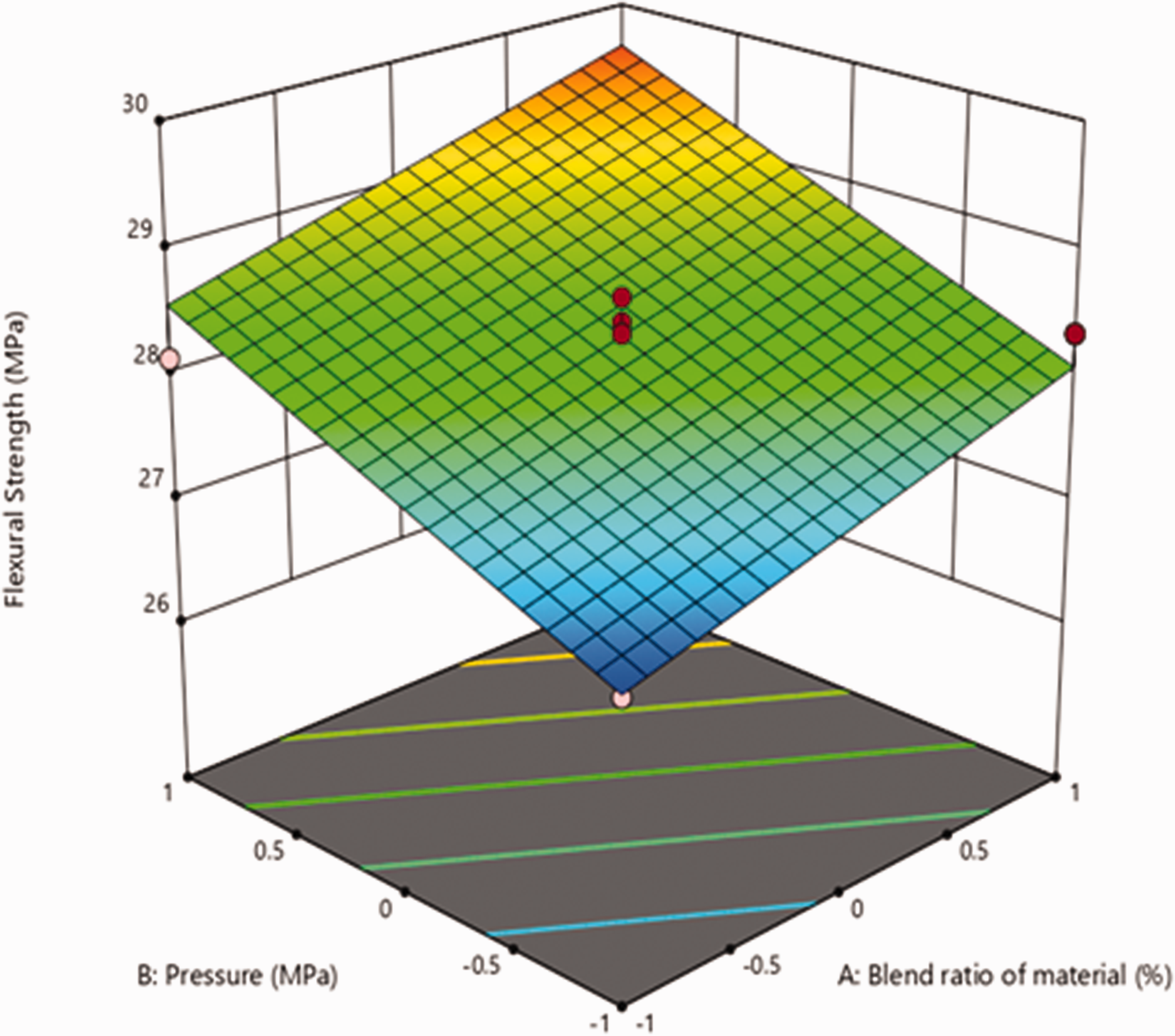
Effect of pressure and blend ratio of material (%) on flexural strength.
From the Table 4, it has been observed that the panel made from 100% basalt fabric using an applied pressure of 20 bars with a curing time of 15 minutes exhibits better results of 29.91 MPa. The panel made from 50% glass fabric and 50% basalt fabric using an applied pressure of 30 bars with a curing time of 15 minutes exhibits 29.51 MPa. It has been noted that the blend proportion plays important role in making the panel more flexible. From the surface response we can conclude that the increase in the ratio of basalt material proportion in the blend significantly increases the flexural strength of the panel. It is due to the inherent combined fibre property of basalt fibre with glass fibre which possesses good tenacity and elongation.
Impact strength
The Impact test was carried out for the composites and the impact strength was obtained the relationship between time, blend composition and pressure is given in equation (4).
The Predicted R2 of 0.7945 is in reasonable agreement with the Adjusted R2 of 0.8661; i.e. the difference is less than 0.2.
Effect of pressure vs blend ratio (%) on impact strength
The effect of pressure and blend ratio of material (%) on impact strength is discussed with the aid of Figure 9.
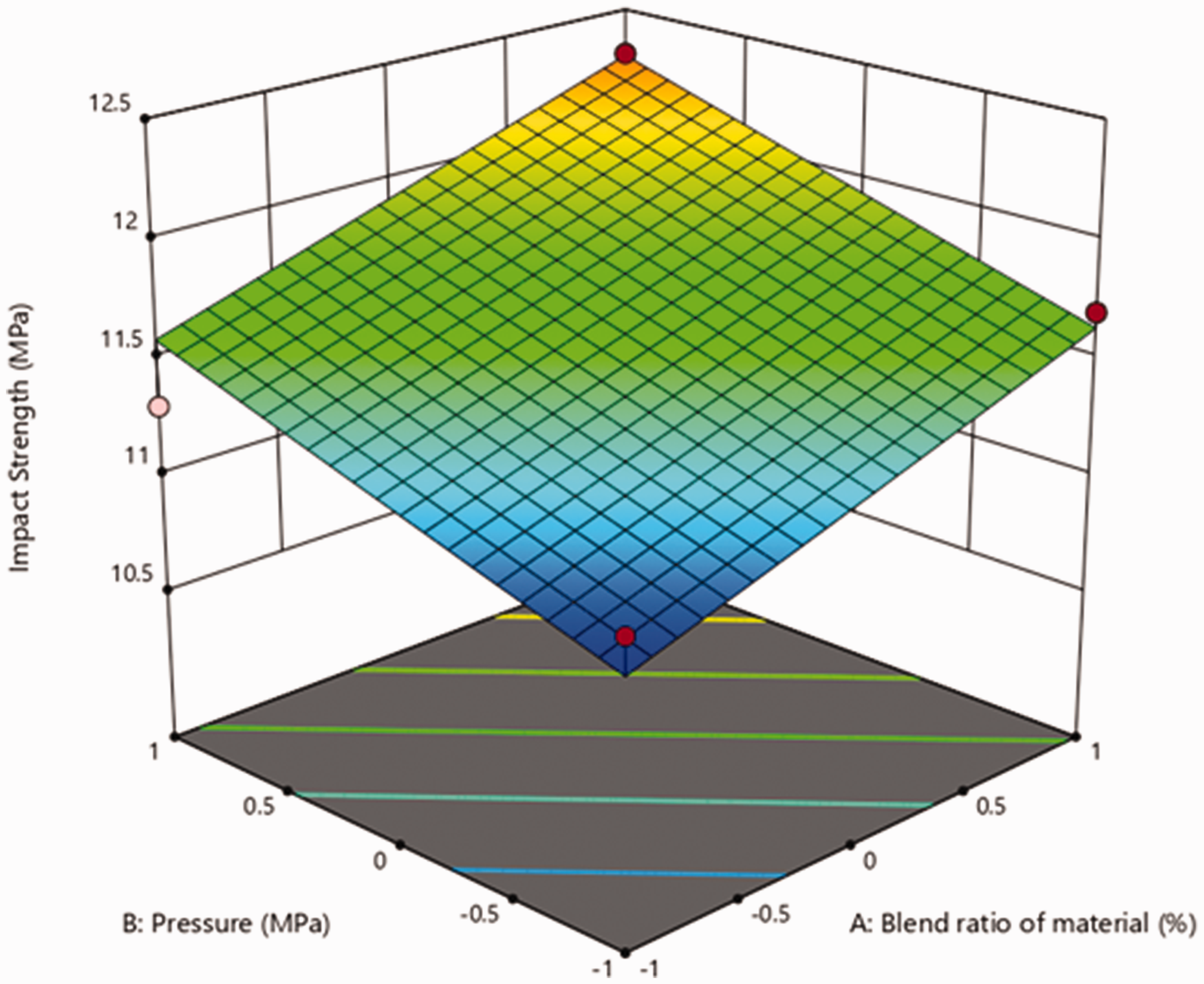
Effect of pressure and blend ratio of material (%) on impact strength.
It is obvious that the impact strength of the panel should be high so that it acts as a shield during collision. The impact strength depends on the fibre property and the construction of fabric. From the Table 4 it has been observed that the panel made from 100% basalt fabric using an applied pressure of 20 bars with a curing time of 15 minutes and applied pressure of 30 bars with a curing time of 10 minutes exhibits 12.40 MPa and 12.30 MPa respectively. The panel made from 100% glass fabric using applied pressure of 20 bars with a curing time of 15 minutes shows impact strength of 11.40 MPa. The panel impact strength is reduced when it is made from the combination of basalt and glass fabric. The increase in impact strength in case of panel produced using 100% basalt fabric is due to that the bonding with resin is strong which makes the panel of higher impact strength.
Conclusion
The composite panel made up of using basalt and glass woven fabric using epoxy resin as binder. The panel was made by using different blend proportion namely 100% glass fabric, 50% glass fabric and 50% basalt fabric and 100% basalt fabric. With respect to the consideration of mechanical properties of panel, the panel produced using 100% basalt fabric with epoxy resin composite using 20 bar pressure and 15 mins time and using 30 bar pressure and 10 mins time gives better results of tensile strength, flexural strength and impact strength compared to the panel produced with 100% glass fabrics and 50/50 glass/basalt. The panel produced with 100% fabric using 20 bar pressure and 15 minutes curing time shows a 2.1% increase in tensile strength when compared to other panels. Similarly, the panel produced with 100% fabric using 20 bar pressure and 15 minutes curing time shows an increase in flexural strength of 8 to 10% when compared with other samples. There is a positive relationship between the pressure and curing time which plays an important role in making the panel. It has been observed the tensile strength and impact strength panel produced with the combination of 50:50 Glass/Basalt fabric considerably increases with increase in pressure and time. The change in impact strength happens in the range of 9.8% to 12.12% due to change in curing time and pressure. It has been concluded that the composite panel mechanical properties are directly influenced by the blend proportion, curing time and pressure used during manufacturing process. Among the above said factor the type of fibre used plays a major role in deciding the properties of the panel.
Footnotes
Declaration of conflicting interests
The author(s) declared no potential conflicts of interest with respect to the research, authorship, and/or publication of this article.
Funding
The author(s) received no financial support for the research, authorship, and/or publication of this article.
