




Abstract
Cloth diapers also known as eco-diapers, traditional sandwich-structured eco-diapers are composed of top and bottom layers that are made of cotton or polyester nonwoven fabrics. On account of the hydrophilic bottom layer, urine permeates when the water absorption reaches saturation. In this study, polypropylene is melt-blown into hydrophobic polypropylene nonwoven fabrics to be used as the top and bottom layer. Polypropylene is hydrophobic but after being fabricated into nonwoven fabrics, the porous structure enables the urine to leak to the absorbent interlayer of eco-diapers. Hence, the top layer of diaper does not contain urine, which makes smart diapers more comfortable than cloth diapers that are made of cotton or other moisture-absorbent materials. Moreover, the sensing mechanism via Bluetooth module can detect the water content of the interlayer with a view to improving the demerit of urine leakage. The interlayer is the sensing layer that has antibacterial function. Two types of antibacterial yarns are treated by zinc oxide and silver ions. The yarns are fabricated into antibacterial woven fabrics, after which the antibacterial properties of fabrics are investigated with quantitative and qualitative tests. Next, two parallel metallic wires are assembled in order to trigger short circuit when sensing moisture, thereby obtaining different electric resistance based on different moisture levels. Furthermore, the miniature senor can signify the cellular phones or buzzers when the two metallic wires generate electrical resistance due to the presence of urine. The metallic wires are silver-plated copper yarns, stainless steel fibers, and copper fibers, which possess different electric resistance for the corresponding miniature sensors. This study proposes an efficient manufacture of smart diapers that require only a combination of woven fabrics and two metallic wires to sense moisture, the design of which can be encompassed in diverse fields.
Introduction
Infants, dementia patients, and disabled people have a considerable demand for disposable diapers. Diapers consume a great number of trees and inflict severe damage to the environment. Babies who are below six months old need more than five diapers per day, and adults may need even more [1,2]. Diapers are composed of hygroscopic polymers that absorb moisture, but the polymers cannot decompose naturally, which jeopardizes the environment. Unlike paper diapers, cloth diapers (eco-diapers) are eco-friendly and can be repeatedly washed and recycled. However, the demands of washing and affliction of skin allergies make them not as popular as ordinary diapers [3]. Therefore, this study aims to improve the functions of cloth diapers in order to increase the usage rate and contribute to environmental protection.
Nanotechnology has been well developed and there are many antibacterial components that can be synthesized with other materials via nanotechnology. The good antibacterial efficacy and effective wound healing of zinc oxide nanoparticles have been proven in previous studies. Zinc oxide nanoparticles are thus made into films that cohere with cotton fabrics to form antibacterial fabrics for a diversity of applications [4,5]. Silver ions are one of the best inorganic antibacterial materials as they restrain and destroy the formation of microorganisms [5,6], such as Acinetobacter, Escherichia, Pseudomonas, and Salmonella [7]. In recent years, extensive efforts have been made in both academia and industry in the research and development of smart wearable systems (SWS), primarily influenced by skyrocketing healthcare costs and supported by recent technological advances in nanotechnologies, miniaturization of sensors, and smart fabrics. The continuous advances in SWS will progressively change the landscape of healthcare by allowing individual management and continuous monitoring of a patient’s health status [8]. To combine electronic components and smart textiles, the textiles should have electronic conduction that can activate electronic components. Numerous current studies have considered smart textiles, known as e-textiles [9,10], to sense physiological signals, such as ECG and EDA, by contacting with the human body [11,12]. Numerous studies emphasized the rendering of textiles with conductive effects. Previous studies coated conductive polymers onto the yarns to make the yarns electrically conductive. The conductive yarns are then combined with sensors to detect differences in temperature and humidity. However, these yarns failed to withstand repeated washing; their manufacturing was complex [13,14].
Internet of Things (IoT) that is rapidly developed has contributed to breakthrough of each research field. For example, the rise of wearable health-monitoring technologies led to the development of smart diapers [15]. Urinary incontinence is one of the mostly common seen healthcare issues. As a result, the use of diapers takes the load off the caregiver while alleviating the living pressure for those who suffer from urinary incontinence, such as babies, the elderly, and the disabled [16]. The wetness of the skin for a longer period of time is therefore the common factor behind the skin rashes while using diapers [17]. In order to address the shortage of healthcare resources, many studies produced sensors to detect the urine in the diapers, which are concurrently incorporated with wireless sensing technology (e.g. Bluetooth and RFID) in order to form smart diapers [18–21]. Wearable device that serve as acquisition technology that collects human physiological parameters has been accepted by people and introduced in the healthcare system, which in turn leads to the development of smart diapers. In the meanwhile, people have increasingly growing environmental awareness. Disposal diapers bring severe damage to the environment and the major population of the users are babies that are younger than 24 months. Although cloth diapers are economical and eco-friendly, without a smart reminder they can cause inconvenience to caregivers and also are short of antibacterial skin protection. Therefore, this study proposes smart diapers that are made of cloth and can be repeatedly washed.
In this study, polypropylene (PP) nonwoven fabrics are made employing the melt-blowing method. They are used as the bottom layer of the smart diapers to prevent the leakage of urine. Commercially available eco-diapers cannot avoid leakage and are thus not suitable for using the proposed sensoring function. Furthermore, the dyeing and finishing technique is used to embed silver ions and zinc ions into cotton yarns. The cotton yarns are made into woven fabrics, and two parallel metallic wires are aligned 6 cm apart during the fabrication. The metallic yarns are copper-plated silver yarns, copper wires, and stainless-steel wires, and all of which have a diameter of 0.10 mm. The resulting antibacterial smart textiles are evaluated in terms of moisture detection, after which miniature senor is designed based on the short circuits of the metallic wires with corresponding different levels of moistures. A Bluetooth module is added in order to connect with cloud applications with an attempt that the antibacterial smart textiles can be used in environmental diapers.
Materials and methods
Testing and analysis
Structural analyses of metal composite yarns, melt-blown non-woven fabrics, and antibacterial fibers are based on the observations by both a scanning electron microscope (SEM, TM1000, HITACHI, Japan) and a stereomicroscope (SMZ-10A, Nikon Instruments Inc., Japan). Metal composition of antibacterial fibers are analyzed using X-ray diffraction (XRD, D8, Discover, Bruker Instruments, Germany). The hydrophobic property of PP melt-blown nonwoven fabric is measured using a water contact angle tester, (OCA-15, Data Physics Instruments, Germany). Humidity resistance is evaluated using a multimeter (Agilent M3500A, digital multimeter 6 1/2 Digit, Agilent, US).
Antibacterial efficacy of smart textiles is evaluated using a quantitative test as specified in AATCC-100 and a qualitative test as specified in JISL1902. Five samples for each specification are used. Gram-positive Staphylococcus aureus and Gram-negative colibacillus are used for the tests. The antibacterial smart textiles are the experimental group, while the untreated cotton fabrics are the control group. The qualitative test uses the inhibition zone to determine the antibacterial effect and the quantitative test uses equation (1) to determine the bacteria reduction rate (BR%)

Polypropylene nonwoven fabric manufacturing
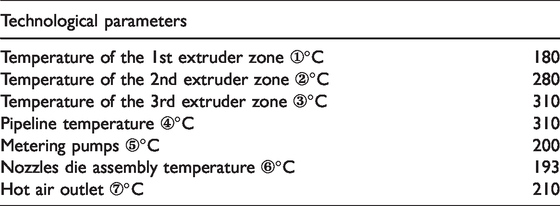
PP fibers (DAELIM Instruments, Korea) are perceived to be one of the most eco-friendly petrochemical fibers as they demand the least energy and water. The top layer of cloth diapers is composed of cotton fibers and has good water absorption and comfortable texture; however, urine is confined to the top layer easily, which nourishes bacterial growth and causes irritation of skins. PP, which is hydrophobic and does not hold urine, is commonly made into women’s pads or protective clothing. PP fibers can be naturally decomposed and reduced into carbon and hydrogen as a result of everlasting exposure to the sun or being buried in soils. Burning PP fibers does not generate toxic gases. Thus, products made of 100% PP fibers can be recycled repeatedly. In this study, 100% PP masterbatches are made into melt-blown nonwoven fabrics with a dense structure and great fiber fineness. Figure 1 shows the melt-blown machine and Table 1 shows the manufacturing parameters.
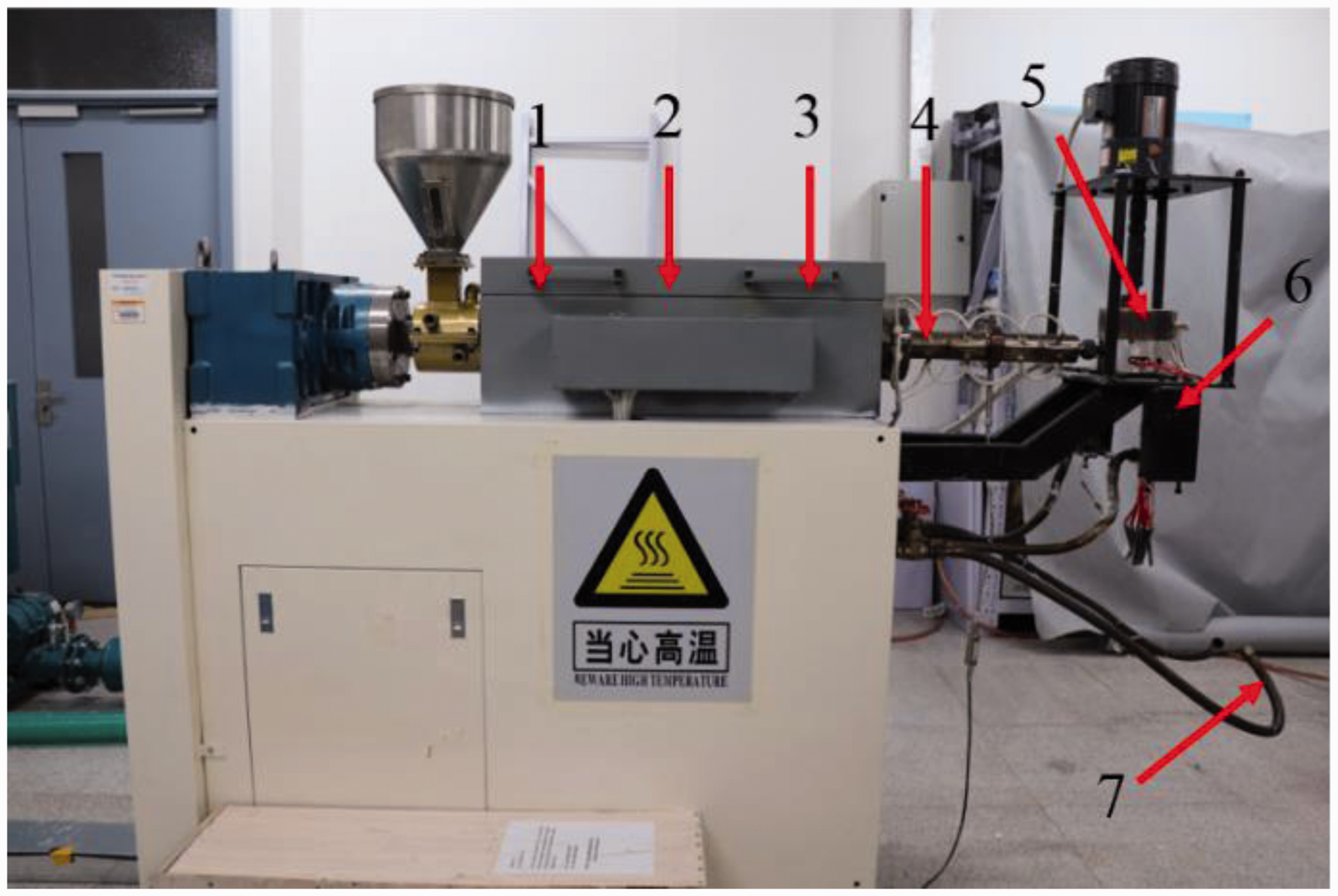
Image of the melt blown machine.
Technological parameters of melt-blown production.
Materials and preparation of smart textiles
The 30 Ne dyed black antibacterial yarns are embedded with silver (Acrylic/C (20/80)) or zinc ions (R/C (20/80) (TUNG HO TEXTILE, Taiwan) using a blending technique. A rapier type shuttleless loom machine (KINGSTON®, King Kong Iron Works, Taiwan) is used to make the yarns into woven fabrics, during which the warp yarns are affixed to the machine, and the shuttle leads the weft yarns to be perpendicular woven with the warp yarns. The warp yarns are 1000 D PET yarns, and the weft yarns are 30 Ne antibacterial yarns that are particularly made to have the same fineness by rotor twister machine. The twisting enables the incorporation of metallic fibers, involving silver-plated copper fibers, copper fibers, stainless steel fibers with a diameter of 0.10 mm (King’s Metal Fiber Technology, Taiwan) with woven fabrics via a loom. The specified twist count is 4 turns/cm. The structural of the sample using a stereomicroscope Figure 2(a) shows the composite yarns made of antibacterial yarns and metallic wires. Next, metal composite yarns are parallel-fitted 6 cm apart in the sensoring site in the beating process. Sample size is 38 cm × 12 cm, which refers to Cortex eco-diapers. Figure 2(b) shows the macroscopic antibacterial smart textiles where the black part shows the interlace of PET and antibacterial fibers and two metallic composite yarns serve as sensors. The weft yarns are plied yarns composed of four 30-Ne antibacterial fibers with a view to having antibacterial properties and same fineness of the warp yarns, 1000 D PET yarns. The proposed manufacture does not require any change to the eco-diapers and provide them diverse functions in order to encourage more people to use eco-diapers. Figure 2(c) shows the rapier-type shuttleless loom machine.

(a) The composite yarn made of antibacterial yarns and metallic wire, (b) the smart textile where the black parts are antibacterial silver or zinc yarns while the white parts are the composite yarns, and (c) the rapier type shuttleless loom machine.
Based on the commercially available eco-diaper, smart diapers are proposed with improved configuration as shown in Figure 3. The top and bottom layers are both composed of PP nonwoven fabrics, enclosing an interlayer that is made of antibacterial woven fabric as well as another interlayer that is urine-absorbent. The absorbent interlayer is further studied in this study with highly developed microfiber and super-absorbent fibers. It is hoped that smart diapers can be comfortable, save healthcare resources, and help environmental protection. Instead of cotton, the top layer is composed of PP nonwoven fabric which keeps per se skins dry and cool while facilitating urine passage to the absorbent interlayer. When the absorbent interlayer reaches saturation, the antibacterial woven fabrics prevent skin allergy and the constituent metallic wires then generate short circuit resistance, which serves as a reference for the caregiver to change the diaper on time.

Configuration of the smart diaper.
Results and discussion
SEM observation and water contact angle test analysis
Figure 4(a) and (b) shows the cotton fibers and the antibacterial composite yarns. The cotton fibers have a sleeker surface than the antibacterial composite yarns, and the roughness of the latter suggests that the metallic ions have been successfully embedded into the composite yarns, which is analyzed using XRD. Figure 4(c) shows the SEM image of 100% PP nonwoven fabric and the constituent fiber fineness is about 10 μ. Melt-blowing method contributes a low fiber fineness and dense structure to the melt-blown nonwoven fabrics. In addition to a drying speed of 11.1%/min and water content rate of 0.05% and subsequent quick-dry and comfort of melt-blown fabrics, PP fibers are pore-free so they do not have demerits of the growth of bacteria and stain resistance. Figure 4(d) shows the water contact angle image where the water contact angle is 141°, sensoring.

SEM images of (a) cotton fibers, (b) antibacterial composite yarns, (c) 100% PP melt-blown nonwoven fabric, and (d) water contact angle of 100% PP melt-blown nonwoven fabric. SEM: scanning electron microscope; PP: polypropylene.
XRD analysis
Figure 5 shows the XRD analysis of antibacterial silver yarn and antibacterial zinc yarn. The three characteristic peaks of antibacterial silver yarns are 2Θ = 15° ((110) plane), 16.5° (shoulder, (110) plane), and 22.5° ((200) plane) [22]; these mentioned peaks also became visible in the XRD patterns of the antibacterial zinc yarn, the major diffraction peaks does not change regardless of the modification process and cotton fabrics preserved their crystalline structure in the unmodified state. While the five characteristic peaks of zinc yarns are 2Θ = 31.9°((100) plane), 34.6° ((002)plane), 36.4° ((101)plane), 47.6° ((102)plane), and 56.7° ((110)plane) [23], crystal planes of pure ZnO with hexagonal wurtzite structure and the lines match well with the normal value reported [24,25]. Both yarns are then tested for antibacterial efficacy with an attempt to incorporate them with smart diapers that decrease the hazard the bacteria cause.

XRD analysis of antibacterial silver and zinc yarns. XRD: X-ray diffraction.
Quantitative and qualitative tests
Figure 6(a) to (f) shows the antibacterial efficacy of the common cotton fabrics, silver-contained smart textile, and zinc-contained smart textiles against Staphylococcus aureus and colibacillus. Silver carries Ag+, zinc carries Zn2+, and the cell membranes of bacteria carry negative electricity. Therefore, they attract each other as a result of Coulomb gravity. The positive charges penetrate the cell walls and prohibit the cells from synthesizing enzyme. The cells lose the ability to propagation and division, and eventually die [26,27]. The inhibition zones show that the silver ions outperform zinc ions in terms of antibacterial effect. In order to display antibacterial effect in digitalization, the qualitative test is performed.

Qualitative test of (a/d) common cotton fabrics, (b/e) silver-contained smart textile, and (c/f) zinc-contained smart textiles against Staphylococcus aureus and colibacillus, respectively.
Figure 7(a) and (d) shows the quantitative test results of cotton fabric against Staphylococcus aureus and colibacillus, and the colonies are used as the experimental group (i.e. “A” in equation (1)). Figure 7(b) and (c) show the quantitative test results of silver- and zinc-contained smart fabrics against Staphylococcus aureus, while Figure 7(e) and (f) shows the quantitative test results of silver- and zinc-contained smart fabrics against colibacillus, the colonies of which are the control groups (i.e. “B” in equation (1)). The bacteria reduction rate is 95% for silver-contained smart textiles and 60% for zinc-contained smart textiles, silver antibacterial is higher than that of zinc, in principle, the microbial cell membrane is destroyed by electric charge, but silver contains microtoxicity, which is harmful to cells or microorganisms.

Quantitative test of (a/d) common cotton fabrics, (b/e) silver-contained smart textile, and (c/f) zinc-contained smart textiles against Staphylococcus aureus and colibacillus, respectively.
Moisture-sensitive electric resistance
The water absorption level is presented as weight-volume percentage. The matrices of antibacterial silver or zinc composite yarns are cotton yarns. Namely, silver ions or zinc ions are added to cotton yarns without interfering with the water absorption rate. The correlation between water content and electric resistance is dependent on the type of metallic wires. The water content rate is computed using weight percentage as equation (2). The dry fabric is denoted as TM0% and the wet fabric that is fully saturated with water is denoted as TM100%, which can be used to yield the total water volume that the fabric absorbs. The electric resistance is yielded according to the short circuit caused by the parallel metallic wires
Figure 8 shows the electric resistance of smart textiles that are composed of silver-plated copper fibers, copper fibers, and stainless-steel fibers as related to different water content rates. The miniature sensor is designed based on the differences in electric resistance. Three metallic fibers also possess different humidity sensitive resistors, which realizes the purpose of gaining a significant change gradient and facilitates the detection of sensors. The regression slope of humidity resistance is computed using equation (3), which are 31.89 for silver-plated copper fiber, 59.71 for copper fiber, and 88.98 for stainless-steel fiber. A high-regression slope indicates a greater change gradient. As a result, silver-plated copper fibers have highest conductivity and thus lowest change gradient of humidity resistance. By contrast, stainless steel fibers have lowest conductivity and greatest change gradient of humidity resistance. Moreover, they have high mechanical properties, durability, and least oxidization, and thus fit the requirements of the sensors for smart diapers
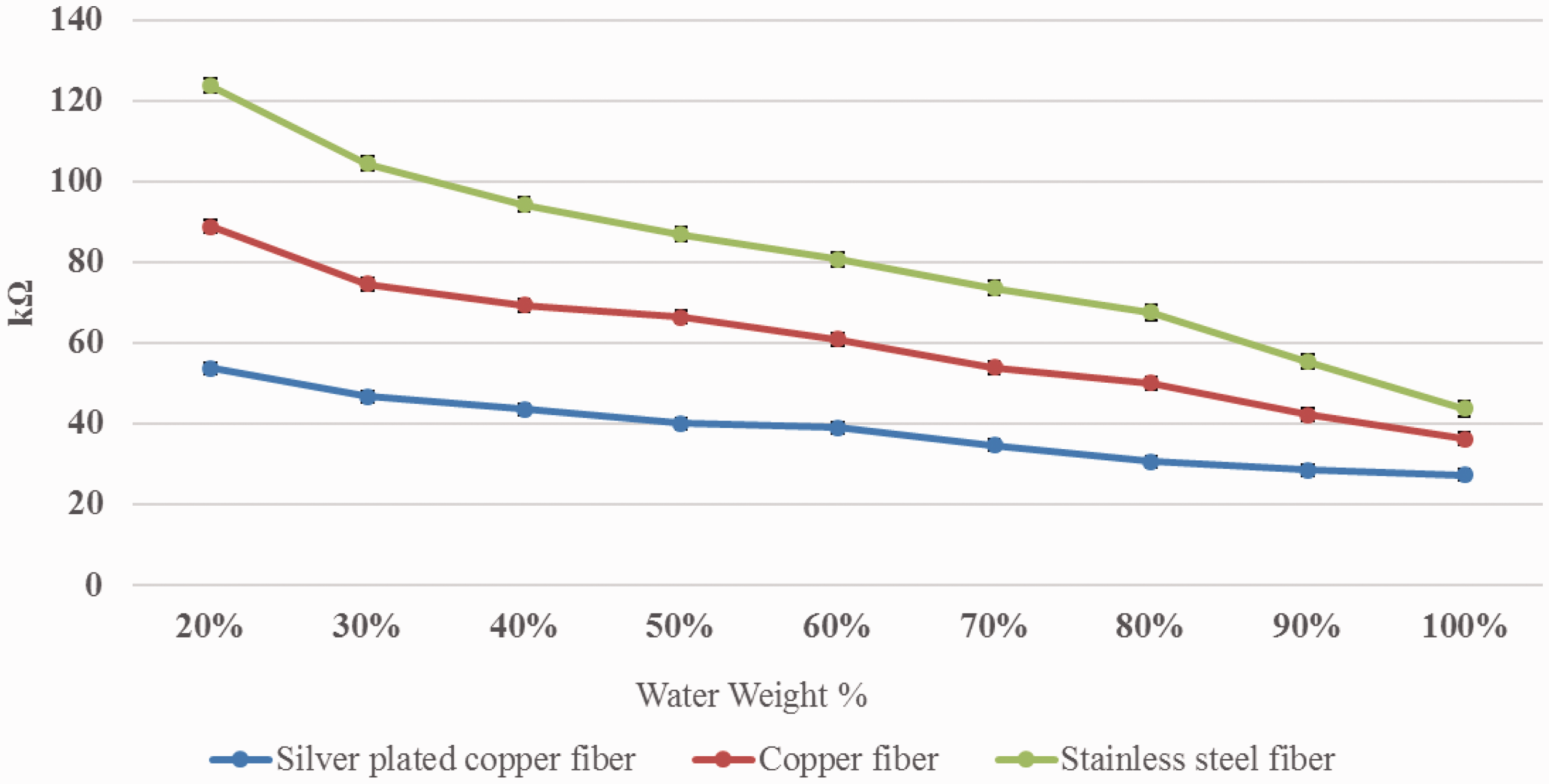
Electric resistance of smart textiles as related to metallic yarns.
Miniature sensor theory
Wheatstone bridge that has been commonly used can measure the electric resistance correctly, and can connect an inverter and sensors with the circuits of amplifiers [19,20]. Moreover, it can measure the unknown electric resistance precisely. The short circuit between the metallic wires indicates the moisture levels of diapers. Thus, connecting a computing amplifier and a simple controller can detect the moisture levels of diapers. Figure 9 shows the antibacterial smart textiles that are composed of two parallel metallic wires. The combination of a computing amplifier, a control set, and Bluetooth module can update the moisture status of diapers any time. The Bluetooth module can upload the information to cloud ends or smart phones, while the control set can send signal to buzzer or cellular phone according to its default. When managing multiple smart diapers, the caretakers can have updated status via the combination of the cloud ends and nurse’s station, reducing the manpower required by irregular checks.

Image of antibacterial/conductive fabrics and the miniature sensor.
Conclusion
The rise of electronic technology and communication technology makes the combination of electronic product and wearable technology the priority of researches. This study proposes an idea, which does not require extra processes or complex processes can make the eco-diaper have intelligent reminders. By contrast, previous studies adopt extra finishing to make the products conductive. For example, they coat conductive materials or print circuits on the fabrics, which makes the mass production difficult. Cloth diapers are a critical product based on the emphasis of environmental protection as paper diapers consume tremendous trees. Moreover, this study proposes using melt-blown PP nonwoven fabrics to replace cotton fibers, making the cloth diaper dry and comfortable for the skins. PP can be decomposed by sunshine and soils without causing environmental pollution, and along with the smart sensing concept, it is hoped that people would use more cloth diapers than disposal diapers. Antibacterial yarns of the cloth diapers decrease the possibilities of skin allergies, but only few studies investigate the effect of antibacterial yarns composed of metallic ions. To sum up, the test results show that yarns consisting of silver and zinc ions have antibacterial efficacy. Moreover, incorporating two metallic wires with cloth diapers facilitates the use of Wheatstone bridge for the detection of moisture levels. The miniature sensors and Bluetooth modules effectively inform the caretakers or nurse’s station of the moisture levels of the diapers.
Footnotes
Declaration of conflicting interests
The author(s) declared no potential conflicts of interest with respect to the research, authorship, and/or publication of this article.
Funding
The author(s) received no financial support for the research, authorship, and/or publication of this article.
