




Abstract
From the beginning of humanity, our generation has been on the edge of finding suitable solutions to increase the product’s life-cycle and reduce the environmental impact of the product. Life-cycle assessment is a process to evaluate the effects of products or services whereas environmental impact assessment is an inter-related process of evaluating the environmental impact of a product or service. Plant fibre reinforced composites are developed by researchers, which are kindled by economic and environmental trepidations. The forest’s wood resources will decline and deplete due to environmental issues caused by natural and renewable resources. The main objective of this review is to conduct life-cycle assessment and environmental impact assessment studies on plant fibres and manufacturing of bio-composites from these fibres. It identifies the differences and causes to the environment, in particular about the total effect on the surrounding atmosphere. Another aim of this work is to assess a techno-economic feasibility based on the environmental impact category. In addition to this, inventory assessments of these composites are also dealt with, alongside the industrial applications. This review concludes a summary of current research and point out the opportunities and challenges for future researchers.
Keywords
Introduction
Bio-fibres–based products are materials which are derived from biological origin, such as, crops, plants or other renewable agricultural, or forestry materials. These products, provide alternative material options to conventional petroleum-based materials by using renewable carbon as feedstock [1]. Natural fibres and their composites are the recent trends in the global context. Natural fibres are a potential substitute for different synthetic materials due to their eco-friendly behaviour, considerable mechanical and physical properties [2,3]. Current researchers focus their research towards novel materials which has a minimal impact on the environment which could replace the conventional composites as they cause ecological problems [4–8]. Plant fibres are the primary choice for such composites as synthetic fibres have severe problems such as they cause skin irritation, allergies, etc [9]. The addition of bio-fillers with plant fibres increases the strength of the composites significantly [10–12]. Measurement of environmental impact assessment (EIA) and life-cycle assessment (LCA) is the current interest of the researchers due to the increased demand for resource conservation [13]. Some properties of plant fibre reinforced composites (PFRCs) are high stiffness, moderate strength, handling adaptability and low density induced the research interest [14,15]. In addition, other factors that reduces the usage or replace the synthetic fibres are lightweight, renewable, non-abrasive, abundant and inexpensive [16–19].
The plant fibres are extracted from the plants by using retting process. This procedure will be influenced by type of soil, climatic conditions, ripeness of plant and harvesting method. In this process, the harvested plants are kept either in the open field or water for 5–10 days, during this period, the chemical composition of fibres is loosened and degraded by micro-organisms. It is the microbial decomposition of pectin, which is commonly used to bind the fibre to the inner core of the plant [20]. The applications of PFRCs are found in many fields like making of bath tubs, chairs, lamp-shades, partitions, fall ceiling, suitcases, trays, tables, and manufacturing of car door panels, interiors, dash-boards, head-liners, decking, parcel shelves, pallets, spare tyre covers, spare-wheel pan, seat backs, etc [21]. Due to the increase in carbon footprints and dependence on raw materials from crude oil, the attention on the green, eco-friendly composites has increased [22]. Land pollution occurred due to the landfill of synthetic fibre reinforced composites upon completion of their life-cycle. Usage of bio-degradable resin with plant fibres has been the current trend as they render bio-degradable, eco-friendly and they can be easily disposed upon completion of their life-cycle [23–25]. In order to confirm the cost saving during the lifespan of the structures, LCA is necessary. More confirmation experiments over the structural stability are needed for the materials that had left the field a long time ago. This is due to the structural failure of materials, such that even the designers are uncertain in mentioning them for such experiments [26].
Shaped fibres with irregular cross-section has large specific surface area, high air permeability with low pressure drop, and are widely used in several applications [27]. The process of manufacturing of the synthetic fibres converts the random structured raw materials into structured fibres by consuming energy, when the carbonization and oxidation furnaces emit NOx, NH3, HCN, etc., which causes hazards to humans and the environment. Due to this reason, various industries like paper-making, packaging, pulping, construction, automotive and bio-medical shifted towards PFRCs which possess numerous advantages and environment friendliness [28–39]. Reinforcement of fibres, energy source and cosmetic products are being catered by parts of plants like seed, bast, straw, woody core and leaf [40]. Natural latex fibres have been widely used in medical devices, gas masks and nipples influenced by high elasticity, good film-forming performance and flexible film, but it is seldom used in nano-materials [41]. Electro-spinning is a process which is used to produce nano-fibres with the help of high electrostatic force [42,43]. The technology uses bubbles to fabricate various functional nano-materials, including nano-fibres, nano-particles, nano-scale porous materials, and two-dimensional nano-materials [44]. During the spinning process for fabrication of cellulose acetate fibres, the moving jet is considered as a string, and its vibration frequency affects the fibre’s mechanical property [45].
Most of the assessments on bio-composite LCAs that were published over last few decades concentrate on EIA comparison of various stages of life-cycle [46,47]. As per the literature, LCAs are focussing towards plant fibre-based composite materials due to the increasing demand for substitution of conventional composites. LCA enumerates the simplified characterization methods for energy consumption assessments. By using this LCA, it could be observed that there is an appreciable impact on the environment due to the materials used for industrial applications, where the assessment is not deeply done [48–50]. Assessment comparisons of existing materials are made for the bio-based plastics and composites where LCA is based on mass or volume production [51,52].
Due to more energy consumption during the manufacturing of bio-composites, their environmental friendliness is doubtful. This can be eradicated by assessing the life-cycle and service life performance simultaneously while the material is designed. It is also helpful in minimizing the environmental hazards during manufacturing. From the literature, it could be found that the studies on LCA for processing of plant fibres and their bio-composites are very limited. The main scope of this review is to conduct LCA and EIA studies on processing plant fibres and their bio-composites. Another aim of this work is to assess a techno-economic feasibility based on the selected impact category. Thus, for industrial and other applications where plant fibre-based bio-composites, this review might be helpful in performing LCA and its impact on the environment. In addition to this inventory and techno-economic assessments for these composites are also dealt with, alongside the industrial applications. The review concludes with the opportunities and challenges in this field for further research.
Life-cycle assessment
Methodology
In the recent years, the life-cycle considerations have become important in the development of composites due to recycling and durability analysis [53]. At each stage of the product life-cycle, from the extraction of feed stocks to the production of a final product, LCA systematically evaluates the environmental burden of a product system using sequential material balance [54]. LCA is one among the intricate methods available for EIA and is also considered to be paramount of all methods irrespective of its demerits [55]. The evaluation of the environmental benefits of potential alternatives may be accomplished using the LCA methodology [56]. Ultimately, LCA can be used to decide the attainability of certain item or process. Each phase of product’s life-cycle and activities with a human intervention are connected with LCA so as to determine resources and analyze the impact of environment. Most robust process for estimating the effects of services and products is considered to be LCA, defined by International organization for standardization (ISO), 2006. The ISO has methodologies of LCA such as ISO 14040, 14041, 14042 and 14043, but for PFRCs, the application of LCA is relatively a new method. This is the reason for the requirement of assessment of fundamental properties of the life-cycle of material throughout. The green tag of an explicit material can be obtained as a result by considering various factors like route towards the end of material’s life, manufacturing process, etc. Indicators like the production of photo-chemical matter, ozone depletion, global warming, eutrophication, acidification, etc., are the common impacts evaluated by using LCA. These impacts, are, however, brought under eco-system, the effect on human health and resources [57]. The categories of widely used impacts in LCA and related assessments are given in Table 1 [58].
Impact categories employed in LCA research [58].

Many adverse environmental effects like green-house gases (GHG) emission are being reduced by reinforcing plant fibre with polymeric material that is established by various LCA studies [51,59,60]. Due to the cognizance of realized inevitability upon human habits and the effect on surroundings and environmental LCA has originated. Organized working upon the environmental issues started during the early 1960s and is still under developing. It was understood from the phenomenon, in which environmental disasters thrived upon energy crisis after the 1960s, that the isolated treatment of events will not work, instead, they are to be faced on in system’s standpoint [61]. LCA initially was applied in USA for the study on beverage packages for the very first time [62]. Environmental disasters and energy crisis that took place in the following years to describe the development of LCA [63,64]. After this, many techniques were developed for analyzing the impact upon the environment by systems or products, and ecological risk assessments [62]. As the whole life of any product or service is taken for its LCA, was a complex process.
The observation of the possibilities and constraints of the methods connected with LCA is naturally vital at all times. The energy flow and materials in the life-cycle of every process are taken into account, as it the actual process of LCA, which remains hidden otherwise. This may result in new ideas for inducing the change and new decisions that have a minimal environmental impact without changing the product functionality. If the data collected and available in hand are deprived and inadequate, then it may end up in the incorrect judgement of the current situation. This communicates that the reliability and quality of data determine the LCA quality which is not only important, but also challenging. Also, while interpreting the results, a clear picture on system boundaries and the basis of analysis are very important [65]. The life-cycle phases for PFRCs from fibre extraction to composite end-life are given in Figure 1 [66].
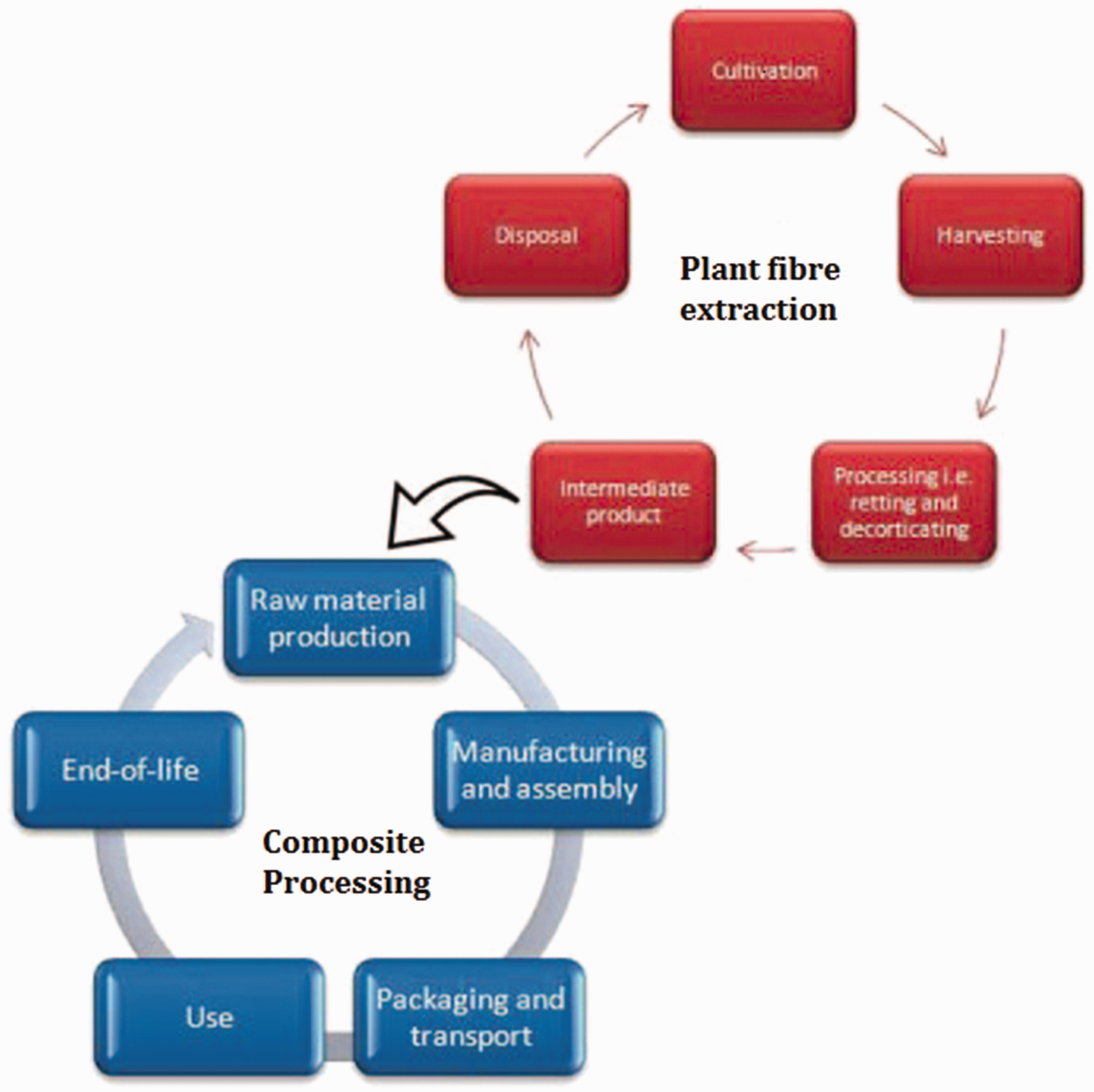
Life-cycle phases for PFRCs [66].
To evaluate the advantages of composite materials upon the environment that has more usage as conventional materials, LCA has gained importance [67–71]. Usually, LCA has following stages: goal and scope definition stage, inventory analysis stage, impact assessment stage and interpretation stage [51,72]. In the current trend of research in materials science, it could be seen that the researchers show a keen interest in enumerating the environmental burdens and different methods for fibre usage along with their potential of reinforcing [61]. Recycling efforts and durability analysis have become a part of LCA which became highly important in composite-based products design. In Figure 2, the unified method developed to use, recover, manufacture and design products and materials for optimal resources throughput along with various aspects of life-cycle engineering concept issues like waste reduction, resource efficiency, life extension and loop closing are shown [73]. This deals with optimal resource concentration during the entire life-cycle by addressing waste minimization and resource efficiency.

Life-cycle engineering [73].
General environmental impacts that could be analyzed by LCA are acidification, ozone depletion, stress on human health and eco-systems, climatic change, tropospheric-ozone, etc. The main reasons for such environmental damage are the consumption of resources, land use and emissions into the environment and these can be assessed by LCA [74]. The comparative LCA between bio-based resin with plant fibre and synthetic resin with glass fibre composites carried out by Rosa et al. [75]. From the results, it could be observed that the bio-based polymers have lower energy consumption and less environmental impact when compared with petroleum-based products. From the comparative study on performance made by Ardente et al. [76] between kenaf fibre board and different usable products, it was concluded that mineral wools had superior performance, whereas the environmental impacts were larger with respect to synthetic materials. Alves et al. [77] disclosed various environmental and economic merits of replacing the glass fibres with jute fibres in an off-road vehicle frontal bonnet through LCA. Ashori [29] made up a toxic-free green sustainable composite using wood. AL-Oqla and Sapuan [78] introduced a composite for automobile industry reinforced with date palm fibres and a comparative study on properties was made. Also, to prove the effectiveness of palm fibre composites in the automotive industry, studies were focussed upon the properties evaluation and compared with other fibres.
The relationship between the environment and society is connected with sustainable development where natural eco-systems that backing the human activities are also considered. This approach needs practices, in which bio-degradable composites can add to advance ecological enhancements in modern methods [77,79]. The quantity of carbon dioxide (CO2) absorbed by PFRCs during processing is equal to the quantity that was given out during the end of their life-cycle when burnt [80]. Figure 3 shows the impounding of CO2 that was maintained by the bio-based products resulted from renewable materials [81]. Above and beyond, high ash content and low energy values during consumption are the characteristics of man-made fibres whereas the plant fibres, have different forms of life cycles which is presented in Figure 4 [82]. Fibres obtained from industrial waste, horticulture waste and consumer waste can be used for fabricating composites [83].

CO2 impounding [81].

LCA of PFRCs [82].
Analysis of LCA
A comparison of the LCA analysis was performed for PFRCs and glass fibre reinforced composites were made and the results may be used to rationalize items ecological execution by identifying the vital causal elements [84–86]. Plant fibres can indicate non-sustainable energy utilization for fibre production, weather conditions, as they are excellent environmental indicators [86]. To kiosk this detention, fibres with low manures and high resistance towards local conditions are to be produced. Few researches for lightweight materials on the theme of LCA occurred in the late 1990s. Earlier stage researches comparing the LCA on automotive door side panels manufactured form hemp fibre and acrylonitrile–butadiene–styrene conveyed that energy needed for the manufacturing of the panel by hemp fibre saves almost 55% when compared with the energy utilization of acrylonitrile. But the problem is quantity of NOx emission, though not too high for hemp fibres, yet was not up to the mark [87]. Schmehl et al. [88] analyzed the results on properties of automobile body components made by hemp and other plant fibres.
Shen and Patel [89] conducted LCA studies in order to gain insight of the environmental profiles of PFRCs in comparison with the conventional petro-chemical polymers. It is found that for each stage of the life-cycle including production, waste management of these products show better environmental profiles than their conventional counterparts in terms of non-renewable energy use and GHG emissions. Pandita et al. [50] investigated the jute/glass fibre composites by using LCA in GaBi 4.3 software steering the focus towards the composite production process. In industrial jute cultivation, high energy consumption is on transportation which is related emphatically with CO2 emission, and also pesticides and fertilizers are required. In 1000 kg of jute fibre production, tentatively 520–1120 kg of CO2 is emitted whereas about 2400 kg of CO2 is inhaled by the plant to grow and so a positive adjustment of 1300–1900 kg of CO2 per 1000 kg of jute fibre is established. The positive effect will be 8.7–12.7 GJ/ton, if at all for every 1 GJ of energy 150 kg of CO2 is released. The energy consumption during the process was presumed to be 30 MJ/kg. The energy utilization for resin infusion or other composite production was supposed to be 10 MJ [90]. Figure 5 shows the stages for preparing hybrid composites which is reproduced from Pandita et al. [50].

LCA stages for preparing of composites [50].
An LCA study for polymeric composites has been carried over by Rosa et al. [75]. This study supported the analysis on the fabrication of composites, effects ecologically induced by the fibre production and the consideration over bio-based and oil-based resins. Based on the usage of composites for various applications and neglecting enormous perspectives with distinct ecological effects, the decision to quit showing the fibres on assembly stage was taken. Appreciable outcomes from LCA based on energy utilization and environmental effects were exhibited by bio-based resins in comparison with oil-based resins. Similarly, synthetic fibres production unveiled higher impact on ecological effect when compared with the production of plant fibres. In contrast, the contribution towards overall procedures was very less form the production of plant fibres, but bio-based resin contributed more for it. It was also proved that while producing eco-resin, there were not only larger depletions in the outflow of GHG and abiotic ingestion when compared with oil-based resin, but also minimal impacts on eco-resin and human health.
LCA was performed to judge the chances of swapping petroleum-based polymers with poly-hydroxyl-butyrate composites [60]. But this study did not consider the effect of the process on the environment, and people or ecological corruption. In a similar way, the hazards on earth increase due to the long response time of several bio-based resins and their low yield which produces huge wastes [91,92]. Equally, the plant fibres may support the ecological execution of composite material as they are seen to be most promising filler. The degree of achieving this can be decided based on the ecological effects of bio-composites in comparison with oil-based composites, and the bio-composites were dominant in all aspects [75]. Since the end of life substitutes would go with bio-based composites suitable for many particular applications, LCA took such situations into account importantly.
The LCA of PFRCs was analyzed by several researchers [93–97]. The LCA of polysaccharide-based materials has been measured by Shen and Patel [89]. From these studies, it could be concluded that plant fibres act as potential replacements for synthetic fibres for land transport applications, as these fibres demand less consumption of energy during production and emitted a lower amount of GHG. Simultaneously, the plant fibres are used to manufacture some interior parts of the automobile; the manufacturers claim that the fuel consumption is better due to the reduction of weight. Additionally, plant fibres are used for the parts like front sub-frames and interior side panels, the emission of GHG reduced by 15%. An exemplary result report on environmental effect was obtained when the plant fibres are used in place of synthetic fibres for bonnet manufacturing [98]. The bonnet for the rough terrain vehicle is fabricated by using cellulosic or synthetic fibres reinforced polymer composites. Even though the difference in properties is obvious, yet it could be seen that plant fibre made bonnets showed improved characteristics. As a result, bio-composites could be used as a potential alternative for improving the properties and environmental execution. LCA had thrown light upon some unnoticed effects like transportation coordination of bio-materials and their recycling in addition to the known effects such as less fuel consumption due to weight reduction when PFRCs were used [99]. Emissions can also be reduced by using plant fibres as they store CO2 at their growth time [100]. Duigou et al. [48] analyzed LCA of bio-composites in accordance with the ISO 14044 standards. This study specified that the PFRCs are quite lesser environmental impacts.
Life-cycle costing/cost benefit analysis
Composites containing incineration, grinding, fluidized bed and end-of-life treatments were investigated through life-cycle costing (LCC) and LCA methods by Astrom [101]. Cost benefit analysis (CBA) is a substitute to LCA and LCC [102–105]. An outline for the evaluation of performance by using CBA for future end-of-life was created by Farel et al. [103] and the economic and technical details were studied. Reliability and correlation between LCC and LCA versus CBA techniques were studied by Hoogmartens et al. [106]. Usually, there are three key differences between LCA, LCC and CBA: first, LCC and LCA are product-related assessments, whereas CBA is a project- or policy-related assessment [107]. Then, LCC and LCA take life-cycles of the products into consideration, whereas CBA, aiming at the life time of a specific product. At last, LCC and LCA have comparative assessment tools, but CBA is usually used for independent evaluation. Recently, concentrations were given to a method that combines EIA and LCC which has a critical role in finding appropriate waste management techniques for taking care of waste burden of end-of-life and producing scrap material. This is advantageous in the determination of applications in the automotive and other areas [108].
Techno-economic analysis
Techno-economic analysis (TEA) is the important factor that is to be considered for ecological changes and sustainability is the importance given to research and development. To stipulate, if the products and technologies are on par with the conventional materials, a bottom-up view can be obtained from a techno-economical investigation. When the techno-economic modelling and innovation go hand-in-hand, the market-driven costs can be assured. Waste of efforts and investments can be avoided by applying techno-economic modelling at the earlier stages of an investigation when all the factors are considered without fail. Execution limit and cost are provided by the models that can assure the materials are being assigned to the finest techniques at a specific time within a certain cycle. But such investigations are unusual in bio-polymers or bio-materials. In an analysis, the impact of adjoining pressure plasma was used for the development of plant fibres which are then used to reinforce into polymer matrices [109]. If the working speed of the foundation-level techno-economic investigation is increased by a factor of 2–10, then financial feasibility for the procedure can be obtained. According to the reports of Wolf et al. [110], the effectiveness of the bio-polymers, attainability of findings such as waste management, farming yield protection and harvest, the framework of industry use phase, handling and industrial productions of fibres are considered to be important aspects. In addition, some other recommendations for the better stimulation include public financing, non-edible industrial utilization of agricultural products and the combination of strategies. At the time of handling, poly-lactic acid can be employed with petty investment cost as it has compatibility with thermo-plastics. Concerning with natural elements, it has been widely accepted by purchasers as they will pay more for eco-friendly items.
TEA is one type of economic impact evaluation which is a market forecast tool used to analyze and compile the fixed capital and variable costs and projects the annual rate of economic return and is usually associated with a commercial production process. A TEA appears to be a viable methodology to analyze the economic impact variations of composites filled with varying materials [111]. Procter and Gamble appraised their business and observed that the market potential depend on the decrease in manufacturing cost, fertilizing the soil, and applies where debasement is vital [110]. Yan et al. [112] inspected the financial and technical components persuading polymer composites. This can oblige as a guide as far as what components can potentially influence the nature irrespective of the usage of plant fibres in place of synthetic fibres. The valorization of biological waste using evolution for the generation of bio-fuels and bio-polymers has been evaluated by Koutinas et al. [113]. They incorporated techno-economic investigation by salient methods and stated that a whole investigation must be done only after preparation of a transitory process sheet that contains the primary procedures. They presumed that the components that should be enhanced to confirm the procedures are focussed incorporate, but not constrained to better end product, better profitability and better yield. At last, few investigations on techno-economic examination are reported that are concentrated on plant fibres and their bio-composites. A cautious investigation on process, comparing it with customary methods, will enable scientists to evaluate and improve the procedures in technically and financially.
Life-cycle inventory assessment
Life-cycle inventory (LCI) describes listing and combination of waste emissions and the resource utilization per a given functional unit. Only after establishing LCI, the assessment on impact can be done on an actual basis. Mainly, this involves the evaluation and categorization of various impacts on environment in a specific life-cycle. Ultimately, in interpretation stage, determination of clear path or probable improvements is decided after going through the results [57]. Burman et al. [61] insisted that the data collection of in- and outflows of the system, calculation of input data and developing a model of process and system is done in inventory analysis phase which consumes much time and resource. Vigon et al. [114] carried out a review of several datasets from different countries with a view of promoting better inter-operability of data sources, the main considerations being the need to improve the process of reviewing LCI and the development of a legal basis to protect the confidentiality of the data.
Environmental impact assessment
The main purpose of EIA is to evaluate the environmental aspects of a product or a process that quantifies the environmental impact of every life stage [115]. The environmental impact of plant fibre-based bio-products are generally assessed by LCA, a well-established methodology that uses a holistic approach to identify trade-offs between impact categories and to avoid shifting burdens over the value chain [1]. This study aims at quantifying the environmental footprint of plant-based bio-fibres processing, identifying the critical environmental aspects and to facilitate systems optimization towards lower overall impacts, and analysis of the environmental impacts of foreseen improvements in the supply chain and production process.
Process of EIA
The EIA is important tool to improve the performance of materials, because it is easy to implement modifications in the design [116]. EIA were assessed based on the following environmental assessment categories: global warming potential (GWP) [117], fossil fuel demand (FFD) [118], acidification and eutrophication [119]. The EIA are performed by using LCA method explained in the ISO standards of 2006. EIA is done by using a method CML 2 Baseline 2000, developed in The Netherlands and named as SimaPro. The impact categories in the CML 2 are abiotic depletion, acidification, eutrophication, global warming, ozone layer depletion, human toxicity and photochemical oxidation.
The EIA was employed to explore the probable impact on environment ensued from the process. Energy consumption, heat flow and mass balance are the main purposes of evaluating the pollutant emissions, energy efficiency and GHG from the procedures [120]. A computing method is projected to assess the impacts on environment resulting from processing by evaluating all components [121]. The environmental indicator to calculate the sustainability of industrial flow process suggested by the Organization for Economic Co-operating and Development (OECD) in 2001. The impacts were evaluated based on the material flow of the particular process [122]. Besides the impacts related to plant growth and cultivation have been taken into account as insignificant factors when compared to the operating phase. It is reported that, when flax fibres are converted into woven form, there is very small or no impact on environment, when compared to synthetic fibres [84,85].
Analysis of EIA
From the review, it could be observed that the environmental impacts during reusing and recycling of fibres are very less land-filling and incinerating of fibres are much advantageous than recycling. However, the studies disclose that there are scenarios in which recycling and reusing are not advantageous regarding environmental impacts. For instance, recycling and reuse may arise if the newly produced fibres are to be avoided. But if they are avoided, then the merits like cleaner production process of fibres and low replacement rates are compromised. If the usage phase is not extended adequately, then there may be environmental impacts due to the transportation of fibres to be reused which is more than the discarded benefit of fibre production [123]. Witik et al. [124] calculated the EIA such as resource utilization, eco-system quality, climate change and health hazards of waste treatments. To determine the equivalent quantity of virgin fibres which act as an alternative to the recycled fibres for the accomplishment of equivalent mechanical performance, a quantitative model was developed. The EIA of manufacturing of optical fibres were examined by using Umberto NXT software, and the results are compared with ReCiPe [125].
For specific applications, the environmental impacts of PFRCs are lesser when compared with certain petro-chemical based composites [59,60,126–128]. Nano-fibre/particles reinforced composite is growing technology, because these fibers/particles can not only improve the mechanical strengths of the composite, but also prevent from vibration related damages [129]. According to Allwood et al. [130], the major environmental issues faced by the textile industry are toxic chemicals, GHG emissions, waste and water use. In accordance with the planetary boundaries outlined by Steffen et al. [131], the industries will remain sustainable if the impact per garment utilization are condensed to 30%–100% by 2050. This range was calculated by Sandin et al. [132] for various EIA categories. Such a tremendous changeover can be possible only if the different aspects of impact reductions are combined, for instance, inclusion in the offing of reuse and recycling more [133]. In an EIA carried out by Li et al. [134] on end-of-life composites, the factors considered are final disposal waste, global warming, energy use, etc. This is inclusive of three choices like incineration, mechanical cycling and landfilling. A comparison between the EIA of composites based on ReCiPe and plastic pellet composites manufactured from bio-materials using LCA was done by Korol et al. [135]. These results were used to quantify the eco-efficiency and are found to conform to the classes EIA. EIA of rice straw-reinforced composites using LCA was analyzed by Boonterm et al. [136]. In spite of higher energy consumption, due to low eco-toxicity and larger fibre yield, the environmental impacts of thermal steam explosion process are lesser than the chemical extraction method.
The EIA of bio-composite materials obtained from polylactide and chicken feathers was investigated by Molins et al. [137]. Cradle-to-gate life-cycle inventories were assessed and found that the addition of bio-fibres to polylactide matrix proportionally reduces all the environmental impacts compared to pure polylactide. Roes et al. [138] studied the environmental and cost assessment of a polypropylene nano-composites and found that clear environmental benefits throughout the entire life-cycle when the composite is processed by using agricultural-based plant fibres. Cellulose hydrolytic degradation of plant fibers is a complex process, it depends upon not only the bond breaking, but also the degree of polymerization [139]. For enhancing the manufacturing process of bio-composites that contains poly (b-hydroxybutyrate)-co-(b-hydroxyvalerate), plant fibre and the environmental impacts are investigated by Miller et al. [95] by using LCA procedures. Usage of alternative fibre types and incineration caused a major fall in impact score, energy consumption and GHG emissions.
A study by Diener and Siehler [99] on plant and synthetic fibres made under-floor panels for all environmental impacts and found that the plant fibre panels dominated in all results by showing a reduction of almost 20% of environmental impact whereas the other fibres showed a lower reduction of impact. From the results, it is evident that the energy needed for the extraction of plant fibre is 80% lesser than the glass fibre. The EIA in the manufacturing of hemp and flax fibres using LCA was studied [140]. Leaving aside the usage of water and pesticide during processing, both fibres behaved alike in all other impacts. But after that, the environmental impact of hemp and flax fibre regarding pesticide use and energy consumption was analyzed by Garcia et al. [141]. In LCA the system boundaries extended from soil management to processing of straw and conveyance fibre bales to mill. Inputs for every system like a seed, fertilizers, energy carriers, pesticides along with their supply was considered in addition to maintenance, use and machinery production. For all the categories of impact analysis, manufacturing of hemp fibres had shown better results.
Gap and further research
The gaps identified from the literature by the review may serve as a motivation for future studies. The advancements in plant fibres and their bio-composites are growing continuously, and the number of studies on them is increasing rapidly. Alongside, as the growth is multiplied by several times during the last decade, the global market for such materials is flourishing. The PFRCs can be utilized in outdoor applications along with the indoor applications in which they are used at present. The effects of LCA on plant fibres and PFRCs have been reviewed owing to adverse ecological reasons. If the important ideas are drummed up support to convince strategy planners, then the bio-based technologies can be confirmed. For instance, the possibility of parts salvaging should be encouraged by lowering the utilize phase emission due to energy, carbon credit after burning and weight decrease. For PFRCs, specifically, the incorporation of the aggregate bio-refinery idea should be carried out as a fresh technique, resulting in improve the fibre properties of the composites. Another key perspective is an endeavor to show synthetic pathways against conventional technologies. With meticulous planning at global and administrative levels, the aforementioned main setbacks can be taken care of. Similarly, to improve the poor damping resistance and mechanical strength, new spearheading research is necessary that improve the adhesion between fibres and polymers.
Conclusions and recommendations
The increasing environmental cautiousness, the demand and utilization of plant fibres, is growing rapidly. The need to achieve sustainability in EIA has incited the formation and expansion of bio-materials by reinforcing plant fibres. This review is used to analyze the overall environmental effects related to products/processes, which governs the mass and energy flows during the material processing. From the literature, EIA on the production of PFRCs can be reduced by performing several agricultural operations, considering the method of ground preparation, usage of organic fertilizer and biological methods to control pests. From the LCA outcomes, it is observed that the resin utilization is the most influential factor to the ecological effect than the reinforcing fibre. From this, it is found that, based on the applications, PFRCs can be compared and found better with synthetic fibre composites. The review proved that the application of plant fibres as reinforcing agent in composites, at first look, it is like an idea that offers a positive effect, naturally, regarding the sustainability of composites. With present technology, the plant fibres-based bio-composites, demand considerably more polymers somehow equalizes the environmental impacts avoided by the fibres and composites. Further researches need to be quickly followed, especially to conduct a widespread analysis of the environmental impact and thorough interpretation of the fibre process industry. Cellulose hydrolytic degradation of bio-based plant fibres is usually characterized in terms of degree of polymerization and fractal ageing model for hydrolytic degradation should be discussed in future.
Footnotes
Declaration of conflicting interests
The author(s) declared no potential conflicts of interest with respect to the research, authorship, and/or publication of this article.
Funding
The author(s) received no financial support for the research, authorship, and/or publication of this article.
