




Abstract
In this work, the synergistic effect of graphene oxide and nanozirconia on the flexural and tribological properties of basalt fiber/epoxy composites was investigated. At the first step, the nanofillers were surface-modified to improve their compatibility with the epoxy matrix. Then, several laminates were fabricated by varying the filler loading. The results revealed that the multiscale composite filled with 0.1 wt.% graphene oxide + 1 wt.% nanozirconia exhibited the maximum flexural strength and wear resistance. Compared to the neat basalt fiber/epoxy composite, the wear rate and friction coefficient of the 0.1 wt.% graphene oxide + 1 wt.% nanozirconia-filled specimen were decreased by 67 and 62%, respectively, whereas the flexural strength was enhanced by 50%. Scanning electron microscopy analysis clearly showed an enhanced fiber-matrix interfacial bonding for the multiscale composite containing hybrid fillers in the matrix.
Keywords
Introduction
Fiber-reinforced polymers (FRPs) with their high strength-to-weight and modulus-to-weight ratios are widely used in many industries, such as aerospace, automobile, marine, and defense. Among all of the reinforcing fibers, basalt fiber as a mineral material has been increasingly employed in high-performance applications owing to its favorable properties such as high mechanical properties, excellent fiber-resin adhesion, good acid-alkali resistance, and high fire resistance [1,2]. Based on these features, basalt fibers have attracted a great deal of scientific interest for fabricating the FRPs. For example, Khalili et al. [3] investigated the tensile and flexural properties of basalt fiber-reinforced and basalt fiber metal laminate composites. Lopresto et al. [4] compared the mechanical properties of E-glass and basalt fiber-reinforced plastic laminates. Colombo et al. [5] investigated the fatigue properties of basalt fiber-epoxy and basalt fiber-vinylester composites. Chen et al. [6] studied the quasi-static and dynamic tensile properties of basalt fiber-reinforced epoxy.
It is generally accepted that the addition of the inorganic nanofillers is an effective way to enhance the mechanical properties of FRPs. This type of material is called multiscale composite. In this regard, numerous publications have investigated the mechanical properties of multiscale composites. For example, in the work of Zhou et al. [7], the maximum improvement in the tensile strength of carbon fabric-epoxy composite was obtained with 2 wt.% loading of carbon nanofibers. Bulut [8] found that the incorporation of 0.1 wt.% graphene nanopellets remarkably increased the mechanical properties of basalt-epoxy composite. Ramakrishnan et al. [9] investigated the effect of nanoclay on the mechanical properties of jute fiber-reinforced epoxy composites. They found that the multiscale specimen filled with 5 wt.% of NaOH-treated fiber and 5 wt.% of nanoclay had higher tensile, flexural, and impact strengths. Abdi et al. [10] showed that with the addition of 3 wt.% nano-CaCO3, flexural strength and tensile strength of basalt fiber-epoxy composite improved by 28 and 20%, respectively. Jamali et al. [11] demonstrated that the tensile, flexural, and compressive strengths of 0.4 wt.% graphene oxide-filled basalt fiber-epoxy composite were 16, 47, and 51% higher, respectively, than that of neat basalt fiber-epoxy specimen.
Due to the high surface-free energy, it is necessary for the nanofillers to be functionalized organically to enhance the filler-matrix bonding. The most useful method to functionalize the inorganic nanofillers is silanization [12,13]. The organic and inorganic groups of the silane molecule react with the organic matrix and inorganic filler, respectively [14]. The positive effects of nanofiller silanization on the mechanical properties of nanocomposites have been shown by some researchers [13,15,16].
From the tribological viewpoint, it is well documented that the incorporation of a small amount of inorganic nanofillers can significantly enhance the wear resistance of FRPs. In the work of Ren et al. [17], it was found that the 2 wt.% graphene-enhanced Nomex fiber/phenolic composite had the highest wear resistance. Anjabin and Khosravi [18] reported that the wear rate of 0.3 wt.% carbon nanofiber-loaded basalt fiber-epoxy composite was decreased by 56% as compared to the neat specimen. Jamali et al. [16] found that the effective graphene oxide content for enhancing the wear resistance of basalt fiber-epoxy composites was 0.4 wt.%. Feiz and Khosravi [13] reported 81% decrease in the wear rate of chopped strand mat-epoxy composite with the addition of 5 wt.% amino-silanized Na+-montmorillonite nanoclay.
In recent years, hybrid nanoparticles have been employed to fabricate the multiscale composites. For example, Li et al. [19] studied the mechanical and thermo-mechanical properties of glass fiber-epoxy composites filled with CNT–Al2O3 hybrids. Tuzemen et al. [20] investigated the synergistic effect of nanoclay and carbon nanotube on the tensile and bending behaviors of carbon fiber-epoxy composites. Synergistic effect of hybrid multi-walled carbon nanotube/nanosilica on the mechanical behavior of carbon fiber-epoxy composites was studied by Monfared et al. [21]. Mechanical properties of graphene oxide + zirconium dioxide-enhanced jute fiber/epoxy composites at different temperature conditions were explored by Prasob and Sasikumar [22].
In a previous study [23], the authors investigated the effect of nanozirconia/graphene oxide hybrid system on the high-velocity impact properties and interlaminar shear strength of basalt fiber-epoxy composite. To the best knowledge of the authors, no experimentally published paper has addressed the synergistic effects of nanozirconia/graphene oxide hybrid system on the flexural and tribological properties of basalt fiber-epoxy composite.
In the present work, the multiscale composites with various amounts of nanozirconia (1, 2, and 3 wt.%), graphene oxide (0.1, 0.3, and 0.5 wt.%), or nanozirconia/graphene oxide hybrid system in the matrix were fabricated, and their behaviors under three-point bending and dry-sliding wear conditions were investigated.
Experimental
Materials
The epoxy resin (KER 828) with a dynamic viscosity of 12–14 Pa s, supplied by Kumho P&B Chemicals (Korea), was used as matrix part. The satin weave basalt fibers with a surface area of 300 g/m2 were obtained through Basaltex (Belgium). Monoclinic nanozirconia with an average particle size of 20 nm and an average specific surface area of 45 m2/g was employed as spherical filler. Also, graphene oxide (6–10 layers) with a thickness of 3.4–7 nm and an average specific surface area of 200 m2/g was used as planar filler. SEM image of graphene oxide and TEM image of nanozirconia are shown in Figure 1. Both nanozirconia and graphene oxide were provided by US Research Nanomaterials Inc. (USA). An amine-terminated silane-coupling agent, 3-aminopropyltrimethoxysilane was provided by Sigma-Aldrich (USA). All material properties are based on company data.
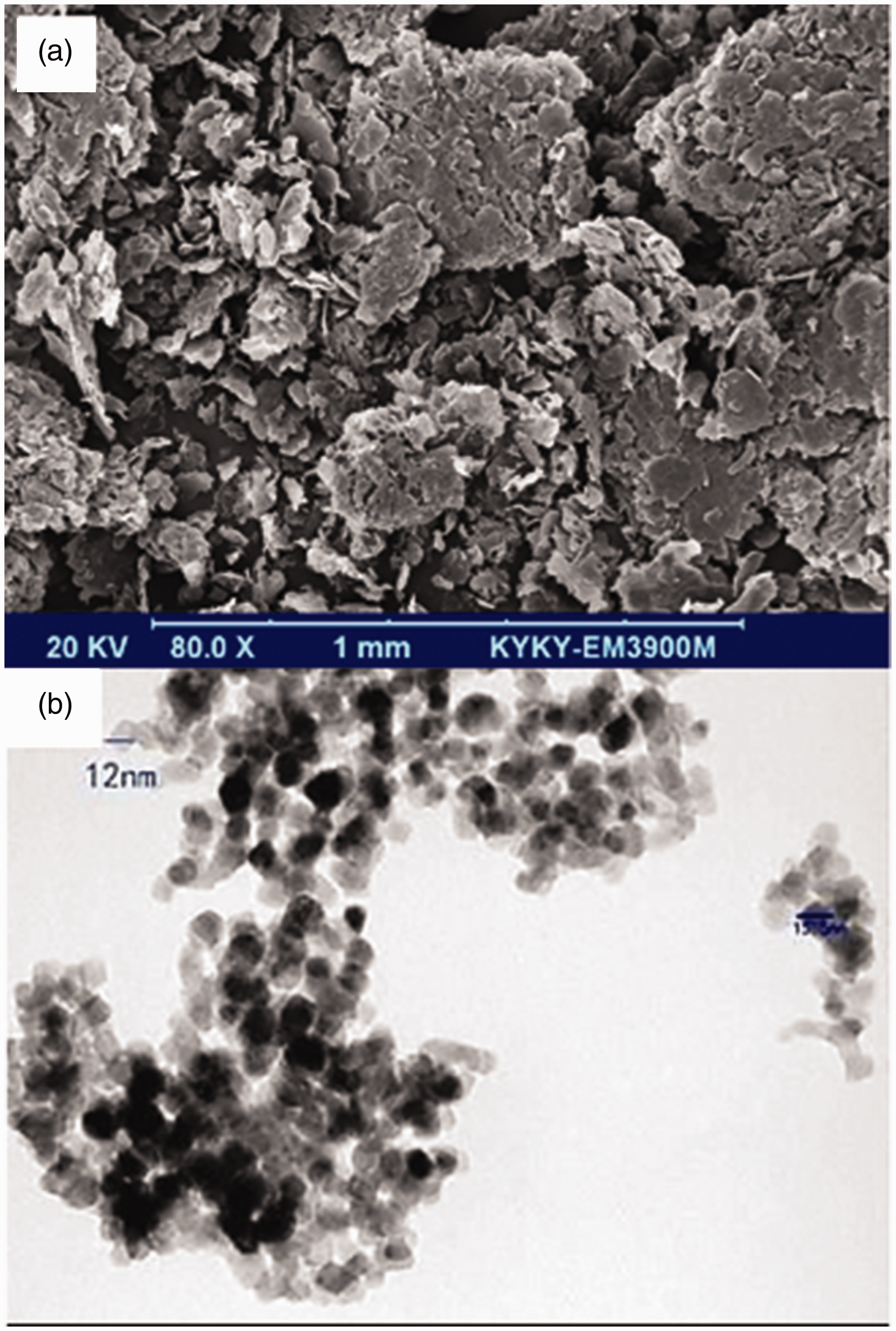
(a) SEM image of graphene oxide and (b) TEM image of nanozirconia.
Surface modification of nanofillers
Three grams of nanozirconia or 0.5 g of reduced graphene oxide were dispersed in 95 ml deionized water + 5 ml ethanol solution. Then, the silane compound at defined levels (3 and 5 g for the nanozirconia and graphene oxide, respectively) was added dropwise to the mixture. The mixture was kept refluxing at 80°C for 8 h, while the pH was fixed at 4 [24,25]. After centrifuging the mixture, the resultant powders were dried at 80°C for 12 h.
Fabrication of specimens
The defined amounts of nanozirconia (1, 2, and 3 wt.%), graphene oxide (0.1, 0.3, and 0.5 wt.%), or nanozirconia/graphene oxide hybrid system were added into the epoxy resin under high-speed stirring for 20 min. Next, the obtained mixtures were sonicated (Ultrasonic Homogenizer 150 W, 24 kHz, TOPSONICS Co., Iran) for 30 min [14,23]. The mixtures were then cooled down to room temperature, and the curing agent was added in 1:10 (hardener: epoxy) weight ratio. Finally, the prepared mixtures were used to fabricate the multiscale composites using the hand lay-up route. For comparison purposes, neat basalt fiber-epoxy composites were also fabricated. The specimens were nominated as “xGO-yZ,” where x and y are the weight percentages of graphene oxide and nanozirconia in the matrix, respectively. The basalt fiber volume fraction in the specimens was estimated around 0.48.
Three-point bending test
The flexural strength and flexural modulus of the specimens were obtained from three-point bending test according to the ASTM: D790-17 standard. For conducting the tests, a Koopa universal machine with 15 kN capacity was employed. The dimensions of specimens were 150 × 25 × 2 mm3, and the support distance was fixed at 64 mm. Also, the cross-head speed of 4.3 mm/min was considered. The values of flexural strength (σf) and flexural modulus (Ef) were calculated using the following equations (based on the standard)


Dry-sliding wear test
Tribological properties of the specimens were investigated using a pin-on-disc wear test according to the ASTM G-99 standard. The slider used was a 52100 steel pin (64 HRC) with a diameter of 5 mm. The applied load, sliding distance, and sliding speed were fixed for all the tests at 20 N, 1000 m, and 0.5 m/s, respectively. The specific wear rate and friction coefficient of specimens were reported. The values of the specific wear rate (K) were obtained by using equation (3) [18]

In this equation, V, N, and l are wear volume loss, applied load, and total sliding distance, respectively.
Characterization techniques
Thermogravimetric analysis (Netzsch TG 209 F1) was performed under nitrogen atmosphere at temperatures ranging from 25 to 900°C at a heating rate of 20°C/min. To characterize the graphene powders, Raman analysis (Teksan (model: Tekram)) with laser excitation of 532 nm was used. A KYKY 3039 M SEM was used to study the worn and fractured surfaces of the specimens.
Results and discussion
Characterization of the modified nanofillers
For demonstrating the successful grafting of silane compound onto the surface of nanofillers, various analyses including FTIR, EDX, TGA, and Raman were conducted. The results of FTIR and EDX analyses have been reported in our previous work published elsewhere [23]. Herein, the TGA and Raman results are reported.
Figure 2 shows the TGA curves of the as-received and silane-modified graphene oxide. With respect to the TGA curve of the as-received graphene oxide, the weight loss between 25 and 180°C is attributed to the adsorbed water on the graphene oxide surface. The weight loss after 180°C is attributed to the decomposition of oxygen-containing functional groups on the graphene oxide surface [15]. On the contrary, TGA curve of the silane-modified graphene oxide shows a remarkable weight loss in the range of 200–600°C which is correlated to the thermal decomposition of silane compound [16]. The TGA curves of the as-received and silane-modified nanozirconia are depicted in Figure 3. It is seen that the as-received nanozirconia is quite thermally stable. However, the silane-modified nanozirconia demonstrates a higher level of weight loss due to the thermal degradation of grafted organosilane chains.

TGA curves of the (a) as-received graphene oxide and (b) silane-modified graphene oxide.

TGA curves of the (a) as-received nanozirconia and (b) silane-modified nanozirconia.
Figure 4 displays the Raman spectra of the as-received and silane-modified graphene oxide. Two characteristics peaks are observable at 1600 (related to the G-band) and 1350 cm−1 (related to the D-band). Higher values of ID/IG ratio represent the more degree of structural disordering [24]. The ID/IG ratios for the as-received and silane-modified graphene oxide are 0.95 and 1.04, respectively, indicating that the ID/IG ratio has not changed significantly after silanization. This means that the surface modification has occurred with a little destruction of the lattice. These observations are in line with the results of other researchers [11,15,16].
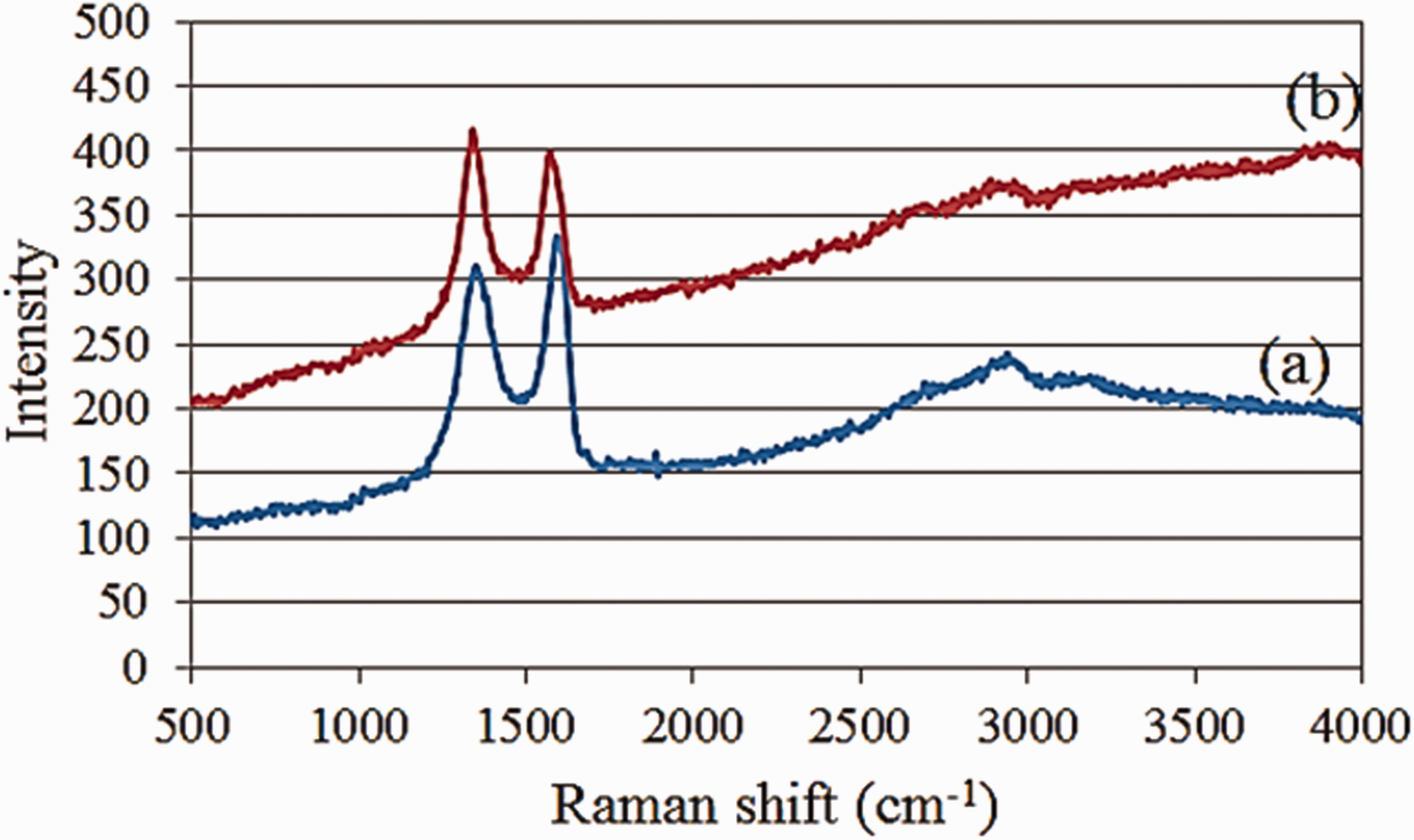
Raman spectra of the (a) as-received graphene oxide and (b) silane-modified graphene oxide.
Flexural properties of specimens
Figure 5 represents the variation of the flexural strength of specimens as a function of filler content. For the graphene oxide-enhanced composites, the 0.3 wt.% graphene oxide-loaded specimen demonstrates the maximum improvement in flexural strength, while for the nanozirconia-enhanced composites, the specimen with 1 wt.% nanozirconia shows the highest flexural strength. The introduction of 0.3 wt.% graphene oxide and 1 wt.% nanozirconia increases the flexural strength of basalt fiber-epoxy composite by 33 and 29%, respectively. However, according to Figure 5, the maximum increase in flexural strength is observed in 0.1 wt.% graphene oxide + 1 wt.% nanozirconia addition (i.e. 50% increase). This clearly indicates the positive effects of nanohybrid system on flexural strength. The observed results are mainly due to the enhanced fiber-matrix interfacial strength contributed by the nanofiller addition. In fact, the nanofillers act as a bonding agent between the basalt fibers and matrix, and as a result, the frictional slippage is limited between them [13]. On the other hand, flexural strength is a matrix-dominated property [25]. By reinforcing the matrix, a considerable part of the applied load is borne by the matrix. At higher loadings of nanofillers (0.5 wt.% graphene oxide + 3 wt.% nanozirconia), the flexural strength is declined probably due to the formation of nanofiller agglomerates within the matrix or interface. This is in line with our previous work [23].
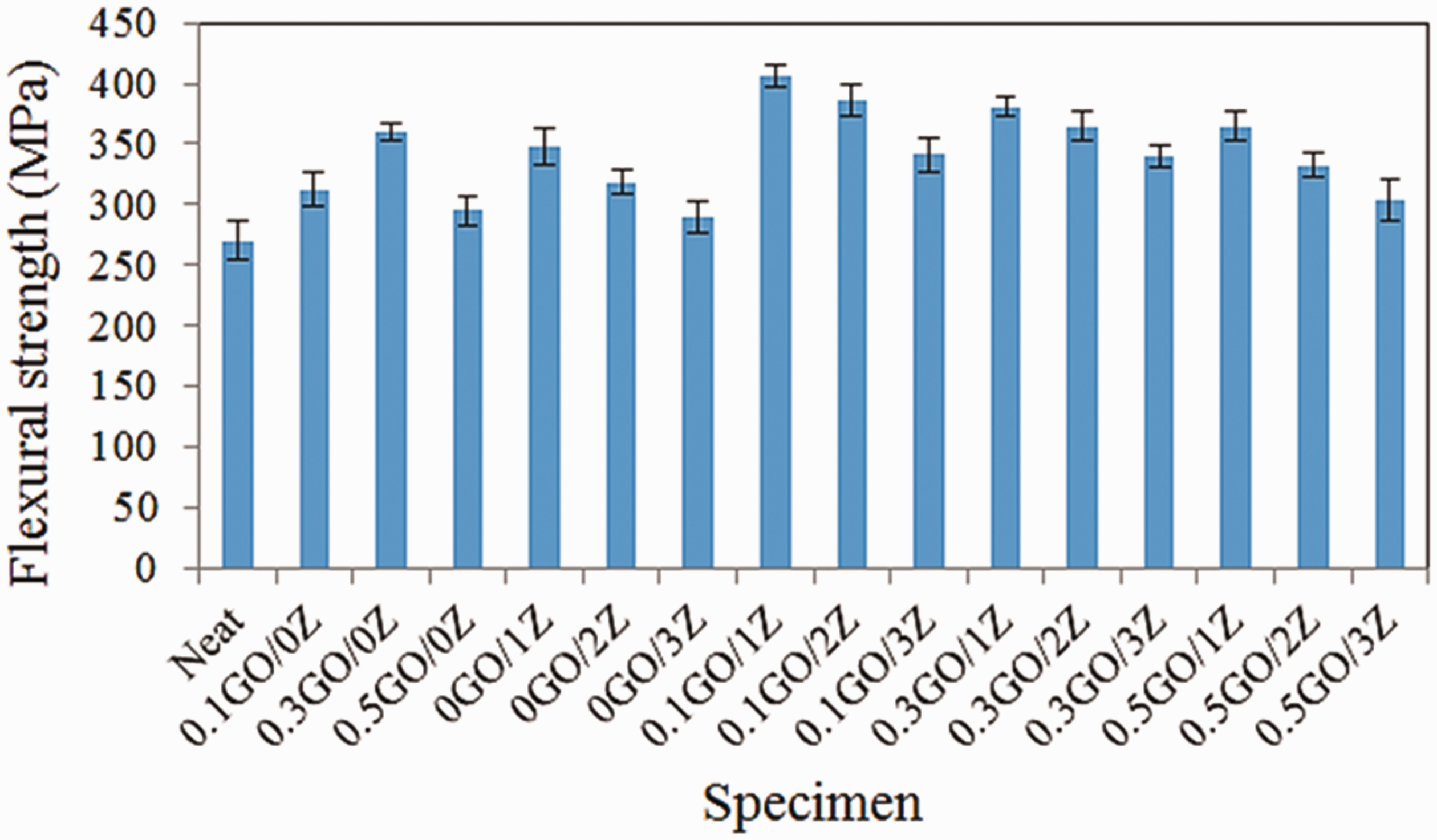
The variation of the flexural strength as a function of filler content.
The variation of the flexural modulus of specimens as a function of filler content is shown in Figure 6. As it is seen, among the various combinations, the multiscale composite with 0.5 wt.% graphene oxide + 3 wt.% nanozirconia addition shows the maximum enhancement in flexural modulus (78%), when compared to the neat basalt fiber-epoxy composite. This is expected due to the higher modulus of graphene oxide and nanozirconia compared to the epoxy matrix.

The variation of the flexural modulus as a function of filler content.
Figure 7 shows the SEM images from the fracture surface of the neat basalt fiber-epoxy and multiscale basalt fiber-epoxy composites filled with 0.1 wt.% graphene oxide + 1 wt.% nanozirconia and 0.5 wt.% graphene oxide + 3 wt.% nanozirconia. For the neat specimen (Figure 7(a)), the surface of the basalt fibers is smooth, indicating that the fiber-matrix debonding is the primary failure mechanism [26]. On the contrary, the presence of matrix along with basalt fibers in Figure 7(b) demonstrates that there is a good interfacial bonding between the fibers and matrix of the 0.1 wt.% graphene oxide + 1 wt.% nanozirconia-enhanced specimen, which is mainly responsible for the improvement in flexural strength. For this specimen, the matrix cracking is the main failure mechanism [26]. Comparing Figures 7(b) and (c) clearly indicate that the interfacial bonding in the multiscale composite containing 0.1 wt.% graphene oxide + 1 wt.% nanozirconia is superior to that in the multiscale specimen containing 0.5 wt.% graphene oxide + 3 wt.% nanozirconia.

SEM images from the fracture surface of the (a) neat basalt fiber-epoxy composite, (b) multiscale 0.1 wt.% graphene oxide + 1 wt.% nanozirconia-enhanced specimen, and (c) multiscale 0.5 wt.% graphene oxide + 3 wt.% nanozirconia-enhanced specimen.
Tribological properties
The wear rate and friction coefficient of the neat basalt fiber-epoxy and multiscale composites containing various amounts of nanozirconia, graphene oxide, and nanozirconia + graphene oxide are shown in Figures 8 and 9, respectively. It should be mentioned that the values of friction coefficients reported in Figure 9 are the averaged values of friction coefficient in the sliding distance range of 0–1000 m. According to these figures, the 0.1 wt.% graphene oxide + 1 wt.% nanozirconia-filled specimen shows the best tribological behavior. When the graphene oxide loading is 0.3 wt.%, the wear rate and friction coefficient of multiscale composite are declined by 37 and 34%, respectively, compared with those of the neat one. Besides, the addition of 1 wt.% nanozirconia into the basalt fiber-epoxy composite reduces the wear rate and friction coefficient by 33 and 37%, respectively. When 0.1 wt.% graphene oxide + 1 wt.% nanozirconia is incorporated, the wear rate and friction coefficient of the multiscale composite reach the minimum values of 3.05 × 10⁻¹⁴ mm3/N m and 0.098, which decrease by 67 and 62%, respectively, compared with those of neat specimen. This clearly indicates the synergistic effect of graphene oxide and nanozirconia for the wear property improvement of basalt fiber-epoxy composites. It is believed that the presence of nanofillers improves effectively interfacial bonding between the basalt fibers and polymeric matrix (see SEM images). The nanofillers act as interlocking agents between the matrix and fibers. Moreover, graphene oxide and nanozirconia can bear some of the applied stress to the specimen during the wear test, and the required stress for the fiber breakage and interfacial debonding is increased. Finally, the nanozirconia particles can prevent the graphene aggregation within the matrix according to the “barrier effect” mechanism [20,23]. At higher loadings of nanofillers (i.e. 0.5 wt.% graphene oxide + 3 wt.% nanozirconia), the wear properties are declined probably due to the formation of agglomerations in the matrix. This is in line with the literature [23].

The variation of the wear rate as a function of filler content.

The variation of the friction coefficient as a function of filler content.
Figure 10 shows the SEM images from the worn surface of the neat basalt fiber-epoxy and multiscale basalt fiber-epoxy composites filled with 0.1 wt.% graphene oxide + 1 wt.% nanozirconia and 0.5 wt.% graphene oxide + 3 wt.% nanozirconia. As indicated in Figure 10(a), the worn surface of the neat basalt fiber-epoxy composite demonstrates the fiber-matrix debonding, matrix cracking, and fiber breakage, which are the primary mechanisms for the FRPs. It can be seen from Figure 10(b) that the interfacial bonding between the nanofiller-enhanced matrix and basalt fibers is improved due to the presence of 0.1 wt.% graphene oxide + 1 wt.% nanozirconia. For this specimen, a relatively smooth surface is observable. As noticed in Figure 10(c), the worn surface of the multiscale 0.5 wt.% graphene oxide+ 3 wt.% nanozirconia-filled basalt fiber-epoxy composite is rougher than that of 0.1 wt.% graphene oxide + 1 wt.% nanozirconia-filled specimen and fiber-matrix debonding can be clearly observed. These observations are in agreement with the results of the wear test.

SEM images from the worn surface of the (a) neat basalt fiber-epoxy composite, (b) multiscale 0.1 wt.% graphene oxide + 1 wt.% nanozirconia-filled basalt fiber-epoxy composite, and (c) multiscale 0.5 wt.% graphene oxide + 3 wt.% nanozirconia-filled basalt fiber-epoxy composite.
Conclusions
In this work, a series of basalt fiber-epoxy composites reinforced with graphene oxide, nanozirconia, and graphene oxide + nanozirconia were prepared, and their wear and flexural properties were evaluated as a function of nanofiller loading. Results showed that the multiscale composite with the addition of 0.1 wt.% graphene oxide + 1 wt.% nanozirconia had the highest flexural strength and wear resistance. The obtained results from the three-point bending test revealed that the 0.1 wt.% graphene oxide + 1 wt.% nanozirconia addition enhanced the flexural strength of basalt fiber-epoxy composite by about 50%. The results of the wear test revealed that the wear rate and friction coefficient of the 0.1 wt.% graphene oxide + 1 wt.% nanozirconia-filled basalt fiber-epoxy composite were decreased by 6 and 62%, respectively, compared with the neat basalt fiber-epoxy specimen. The morphological study revealed that the reinforcement of the matrix in the basalt fiber-epoxy composites improved the bonding between the fibers and matrix.
Footnotes
Declaration of conflicting interests
The author(s) declared no potential conflicts of interest with respect to the research, authorship, and/or publication of this article.
Funding
The author(s) received no financial support for the research, authorship, and/or publication of this article.
