




Abstract
In recent years, the frequent emission of oily wastewater and marine oil spills has resulted in water bodies containing large amounts of light oil/water/heavy oil mixtures. The increasing pollution of the water prompts us to develop new materials that can separate oil and water effectively. In this work, a mixed special wettability fabric based on the backed weave organization is prepared by using different yarns with special infiltration properties. The mixed special wettability fabric can separate the light oil/water/heavy oil three-phase mixtures successfully in one step, due to the effect of gravity-driven and capillary force-driven. Under the optimal process with the reed number of the fabric 84#, the separation efficiency of water can reach 98.36%, and the average separation flux is 0.447 L/m2 s. In addition, the mixed special wettability fabric shows a good recycling, as well as structural stability, which is good for the application in practical oil–water separation.
Keywords
Introduction
The oil/water separation technology can dispose and purify the sewage and achieve the secondary utilization of energy and water resources. Therefore, it shows excellent application prospect in the fields of petrochemical, organic solvent separation, oil production wastewater recovery and sea surface pollution oil treatment [1,2], etc. In recent years, the development of high-efficiency oil–water separation materials and method is one of the research hotspots [3–8]. However, conventional oil–water separation methods [9–11], such as gravity-driven, centrifugation, air flotation, adsorption, biological and chemical methods, usually display low separation efficiencies and discontinuous separation, which increase the workload of workers and cannot meet the requirements of modern industrial development. Due to the difference in surface oil or water wettability of the special wettability materials, it could selectively absorb or repel which might attributed to surface tension mechanism [12–15]. Thereby, the separation efficiency can be greatly improved with this material compared to conventional materials. Up to now, some special wettability materials have been reported for oil–water separation, such as metal mesh [16–18], sponge [19–21], and fiber [22–25], etc. However, most of these materials are difficult to prepare and the preparation processes are inconvenient for mass production and application. Furthermore, all these materials just have a single special wettability which can only be applied to separate a light oil/water or water/heavy oil two-phase mixture. Cao et al. [26] prepared a wettable copper mesh with high efficiency separation by electrodeposition and impregnation process, which can filter oil while intercepting water on the copper mesh. Cao et al. [27] used an amphiphilic cotton fabric (CSPF) for double pre-wetting of oil and water (DCSPF) to give the fabric a special blend of wettability, which can be used for oil–water three-phase separation with a high efficiency of more than 97%.
The backed weave fabric consists of two warp yarn systems and two weft systems, and a separate side of fabric is woven using one weft system and one warp yarn system [28]. Based on the special structure of backed weave fabric, it is possible to weave a special wettability fabric which has the same or opposite wettability for two sides. By changing the weaving parameters, the mixed special wettability backed weave fabrics (MSWBWF) with opposite wettability on the front and back of the fabric, as well as different wettability on the same surface can be weaved. It can be applied to the light oil/water/heavy oil three-phase mixtures continuous separation. Therefore, the effectively separation of oil–water mixture and secondary utilization of energy and water resources [29] can be realized through backed weave fabrics with the mixed special wettability, which are suitable for mass-production at low cost.
To our best knowledge, the design and contexture of special wettability fabrics based on backed weave organization for oil/water separation are rarely reported. In this work, to weave the backed weave organization, super-hydrophobic polyester (PET) yarn and super-hydrophilic viscose yarn were used as two warp yarn systems, respectively. By changing the fabric structure and the beating sequence, the MSWBWF, with different special wettability on the same side and opposite wettability on two sides, was weaved. When the MSWBWF was used for light oil/water/heavy oil three-phase separation, heavy oil and water could fall from both sides of the fabric, respectively, while the light oil was carried onto the fabric.
Experimental section
Materials
PET yarns (32 Tex) and viscose yarns (120 D) were purchased from Zhangjiagang Xiang Mei Textile Co., Ltd and Dongguan Hengzhisheng Textile Co., Ltd. Hydrophobic agent (Fluorine-containing C6 liquid) and the hydrophilic agent (polysiloxane hydrophilic agent) were purchased from Zhejiang Kefeng Silicone Co., Ltd and Jiashan Textile Material Co. Ltd. Absolute alcohol (AR), heavy oil (Chloroform) and light oil (N-heptane) were purchased from Chinese Medicine Group Chemical Reagent Co., Ltd. All reagents were directly without further purification.
Pretreatment of the yarns
In this study, the yarns were finished by conventional dyeing and finishing methods (dipping-drying-baking). First, the yarns were washed twice with deionized water and absolute ethanol to remove stains that were stained during production and transportation. Then, the dried PET yarn and viscose yarn were separately immersed in hydrophobic agent (60 g L−1) and hydrophilic agent (50 g L−1) for 2 h and kept stirring. Finally, both yarns were dried at 80°C for 30 min and baked at 150°C for 3 min. The yarns prepared by this method have a uniform surface effect.
Weaving MSWBWF
The backed weave fabric based on backed weave organization consists of two sets of warp yarns and two sets of weft yarns that do not affect with each other. The external weft and external warp are interwoven to form an upper layer structure, forming a top view of the fabric, while the inner weft and the inner warp are interwoven to form the lower layer to form a bottom view of the fabric. The upper and lower layers of the fabric are interwoven in the interior of the fabric, but are independent of each other. When the fabric is being woven, the MSWBWF can be woven by replacing the upper and lower layers (Figure 1). The entire weaving process includes five steps: warp let-off, shedding, weft insertion, beating-up, and fabric taking-up.

Fabricating processes and the structure of the backed weave fabric.
Oil/water separation
The light oil/water/heavy oil three-phase mixtures were made up of N-heptane, water and chloroform. Just as shown in Figure 6(a), the fabric is sandwiched between the liquid holding device and the separation tube. There are two glass tubes on the separation device for diversion of heavy oil and water. When separating oil and water, the hydrophilic portion of MSWBWF was pre-wetted, then the fabric was fixed in the separation equipment. Next, 20 mL heavy oil/20 mL water/20 mL light oil mixture was injected into the separation device with a syringe. The oil phase and the water phase are dyed red and blue by Sudan Red III and methylene blue, respectively.
Characterizations
All fabrics in this experiment were woven by Jiangyin Tongyuan Textile Co., Ltd. SGA598 semi-automatic loom. The surface morphology of the yarns and fabrics was collected with a Japanese HITACHI-TM1000 scanning electron microscope (SEM). The German Kruss-DSA30 contact angle and surface tension measuring instrument are used to characterize the hydrophilicity and hydrophobicity of the fabric surface; 5 mL of distilled water droplets were used for each measurement, and 5 points of each cloth were randomly selected for testing, and finally averaged. The diameter of the yarn and the thickness of MSWBWF were measured using a spiral micrometer, and 5 points were randomly selected for testing to gain average values. The pore size of MSWBWF was tested by Porolux 100 capillary flow aperture analyzer and the frictional resistance was tested by CM-5 color fastness friction tester.
Results and discussion
Characterization of yarns
The typical scanning electron microscope (SEM) images and the diameter test results of yarns can be seen in Figure 2. Figure 2(a) and (c) shows the SEM images of untreated original PET yarns and viscose yarns, while Figure 2(b) and (d) shows the superhydrophobic PET yarns and super hydrophilic viscose yarns treated with a hydrophobic agent and a hydrophilic agent, respectively. It can be clearly seen that the original PET fiber has a smooth surface without any impurities, but the surface of the PET yarn treated by hydrophobic agent is roughened because of loading a layer of hydrophobic material. The surface of the original viscose fiber has small ditches, while the fiber treated with the hydrophilic agent is partially filled and seems rough. It can be concluded that the finish adheres well to the fibers, giving the fabric a special wettability. The diameter results in Figure 2(e) show that the diameters of the two treated yarns are substantially the same, both of which are 0.08 mm providing the basis for subsequent weaving.

SEM images of the yarns. (a) Original PET yarns; (c) hydrophobic PET yarns and (b) original viscose yarns; (d) hydrophilic viscose yarns and the diameter of yarns (e).
Structure of MSWBWF
Figure 1 shows a 3D simulated image of MSWBWF. It shows that the MSWBWF were woven from two different layers of yarns. From one side of MSWBWF, the underlying yarns were covered completely by the surface yarn. Besides, the surface layer yarns and the lower layer yarns can alternate with each other, which give MSWBWF a special mixed wettability. The visual photograph taken by a digital camera and SEM images of the surface is illustrated in Figure 3. Figure 3(a) shows the MSWBWF woven from white viscose yarns and yellow PET yarns, and different parts of MSWBWF are numbered in the figure. The front PET portion and the viscose portion are labeled P1-f and P2-f, while the opposite viscose portion and the PET portion are denoted as P1-b and P2-b, respectively. Figure 4 shows the SEM photographs of the junction of two fabric structures. In the figure, the portion marked with red is a viscose hydrophilic surface, and that with yellow is a PET hydrophobic surface. As can be seen, the two yarns at the joint have a very obvious boundary. The SEM was used to further observe the fabric structure. As can be seen from the SEM image of MSWBWF (Figure 3(b) to (e)), the yarns on each side of the fabric are neatly and closely arranged. On one side of the fabric surface, one yarn is completely covered by another, just like only one kind of yarns. It indicates that the MSWBWF is weaved successfully and has good double-sidedness.

Intuitive photo (a); SEM images; (b) P1-f; (c) P1-b; (d) P2-f; (e) P2-b.

SEM images of the two-part junction on the MSWBWF at low and high magnifications, respectively, (a, b) front; (c, d) back.
Surface wettability of MSWBWF
The pretreatment of yarns reduces the surface tension of the polyester yarn and increases the surface tension of the viscose yarn. Combining with the high roughness of the fabric itself, the surfaces of the fabric obtain a high special wettability, which is consistent with the Wenzel model of the wetting theory. To better intuitively express the wettability of various parts of MSWBWF, the visual photographs characterization and contact angles test were performed. The water was dyed with blue dye and the oil was dyed red, which can display better separation effect. As shown in Figure 5(a), on P1-f and P2-b of MSWBWF, the blue water is spherical on the surface of the fabric, exhibiting super-hydrophobicity. Contrastively, due to the super-hydrophilicity of P1-b and P2-f, the water wets and spreads on the surface of the fabric causing the dyeing process of the fabric by blue water. It can be seen that the front and back of each part of MSWBWF have exactly the opposite specific wettability. In addition, there are different special wettability on the same surface of MSWBWF, which gives the fabric a special mixed wettability. The oil wettability of MSWBWF under water is shown in Figure 5(b). Figure 5(c) and (e) shows the photographs of the contact angles of P1-f and P2-b with contact angles of 151.3° ± 1° and 152.8 ± 1°, respectively, which shows the super-hydrophobic properties of PET fabric. Figure 5(d) and (f) shows the photographs of the contact angles of P1-b and P2-f, respectively. The test results show that the water droplets can diffuse to the viscose fabric surface at a contact angle of 0° within 1 s to achieve super-hydrophilic standards. The contact angle of P2-b is much higher than that of P1-f because the surface of P1-b is mainly composed of weft, while the surface of P2-f is mainly composed of warp, which received more friction during the weaving process.
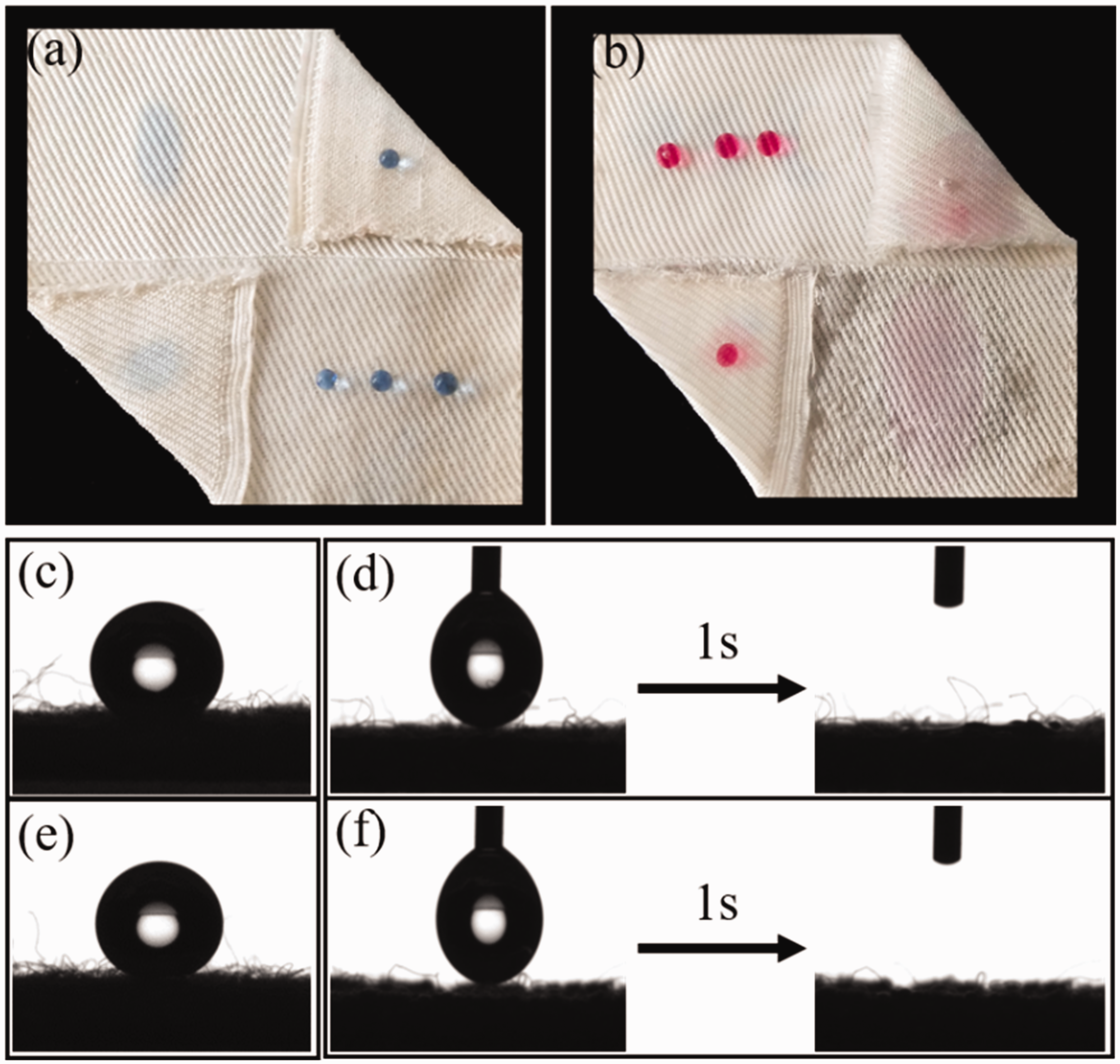
(a) Intuitive photo of blue water droplets dripping on fabric surface; (b) Intuitive photo of red heavy oil droplets dripping on fabric surface under water; Contact angle photo (c) P1-f; (d) P1-b; (e) P2-b; (f) P2-f.
Oil/water separation for the fabric
The MSWBWF shows a different specific wettability on either side, which has good central symmetry. Before separating the light oil/water/heavy oil three-phase mixtures, the hydrophilic portion of MSWBWF is pre-wetted prior. During the separation process, heavy oil and water can continuously flow down from both sides of the separation device, and finally the water film intercepts the light oil above the fabric to achieve the separation, as shown in Figure 6. The performance of separation can be measured by the separation efficiency and separation flux of each phase.
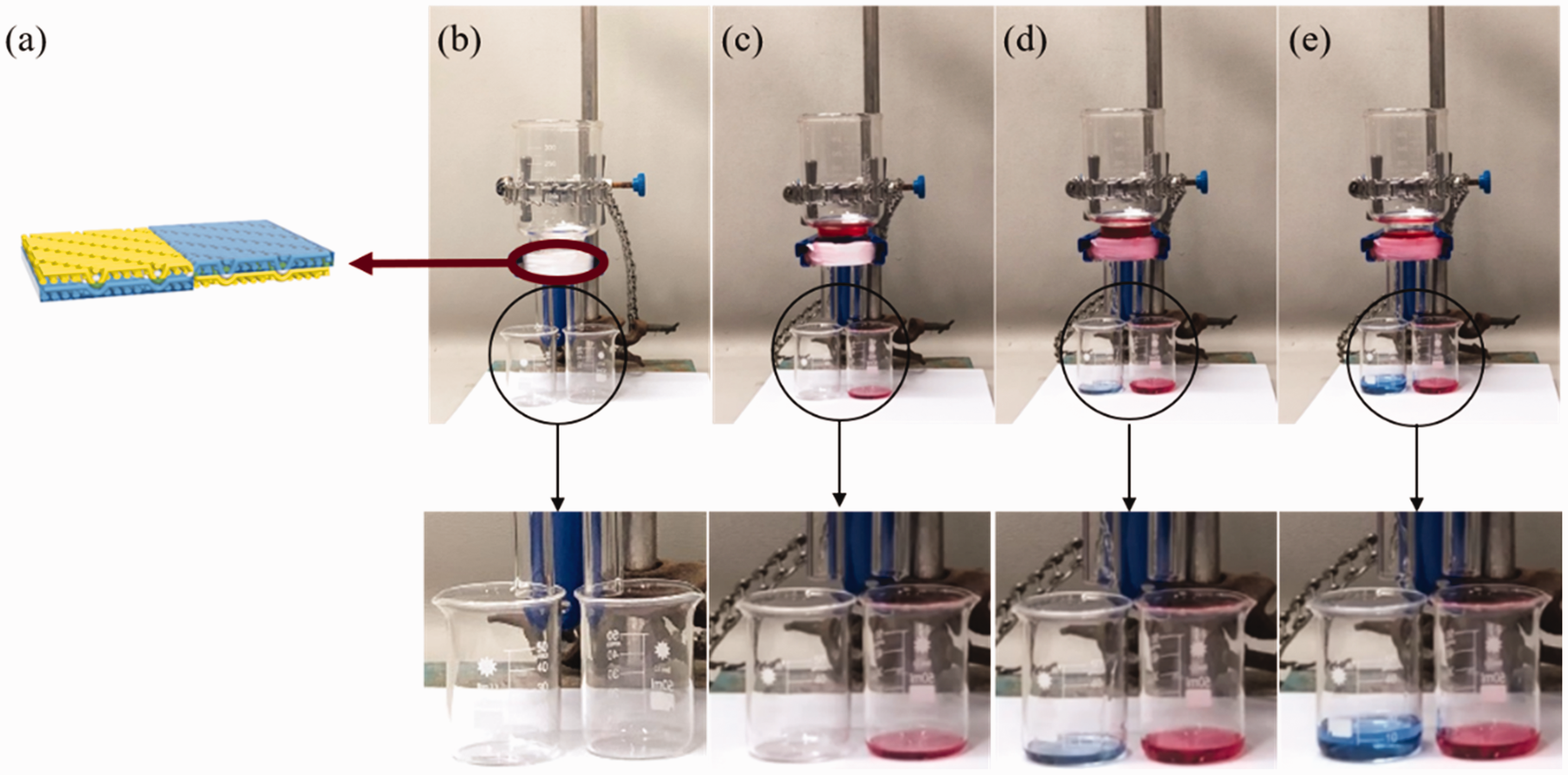
Light oil/water/heavy oil three-phase mixtures continuous separation processes of MSWBWF. (a) Pre-wet 84# MSWBWF; (b) prior to separation; (c) heavy oil flows down the hydrophobic yarn; (d) water flows down the hydrophilic yarn; (e) light oil is intercepted above the fabric.
A certain amount of oil and water were mixed for the oil–water separation experiment. The separation efficiency was obtained by calculating the mass ratio of oil or water before and after the separation, based on the below formula

The separation flux of MSWBWF is expressed by the ratio of the volume of the substance (oil or water) separated by the fabric to the effective area and the circulation time in the separation of the fabric. The specific calculation formula is as follows

The successful separation of the light oil/water/heavy oil three-phase mixtures benefits from the suitable density of MSWBWF, rather than the special wettability [30]. When the density of MSWBWF is too low, the water film cannot intercept the oil and the oil film cannot intercept the water neither, which will lead to all liquid fall from both sides of the device. On the contrary, the separation flux and efficiency will reduce, and even all liquids are impermeable to fabric when the density of MSWBWF is too large. Therefore, only when MSWBWF has a suitable density, the water film formed by the pre-wetting can intercept the heavy oil and compel heavy oil flow down the hydrophobic yarn. Also due to the water film, the light oil can be intercepted on the fabric instead of flowing down the hydrophobic yarn.
In this work, the density of MSWBWF was investigated by a single factor experiment. The density of MSWBWF can be expressed by reed number (RN) which refers to the number of reed teeth per 2 inch length of steel reed (root/2 inches unit, usually written as #). MSWBWF with 56#, 70#, 84# and 98# reed number were woven separately and subjected to oil–water separation experiments. As show in Figure 7, with the increasing of density, the thickness of MSWBWF and the surface contact angle of the hydrophobic portion increase. When the density of MSWBWF reached 84#, the contact angle of the hydrophobic surface in MSWBWF can reach to 150°, exhibiting superhydrophobic properties.

Thickness of the special wettability fabrics. Water contact angle of the hydrophobic surface of the fabric with different reed number.
When the reed number is 56#, all the liquid fall down from both sides due to the loose structure and large gap of MSWBWF, which goes against the purpose to separate oil–water mixture. With the increasing of the reed number to 70#, the heavy oil and water can be dropped from both sides in succession, but the water film cannot intercept the light oil above the fabric finally. Then, when the reed number reached to 84# and 98#, the MSWBWF become closer for successive separation of light oil/water/heavy oil three-phase mixtures. Notably, when the reed number is 98#, the structure of MSWBWF is too tight causing the separation flux lower and the separation time longer, which is unable to meet the principle of efficient separation. Thus, the conclusions could be drawn out that proper fabric density is important to fabricate effective fabrics applied for light oil/water/heavy oil three-phase mixtures continuous separation. When the reed number is 84# with the average fabric thickness of 0.54 µm, the oil–water separation efficiency of water can reach 98.36%. The separation flux of the heavy oil is 0.351 L/m2 s, while the separation flux of water is 0.543 L/m2 s.
The mechanism of oil–water continuous separation can be illustrated in Figure 8. Firstly, the MSWBWF is pre-wetted to separate the heavy oil and water. When the heavy oil is separated, a water film is present in the hydrophilic portion of the MSWBWF. At this point, the heavy oil droplets flow down the weakest portion of the water film along the hydrophobic yarn, due to the combined action of their own gravity, hydrostatic pressure, capillary driving force and resistance from the water film, as shown in Figure 8(a) and (b). After the separation of the heavy oil, an oil film is formed on the hydrophobic yarn of the MSWBWF to hinder the passage of water. When the aqueous phase of the mixture contacts the water film on the external hydrophilic yarn of the MSWBWF, the presence of the heavy oil film on the hydrophobic yarn prevents it to further flow. Then, the water droplets are affected by their own gravity, hydrostatic pressure, capillary driving force and resistance from the water film, which causes them to pass through the weakest portion of the heavy oil film and flow down along the hydrophilic yarn (Figure 8(c) and (d)). Lastly, when the aqueous phase is separated successfully, there is a water film in the hydrophilic part of the MSWBWF. Meanwhile, because of the small density and less residual liquid, the combined force of light oil own gravity, hydrostatic pressure and capillary driving force is unable to resist the resistance of the water film. Therefore, the light oil is intercepted above the MSWBWF (Figure 8(e) and (f)). In conclusion, the success of light oil/water/heavy oil three-phase mixtures continuous separation relies on the driving of gravity and capillary forces, where the capillary force depends on the superhydrophilic-underwater superoleophobicity and superhydrophobic-superlipophilicity of the two parts of the MSWBWF. As shown in Figure 9, on the fabric after successfully separating, the oil phase was adhered to the polyester portion of the fabric. The water phase was adhered to the viscose portion, which verifies the correctness of the separation mechanism.

Force diagrams of droplets on MSWBWF surface during oil–water separation. (a, b) Force diagram of heavy oil droplet on the super-hydrophobic surface when water film exists; (c, d) force diagram of water droplet on the super-hydrophilic surface when heavy oil film exists; (e, f) force diagram of light oil droplet on the super-hydrophobic surface when water film exists (Go: Oil gravity, Gw: Oil gravity, Fr: Resistance, Fh: Hydrostatic pressure, Fc: Capillary driving force).

Fabric after separation of oil and water. (a) F1; (b) F2.
To investigate the importance of pre-wetting for continuous separation of light oil/water/heavy oil three-phase mixtures, oil–water separation experiments on MSWBWF without pre-wetted were compared. In this experiment, when the three-phase mixtures of light oil/water/heavy oil are separated, the heavy oil can only be separated successfully. The separation efficiency of heavy oil is 88% (the fabric absorbs part of the heavy oil) with 12.632 L/m2 s of the separation flux. During the separation process, heavy oil falls from both sides of the device because the hydrophilic portion has no water film. After the heavy oil flowed, the separation cannot continue because the entire MSWBWF is covered by a heavy oil film intercepting the mixture of water and light oil (Figure 10(a)). The water/heavy oil two-phase mixture is separated by the MSWBWF that has not been pre-wetted, and only heavy oil can be successfully separated (Figure 10(b)). The separation principle in the compared experiment is the same as the separation continuous of the three-phase mixtures, and the separation efficiency of the heavy oil is 86%, with 9.825 L/m2 s of the separation flux. The separation flux is smaller than the former because the two-phase mixture is lighter than three-phase. Thus, the heavy oil is subjected to a small hydrostatic pressure. When the light oil/water two-phase mixture is separated by the MSWBWF not been pre-wetted, the water flowed down the hydrophilic yarn and the light oil is intercepted above the MSWBWF by the water film (Figure 10(c)). The light oil/water mixture can be successfully separated. However, the water needs to wet the hydrophilic portion of the MSWBWF along the hydrophilic yarn, which extends the separation time. The experimental phenomena indicate that no droplets flow at the beginning of the separation. As the water wetted the MSWBWF and begun to drip, the water phase flows down the hydrophilic yarn more quickly to the side of the device. It can be concluded that pre-wetting of the MSWBWF is a necessary condition for the separation of the light oil/water/heavy oil three-phase mixtures successfully.

Oil–water separation of 84# MSWBWF without pre-wetting. (a) Light oil/water/heavy oil three-phase mixtures’ separation process; (b) water/heavy oil mixture’s separation process; (c) light oil/water mixture’s separation process.
In order to evaluate the stability and recyclability of the MSWBWF prepared, the effect of cycle number on separation efficiency was also investigated. The MSWBWF was subjected to separate oil and water continuously using an n-heptane/water/chloroform three-phase mixture. It is worth noting that the first oil–water separation shows the lower separation efficiency of heavy oil, which is because of some of the heavy oil adsorbed by the polyester yarn and remained in the separation device. After 30 times of separations, the separation efficiency is maintained above 96% (Figure 11(b)). In addition, the hydrophobic surface of the MSWBWF remains highly hydrophobic (contact angle was maintained above 140°), while the hydrophilic surface still remains superhydrophilic (contact angle is 0°) (Figure 11(a)). Therefore, the MSWBWF in our work exhibits excellent cyclability.

Cycle test of oil–water separation. (a) Water contact angle tests of the MSWBWF on super-hydrophobic surface and super-hydrophilic surface after 30 cycles; (b) separation efficiency tests of the MSWBWF for light oil (N-heptane)/water/heavy oil (chloroform) mixtures after 30 cycles.
Pore size of MSWBWF
The pore size refers to the shape and size of the pores in the porous solid. The pores in the object are basically irregular. We usually think pore as a circle and use its diameter to indicate the size of the pore. The pore size distribution of 84# MSWBWF is shown in Figure 12. The results show that the average diameter of the pore is 0.22 µm. Therefore, it can be concluded that 84# MSWBWF with an average fabric thickness of 0.54 µm and an average pore size of 0.22 µm has the best separation effect of light oil/water/heavy oil three-phase mixtures.

The pore size distribution of 84# MSWBWF.
Frictional resistance of MSWBWF
Furthermore, the frictional resistance of the MSWBWF was tested through a rubbing fastness test with cotton as standard friction cloth. As shown in Figure 13, after 300 times of frictions, the contact angle of the droplet on P1-f hydrophobic surface remains 139.6°, while the contact angle on the P2-b hydrophobic surface is 144.7°, which remains hydrophobic, close to superhydrophobic. After rubbing 300 times on the hydrophilic surface of the viscose, there was no damage or obvious pilling remaining 0° of the contact angle, indicating the hydrophobic agent and the hydrophilic agent have excellent effects on the finishing of the PET yarn and the viscose yarn, respectively. Besides, after passing the friction with the loom and friction tests, it still maintains good hydrophilicity and hydrophobicity.

The anti-friction test results of the MSWBWF. (a, b) Intuitive photos of the front and back of the fabric after 300 rubs, respectively; water contact angle (WCA) photo after 300 rubs (c) P1-f; (d) P1-b; (e) P2-b; (f) P2-f.
Conclusions
In summary, a MSWBWF with different special wettability on the same side and on two sides was weaved using super-hydrophilic viscose yarn and super-hydrophobic PET yarn as raw materials based on backed weave organization. The MSWBWF can effectively separate light oil/water/heavy oil/three-phase mixtures continuously driven by gravity and capillary forces, with a separation efficiency of 98.36% and 0.447 L/m2 s of the average separation flux. After 30 times of separations, the separation efficiency maintained above 96%. Compared with other oil–water separation materials, the MSWBWF in this work has many advantages, such as simple preparation method, extensive raw materials, good cyclability and mass-production potential. More importantly, our research provides new ideas for one-step oil–water three-phase separation and has great potential in solving water pollution problems, including recycle of gutter oil, wastewater treatment, reclamation of oil seepage. The fabric is also expected to be used for water-harvesting and for the preparation of sportswear fabrics with a single-guide wetness.
Footnotes
Declaration of conflicting interests
The author(s) declared no potential conflicts of interest with respect to the research, authorship, and/or publication of this article.
Funding
The author(s) received no financial support for the research, authorship, and/or publication of this article.
