




Abstract
This study fabricated flexible radar-absorbing knitted compound materials by weft knitting and blending ferromagnetic nickel micron-fibers and cotton fiber into structures with a concave–convex surface, including rhombic, mat, wavy, and leno stitches. The electromagnetic wave-absorbing capability and mechanical properties of the flexible radar-absorbing knitted compound materials were evaluated. The results showed that the rhombic, mat, and wavy stitches displayed high mechanical properties with high bursting strength and there were no significant differences among them. The rhombic stitch flexible radar-absorbing knitted compound material with a ferromagnetic nickel micron-fiber content of 14% had a maximum bandwidth of 13 GHz and achieved a minimum reflectance of −20 dB at 7 GHz, which was 150% that of mat fabric, and 200% that of wavy fabric and leno fabric. This was ascribed to the fact that the concave–convex surface with regular diamond-shaped block improved the dispersion of the electromagnetic wave, weakened the wave strength, and increased the interference. Therefore, the rhombic stitch flexible radar-absorbing knitted compound material was the most suitable for flexible radar-absorbing material in this study. The development of flexible radar-absorbing materials, by combining aerospace technology, military technology and textile technology, is important for the application in stealth of aircraft and weapons.
Keywords
Introduction
Radar stealth technology refers to the weakening of signals from an object and reducing the probability of being discovered, in order to conceal and protect the target [1]. Voice stealth technology, radar stealth technology, visible light stealth technology, and infrared stealth technology are the main stealth technologies currently in use, among which radar stealth technology is considered to be the most important [2]. For better results, reducing the radar scattering area of the target by applying wave-absorbing materials or configuration design are preferred, rather than changing the target shape, which is limited by high costs and manufacturing challenges. Therefore, the application of stealth technology mainly depends on electromagnetic wave-absorbing materials.
There are two methods of electromagnetic wave absorption: firstly, electromagnetic wave-absorbing materials absorb and attenuate the energy of incident electromagnetic waves by converting the electromagnetic energy into heat energy; secondly, electromagnetic waves are dissipated through interference [3,4]. Electromagnetic wave-absorbing materials use two wave loss mechanisms to attenuate incident electromagnetic waves: magnetic losses and dielectric losses. The former is achieved by using a magnetic material, while the latter mainly converts the incident electromagnetic wave energy into heat energy or other forms of energy by means of electrical loss of the material [5]. The thickness, mechanical properties, and adaptability to the environment of electromagnetic wave-absorbing materials are important factors [6]. In the battlefield, electromagnetic wave-absorbing materials are employed to protect lives.
The radar-absorbing material eliminates the impact of electromagnetic waves on some technical equipment to guarantee its normal work and increase the service life of the equipment [7]. From the previous research on radar-absorbing materials, most studies have been focused on fabrication and properties of filling or surface coating of hard materials [8]. However, fewer researches have explored the development of flexible radar-absorbing materials. Therefore, it is important to develop flexible radar-absorbing materials with knitting structure to advance the future of stealth technology [9,10]. Among various fibers used to fabricate flexible radar-absorbing materials, ferromagnetic nickel micron-fiber has the advantages of having high resistance, good conductivity, high permeability, and strong electromagnetic wave absorption. It has been used as an absorbing material in the military, medical, or transportation applications [11]. However, ferromagnetic nickel micron-fibers are relatively brittle, poor in elasticity and strength. Therefore, to overcome its shortcomings, we used a ferromagnetic nickel micron-fiber /cotton fiber with blended yarn to knit flexible fabrics [12,13].
In this study, flexible radar-absorbing knitted compound materials with blended yarns of ferromagnetic nickel micron-fiber and cotton are fabricated via weft knitting. The development of flexible radar-absorbing materials, by combining aerospace technology, military technology, and textile technology, which are mainly employed in stealth of aircraft and weapons, has important practical significance [14]. To develop a lightweight, high strength, effective, and flexible radar-absorbing material, the fabric sheets with concave–convex surfaces and different structures were prepared, including rhombic stitch, mat stitch, wavy stitch, and leno stitch. These four kinds of tissues were chosen because they are relatively common, display high unevenness and are woven using a simple process. The electromagnetic wave-absorbing capability and mechanical properties of the flexible radar-absorbing knitted compound materials were evaluated.
Experimental
Materials
X-ray diffraction data of ferromagnetic nickel micron-fiber.

The nickel–iron content in the ferromagnetic nickel micron-fiber was more than 90%, which is responsible for the electromagnetic wave-absorbing properties of the fiber. Trace oxygen content is presumed to be due to partial oxidation of surface of the ferromagnetic nickel micron-fiber [15]. Figure 1 represents the scanning electron microscopic (SEM) images of the ferromagnetic nickel micron-fiber in cross-sectional and longitudinal directions. SEM images of the ferromagnetic nickel micron-fiber in (a) cross-sectional and (b) longitudinal directions.
It is apparent that the ferromagnetic nickel micron-fiber is straight with irregularly shaped cross-sectional and longitudinal grooves. The radar-absorbing principle of the profiled section is similar to that of the wedge absorber. The longitudinal groove of the ferromagnetic nickel micron-fiber expands the specific surface and increases the hysteresis loss of the wave, leading to the enhancement of the radar-absorbing property. Furthermore, the longitudinal groove improves the cohesive force between the fibers, which contributes to the formation of textile semi-finished products and improves yarn formation.
Ferromagnetic nickel micron-fiber/cotton fiber blended yarn (supplied by Hebei Shenhui Textile Co., Ltd), was the main absorbing material in this study, which was prepared with various fiber blend ratio. Specifications of the ferromagnetic nickel micron-fiber /cotton fiber blended yarn are shown in Table 2. Figure 2 presents the SEM images of the blended yarns with 10% and 14% ferromagnetic nickel micron-fiber ratio in cross-sectional and longitudinal directions, in which the fibers with hollow structure are cotton fiber and the others are ferromagnetic nickel micron-fibers. SEM images of the blended yarn with10% ferromagnetic nickel micron-fiber ratio in the (a) cross-sectional direction and (b) longitudinal direction; the blended yarn with14% ferromagnetic nickel micron-fiber ratio in the (c) cross-sectional direction and (d) longitudinal direction. Specifications of the ferromagnetic nickel micron-fiber /cotton fiber with blended yarn.

Fabrication of knitted compound structure
Specifications of electromagnetic wave-absorbing materials.

The rhombic stitch is formed by the rhombic shape of the front loop and reverse loop, and the surface of the fabric presents a relatively clear concave and convex appearance, which is a single jersey structure. The mat stitch is alternately knitted by the front loop and reverse loop in the same course. The surface of the fabric produces a concave and convex effect with a small square pattern with mesh stitch, which is also a single jersey structure. Wavy stitch consisted of a loop and suspension arc with single-needle multi-column tuck. The leno knitting process was realized by transferring the loop needle into a mesh stitch, the transfer mode is carried out according to the pattern requirements. The loops on needles 2, 4, 6, and 8 are transferred to needles 3, 5, 7, and 9 on the first course of a complete organization. The 2, 4, 6, and 8 needles in the second row were looped on the empty needle. On the fabric surface, the wales are temporarily interrupted to form a mesh. The preparation process of the rhombic stitch, mat stitch, and wavy stitch is shown respectively in Figure 3(a), (b), and (c), and the leno stitch is a transfer stitch that is guided by the program to control needle bed to the left and right to achieve the loop transfer. The loop transfer process is shown in Figure 3(d). The notations of four stitches are plotted in Figure 4. Notations of four stitches: (a) the rhombic stitch, (b) the mat stitch, (c) the wavy stitch, and (d) the leno stitch. Photographs of front and back faces of (a) rhombic stitch, (b) mat stitch, (c) wavy stitch, and (d) leno stitch.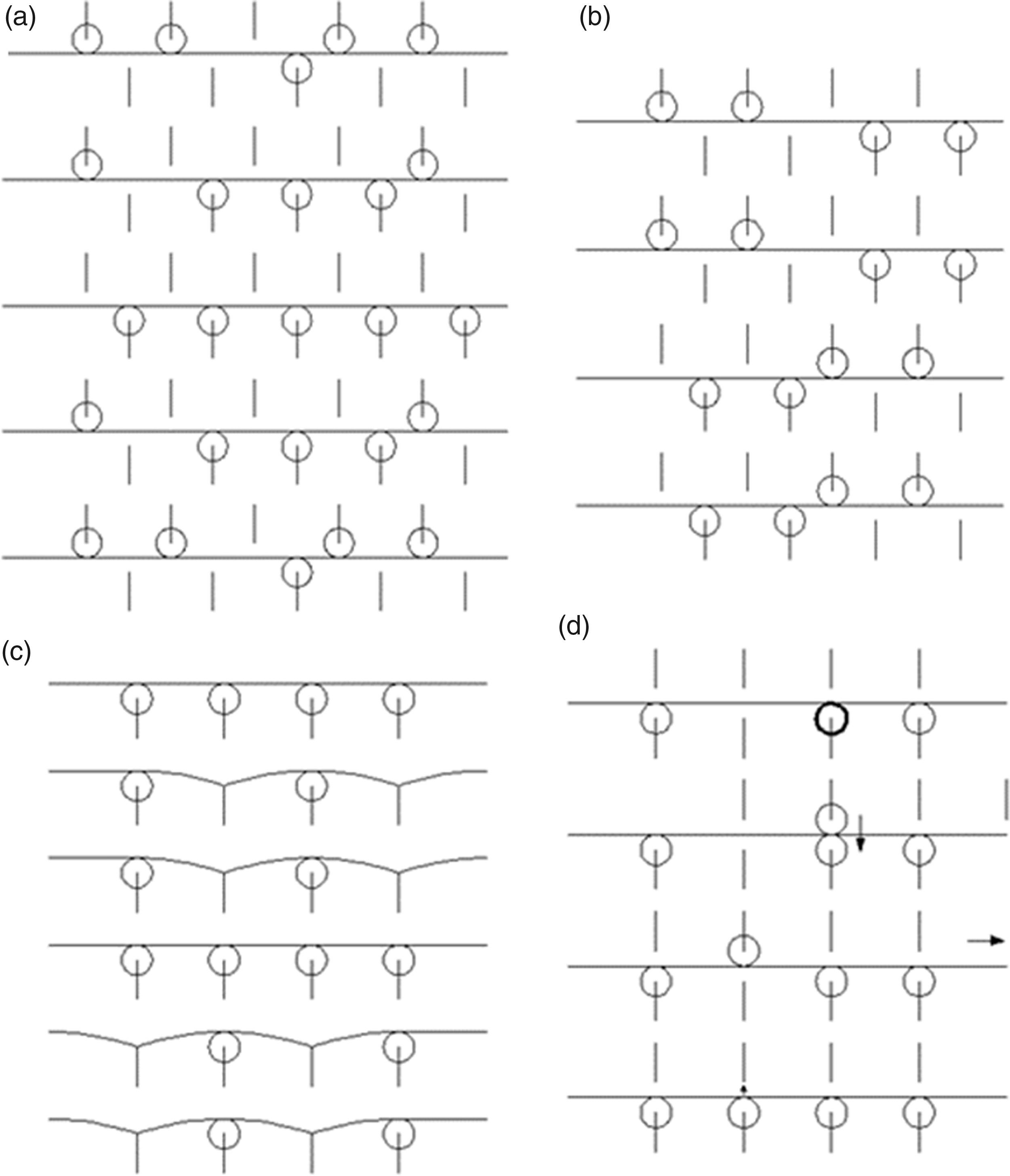

Testing
Yarn performance test
The yarn tenacity test was carried out by YG020B single yarn tenacity meter (ShuangguDunda Electromechanical Technology Co., Ltd. Changzhou) in reference to ASTM D2256/D2256M-2010e1 “Standard Test Method for Tensile Properties of Yarns by the Single-Strand Method”. The sample length was 500 mm and was drawn at a velocity of 500 mm/min. The YG171B-2 yarn hairiness tester (ShuangguDunda Electromechanical Technology Co., Ltd. Changzhou) was used to test the hairiness of the yarn according to the FZ / T01086-2000 standard. The test speed was 20 m/min, and the number of test groups was 10. Each group was 10 m. The Y731-type cohesion force tester (Xinrui Instrument Co., Ltd., Xiamen) was used to test the yarn wear resistance. The load cell of tension hammer was 200 N, and the number of tests was 30.
The air permeability test
Samples and the corresponding air jet hole sizes.

Bursting strength test
The bursting strength was measured on the YG (L) 031 type of the top breaking strength machine (2500 N Load cell, Textile Research and Measurement Equipment Development Center, Shandong) with reference to the standard of GBT 3923.1-2013. Samples were trimmed to a circular fabric with a diameter of 60 mm. Ten specimens from each category were evaluated.
Electromagnetic wave-absorbing test
Reflectivity is an index used to represent the absorbency of electromagnetic waves by wave-absorbing materials. Thus, reflectivity is an important parameter for characterizing the absorbing properties of a material. In the case of negligible transmission, the reflectance and absorptive are equal to 1, a smaller rate reflects a better absorbing capacity of the material. The reflectivity of an electromagnetic wave-absorbing material is measured by the arch reflection testing method in accordance with the military standard of GJB2038A-2011. The test system consists of an arch reflection testing system, a transmitting signal device, a network analyzer, and an absorption signal device [17]. The arch emits electromagnetic waves to the specimen located on a conductive metal platform. When passing through the transmitting antenna to the fabric surface, the electromagnetic wave is reflected and transmitted back to the receiving antenna. Then, the network analyzer collects the data, which is recorded in the computer. The schematic diagrams of the arch reflection testing system and test equipment physical map are shown in Figure 5. The ratio of reflected power values of the sample to the conductive metal platform equals to the reflectivity. The formula is given as follows The schematic illustration of the arch reflection testing system.

Results and discussion
Effect of fiber blend ratio on yarn tenacity
Yarn tenacity with different fiber blend ratios.

Volume modulus of stitch and tightness factor of flexible radar-absorbing knitted compound materials
The volume modulus of stitch reflects the space in the fabric that is not filled by the yarn, which can be used to determine the actual density of the knitted fabric. The larger the volume modulus of stitch, the looser the fabric is. Another parameter that indicates the actual density of the knitted fabric is the tightness factor. The greater the tightness factor, the tighter a fabric is. That is to say, the relationship between actual density of the knitted fabric and tightness factor is exactly opposite to the modulus of stitch volume. It can be seen from Table 3 that the rhombic stitch has the lowest volume modulus of stitch but with the largest tightness factor. The unfilled coefficient of the leno stitch is the highest, whereas its tightness factor is the lowest. The rhombic stitch has a high density and its leno stitch is the slackest.
Bursting strength of flexible radar-absorbing knitted compound materials
Figure 6 shows the bursting strength of flexible radar-absorbing knitted compound materials with various fiber blend ratios and knitting structures. The bursting performance directly affects the practical application of the flexible radar-absorbing knitted compound materials, in terms of the signal projector, detector, protecting instruments, vehicles and buildings, etc. Bursting strength is related to fiber type, yarn fineness, fabric structure, and finishing method [22]. It can be seen from Figure 6 that there is a slight difference in the bursting property between the flexible radar-absorbing knitted compound materials fabricated with same structure and those with different yarns. Comparison among samples with various structures showed that leno stitch exhibited the lowest bursting strength of approximately 700 N. The bursting strength values of rhombic stitch, mat stitch, and wavy stitch ranged from 1050 to 1150 N, which were about 150% of the leno stitch. The main reason is that the leno stitch has openwork structure while the other three structures have no openwork element. Consequently, the leno stitch exhibited the lowest bursting strength. Comparison of bursting strength of flexible radar-absorbing knitted compound materials with various structures.
Air permeability of flexible radar-absorbing knitted compound materials
Air permeability refers to the materials covering coefficient, which strongly influences the transmissivity of electromagnetic wave and radar-absorbing performance [23]. However, flexible radar-absorbing knitted compound materials can improve the heat dissipation of the protected vehicle at given air permeability when applied in the military, thus optimal air permeability is a necessary parameter of the radar-absorbing material. The air permeability of a fabric depends on the size and number of voids in the fabric [24]. The air permeability is inversely related to the stitch density. When the stitch density of the fabric is high, the amount of fabric permeation is low and the air permeability is poor. Figure 7 illustrates the air permeability of the four kinds of flexible radar-absorbing knitted compound materials with the ferromagnetic nickel micron-fiber ratio of 10%. It can be seen that the leno fabric has the highest air permeability, whereas the surface of the wavy fabric has the smallest air permeability. This is could be explained by the mesh opening in the leno stitch causing the lowest total density, which was only 66% that of the wavy stitch density. Wavy fabric exhibited the highest thickness but the lowest volume modulus, hence it had the lowest air permeability. Air permeability values of the four flexible radar-absorbing knitted compound materials with the same organization and different ferromagnetic nickel micron-fiber contents.
Comparison of the air permeability among the four kinds of flexible radar-absorbing knitted compound materials with the ferromagnetic nickel micron-fiber ratio of 14% in the fabric showed that the leno fabric exhibited the highest air permeability while the wavy fabric exhibited the lowest air permeability, which was similar to the phenomenon with 10%.
For the same fabrication structure, the sample value with ferromagnetic nickel micron-fiber ratio of 14% was always lower than that of 10%. The main reason is that the ferromagnetic nickel micron-fiber contained inorganic particles, which had higher fiber density and lower fineness than cotton fibers, thus that the porosity of sample with ferromagnetic nickel micron-fiber ratio of 14% was higher but fiber volume fraction was much lower than the sample with a ratio of 10%. The resistance to airflow was consequently increased.
Electromagnetic wave-absorbing capability of flexible radar-absorbing knitted compound materials
The electromagnetic wave-absorbing capability is represented by reflectivity. The electromagnetic wave-absorbing capability increases with the decrease in reflectivity.
In the frequency–reflectivity curve shown in Figure 8, the peak represents the maximum reflectivity to the electromagnetic wave at this frequency, whereas the trough represents the minimum reflectivity. The sample with the lowest reflectivity has the best absorption effect. The electromagnetic wave-absorbing capability was compared between different structures of the flexible radar-absorbing knitted compound materials with a ferromagnetic nickel micron-fiber content of 10%, and the results are shown in Figure 8. Comparison of electromagnetic wave-absorbing capability among different structures with ferromagnetic nickel micron-fiber content of 10%.
It is apparent that the flexible radar-absorbing knitted compound materials with rhombic stitch exhibited the reflectance of −20 dB at 7 GHz, which was 150% the value of the mat stitch sample, and approximately twice that of the wavy stitch and the leno samples. This is because the rhombic stitch structure exhibited regular diamond-shaped blocks on the surface, which produced a relatively concave–convex phenomenon and irregularly dispersed electromagnetic waves, weakened the waves with high frequency, increased interference between waves, all of which resulted in internal reflection, refraction, and loss. Therefore, the structure enhanced the radar-absorbing effect.
Figure 9 illustrates the electromagnetic wave-absorbing capability of the four kinds of structures with the ferromagnetic nickel micron-fiber content of 14%. The rhombic stitch structure achieved a reflectance of −24 dB at 23 GHz, which was 150% the value of the mat stitch fabric, and twice the value of wavy fabric and leno fabric. It can be observed that the influence of the fabric structure on the electromagnetic wave-absorbing capability of the fabric is nonsignificant as the blend ratio of ferromagnetic nickel micron-fiber increases. Comparison of electromagnetic wave-absorbing capability among different structures with ferromagnetic nickel micron-fiber content of 14%.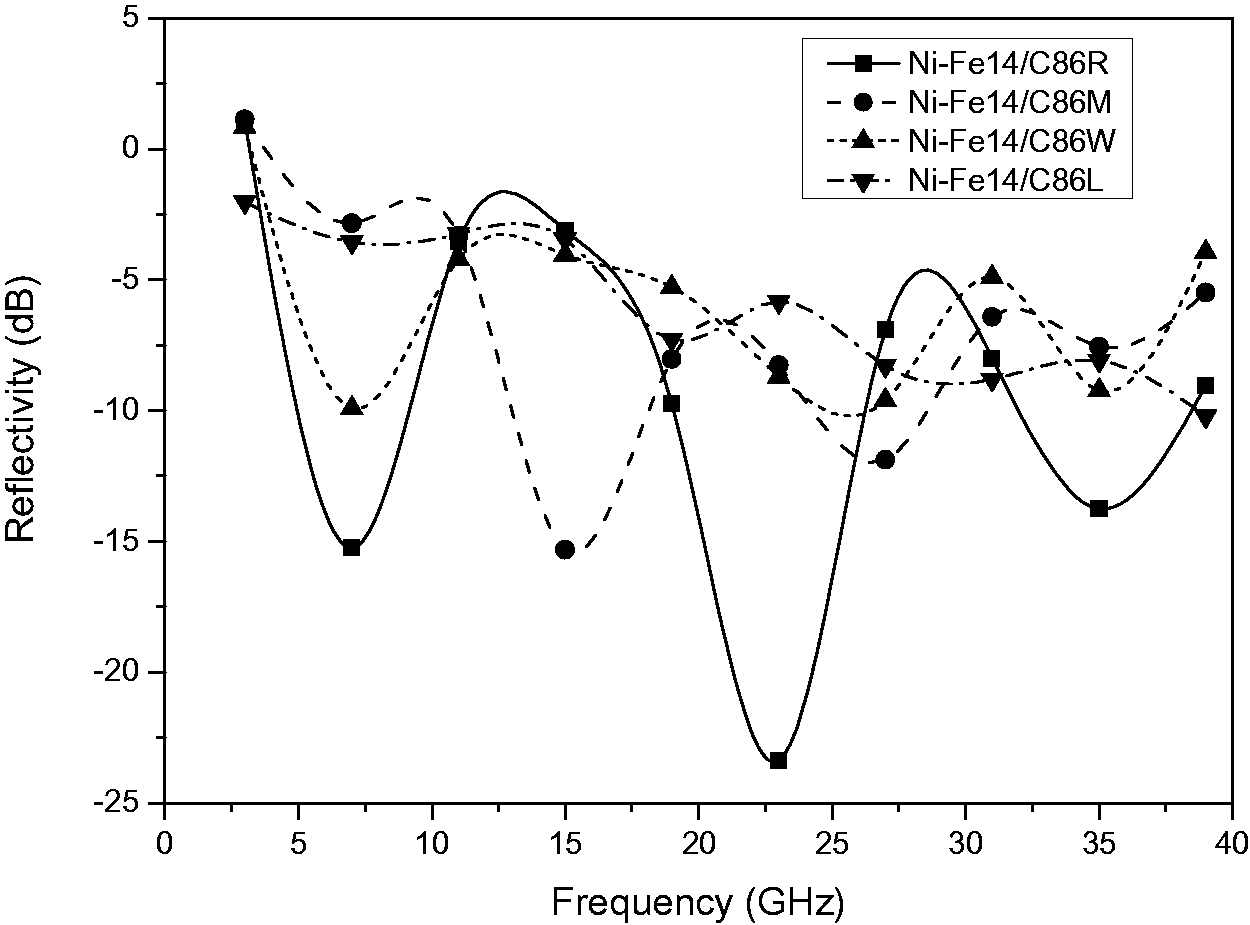
Figure 10 shows the comparison between reflectivity of flexible radar-absorbing knitted compound materials with a fiber blend ratio of ferromagnetic nickel micron-fiber of 10% and that with 14%. The reflectivity of the sample with a ratio of 14% was lower than that of 10% at the frequency range of 15–40 GHz. At the frequency range of 3–15 GHz, however, the sample with a ratio of 10% exhibited a lower reflectivity than the sample with 14%. Comparison of the optimum reflectivity of flexible radar-absorbing knitted compound materials with different ferromagnetic nickel micron-fiber ratios: (a) rhombic stitch, (b) mat stitch, (c) wavy stitch, and (d) leno stitch. Comparison of the bandwidth of flexible radar-absorbing knitted compound materials with various ferromagnetic nickel micron-fiber ratios.

Bandwidth is an important index used to indicate effectiveness and application range of flexible radar-absorbing knitted compound materials. As shown in Figure11, the flexible radar-absorbing knitted compound materials with the ferromagnetic nickel micron-fiber blend ratio of 14% displayed wider bandwidth range than the sample with 10% when the sample structures were same, which was ascribed to the high content of metal particle. All samples with 10% ratio had a bandwidth below 6 GHz. The rhomboid stitch and wavy stitch exhibited approximately equal and widest bandwidths of 6 GHz, which were 50% higher than that of mat structure and six times that of leno. The flexible radar-absorbing knitted compound materials with rhombic stitch and a ferromagnetic nickel micron-fiber content of 14% had the maximum bandwidth of 13GHz, which was 30% higher than that of mat stitch, approximately twice that of wavy stitch, and six times that of leno structure. Based on the optimal bandwidth, the rhombic, mat, wavy, and leno stitches samples were ranked as suitable for application, in that order. Rhombic stitch with diamond structure exhibited the most excellent radar-absorbing property.
Conclusions
This study successfully prepared flexible radar-absorbing knitted compound materials by blending ferromagnetic nickel micron-fibers and cotton fibers to form concave–convex surface structures, including rhombic, mat, wavy, and stitches. Electromagnetic wave-absorbing capability, bursting strength, air permeability, and yarn tenacity of the flexible radar-absorbing knitted compound materials were measured. The following conclusions can be drawn from the results of this study. The rhombic, mat, and wavy stitches exhibited high bursting strength and there were no differences among them, which were approximately 50% that of leno stitch with the lowest bursting strength. The yarn with a ferromagnetic nickel micron-fiber ratio of 10% had the highest unevenness. Rhombic stitch sample achieved a minimum reflectivity of −20 dB at 7 GHz, which was 1.5 times of the mat stitch, and twice that of the wavy or leno stitch. The main reason of the advantage is that the diamond-concave and convex exhibited on the surface of rhombic stitch. Incident electromagnetic waves are focus and intensive and the diamond-concave and convex can dissipate the waves, weaken the intensity and increase the interference, which can finally weaken the incident waves and exhibit the highest electromagnetic wave-absorbing capacity. Leno stitch performs the lowest electromagnetic wave-absorbing capacity because of the openwork structure and thin thickness. Another way to weaken the electromagnetic wave is multiple layered laminates, which reflects waves among layers and enhances the wave interference. It is apparent that the reflected frequency of electromagnetic wave of leno stitch is lower than the other three stitches and, consequently, the electromagnetic wave-absorbing capacity is the lowest. This led enhanced the radar-absorbing property of the materials. As the ratio of ferromagnetic nickel micron-fiber increased, the absorbing capacity of the fabric was enhanced significantly.
We intend to systematically investigate the isotropy of wave absorption, which reflects the absorption capacity of the incident wave from various directions. Given that textile materials have high flexibility, convenient processing, lightweight, low cost, etc., they can be applied in many fields, including ordinary and unordinary situations, such as covering irregular and complicated surface devices. Multi-functional flexible radar-absorbing knitted compound materials integrating lightweight and high-strength three-dimensional properties are ideal mainstream protective materials for military applications.
Footnotes
Declaration of Conflicting Interests
The authors declared no potential conflicts of interest with respect to the research, authorship, and/or publication of this article.
Funding
The authors disclosed receipt of the following financial support for the research, authorship, and/or publication of this article: This work was supported by the Key R & D projects of Hebei Province Science and Technology Department [16211009D]; the National Defense Research Project of Hebei University of Science and Technology [2016GF07]; Funding of Hebei Education Department [QN2018038]; Funding of the doctoral program of HEBUST [1181240]; Funding of Hebei Natural Science Foundation [E2019208424]; and Youth Talents Plan of Hebei Province.