




Abstract
Soft elastomer-coated fabrics are widely used in engineering and protective applications. Puncture cutting by sharp-tipped objects is one of the most common failure modes of protective gloves made of coated fabrics. In order to investigate the puncture-cutting process of soft elastomer-coated fabrics, we studied the mechanisms and mechanics of pointed-blade insertion into specimens cut out from four protective gloves. Experimental and analytical analyses showed that total energy and critical puncture-cutting force calculated analytically are both able to predict the puncture-cutting resistance of soft elastomer-coated fabrics measured experimentally. Total energy is obtained from the relationship between the puncture-cutting work and the created fracture area, while critical force is calculated by two analytical models developed for soft elastomeric membranes. The components of the critical puncture-cutting force are predicted analytically and then used to calculate the compressive and shear loading stress components based on the contact surface between the pointed blade tip and material. Since there is a linear relationship between the compressive stress component and shear stress component, a modified linear strength criterion is proposed for puncture cutting of soft elastomer-coated fabrics by a pointed blade. Our stress-based criterion connects the 45° tensile strength (in the 45° direction) and biaxial strengths (in the course direction, 0°, and wale direction, 90°) to both compressive and shear loading stresses. The analytical and experimental results are consistent. This investigation can be used as a guideline to evaluate the puncture cutting of soft elastomer-coated fabrics using an energy-based criterion, critical force-based criterion, or stress-based criterion.
Introduction
A soft-coated fabric is the combination of two different materials and has properties not available in a single material [1]. For protective gloves, knitted fabrics generate good flexibility and, when made of high-performance fibers, generate high strength to protect hands from sharp-edge cuts, among other properties. However, these fabrics generate no chemical, biological, or puncture resistance. When coated with a polymer, they can generate resistance to chemical and biological hazards, as well as to puncture, while maintaining their flexibility [2]. Soft elastomer-coated knitted structures are widely used in protective gloves, which are factory-made through a dipping process [2].
Workers in occupations such as metalworking, food processing and industrial papermaking commonly wear protective gloves of this kind, as they are exposed to various cut and puncture hazards. Failure of soft elastomer-coated fabric caused by an indenter or blade has not much been investigated. Some researchers have tested the puncture resistance of coated fabrics using a pointed blade [3], rounded probe [4,5] or flat-tipped cylindrical probe [6]. Specific puncture mechanisms such as fiber stretching, breaking, and delamination have been considered the main contributors to the puncture of an uncoated material by a rounded probe [7], but Hassim et al. [4] showed that all these mechanisms become insignificant in the puncturing of coated fabrics, due to the effect of the coating layer. Furthermore, they showed that the coating layer restricts the deformation of the specimen. They observed a circular deformation on the front face of the specimen, but only a small deformation on the back face. Although there is very little information in the literature on the puncture and cutting mechanics of soft elastomer-coated fabrics, the failure mechanisms and mechanics of fabrics in general have been widely investigated [7,8]. In the quasi-static puncture of high-strength polyester yarns, the indenter experiences yarn slippage during penetration due to the contact pressure [7]. In the slice-push cutting of woven and knitted fabrics by a blade, however, two types of friction control the critical cutting force: a macroscopic friction on both sides of the blade and a sliding friction on the cutting edge of the blade [8]. Vu Thi et al. [8] applied the same cutting mechanics to fabric materials and elastomeric membranes to investigate the force state. They showed that the critical cutting force is a result of the pushing force and the slice friction force exerted by the cutting edge of the blade. In this case, the critical force was related to the local effective 45° tensile strength of the interface. Dolez et al. conducted the first experimental puncture cutting of coated fabrics by a pointed blade [3]. They presented results related to the effect of a variety of parameters, such as blade tip angle, sample thickness, probe displacement rate, blade reuse, blade lubrication, and sample support on the puncture-cutting resistance of the materials.
Moreover, some researchers have adopted different approaches to improve the impact resistance performance of soft body armor systems by using shear-thickening fluid (STF)-treated fabrics [9–14]. The STF preparation stage was basically synthesized with spherical silica particles. Because the viscosity of an STF increases as the applied shear rate increases, a fabric treated with STF becomes more resistant to impact due to the transformation of the STF into a solid-like material while maintaining its suppleness [9–14]. These authors showed that STF-treated fabrics could absorb more impact energy since the STF provided better energy dissipation. Gürgen and Kuşhan [11,12] showed that STF caused an increase in the inter-yarn friction of the STF/fabric systems, which mainly increased the energy dissipation.
To our knowledge, no analytical study has considered the puncture-cutting mechanisms that occur during the insertion of an indenter into soft elastomer-coated fabrics. However, in an effort to better understand this combined pushing and shear loading, recent studies have focused on modeling the puncture and/or cutting of soft isotropic solids. The failure behavior of isotropic material has been determined in terms of critical force [15–17], energy [18–21], or stress [22–24]. Triki and Gauvin [24] showed that the combined puncture and cutting of soft elastomeric membranes by a pointed blade results from a combined loading of the compressive stress component (σ) and the shear stress component (τ) at the cut edge of the material. They described the relationship between σ and τ using a linear stress-based criterion to predict the failure strength corresponding to pointed-blade insertion into soft isotropic membranes (neoprene rubber) [24]. On the other hand, in the case of orthotropic materials, such as soft elastomer-coated fabrics, subjected to complex loading, many classical strength criteria, including the Yingying criterion [2], Tsai-Hill criterion [25,26], Yeh-Stratton criterion [27], Hashin criterion [28] and Norris criterion [29], have been used to predict the tensile strength of materials. All these criteria are always composed of applied stresses, 45° tensile strength and uniaxial tensile strength along the principal axes of the fabric structure. Furthermore, the tearing of soft elastomer-coated fabrics was also modeled by Triki et al. [30], who proposed an energetic approach based on the Griffith theory [31].
The main objective of the work described here was to model the combined puncture cutting of soft elastomer-coated fabrics with a view to proposing a fracture criterion. We extended our analytical analysis of puncture cutting of soft isotropic materials in [24] to soft orthotropic materials, evaluating puncture-cutting resistance through force measurement and energy calculation. Uniaxial tensile tests were carried out, as well, to measure the mechanical properties of materials that could be involved during puncture-cutting tests. Then, we modeled the critical puncture-cutting force using the stress state analysis that had been developed for pointed-blade insertion into soft elastomeric materials. Finally, we came up with a stress-based criterion derived from our experimental results.
Theoretical background
In our recent paper on the puncture cutting of soft elastomeric membranes by a pointed blade [24], we analyzed the force field at the cut edge of the material (Figure 1). In that case, the force state at the cut edge is a combined loading of pushing and shear forces, and the material failure always occurs as the result of two applied forces: the pushing force component (FP) in the z-direction (ez) and the shear force component (FC) in the x-direction (ex).
Combined puncture-cutting test: Force state analysis and relationship between puncture and cutting force components.
Furthermore, stress state analysis makes it possible to define the stresses involved in the pointed-blade insertion into the elastomeric membrane. Building on the work of Deibel et al. [16], Triki and Gauvin have shown that the stress state is governed by contact pressure (p) from the pointed blade in the normal direction of the created fracture surface [24]. Hence, both force components, FP and FC, have been expressed as




To estimate the pressure, p, Deibel et al. [16] found that the three stress intensity factors could be calculated as


As shown in Figure 1, the critical puncture-cutting force, FP/C, was predicted from the above force components as

Moreover, using an energy-based approach, Triki and Gauvin also predicted, in [17], the value of FP/C as

In order to further examine the rationale behind our two models (equations (8) and (9)) and to achieve an overall understanding of the main role of the pushing and shear forces, we extended these two models to the puncture cutting of soft elastomer-coated fabrics. To this end, we performed experimental tests on soft elastomer-coated fabrics and measured the total puncture-cutting energy using Poisson’s ratio and Young’s modulus as required in equation (3).
Material and experimental tests
Material
Material composition and fabric construction of protective gloves studied.

Combined puncture-cutting test
The materials’ puncture-cutting performance was measured by driving a pointed blade into the specimens. Three pointed blades with different tip angles were used (X-Acto, Model X211, Model X224 and Model X219), as detailed in [17]. In contrast to the experimental test developed in [32], where the material specimen was clamped between two steel plates, each having a hole to let the specimen deform freely during the test, here the specimen was positioned freely on a soft support. Both experimental methods, clamped specimen and free specimen, showed similar results when using sharp-tipped blades [33].
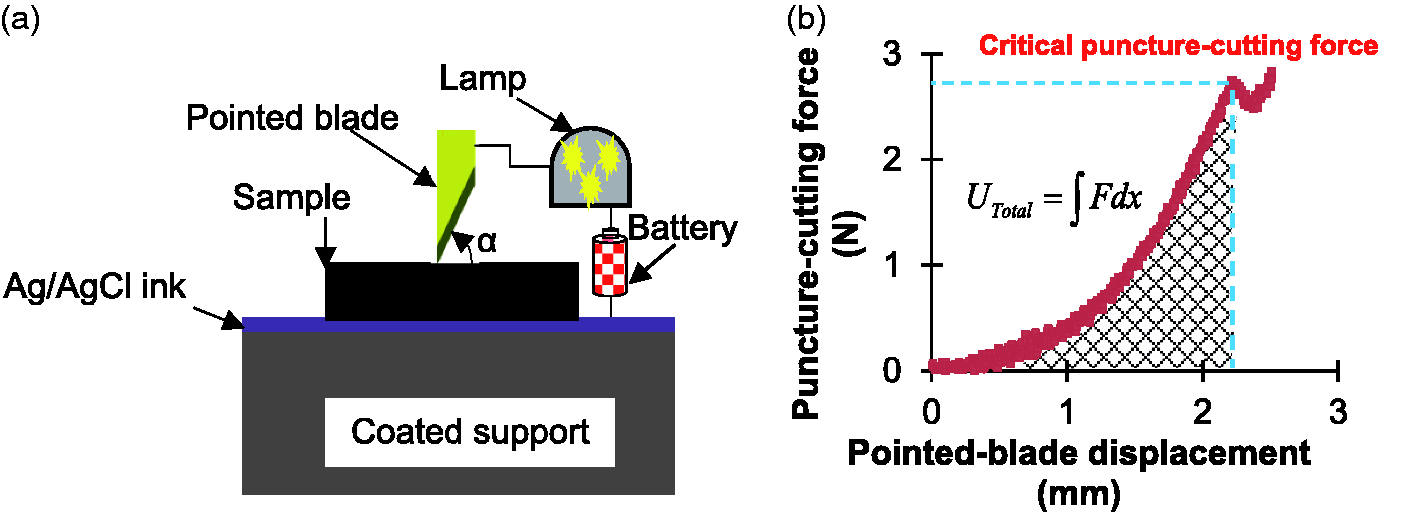
Each specimen was positioned freely on a soft neoprene rubber support (25 mm thick and 42 Shore A) coated with a silver/silver chloride layer (Ag/AgCl ink, Sigma-Aldrich, U.S.A.) as a conductive substrate (Figure 2(a)). A pointed blade was fixed to the crosshead of a universal testing machine (ADMET Inc., Norwood, MA) equipped with a 25 lb load cell. The puncture-cutting test consists in lowering the pointed blade into the specimen at a crosshead speed of 30 mm/min. Pointed blade displacement and force were recorded (Figure 2(b)). The conductive layer of Ag/AgCl was coupled with the blade to close an open circuit that detects the full penetration of the blade through the specimen, which occurs as soon as the blade tip comes into contact with the Ag/AgCl layer. The critical puncture-cutting force required to puncture and cut a soft elastomer-coated fabric corresponds to the force measured at the full penetration of the pointed blade. The critical force and total puncture-cutting work (UTotal) were obtained for three specimens (i.e., three replicates) of each glove material punctured by a pointed blade at various cutting-edge angles (20° ≤ α ≤ 80°). The fracture surface area (A) was estimated from the inserted part of the pointed blade shape at full penetration and is given as
(a) Experimental setup of puncture-cutting test and (b) puncture-cutting force vs. pointed-blade displacement curve for soft elastomer-coated fabric specimen.
Uniaxial tensile test
Uniaxial tests were carried out to measure the material’s tensile strength and Young’s modulus. Specimens measuring 200 mm × 25 mm were cut out from the palms of protective gloves in three directions: the wale direction (ψ = 90°), course direction (ψ = 0°), and bias direction (ψ = 45°) (see Table 1). The specimens were clamped in the opposing clamping jaws of an MTS-Alliance tensile machine equipped with an automated data acquisition system (Figure 3(a)) and the two ends were pulled apart at a constant crosshead speed of 500 mm/min until the specimen ruptured. For each direction, three specimens were tested, and the strain–stress curve was recorded (Figure 3(b)). In the present study, the Young’s modulus was determined at a strain of 0.1%. It should be noted that a constant crosshead speed of 30 mm/min, as applied in puncture-cutting tests, was first used for tensile tests. However, our predicted results of the critical-puncture cutting force (Eq. (8)) did not match well with the experimental results.
Uniaxial tensile test: (a) Dimension of tensile test specimen and (b) typical curves of stress vs. strain obtained in three directions for Glove A.
Poisson’s ratio test
In order to measure the Poisson’s ratio, three rectangles (ABCD, CDEF and ABEF) were selected in the 200 mm × 25 mm specimen, which was loaded at 500 mm/min in uniaxial stress (Figure 4(a)). A black indelible ink pen was used to mark the ABCDEF corners, making them visible to image digitization. Many digital photos of the loaded specimen were recorded at successive strain values. The photos were then imported into a Java-based image processing program, ImageJ, to estimate the displacement in length (Δl) and width (Δb) of all three rectangles (Figure 4(b)). Extension (ɛi) and contraction (si) were calculated at various steps of deformation, i = 5%, 10%, 50%, 100%, etc., using equations (11) and (12), respectively.
Uniaxial tensile test of coated fabric: (a) Undeformed specimen and (b) axial displacement (Δl) and lateral displacement (Δb) of tested specimen.


The average of the transverse strains 
Results and discussion
Puncture-cutting mechanisms of soft elastomer-coated fabrics
To understand the failure of soft elastomer-coated fabrics caused by a pointed blade (Figure 5(a) and (b)), it was necessary to investigate the curves of pointed-blade displacement vs. force obtained from the three replicates (Figure 5(c)). As loading begins (position no. 0), a small material deformation is enough to initiate a crack, due to the blade’s acute tip and its cutting edge (Figure 5(b)). As shown in Figure 5(c), the initiation process requires a small applied force (≤ 0.5 N). The material shows low elastic deformation resistance (zone 0-1). Once the pointed blade smoothly penetrates the specimen (position no. 1) (Figure 5(d) and (e)), the applied force gradually increases (zone 1-2) until it reaches a maximum value (position no. 2), the critical puncture-cutting force, FP/C (Figure 5(c)). FP/C corresponds to the full penetration of the pointed blade into the specimen. When the pointed blade continues to penetrate into the sample beyond that point (beyond position n°2), the puncture cutting of the soft support underneath the sample occurs (Figure 5(f)) and, therefore, the applied force increases again (position no. 3). During the pointed-blade insertion, the elastic deformation resistance of the material is found to increase remarkably. This trend could be associated with the friction between the pointed blade and material, which does not happen during crack initiation. In the linear part of these curves, the measured force is therefore a result of fracture and friction mechanisms. Triki et al. conducted loading/unloading/reloading/unloading tests to estimate the friction contribution during pointed-blade insertion into the specimen [17,18]. They found that the total puncture-cutting energy (given by the fracture energy and the friction energy) of soft elastomeric membranes punctured by a pointed blade includes a friction energy contribution of over 60%. At the critical puncture-cutting force, the material deformation reaches a maximum value and the pointed blade penetrates all the way through the specimen. Deep penetration by the pointed blade involves a radial expansion of the material, which is highly dependent on the cutting-edge angle (α) (Figure 5(e) and (f)). Insertion of a pointed blade having a small α gives rise to high radial material deformation. For example, Triki et al. [24] showed that during the puncture-cutting process by pointed blades with small α (e.g., α = 5°), crack growth is largely dominated by the opening stresses (σxx and σyy) related to fracture Mode I that cause a radial expansion of the material, and by the shear stress (τyz) related to shear fracture Mode II. The curves given as an example in Figure 5(c) show that the pointed blade penetrates the soft elastomer-coated fabric smoothly and gradually, and that behavior of the material is uniform until full penetration by the pointed blade is achieved. It thus appears that the knitted fabric on the underside of the specimen does not contribute during the puncture-cutting process. However, the structure of the knitted fabric seems to contribute when the blade tip reaches the underside of the membrane (position no. 2, Figure 5(c)). At full penetration, the contact between the blade and the knitted fabric looks arbitrary; i.e., in one test, the blade punctures a crossover point, giving higher FP/C, and in another test, the blade goes easily through an open loop formed by the yarns, giving lower FP/C. In fact, a significant variation of FP/C is observed in position no. 2 (Figure 5(c)).
Puncture-cutting test of soft elastomer-coated fabric by pointed blade: (a) Unpunctured specimen; (b) crack initiation step; (c) force-blade displacement curve recorded during insertion process for three replicates; and (d), (e), and (f) typical penetration steps.
Energy-based approach of combined puncture and cutting test
In this section, total puncture-cutting energy, GTotal, was calculated using a procedure outlined in our previous articles [17,18]. According to this procedure, GTotal is given by

The puncture-cutting tests on the four protective gloves were carried out for various cutting-edge angles. Figure 6 displays the variation of UTotal as a function of the created surface of the puncture-cutting crack area (A) for the four protective gloves. For each glove, the puncture-cutting work appears to be linearly proportional to the fracture surface area. This linearity indicates that the proposed total puncture-cutting energy defined by equation (14) seems to be valid for those composite materials. GTotal is given by the slope of the regression line in Figure 6. It is important to note that the coefficient of variation in all experimental tests (puncture cutting and tensile tests) was less than 20%.
Variation of puncture-cutting work (UTotal) as a function of crack surface area (A) for four protective gloves.
Uniaxial and biaxial test results
Uniaxial tensile tests were conducted to measure the mechanical properties of soft elastomer-coated fabrics and then predict the biaxial tensile properties that may be involved during the insertion of a pointed blade, such as tensile strength in the wale and course directions. After that, the values of these properties were used as described in “Force-based approach” section to predict puncture-cutting behavior.
Values of tensile and 45° tensile strengths (σU and S) and Young’s modulus (E) of four protective gloves in three directions.

Note: The coefficient of variation is less than 10%.
The experimental results for the four protective gloves given in Table 2 and Figure 6 reveal that there appears to be no correlation between GTotal and σU, S or E. For example, the gloves with high GTotal did not necessarily perform well in terms of uniaxial tensile properties. Hence, the uniaxial tensile test results in each axial direction cannot predict by themselves (or independently of other properties) the puncture-cutting behaviors of soft elastomer-coated fabrics. However, developing a relationship between these uniaxial tensile properties may predict the behavior of material during pointed-blade insertion, as has been done in the case of woven fabric subjected to complex loading [34].
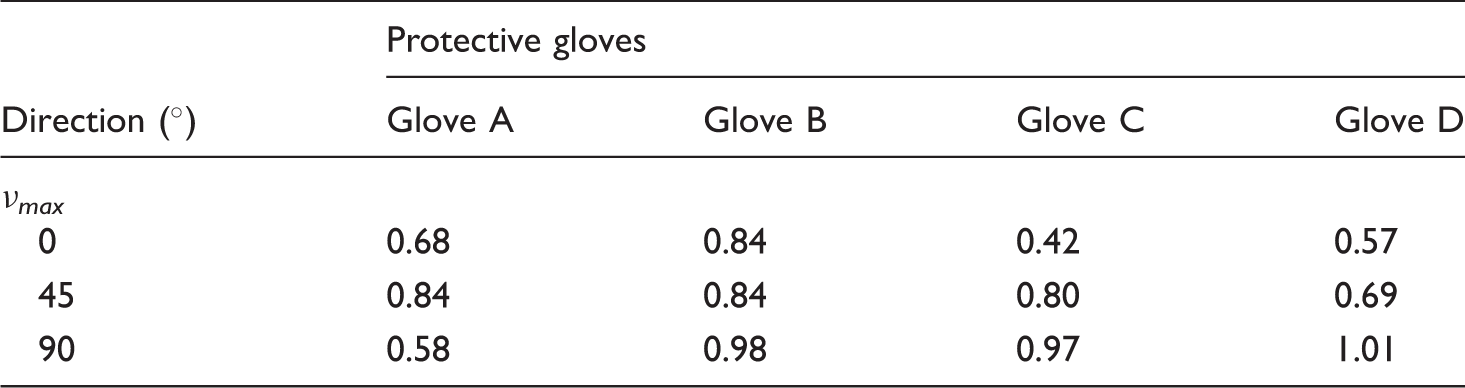
Poisson’s ratio is one of the fundamental properties of all structural materials, including soft elastomer-coated fabrics. For that reason, we used it to predict the biaxial tensile properties and then puncture-cutting behaviors of soft elastomer-coated fabrics. The average values of Poisson’s ratio were obtained for the three directions (three replicates each) at various stages of specimen deformation, illustrated in Figure 7. At the beginning of the uniaxial tensile test, more axial than lateral extension of the specimen is observed, due to the hyperelastic behavior of the coating material (Figure 7). The increase in the specimen’s axial extension leads to a gradual increase in Poisson’s ratio until maximum values are reached at an extension of around 100%. At that point, the coated fabrics show maximum lateral strain: the contraction of the specimen seems stable, while its extension progresses. Consequently, the Poisson’s ratio value decreases. As shown in Figure 7, the Poisson’s ratio–strain curve shows a similar tendency in the three directions tested for all four protective gloves. The maximum Poisson's ratio values presented in Table 3 were used as described in equations (11), (12) and (13) to predict the critical puncturecutting force of soft elastomer-coated fabrics, as required in Eq. (8).
Typical curves of Poisson’s ratio vs. strain obtained in three directions, 0°, 45°, and 90°, for four protective gloves. Maximum Poisson’s ratio values for four protective gloves obtained in three directions.
The biaxial tensile strengths of soft elastomer-coated knitted fabric in the wale direction (σ1, corresponding to 90°) and course direction (σ2, corresponding to 0°) were predicted by means of the uniaxial tensile strength using equations proposed by Ambroziak [35] for coated woven fabric:


Using the results of Poisson’s ratio illustrated in Table 3, equations (15) and (16) allow us to plot typical strain–stress curves for those two directions (Figure 8), as detailed in [35]. The maximum values of the predicted biaxial tensile stress corresponding to the moment of a specimen’s failure are given in Table 4. As shown in Figure 8, the uniaxial experimental data and predicted biaxial results are not the same. However, it should be noted that uniaxial and biaxial tensile stress–strain curves can be similar, as shown for Material B (Figure 8(b)). This can be explained by the similar values of the Poisson’s ratio in the three directions (0°, 45°, and 90°) for glove material tested (see results for Glove B in Table 3). The predicted biaxial results were used as described in “New stress-based failure criterion” section to develop a new fracture criterion.
Typical predicted curves of stress vs. strain of biaxial tensile test corresponding to (a) wale direction (90°) and (b) course direction (0°) obtained for Glove B. Values of biaxial tensile strength stress of four protective gloves obtained in two directions.

Force-based approach
In this section, we examine the two analytical models of critical puncture-cutting force, which were developed for soft elastomeric membranes and based on energetic analysis (equation (9)) [17] and stress analysis (equation (8)) [24]. In equations (8) and (9), FP/C depends not only on total energy (Figure 6), Poisson’s ratio (Table 3), and Young’s modulus (Table 2) but also on fracture energy (fracture toughness), GC, and the three fitting parameters. As mentioned in section “Puncture-cutting mechanisms of soft elastomer-coated fabrics,” it is assumed that the contribution of the fabric structure during pointed-blade insertion (before the blade tip reaches the underside of the membrane) is negligible due to the blade’s acute tip.
Therefore, GC can be estimated to be about 40% of GTotal, as in the case of soft elastomeric materials, reported by Triki et al. [17,18]. The same values of the fitting parameters (cI = 0.055, cII = 0.55 and cIII = 0.8) estimated for puncture cutting of soft elastomeric membranes were then used for soft elastomer-coated fabrics.
Figure 9 provides a graphical representation of the variation in critical puncture-cutting force as a function of cutting-edge angle, which was obtained from the experimental data, and our two analytical models of the stress-based approach (equation (8)) and energy-based approach (equation (9)). Our analytical models were validated with experimental data by calculating the root-mean-square errors (RMSE) [36]. Our results indicate that the two proposed models are good predictors of the puncture-cutting resistance of soft elastomer-coated fabrics by pointed blades (RMSE below 0.38 in all cases).
Comparison of predicted data (equations (8) and (9)) and experimental data for four protective gloves.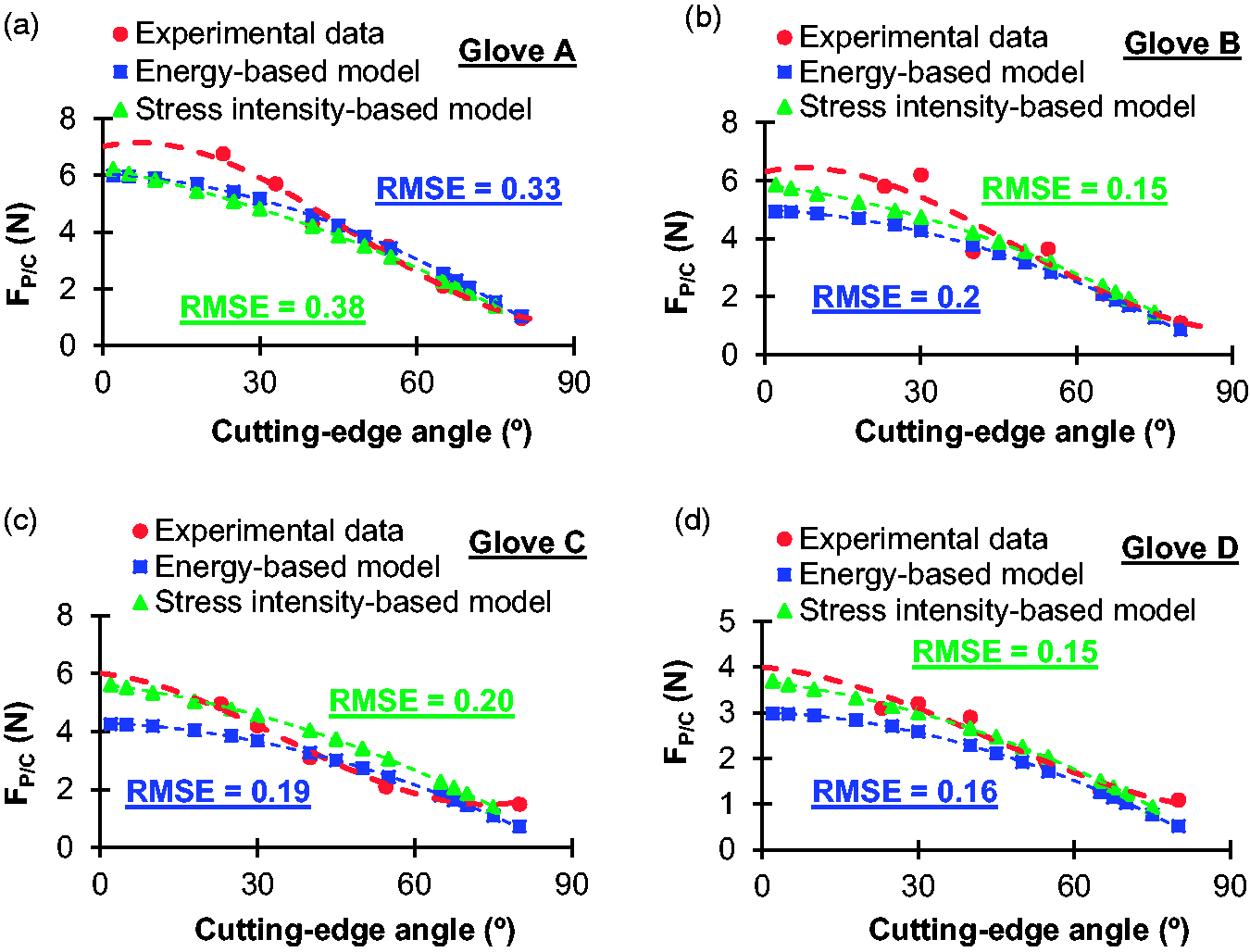
Similar to elastomeric membranes [24], the decrease in critical puncture-cutting forces (FP/C) of coated knitted fabrics with increasing cutting-edge angle (α), seen in Figure 9, can be explained by studying how FP and FC values change with α. The influence of α can be clearly seen in the force profiles shown in Figure 10. For the four protective gloves of various thicknesses, the predicted profiles of the pushing force component (equation (1)) and shear force component (equation (2)) show the same characteristic behavior with the change in the cutting-edge angle. Our results show that pushing force decreases with increasing cutting-edge angle, while shear force increases until it reaches a maximum (when α ≈ 45°) and then decreases. Although this shear force profile was unexpected, it is consistent with experimental data obtained by slicing soft gel by a wire [23]. Moreover, the results shown in Figure 10 can be related to the change in the fracture mode from tensile failure-dominant to shear failure-dominant, while α increases from 0° to 90° (see “New stress-based failure criterion” section). Triki et al. showed that the material failure becomes tensile/shear mixed failure in puncture-cutting tests of elastomeric membranes using intermediate angles [25]. Through modeling analysis, Triki et al. showed that adding a shear force to a pushing force, as can occur when the cutting-edge angle increases in a puncture-cutting test [23], creates a three-dimensional stress state and generates fracture using the shear stress criterion [37].
Typical curves of predicted pushing force (FP) and shear force (FC) as a function of cutting-edge angle for four protective gloves.
New stress-based failure criterion
In this section, we propose a linear stress-based criterion for pointed-blade insertion into soft elastomer-coated fabrics using the analysis developed for soft elastomeric membranes detailed in [24]. The compressive stress (σ) and shear stress (τ) acting at the cut edge of the material were calculated from FP and FC, respectively. As they established a linear relationship between σ and τ, Triki and Gauvin proposed a linear strength criterion for insertion of pointed blades into soft elastomeric membranes [24]. The blade’s acute tip has a low coefficient of friction (μ << 1), so the effect of the knitted fabric structure can be neglected during pointed-blade insertion. We therefore took our solution of the contact surface developed for pointed blades and elastomeric membranes and applied it here to soft elastomer-coated fabrics. In [24], we estimated the contact surface corresponding to the pushing force components as

The effective shear contact area, Digital photo of punctured specimen showing fracture process zone.

After calculating the contact areas from equations (17) and (18) and considering the pushing force and shear force, the compressive stress (σ) and shear stress (τ) components were calculated. Figure 12 shows the variation of σ and τ as a function of α. Interestingly, when α is small, the failure of the membrane is dominated by compressive stress, while at high α values, shear stress dominates; in other words, τ becomes maximum (Figure 12(a)). The results illustrate that puncture cutting of soft elastomer-coated fabrics involves a pushing/shear-dependent loading that indicates mixed failure modes [24]. The synergistic variation between the compressive stress component and shear stress component, at 0° < α < 90°, allows a linear relationship, σ-τ (Figure 12(b)).
(a) Typical curve of applied stresses vs. cutting-edge angle and (b) typical curve of relationship between compressive stress component and shear stress component for soft elastomer-coated fabrics.
Due to the linearity between σ and τ discussed above, the linear strength criterion used in combined loading of soft elastomeric membranes [24] and composite materials [38,39] can be adopted here. Since the behavior of soft elastomer-coated fabrics is anisotropic, the linear strength criterion, σ-τ, is modified in order to take into account the material strengths corresponding to the wale direction (ψ = 90°), course direction (ψ = 0°) and bias direction (ψ = 45°). The new linear relationship is therefore described as

By predicting X and Y (Table 4) and measuring S (Table 2), it is possible to plot the predicted shear stress as a function of compressive stress (Figure 13). As shown in Figure 13, the proposed criterion describes well the fracture behavior generated in combined loading of compressive and shear stresses that occurs at various cutting-edge angles. It should be noted that the most commonly used fracture criterion is the stress-based criterion, expressed in terms of strengths [26–29]. In addition, our stress-based criterion for coated knitted fabric can be used to overcome the difficulty associated with other criteria, such as the energy-based criterion and force-based criterion, in term of measuring FP/C using a puncture-cutting test setup with a conductive layer. Our proposed criterion can also highlight the dominant fracture mechanisms concerning the stresses involved. However, it should be noted that our proposed model may show some limitations in tests of dynamic impacts, such as knife impacts. If the shape of the pointed blade is typical, the puncture-cutting resistance of protective gloves can be evaluated and compared using force FP/C, as detailed in Figure 2. Although the energy-based criterion requires (1) experimental tests of insertion of the pointed blade into the material and retraction and (2) measurement of the fracture surface area [17], it appears to be the suitable criterion for understanding the puncture-cutting mechanisms at any mechanical aggressor geometry.
Comparison between experimental data and prediction data from linear strength criterion of four protective gloves.
Conclusions
Experimental and modeling investigations were conducted with a view to proposing a stress-based criterion for the puncture cutting of soft elastomer-coated fabric by a pointed blade. We focused on the mechanisms and mechanics of the puncture-cutting process. The experimental results show that the process of inserting a pointed blade into a soft elastomer-coated fabric involves the material’s stiffness and toughness, as well as the friction between pointed blade and material. However, due to its structural design, the fabric support on the back of the specimen does not make any contribution during the insertion process. Knitted fabric contributes only at the last step of pointed-blade insertion, when the blade tip reaches the underside of the specimen. Two analytical models of energy and critical force corresponding to puncture cutting of soft elastomeric membranes were used successfully to develop a new stress-based criterion for puncture-cutting resistance of soft elastomer-coated fabrics. The compressive stress component (σ) and shear stress component (τ) are calculated using analytical and experimental results involving the contact surface between the material and the pointed blade. Because there is a linear relationship between σ and τ, a modified linear strength criterion was derived from the stress criterion that had been developed for soft elastomeric materials. The predicted and experimental values were consistent, suggesting that puncture-cut resistance of protective materials can be evaluated by measuring the stresses. One advantage of the proposed stress-based criterion is that only simple experimental measurements under tensile tests at 0°, 45°, and 90° are needed to predict all other mixed-mode puncture-cutting failure.
Footnotes
Declaration of conflicting interests
The author(s) declared no potential conflicts of interest with respect to the research, authorship, and/or publication of this article.
Funding
The authors would like to thank the Institut de recherche Robert-Sauvé en santé et en sécurité du travail (IRSST) for its financial support of this work.