




Abstract
The Hashin criterion is one the most popular failure criteria for fibre reinforce composites. It is critically appraised in this paper. The most significant feature of the criterion is failure modes introduced and the assumption that failure is determined by the traction on the failure plane. For this assumption, there has never been any justification provided in the literature, except the available arguments in the Mohr criterion, where the concept of plane failure as opposed to point failure was first introduced based on this assumption. However, the arguments there were applicable only to isotropic materials and, even so, they are not without exceptions. As contradictions to the assumption in the context of composite failure, three relatively simple cases have been considered in this paper, supported by physical evidence. In each case, failure is observed in a plane on which traction vanishes completely, to which the failure cannot be attributed. The assumption is therefore unfounded both theoretically and physically for anisotropic materials, which dismisses the validity of the Hashin criterion in turn.
Introduction
The study of material failure criteria is an arena where scientific principles are mingled with individuals’ perceptions. As one of the most pronounced examples, for a question as fundamental as whether a failure criterion should be formulated in terms of stresses or strains, a clear answer has not been available until recently. 1 In the meantime, there has been no lack of strong views against each other, based mostly on perceptions rather than scientific evidence, despite of claims of strong experimental support to either side. The present paper is to address another case of similar characteristics but in the context of the Hashin failure criterion 2 for composites, in which an unfounded assumption amounted to little more than a personal perception underlying the theoretical framework without any scientific justification. Yet, it has become one of the most popular criteria for composite materials in the literature as well as in engineering applications according to Christenson 3 where he honoured the Tsai-Wu criterion 4 and the Hashin criterion 2 as two that outstood amongst as many as a hundred of various criteria available for composites. The Hashin criterion gained its popularity partially due to its introduction of failure modes into the formulation of the criterion.
The failure of fibre reinforced composites predicted using the early primitive criteria, such as the maximum stress, came with a clear indication of the failure mode, associated with the specific stress component responsible for the failure and, in the case of a direct stress component, the sense of it. Although there had been some inconsistencies in some of these simple criteria, they could be relatively easily corrected.5,6 The crucial deficiency of such simple criteria was the lack of interactions amongst stress components, and hence the subsequent generation of failure criteria emerged employing a failure function of all stress components, where constant coefficients involved would be expressed in terms of experimentally measured strengths of the material. Typical examples were the Hoffman criterion 7 and the Tsai-Wu criterion, 4 to name but a few. Some of the originators categorised these failure criteria as purely empirical exercises. 8 Whilst there is a good degree of truth in this modest description for these criteria in the forms when they were originally proposed, it could be a considerable understatement, especially if the empiricism is further enriched by appropriate rationalism in terms of logic and mathematics, with the Tsai-Wu criterion rationalised in 9–12 being an example. It should be noted that such rationalism has not even been achieved properly in failure criteria even for homogeneous and isotropic materials until recently 13 where the rationalism underlying the von Mises criterion 14 for ductile materials has been extended consistently to brittle materials for the first time, although relevant criteria by Raghava, Caddell and Yeh 15 and Christensen 16 were proposed decade(s) ago.
Another historical account of failure criteria for homogeneous and isotropic materials was due to Mohr, 17 which was based on a key underlying assumption that failure is determined by the Traction on the Failure Plane, referred to as Assumption TFP hereafter in this paper. This assumption formed the cornerstone of the Hashin criteria under scrutiny in this paper.
The development in composites failure theories took a sharp turn when Hashin proposed his failure criterion 2 where different failure modes were introduced. To facilitate the partitioning of the stresses associated with the failure modes, Assumption TFP 1 was adopted. A natural consequence of the adoption of the Assumption TFP in the Hashin criterion is that only some of the six stress components contribute to each of the failure modes introduced. This of course led to significant simplification to the formulation. Whilst the simplifications are attractive, the underlying assumption cannot be simply justified by the simplifications it introduced alone.
In 2, the only justification for Assumption TFP offered was through a counterargument, namely, the case of failure under fibre direction compression, that was cited and dismissed there by referring to an established conclusion on fibre buckling and the shear mode associated with such buckling mechanism. 18 To the best of the authors’ knowledge, nowhere else has any further justification ever been provided to the adoption of Assumption TFP in anisotropic composites, in particular, associated with any of the matrix failure modes.
On the other hand, given the popularity of the Hashin criterion, it has been incorporated in commercial finite elements codes, e.g. Abaqus, 19 through which its blind applications became widespread. As separate subsequent developments, Assumption TFP has been taken for granted in many influential failure theories of composites, e.g. 20, 21, as one of the key assumptions. They are even labelled as ‘physically based’ theories, more or less because of their employment of Assumption TFP, rendering their seemingly unchallengeable status. This paper aims to offer a long overdue critical appraisal of the Hashin criterion, in particular, Assumption TFP, and its inapplicability to anisotropic composites.
This will be pursued by a re-examination of Assumption TFP first in the next section, followed by a comparison between the Hashin criterion and the Tsai-Wu criterion to appreciate the role Assumption TFP plays in the former in the section after. Then, three contradictions with Assumption TFP will be presented when applied to anisotropic materials. Discussion about the failure modes will be made before concluding the paper.
Justifications of Assumption TFP in the Mohr criterion and its inapplicability to anisotropic materials
Assumption TFP was a part of the Mohr failure criterion. 17 A quick survey on the Mohr failure criterion will reveal that, apart from few excessively complicated accounts as reviewed in 22, 23, the only existing implementation of the Mohr criterion is based on a linearised failure envelope, leading to what is commonly unknown as the Coulomb-Mohr criterion (CM). In terms of understanding of the failure modes, CM is definitely not helpful, because according to it the orientation of the failure plane relative to its the 1st principal direction is kept constant under all stress states for a given material. It was made clear in 22 that the justifications for Assumption TFP in the Mohr criterion were reasonable but only for isotropic materials. Even for isotropic materials, Assumption TFP is not without exceptions, and one of them will be revealed later in the paper. It is because of the lack of practically manageable implementation of the Mohr criterion in the past that the limitations and implications of the criterion as well as its underlying Assumption TFP has never been fully appreciated and respected, even amongst those who rely heavily on the assumption in their theories. With a recent attempt of implementing the Mohr criterion in its general form rationally and reasonably simply as presented in 23 as a quantitative account of the Mohr criterion, in addition to its qualitative predecessor in 22, readers should be able to objectively evaluate now the relevance, in fact, the lack of it, of Assumption TFP to anisotropic composites. As a truthful statement out of the reflection, the relevant understanding of the Mohr criterion and Assumption TFP has been patchy and often twisted by perceptions rather than facts, as will be gradually unravelled in his paper.
Assumption TFP in the Mohr criterion is not made in isolation. It is justified and supported by a number of considerations or assumptions, in which the employment of principal stresses plays a crucial role. First of all, a stress state defined in terms of the principal stresses can be represented by the 1st and the 3rd principal stresses in the context of the Mohr criterion. This is achieved through the Mohr’s circles as sketched in Figure 1 for a general 3D stress state expressed in terms of three principal stresses σ1, σ2 and σ3 (in descending order). Any point P on the σ-τ plane within the shaded zone represents the orientation of a plane and the traction on that plane. A different orientation of the plane and hence different traction corresponds to a different location of point P. As one of the most important considerations in the Mohr criterion, the shear component of the traction always promotes failure of the plane. At the same value of the direct component of the traction as that of P, points Q and R on the major Mohr’s circle are always more critical than P, because they correspond to planes of higher magnitude of the shear stress at the same direct stress. As a result, the critical plane is always found on the major Mohr’s circle. This partially fixes the orientation of the failure plane to those parallel to the 2nd principal direction. Mohr’s circles for a 3D stress state.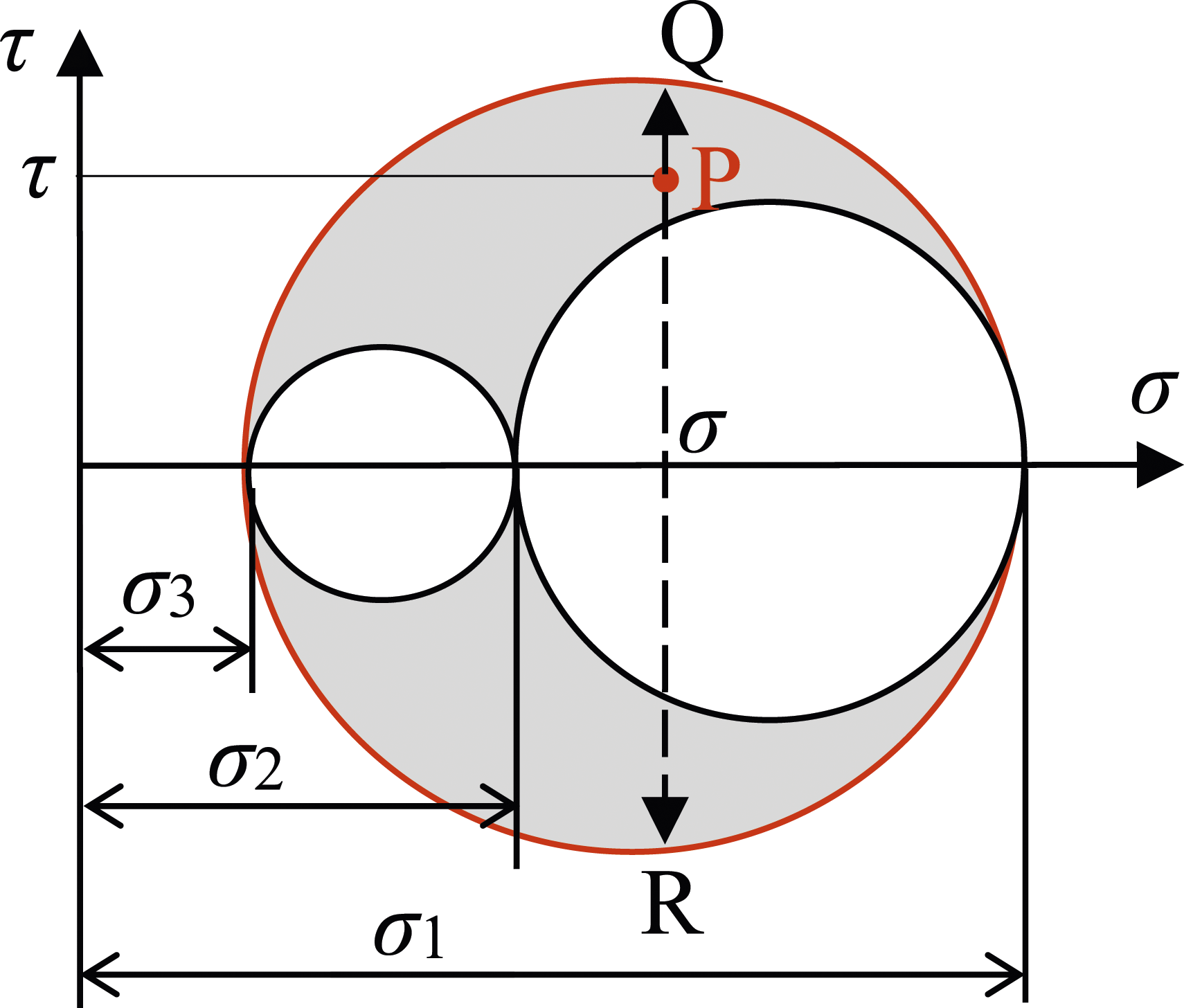
The transition from point P to Q or R is a process of selecting the orientation of failure plane based on the principal stresses. This consideration reduces a 3-dimension stress state into a 2-dimensional problem expressed in terms of 1st and 3rd principal stresses. Equivalently, the 2-dimensional problem can be expressed in terms of the traction on a plane parallel to the 2nd principal direction. This offers the justification underlying Assumption TFP in the context of the Mohr criterion, which is possible only because the stress state can be expressed in terms of three principal stresses with the principal directions as references for the orientation of the failure plane under the pre-condition of isotropy of the material. The isotropy of the material implies that the failure plane is determined by the stress state completely, without any predetermined directions as present in anisotropic materials.
In essence, the Mohr criterion states that failure is determined by the 1st and 3rd principal stresses and the failure plane is parallel to the 2nd principal direction. Principal stresses and principal directions are vital, as a strong implication of Assumption TFP in the Mohr criterion.
In composites, principal stresses are no longer as informative as in isotropic ones. Instead, stresses in the principal axes of the material, in presence of shear stresses in general, are usually employed, instead of the conventional principal stresses in absence of shear stresses. As a result, the justifications available in the Mohr criterion for Assumption TFP do not offer any support to its extension to anisotropic materials. In other words, if Assumption TFP was to be introduced to anisotropic composites, one would have to justify its applicability to the materials concerned. Such justifications have been absent.
An interesting and also revealing example can be found in 24 where tensile tests were conducted on metallic glass specimens with inclined notches to predetermine the orientation of the failure plane. Such artificial interference of the orientation of the failure plane compromises the validity of the Mohr criterion and hence Assumption TFP. In other words, the failure of such a plane is not completely determined by the traction on the plane. Without the artificial interference, the plane failed in the tests would not have failed and the failure would have taken place at a different load level on a different plane according to the Mohr criterion. In the Hashin criterion, the orientation of a failure plane was predetermined to a great extent, perpendicular or parallel to the fibre direction, regardless the stress state. The applicability of Assumption TFP cannot be taken for granted without appropriate justifications.
Assumption TFP plays a key role in the Hashin criterion. Without it, the introduction of failure modes alone would not bring forward any simplification. Before the simplifications associated with Assumption TFP makes the differences, its failure function is identical to that of the Tsai-Wu criterion. The identical nature of the failure function to that of the Tsai-Wu will be briefly shown in the next section to highlight the role of Assumption TFP in the Hashin criterion from a different perspective.
The relationship between the Hashin criterion and the Tsai-Wu criterion
Before Hashin introduced failure modes in terms of fibre failure and matrix failure as two major categories, the failure function, as quoted precisely from 2, was


It should be pointed out that, although systematic use of stress invariants for failure criterion formulation can be traced back to the von Mises criterion, 14 which applies strictly to isotropic materials of equal tensile and compressive strengths, hence ductile, no complete rationality has achieved until very recently beyond that of the von Mises criterion. For brittle materials characterised by their higher compressive strengths than tensile ones, three coefficients to the invariant terms are required to ensure the consistency in truncating the failure function at the 2nd order of a polynomial, whilst there are only two conditions available associated with the tensile and compressive strengths. This difficulty has only been resolved recently by the author 13 after recognising that the failure envelope is a paraboloid in the space of principal stresses.
Along a similar line, the number of independent coefficients involved in failure functions for transversely isotropic materials have been determined as five in 10, 11, which have been successfully expressed in terms available strength properties for these materials.
A further extension has been made to orthotropic materials in 12 for which only nine independent strength properties are required and they can all be determined in terms of conventional strength properties whose measurements can all be supported by existing industrial standards.
Given the fact that the above-mentioned progresses have only been achieved recently, those coefficients as introduced in the original Tsai-Wu criterion had not been completely and convincingly determined over the space of half a century subsequent its first publication in 4. Avoiding some of them motivated Hashin to come up with his criterion, as stated in 2. He pursued this goal by introducing Assumption TFP before further introducing the so-called failure modes.
The failure function of the Tsai-Wu criterion for transversely isotropic materials as quoted from 4 can be given as follows with two terms slightly rearranged as highlighted in boldface.
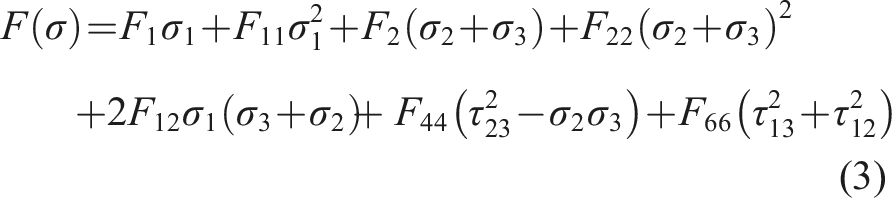
A one-to-one correspondence to those in the Hashin’s failure function (1) can be given as

It is clear that up to this point, i.e. before introducing Assumption TFP, the Hashin failure function is identical to that of the Tsai-Wu criterion, although Hashin employed stress invariants to construct the failure function, differing from what Tsai and Wu did in their approach. 4
A distinct and certainly popular feature of the Hashin criterion was the introduction of failure modes, fibre mode and matrix mode, before subdividing them into tensile and compressive, respectively. The so-called fibre mode and matrix modes are identified by the orientations of their respective failure planes. The failure plane of the fibre mode is perpendicular to the fibres and that of the matrix mode parallel to fibres. It should be noted that the exact orientation of the failure plane in the matrix mode is not actually determined in the Hashin criterion. Its determination is one of the highlights in the Puck criterion 20 which was also built on top of Assumption TFP.
The introduction of fibre mode and matrix mode would not have helped much in the Hashin criterion if the failure had to be determined by the stress state, i.e. all six stress components. Assumption TFP allowed some of the stress components to be dropped from the failure function (1) for each of the failure modes. On the failure plane for fibre mode,
Although the failure plane for the matrix mode had not been determined completely, it had been set to be parallel to the fibres. This was enough to conclude that
It should be pointed out that Hashin did not determine C12 and he certainly did not set it to zero, either, because there was no need to do so anymore. Eliminating the contribution from this interactive term, hence avoiding the challenges of determining interactive coefficient C12 was one of the most appealing features of the Hashin criterion when it was formulated. However, this was made possible only through Assumption TFP.
Another effect of the failure modes Hashin introduced on the formulation of his composite failure criterion was that the corresponding failure envelope in the 6-dimensional stress space was a piece-wise defined surface, with each piece corresponding to a specific failure mode, fibre tension, fibre compression, matrix tension and matrix compression. For this reason, Hashin referred to them as a set of criteria (plural). 2 As these pieces are continuous, forming a single integral and comprehensive failure envelope, it is reasonable to consider it as a criterion (singular), as was also so referred to in the literature, e.g. in 3. Piecewise defined failure envelope could indeed be a way forward in order to improve the accuracy a failure criterion without escalating the order of failure function.
Apparently, all attractive features of the Hashin criterion which have been considered to be superior to the Tsai-Wu criterion relies crucially on the validity of Assumption TFP. It is the objective of this paper to establish that Assumption TFP unfortunately does not stand scrutiny in its application to anisotropic composites.
Contradictions to assumption TFP
Whilst no appropriate justifications had been provided to Assumption TFP in 2, experimental cases of composite failure contradicting the assumption will be demonstrated and elaborated in this section as the main subject of this paper. They should dismiss the general applicability of Assumption TFP to anisotropic composites.
In order to draw the relevance of the physical tests conducted as close as possible to the points to be made, some qualitative analyses will be carried out closely associated with the experimental cases to be presented for the first two cases. The prime interest of the experiments involved is the relationship between the observed failure plane and the traction on the failure plane. The qualitative analyses serve as a steppingstone to the respective physical experiments, offering a basic level of theoretical justifications to the experimental observations. It would be relatively straightforward to justify the modes of failure through these qualitative analyses, given the idealised stress states and their corresponding deformations, based on common sense and basic reasoning in micromechanics, although the outcomes will always be presented at the macroscopic scale phenomenologically. Readers are reminded that Assumption TFP was made in the context of macroscopic stresses in a phenomenological manner. To mimic these qualitative analyses, two relatively simple physical experiments have been conducted with results presented in this section, followed by a third commonly observed case in experiments. Although the experiments conducted for the first two cases do not reproduce the conditions of the qualitative analyses precisely, they should be sufficient to put the observations made and conclusions drawn from them beyond any reasonable doubt.
Contradiction 1
A qualitative analysis of a UD composite under equal biaxial transverse compression
The first contradiction to Assumption TFP in the context of its applications to anisotropic materials is associated with UD composites subjected to the biaxial compression in the plane transverse to fibres. For the ease of elaboration, an ideal stress state of equal biaxial compression as depicted in Figure 2 is considered. A stress state of equal biaxial compression transverse to fibres.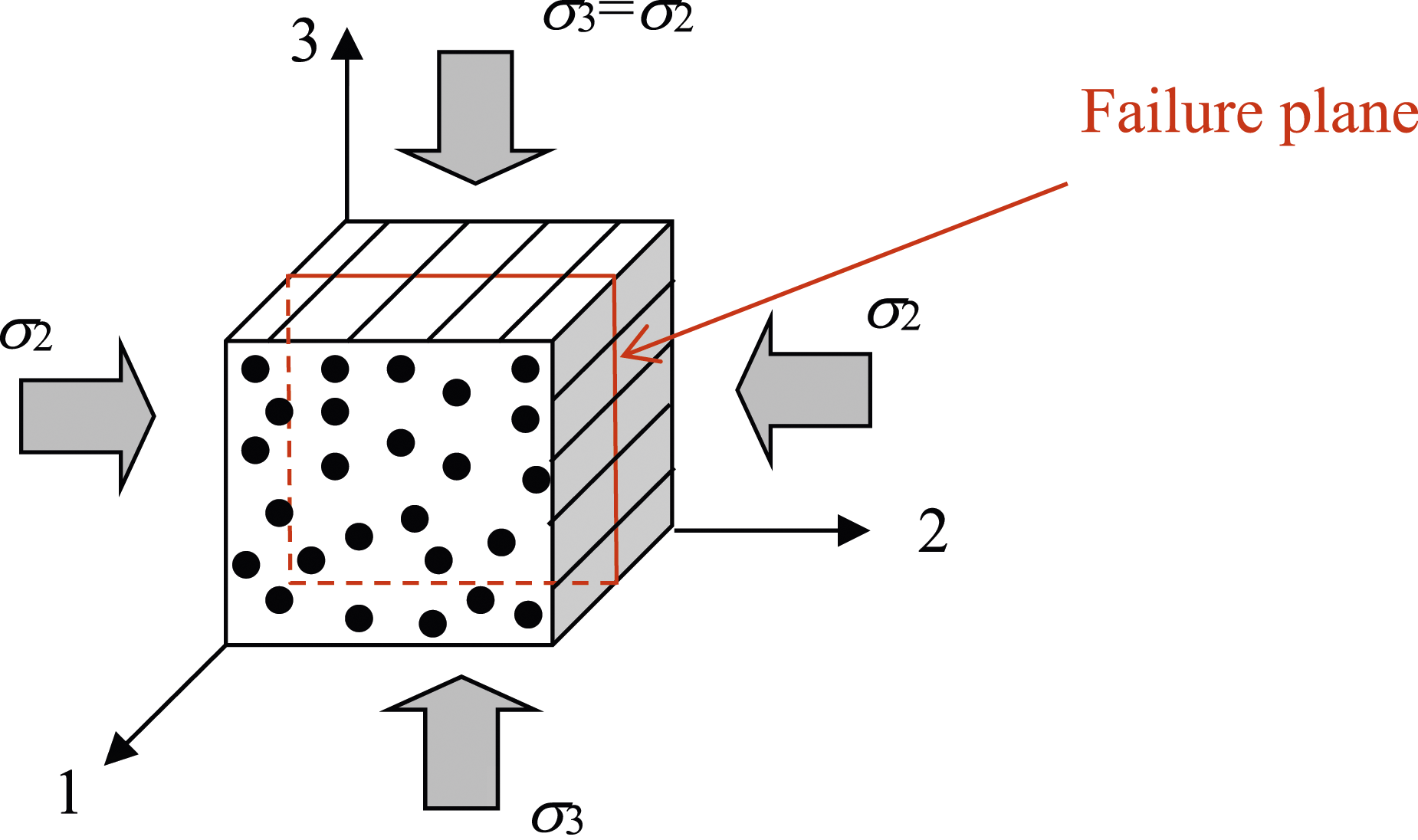
For this particular stress state, Hashin 2 assumed an infinite strength in order to obtain an additional condition to determine one of the constant coefficients in the failure function. This assumption can be considered as a reasonable approximation mathematically as the strength under this stress state is bound to be significantly greater than its counterpart under uniaxial compression. This is not subjected to any dispute here. Since no failure was predicted under this stress state according to the Hashin criterion, the failure mode was irrelevant, as far as the Hashin criterion is concerned. However, failure does take place in reality, as will be explained below, though at a very high stress level indeed. It is the failure mode under this stress state that is most revealing. It is therefore the subject of the discussion in this subsection.
According to the generalised Hooke’s law for transversely isotropic materials,
25
under an equal biaxial transverse compressive stress state as shown in Figure 2, i.e. when

On the other hand, microscopically the matrix is under triaxial compression: biaxial compression due to applied loading and compression in the fibre direction as described above due to the Poisson effect. Given the high longitudinal stiffness of the fibres, a significant part of the triaxial compression in the homogeneous and isotropic matrix under consideration is of a hydrostatic nature. According to the von Mises criterion, 14 the hydrostatic part of the stress state does not contribute to failure, and as a result, the matrix can be expected to sustain a high level of stresses concerned.
As the load increases, the composite will eventually reach a stage when the fibres can no longer sustain the tension in the longitudinal direction. Then fibre breakage takes place. This might also be promoted to an extent by the transverse compression microscopically. Such fibre breakage releases of the tensile stress in the fibres, equivalent to a compressive stress wave emanating from the fracture surface along the fibre direction toward both ends of the specimen. As the ends are free, a compressive stress wave reflects back into tensile wave, breaking the remaining part of the specimen eventually. Macroscopically, as a composite, fracture in planes perpendicular to the fibres should be observed, described as fibre failure mode of the composite as in the Hashin criterion.
This particular mechanism of failure could also be considered within the framework of the Puck criterion for fibre failure.
20
The magnitude of the applied compressive stress can be predicted from

Although its quantitative accuracy is yet to be validated when the material is loaded in absence of the direct stress in the fibre direction, (6) at least indicates qualitatively that failure could take place under equal biaxial transverse compression.
It should be pointed out that the Hashin criterion was proposed based on the effective stresses in the composite, although micromechanics has been employed above to explain and justify the mechanism of failure anticipated. When the qualitative analysis is presented in terms of effective stresses in the composite, the outcome would clearly contradict Assumption TFP. In other words, failure cannot be determined by the traction on the failure plane under the loading condition as in the present example, since the traction vanishes on the failure plane. Because the traction on the failure plane does not change with the applied load, one would conclude that failure could take place at any load level, which was apparently not reasonable.
To support the qualitative analysis above, physical proof would play a decisive role. This will be pursued in the next subsection.
An experiment of a UD composite under transverse biaxial compression
Practically, an equal biaxial compression is not easy to achieve experimentally. As a compromise whilst remaining as a close representation of the qualitative analyses, a relevant physical test is biaxial transverse compression with an unequal but obtainable ratio between the two transverse stresses. Provided that the stress state would still allow the strain in the composite specimen to build up in the fibre direction, the failure would still be in fibre tension on the plane perpendicular to fibres, whilst the traction on the failure plane of the composite vanishes.
This was achieved by putting a UD composite cube inside a channel within a steel block as the fixture, as shown in Figure 3(a) and (b), with the fibre direction aligned with the length direction of the channel. The composite was made from IM7/8852 prepreg produced by hand layup process and cured in autoclave following the instruction from the manufacturer.
26
Basic elastic properties from the manufacturer broadly agree with those measured independently.
27
The UD cube was loaded in one of the transverse directions, denoted as (a) Steel fixture, (b) top view of the fixture with a specimen as indicated, and (c) a section view of the test arrangement where fibres in the specimen are orientated out of the page.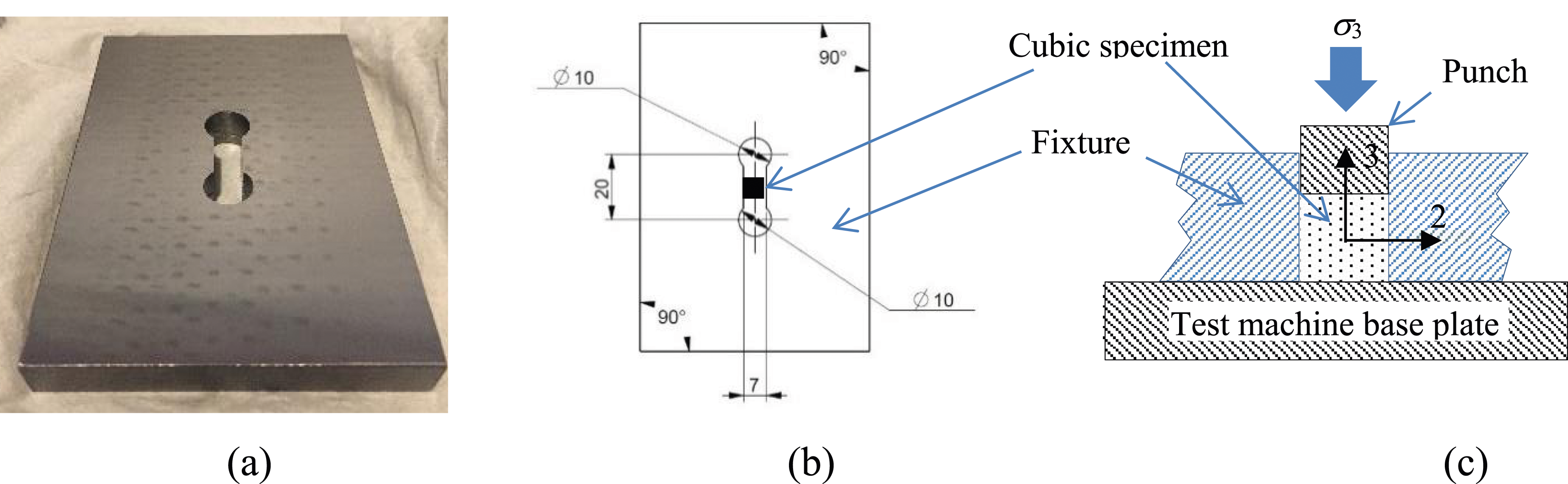
Biaxial compression is generated due to the Poisson effect. Approximating the constraints from the channel walls of the fixture as rigid, i.e.
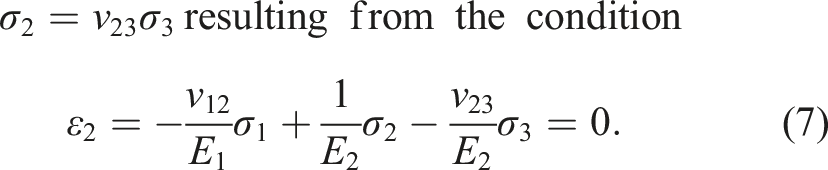
This leads to a stress ratio of

Following the same argument as was made in the qualitative analysis in the previous subsection, fibre failure due to tension will eventually take place at a sufficiently high load level when
The applied stress indeed went to a much higher level than the transverse compressive strength of the composite obtained under uniaxial compression, as shown in Figure 4. The uniaxial compression test had also been conducted separately on identical cubic specimens from which a typical stress-strain curve has also been presented in Figure 4 and compared with that from biaxial compression. Experimental stress-strain curves.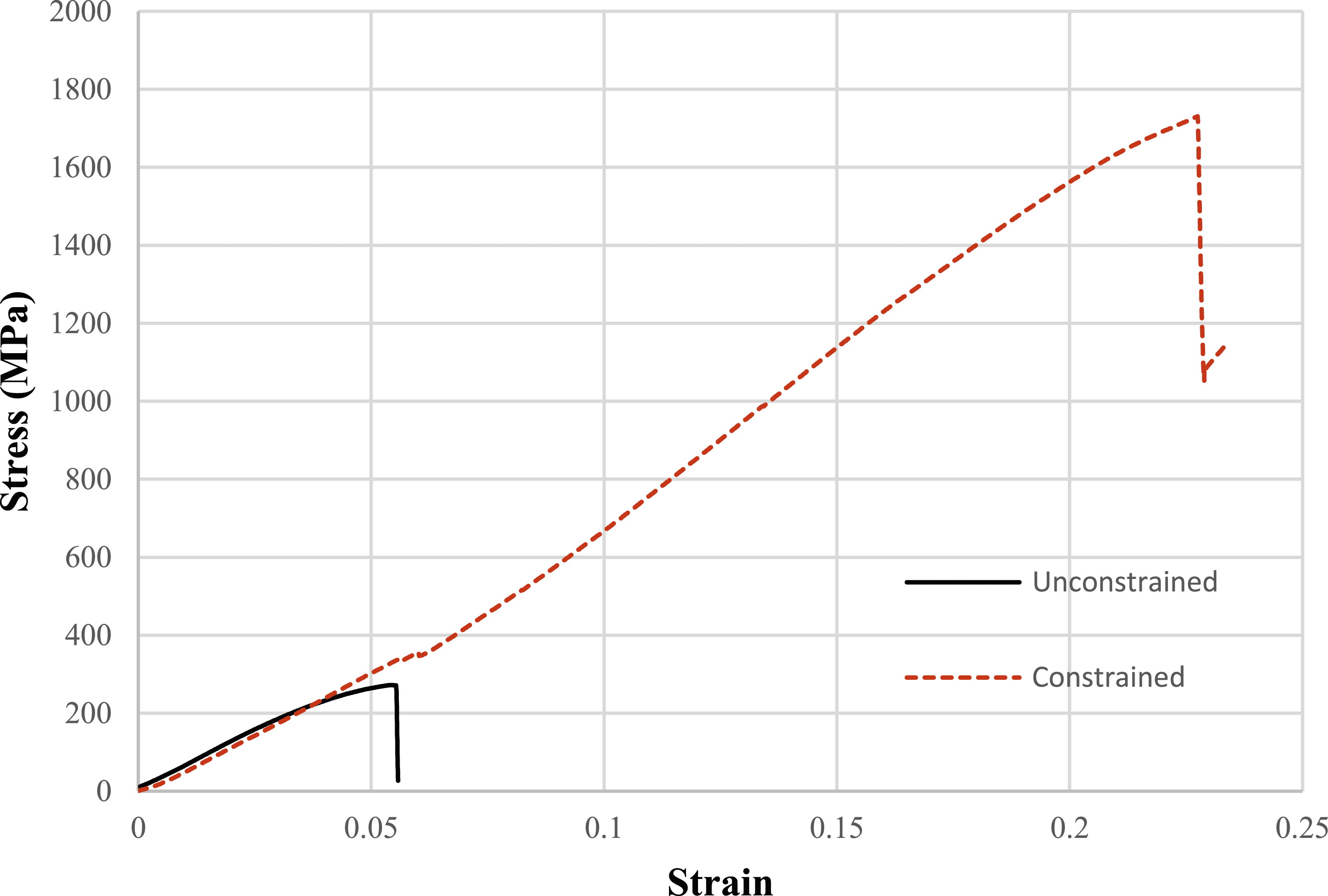
When failure under biaxial compression eventually took place during the test, it was explosive. The failed specimen was very fragmented as shown in Figure 5(a). The characteristics of a tensile fibre failure were obvious in the SEM pictures as shown in Figure 5(b), in support of the qualitative analysis. The matrix was subjected to triaxial compression and it is unlikely to initiate such a failure. (a) Fragments of a failed specimen and (b) an SEM image of the fracture surface.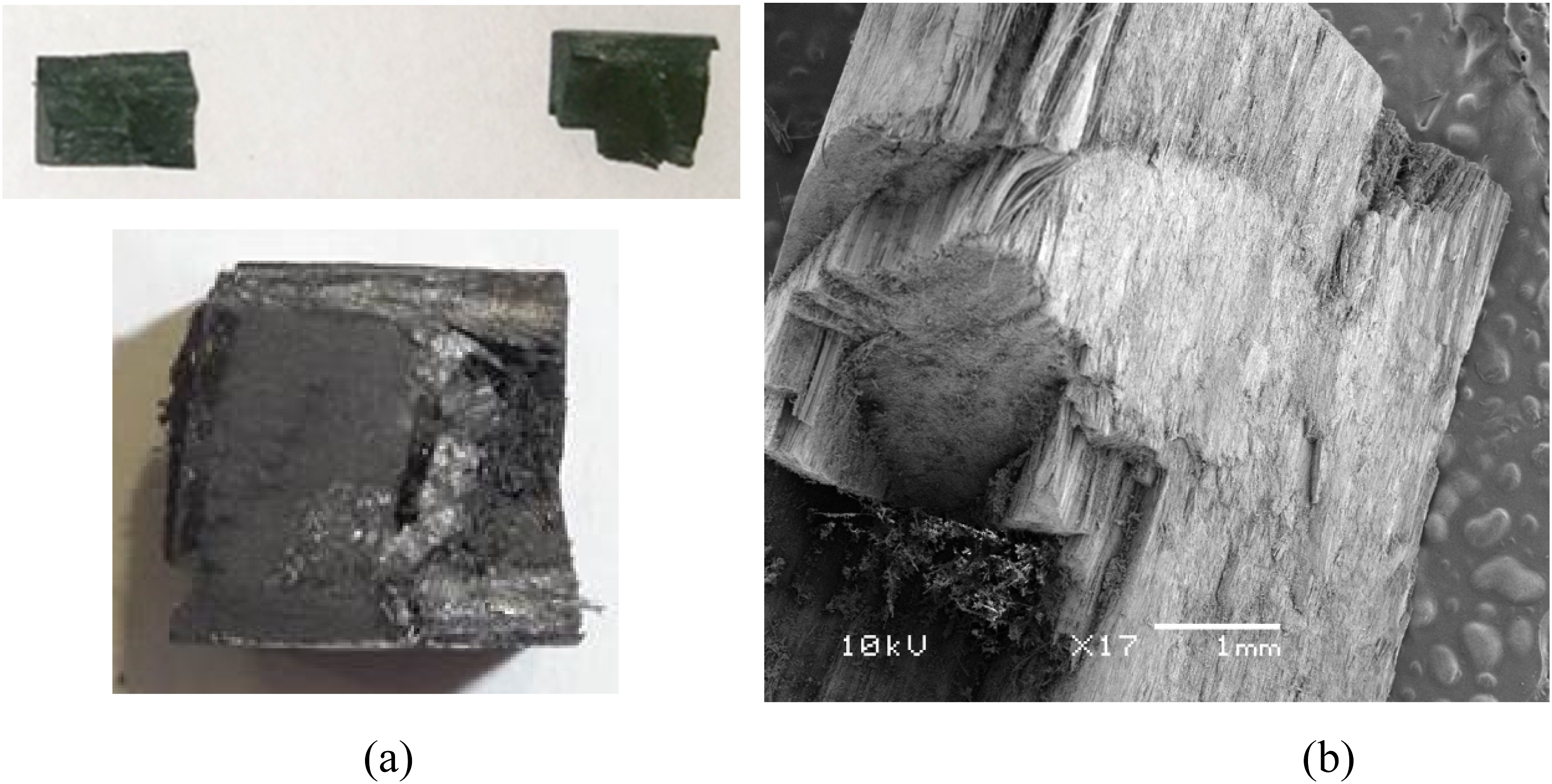
Phenomenologically, the observation was that the composite failed over a cross-section on which the traction vanishes completely. If the material failure was to be determined by the traction on the failure plane, the strength would be an arbitrary value, because the traction on the failure plane vanished identically, independent of the loading applied. This is obviously unreasonable. One has to concede that, at least in this particular case, failure was not determined by the traction on the failure plane of the composite, which of course contradicts the Assumption TFP. As has been pointed out earlier, without Assumption TFP, the introduction of failure modes alone would not be able to bring forward any simplification as employed in the Hashin criterion. In absence of any alternative and more representative way of partitioning stresses, one will have to retreat to a position that failure is determined by the stress state, i.e. all six components of the stress tensor, rather than those on the fracture plane. The qualitative analysis and the physical experiment collectively have delivered the first contradiction to Assumption TFP.
At the actual failure under transverse biaxial compression, the fibre direction strain
There are a number of additional aspects which differ from the ideal case as discussed in the previous subsection in addition to the fact that
Another consideration could be strength variability amongst fibres. Tensile failure of fibres was often triggered by the breakage of the weakest ones. As the stress at failure and the observed failure mode fell within the expectation and the experimental result could be considered as both reasonable and reliable. Any difference made by the variability concerned would only affect the outcome quantitatively, but not qualitatively.
In the elaboration above, the effects of friction between the specimen and its surroundings have been neglected, as well as the deformation of the steel fixture. The friction was eased by greasing the surfaces of the specimen before testing. Qualitatively, the effect of the friction would generate a minor tendency to resist the free expansion in the fibre direction impeding the observed fracture. The fact that fracture did actually take place in the test suggested that the friction effect was not significant. The deformation of the fixture was another factor neglected. If incorporated into the consideration, it would tend to reduce the magnitude of σ2. This would deviate the transverse stress ratio from
Similar experiments were reported in 28 where specimens of quasi-isotropic layup were subjected to uniaxial compression in the through-thickness direction. The results were employed in the Second World Wide Failure Exercise (WWFE-II) 29 to establish one of the test cases for participating theories to compare with. In such experiments, the in-plane transverse constraints to a ply were provided by its neighbouring plies with fibres orientated in different directions, in particular, those running in the perpendicular direction. The nature of the failure observed then was similar to that presented above and fibre fracture was clearly identified. Note that in those experiments a degree of macroscopic tensile stress in the fibre direction was present in each ply due to the quasi-isotropic layup. However, this macroscopic tension alone was far from being sufficient to cause the fibre tensile failure of the plies involved. The dominating tensile stress in fibres responsible for the failure resulted from the micromechanical consideration as given in the qualitative analysis in the previous subsection.
Despite the disparity between the physical test and the qualitative analysis in terms of the ratio between transverse stresses and other considerations as cited above, similar responses have been observed, suggesting that the physical test captured the idea conveyed through the qualitative analysis, contradicting Assumption TFP.
Contradiction 2
A qualitative analysis of a UD fibre-weakened composite under uniaxial transverse compression
The second contradiction can be revealed in a special type of anisotropic composites where fibres were of elastic properties so low in comparison with those of the matrix that they can be considered as voids. These ‘fibres’ are unidirectionally aligned in the matrix. When such a ‘composite’ is uniaxially compressed in its transverse direction, as illustrated in Figure 6, the microscopic stresses around a ‘fibre’ are readily obtained from a well-known problem in the theory of elasticity, namely, the stress concentration around a circular hole, provided that the fibres were distributed sufficiently sparsely over the cross-section of the ‘composite’ so that the stress distributions around a ‘fibre’ is not affected by the presence of other ‘fibres’ around it. The stress concentration problem has been sketched in Figure 7 with the values of the circumferential stress at typical points indicated.
30
Whilst the highest stress can be found at θ = ±90°, which is compressive, a tensile circumferential stress can be found at θ = 0° or 180°, which is of the same magnitude of the applied far-field stress but opposite in sense. It should be noted that stress concentration does not necessarily leads to failure, at least not necessarily at the site of highest stress concentration. How a material responds to these stress concentrations depends as much as on the nature of the material as on the stress concentrations. UD fibre-weakened composite under uniaxial compression transverse to fibres. Circumferential stress along the edge of a circular hole in a 2-dimensional elastic body under uniaxial compression.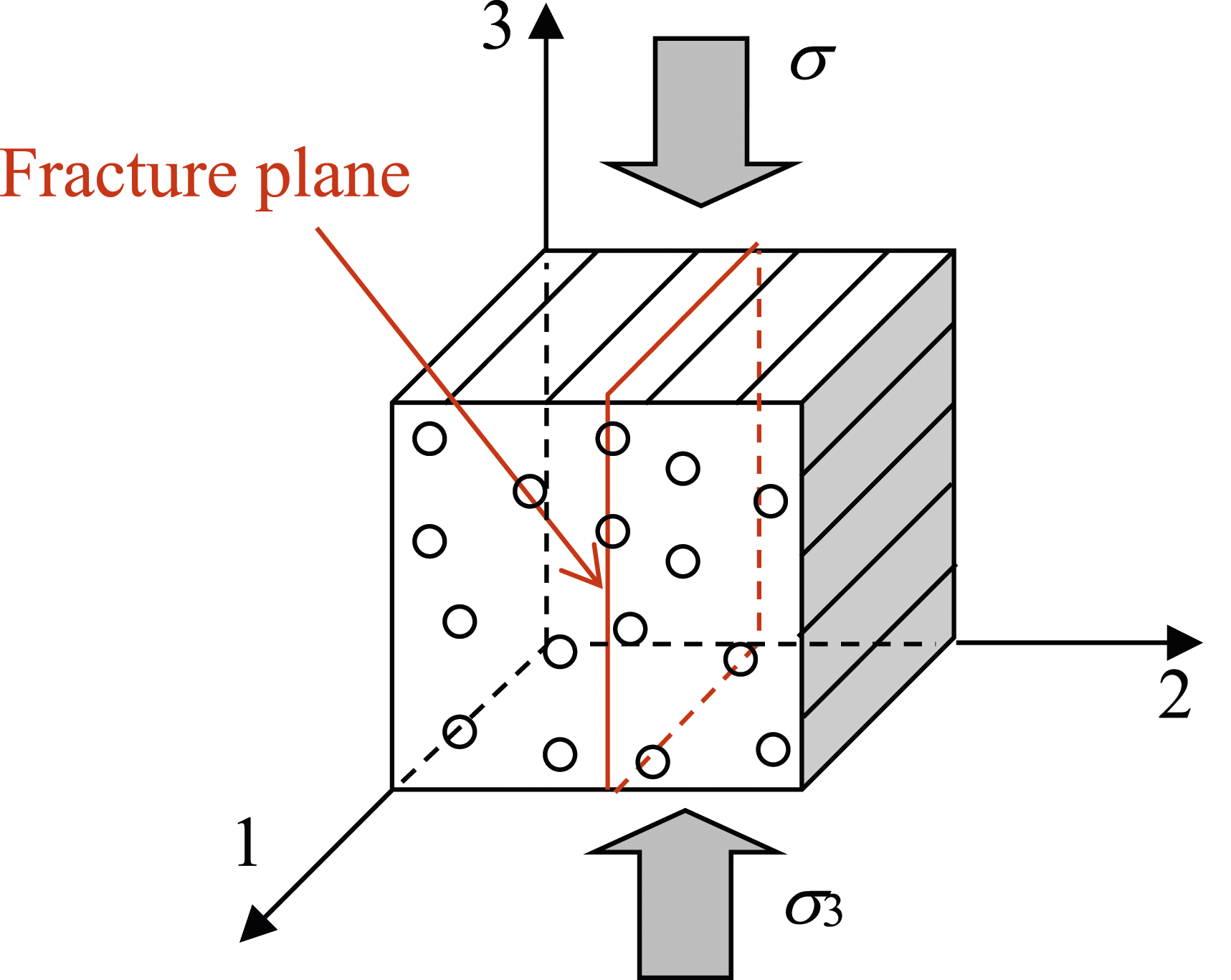
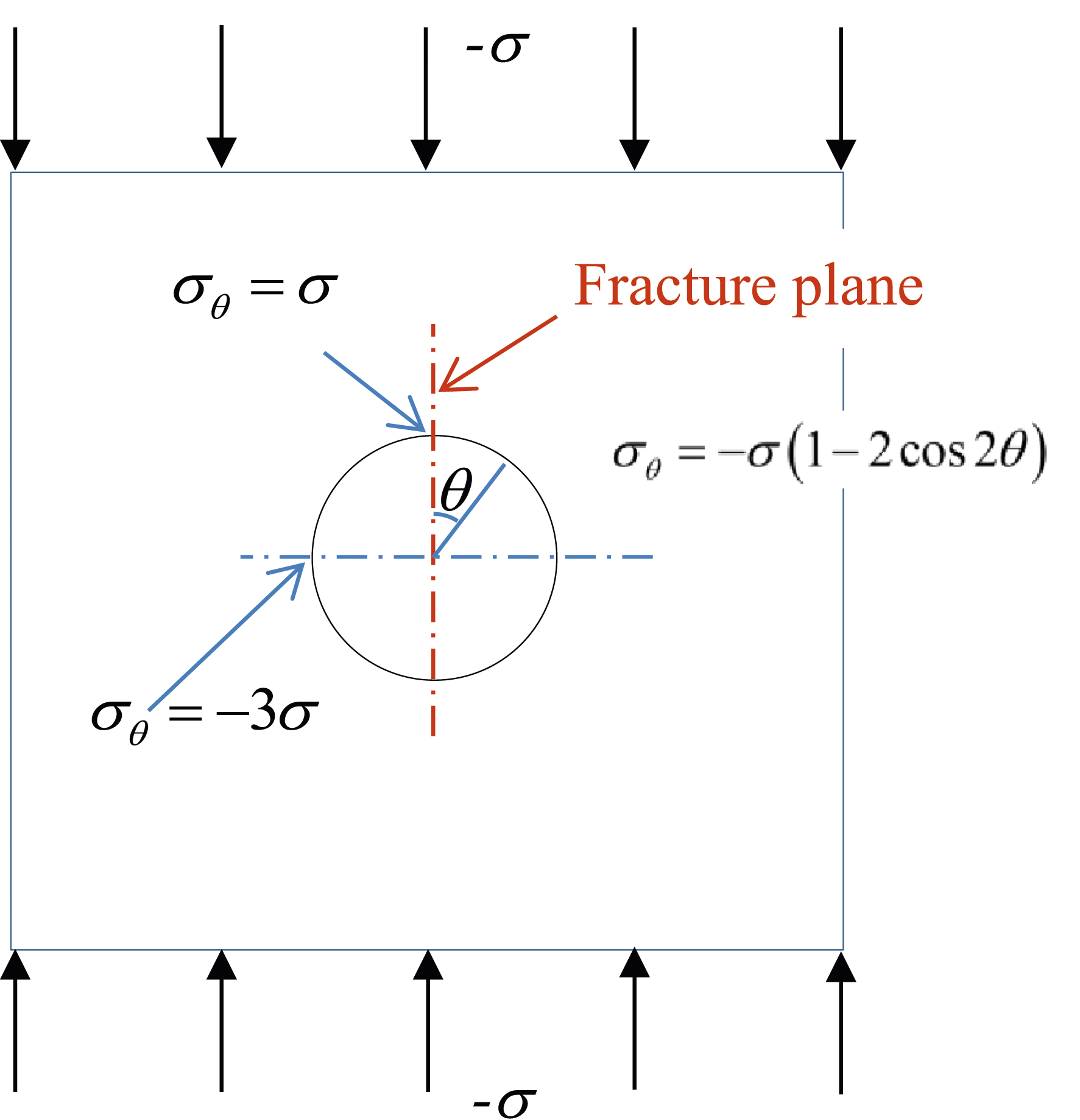
As a brittle material, it can sustain higher compressive stress than tensile stress. The highest stress concentrations are on the sides of the ‘fibres’. However, since they are under compression, they do not necessarily result in failure. On the other hand, as a secondary site of stress concentration, circumferential tensile stress is found on the top and the bottom of the ‘fibres’. These tensile stresses are the 1st principal stresses at these locations. A commonly accepted view for sufficiently brittle materials is that when the 1st principal stress is tensile whilst the 3rd principal stress is insufficient to cause compressive failure, the failure is usually dictated by the 1st principal stress. The action plane of these tensile stresses is parallel to the applied compression and also parallel to the ‘fibres’. Failure could take place due to the tensile stress and, if so, the failure plane would be the action plane of the tensile stress. Reflecting this failure mechanism, a qualitative analysis can be presented below.
A unidirectionally fibre-weakened composite of the characteristics as described above is considered, as illustrated in Figure 6. It is subjected to uniaxial compression transverse to the fibres. If the matrix is so brittle that its compressive strength is more than three times of the tensile one, the failure will be due to the microscopic tensile stress, and the failure plane will be parallel to the directions of the applied stress and also to the fibres, as indicated in Figure 6. This particular plane in the composite at macroscopic scale is free from any non-vanishing traction. The phenomenological observation will conclude that the failure is not determined by the traction on the failure plane. This provides yet another contradiction to Assumption TFP.
A qualitative analysis of a particulate-weakened composite under uniaxial compression
The qualitative analysis as presented in the previous subsection is relatively easy to envisage but by no means straightforward to implement physically in reality due to the lack of materials bearing characteristics of unidirectionally fibre-weakened composite as was required above. To draw the position a step closer to the realistic testing, considerations are given to a brittle material weakened by spherical particulates sparsely suspended in it. Under uniaxial compression, stress concentration occurs around each spherical particulate. If the particulates are so compliant that they could be approximated as voids, the 3D stress field with stress concentration characteristics will be similar to that in the 2D case.
31
With the particulates being sparsely distributed, the stresses around a particulate will not be affected by those around it. Each particulate can be approximated as an isolated one. In this case, as a reasonable resemblance to the 2D scenario, under uniaxial compression, tension is found on the poles of the particulate whilst concentrated compression is present along the equator of the particulate,
31
although the magnitudes of these stresses tend to differ from their 2D counterparts slightly. As long as the matrix material is sufficiently brittle, the tensile stresses on the poles would be more critical than the compressive one at the equator. As a result, fracture will be expected to initiate at poles, propagating microscopically as a mode I crack along the loading direction. A major difference from the case of uniaxially fibre weakened composite as in the previous subsection is that the tension on the poles is biaxial. As a result, the orientation of the failure plane is not unique now but can take any direction parallel to the loading direction, as shown in Figure 8. However, no matter which plane the fracture takes place in, it is free from traction on it macroscopically. As the traction on the failure plane is zero, the failure cannot be determined by it and hence the case can be presented as another contradiction to Assumption TFP. Particulate-weakened composite under uniaxial compression.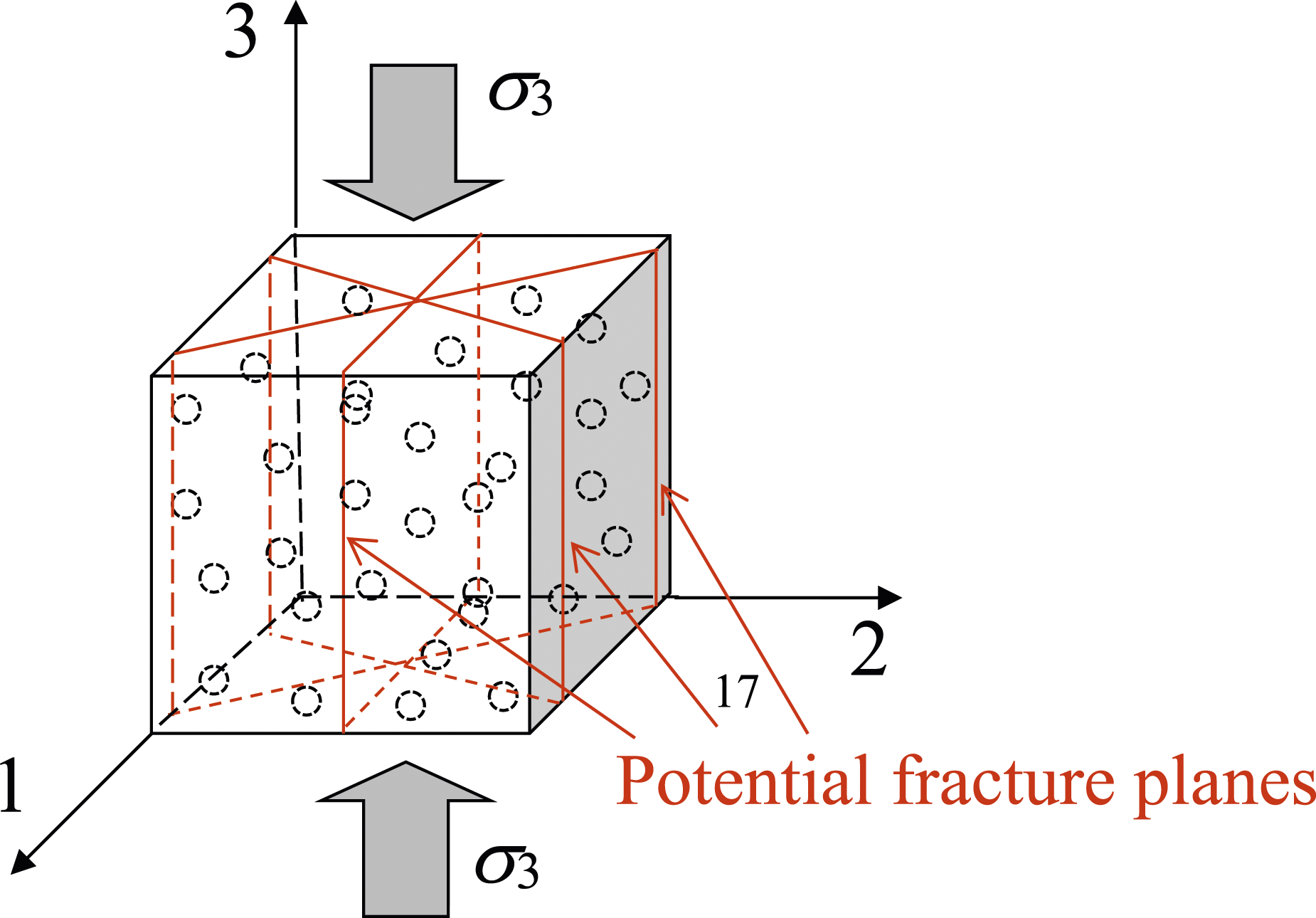
The reasoning as elaborated above has been logical. However, their authenticity needs a crucial support, i.e. some physical proof. This is the subject of the next subsection.
Experiments on a particulate-weakened composite under uniaxial compression
Relatively, a particulate-weakened composite is easier to obtain than a unidirectionally fibre-weakened one. Untoughened crystal glass bricks with bubbles sparsely suspended in them, as shown in Figure 9, are widely available. They can be regarded as spherical particulate-weakened composites as a reasonable resemblance of the material employed in qualitative analysis in the previous subsection. To facilitate the experiment, the brick was water jet cut into 20 × 20 × 20 mm cubes as the specimens to be tested, as shown in Figure 10(a), where the air bubbles were of a diameter of around 1 mm. The cubes were compressed uniaxially with contact surfaces greased to minimize the effect of friction. An untoughened crystal glass brick with sparsely suspended bubbles. Cubic glass specimens (a) before testing (with a clear surface chosen to show the bubbles inside) (b) after testing (loaded in uniaxial compression vertically, different specimen from that in (a)).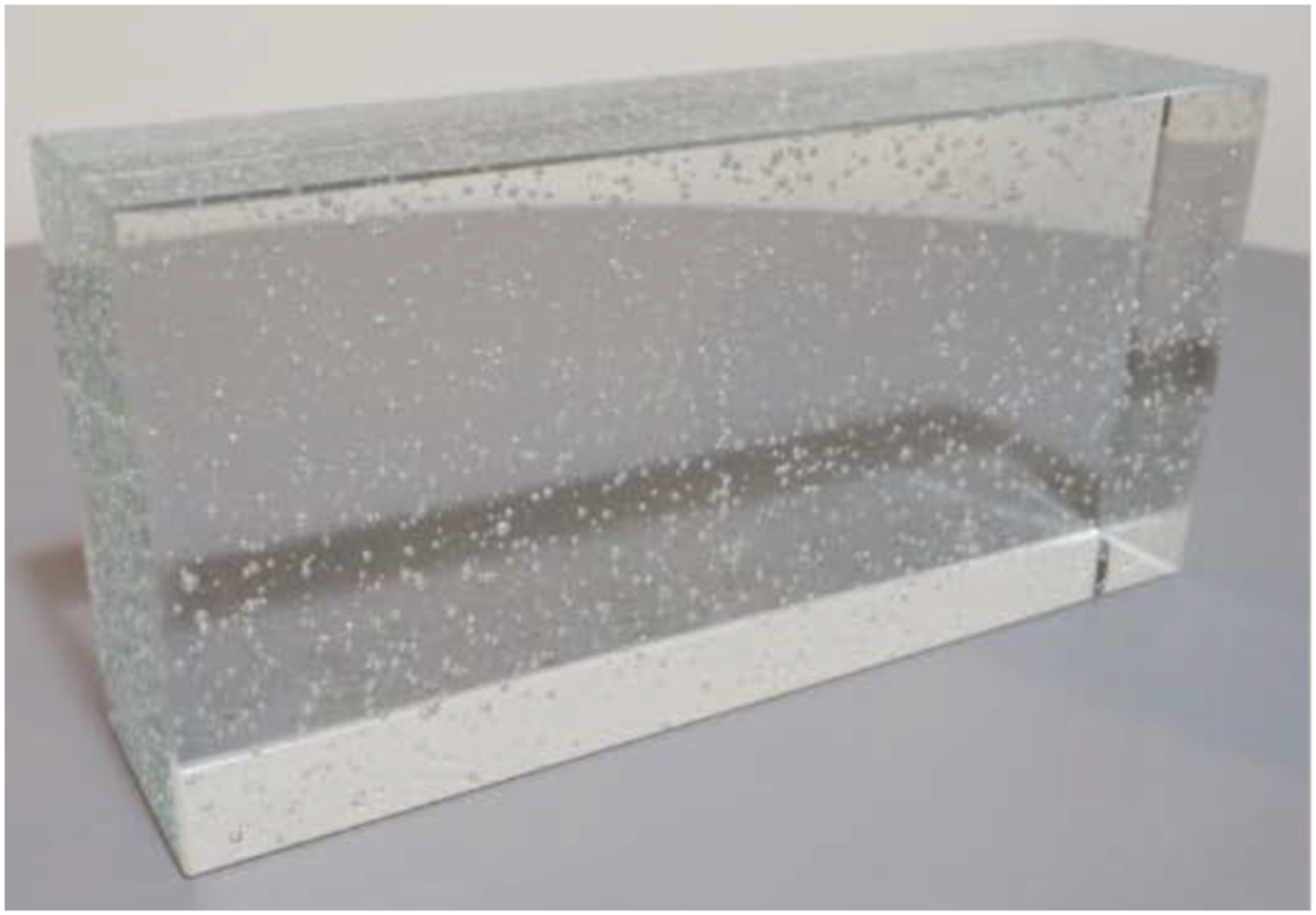
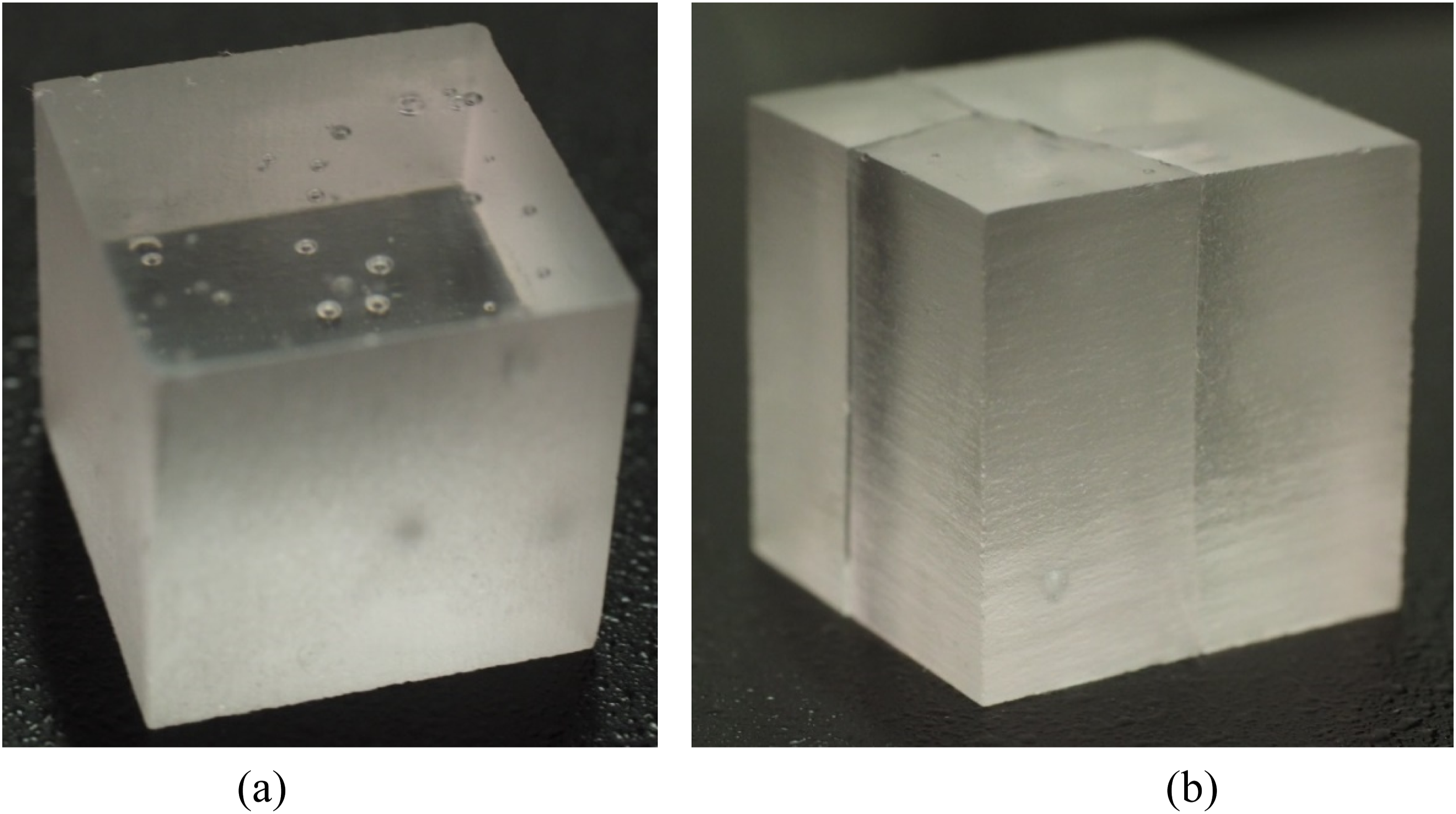
As expected, fracture took place on planes parallel to the direction of loading as can be seen in Figure 10(b) where the specimen was loaded in the vertical direction in compression. As argued in the previous subsection, there is no preferred failure plane orientation amongst those parallel to the loading direction and hence the material selected the plane(s) to suit itself. On the failure plane, the macroscopic stresses vanish and the failure in this particular case cannot be determined by the macroscopic traction on the failure plane.
The experimentally recorded stress-displacement curves for some of the specimens tested are shown in Figure 11 where the curves had been artificially offset one another to avoid overlapping. The recorded displacements and the strain scale as marked in Figure 11 should not be read too literally as they were measured from the crosshead of the test machine, which tended to exaggerate the readings. They are nevertheless indicative at least. The stresses went to relatively high levels as shown due to the high compressive strength of brittle materials in general. Experimental stress-strain curves for a range of specimens.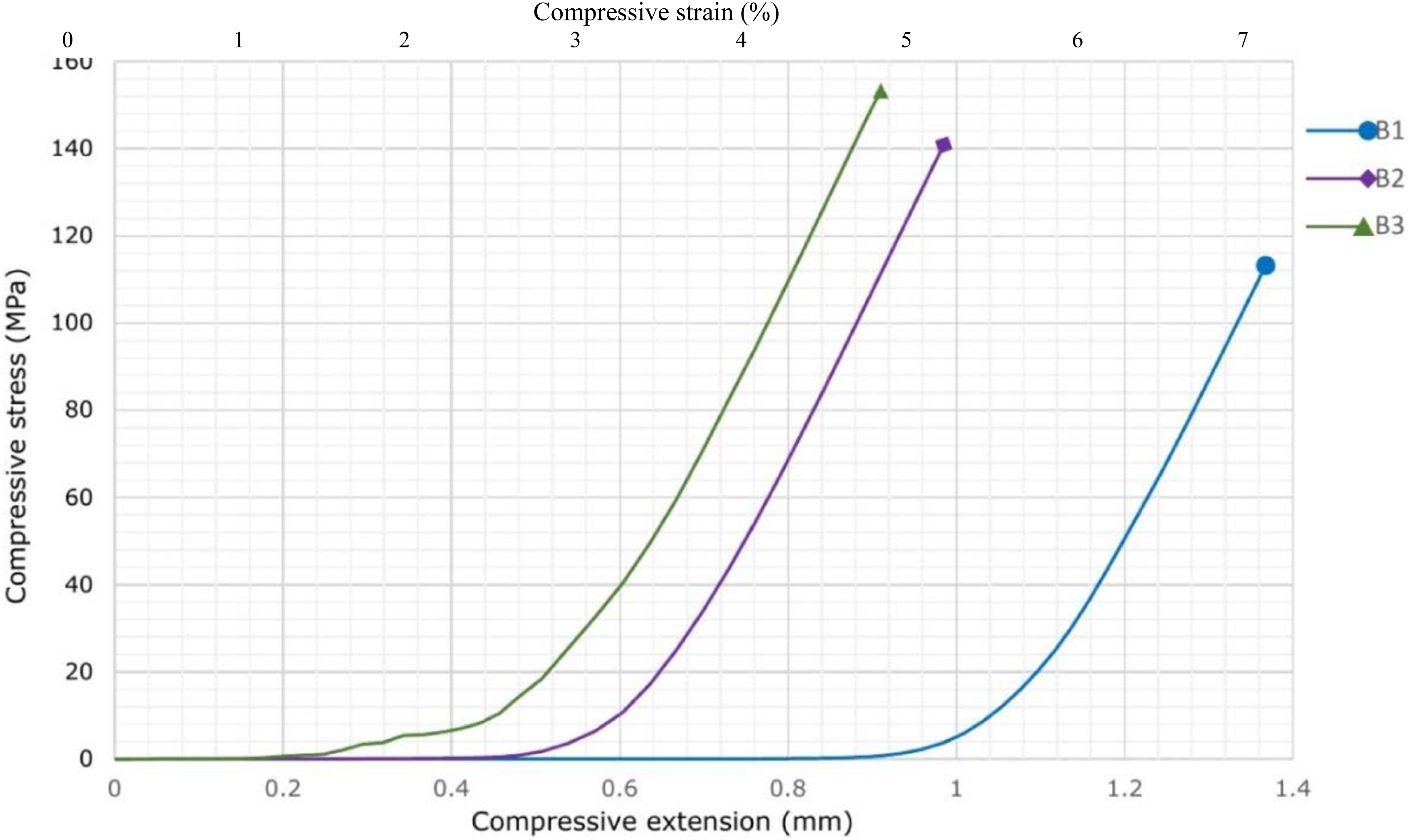
A valid counterargument can be made against the experimental case presented in this subsection. The material of the specimens can be considered isotropic macroscopically. If so, the failure plane is perpendicular to the 1st principal direction, though the magnitude of the 1st principal stress is zero. This challenges Assumption TFP not only in the context of the Hashin criterion, but also in the context of the Mohr criterion for isotropic materials. The validity of Assumption TFP cannot even be take for granted for isotropic materials in this particular case as an exception. The danger of stretching it blindly to anisotropic composites is now conceivable. Isotropy is a necessary condition for TFP, but not sufficient, in general.
An attempt is being made to extend the Mohr criterion as implemented in 23 to embrace the extraordinary phenomena as revealed in 24 for metallic glass under uniaxial tension and that as observed above under uniaxial compression. One of the objectives is to justify Assumption TFP for highly brittle isotropic materials fracture in the manner as observed above. The outcomes will be presented in a future publication soon, but none of them would help with the justification of the extension of Assumption TFP to anisotropic materials.
Contradiction 3
Splitting is one of the failure mechanisms in the experiment of UD composites subjected to uniaxial tension or compression in the fibre direction, as sketched in Figure 12, where cracks often appear in their multiplicity instead of a single one as illustrated. This mode of failure is perhaps more commonly observed in actual experimentation than systematically reported in the literature. Macroscopically, the failure plane is parallel to the direction of loading and therefore on the failure plane, traction vanishes. This mode of failure is somewhat counterintuitive and it may be almost embarrassing to report this observation. Researchers tend to blame themselves and try to identify possible mistakes or oversights in their experimentation, rather than challenge their intuition by exploring any unknown but intrinsic behaviour of material failure. There have been explanations from micromechanics perspective, such as fibre misalignment,
32
or weak bond between fibres and matrix,33,34 etc. Genuine causes as they might be, macroscopic fact is that the traction on the failure plane vanishes, completely or nearly. Apparently, the phenomenon is present even for some of the brittle isotropic materials as revealed in the previous subsection when glass cubes with bubbles inside were subjected to uniaxial compression, where the issues, such as fibre misalignment and weak bond were not even relevant. Splitting failure in UD composites under uniaxial (a) tension and (b) compression along fibres.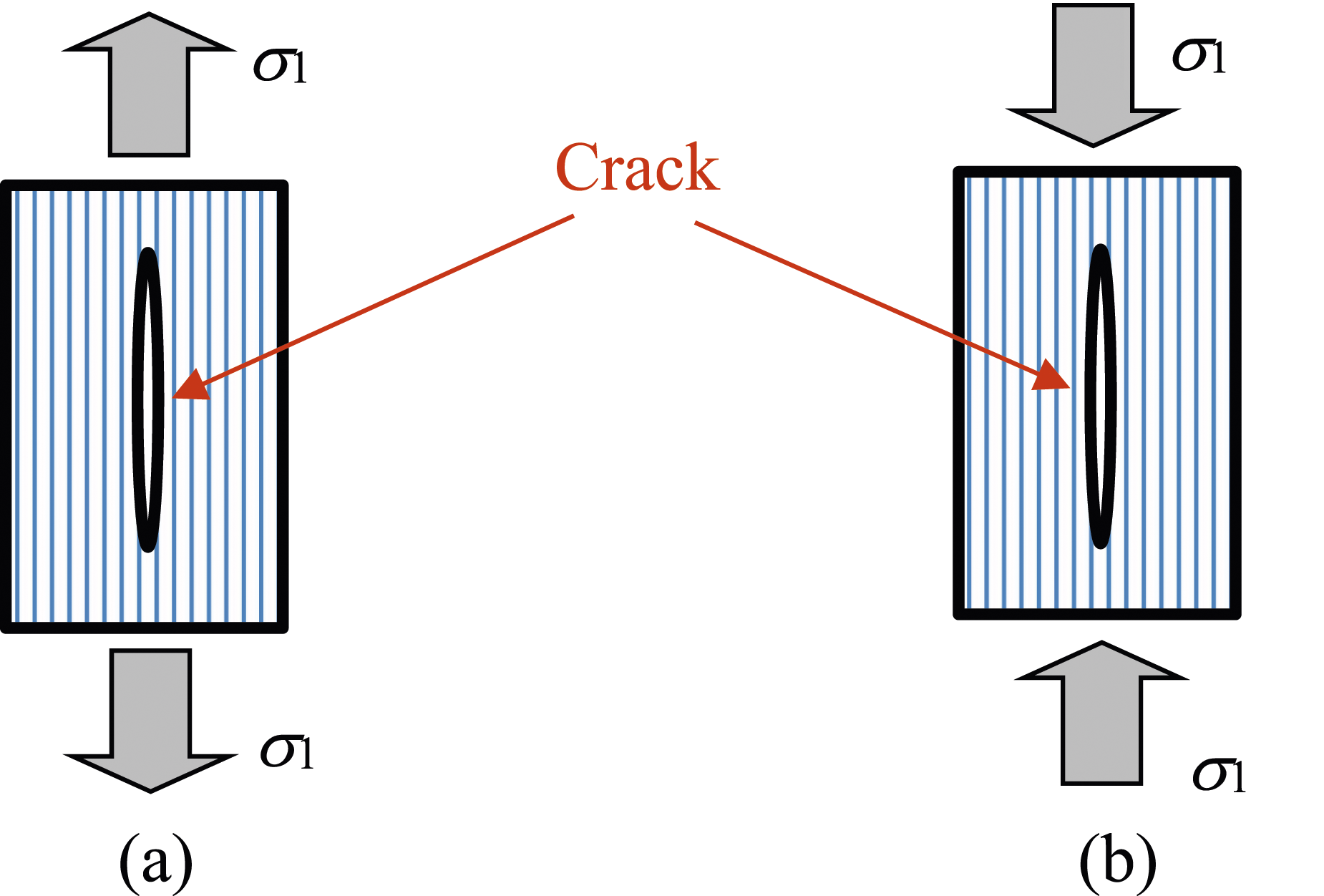
Splitting failure as described above will certainly serve as yet another contradiction to Assumption TFP.
A statement on assumption TFP
The inapplicability of Assumption TFP to anisotropic materials has been reviewed in early on in this paper. Its success in the Mohr criterion for isotropic material does not lend any justification for its extension into anisotropic materials. Should it be employed in the formulation of a failure criterion for anisotropic materials, it would have to be justified separately. There has never been any tangible justification for it in the Hashin criterion, which was proposed specifically for transversely isotropic materials, neither in other criteria built on top of it.
On the other hand, based on the outcomes of the three contradictions as presented above in this section, Assumption TFP has been found to contradict with experimental observations, at least for the three examples cited above. They should be sufficient to dismiss the universal applicability of the assumption to UD composites in general. A fresh examination needs to be given to each of the failure criteria in the literature, such as 20,21, based on this assumption for anisotropic composites.
About the failure mode in the Hashin criterion
There is another aspect of the Hashin criterion that should be challenged related to the failure modes as another key element in the theory.
In the field of material failure criteria, perception sometimes overrides scientific understanding. On the subject of the Hashin criterion, there has also been such an observation regarding the failure modes. In addition to fibre and matrix modes of failure, Hashin also introduced tensile and compressive modes of failure. 2 There are two issues which have left quite some misperception behind amongst its users.
Firstly, in the formulation as Hashin finally arrived, the tensile failure is independent of the compressive strength and vice versa. This seemed to have created a perception that compressive strength should not play any part in the prediction of failure in tensile mode, and vice versa. However, there has never been any justification for this, just like Assumption TFP. It has been taken for granted and never been challenged.
Based on scientific understanding, not any perception, a serious challenge could come from the Mohr criterion, bearing in mind that the Hashin criterion rests heavily on the Mohr criterion. In the Mohr criterion, the failure envelope should be constructed from all Mohr’s circles at failure in theory. As obtaining all Mohr’s circles at failure is impractical, those for uniaxial tension and uniaxial compression should be presented at least. As the result, unless the stress state concerned happens to be uniaxial tension or uniaxial compression, when the failure is dictated by tensile or compressive strength exclusively, respectively, failure should be determined by the tensile and compressive strengths collectively under any other stress state, in general, whether the failure mode is classified as tensile or compressive. Even under uniaxial compression, the orientation of the failure plane would be affected by the tensile strength. The conclusion is that in the prediction of a so-called compressive failure, the tensile strength of the same material can legitimately play a part without contradict any established understanding, and vice versa for tensile failure.
The second issue is associated with matrix failure. The partition between tensile and compressive modes was based on the sum of the two transverse direct stresses. Again, the Mohr criterion tells that tensile failure could take place even if the sum was negative provided that one of them was positive and of a sufficiently large magnitude and the material is sufficiently brittle. This has been fully demonstrated in 23. Such classification of failure modes into tensile and compressive ones in the Hashin criterion was rather baseless.
The arguments made above are not to dismiss the consideration of failure modes as a part of the considerations in the formulations of a failure criterion. They are to reveal the fact that the way Hashin introduced the failure modes has not been justified in much scientific manner but unduly glorified. According to 2, the introduction of the concept of failure modes was mostly to avoid the coefficient to the interactive term in the quadratic failure function, rather than any full scale of micromechanical investigation. It did not use any mode-related information other than Assumption TFP when partitioning fibre mode and matrix mode, whilst artificially avoiding compressive strength when deriving the criterion for tensile failure and vice versa. In order to reflect the failure mode in a failure criterion objectively, more systematic investigation is required. It is not the objective of this paper to achieve this. Instead, the key message out of the present paper is, if thinking is restrained by the framework in 2, e.g. by blindly adopting Assumption TFP and the failure mode partition as in 2, no serious achievement would be possible.
Conclusions
The key assumption (Assumption TFP) of the Hashin failure criterion stating that failure is determined by the traction on the failure plane is under scrutiny in this paper. As an assumption, it was originally introduced as a part of the Mohr criterion for brittle and isotropic materials. It has been argued in this paper based on the understanding established in 22 that this assumption is inapplicable in general to anisotropic materials. Before this assumption was introduced for the failure modes to take advantage of it, the failure function obtained in the Hashin criterion was identical to that of the Tsai-Wu criterion. Any difference from the Tsai-Wu criterion rests on the introduction of Assumption TFP.
Whilst there was lack of much needed justification to demonstrate the validity of Assumption TFP in its application to anisotropic composites, three serious contradictions have been presented in this paper, in which the assumption falls apart completely. They have been argued in the realm of a phenomenological approach as far as the failure is concerned, on the same basis as the Hashin criterion. In the first two cases, some qualitative analyses have been made resorting to basic concepts of micromechanics in order to explain the mechanisms of the failure observed. They were followed by physical tests which agree well with the qualitative analyses. In each of the three cases cited, the failure plane was free from macroscopic traction, which contradicts the assumption of failure being determined by the traction on the failure plane. The extension of Assumption TFP from the Mohr criterion for isotropic materials to failure criteria for anisotropic composites is therefore invalid, in general. Fresh thinking is required before any breakthrough can be envisaged leading to a consistent and reliable composite failure criterion.
Footnotes
Acknowledgments
The authors are indebted to undergraduate final year project students Mr A. Temperton (2017, biaxial compression tests of UD IM7 composite), Mr H. Zhao (2017, SEM imaging) and Mr W. Chulapana (2019, uniaxial compression tests of glass cubes) for their efforts in conducting the physical experiments and processing the experimental results as presented in this paper.
Declaration of conflicting interests
The author(s) declared no potential conflicts of interest with respect to the research, authorship, and/or publication of this article.
Funding
The author(s) received no financial support for the research, authorship, and/or publication of this article.

Data availability statement
Data sharing not applicable to this article as no datasets were generated or analyzed during the current study.