




Abstract
In view of the cumbersome and sultry problem of thermal protective clothing, this study proposes a new method to optimum the protection and comfort properties of the multilayer fabric systems by changing the structure of a separate fabric layer. This research applied the honeycomb structure into thermal liner of multilayer fabric systems in thermal protective clothing. In the study, the experimental samples included 48 honeycomb sandwich structures and 4 traditional structures. A thermal protective performance tester was applied to measure the thermal protective performance provided by these fabric systems and the influence of honeycomb parameters on thermal performance was studied. The results show that the honeycomb sandwich structure fabric systems are lighter in weight and more comfortable to wear than traditional fabric systems. The core thickness plays a dominant role in the thermal protective performance of honeycomb sandwich structure fabric. Additionally, the honeycomb's side length and wall thickness both affected the thermal protection performance of the fabric system. Increasing wall thickness as well as decreasing the side length can improve the thermal protective performance of honeycomb sandwich structure fabric system. Finally, by comparing the thermal protection performance growth rate ratio, an optimal solution was found (core thickness: 2.04, side length: 2, and wall thickness: 7.8). Research on the thermal protection performance of honeycomb sandwich fabric systems helps to provide appropriate guidance to improve thermal protection and reduce heat burden by means of structural effects that affect heat transfer.
Keywords
Introduction
Firefighters are usually the first responders to emergencies in locations with high ambient temperature and fire hazards [1,2]. Thermal protective clothing play an important role in protecting the health and safety of firefighters [3,4]. At present, typical thermal protective clothing generally adopts a multilayer fabric system, which usually consists of an outer shell, moisture barrier, thermal liner, and comfort liner [5]. The outer shell has flame resistance and high strength; the moisture barrier layer is waterproof and breathable; the thermal liner is heat insulated, and the comfort liner is comfortable. Though each layer can contribute its own functions, the maxes of these functions limit evaporative heat dissipation from the human body and impede thermoregulation [6]. Especially, the thickness and gram weight of the fabric have a great influence on the thermal protection performance [7,8], and all have positive effects [9,10]. Thence, the heavy multilayer fabric systems increase the firefighters' load, and strongly affect the firefighter's activity sensitivity and rescue efficiency. Consequently, risks of heat stress and steam burn injuries greatly increase [11] when exposed to a harsh environment. Some studies have proposed the use of phase change materials to reduce the weight [12] and improve the thermal protective performance [13–15]. Others have demonstrated that the aerogel-treated protective clothing exhibited higher thermal protective performance and lighter quality than existing protective clothing [16–18]. In practice, the key point is that we should not only focus on its protection but also allow dissipation of metabolic heat [19]. The contradiction between function and comfort of thermal protective clothing should be seriously concerned. The problem of internal sultry still exists for thermal protective clothing. This requires a better thermal protective system to function as expected.
In order to give full play to the composite performance of the multilayer fabric system, thermal protective clothing must overcome the shortcomings of the traditional structure. The structure should be lighter, have better breathability and moisture permeability, while ensuring the flame-retardant and heat-insulating function. The honeycomb sandwich structure is a porous structure with unique properties, such as light weight, high specific strength and specific stiffness [20,21], excellent thermal insulation properties and thermal stability. Therefore, honeycomb sandwich structures are widely used in fields such as aerospace [22], automotive, marine, construction and packaging. However, in the field of textiles and clothing, few scholars have applied the honeycomb sandwich structure to thermal protective clothing, let alone studied the influence of the honeycomb sandwich structure on its thermal protection performance.
Therefore, this study utilizes such characteristics of honeycomb structure as light weight, heat insulation and high temperature resistance. The traditional multilayer structure is proposed to be replaced with honeycomb sandwich structure to settle the contradiction between clothing function protection and human body heat balance, as well as to achieve comprehensive improvement of thermal protection and heat and moisture comfort. In this study, the internal heat transfer mechanism of the honeycomb sandwich structure was analyzed, and the preparation process of the honeycomb structure was studied. The basic experimental study on flash protection performance of honeycomb sandwich structure was carried out to investigate the effect of side length, wall thickness and core thickness of honeycomb structure on thermal protection performance of thermal protective clothing to meet the application requirements in many fields.
Experimental
Materials
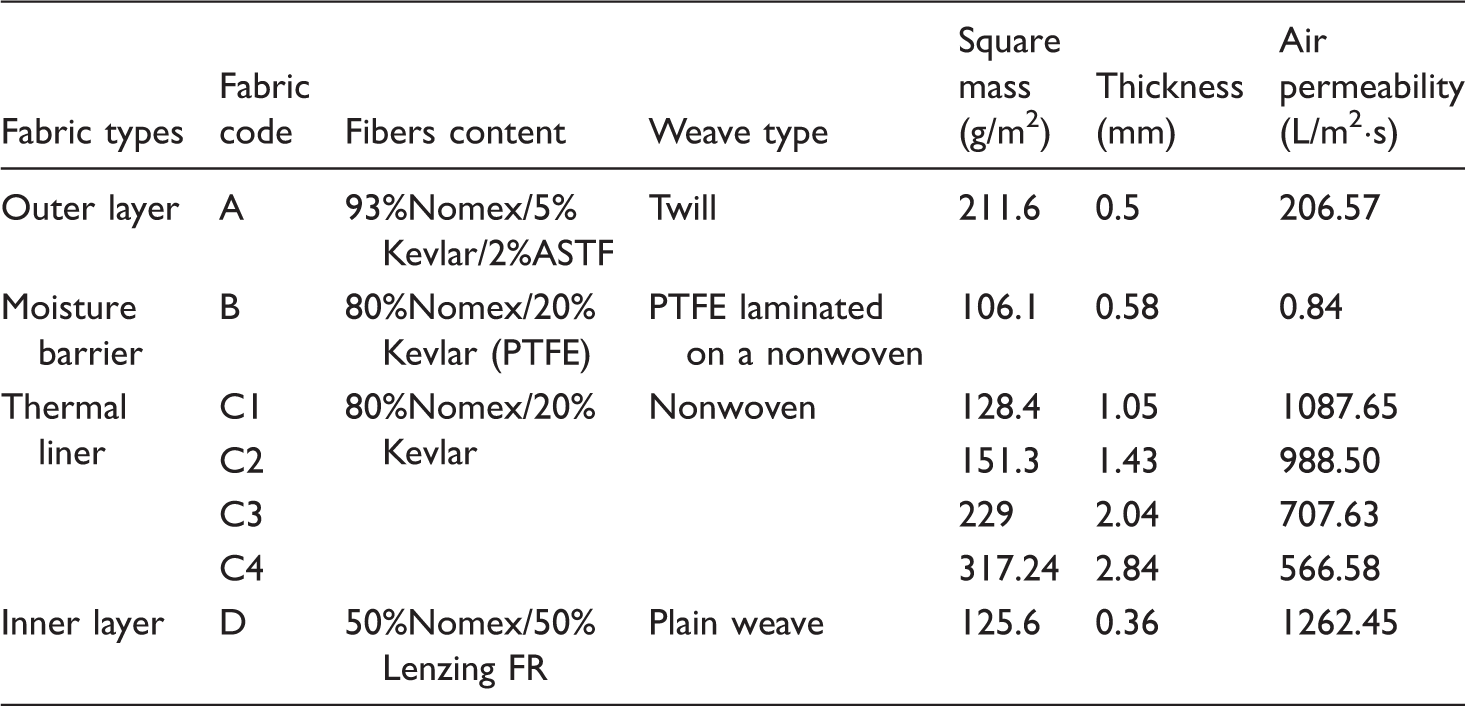
Structure features of experimental fabrics.
Honeycomb structure design and preparation
The generation of honeycomb structure is derived from the study of hexagonal hive built in bionics. In this paper, a regular hexagonal honeycomb structure was selected in which the side length (l), wall thickness (t) and core thickness (h) are the main geometric parameters of the hexagonal honeycomb structure, as shown in Figure 1.
Schematic diagram of a honeycomb sandwich fabric system of thermal protective clothing.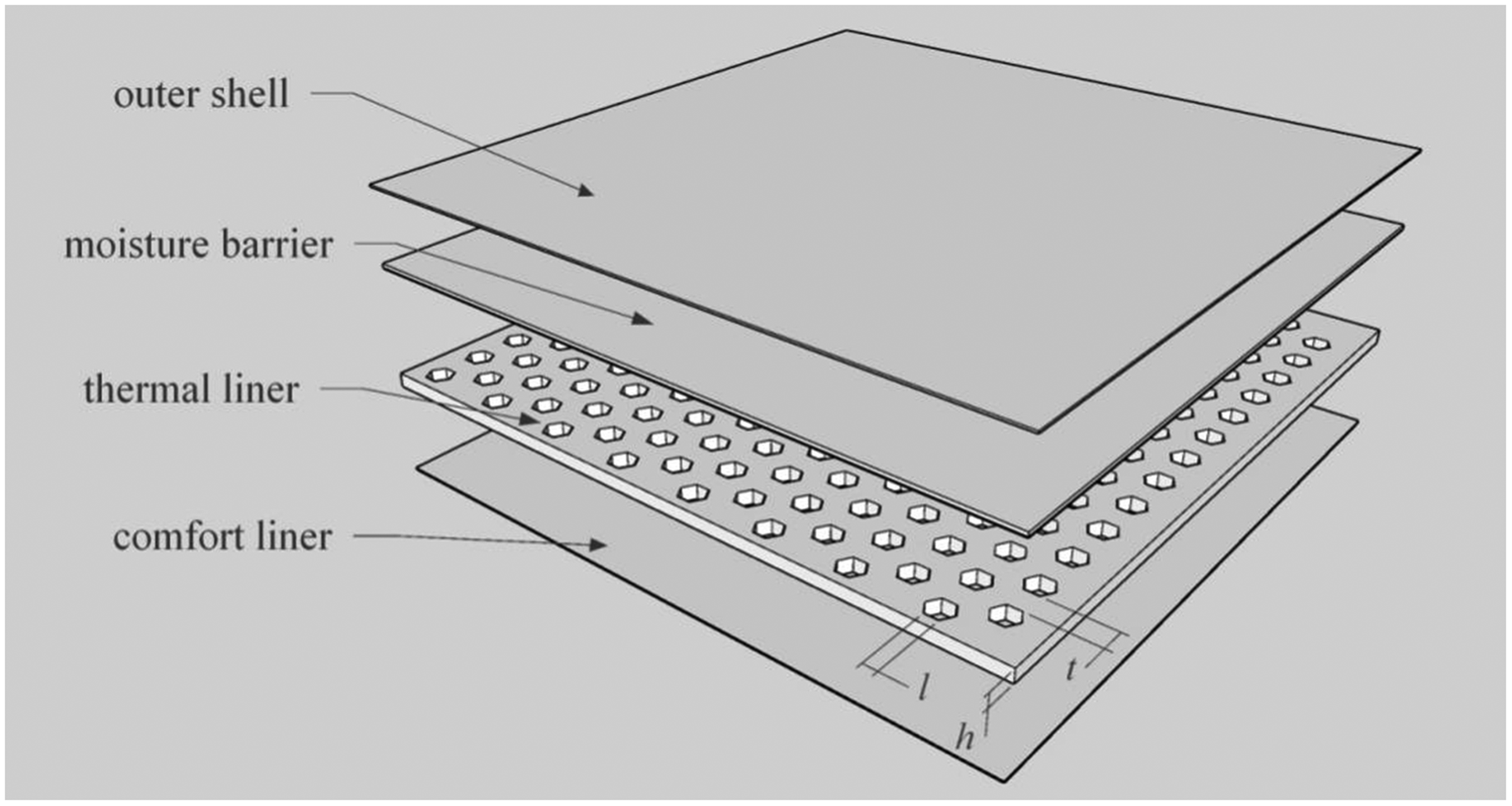
Studies have shown that with side length and core thickness of honeycomb structure increased, the equivalent thermal conductivity decreased; however, the equivalent thermal conductivity increased with wall thickness increased, in metallic honeycomb panel [23]. When the side length of the honeycomb structure is continuously increased, gas convection gradually occurs inside it. In order to avoid convective heat transfer [24], the corresponding side length should be controlled within 15.6 mm. Therefore, this study designed four side lengths, which were 2, 4, 6, and 8 mm, respectively. The weight of a firefighter's protective clothing should not exceed 3.5 kg as described in GA 10-2002. Thus, there is a certain limit to the thickness of the four-layer combination of the thermal protective clothing. When the core thickness is 4.3 mm, the weight of a set of firefighter protective clothing is close to 3.5 kg. So, four kinds of core thickness of 1.0, 1.4, 2.04 and 2.84 mm were designed. In addition, if the wall thickness of the honeycomb structure is too small, it will affect the performance of the firefighter protective clothing. On the contrary, if it is too large, the fabric will collapse. Thus, this study designed three wall thicknesses – 2.6, 5.2, and 7.8 mm. In summary, the design of the honeycomb structure is as shown in Table 2, including 4 side lengths, 3 wall thicknesses, and 4 core thicknesses, a total of 48 kinds of honeycomb structures, of which the design of two-dimensional honeycomb hole scheme is shown in Figure 2, and is represented by E1-E12, respectively. Further, four traditional structures were designed as a control group.
Schematic diagram of honeycomb hole size. Scheme design of honeycomb structure in thermal layer.

In this work, a new approach of cutting the thermal liner into a honeycomb structure by using laser cutting technique was proposed. This study selected carbon dioxide laser cutting machine, which had the advantages of high power, high cutting efficiency, smooth cutting, low processing cost and small thermal deformation. It is widely used in textile, leather and handicraft industries. The thermal layer being cut is called the honeycomb core layer in this paper.
Experimental apparatus and protocol
Currently, the TPP test is the internationally accepted test method for testing the thermal protection performance of thermal protective clothing. The test apparatus employed in this experiment was CSI-206 (Custom Scientific Instrument Corporation, USA) designed according to the US NFPA 1971 standard [25]. The testing fabric is insulated from thermal exposure by a water-cooled shutter before test. During the experiment, the sample was placed horizontally on a sample holder 125 mm away from the quartz tube, which establishes a heat flux of 84 kW/m2 by accepting two different forms of heat transfer with 50% radiation and 50% convection. The temperature of the copper calorimeter in the sample varies with the time of heat exposure and measures the time and total heat flux (TPP) required to cause a second degree burn of the human skin.

For this experimental series, the configuration of the multilayer fabric system is shown in Figure 1. The outer layers, moisture barrier and inner layer, and 52 sorts of core layers were combined to obtain 52 experimental groups. The test specimens were cut into 152 mm×152 mm squares before testing, and then preconditioned in a standard condition (20 ± 2℃ and 65 ± 5% relative humidity) for 24 h. Three experiments were performed for each set of samples to reduce the error.
Results and discussion
Effect of core thickness on TPP of honeycomb sandwich structure fabric system
The effect of core thickness on TPP of honeycomb sandwich structure is shown in Figure 3, where 2–7.8 represents a honeycomb sandwich structure fabric system with a side length of 2 mm and a wall thickness of 7.8 mm, and so on. From Figure 3, it was found that when the core thickness was 2.84 mm, the corresponding honeycomb sandwich structures had the highest thermal protection performance; when the structural core thickness was 1.05 mm, the corresponding thermal protection performance was the smallest. Moreover, when the core thickness was the same, the 2–7.8 honeycomb sandwich structure had the highest thermal protection performance, and the 8–2.6 honeycomb sandwich structure had the worst thermal protection performance. This observation suggested that the increasing of core thickness can effectively increase the thermal protection performance of honeycomb sandwich structure (the partial correlation coefficients is 0.866, p < 0.01). This effect is caused by the increase in the thickness of the honeycomb core significantly reducing the angular coefficient between the upper and lower surfaces, so that the amount of radiant heat exchange between the upper and lower surfaces is significantly reduced. So increasing the core thickness of the honeycomb will increase the thermal protection performance of the honeycomb sandwich structure.
Schematic of the effect of core thickness on TPP.
Effect of side length on TPP of honeycomb sandwich structure fabric system
Figure 4 shows the effect of side length on the thermal protection performance of the honeycomb sandwich fabric system, where the X axis represents the side length of the honeycomb structure, and t2.6, t5.2, t7.8 represent the wall thickness of the honeycomb structure which is 2.6 mm, 5.2 mm, 7.8 mm, respectively. As seen in Figure 4, the honeycomb fabric system with a side length of 2 mm has the largest TPP value, followed by 4 mm, 6 mm, and 8 mm. However, Figure 4(a) shows a slight difference in the second stages of the curve compared to the other figures. In order to further examine the correlation between the side length of the honeycomb and the TPP value, a partial correlation analysis was performed on the relationship between the TPP value and the three factors. The result showed that the correlation between the TPP and the side length was significant (the partial correlation coefficients is −0.760, p < 0.01). Therefore, the fabric side length has a direct negative effect on the TPP. The results indicated that the larger the side length of the honeycomb, the worse the thermal protection performance of the fabric system.
Schematic of the effect of side length on TPP: (a) core thickness is 1.0 mm; (b) core thickness is 1.4 mm; (c) core thickness is 2.04 mm; (d) core thickness is 2.84 mm.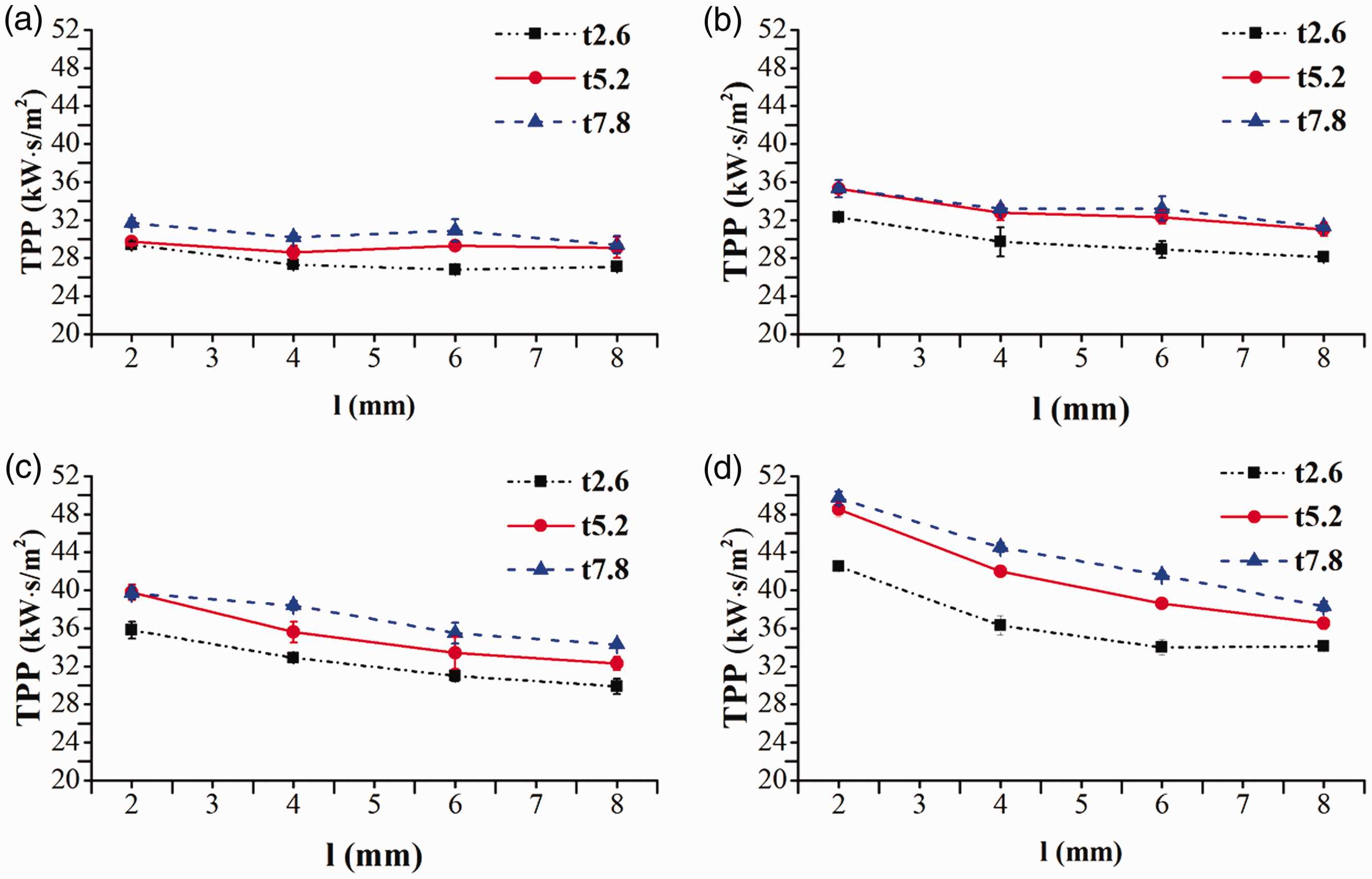
Moreover, in the process of increasing the side length of the honeycomb from 2 mm to 8 mm, the rate of decline of the TPP value at each stage was different. When the side length was increased from 2 mm to 4 mm, the TPP value dropped the fastest, and then gradually became slower. The larger the core thickness, the more obvious this change rule. This phenomenon may be explained by the fact that in the process of increasing core thickness, the influence of the side length on the thermal protection performance of the honeycomb sandwich structure is gradually weakened.
Effect of wall thickness on TPP of honeycomb sandwich structure fabric system
The effect of wall thickness on the thermal protection performance of the fabric system can be observed from Figure 5. It can be observed that the TPP value was the largest when the wall thickness was 7.8 mm, and the TPP value was the smallest when the wall thickness was 2.6 mm. In addition, the partial correlation coefficient of core thickness and TPP was 0.367 (p < 0.01). The results showed that the effect of honeycomb wall thickness on the thermal protection performance of the fabric system was that the thermal protection performance of the fabric system increases with the increase of the wall thickness of the honeycomb.
Schematic of the effect of wall thickness on TPP: (a) core thickness is 1.0 mm; (b) core thickness is 1.4 mm; (c) core thickness is 2.04 mm; (d) core thickness is 2.84 mm.
There are three main heat transfer modes of the honeycomb sandwich structure: the heat conduction of the solid core wall, the heat radiation between the honeycomb cavity and the upper and lower surfaces, and the thermal convection of the gas in the cavity (the natural convection can be completely suppressed in the case of a small honeycomb size). As known, in the research of metal honeycomb sandwich structure, it is found that as the side length increases and the wall thickness decreases of the honeycomb unit, the proportion of the cross-sectional area of the solid core wall in the cross-sectional area of the entire honeycomb unit decreases. So the heat transfer conductance of the solid core wall in the honeycomb unit is relatively reduced. However, compared with the metal honeycomb sandwich structure, the wall thickness of the honeycomb core structure is very large, resulting in a very small aspect ratio of the honeycomb. At this time, the radiation heat exchange plays a leading role in heat transfer. This is also the main reason that increasing the side length and decreasing the wall thickness can reduce the thermal protection performance of protective clothing.
Performance comparison of honeycomb sandwich structure
The design of the honeycomb sandwich structure needs to consider of the three control parameters – the side length, wall thickness and core thickness of the honeycomb. In fact, it is possible to compare the thermal protection performance of the honeycomb sandwich structure by establishing the thermal protection performance growth rate ratio

Thermal protection performance growth rate ratio of honeycomb structures with different core thickness.

In this research, the evaporative resistance (Ref) of traditional fabric system and the evaporative resistance (Ref) of optimal thermal protection performance honeycomb structure fabric system were measured according to ASTM F 1868, Standard Test Method for Evaporative Resistance of Clothing Materials Using a Sweating Hot Plate. The experimental results showed that the evaporative resistance of the multilayer fabrics was lower than 30 pa·m2·W−1, which met the requirements of European standards and the optimal thermal protection performance honeycomb structure fabric system had a lower evaporative resistance (Ref = 18.421 pa·m2·W−1) than that of the traditional fabric system (Ref = 18.566 pa·m2·W−1), which was beneficial to the loss of water vapour.
Conclusions
This paper presents a new perspective that influences the thermal protection performance of fabric systems by changing the structure of the thermal liner of traditional fabric systems. The carbon dioxide laser cutting machine was used to prepare the honeycomb structure and the basic experimental research on the flash thermal protection performance of 52 fabric systems was carried out. The results show that honeycomb sandwich structures are lighter in weight and more comfortable to wear than traditional structures. Furthermore, the core thickness, side length and wall thickness of the honeycomb sandwich structure have an effect on the thermal protection performance. The increment of core thickness significantly increases the thermal protective performance of honeycomb sandwich structure (correlation = 0.886, p < 0.01). Increasing the wall thickness (correlation = 0.367, p < 0.01), and decreasing the side length (correlation = −0.760, p < 0.01) can also improve the thermal protection performance of the honeycomb sandwich. In addition, this paper obtained the optimal thermal protection performance honeycomb structure (core thickness = 2.04 mm, a side length = 2 mm, and a wall thickness = 7.8 mm) by constructing the evaluation index of the thermal protection performance honeycomb structure.
Footnotes
Declaration of conflicting interests
The author(s) declared no potential conflicts of interest with respect to the research, authorship, and/or publication of this article.
Funding
The author(s) disclosed receipt of the following financial support for the research, authorship, and/or publication of this article: The authors would like to acknowledge the financial support by the National Natural Science Foundation of China (Grant No. 51703026) and the Fundamental Research Funds for the Central Universities (Grant No. 2232019G-08).