




Abstract
In this study, nylon 66 industrial fabrics (used in the conveyor belts) were exposed artificially to the accelerated ultraviolet rays and the degradation mechanism was evaluated using spectral, thermal, and morphological analyses. The fabric samples were exposed to six different exposure times in a UV chamber and tensile tests were carried out in the main and bias (45°) directions. The results showed that the shear modulus was reduced in the early stages covering 4 h of the UV radiation because of the linkages breakage and the increase in the amorphous regions. However, after this early stage, the shear modulus started to increase. The Fourier transform infrared spectroscopy (FTIR), scanning electron microscope (SEM) analysis, and X-ray photoelectron spectroscopy (XPS) study were also performed to evaluate the surface morphology and the degradation mechanism of the nylon 66 fibers after UV illumination. The results also revealed that the formation of new links by free radicals caused the change in the bond wavelengths. Furthermore, it was found that there was an interesting mechanism for the UV degradation of nylon 66 fabrics at different exposure times, as confirmed by the results obtained regarding the mechanical properties of the samples. The results of this study can be, therefore, helpful for the industrial application of nylon 66 woven conveyor belts exposed to solar UV radiation.
Introduction
The product life of polymeric goods depends on their ability to resist against the weathering factors that can degrade their appearance and physical properties. Weathering effects could result from the interactions of various parameters such as environmental conditions, solar rays, heat or cold climates, humidity, oxygen, and pollutants with the materials. Some researchers have reviewed the aging of polymers with a focus on the mechanisms of degradation and stabilization, the methods of testing the weather ability, and the predictive modeling of degradation [1–8].
One of the disadvantageous effects of the weathering condition is the degradation of textiles that are exposed to UV radiation. In fact, there are many textiles and related products that should be under the exposure of the sun and accordingly, they are subject to the ultraviolet rays. When sensitive thermoplastic polymers, such as polypropylene, polyethylene, and poly (methyl methacrylate) and aramid fibers, absorb UV radiation, chains degradation, and loss of strength occur at the critical points of the chain structure. Some researchers have evaluated the change in the chemical and mechanical properties of the polymers by UV degradation [9–14].
Zhang et al., for instance, investigated the effects of solar UV radiation on the tensile and structural properties of Twaron 2000 Para-aramid fibers [15]. They concluded that the mechanical properties of fibers such as strength, modulus, break strain, and work of rupture were clearly decreased after UV radiation. UV radiation caused intense surficial damages and chain scission, but the crystalline structure of the fibers remained unchanged. However, local reconfiguration of the crystalline parts could occur. They also found that the surficial cracks and shortening of the crystalline length in the fiber axis direction were the main structural reasons for the mechanical loss induced by UV radiation. Shokrieh and Bayat also applied the micromechanical models to simulate the mechanical properties of glass/polyester composites under UV radiation [16]. Their results showed that the shear modulus of the samples was dropped due to the UV degradation.
Cui et al. also studied the UV degradation of biopolymers [17]. SEM and FTIR evaluations showed that the polymer degradation process was accelerated with the increase in the UV exposure time. They also found that the crosslinking density of the copolymer was increased in the initial phase of degradation (before chain scission). They stated that the surface cracks and loss of ductility were the main reasons for the most reductions of the mechanical properties. Further, Marek et al. studied the rheological behavior of some polyolefins within a range of temperature (160–200℃) during UV radiation [18]. They found that there was a competition between the chain scissions and the chain crosslinking process.
Polyamides (PA) are the most important polymers in terms of industrial and textile applications [19–22]. Investigation and characterization of the textiles exposed to UV radiation can be, therefore, important from the mechanical properties point of view. In this regard, some researchers have addressed the effects of the UV radiation on the chemical and mechanical properties of the technical textiles. Shamey and Sinha, for example, worked on a review of the degradation of PA66 by exposure to the environmental conditions [23]. Moezzi and Ghane also investigated the toughness of PA66/polyester fabrics under UV irradiation [24]. They used the regression method to find the relationship between the UV exposure time and the loss rate of the toughness. Their results showed a good relationship between the theoretical and experimental results. Moezzi et al. also predicted and analyzed the mechanical response and tensile properties of UV degraded nylon 66/polyester woven fabrics using regression, artificial neural network, and finite element (FEM) models [25,26]. As well, Jafari et al. studied the recovery behavior of acrylic carpets after UV irradiation [27]. They found a relationship between the thickness loss of the UV radiated carpets and exposure times using the regression models.
Shear modulus of the industrial fabrics in the outdoor applications is an important parameter. However, this feature has not been investigated as an independent factor in the literature. Shear modulus can have an important effect on the end usage of the entire products and plays an effective role in characterizing the unexposed and UV-radiated materials. The main aim of this study was, in fact, to investigate the effects of the UV radiation time on the shear modulus of the industrial conveyor belts made of nylon 66 woven fabrics. As stated, the previous studies have only focused on the mechanical aspects and modeling of the UV irradiated fabrics. However, there is no study characterizing the degradation mechanism of the PA66 fabrics under UV illumination. In this paper, the industrial nylon 66 woven fabrics were exposed to UV radiation in various times. Then, the mechanical properties of the specimens were measured. Subsequently, FTIR, microscopic studies (optical and scanning electron microscope), XPS, and thermogravimetric analyses were carried out to analyze the morphological, chemical, and molecular characteristics of the UV-treated and unexposed samples. Mechanical properties together with chemical evidence showed an interesting mechanism for the UV degradation of PA66 fabrics. These results could be useful for industries using typical nylon 66 conveyor belts to estimate the optimum working life of their apparatus under solar UV radiation.
Materials and methods
Materials
Industrial nylon 66 woven fabrics (untwisted 1250 denier/240 filaments nylon 66 yarns; fabric thickness: 0.53 mm; warp density 12.6 cm−1, weft density 9 cm−1) were supplied by Saba Tire Cord Co., Iran.
UV Illumination experiments
Thirty-five specimens with the dimensions of 50 mm × 200 mm were cut in the bias direction of the nylon 66 fabric. The samples were oriented at 45° in the bias direction based on the elongation path. UV chamber was used to evaluate the degradation of the polymeric samples. The UV chamber consisted of eight ultraviolet lamps (TUV30W G30T8 model) supplied by Philips. These lamps produced ultraviolet rays at the wavelength of 253.7 nm. Samples were placed on the plate of the UV chamber and exposed to six various UV exposure times (2, 4, 8, 10, 15, 20 h) at the vertical distance of 17 cm from UV lamps. This procedure was repeated five times and five specimens were not exposed to UV light as the control samples. The schematic of the UV chamber is illustrated in Figure 1(b).
(a) The tensile test setup for testing the nylon 66 fabrics and (b) UV radiation chamber.
Tensile test
Tensile tests were carried out on seven series of the samples (five samples in each series) with the uniaxial tensile testing machine (Zwick universal testing machine-144660) under the standard condition. The tensile tests were performed at 45° or the bias direction. In each level of the exposure time, five samples were tested and the results were averaged. The width of samples was 50 mm and the gauge length was set to 100 mm [28,29]. The samples were firmly fixed between clamps, and the stress–strain curves were obtained. The test speed was also set at 10 mm/min. Samples were tensioned until the tension force reached to 25 N and after that, the bottom clamp returned to its initial location. The aim of tests was to perform the cycling loading. For this purpose, several tests were performed and 25 N force was selected as an optimum tension level that fabric rupture does not occur before that. The reason for choosing cyclic loading was low stress and strain conditions during the application state of the nylon 66 fabrics. The tensile instrument setup is shown in Figure 1(a).
Calculation of the initial modulus in the bias direction
The stress–strain curves in the bias direction were analyzed to obtain the initial modulus of the fabrics. The stress–strain curves consisted of two different parts, i.e., the initial part and the secondary part. The first part of the stress–strain curve in the bias direction was analyzed to obtain the initial modulus of the fabrics. It was assumed that the initial part obeyed an exponential path as follows [24]

The elastic modulus could be defined as the tangent of the initial section of the stress–strain curve. Thus, the differentiation of the equation (1) represented the tangent modulus as

In this study, the initial modulus was calculated at 2% strain in the stress–strain curves according to the equation (2).
Calculation of the shear modulus
According to the research conducted by Leaf and Sheta, when a fabric ensconces under tensile load in the bias direction, the Young modulus of the bias sample (E45) is related to the shear modulus (G) as follows [30]

In general, modulus in the bias direction is very smaller than that in the warp and weft directions. We can consider the Poisson ratio equal to 1. Thus, equation (3) could be written as follows

The initial elastic modulus of all samples in the bias direction (E45) was obtained from equation (2); then the shear modulus of the fabrics was calculated using equation (4).
Microscopic analysis
Microscopic analysis was performed to investigate the surface and internal morphology of the UV degraded nylon 66 fibers. Optical microscope (Zeiss Primotech, Germany) was used to study the internal changes of the fibers by transmitted light. Scanning electron microscope (Jeol, JSM-840A, Japan) was also used to evaluate the surface morphology of the PA66 fibers before and after the UV illumination. The UV irradiated fabrics were cut in 1 × 1 cm2 samples and sputtered with gold ions using an SEM sputtering system (JEOL, JFC-1100E, Japan); then SEM images were captured.
FTIR and XPS analysis
The Fourier transform infrared spectroscopy test (FTIR) was performed according to ASTM D 2654-89a. Bomem spectrometer was also used and the results were recorded between 4000 cm−1 and 400 cm−1 wavelengths using the KBr pellet technique. This test is usually used to detect the chemical groups in different materials. Fabric samples were cut into very thin pieces and ground with KBr to make a pasty powder sample. The powder sample was converted to a thin and transparent pellet by a press apparatus. Then, the pellets were put in the sample holder of the FTIR instrument.
XPS (X-Ray photoelectron spectroscopy) analysis was performed with the 8025-BesTec twin anode XR3E2 X-ray source system to evaluate the surface chemistry of the UV irradiated fibers at different exposure times.
Thermogravimetric analysis
In order to evaluate the thermal behavior of the nylon 66 fabrics under the UV illumination, approximately 0.1 g of each sample was weighted and placed in the sample holder of the TGA system. Then, the weight loss measurements were performed from room temperature to 800℃ with a thermogravimetric analyzer (Sanaf, Iran) at the heating rate of 20℃/min and in the air atmosphere. Five tests were performed for each sample and the results were averaged.
Results and discussion
Mechanical properties
Physical and mechanical properties of the polymers can specify their end usage. Therefore, evaluation of the physical properties by suitable instruments could help us to optimize the final application of the products. In this study, all samples were tested in the bias direction.
Figure 2 shows the stress–strain curves of PA66 samples under various UV exposure times. The ultimate stress (0.94 MPa) was simply calculated by dividing the ultimate force (25 N) over the cross section area of the fabrics (50 mm × 0.53 mm). At first, it was predicted that the physical properties of the samples would be decreased with increasing the UV exposure time. However, in practice, the stress–strain curves of PA66 samples in various UV exposure times were going to different trends with increasing the intensity of the exposure. It seemed that more analyses were required to explain the reason for this interesting trend.
Bias stress–strain curves for the samples exposed and unexposed to UV light.
Curve fitting constants of different samples at various exposure times.
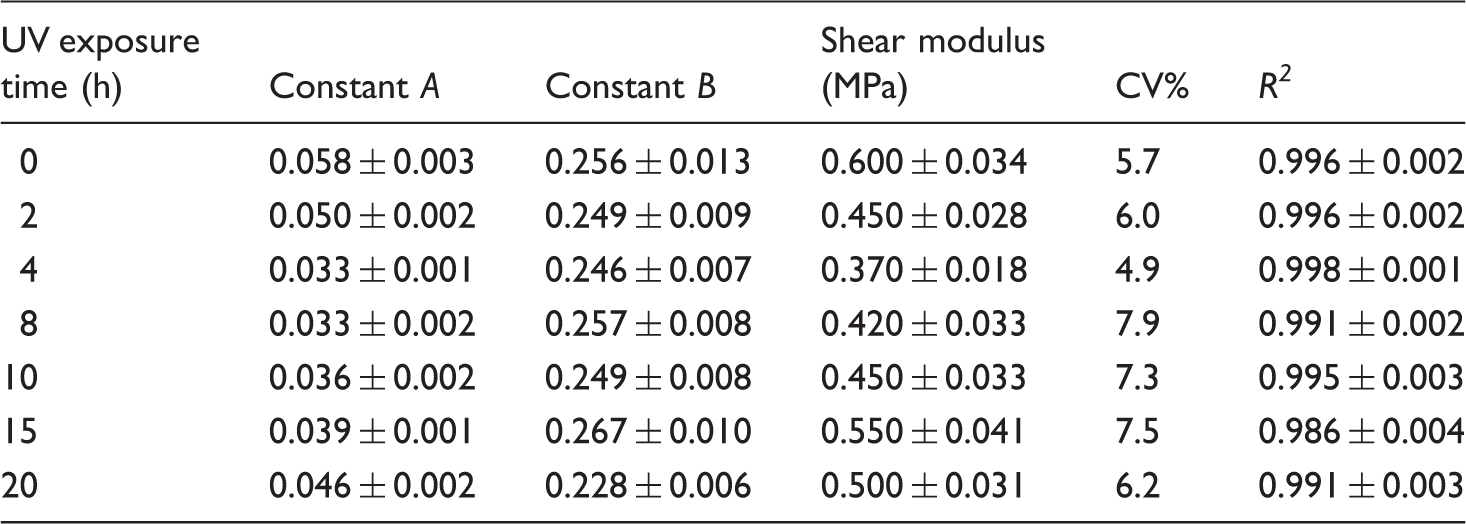
The shear modulus curves of all samples were determined using equation (2), as shown in Figure 3. The coefficient of variation (CV%) of the measured shear modulus values was also measured and was reported in Table 1. The CV% statistic is a measure of repeatability and precision of the experiments and dispersion of the results. The smaller value of the CV% between a data set means the greater precision in the trials. This parameter is defined as the ratio of the standard deviation to the mean value. The obtained results indicate that the CV% values for measured shear modulus lie within the range of 5–7.5%. Results show that there is no significant variation between the replicated experiments on a particular sample. The obtained results showed that the unexposed fabric had the highest modulus among other samples and UV irradiation exerted a visible impact on the mechanical modulus of the fabrics. UV illumination of the fabrics also led to decreasing the shear modulus in the bias direction. But there were two exceptions. The maximum drop in the shear modulus was seen in the samples with 4 h irradiation; there was also some improvement in the mechanical properties after 15 h of the UV exposure time. This trend could not be explained by the mechanical results alone, and it was necessary to analyze other experimental results for the better explanation of the observed exceptions. For this purpose, the statistical analysis was also performed to investigate the significance level of the obtained results.
Calculated bias direction modulus (E45) curves of nylon 66 industrial fabrics.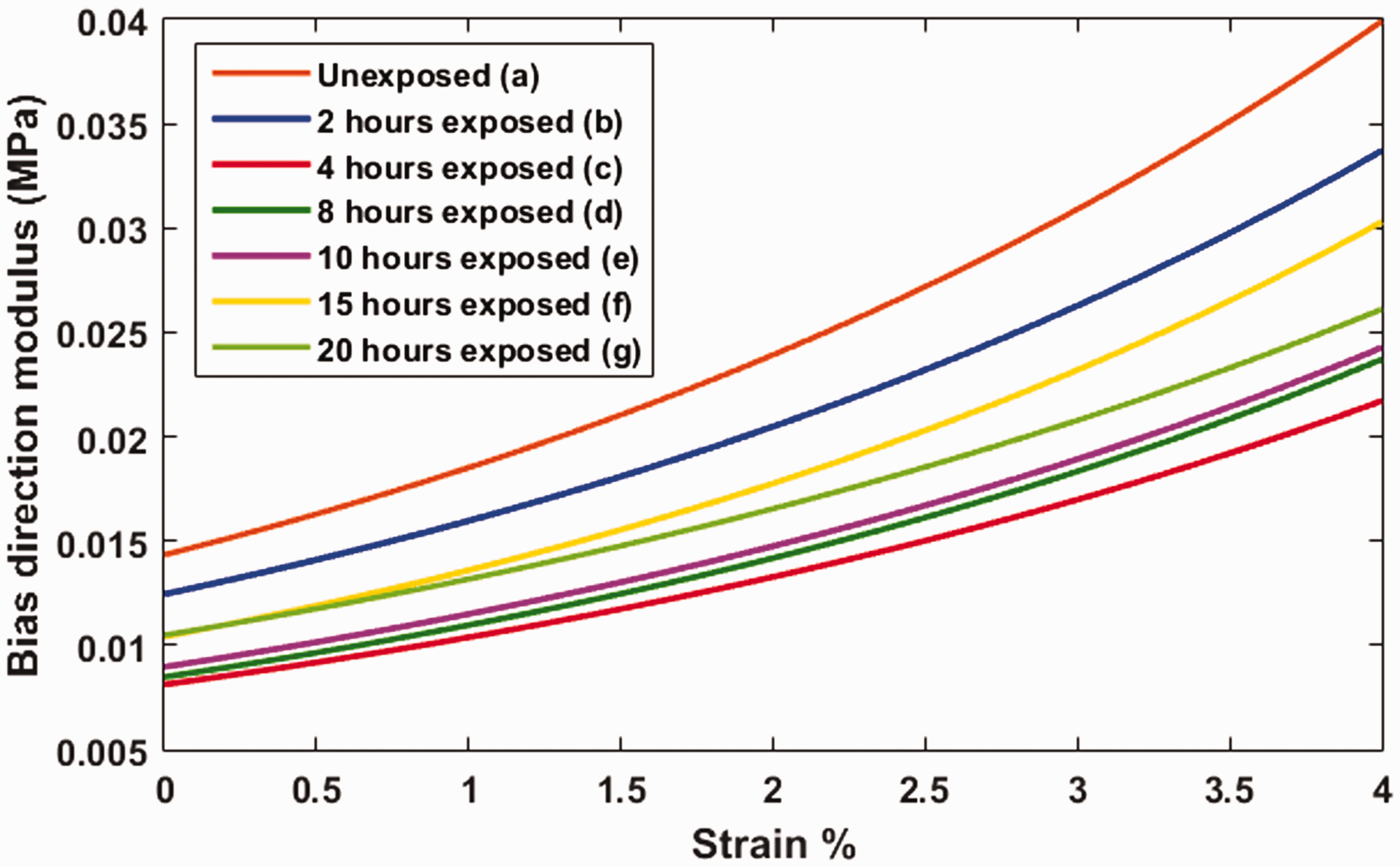
Statistical analysis
The results of ANOVA test for the shear modulus of the PA66 fabrics under different UV exposure times.

Table 2 shows that the mean differences of measured shear modulus is significant (p value = 0.000 < 0.05) at α = 0.05 level. Thus, it can be said that the UV exposure time had a significant effect on the shear modulus of the nylon 66 fabrics.
The results of Duncan test for the effects of UV exposure times on the shear modulus of the nylon 66 fabrics.

According to the results of the Duncan test, it was found that there were three exposure times with significant effects on the shear modulus of the specimens (4, 15, and 20 h). Thus, these exposure conditions were selected for further analysis including the microscopic, FTIR, XPS, and TGA analyses.
Microscopic analysis
Optical microscope and SEM images were used to inspect the surface and internal morphology of the fibers. The microscopic images of the surface of samples untreated and exposed to UV light are shown in Figure 4. The unexposed sample showed an even surface morphology and no crack was observed in the structure of the untreated fibers. Figure 4 shows that the UV irradiation led to creating the cracks on the surface of fibers. Figure 4(b) to (d) is also related to the UV-exposed surfaces. The created micro cracks are marked with the green arrows in the magnified images. Although the distribution of micro cracks in the UV degraded surfaces with various exposure times was different, in all cases, the micro-cracks were observed. Figure 4(b) to (d) shows the samples which had received 4, 15, and 20 h of UV light, respectively. The comparison of the surface morphologies also showed the increase in the number of micro cracks with raising the exposure time. But it seemed that after 4 h to 15 h exposure times, the crosslinking process led to increasing the adhesion in the crack edges. These results were confirmed by the analysis of the physical tensile test.
Optical microscopic image of the surface of nylon 66 fibers: (a) unexposed nylon 66, and exposed samples after (b) 4 h, (c) 15 h, and (d) 20 h of UV irradiation.
The SEM analysis was also performed to investigate the morphological changes of the surface of PA66 fibers after UV irradiation. Figure 5 shows the SEM images of the unexposed and treated samples with UV illumination. An increase in the number of micro cracks after the first irradiation step could be seen (4 h). However, it seemed that by increasing the exposure time from 4 h to 15 h, the crosslinking process led to enhancing the adhesion in the crack edges. On the other hand, increasing the exposure time from 15 h to 20 h led to the creation of the new cracks inside the fibers. The SEM images of the treated samples showed some surface defects in the fibers after different UV exposure times. Figure 5(a) relates to the unexposed sample. As the first step of UV exposure (Figure 5(b)), the surface of PA66 fibers began to burn and some longitudinal tracks were created on the fibers. These grooves served as stress concentration centers and sites to significantly reduce the mechanical strength. As the exposure time was increased from 4 h to 15 h (Figure 5(c)), these tracks were closed by the molten polymer and their negative impact could be reduced. The melting process of the polymer was enhanced by the continued irradiation and the fibers structure had almost collapsed (Figure 5(d)).
SEM images from the surface of PA66 fibers after different exposure times: (a) unexposed sample (b) 4 h, (c) 15 h, and (d) 20 h.
To better understand the microscopic analysis, the trend of mechanical properties after different exposure times is shown in Figure 6. The initial modulus at 2% strain in the stress–strain curves was calculated according to equation (4), as plotted in Figure 6. Figure 6 shows that the shear modulus was reduced in the early stages up to 4 h of the UV exposure time. However, after this early stage, the shear modulus started to increase. As the radiation was increased up to 15 h, the shear modulus showed a decreasing trend and tended to fall again. As could be observed by the microscopic images, after the first stage of illumination (4 h), some surface and internal cracks were created, leading to decreasing the mechanical properties. After this step, crosslinking of the polymer chains by melting fill these gaps and stress concentration sites could be reduced. Therefore, the shear modulus of the fabric could be enhanced slightly. By continuing the irradiation process, the chains of polymer could be broken and the fibrous structure of the PA66 fabric would be collapsed. Thus, the mechanical properties of the nylon 66 fabric were reduced again.
Shear modulus variations against UV exposure time.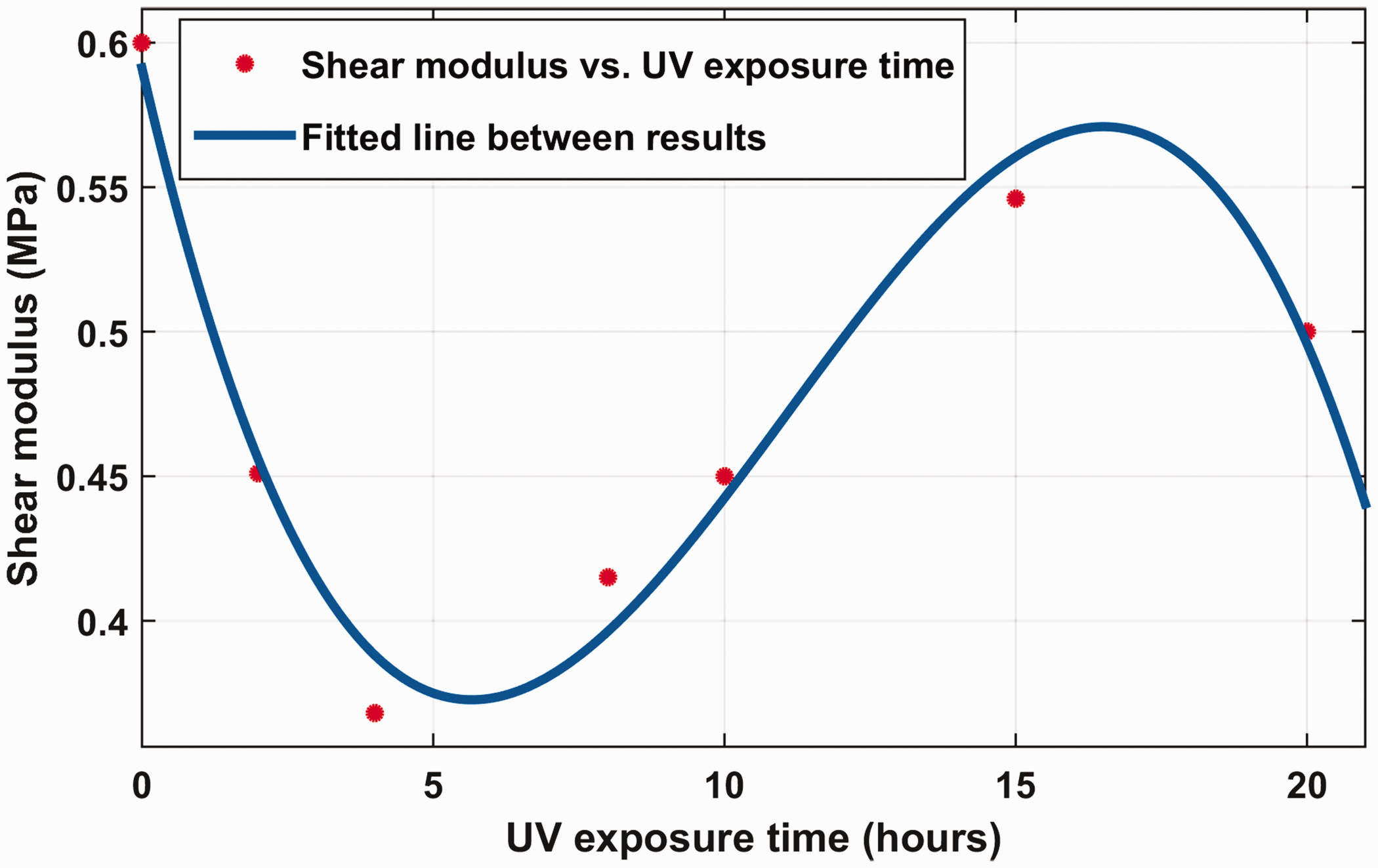
FTIR analysis
Aliphatic polyamides (like nylon 66) are outstanding fiber materials and multipurpose engineering thermoplastics. Based on the applications area, polyamides are frequently used in the adverse environmental conditions. In most cases, the degradation process of polymers involves scissoring of bonds in the main or side chains of macromolecules by several chemical and physical methods accompanying the deformation of the polymer physical parts. Degradation of organic structures like polymers is an irreversible phenomenon. The performance of the polymers is directly related to the structural health of the macromolecules. Degradation is a very harmful phenomenon which affects the polymer applicability in the daily lives. The information of the degradation mechanism can, therefore, help to understand the lifetime of the polymers. Alternatively, this knowledge of the degradation mechanism assists the development of preserving strategies for increasing the performance life of the products. In the case of nylon 66 (PA), different degradation mechanisms based on physical and chemical conditions have been reported in the literature.
The UV degradation of macromolecule (PA) under UV-weathering condition has been illustrated in Figure 7. The succinic acid was assumed as a byproduct of the degradation process. Figure 7(b) shows the formation of hydroperoxide product. By exposure to the weathering condition, the intermediate hydroperoxide was oxidized again, and at the final step (Figure 7(d)), by hydrolytic cleavage, the succinic acid was removed as a byproduct of the degradation process. This mechanism clearly illustrated the chain fragmentation of the nylon 66 in the experimental condition.
The degradation mechanism of PA66 macromolecule under UV irradiation.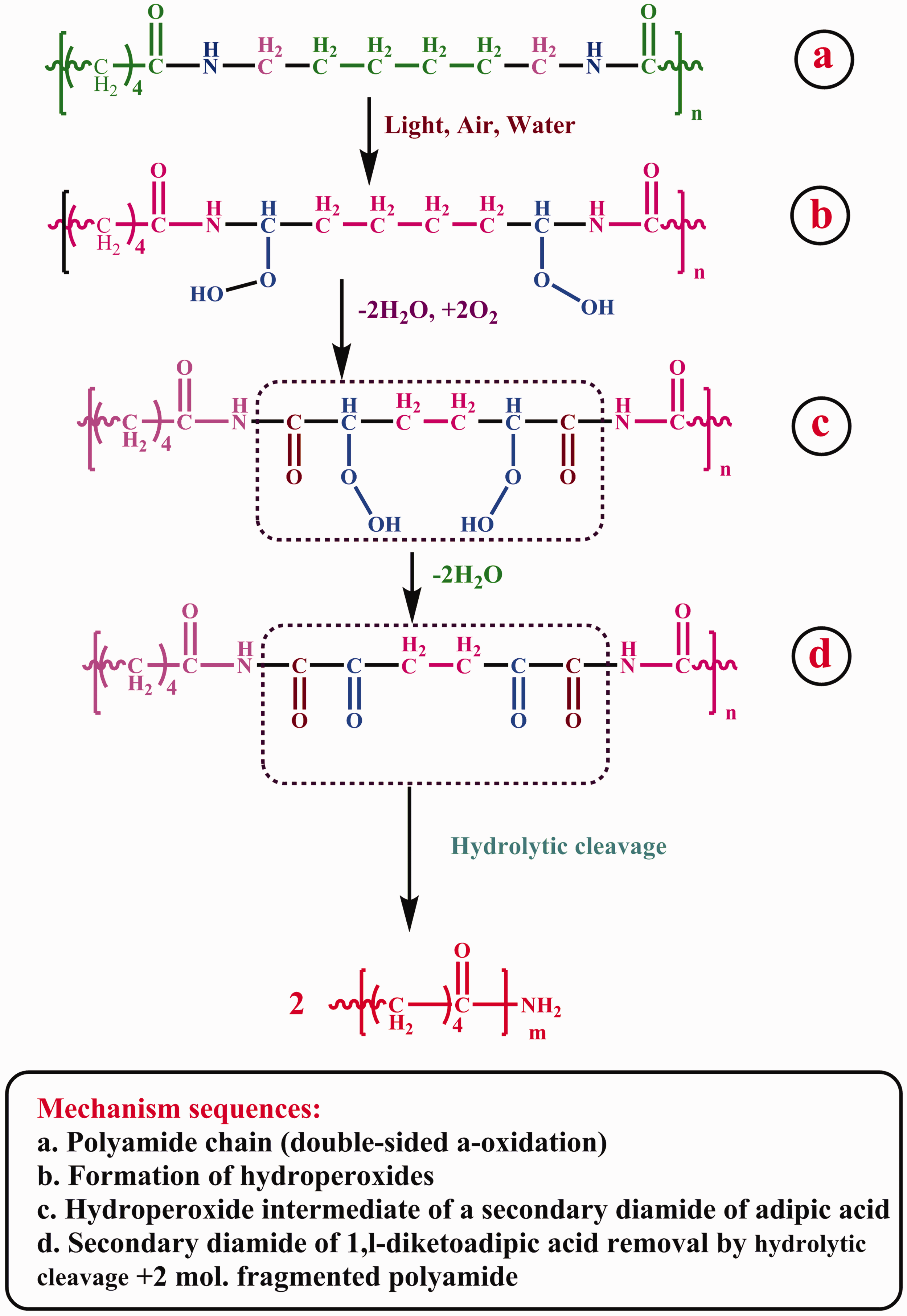
Different functional units are created due to the oxidation process of the polyamide chains. The presence of the functional units could be tracked using FTIR spectroscopy method. FTIR analysis was, therefore, performed to evaluate the effects of UV-weathering condition on the structural changes in the chemical degradation of nylon 66 (PA). FTIR spectra of the untreated PA66 and PAs exposed to different UV-weathering conditions (4, 15, and 20 h) are shown in Figure 8. In the structure of PAs, after treatment with UV lights, the absorption bands related to the hydroxyl and hydroperoxyl groups around 3350–2700 cm−1 appeared as broad peaks. According to the FTIR spectra of the samples, there was a notable reduction in the absorption observed in this area. After the first decrease, absorption changed differently with aging time. This showed that hydroxyl and hydroperoxyl units were the unstable intermediate products fabricated in reality, but they disappeared constantly during the process (Figure 8(d)). The carbonyl region (1820–1640 cm−1) showed several bands. The characteristic vibration band at 1661 cm−1 was assigned to the amide units. Some carbonyl species were produced by the exposure to UV radiation; they mainly consisted of carboxylic acids, aldehydes and other unsaturated carbonyl groups. The C=O absorption peak was grown up with the weathering time. However, the spectra were broadened gently in the later samples, which showed that at the greater weathering, the carboxylic acid of carbonyl species was produced. The intensity of the absorption band at 2980 cm−1 (Figure 8(d)) was altered with the increase in the weathering time. These results were confirmed by the analysis of the physical tensile tests. Due to the hydrogen bond, short-ranged steric, the electrical interaction between short chain organic molecules and different functional units of PAs, the characteristics and the peaks related to the functional groups of these weathered samples were shifted towards the lower wavelengths in comparison to the untreated PA. Therefore, the suggested mechanism was exactly supported by the FTIR and the results of the tensile tests.
FTIR analysis results for nylon 66 fabrics before and after the UV irradiation: (a) Unexposed sample, and after (b) 4 h, (c) 15 h, and (d) 20 h of UV irradiation.
XPS results
X-ray photoelectron spectroscopy (XPS) is a surface-sensitive quantitative spectroscopic technique that measures the elemental composition of the chemicals on the surface of a material. XPS can be used to analyze the surface chemistry of a material in its original state, or after some treatments such as weathering or exposing by light and heat radiation. The XPS spectra for different exposure times of the samples are represented in Figure 9. The surface elemental compositions of the illuminated samples were determined by the XPS analysis, as reported in Table 4.
XPS results for (a) unexposed PA66 fabric and treated fabrics after (b) 4 h, (c) 15 h, and (d) 20 h UV irradiation. Elemental composition of the samples after different UV exposure times.

The results showed that the surface of a polyamide sample was characterized by carbon, nitrogen and oxygen. As UV illumination was continued, conversely, the level of oxygen was increased as the oxidation of the polymer took place. The binding energy of the nitrogen did not change significantly as the illuminated samples were proceeding. This indicated that the nitrogen remained in the form of an amide functional unit. Based on the degradation mechanism, it could be suggested that by the chain segmentation of the macromolecule, the level of nitrogen in the remaining polymer was increased as the degradation of the polymer took place.
Thermal analysis result
Thermal properties of the PA66 samples were evaluated by the thermogravimetric analysis (TGA) technique at a heating rate of 20℃/min under the air atmosphere. TGA was used to determine the weight loss percentage of the unexposed and exposed samples (after 4, 15, and 20 h).
Approximately 0.1 g of each sample was heated from room temperature to 800℃. As the sample was heated, the mass was measured as a function of temperature. Figure 10 represents the TGA results for the unexposed and treated samples.
TGA plot of nylon 66 sample and exposed (4, 15, and 20 h) as a function of UV degradation times.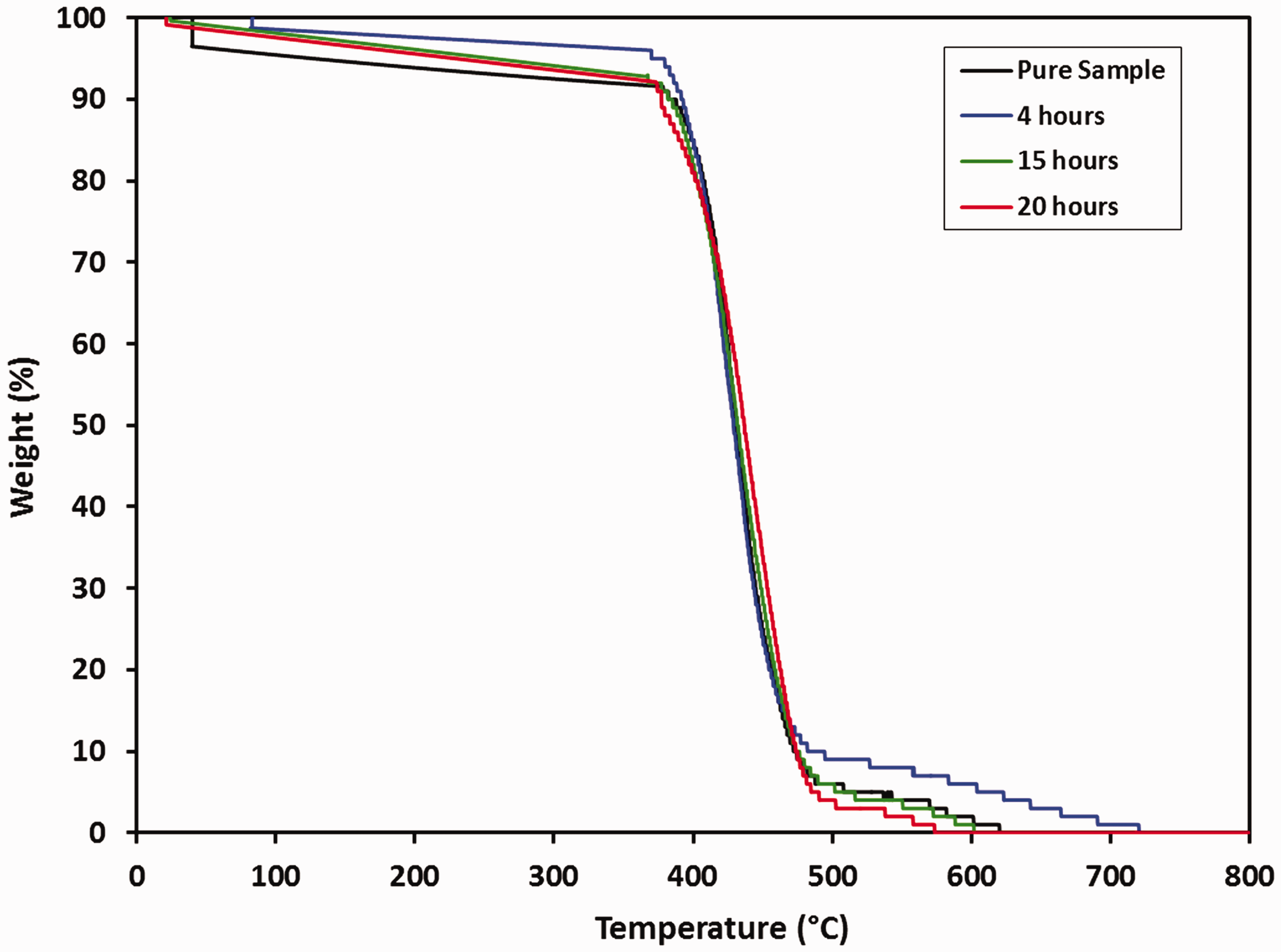
Thermal properties of the illuminated samples (after 4, 15, and 20 h).

Temperature at which 5% weight loss was recorded by TGA at the heating rate of 20℃/min under an air atmosphere.
Temperature at which 10% weight loss was recorded by TGA at the heating rate of 20℃/min under an air atmosphere.
Weight percentage of the material left undecomposed after TGA analysis at a temperature of 500℃ under an air atmosphere.
Limiting oxygen index (LOI) evaluated char yield at 500℃.
The char yield factor (CR) is often used as a criterion to evaluate the limiting oxygen index (LOI) of the polymers according to Van Krevelen and Hoftyzer’s equation, LOI = 17.5 + 0.4CR [31]. Generally, if the LOI of a material is greater than 26%, it is considered as an inflammable substance. The LOI values for PA66 fabrics were calculated based on their char yields at 500℃, as listed in Table 5. The results showed that the LOI values were in the range of 19.1–21.1%. Thus, it could be said that the UV irradiation had no significant effect on the flammability of the PA66 fabrics.
Conclusion
The shear modulus is an important parameter in some particular applications of industrial nylon 66 fabrics. The shear modulus in the bias direction could be calculated with high approximation using theoretical equations. Based on the obtained results, the following conclusions could be drawn regarding the UV degradation mechanism of nylon 66 industrial fabrics:
Statistical analyses showed that the UV-exposure time had a significant effect on the shear modulus of the polyamide woven fabrics. Duncan test showed that there was significant effect of the UV-exposure times of 4, 15, and 20 h on the shear modulus of the nylon 66 fabrics. Despite the initial impression to decrease the mechanical properties of PA66 samples, with the increase in the irradiation time, there was an exception. The shear modulus of the fabrics in the bias direction was decreased after 4 h of exposure time and then enhanced by increasing the exposure time to 15 h. Again, the shear modulus was reduced by increasing the UV exposure time to 20 h. From microscopic and chemical analysis (FTIR and XPS studies), it could be said that nylon 66 rebuilt itself. After the breakage of polymer chains in the initial times of UV exposure, it reached consistency by the changes in the crystalline regions and the new bond formation. In the initial exposure time, the intensity of the radiation caused chains breakage and the formation of free radicals. Thus, NH2 and COOH radicals were released. Progressively, free radicals joined each other (in folded shape), resulting in the increase of crystallinity. However, in the high UV exposure time (20 h), the speed of degradation was faster than that of formation of bonds, and the amorphous regions were increased again. The mode changes in the initial and second modulus were quietly different. This difference was due to the locking phenomenon in the second modulus. TGA results also showed that UV radiation had no significant impact on the thermal stability and flammability of the fabrics. SEM and optical microscope analyses further revealed that nylon 66 fibers endured the internal cracks and surface damages after the initial step of UV irradiation. These cracks and surface tracks could be rebuilt with the increase in the irradiation time via crosslinking. With the continuous increase in the UV illumination, the structure of the fibers collapsed, causing the mechanical properties to drop. The results also indicated that there was an optimum life time for nylon 66 conveyor belts to maintain their performance under the solar UV irradiation during the industrial application.
Footnotes
Declaration of conflicting interests
The author(s) declared no potential conflicts of interest with respect to the research, authorship, and/or publication of this article.
Funding
The author(s) received no financial support for the research, authorship, and/or publication of this article.