




Abstract
Auxetic fabrics with traditional filaments and auxetic structures have been provided by knitting method; however, the auxetic behavior and applicability of woven fabric with auxetic yarns remain to be studied. Thus, the paper aims to present the special characters of woven fabrics with heliacal auxetic yarns. Auxetic yarns with the maximum value of Poisson's ratio −0.88 were used as weft yarns to do the weaving by the semi-automatic loom. Then the properties of the fabrics have been tested and analyzed under tensions of different directions (warp, weft, and diagonal). The results indicated that the fabric presented auxetic effect with the maximum value of Poisson's ratio −0.3 under diagonal tension and also showed self-curling and self-folding behavior in natural state. Moreover, the relationship between properties and fabric weaves was also discussed and analyzed. It is expected that the study of fabrics with helical auxetic yarns could promote the practical applications of auxetic textiles such as the self-folding property for smart cladding materials.
Introduction
The traditional woven fabric which needs to be stuck by glue is widely used as cladding materials to avoid collision and abrasion in automobile industry. Thus, it is valued to manufacture woven fabric with particular properties such as auxetic and self-folding to be smart cladding materials. As for auxetic textiles, various kinds of fabrics with negative Poisson's ratio have been reported, and the special structures and properties similar to pores opening when stretched [1,2] and the curvature of the same direction when bending [3] lead to the promising application of functional and smart materials in filter [4], biomedicine [5], and sportswear [6].
According to the efforts of fabricating auxetic fabrics, most researchers mainly focused on the knitting technique to form auxetic structures with the traditional yarns, while others reported the method of weaving using yarn with negative Poisson's ratio. For the first one, due to the need of various structures, warp knitting and weft knitting are the preferred technology to manufacture auxetic fabrics. Based on the basic reference geometrical structures, foldable structure, rotating rectangle, reentrant hexagon, and three-dimensional NPR structure constructed with parallelogram planes of the same shape and size, auxetic fabrics were fabricated with flat knitting technology [7,8]. They also discussed the experimental and calculated results about the variation trend of fabric Poisson's ratio with axial strain. Besides, four warp-knitted structures with negative Poisson's ratio based on a rotational hexagonal structure [9] were produced and auxetic properties of the warp-knitted textiles have a complicated relationship with the rotation angle. Hexagonal structure from chain and inlay yarns [10,11] were also designed and produced as auxetic textiles. And the factors that influence Poisson's ratio were identified as yarn type, number of chain courses, and strain level. All mentioned above are two-dimensional structures, while several 3D auxetic fabrics [12], spacer fabrics [13,14], and composite reinforcement [15,16] were reported with theoretical study and finite element analysis.
With the development of auxetic yarns based on helical wrapping structure [17–20], the tensile property, deformation mechanism and influence factors of auxetic behavior with experimental, theoretical, and numerical study methods were discussed and analyzed. In order to promote the practical applications of auxetic materials, it is valued to produce and study the property of fabrics with auxetic yarns. There was one report about low-stiffness fabrics exhibiting negative Poisson's ratio to −0.1 with auxetic yarns in horizontal, and the ability to open pores in the fabric structure was exploited [2]. Auxetic plied yarns with different weaving parameters were also used to produce woven fabric, and the auxetic effect and percent open area were studied [21]. In addition, an auxetic composite using inherently auxetic yarn in a woven textile structure was also presented [22].
As the study of auxetic-woven fabrics with auxetic yarns is limited but significant, yarns with helical wrapping structure and negative Poisson's ratio [23] fabricated by us were used as weft yarns to produce fabrics by semi-automatic loom. Fabrics with different weaves were produced, and the properties have been discussed and compared with three different stretching directions, warp, weft, and diagonal.
Experimental
Fabric design
To make better use of helical auxetic yarn as geometrical interweaving structures, weaving machine was preferably chosen to form the fabric. At the same time, the helical auxetic complex yarn has good elasticity, and the warp yarn has to suffer friction from heald frame and reed all the time during the weaving; thus, it is used as weft yarn to avoid the bad influences to the structure and properties and the adjusting of weaving tension. A filament with certain strength and smooth surface that can prevent the breaking during the weaving and too much binding to the helical auxetic yarn in the fabric was selected as warp yarns. Then fabrics with three different kinds of weaves, including plain, pointed twill, and diamond twill, were designed and weaved with the same warp and weft yarns as shown in Figure 1.
Three weaving diagrams of the fabric: (a) plain; (b) pointed twill; (c) diamond twill.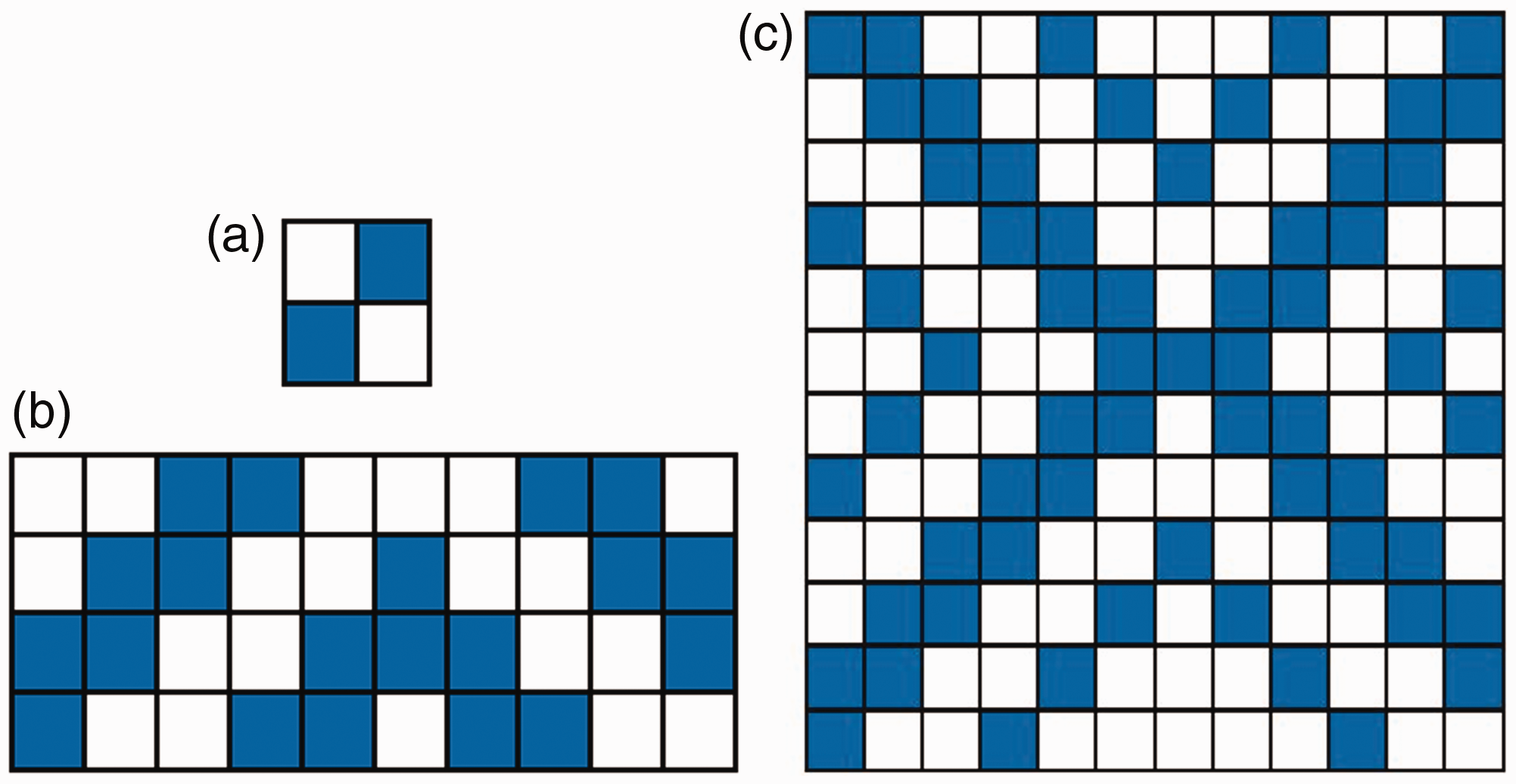
Materials and fabrication
The helical auxetic yarns composed of two filaments, one core filament and one wrap multifilament, were manufactured as weft yarns. Polyurethane as the core was helically wrapped by polyester with the higher modulus and smaller fineness. It showed increased contour dimension when stretched along the axial direction as a result of the difference of property and the interaction force between the yarn components as presented in Figure 2.
Helical auxetic yarns: (a) in natural state; (b) under axial strain of 20% (magnified 10 times).
Specifications of the fabric samples.
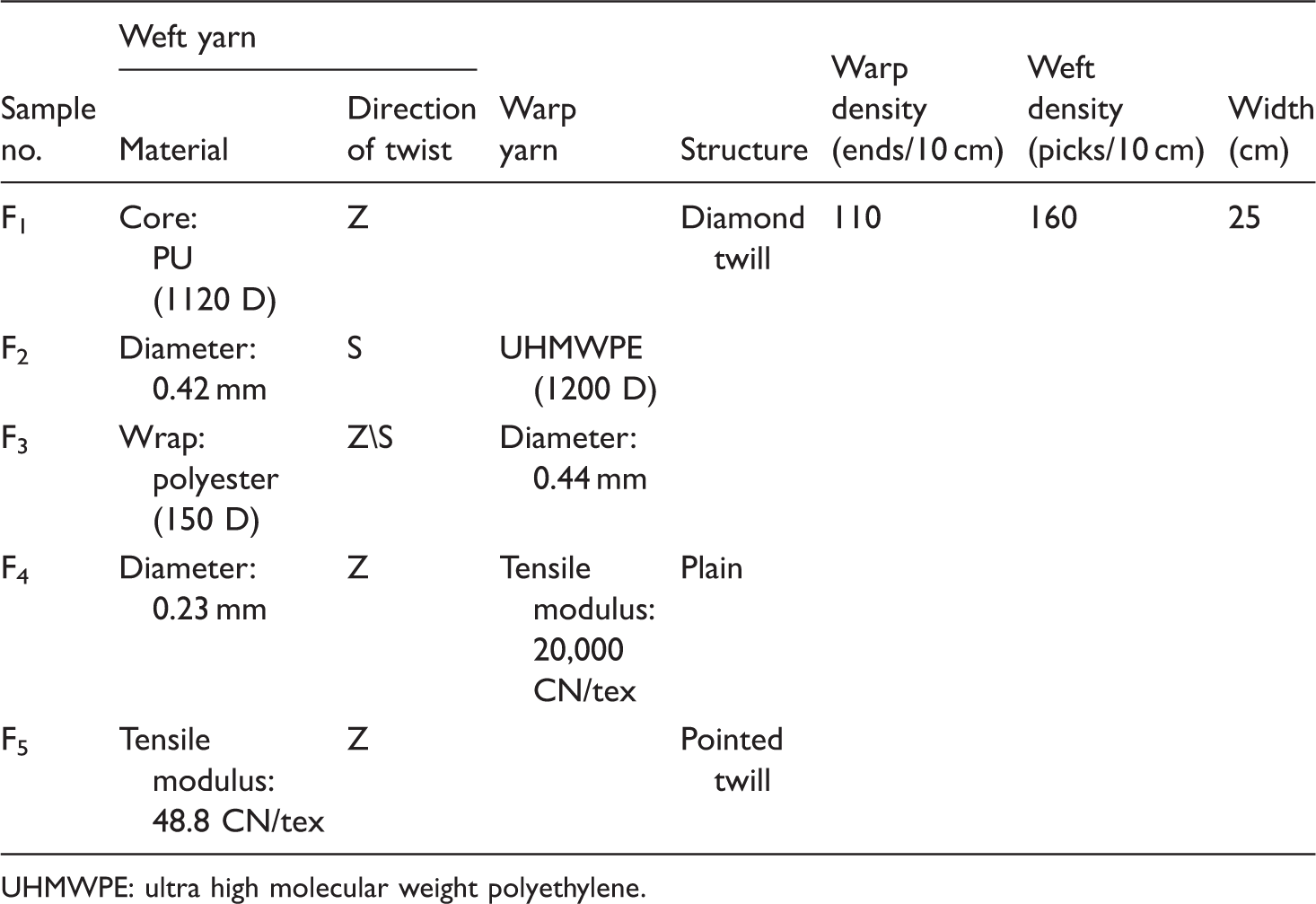
UHMWPE: ultra high molecular weight polyethylene.
Results and discussion
Auxetic behavior and Poisson's ratio
According to the fabric design, five samples were woven and analyzed. Considering the weft yarn was auxetic and elastically complex structure, tensile tests of the fabric in the direction of warp, weft, and diagonal were carried out to obtain the strain in the vertical direction, and then Poisson's ratio of fabric could be calculated. Moreover, to study the deformation of the fabric, the elongation was recorded during the tensile test as shown in Figure 3. In the free state, the fabric was being folded. Under tension, the fabric sample was gradually spread to the flat. At the moment of removing the tension, the fabric would be self-folded to the initial state with great elastic resilience.
Photographs of fabric sample F2: (a) without tension; (b) at the transverse (weft) strain of 100%; (c) at the transverse (weft) strain of 200% (magnified 1.5 times).
After the tensile test in the direction of warp, weft, and diagonal, the Poisson's ratio of the fabric was separately calculated and shown in Figure 4. With the tension along the direction of warp and weft, the fabric was presented with zero Poisson's ratio, which meant that the width of the fabric in the direction of warp or weft remained unchanged with the max value of elongation of the fabric, 200% and 10%, separately in weft and warp. However, when it was stretched along the direction of diagonal, the fabric showed auxetic behavior under certain strain. As in Figure 4, the Poisson's ratio of the fabric was zero with the strain along the diagonal direction from initial state to 10%. When continuing to stretch, the fabric was also extended in the vertical direction and presented negative Poisson's ratio. The maximum value of Poisson's ratio was −0.3 with the strain of 100%, and the fabric was from folded state to plain state under tension.
Variety of Poisson's ratio during tensile test of fabric sample F2.
The variety of Poisson's ratio during tensile test of the fabric was discussed above, and it was largely due to the structure and property of the complex yarn used as weft. The auxetic complex yarn was helical wrapping structure, and the yarn itself has great residual torque after twisting, which resulted in the kinking behavior in the free state as shown in Figure 5(a). When it was interwoven with the warp ends to form the fabric, the yarn would still keep kinking which led to the fabric folding and waving section without stretching like Figure 5(b). Therefore, the warp length of the fabric kept no expansion or contraction when stretched in the weft direction, and it was only a process of opening the folding state. A folding unit marked in thicker black is shown in Figure 5(c). The solid line in thicker black was composed of warp interlacing points, and the folding unit would be formed in the warp direction which led to the zero Poisson's ratio under the warp tensile test that the same as weft drawing. While, under the tension in the direction of diagonal, the fabric would be elongated in the vertical direction with the folding state to flat state. The deformation of the fabric during the tensile test is presented in Figure 5(e).
Schematic illustration of the deformation and the auxetic behavior of the fabric (a) an auxetic yarn in free state; (b) the curling state of auxetic yarn in the fabric; (c) folding unit in the fabric in stretching state; (d) folding unit in the fabric in free state; (e) the deformation state of the fabric before and after stretching.
Self-curling behavior
The fabric with helical auxetic yarns exhibited selvedge curling behaviors in the free state in addition to the auxetic property, which means great flexibility. Considering the effect of the twist and residual torque of helical auxetic yarns, experimental verification is taken in Figure 6, where fabrics are woven separately using helical auxetic yarns in Z twist, S twist, or alternately. The direction of the fabric curling was the complete opposite of using Z twist yarns and S twist yarns. However, fabric with two twist direction yarns alternately was in flat state without selvedge curling. Besides, fabrics with different weaves and the same yarns in twist directions presented the same selvedge curling property. Thus, it could prove that the twist direction of the helical auxetic yarn was the decisive factor to the selvedge curling property of the fabric, and it could keep balance through this way. This also provides a solution to the selvedge curling behavior that using two twist direction yarns alternately in the beginning and ending stage or just fixing them. It is believed that the property is not a big problem for the application of the fabric, even a special character in woven fabrics. In addition, the fabric with selvedge curling property may have potential application in fashion designing and covered materials.
(a) Photograph of fabric samples F1, F2, F3; (b) photograph of fabric sample F4; (c) photograph of fabric sample F5.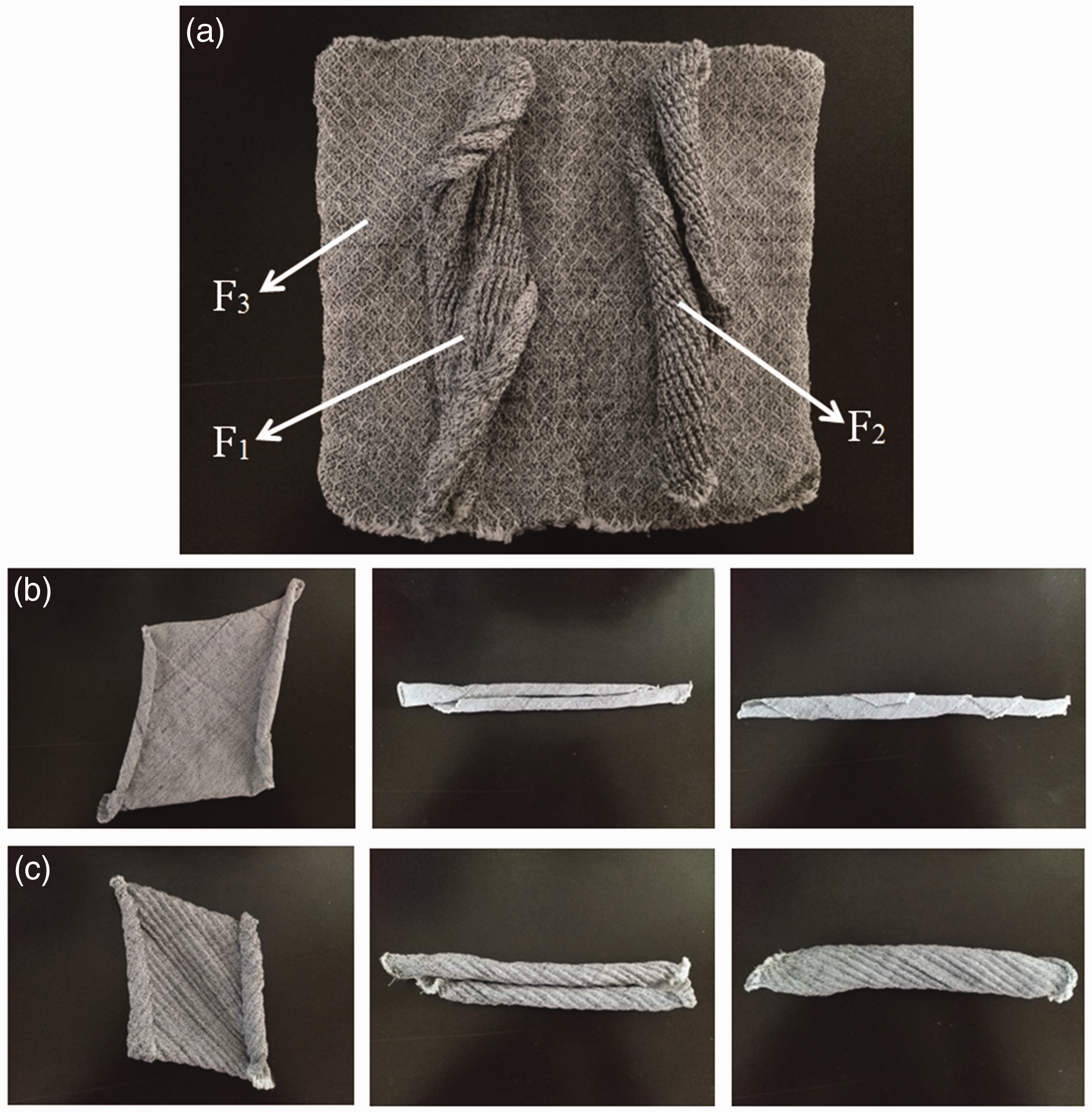
Self-folding behavior
The fabrics with helical auxetic yarns also exhibited folding behaviors without tension. As shown in Figure 7, fabrics with different weaves were presented in different degrees of folding. Fabric with plain weave was in flat state, while fabrics with pointed twill and diamond twill weave were in folding with increased density. Besides, fabric sample F3 in Figure 5(a) was also in flat state without foldable property as a result of being balance with two twist direction yarns alternately. Thus, fabrics woven using helical auxetic yarns with single twist direction showed folding behavior, except plain fabric due to the same warp and weft interlacing points to control the curling of weft ends.
(a) Photograph of fabric sample F4; (b) photograph of fabric sample F5; (c) photograph of fabric sample F1 (magnified two times).
The characterization of fabric folding property.

To get the relation of fabric weave to folding degree, the fabric sample F5 with reverse twill weave was analyzed. A folding unit marked in blue is shown in Figure 8, and the solid blue line is composed of warp interlacing points which lead the weft ends around it to curling and folding behavior in warp direction. Thus, fabrics with different folding behaviors can be designed, woven, and applied for automobile industry as cladding materials to avoid friction.
Schematic illustration of the deformation and the folding behavior of fabric sample F5.
Conclusions
Woven fabrics with helical auxetic yarns and different structures were produced and tensile testing was carried out to study and analyze the property and applicability. Based on the experimental results, it has been proved that the fabric with diamond twill structure presented auxetic behavior when stretched along the direction of diagonal and the maximum value of Poisson's ratio was −0.3 with the tensile strain of 200%. Woven fabrics also showed self-curling and self-folding behavior in natural state, and both the structures and the twist direction of auxetic yarns being used can affect the two properties, which provide a possibility of potential application in smart cladding materials and fashion designing. Moreover, all types of auxetic yarns and preparation methods could be tried to provide auxetic textiles with special properties and applicability.
Footnotes
Declaration of conflicting interests
The author(s) declared no potential conflicts of interest with respect to the research, authorship, and/or publication of this article.
Funding
The author(s) disclosed receipt of the following financial support for the research, authorship, and/or publication of this article: The author(s) received financial support from National Key Research and Development Program of China (grant number 2016YFC0802802); the Fundamental Research Funds for the Central Universities (grant number 2232018G-01); Fok Ying Tung (huoyingdong) Education Foundation (grant number 151071); and Fujian Provincial Key Laboratory of Textiles Inspection Technology (Fujian Fiber Inspection Bureau) of China (grant number 2016-MXJ-02) for the research, authorship, and/or publication of this article.