




Abstract
The investigation of thermal protective performance of fabrics is highly relevant in order to procure and further develop the firefighters' protective clothing. Therefore, this paper aims at investigating the thermal protective performance of fabrics used in firefighters' clothing under different levels of radiant-heat exposures. For this, properties of a set of thermal protective single- and multi-layered fabrics were measured, and these fabrics were tested under radiant-heat exposures using the Method B of ISO 6942:2002 standard. During the testing, fabrics were exposed to low (10 kW/m2), medium (40 kW/m2), and high (80 kW/m2) intensity radiant-heat exposures; and the heat transfer level (i.e., time required to increase the skin temperature of a wearer/firefighter by certain degrees) through these fabrics were calculated to measure their thermal protective performance. The effects of fabric parameters, structures, properties, and radiant-heat intensities on the protective performance were characterized, and fabric properties that significantly affected the protective performance were statistically identified at different level of radiant-heat exposures. It has been found that weight, thickness, thermal resistance, and evaporative resistance can positively affect the protective performance. Also, the significant fabric properties affecting the protective performance vary for single- and multi-layered fabrics. By using these significant properties, the protective performance of single- and multi-layered fabrics were also separately predicted by mathematical models, i.e., multiple linear regression models and multiple logarithmic regression models. As per the findings of this study, multiple linear regression models can effectively be used to predict the thermal protective performance of fabrics. This study will lead towards building a better understanding and prediction of thermal protective performance of fabrics under radiant-heat exposures.
Keywords
Introduction
Among the European and North American countries, the highest number of fire incidents (1,345,500) occurred in USA in 2015 [1]. These incidents resulted in several firefighters' deaths (68) and injuries (68,085) [2]. The majority of firefighter injuries occurred due to the inadequate performance of their protective clothing. Indeed, the protective performance is largely dependent on the types of thermal exposure faced by firefighters [3,4].
It is most likely that firefighters get exposed to radiant heat while fighting a fire [3–5]. In fact, they are exposed to different levels (low intensity of <20 kW/m2, medium intensity of 20–40 kW/m2, and high intensity of 80 kW/m2) of radiant-heat exposures depending upon their work situations [6–12]. For instance, wildland firefighters are mainly exposed to low to medium levels of radiant-heat exposures [6,7]. However, structural firefighters can be exposed to low to high levels of radiant-heat exposure while dousing a building fire [9,12]. During the radiant-heat exposure, thermal energy transfer occurs through the fabrics used in firefighters' protective clothing towards their bodies and causes skin burns.
In the past literature, thermal protective performance of single- and/or multi-layered (SL/ML) fabrics was evaluated under radiant-heat exposures of different intensity levels using the standardized (e.g., ISO 6942, ASTM F 1939) or customized test methods [6–12]. As per these methods, fabric specimens were placed on a holder and exposed to the radiant heat for a defined duration. The amount of thermal energy transferred through the fabric specimens over time were measured by a heat flux sensor. This energy was further employed in the Stoll curve or Henriques Burn Integral equation for calculating the time to generate burns on wearers' bodies [13]. This burn time is usually inferred as the thermal protective performance of fabrics. It has been found that fabric structure, properties and/or intensity of radiant heat could affect the protective performance. Thus, these parameters could provide the basis for the effective prediction of protective performance through an empirical modeling approach.
Contextually, Perkins, Sun et al., and Song et al. evaluated the thermal protective performance of SL and/or ML fabrics under low intensity (<20 kW/m2) radiant-heat exposure [6–8]. They identified that fabric structure (e.g., number of layers, orientation of the layers) and physical properties (e.g., weight, thickness) could affect the protective performance. Rossi and Zimmerli, and Rossi et al. found that mechanical properties of fabrics (e.g., strength, durability) deteriorate under medium intensity (20–40 kW/m2) radiant-heat exposure, which could affect their protective performance [9,10]. Recently, Mandal et al. and Mandal investigated the thermal protective performance of fabrics under high-intensity (80 kW/m2) radiant-heat exposure, and they developed empirical models for predicting the protective performance using fabric properties such as thickness and thermal resistance [11,12].
Even though the thermal protective performance of fabrics was studied under different levels of radiant-heat exposures, different types of fabrics were used in these studies [6–12]. This complicates the comparability and conclusions about the effects of different levels of radiant heat particularly as it was found that fabric structures and properties affect the protective performance. Therefore, the knowledge of protective performance of a fabric under different levels of radiant-heat exposures is still scanty and/or ambiguous. To date, no study has been carried out to investigate and compare the protective performance of the same set of SL and ML fabrics under different levels of radiant-heat exposures. Also, the effect of various fabric parameters (fiber content, weave design, and construction) on the protective performance has not been addressed systematically in the previous research. Thus, a comprehensive knowledge of the thermal protective performance of the fabrics under different levels of radiant-heat exposures is still limited and fragmented. This comprehensive knowledge is essential because firefighters remain at the risk of all levels of radiant-heat exposures when they attempt to enter and have already entered into a structural- or wild-fire hazard [14,15].
Previous studies have developed mathematical models for predicting the thermal protective performance of fabrics under flame and/or radiant-heat exposures [16,17]. But, these models were developed theoretically by considering the factors affecting the heat and mass transfer through fabrics (e.g., emissivity, thermal conductivity). Thus, these models are complicated, cumbersome, and/or may require expensive software to calculate the fabric performance on a regular basis in an industry or academia. Recently, a group of researchers developed a mathematical model for empirically predicting the protective performance from fabric properties under radiant-heat exposure [12,18,19]. However, this model is only applicable for high-intensity radiant-heat exposure of 80 kW/m2 and is not suitable for predicting the protective performance under radiant-heat exposures of different intensities. Altogether, no comprehensive empirical mathematical model has been developed to date for predicting the protective performance of SL and ML fabrics under different levels of radiant-heat exposures.
In this study, thermal protective performance of a set of SL and ML fabrics is determined for different levels of radiant-heat exposures. The effects of radiant-heat intensity as well as fabric parameters, structures, and properties on the protective performance are characterized. Fabric properties that significantly affect the protective performance are statistically identified; and incorporated into mathematical models to empirically predict the protective performance of the SL and ML fabrics under radiant-heat exposures. This study will help textile and materials engineers to develop a high-performance fabric for firefighters' protective clothing. Also, the mathematical models developed in this study can be used for quick and effective prediction of thermal protective performance.
Materials and methods
Fabric systems selected for this study.

Properties of the selected fabric systems.
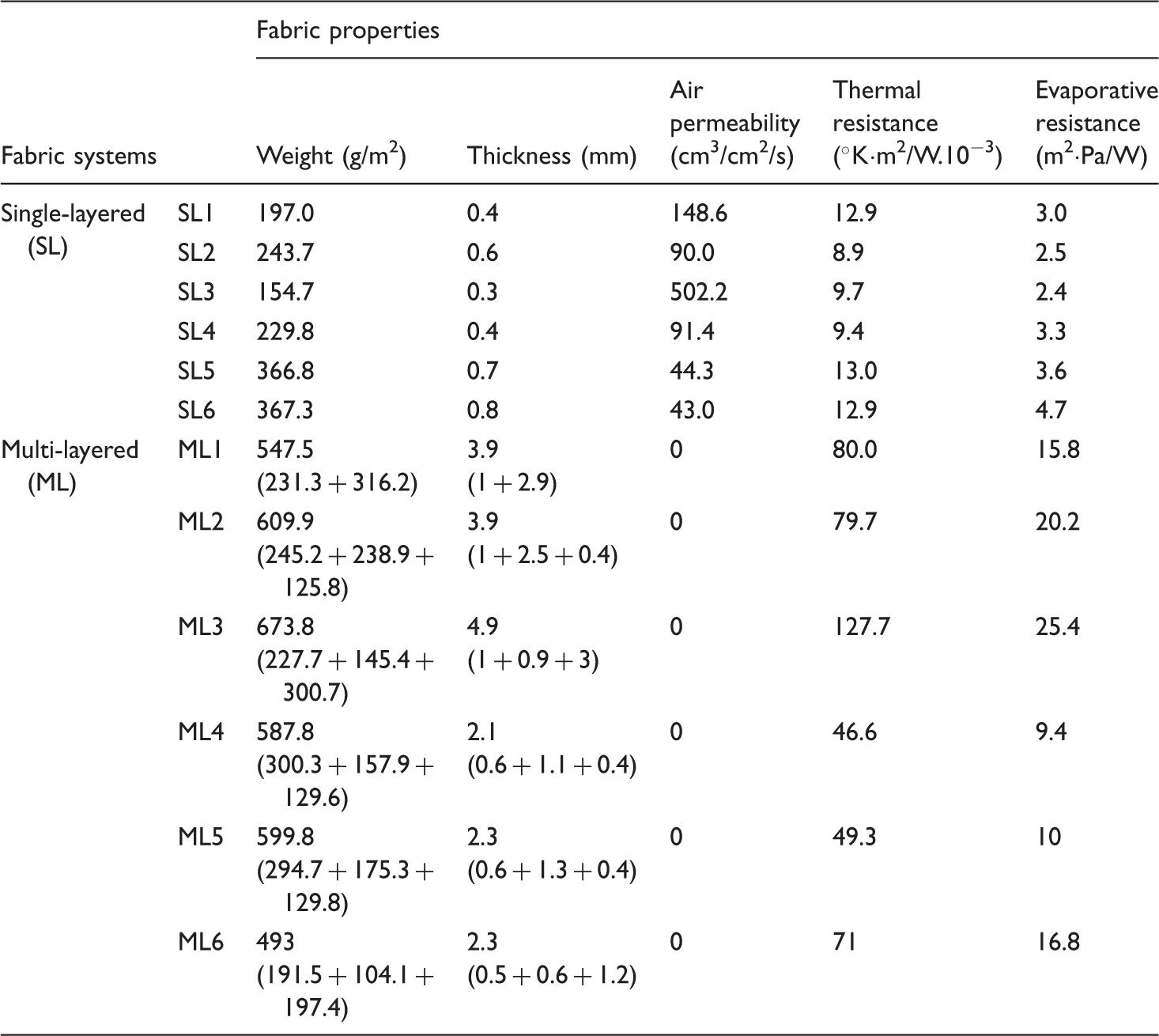
In order to measure thermal protective performance of fabric systems under radiant-heat exposures, three specimens (230 × 80 cm) of each of the SL and ML fabric systems were prepared according to ISO 6942:2002 standard [23]. For the ML specimens, the OutL, MidL, and InnL fabric specimens were assembled as per the sequence mentioned in Table 1, and each fabric assembly was stapled together at the corner (Figure 1). Thereafter, both SL and ML specimens were conditioned at 20 ± 1℃ and 65% ± 5% relative humidity according to ISO 139:2005 standard [24].
Specimens of ML fabric systems.
The conditioned specimens were tested under low (10 kW/m2), medium (40 kW/m2), and high (80 kW/m2) intensity radiant-heat exposures according to the Method B of ISO 6942:2002 standard (Figure 2). By following this standard method, a copper sensor (i.e., a 1.6 mm thick, 50 × 50.3 mm rectangular copper sheet attached with a copper constantan thermocouple) was directly placed behind a fabric specimen. In order to ensure that no air gap existed between the sensor and specimen, one end of the specimen was clamped with the sensor holder and the other end was tightly pulled by a clamp (Figure 2(b)). Next, this fabric specimen was exposed to a particular radiant-heat flux. Radiant heat was generated from six horizontally placed and electrically heated silicon carbide rods (Figure 2(a)). The heat transfer level through the specimen during the exposure was calculated. For this, time (in seconds) required for achieving the sensor temperature rise (from the initial sensor temperature at ∼25–28℃) of 12℃ and 24℃ were recorded, and represented by T12 and T24, respectively. The average T12 and T24 of three specimens of each fabric system were calculated, and these average T12 and T24 values were considered as the thermal protective performance of the fabric system (Table 3).
Radiant-heat exposure tester as per ISO 6942:2002: (1: Radiant-heat Source; 2: Fabric and sensor assembly; 3: Clamp; 4: Sensor holder). (a): Radiant heat Source; (b) Sensor-specimen assembly. Thermal protective performance of the selected fabric systems.

The properties and thermal protective performance values of the fabric systems were normalized within a range of −1 to + 1. Here, thermal protective performance was namely T24 value because it can represent the time to second-degree burns on wearers' bodies. Normalization process reduced the redundancy rates in the data set by pulling out abnormal factors. The normalization procedure of a variable can be represented by equation (1), where, X
i
is the value of the selected variable (weight, thickness, or T12), X
i,avg
is the average value of that variable, and R
i,max
is the maximum range between the average value (X
i,avg
) and either the minimum (X
i,min
) or the maximum (X
i,max
) of that variable as per equation (2). Thereafter, all the statistical analysis was carried out using the SPSS Statistics Data Editor developed by IBM Corporation, USA.


By using the normalized values, t-tests were carried out between each SL/ML fabric property and the protective performance. Based on the sign of T-stat value obtained from the t-test, the association between the fabric property and protective performance was interpreted. P values obtained from the t-test were also analyzed to identify the fabric properties that significantly affect the protective performance.
By employing the significant fabric properties, Multiple Linear Regression and Multiple Logarithmic Regression models were separately developed for SL and ML fabric systems. The purpose of developing these models was to mathematically predict the T24 value of a fabric system under a radiant-heat exposure. Also, linear and logarithmic forms were chosen for presenting the models in an accurate and simplistic way. Generic forms of Multiple Linear Regression (MLinR) and Multiple Logarithmic Regression (MLogR) models are shown in equations (3) and (4), respectively, where, C = identically distributed constant normal error, (SFP)1..…(SFP)n = n numbers of significant fabric properties (SFP), and β1 …βn = regression coefficients that determine relative strength of the respective significant fabric properties. The predicting performance of the developed Multiple Linear Regression and Multiple Logarithmic Regression models were further evaluated by their Root Mean Square Error (RMSE), P values, and R2. A model with low RMSE, high R2, and P values of <0.05 was inferred as the high-performance model.


Results and discussion
The thermal protective performance values of the fabric systems obtained from the above tests are presented in Table 3. In this table, a fabric system with high T24 or T12 value possesses a higher thermal protective performance than a fabric system with low T24 or T12 value. Also, as obvious, the thermal protective performances of SL fabric systems are considerably lower than the ML fabric systems.
Thermal protective performance of SL5 and SL6 fabric systems are generally little higher than the thermal protective performance of SL2-SL4 fabric systems (Table 3). This is because SL2-SL4 fabric systems comprise meta-aramid Nomex® fiber only, which is inherently fire resistant. Whereas, SL5 and SL6 fabric systems comprise cotton and/or modacrylic fibers, which have been treated with Proban® to make them fire retardant (FR). Chemically, Proban® is a phosphine oxide and produced by the treatment of Tetrakis(hydroxymethyl)phosphonium chloride (THPC) with Urea (equation (5)) [25]. During a radiant-heat exposure, crosslinking of the chemical substances (Proban®) occurs on the surface of cotton or modacrylic fibers of SL5 or SL6 fabric systems and forms a self-extinguishing carbonaceous char on the technical face side of the fabric that is exposed to radiant-heat (see Figure 3(b) for SL5 fabric system). This carbonaceous char does not melt, forms a hole on the fabric, or leaves sticky residues that could adhere to the wearers' skins. Thus, this carbonaceous char itself does not contribute to any potential burn injury on wearers' bodies. Also, this carbonaceous char insulates the underlying cotton and/or modacrylic fibers from radiant-heat. Eventually, this char prevents the production of new fuel for further burning, which slightly enhances the protective performance of SL5 and SL6 fabric systems. Because this kind of carbonaceous char did not form on the surface of the Nomex® fiber-based SL2-SL4 fabric systems (see Figure 3(a) for SL4 fabric system), their performances are marginally low.
Radiant-heat exposed surface of the SL4 and SL5 fabric systems. (a): SL4 fabric systems; (b): SL5 fabric systems.
Experimentally, it was also evident that the directly radiant-heat-exposed side (technical face of the fabric) and indirectly radiant-heat-exposed side (technical back of the fabric that is aligned with the wearer skin) of the plain-weaved, light-weighted SL fabric systems (e.g., SL3) denatured equally (Figure 4). While the directly and indirectly radiant-heat-exposed sides of the twill-weaved, heavy-weighted SL fabric systems (e.g., SL6) denatured differently (Figure 5). Actually, the plain-weaved SL3 fabric system is constructed by alternative (1 weft up and 1 warp up) interlacement of weft and warp yarns (Figure 6) [26]. As the surface contact area between the weft and warp yarns is high in a plane-weaved fabric (Figure 6), the conductive heat transfer from the directly radiant-heat-exposed side to the indirectly radiant-heat-exposed side of SL3 fabric system is quick [27]. This situation denatured both the sides of the SL3 fabric system in an equal manner and resulted in lower T24 and T12 values (Table 3). On the other hand, the weave design of SL6 fabric system is 3/1 twill (1 weft up and 3 warp up) and this results in less surface contact area between weft and warp yarns (Figure 7). Also, the number of weft yarns per centimeter of SL6 fabric system is lower (20 weft/cm) than that of SL3 fabric system (30 weft/cm); and, the diameter of weft and/or warp yarns of SL6 is higher than that of SL3 because SL6 has less number of yarns/cm2 (SL3: 60 yarns/cm2; SL6: 55 yarns/cm2) but still heavy-weighted (weight of SL3: 154.7 g/m2; weight of SL6: 367.3 g/m2) (Tables 1 and 2). Due to all these factors (less surface contact area between the warp and weft yarns, less number of weft yarns per centimeter, and/or high-diameter yarns in a fabric area), the conductive heat transfer from the directly radiant-heat-exposed side to the indirectly radiant-heat-exposed side of SL6 fabric system is slow. This caused unequal denaturation of both the sides of SL6 fabric system and resulted in higher T24 or T12 values (Table 3).
Directly and indirectly radiant-heat-exposed sides of plain-weaved and light-weighted fabric (e.g., SL3). Directly and indirectly radiant-heat-exposed sides of twill-weaved and heavy-weighted fabric (e.g., SL6). Conductive heat transfer through plain-weaved and light-weighted fabric (e.g., SL3). Conductive heat transfer through twill-weaved and heavy-weighted fabric (e.g., SL6).


It is further evident from Table 3 that the protective performance of ML1, ML2, and ML3 fabric systems with same Nomex® Titan outer layer varies significantly (P value < 0.05) under radiant-heat exposures. In fact, ML1 and ML3 fabric systems possessed the lowest and highest protective performance, respectively, under all radiant-heat exposures. Basically, heat transfer through ML1 and ML3 fabric systems occurred differently due to their substantial structural differences. As a result, the surface of their innermost side (aligned with the wearer's skin) denatured differently and caused the differences in the protective performance (Figure 8). Further, a close examination of the structures of ML1 and ML2 fabric systems (Table 1) could reveal that they comprised GORE-TEX® Airlock® fabric of nearly similar thickness. The PU dots of the Airlock® fabric in ML1 were aligned towards the OutL; however, the dots were aligned towards the InnL or towards the sensor in ML2 (Figure 1). Additionally, ML2 comprised an extra fabric layer (of 50% Nomex®/50% FR Viscose fibers) that was aligned with the wearer's body. Due to the different orientation of the Airlock® fabric and/or extra fabric layer, ML2 fabric system reached a higher protective performance than ML1. Furthermore, both ML2 and ML3 fabric systems are triple-layered; however, the protective performance of ML3 is higher than ML2. This is because InnL fabric of ML3 comprised a regenerated aramid felt of 300.7 g/m2 weight and 3 mm thickness (Figure 9). As this felt-structured thick fibers web traps a large amount of insulative stationary air, this resulted in higher protective performance of ML3 than ML2.
Denatured innermost side of the ML1 and ML3 fabric systems. Aramid regenerated felt in ML3 fabric system.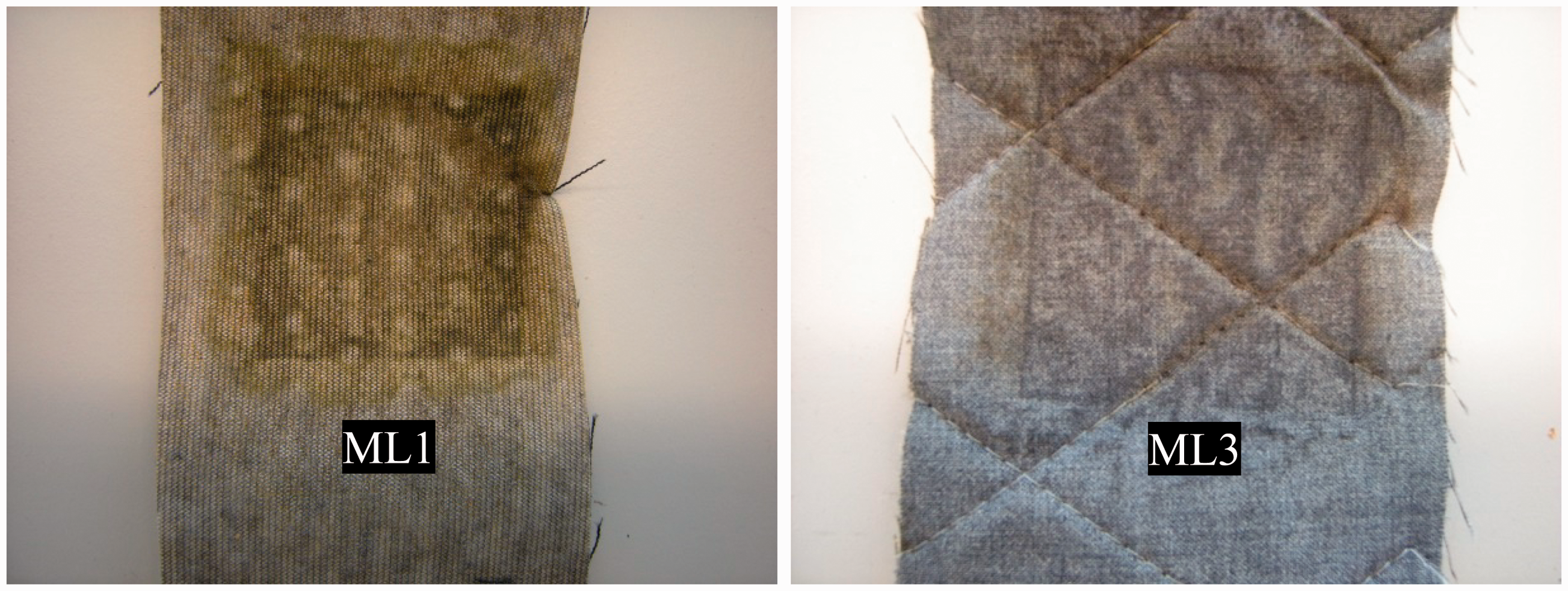

Interestingly, ML1–ML6 fabric systems possess a T24 value of greater than 13 s at 40 kW/m2 (Table 3). Eventually, the guideline of EN 469:2005 [28] confirms their suitability for manufacturing firefighters' turnout gears, especially where the protection from low to medium intensity (10–40 kW/m2) radiant-heat exposure is of prime concern. Notably, the difference between T24 and T12 (T24−T12) values of the most of the fabric systems (ML1, ML2, ML4, ML5, and ML6) is below 4 s at 80 kW/m2 radiant-heat exposures (Table 3). Thus, according to EN 469:2005, these fabric systems may structurally degrade during the radiant-heat exposure of 80 kW/m2. As an example, some structural degradation of the ML1 system was observed in this study immediately after the 80 kW/m2 radiant-heat exposure (Figure 10). As T24−T12 values of ML3 fabric system is 4.5 at 80 kW/m2 radiant-heat exposure (Table 3), its structural degradation is comparatively lower than the ML1 (Figure 10). As per Figure 10, some amount of shrinkage of the black OutL fabric (Nomex® Titan) is quite visible for the ML1 and ML3 fabric systems. In fact, relatively more shrinkage of the black OutL fabric (Nomex® Titan) in the ML1 fabric system than ML3 fabric system is also clearly visible in Figure 10. Thus, the shrinkage of meta-aramid fiber-based Nomex® OutL fabric could be dependent upon the structure of the fabric systems like number of layers, fiber composition, or weave construction of the inner and/or middle layer.
Structural degradation of the ML fabric systems at 80 kW/m2.
Furthermore, the thermal protective performance of all the fabric systems gradually decreased with an increase in the intensity of radiant-heat (Table 3). As obvious, an increased intensity of radiant-heat source also raises the temperature of the fabric system. Due to this high temperature, their radiant emittance (radiant-heat emitted by a surface per unit area) increases as per the Stefan-Boltzmann Law [27]. As a result of increased radiant emittance, fabric systems tend to absorb both long and short wavelength-based incident electromagnetic radiant-heat waves, i.e., generated from the radiant-heat source (Figure 11). This situation results in more emission of thermal energy towards the sensor or wearer's body, which ultimately lowers the thermal protective performance of fabric system. As the emissivity (ε) of a fabric system can lie between 0 and 1 [27], a fabric with high emissivity will emit more thermal energy towards the wearer's body and will possess the lower thermal protective performance. Notably, ε of a fabric system depends upon its surface optical properties: namely, surface roughness, surface frictional coefficient. During the radiant-heat exposure, the outermost surface (directly exposed to radiant-heat) of the fabric system denatures, which changes its surface roughness and frictional coefficient. Indeed, this denaturalization increases the surface roughness of the fabric system, which lowers the reflectivity of the thermal energy from the surface of the fabric systems towards the environment and that enhances the thermal energy emission through the fabric system towards a wearer's body. Consequently, the thermal protective performance of the fabric system can be lowered.
Thermal energy emission through a fabric system.
Effect of fabric properties on thermal protective performance
Results of t-test.

Basically, a fabric system with high weight and thickness can trap a considerable amount of stationary or dead air within its structure [29,30]. As the thermal insulation value of this stationary air is high, it does not allow easy transmission of thermal energy in the form of electromagnetic radiant-heat waves (generated from the radiant-heat source) through the fabric system. This situation can enhance the thermal protective performance of the fabric system [12,18]. Based on the P value (<0.05) in Table 4, weight and thickness are the significant properties for the thermal protective performance of SL fabric systems at 10 and 80 kW/m2 radiant-heat exposures. Nevertheless, weight and thickness of a fabric are generally mutually dependent; so, the most significant property among weight and thickness can be identified by comparing their correlation coefficient (r) with the protective performance. The correlation coefficient between the weight and performance (r ≥ 0.94) is higher than the correlation coefficient between thickness and performance (r ≥ 0.82). Hence, weight is relatively a more significant property than thickness for the protective performance of SL fabric systems at 10 and 80 kW/m2. Notably, both weight and thickness are not the significant properties for ML fabric systems under all levels of radiant-heat exposures. Nevertheless, thermal resistance is the most significant property for ML fabric systems under all levels of radiant-heat exposures. As thermal resistance accounts for the conductive (i.e., through the solid areas of yarns or fibers of the fabric and entrapped air) and radiative (i.e., through both the pore and solid areas of the fabric) heat transfer through thick and heavy-weight fabrics (Figure 12), this property has the maximum impact on the thermal protective performance. Interestingly, thermal resistance is not a significant property (P value > 0.05) for SL fabric systems under all levels of radiant-heat exposures. Fundamentally, in the case of SL woven fabric systems, weight and/or thickness primarily control the thermal resistance of the fabric; whereas, weight and thickness of each fabric layer and/or the trapped air within and between the layers control the thermal resistance of the ML fabric systems. So, weight and/or thickness play more significant role than the thermal resistance for the protective performance of SL fabric systems. Contextually, based on P values (all P values are greater than 0.05), no fabric property can significantly affect the protective performance of SL fabric system at 40 kW/m2. However, the P value of weight is marginally higher than the 0.05; so, weight could be considered as a marginally significant fabric property for the thermal protective performance of SL fabric systems at 40 kW/m2.
Heat transfer through porous fabrics.
Additionally, a woven or nonwoven fabric with high evaporative resistance usually comprises lower number and size of pores. The use of a semipermeable membrane or coating like PTFE/PU will further reduce the pore sizes. Due to the existence of less number of pores or no pores at all, such fabric-based systems can slow down or restrict the transmission of electromagnetic radiant-heat waves through its structure under a radiant-heat exposure, respectively; and thus, enhance the thermal protective performance of the fabric system. Nevertheless, as no evaporation phenomena occurred in the present study, evaporative resistance did not play a significant role on the thermal protective performance of the fabric systems. It is also noteworthy that a fabric system with low air permeability can considerably increase its evaporative resistance [31,32]. Thus, this situation can enhance the thermal protective performance of the fabric system, which infers that air permeability possess a negative effect on the thermal protective performance of fabric systems. Air permeability was found not to significantly affect the thermal protective performance of SL fabric systems under all levels of radiant-heat exposures.
Significant fabric properties affecting the thermal protective performance (✓ = significant; × = non-significant).

Prediction of thermal protective performance of fabric systems
Performance predicting parameters of linear and logarithmic models.

Thermal protective performance prediction models for SL fabric systems






Thermal protective performance prediction models for ML fabric systems



Table 6 shows that RMSE of linear and logarithmic models have progressively decreased with an increase in the intensities of radiant-heat exposures. So, it can be concluded that the models developed based on data from the 80 kW/m2 exposure show the best performances. A possible explanation in this context is that thermal protective performance value (T24) at lower heat flux intensity (10 kW/m2) could be dependent upon the wavelength of the exposed radiant-heat only. On the other hand, the protective performance values at higher heat flux intensity (80 kW/m2) are primarily dependent upon several parameters such as the wavelength of the exposed radiant-heat, fabric structures and properties. This situation may help to produce the better model prediction results at 80 kW/m2 heat flux.
According to Table 6, the RMSE, R2 and P values of the linear and logarithmic models of SL fabric system vary marginally. Therefore, it is better to consider the comparatively simple linear models for predicting the thermal protective performance of SL fabric systems. In the case of ML fabric system, the predictive performance of the linear models seems to outreach the logarithmic models because RMSE/P values and R2 values of linear models are much lower and higher than the logarithmic models, respectively. Altogether, it can be inferred that linear models are comparatively better to use than the logarithmic models for predicting the performance of SL and ML fabric systems. It can be reasoned out that the output variable (T24) of these models is a continuous numerical value depending upon the input values of significant fabric properties. Thus, linear models can better predict the thermal protective performance than logarithmic models.
Furthermore, the correlation coefficients (r) between the thermal protective performances (T24) predicted by models at different heat fluxes were calculated. In the case of SL and ML fabric systems, it has been found that the correlation coefficients between 10 and 40 kW/m2, 40 and 80 kW/m2, and 10 and 80 kW/m2 are all greater than 0.98. Hence, a strong linear relationship exists between the thermal protective performance values obtained at 10, 40, and 80 kW/m2. Thus, equations (18) to (21) can be successfully used (R2 > 0.98) to predict the protective performance at 40 and 80 kW/m2 from the protective performance values obtained at 10 kW/m2. Notably, measuring the protective performance at medium to high heat flux is sometime cumbersome; so, equations (18) to (21) could also be useful for industry to conveniently predict the protective performance at medium (40 kW/m2) to high (80 kW/m2) heat flux, if the protective performance value at low (10 kW/m2) heat flux is available.



Summary and conclusion
From this study, it can be concluded that fabric features (fabric parameters, structures, and properties) primarily affect the thermal protective performance of a fabric under different radiant-heat exposures. In general, fabric parameters (fiber content, weave design, and construction), structure (e.g., number of individual fabric layers in a fabric system, orientation and type of the individual fabric layer), and intensity (heat flux) of the radiant-heat source can control the heat transfer towards wearers' bodies and considerably influence the protective performance. Additionally, a fabric with high weight, high thickness, high thermal resistance, high evaporative resistance, and low air permeability shows a higher protective performance than a fabric with low weight, low thickness, low thermal resistance, low evaporative resistance, and high air permeability.
According to this study, fabric weight and thermal resistance significantly affect the thermal protective performance in the case of SL and ML fabric systems, respectively. By employing the significant properties, thermal protective performance of SL or ML fabrics can be predicted separately and mathematically using the multiple linear and logarithmic models developed in this study. Nevertheless, it is suggested to use the linear models instead of logarithmic models for accurately predicting the protective performance of SL and ML fabric systems. It has also been obtained that the linear model predicted protective performance of SL and ML fabric systems varies linearly with different levels of radiant-heat exposures.
This study provides an in-depth insight into the effects of fabric parameters, structures, properties, and radiant-heat intensities on the thermal protective performance. Based on this understanding, textile or materials engineer can select and/or develop a fabric for the customized thermal protective clothing for a particular radiant-heat exposure. This type of clothing would provide better protection and safety to firefighters across the world. The developed and suggested models in this study can also be used in industry for quick and effective prediction of thermal protective performance under a particular radiant-heat exposure. This study can further be extended by analyzing the mechanical degradation or off-gassing characteristics of the fabrics under the radiant-heat exposure of different intensities.
Footnotes
Authors' Note
The findings from this research on the thermal protective performance were obtained by testing the fabrics in different simulated and controlled radiant-heat exposures. As these exposures did not represent the uncontrolled and unqualified nature of the real fire hazard scenarios, the derived conclusions from this study regarding the safety of firefighters should be employed with caution.
Acknowledgements
The authors would like to thank DuPont, Switzerland for supplying the fabrics for this study. The authors appreciate the technical support from Ms. Shelly Kemp during the laboratory tests. They also thank Mr. Thomas Pitts and Ms. Jemma Greve for the data collection and reviewers for their valuable comments regarding the improvement of this manuscript.
Declaration of conflicting interests
The author(s) declared no potential conflicts of interest with respect to the research, authorship, and/or publication of this article.
Funding
The author(s) received no financial support for the research, authorship, and/or publication of this article.