




Abstract
As far as the value addition of textile is concerned, flame retardancy of textile materials is considered to be one of the most important properties in textile finishing by both industries as well as academic researchers. Flame-retardant property with thermal stability was imparted to cotton by using green coconut (Cocos nucifera Linn) shell extract, a natural waste source of coconut. Coconut shell extract was analyzed by high-performance liquid chromatography, Fourier transform infrared spectroscopy, energy-dispersive spectrometry and its phytochemical analysis was also carried out. The coconut shell extract (acidic after extraction) was applied in three different pH (acidic, neutral, and alkaline) conditions to the cotton fabric. Flame-retardant properties of the untreated and the treated cotton fabrics were analyzed by limiting oxygen index and vertical flammability. The study showed that all the treated fabrics had good flame resistance property compared to that of the untreated fabric. The limiting oxygen index value was found to increase by 72.2% after application of the coconut shell extract from alkaline pH. Pyrolysis and char formation behavior of the concerned fabrics were studied using thermogravimetric analysis and differential scanning calorimetric analysis in a nitrogen atmosphere. The physicochemical composition of the untreated and coconut shell extract treated cotton fabrics were analyzed by attenuated total reflection–Fourier transform infrared, scanning electron microscope, and energy-dispersive X-ray spectroscopy. Also, treated cotton fabric showed natural brown color and antibacterial property against both Gram-positive and Gram-negative bacteria. The durability of the flame-retardant functionality to washing with soap solution has also been studied and reported in this paper.
Keywords
Introduction
Cotton textiles are mostly used in the domain where comfort, soft feel, and good moisture management properties are the primary concern for the end users. Also, cotton textiles are widely used in home furnishing, hospitality, and transport sectors such as railways, aircraft, etc. However, the cotton material being cellulosic in nature easily catches fire and is responsible for many serious accidents. For example, fire propagated throughout the clothing and garments industry killed more than 150 people (textile workers) in Bangladesh on 25 November 2012. About 100 people were killed and over a 100 critically injured in March 2006 when a major fire broke out at a textile industry in Chittagong, Bangladesh. These days, mishaps have been on the rise either on the road or fire, mainly due to the reckless attitude of the people towards protection from fire. Most of the accidents could have been avoided if timely preventive and protective measures had been adopted. Therefore, there is a need felt by researchers all over the world to explore relatively easier and economical way of making flame-resistant cotton textile.
Essential elements in case of flammable materials are combustibility, ignitability, flame spread, and heat release. Secondary effects are smoke development, toxicity, and corrosiveness of gases [1]. All of these are important factors in the development of suitable flame-retardant systems for particular substrates. Conventional flame retardants for cellulosic or ligno-cellulosic materials, such as those containing phosphorus or nitrogen components, decompose upon burning at lower temperatures than the corresponding untreated materials and they also have greater char residues than that of the untreated cellulose. As far as the fire retardant effect of the cellulosic material is concerned, borax and boric acid combination, phosphorous and nitrogen-based condensate like di-ammonium hydrogen phosphate, urea, etc. are the most commonly used chemicals for imparting fire retardant property to cellulose material. Recently, researchers are also advocating the use of nitrogen and sulphur based ammonium sulphamate for making fire retardant cellulosic and lignocellulosic substrates [2–5]. However, these chemicals are not eco-friendly, and the treated fabric was found to have lost fire retardancy after laundering. Halogen-based chemicals are also used for imparting flame retardancy by gas phase mechanism; however, they are not widely used because of the release of toxic gases like furanes during processing, and the treatment is also not durable. Antimony in combination with a halogen-containing species, typically brominated organic molecules imparts good flame retardance property on cellulosic, lignocellulosic as well as synthetic textiles [2].
With time, formulations based on tetrakis (hydroxymethyl) phosphonium chloride (THPC) and melamine resin, pyrovatex, and melamine resin engulfed the commercial market because of its high level of fire retardancy and excellent wash durability. However, formaldehyde emission occurred during finishing, if the process is not run in controlled conditions. Also, a lot of chemicals are used for the treatment, making the treated fabric stiffer and harsher. Therefore to get an easy, eco-friendly, cheap fire retardant process while maintaining the quality of the fabric intact, is the major challenge before the researchers. Besides, with increased awareness on human health and hygiene as well as eco-friendly processed goods among consumers, cellulosic textiles which are finished with natural products, such as natural dyes for coloration, an enzyme for bio-polishing, neem and aloe vera extract for antimicrobial finishing, etc. [5–11] are increasing attention. So far, very few researches have reported fire retardancy to cellulosic textile materials using natural products. Some of the researchers have started exploratory work in finding out eco-friendly natural resources to obtain fire retardant textiles instead of generally used synthetic chemicals [12–14]. In this direction, Alongi et al. [12,15,16] recently attempted to impart fire retardancy to the textile material using casein, whey proteins, hydrophobins, etc. Starch as a source of the biomolecule was reported as a thermal stabilizing agent by the same group of researchers [17]. Fish DNA-modified clays were used towards highly flame-retardant polymer nanocomposite with improved interfacial and mechanical performance [18]. A research group in China has reported the use of chicken feather based protein biomolecule for thermal stability of cotton fabric [19]. The use of natural green waste such as spinach leaves [20], banana pseudostem sap [21,22] green coconut shell extract [23,24] also has been done for making fire retardant textile material.
The literature reports the decoction of coconut husk fiber is used for a medicinal purpose as in the treatment of diarrhea and arthritis, antibacterial and antiviral, anti-inflammatory, leishmanicidal, and antimalarial. Coconut shell charcoal has also been utilized for the removal of toxic metal ions from waste water [25,26]. Here we report the application of coconut shell extract (CSE), a natural waste bio-resource for finishing of cotton fabric. The green coconut shell is widely available in India and other tropical countries, and it is mainly considered as a waste product (as it is discarded after drinking coconut water). This paper reports the study on the application of this CSE on cotton fabric and the analysis of the properties imparted to the cotton textile material.
Experimental
Materials and methods
A 200 g/m2 plain woven bleached cotton fabric of 30 ends/inch, 40 picks/inch with 25s warp and 30s weft counts procured from the local market was used in the study. Green coconut waste was collected from the local market at Mumbai, India. The mesocarp of green coconut was cut into pieces, and then sap was extracted out using a grinder. Original fresh CSE solution after extraction was yellowish brown in color with pH of 4.5. It was made neutral (pH 7) and alkaline (pH 10) by the addition of anhydrous sodium carbonate (Na2CO3). Fresh bleached cotton fabrics were then impregnated with a different concentrations of CSE (original as it is extracted CSE (CA), double concentrated (CB) by evaporating the extract to half of its volume) at 90℃ with material-to-liquor ratio of 1:15 for 60 min. Treated cotton fabric was then dried in air at room temperature.
Particle size analysis of CSE
The average particle size of the CSE particles was measured by nanoparticle size analyzer, Shimadzu SALD-7500 (Wings SALD II: Version 3.1.1). Particle size analysis data was done for the cold pressed solventless extraction product of green coconut shell which shows pH of 4.5, containing residual water from the shell, as “CA”.
Determination of add-on%
Add-on% of the CSE-treated fabrics was determined by gravimetrically using the following formula

Phytochemical analysis
Chemical tests for the screening and identification of bioactive constituents in the CSE were carried out with the extracts using the standard procedure [24]. For each test of saponin, phenols, tannins, terpenoid, flavonoids, and glycoside, 2 mL of CSE was used for analysis. Glacial acetic acid extra pure, chloroform (LR), hydrochloric acid, sulphuric acid (99.8%), and ferric chloride hexahydrate LR were received from S. D. Fine Chemicals Limited (SDFCL) Mumbai, India. Zinc dust (A.W. 65.37) was received from RFCL Limited, Gujarat, India.
High-performance liquid chromatographic analysis of CSE
Analysis of CSE was performed by liquid chromatography using a Thermo Scientific Dionex UltiMate 3000 high-performance liquid chromatography (HPLC) apparatus equipped with two pumps, a UV–VIS module, a Rheodyne injector 20 μL loop with ODS2 Waters Spherisorb column (250 mm × 4.60 mm, 5 μm particle size). Chromatograms were obtained and analyzed using the system software. The mobile phase consisted of a binary mixture of methanol: water (40:60 v/v) adjusted to pH 2.8 with phosphoric acid [27] at an isocratic flow rate of 1.0 mL/min. The absorbance was monitored at λ = 280 and 300 nm.
Flammability assessment
Burning behavior of the untreated and treated samples was evaluated by standard methods. For limiting oxygen index (LOI) analysis, ASTM D2863 test method was used. In vertical flammability tester, different parameters were measured as per the IS 1871 method A. The average values of the measured LOI were compared using a one-way ANOVA analysis. All statistical analyses were carried out using the software “PAST” [28].
Thermogravimetric analysis
Thermogravimetric analysis curves of both the untreated and the treated fabrics were obtained by using a differential thermogravimetric analyzer in DTG–60H, simultaneous DTA–TG apparatus, Shimadzu at a heating rate of 10℃/min in a nitrogen atmosphere in the temperature range of 30–500℃ at a flow rate of 50 mL/min. The temperature accuracy of the instrument was ± 0.3℃, with a reproducibility of ± 0.1℃; the weighing precision was 1 μg, with a sensitivity of 0.1 μg, and a dynamic range of ± 500 mg, having a measurement accuracy of ± 1%.
Differential scanning calorimetric analysis
Thermal properties of untreated and CSE-treated cotton samples were analyzed in a nitrogen atmosphere (flow rate 10 mL/min) by differential scanning calorimetry (DSC), Shimadzu, Japan.
ATR–FTIR analysis
Attenuated total reflection (ATR) Fourier transform infrared (FTIR) spectra of untreated and the CSE-treated cotton were recorded using pike miracle ATR module with diamond/ZnSe crystal on FTIR Shimadzu FTIR-8400S spectrometer at a resolution of 1 cm−1 in the wavelengths region of 800–4000 cm−1.
Scanning electron microscope and energy-dispersive X-ray spectroscopy analysis
The surface morphology of the untreated and CSE-treated cotton fabric was analyzed using scanning electron microscope (SEM) and energy-dispersive spectroscopic (EDS) analysis. EDS analysis gave the results regarding elements present and their respective weight and atomic percentage were analyzed using JEOL, field-emission scanning electron microscope JSM-7600F. SEM images for char analysis were also done on FEG-SEM of TESCAN. Specimen size of 5 × 5 mm2 was used. The conductive agent used was of platinum sputter coated for 600 s. The beam voltage of 15 kV and a working distance of 15 mm for examining the sample were maintained.
Antibacterial activity
Antibacterial susceptibility testing was done using the well diffusion assay, according to the standard of the National Committee for Clinical Laboratory Standards. Antibacterial activity was qualitatively evaluated by AATCC 147 test method, measuring the size of the zone of inhibition of bacterial growth around the well. The antibacterial activity was quantitatively evaluated against S. aureus (ATCC 25923) and E. coli (AATCC 25922) according to the AATCC 100-2004 test method. Colonies of bacteria recovered on the agar plate were counted, and the following equation calculated the % reduction of bacteria (R)

Coloration of cotton fabric
Bleached cotton fabric when subjected to treatment with CSE solution at pH 4.5, 7, and 10 with two concentrations of CSE i.e. CA and CB by maintaining material to liquor ratio of 1:15 at 90℃ for 60 min, it was found to be colored intensely. Color depth of the samples was evaluated measuring the reflectance values on the computer color matching system at λmax using spectra Scan 5100+. The reflectance values were determined using following equation

Assessment of fastness properties
Washing fastness of CSE-treated dyed sample at different pH was carried out according to BIS standard-IS/ISO 105 C-10: 2006 method [23]. Similarly, light fastness and rubbing fastness of the same samples were also assessed according to ISO 105-B02:2013 and ISO 105-X 12:2002 methods, respectively.
Wash durability of the fire retardant and antibacterial finish
The durability of the flame-retardant property and antibacterial activity of the finished cotton samples was evaluated as per ISO 2 washing test, wherein sample was washed with 5 g/L of soap in a solution with liquor ratio 50:1 at 50℃ for 45min, then rinsed properly with water and dried. After that, the samples were conditioned in a desiccator for 24 h, before conducting flammability and antibacterial tests.
Determination of tensile strength
Effect of treatment on the breaking load of the cotton fabric was evaluated by measuring breaking load of the samples in H5KS Single Column Universal Tester (Tinius Olsen) as per the ASTM D 5035-1995 method.
Results and discussion
Particle size analysis of CSE particles
Figure 1 shows the particle size analysis of CSE. It was observed that formed CSE particles have a uniform size distribution with a mean volume diameter of 30 nm (standard deviation 0.98). The use of nanoparticles in the flame retardancy field has shown encouraging results and seems to be a good alternative in particular when applied as coatings on fabric surfaces [29–31]. Nanoparticles can be directly synthesized in situ on the fibers and fabric surfaces through techniques such as sol–gel processes, or preformed nanoparticles can be deposited on the fabric surface by using layer-by-layer (LbL) assembly or nanoparticle adsorption [29].
Particle size analysis of green coconut shell extract at its original concentration (CA).
Here, in our case coconut shell, which we extracted as it is, showed nanoparticles and it was employed as exhaustion method with cotton fabric. CSE nanoparticles were applied on cotton fabric at different pH values, which gave flame retardance as well as antibacterial property along with inherent dyeing property is discussed in the later part of this paper.
Phytochemical analysis
Phytochemical constituents of coconut shell extract.

Positive
Flavones where R1 = OCH3/H/OH; R2 = H/OH, R defines the terpene or terpenoid.
High-performance liquid chromatographic analysis of CSE
High-performance liquid chromatography is probably the most widely used analytical technique for characterizing the polyphenolic compounds [33]. The results in Figure 2 and the attached table showed that almost 14 compounds were detectable at the UV wavelength of 280 nm and this number decreased to 12, when detected at 300 nm. Detection is due to the polyphenolic class of compounds [34,35] present in the CSE extract, which is aqueous and obtained by room temperature grinding of shell without any additional organic/ aqueous solvents. It was seen that gallic acid and catechins were detectable at 280 nm and hydroxy-cinnamic acids at 300 nm [35], and the comparison of UV absorbance spectra of phenols derived from lignin, showed that syringyl, p-hydroxy, and vanillyl phenols absorbed around 280 nm, while the cinnamyl phenol absorbed at 300 nm [36]. This explains the difference in the two HPLC chromatograms of the CSE peaks at 8.3, 10.6, and 13.1 min in the chromatogram (a) being cinnamyl phenolics while the rest of the peaks, may be of catechin and gallic-acid-derived substances. The hydroxybenzoic acids occur in plants mainly as glycosides, whereas hydroxycinnamic acids are bound to cell wall polymers, or they occur as simple esters [35] as observed in CSE. The phenolic acids detected are derived from tannins and building blocks of lignin. These are known flame retardants as used in increasing the flame resistance of polyester and increasing its T
g
. Cinnamic acid is also a known industrial flame retardant [37].
HPLC analysis of reversed-phase chromatograms of coconut shell extract (CSE) at its original concentration (CA) at (a) 280 nm (b) 300 nm with corresponding peak tables.
Vertical and LOI flame retardancy analysis
Vertical flammability test of the untreated and CSE-treated cotton fabrics.

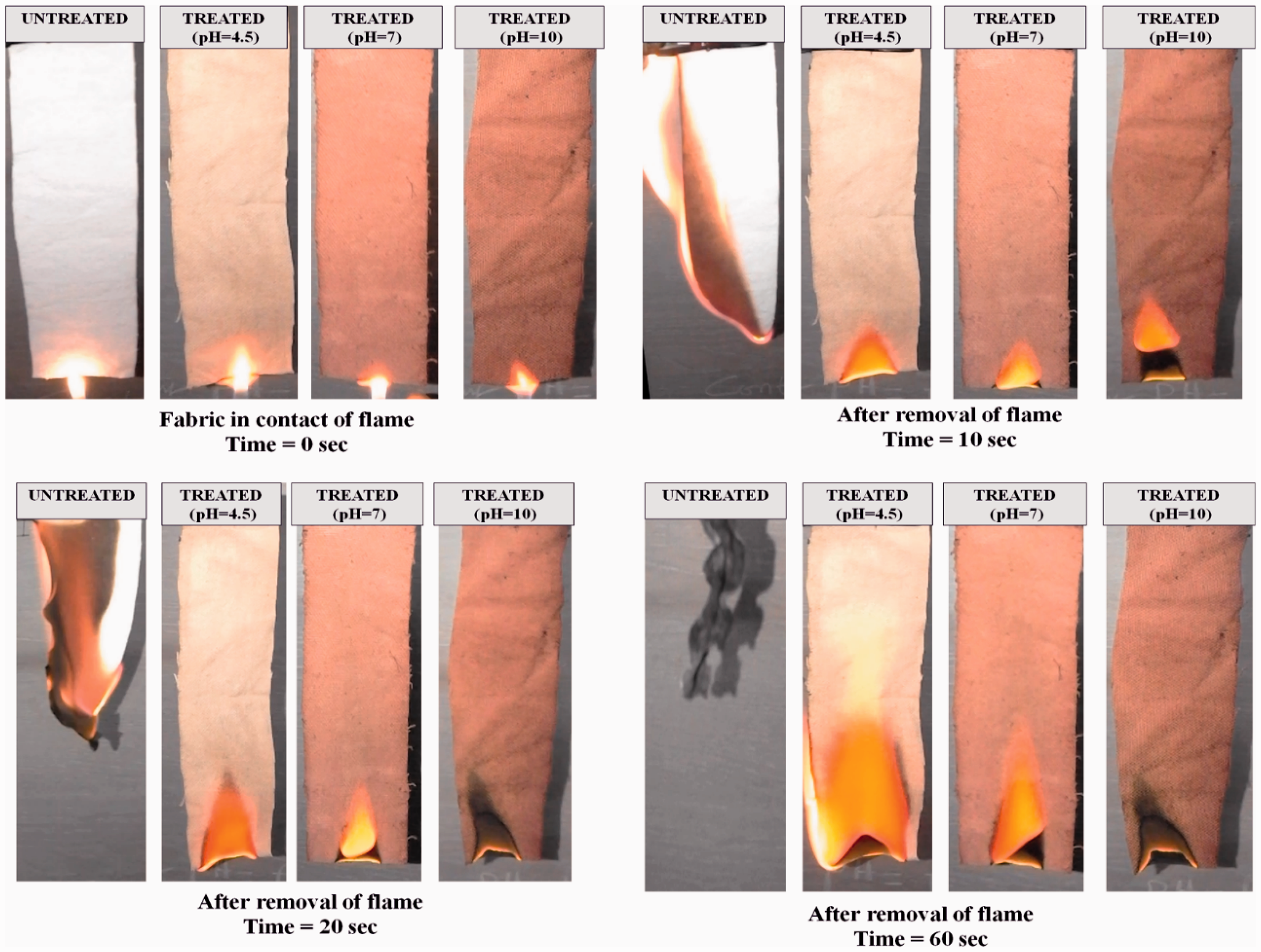
Vertical flammability of the untreated and CSE-treated cotton fabric for at original concentrated (CA).
A one-way between samples ANOVA was conducted to compare the effect of CSE treatment at different pH and concentrations on LOI in untreated cotton, CSE-treated cotton at pH 4.5, 7, and 10 conditions at original concentration (CA) extract and concentrated levels (CB) (refer Figure 4(a) and (b)).
(a) Variation in LOI means (with SD whisker), of samples treated with CSE at different pH and concentrations compared to untreated and (b) histogram plot of residuals follows a normal distribution.
One-way ANOVA summary.

Univariate statistical analysis of LOI values for untreated and CSE-treated cotton fabrics.
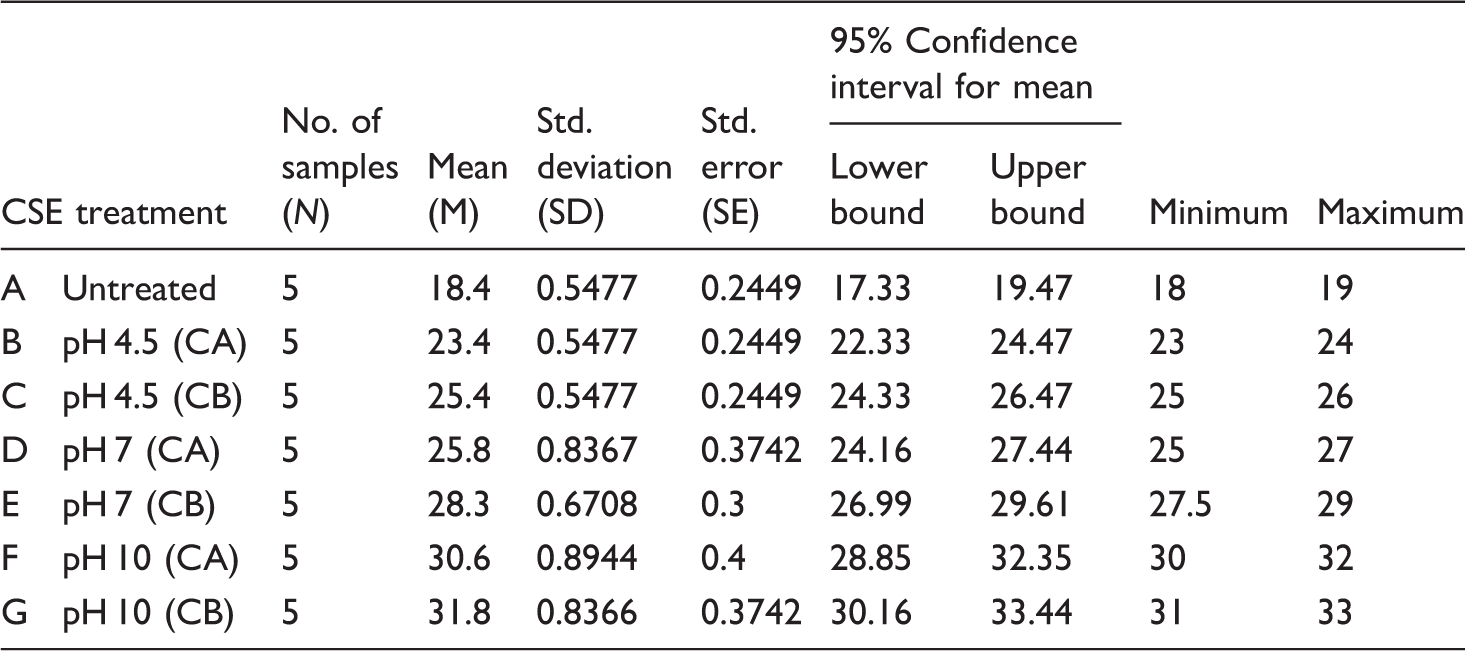
CSE: coconut shell extract; CA: CSE at its original concentration; CB: double concentrated.
Test of homogeneity of variances for the LOI data, the Levene's test p = 0.7795, significance > > 0.05. The variances are relatively similar, hence the high probability value and indicate the homogeneity of variance. However, the sample size in each group being relatively small (N = 5), assumption of homogeneity of variance is questionable; so the Welch test in the case of unequal variances is done, showing F = 186.9, df = 12.39, p = 2.037E-11. This robust test for equality of means (Welch F test) indicates the effect of CSE treatment is significant (p < 0.05).
Attenuated total reflection Fourier transform infrared analysis in nitrogen atmosphere
The thermal behavior of cotton treated with CSE at different pH for concentrated (CB) was examined by thermogravimetric analysis (TGA) and differential thermal analysis (DTA) as shown in Figure 5. CSE dried as such (refer to Figure 5(e)), was also characterized by these analyses. Table 5 summarizes data from the TGA of the CSE-treated cotton samples, untreated cotton, and CSE. From Figure 5, it is seen that all CSE-treated fabrics showed two-step weight loss thermal degradation (225–325℃, 330–450℃); as against only a single-step weight loss degradation (290–375℃) observed for untreated cotton. Up to 200℃, loss in weight of 5% for cotton and slightly more for CSE-treated cotton occurs due to the removal of physically adsorbed water. Pyrolysis did not begin until 275℃ for cotton, but proceeded very rapidly as temperature rose still further, and was completed at 500℃ with a yield of char of only 6%, which well compared with reported in literature 8.7 %value [41] for char yield of cellulose under isothermal pyrolysis at 500℃ for 5 min.
(A) TGA and (B) DTA curves of the (a) untreated cotton, coconut shell extract (CSE)-treated cotton fabric at pH (b) 4.5, (c) 7, (d) 10, and (e) TGA–DTA of dried CSE in a nitrogen atmosphere at a heating rate of 10 ℃/min for double concentrated (CB). Different TGA parameters of untreated and coconut shell extract (CSE)-treated cotton.

Weight loss % at different temperatures for untreated, CSE-treated cotton, and dried CSE.

From the TGA of the coconut shell extract (refer to Figure 5(e)), it is found to be similar to that reported for the fire retardant bark sample [46]. The TGA of CSE is almost identical, and evolution of CO2 and water are detected in the TG-coupled FTIR spectra of the volatiles of the bark [46]. It is also seen from reported TGA of xylan and lignin in comparison with cellulose [41,47] that CSE seems to contain a water-soluble xylan–lignin component of the green coconut shell [48]. Xylan, lignin, and cellulose have different pyrolysis mechanisms with xylan, a hemicellulose, starting to decompose at 150℃, while lignin begins to decompose above 200℃, at a slow rate up to 500℃. Xylan–cellulose interactions extend the semi-crystalline cellulose microfibril size and alter its properties in plant cell walls. In dicot cell walls, a coating of the hydrophilic faces of cellulose microfibrils with the acetylated and glucuronosylated form of xylan found may lead the otherwise hydrophilic surfaces to be relatively hydrophobic (because of acetate groups) and acidic (because of glucuronic acid groups) [49]. Such natural interactions may be imitated in the coating behavior of CSE on cotton increasing its thermal resistance. The TGA–DTA curves of CSE extract also show a resemblance in profile to the tannin containing hot water extract of pine bark [50].
The DTA Figure 5(B) provides visual information on when pyrolysis reactions are taking place and the extent of fractional conversion. Within the DTA curves, comparing the samples based on (i) location of peaks, (ii) relative height of peaks, and (iii) broadness of the DTA curves on the temperature scale, it is seen from Figure 5(B) that two peaks are seen in the CSE-treated cotton at 320℃ and later at 420–440℃, compared to untreated cotton, which showed a single peak close to 360℃, related to cellulose decomposition. The first peak at 320℃ in CSE-treated cotton is related to hemicellulose decomposition, starting at 250℃ [45]. The DTA of tannins, obtained from hot water crude extract of pine bark [50] is seen to have a peak at 280℃, while hemicellulose continue to undergo pyrolysis up to 350℃. It can be inferred that a tannin–hemicellulose mixture from CSE containing differing proportions of tannin (least in the acidic, as hydrolysed tannins are not favorably deposited on cotton) based on the treatment pH and treatment temperature of 90℃ is deposited on cotton to confer thermal resistance [51]. The second peak in CSE-treated cotton seen at 410–440℃ (common to all CSE-treated cotton), which is present in addition to peak at 400℃ for acidic pH treated cotton, indicates the thermal decomposition of lignin, which occurs at 280–500℃ yielding phenol via cleavage of ether and carbon–carbon linkages [51]. Tannins can act as scavengers for free radicals produced during combustion, inhibiting chain reactions [51].
Differential scanning calorimetric analysis
The DSC curve of CSE shows a broad endotherm at 100℃, showing loss of adsorbed water followed by a second minor endothermic feature at 200℃ consistent with the onset of degradation, which was followed by exothermic heat flow on further heating [51]. There was a minor shoulder exotherm at 360–380℃, ascribed to the disintegration of intramolecular interaction and the decomposition of hemicellulosic components in CSE. There was a distinct exotherm at 482.4℃, related to the combustion of lignin–carbohydrate complex present in CSE [52]. Referring to Figure 6 and Table 7, the latent heat energy storage of CSE-treated cotton, decreased for the first dehydration peak from 127.3 J/g in untreated cotton to 26.5 J/g for treated cotton (pH 4.5), to 0.8 J/g for CSE-treated cotton (pH 10). The untreated cotton shows a prominent endothermic peak with a maximum at 339.1℃, followed by a minor endothermic peak at 368.1℃, related to stages of cellulose decomposition. The DSC of CSE (pH 4.5)-treated cotton shows an exothermic peak at 361℃, related to combustion of amorphous polysaccharide/hemicelluloses, followed by combustion of lignin–polysaccharide complex, a slow rate of degradation with a high amount of nonvolatile products formed. The exotherm related to lignin–PS complex combustion is present in all CSE-treated cotton, though the peak maximum temperature increases with treatment pH. The hemicellulose decomposition around 370℃, is not present as a distinct exothermic peak, but as a continuous increasing exothermic heat flow in the cotton treated at pH 10 with CSE, as in CSE itself. The cotton treated with CSE at pH 7 shows an exotherm at 339.8℃, with heat flow of 48.2 J/g, opposite to the endothermic peak at the same temperature for untreated cotton. This confirms the fire retardancy effect of CSE. The lignin-related combustion peak indicates the degradation of polyphenolics present in CSE, followed by greater weight loss [50]. Minerals present in CSE (EDS and FTIR data) play a key role in catalyzing pyrolysis reactions; cations like sodium and potassium (CSE is rich in potassium, like coconut water), are responsible for accelerated catalytic decomposition of cellulose and hemicellulose [47].
DSC curves of the (a) untreated cotton, coconut shell extract (CSE)-treated cotton fabric at pH (b) 4.5, (c) 7, (d) 10 and (e) dried CSE in a nitrogen atmosphere at a heating rate of 10 ℃/min for double concentrated (CB). Comparison of Peak temperature and heat release of untreated and CSE-treated cotton at different pH for double concentrated (CB).

Fire retardance due to CSE occurs through additive effect of its different organic and inorganic components possibly in multiple ways. It could be due to promoting the formation of increased extent of char at a lower temperature, which acts as a protective barrier against heat and flame. The CSE also forms a coating on the cotton surface, which acts as a fire barrier leading to intumescence. The residual water in the coating absorbs latent heat of vaporization from pyrolysis reactions until all water is vaporized, thereby removing heat from the pyrolysis zone. DSC and DTA data indicating the changes in the heats of reactions, and the shifts in the position of pyrolysis reactions, on temperature progress, show the decreased volatilization with depolymerization progress for the treated samples [41,53] and thus inhibiting the continuation of the flame.
Attenuated total reflection Fourier transform infrared analysis
The observed peaks in the range of 800–1300 cm−1 wavelength were mainly due to the presence of inorganic salts in dried CSE as shown in Figure 7(e). FTIR spectra of CSE have shown the peak at 3271 cm−1 in the FTIR spectrum of CSE is due to stretching vibration of phenolic hydroxyls (OH bond) and broad area indicates the intermolecular hydrogen bonding among the polyhydroxy aromatic compounds. The peak at 2940 cm−1 is due to the C–H stretching frequencies of methylene –CH2 groups. Compared to untreated cotton, the acidic pH and neutral pH showed sharper peaks at 2940 cm−1, while the alkaline pH treated cotton, showed a greater broadening of the same peak. Compared to untreated cotton spectra, the acidic pH and neutral pH CSE-treated cotton showed a small peak at 1735 cm−1 and it was absent in the alkaline pH CSE-treated cotton. Also CSE-treated cotton has a broad peak at 1425 cm−1, compared to untreated cotton. This may be due to the xylan present in CSE [54].
FTIR analysis of (a) untreated cotton, coconut shell extract treated cotton at (b) pH 4.5, (c) pH 7, (d) pH 10, and (e) dried coconut shell extract.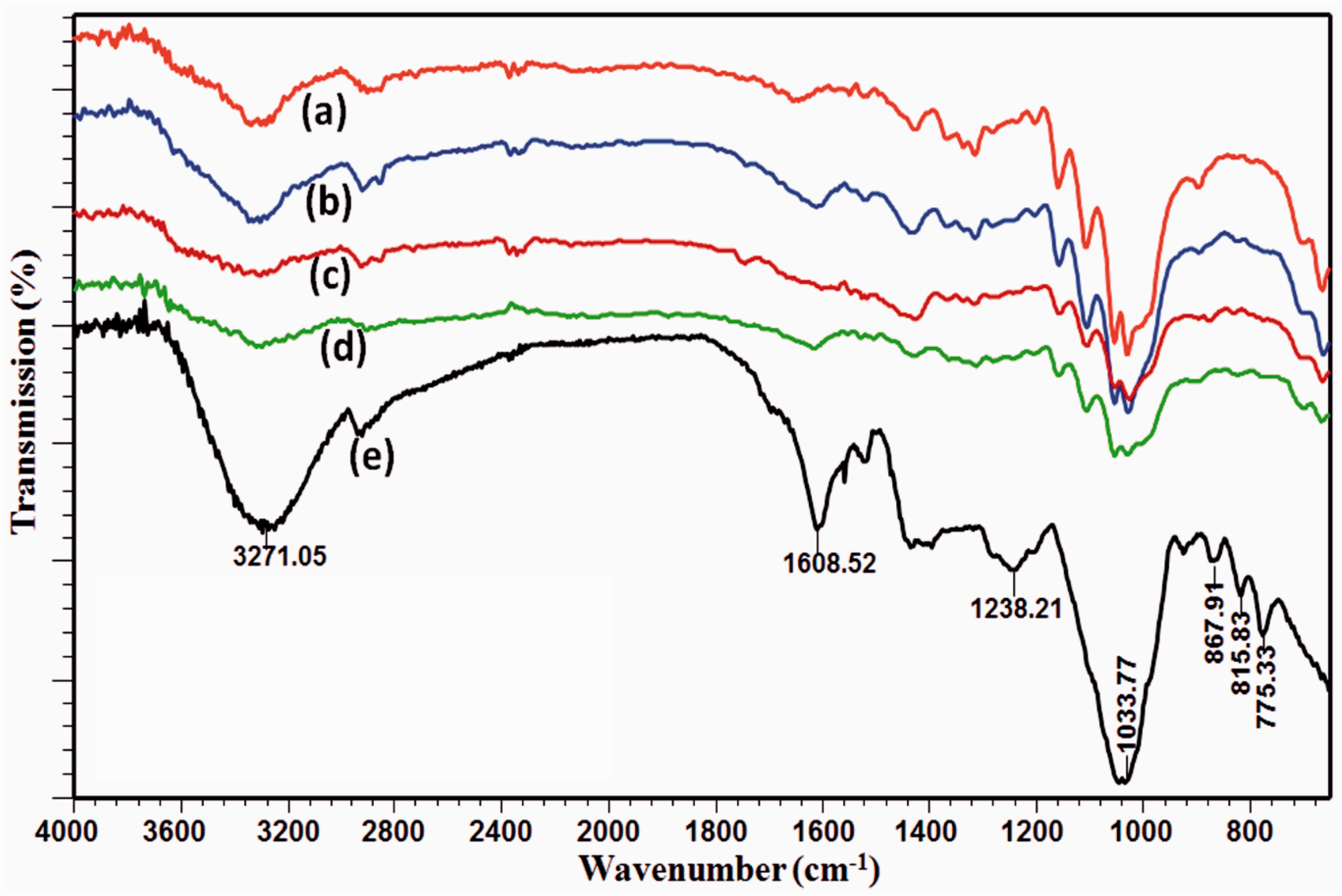
The peak at 1608 and 1033 cm−1 are due to the presence of aromatic rings and C–O groups in the coconut shell extracts respectively [25]. The small peaks observed at 1176 and 873 cm−1 might be due to the presence of magnesium chloride and potassium chloride salts respectively [55]. Similarly, the peak observed at 1000 cm−1 was due to the presence of sodium phosphate [56]. These types of elements in the inorganic salts have also been detected in the EDS analysis of the CSE and the CSE-treated cotton fabric. According to Barroso [57] and Noguera et al. [58], the green coconut shell is composed of a variety of nutrients and micronutrient sources varying from 50 to 142 mg/L of P, 115 to 803 mg/L of K, 0.5 to 28.0 mg/L of Ca, 0.5 to 18 mg/L of Mg, 12.5 to 37 mg/L of Na, 11.4 to 19.7 mg/L of Fe, 2.2 to 31.8 mg/L of Zn, 8 to 23.3 mg/L of Mn, and 2.3 to 6.6 mg/L of Cu. The FTIR of untreated cotton shows peaks at 1048 cm−1 and a small peak at 968 cm−1, both of which decrease in intensity with CSE treatment from acidic to neutral to alkaline pH. These bands are associated with the ring vibrations, overlapped with the stretching vibrations of the (C–OH) side groups and the (C–O–C) glycosidic band vibrations of cellulose chain. These are related to the decreasing glycosidic linkage, by increasing interaction with polyphenolics and metal salts chelation[59].
Scanning electron microscope analysis
The SEM images of the untreated and CSE-treated cotton fabric at different pH are shown in Figure 8. It can be seen from Figure 8(a) that untreated cotton sample showed clean surface, without any deposition. However, after the CSE treatment, the coating of coconut shell extract solution could easily be visible in Figure 8(b), to (d). CSE-treated cotton fabric was distributed over the entire surface of the fabric at pH 4.5(b) and pH 7(c), but deposition was more at pH 10(d). The coating layer deposition on the cotton fabric was responsible for more LOI value, thus giving enhanced flame retardance.
SEM images of (a) untreated cotton fabric, coconut shell extract (CSE)-treated cotton fabric at (b) pH 4.5, (c) at pH 7, (d) at pH 10 for double concentrated (CB).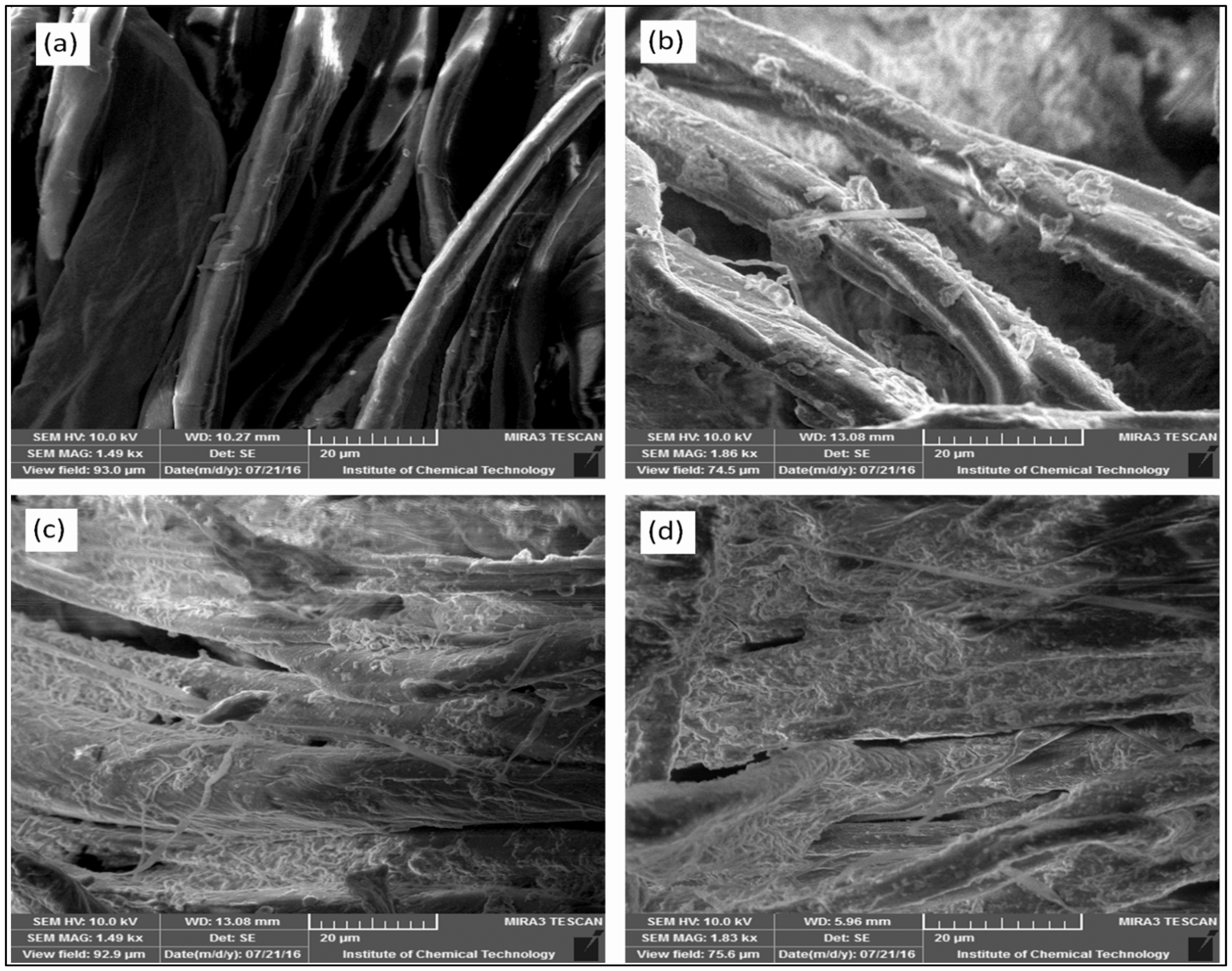
Char analysis of untreated and treated cotton fabrics with SEM and ATR–FTIR
Figure 9(a) shows the untreated cotton fabric, which has lightweight, ash-like white char mass. CSE-treated cotton fabric as illustrated in Figure 9(b) to (d) shows a hard, solid, and blackish carbonaceous char mass at all pH values for concentrated solution i.e. CB. Untreated cotton char showed open broken fiber structure due to which volatile flammable gases can pass through easily and help to burn the cotton fabric continuously. However, CSE-treated cotton char showed few bubble like char structures formed of closed cells containing pockets of gases at pH 4.5(b) and pH 7(c). Char showed much denser bubble and compact closed pockets of gases at pH 10(d). This closed cell char structure helps to restrict the flow of flammable gases and prevents them from coming out in contact with the flame source thus taking a longer time to burn out. Also, it restricts the formation of the flammable liquids by forming a heat insulating foam-like layer on the polymer substrate.
Char residual analysis of (a) untreated cotton, coconut shell extract treated cotton at pH (b) 4.5, (c) 7, (d) 10 for double concentrated (CB).
On comparison of the ATR–FTIR spectra of burnt fabric untreated and treated samples as shown in Figure 10, it is seen that the peak at 1440 cm−1 (attributed to aromatic – C = C – skeletal vibration) in untreated cotton char changes to include a 1480 cm−1 component at neutral pH char. The 1440 cm−1 band decreased in intensity as CSE treatment changed from alkaline to neutral to acid pH. It also includes peak appearance at 1560 cm−1 with increasing pH from neutral to alkaline (increasing aromatic carbon content with treated sample) and also broadening of the same to include –C=O frequencies [60]. This signals the formation of unsaturation and carbonyl groups by dehydration and rearrangement. The 1000–1200 cm−1 region (C–H deformation vibrations) shows an increase in intensity and broadening of the peaks, indicating the broad absorption typical of substituted aromatic rings such as benzene [60]. This further supports the maximum level of thermal stability offered by the cotton sample treated with CSE at pH 10.
ATR–FTIR analysis of the char of (a) untreated cotton, coconut shell extract treated cotton at (b) pH 4.5, (c) pH 7, and (d) pH 10 for double concentrated (CB).
Energy-dispersive X-ray spectroscopy analysis
EDS analysis of the dried CSE, untreated, and CSE-treated cotton fabric is represented in Figure 11, and the elements with weight and atomic percentage are reported in Table 8. As expected, the untreated cotton sample as shown in Figure 11(b) showed only the presence of carbon, oxygen, and traces of sulphur atoms [20] as the technique used cannot detect hydrogen atom. However, the CSE-treated cotton fabric showed several atomic peaks as seen in Figure 11(c). It can be observed from Table 8 that the pure CSE contains elements like magnesium, chlorine, potassium, sodium, silicon, sulphur, phosphorous, aluminum, calcium, etc. In the literature, it is reported that coconut water also showed the presence of similar types of inorganic elements such as Ca, Fe, Mg, P, K, Na, Cu, Cl, S, Al, etc. and thus it supports the EDS results (refer to Figure 11(a)] for CSE [61].
EDS analysis of (a) dried coconut shell extract, (b) untreated, and (c) CSE-treated cotton fabric at pH 10 for double concentrated (CB). Quantification of elements present in CSE, untreated, and CSE-treated cotton fabric. CSE: coconut shell extract.

It was also observed that the same elements are also present in the CSE-treated cotton fabric with more or less similar weight and atomic percentage. The elements like sulphur, sodium, magnesium, silicon, phosphorus, and calcium are present with an increase in weight and atomic percentage in the CSE-treated cotton fabric. It might be because on drying, CSE was not so much active to get detected by EDS analysis, whereas CSE on application to the cotton fabric at 90℃ in alkaline pH, these elements became active and showed an increase in atomic and weight percentage peaks (Table 8). Sodium is being detected more in the treated sample might be due to the presence of sodium carbonate (Na2CO3) used to maintain the pH around 10.The inorganic elements present in the CSE-treated cotton fabric may be responsible for its fire retardance.
Antibacterial activity of coconut shell extract
Antibacterial activity of untreated and CSE-treated cotton fabric at different pH was quantitatively assessed to determine the percentage reduction in bacterial populations in liquid media for E .coli and S. aureus as shown in Figure 12. Antibacterial activity of untreated and treated fabrics at different pH was qualitatively assessed (AATCC 147) to determine the zone of inhibition (mm) in the presence E. coli and S. aureus media and results are shown in Table 8. In all these cases, CSE-treated cotton fabric showed a zone of inhibition more than 6 mm thereby indicating good antibacterial property. Quantitative test (AATCC 100) results as shown in Table 9 and Figure 12 clearly indicate that the cotton fabric treated with CSE showed very good antibacterial properties both against S. aureus and for E. coli having more than 98% bacterial reduction.
Antibacterial activity of S. aureus (a) and E. coli (b) on the untreated and treated cotton samples at different pH for double concentrated (CB). Bacterial reduction percentage of E. coli and S. aureus on CSE-treated cotton fabric. CSE: coconut shell extract.

Coconut shell extract solution itself having antibacterial property, attributed to the presence of saponin, phenol, tannin, terpenoid, glycoside, flavonoids, etc. as shown in Table 1. Also, various metallic salts (metal based on magnesium, sodium, sulphur, phosphorus, potassium, aluminum, silicon, calcium) and metal oxides (elements are visible from EDS analysis) also assist in enhancing the antibacterial properties of the CSE. Tannin-like polyphenolic compounds are reported to have antibacterial activity [62–64]. Flavonoids are hydroxylated polyphenolic compounds known to be produced by plants in response to microbial infections. Terpenoids although mainly used for their aromatic qualities have also been found to be a potential agent for inhibiting bacteria. Saponin, which are glycosides, have been found to have inhibitory effects on Gram-positive organism [24]. Green coconut shell (mesocarp) is rich in different types of plant secondary metabolites especially antioxidants, which are essential for microbial infection resistance to protect the coconut from biotic attack [65]. Hydroxyl (–OH) group of cotton fiber will form hydrogen bonding with tannin and have minor van der Waal interactions too. Moreover, metal ions, tannin, and the hydroxyl group of the cotton fiber form strong coordinate bonding between them on treatment with metallic salts. Besides it, the large insoluble metal–tannin complex molecules are responsible for imparting antibacterial effect when it is inside the cotton fiber [63,64].
Color parameters of the CSE-treated cotton fabric at different pH
K/S values and color coordinates of dyed cotton fabric with CSE.
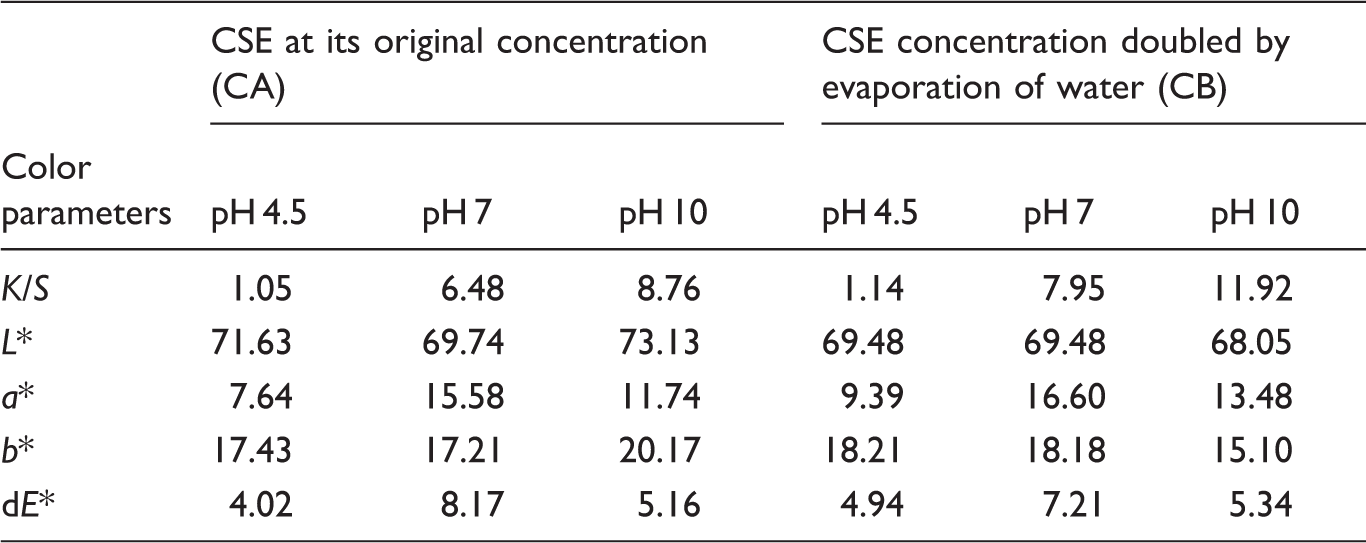
CSE: coconut shell extract.
L*: lightness (0 = black, 100 = white), a*: red-green coordinates (positive values = red, negative values = green), b*: yellow-blue coordinates (positive values = yellow, negative values = blue), dE* = total color difference.
Fastness properties of the dyed cotton fabric
Fastness properties of cotton fabric at different pH.

Wash durability of flame retardancy and antibacterial property
Wash durability was determined for the treated cotton fabric to understand the durability of the fire retardant on the fabric after washing. It was found that after ISO 2 wash, the CSE-treated cotton fabric showed LOI of 24 at neutral pH and 27 at pH 10 against the value of 18 LOI for untreated cotton fabric. In other words, after wash it was still 33.33% higher at neutral and 50% higher at pH 10 than that observed for the untreated sample. However, after five washes, the CSE-treated fabric (CB) with concentrated solution at pH 10 showed fire retardance with LOI value of 25. But up to four washes, the flame retardance of the order of LOI 26 was observed and thus it could be considered as a flame retardant. The decrease in the flame retardance in the CSE-treated sample, after five washing, may be attributed to the partial removal of the active component of CSE molecules such as metal salts, phosphate, and sulphates. Further research regarding improving the wash durability is going on in this direction.
Wash durability for antibacterial effect was carried out as per ISO 2 method. It was found that after five washes antibacterial effect was found to be more than 90% at three different pH namely 4.5, 7, and 10 for CB. It was found that colonies reduction (%) for E. coli was 94.81, 96.13, and 96.7 for pH 4.5, 7, and 10, respectively. Colonies reduction % for S. aureus was also found to be 91.94, 95.82, and 96.41 for pH 4.5, 7, and 10, respectively. Thus, CSE-treated cotton fabric showed very good durability to five washes.
Tensile strength of cotton fabric
There was marginal detrimental effect on the mechanical properties of the cotton fabric treated with CSE at different pH conditions. It was observed that the tensile strength of cotton fabric decreased slightly at pH 4.5, 7, and 10 for treated CSE as compared to that of the untreated cotton fabric as shown in Figure 13. The CSE acts as finishing cum coating agent for the cotton polymeric chains and its deposition (as seen in increase in add on) in the fabric matrix hinders the freedom of individual chain molecules in sharing the tensile load. It is for this reason that a slight decrease in the tensile strength was observed.
Tensile strength of untreated and CSE-treated cotton fabric at different pH for double concentrated (CB).
Conclusions
The present study reveals conclusively the ability of CSE to impart flame retardance and antibacterial properties on the cotton. CSE-treated cotton fabric showed increased thermal stability and flame retardance with an increase in pH and concentration. This flame retardance of CSE-treated cotton fabric is attributed to the presence of inorganic metal salts, metal oxides, phenolic groups, etc. which helped in the increase in production of foaming char acting as a protective barrier and decrease in volatilization thus reducing the formation of combustible gases, which are required for continuation of fire. As far as the physical observation (heavy intense black color char mass formation after burning, earlier dehydration from the TG curve, voluminous foamy nature of CSE observed from SEM analysis) is concerned, it can be said that CSE worked on the condensed phase intumescent mechanism. Treated cotton fabric also showed excellent antibacterial property against S. aureus and E. coli. The presence of tannin, phenol, terpenoid, glycoside, and flavonoid was responsible for depicting antibacterial property after treatment with CSE. Treated fabric at alkaline medium and higher concentration showed enhanced thermal stability and antibacterial property. In addition, CSE-treated fabric showed natural brown coloration, which changed into red with an increase in pH. Although the durability of flame retardance was only up to four washes, the antibacterial property was significantly high even after five washes. Thus, CSE-treated cellulosic fabric could be used for various applications such as making low-cost home furnishing products like sofa cover, curtains, products for interior design in public halls, theatre, protective materials for making tents, etc.
Footnotes
Author's Note
Correspondence to this article can also be addressed to Pintu Pandit, Department of Fibres and Textile Processing Technology, Institute of Chemical Technology, Mumbai, India. E-mail: pintupanditict@gmail.com.
Declaration of Conflicting Interests
The author(s) declared no potential conflicts of interest with respect to the research, authorship, and/or publication of this article.
Funding
The author(s) disclosed receipt of the following financial support for the research, authorship, and/or publication of this article: Pintu Pandit is indebted to University Grants Commission-Basic Scientific Research (UGC-BSR) having award letter number F.25-1/2014-15 (BSR)/No. F.5-65/2007(BSR), for the scholarship support from the Govt. of India during the study period.