




Abstract
This study evaluated the deterioration in thermo-mechanical and performance properties of the polyaramid and polybenzidimazole fabric used in firefighters’ protective clothing after exposure to ultraviolet irradiation, and the effect of weathering. The performance of firefighters’ protective clothing plays an important role in protection against heat and physical threats to firefighters. However, frequent exposure to heat and ultraviolet irradiation can deteriorate performance. Test results demonstrated a 79% drop in the residual strength of polybenzidimazole/Kevlar® fabric and a 51% drop in the residual strength of polyaramid (Nomex® IIIA). The results confirmed that heat accelerates the degradation of PBI, resulting in lower performance, an important consideration for firefighters’ protective clothing. In this study, a new ‘UVPro-Tex’ sensor was developed, with the capability to record the amount of ultraviolet irradiation absorbed by the fabric. When the amount of the absorbed ultraviolet irradiation reaches a critical value, the sensor warns the wearer of the end-of-life of the garment.
Introduction
The performance of firefighters’ protective clothing (FPC) is an important factor in minimising risks during firefighting. Performance of the FPC is impacted by exposure to ultraviolet (UV) radiation, the level of usage and frequency of cleaning over the lifetime of the garment [1–3]. It is, therefore, essential to understand the effect of the environmental conditions on the performance of the FPC and to accurately assess the effective lifetime of the clothing [1,4].
The outer layer of most FPC is constructed of polybenzimidazole (PBI), and polyaramid (Nomex® and Kevlar®), all of which are sensitive to light exposure [3–5]. Prolonged exposure to UV irradiation can result in significant loss of strength, leading to reduced protection from thermal exposure and other physical hazards [3,6–8].
A number of research studies have investigated the impact of UV irradiation on the performance of PBI and polyaramid polymers used in the outer layer of FPC [3,7]. Davis et al. [8] investigated the impact of UV on PBI and polyaramid (Nomex®) fabric. They reported a significant surface decomposition of the polymer after 13 days of exposure to accelerated weathering in laboratory conditions. While the polyaramid fabric experienced a reduction in its mechanical properties in excess of 40%, the PBI was less affected by the conditions, maintaining 20% more of its properties [8,9]. Houshyar et al. [6] also reported the effect of UV light on performance of PBI and polyaramid fibers. They found that PBI and polyaramid fabrics no longer protect the wearer after 7 days of exposure to high intensity UV light. It is therefore important to assess the performance of the FPC at regular intervals. Nazare et al. [3] discussed the difficulty of detecting the degradation and loss in mechanical properties of the outer layer by visual inspection alone, concluding that objective testing is required [3]. However, the high cost of FPC and the damage caused to the garment by objective testing imposes a financial burden on firefighting organisations. It would therefore be advantageous to develop a method or device to estimate the effective lifetime of the FPC based on scientific measurements in laboratory conditions, avoiding unnecessary damage to the clothing [3,6,9–14].
In this study, the impact of UV irradiation on the mechanical properties of FPC such as tensile and tear strength and thermal performance was investigated. The potential to apply a UV sensor to predict the end-of-life of the garment was also considered. Fabrics used in the outer layer of commercial FPC (prepared from PBI/Kevlar® and Nomex® IIIA fabrics) were exposed to UV light for a specific time with tear strength, tensile strength, heat resistance to flame and the residual strength subsequently recorded and compared to the original properties. The recorded values were compared with the minimum accepted standard values for protective clothing. The FPC is considered to have reached ‘end-of-life’ when the protection and other values fall below standard specifications, as the fabrics no longer meet the minimum requirements for protection.
Materials and methods
Detailed properties of Fabric samples [6].

aMade of filament and there is no UV-resistant finish/ coating.
Fabric samples were stored in black plastic bags to avoid any possible degradation due to the exposure to light. The samples were tested for mechanical and thermal properties, to measure the effect of the UV irradiation on the performance properties of the fabric. Both unexposed (control) and exposed (UV irradiated fabric) specimens were tested for tensile strength and tear strength, after exposure to radiant heat. Furthermore, the heat transfer (flame) was tested in these samples to evaluate the influence of UV irradiation on performance properties.
UV irradiation
Rectangular samples (20 cm × 5 cm) were prepared for each of the fabrics (in warp and weft directions) and exposed to high UV irradiation in a weather-o-meter (ci 4000, Figure 1). Accelerated exposure of the fabric to high UV intensity was carried out using a Xenon lamp system to produce a uniform UV flux in the environmental chamber at 340 nm wavelength. Samples were exposed to UV radiation at 40℃ and 50% relative humidity (RH) for 10080 min (ASTM G155 [15]). Samples were continuously exposed to UV dosage of 0.24 ± 0.01 W/m2 for four days, removed from the chamber and tests were performed. The interval of four days was selected based on the results from a previous study [6]: after exposure to this amount of UV irradiation the fabric degraded, no longer meeting the minimum requirements for FPC based on AS/NZS 4967:2009 and AS/NZS 4399:1996 [16,17].
Atlas weather-o-meter sample holder (left) with UV irradiation (right).
Evaluation of mechanical properties
Both the control (unexposed) and exposed specimens were tested for tensile strength in accordance with ISO 13934-1 [18] and tear strength according to ISO 4674-1 [19], using the Instron Universal Test Instrument (Model 3300 Single Column). Five test specimens were used to measure each for the tensile and tear strength in warp and weft direction of each fabric. The average values for load at break and tear strength were calculated using Bluehill software and reported.
Residual strength of the fabric before and after exposure to radiant heat.

aValues in the parenthesis indicate the requirements as per AS/NZS 4967.
Evaluation of thermal performance properties
Thermal performance properties of the FPC were assessed by measuring the heat flow through the garment when exposed to a specific heat flux. Heat transfer (flame) was measured according to ISO 9151:1995 [22] standard test methods. In this test, the specimen was horizontally mounted while partially restrained from moving and subjected to an incident heat flux of 80 kW/m2 from a gas burner flame placed below (performed at BTTG). A copper calorimeter placed on top of the specimen was used to measure the heat passing through it. The specimens were tested in a laboratory maintained at a temperature of 24℃ and a RH of 41%. The heat transfer (flame) performance was evaluated by measuring the time the fabric combinations took to reach a temperature increase of 12 ± 2℃ and 24 ± 2℃ in the calorimeter (designated as t12 and t24, respectively). The samples were considered pass if the conditions in the parenthesis were met (pass if t24 ≥ 17.0 s and t24-t12 ≥ 4 s).
The recorded test results were used solely for characterization of the materials and are not applicable to actual fire conditions.
Results and discussion
Mechanical properties
As mentioned in the experimental section, to understand the effect of UV irradiation on mechanical properties, tensile and tear strengths of the UV exposed fabric were recorded and compared with the control fabric. These results are graphically shown in Figure 2.
Load at break in (a) warp and (b) weft direction; tear strength in (c) warp and (d) weft direction.
Figure 2 indicates that exposing fabric to UV irradiation can lead to the loss of mechanical properties. It is clear that after four days of UV exposure, Nomex® IIIA fabric exhibited load at break in weft and warp direction below the minimum standard value requirements, a reduction of 63%, and 64%, respectively. However, the loss in load at break for PBI/Kevlar® fabric was lower than that of the Nomex® IIIA fabric, a reduction of 61% and 48% for weft and warp, respectively. The significant reduction exhibited in the results might be due to polymer degradation and deterioration. As mentioned in the literature [3,6,8], PBI/Kevlar® fiber has a skin–core structure with high core crystalline, while Nomex® fiber has little skin area with little difference between the structure of the core and skin. Therefore Nomex® IIIA (m-aramid) is less stable than the PBI/Kevlar® (p-aramid) when exposed to UV irradiation [3,6,22].
It is clear from Figure 2(c) and (d) that the tear strength of the fabric decreased when exposed to UV irradiation. There were 72% and 80% reductions in the tear strength of the PBI/Kevlar® fabric in warp and weft directions, respectively. The level of reduction increased for Nomex® IIIA fabric to 80% and 81% for warp and weft directions, respectively. As mentioned in the literature, these reductions might be caused by aramid chain cleavage that resulted in polymer degradation.
The critical implication of these results is that after four days of exposure to UV irradiation, fabrics no longer provide adequate protection against most physical threats, which is the most important aspect of the protective clothing. The results for the residual strength of the exposed fabric to UV irradiation and heat are listed in Table 2.
As shown in Table 2, reduction in residual strength is greater for PBI/Kevlar® in comparison with Nomex® IIIA in both weft and warp direction, respectively. PBI/Kevlar® exhibited around 79% reduction in both directions while Nomex® IIIA showed 51% and 78% in warp and weft directions, respectively. It can be concluded that the effect of the heat is greater on PBI/Kevlar® than Nomex® IIIA after UV irradiation. This confirms the results from the heat flame transfer test. The previous papers reported thermogravimetric analysis (TGA) results for UV exposed PBI/Kevlar® and Nomex® IIIA. The results showed that UV exposed PBI/Kevlar® was less stable than UV exposed Nomex® IIIA, when exposed to high temperature, due to the cleavage of benzene rings [3,6,24], which supports this findings.
Performance properties
Heat transfer flame of the fabric assemblies before and after UV exposure.
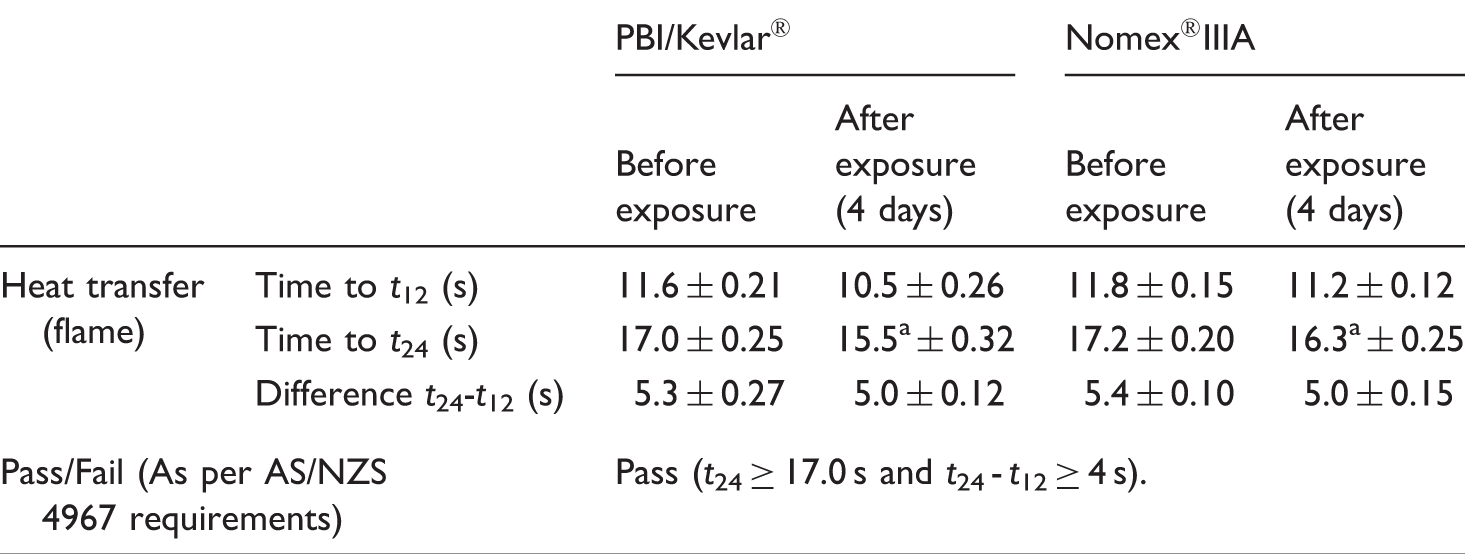
aThe samples did not pass the requirements after exposure to UV for four days.
End-of-life prediction for FPC
FPC is constructed of high-performance materials, which are capable of protecting the wearer against a wide range of external conditions. As discussed by Nazare et al. [3], the protective clothing is exposed to different levels of UV irradiation according to the position of the firefighter in relation to the fire front line and the type of activity. The effective life time of the protective clothing is influenced by the following factors: the type of the activity in which the firefighters are engaged, the level of exposure to UV radiation, the level of usage and the frequency of cleaning. As a result, it is difficult to accurately predict the lifetime of the protective clothing without considering these complex factors in combination.
Protective clothing generally has a fixed lifetime of ten years, which may be subjectively reduced [16]. The detection of end-of-life of a FPC during use is a difficult task. There is typically no visually detectable sign of degradation in degraded clothing. The objective method of evaluation of the FPC as per AS/NZS 4967 is not feasible as it is a destructive test. Hence, this study used a novel approach of using a sensor that can measure the amount of UV and number of washing cycles. Following section describes more on the sensor.
As previously discussed, degraded protective clothing does not provide adequate thermal or physical protection against threats, which may result in firefighter injuries. It is therefore important to develop a reliable method of predicting the effective lifetime of the protective clothing after prolonged storage or usage, before non-compliant performance endangers the wearer.
In this study, the UVPro-Tex (Figure 3) sensor was developed to record the amount of UV absorbed by the FPC and to alert the wearer when exposed to temperatures greater than 270℃ for more than 30 sec When the amount of the absorbed UV irradiation reaches a critical value, the sensor warns the wearer of the end-of-life of the garment. The critical value for the maximum amount of UV able to be absorbed by the FPC was determined to be the total absorbed over four days in the weather-o-meter. After this amount of time, exposed fabric no longer meets minimum requirements for protection. During the experiments for all fabrics, the UV sensor was placed in the weather-o-meter to record the level of absorbed UV. The UV sensor calibrations were based on the data from the weather-o-meter and the properties of the fabrics.
UVPro-Tex sensor.
In a real life firefighting situation, the amount of UV irradiation absorbed by the UV sensor reaches the predetermined critical value (based on laboratory experiments, weather-o-meter), the sensor will beep and flash to indicate that the FPC no longer provides adequate protection for the wearer. The UVPro-Tex sensor should be separately programmed for each fabric type, as each fabric displays different properties when exposed to UV irradiation.
This small UVPro-Tex sensor may be fastened to the top of the shoulder of the protective clothing. The UVPro-Tex sensor will undergo further trials to confirm the data gathered are upto date and the results published are accurate.
Conclusion
The performance properties of the outer layer fabric used in FPC were investigated after exposure to UV irradiation and heat. Results indicated that the loss in load at break for PBI/Kevlar® fabric was 48% and 61% for warp and weft, respectively and Nomex® IIIA showed 64% and 63% in warp and weft directions, respectively. Similarly, there were 72% and 80% reductions in the tear strength of the PBI/Kevlar® fabric in warp and weft directions respectively, whereas for Nomex® IIIA fabric it was 80% and 81% for warp and weft directions, respectively. This loss was greater for Nomex® IIIA than for PBI/Kevlar®, due to PBI/Kevlar® fabric has a skin-core structure with high core crystallinity, while Nomex® IIIA has little skin area with little difference between the structure of the core and skin. Therefore Nomex® IIIA (m-aramid) is less stable than the PBI/Kevlar® (p-aramid) when exposed to UV irradiation. However, PBI®/Kevlar® fabric exhibited a greater reduction in heat transfer (flame) and residual strength than did the Nomex® IIIA fabric.
The results demonstrated that the outer layer of the protective clothing degrades and deteriorates when exposed to UV irradiation, providing significantly reduced protection against thermal and physical threats. It is therefore recommended that the clothing be stored away from sunlight and be checked at specific time intervals for performance. The majority of mechanical tests are destructive in nature and visual inspection alone cannot provide sufficient information with regard to degradation and loss of mechanical and thermal properties. Consequently, UVPro-Tex sensor embedded in the protective garment can provide critical information about the exposed external temperature and the amount of UV absorbed by the fabric during usage. This information, together with the laboratory information, can be used to predict the effective lifetime of the garment without destructive testing. However, more investigation is required before further application of the UVPro-Tex sensor.
Footnotes
Declaration of Conflicting Interests
The author(s) declared no potential conflicts of interest with respect to the research, authorship, and/or publication of this article.
Funding
The author(s) disclosed receipt of the following financial support for the research, authorship, and/or publication of this article: This study was funded by the Commonwealth Government under the Strategic Capability Program (SCP).