




Abstract
The proposed 3D orthogonal woven ramie/Kevlar reinforced poly (lactic acid) composite in this paper is a new type composite in which the 3D orthogonal structure has great advantages of high impact and delamination resistance due to the Z yarns and the hybridization of natural and manmade fibers provides not only partial environment friendly benefit but also efficient compensation for the relatively low mechanical properties from pure natural fibers. Eight types of the aforementioned composites were designed and fabricated. The results showed that as the volume fraction of Kevlar was increased, the tensile properties showed increasing trends, while the flexural properties were predominantly dependent on the fabric structures, especially, the weft yarns properties in the first and second layers from the upper and bottom surfaces. Furthermore, the impact strength was enhanced as the volume fraction of Kevlar increased to 5.5% and leveled off when Kevlar yarns continuously increased.
Introduction
Biocomposites made of biodegradable resins and natural fibers have attracted increasing interest for their advantages of biodegradability, sustainability and low density [1] Some biodegradable matrix polymers are derived from renewable resources, i.e. poly (lactic acid) (PLA) from corn starch [2], and soybean-based thermoset polymers [3]. It makes important contributions by reducing the dependence on fossil fuels and in turn the related environmental impacts [4]. Natural vegetable fibers mainly composed of cellulose, such as jute, flax and ramie fibers from plant stems, are renewable and used as reinforcements for green composites in the forms of fibers, yarns and fabrics [5].
Till now, the natural fiber-reinforced composites are still limited to the non-structural and sub-structural applications due to their relatively low mechanical properties [6,7]. Many attempts have been made to improve the mechanical properties of green composites, including chemical and/or physical modification on polymers and/or reinforcements [8]. However, the mechanical properties of pure vegetable fiber-reinforced composites are still substantially lower than those of the high performance fiber-reinforced composites. To further improve the mechanical properties of natural fiber-reinforced composites so as to substitute them for regular high performance fiber reinforced composites in medium load-bearing applications, the hybridization of natural fibers with high performance fibers has been studied. It is considered that natural/high performance fiber-reinforced hybrid composites would take full advantages of the properties of each constituent, resulting in an economical composite with reasonable mechanical properties for structural applications.
Quite a few studies have investigated properties of natural fiber core and manmade fiber skin type of hybrid composites [9–13]. For example, Reis et al. [10] studied the flexural behaviors of hybrid laminated polypropylene composites with a non-woven hemp fiber mat sandwiched with glass fabric surface layers, and found that the specific static stiffness and strength of hybrid composites were about 22% higher than those of the glass fabric-reinforced composites. Others have studied the effect of stacking sequence on the mechanical properties of hybrid composites [7,14] and found that stacking sequence had obvious influence on the tensile properties of hybrid composites.
These studies of natural/manmade fiber-reinforced hybrid composites are mainly focused on the natural fiber reinforcement with fibers and 2D fabric structures. For composites reinforced with short fibers, the fiber mechanical properties may not be fully used due to the random orientation of the fibers in the matrix. Though 2D fabric reinforcements are in better oriented state, the corresponding composites would be prone to delamination failure and the mechanical properties might be reduced in the yarn-oriented direction by the yarn crimps at warp and weft yarn interlacing points. However, in 3D orthogonal woven fabrics, warp and weft yarns have almost no crimp and the mechanical properties of the warp and weft elements are fully used. In addition, the Z yarns could prevent macro delamination and especially, the water-induced macro delamination which could be a serious problem for natural fiber-reinforced composites as natural fiber could absorb a lot of water. Therefore 3D woven fabrics could be a good choice for reinforcement of natural/manmade fiber-reinforced composites with better overall mechanical performance.
In this study, eight types of 3D orthogonal woven fabrics were fabricated to systematically analyze Kevlar volume fraction and fabric structures on the mechanical properties of natural/manmade fiber-reinforced hybrid composites. Multifilament aramid yarns (Kevlar 964C) with high impact resistance and low density and staple ramie yarns rich in China were chosen as the low elongation (LE) and the high elongation (HE) elements, respectively. Poly (lactic acid) (PLA) was selected as the matrix. The tensile, flexural and impact properties of composites were tested.
Materials and methods
Materials
Ramie yarns were purchased from Dongting Ramie Textile Printing & Dying Mill (Hunan, China). Kevlar-964C was supplied by E. I. du Pont de Nemours & Co., Inc. PLA pellets (Nature Works® 3052D) was provided by Shanghai Suqing Trading Co., Ltd. (Shanghai, China). The specific gravity of PLA is 1.24 and the melting temperature range is 145–160℃.
Tensile tests of yarns

Physical and mechanical properties of ramie and Kevlar yarns.

3D Fabric design and preparation
In this study, hybrid of Kevlar yarns and ramie yarns of 187 tex in weft layers of 3D orthogonal fabrics with four warp and five weft layers was considered as an example. For all the fabrics, ramie yarns with linear density of 187 tex and 65 tex were used as warp yarns and Z yarns, respectively. The design principle for 3D hybrid fabrics in weft direction was to make structurally symmetrical fabrics with different dispersion of Kevlar yarns. In general, the Kevlar yarns were arranged as uniformly as possible in each weft layer, and then were preferred to be in the outer layers in order to acquire better flexural properties. Based on these principles, two kinds of hybrid fabrics were designed in this study, namely, fabrics with surfaces of hybrid yarns of ramie yarns and Kevlar yarns (as shown in Figure 1(c) and (e)) and fabrics with surfaces of Kevlar yarns only (as shown in Figure 1(d), (f) to (h)). In addition, fabrics with pure ramie yarns and pure Kevlar yarns in all weft layers were also designed for comparison as shown in Figure 1(b) and (i), respectively. The fabric samples were named after yarns types of each weft layer successively with R, K and H standing for pure ramie weft layers, pure Kevlar weft layers and ramie/Kevlar hybrid weft layers, respectively. For example, KHRHK stands for fabrics with Kevlar yarns in the upper and lower surface layers, hybrid yarns in the upper and lower secondary layers, and ramie yarns in the middle layer shown in Figure 1(g). Meanwhile, the HHHHH and the KRKRK are the typical intra and inter hybrid 3D reinforcements as shown in Figure 1(e) and (f), respectively.
The typical structure of 3D orthogonal hybrid fabric (a) and the cross sections in warp directions for eight types of 3D fabric: (b) RRRRR, (c) HRRRH, (d) KRRRK, (e) HHHHH, (f) KRKRK, (g) KHRHK, (h) KKRKK, and (i) KKKKK.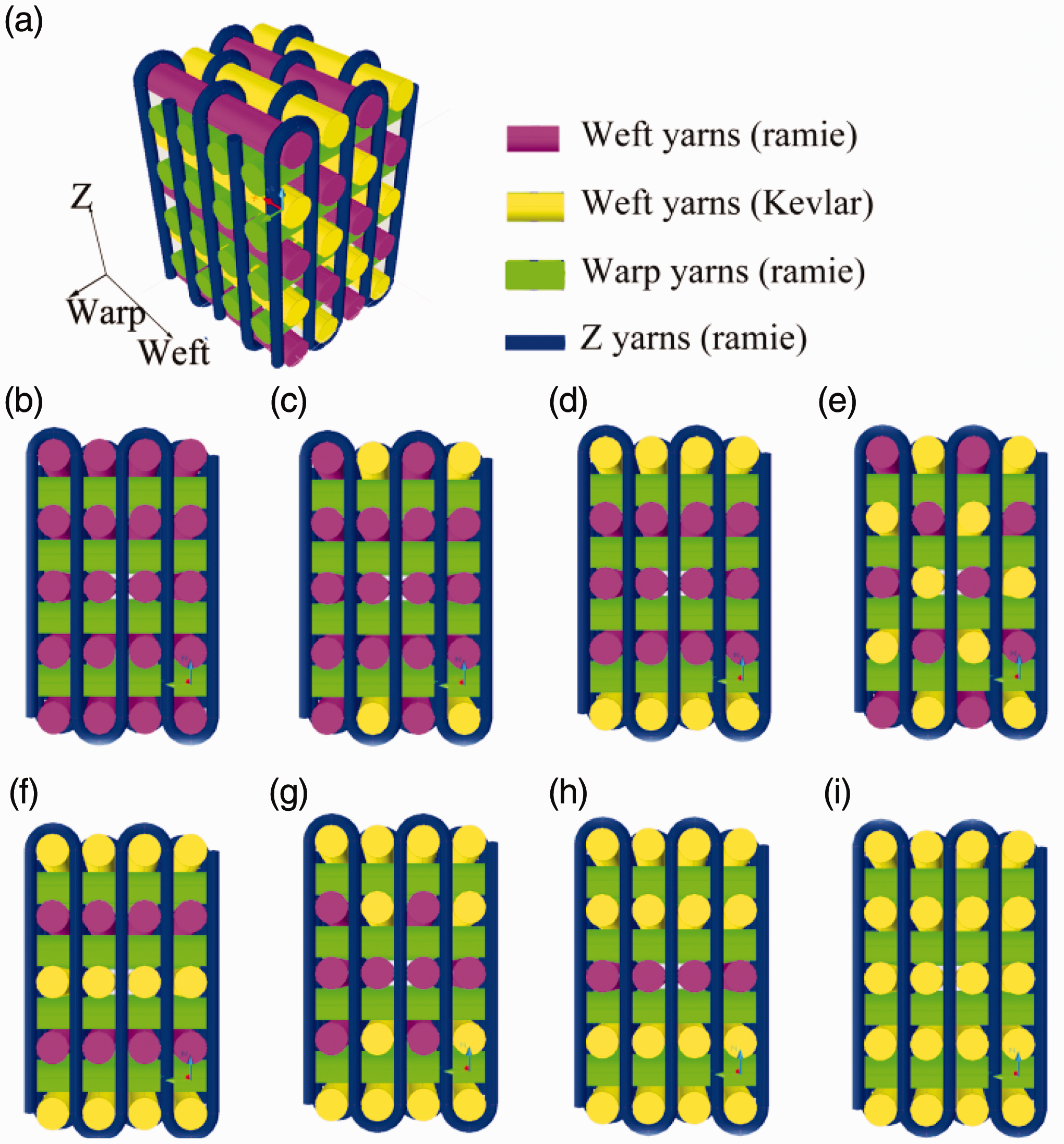
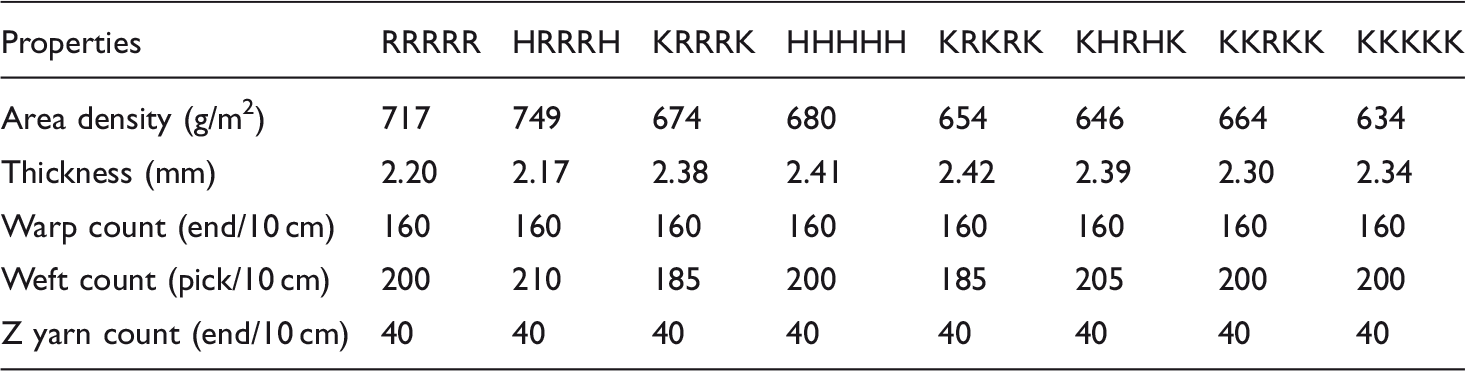
Basic structural parameters of fabric samples
Composite preparation
All the preforms and PLA pellets were dried in a vacuum oven at 80℃ for 12 h to remove the absorbed moisture before consolidation of composites. Dried PLA pellets were preheated at 175℃ for 3 min and pressed at 3 MPa for 3 min to produce films with a thickness of 0.5 mm in a compression molder (Qicai Hydraulic machinery Co. Ltd., Shanghai, China).
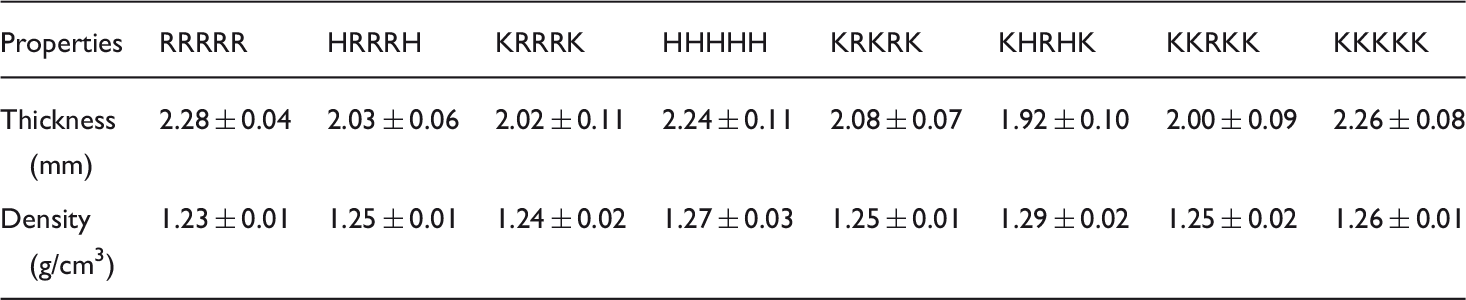
Basic physical properties of the composites.


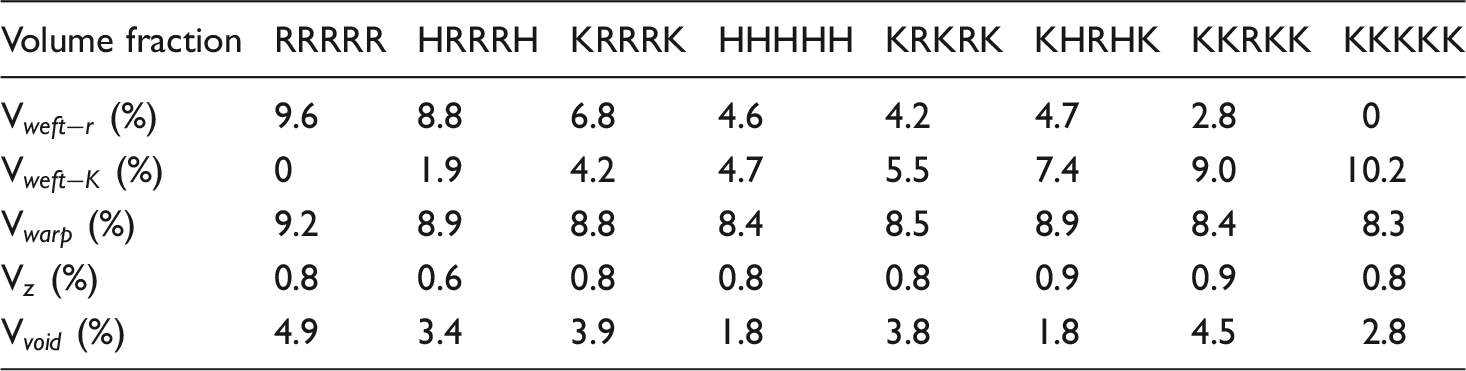
Volume fraction of composite components.
Mechanical testing of composites
Tensile tests for composites were performed on a QJ-212C universal testing machine (Shanghai Qingji Instrumentation Technology Co., Ltd., Shanghai, China) with a crosshead speed of 5 mm/min, a gauge length of 50 mm and a distance between the grips of 115 mm in accordance with the ASTM D638-10 Standard Test Method. The samples were cut into dog-shaped specimens using a Type I template.
The three-point bending test was carried out according to the ASTM D790-10 Standard Test Method using the same machine as for the tensile test. The sample size was 55 mm × 12.7 mm × respective thickness with a loading rate of 10 mm/min. The span-to-depth ratio was 16:1.
The impact specimens were prepared and tested according to the EN ISO 180: 2000 Standard Test Method by an XJU-5.5 Izod impact tester (Chengde Dajia machine Co., LTD., Hebei, China). Un-notched specimens with a dimension of 80 mm × 10 mm × respective thickness were tested. The absorbed impact energy was determined from the difference in potential energy before and after the test. The impact strength was calculated by dividing the recorded absorbed impact energy by the cross-sectional area of the specimens.
All composite specimens were conditioned at 20℃ and 50% RH for 24 h before testing. At least five specimens in weft direction were tested for each sample.
Scanning electron microscopy analysis
Postmortem analyses were carried out for the tensile, flexural and impact fractured surfaces of the composites using a scanning electron microscope (SEM) (Hitachi TM-3000, Japan). Prior to the SEM observation, the specimens were coated with gold to improve their surface electrical conductivity.
Statistical analysis
Data on the mechanical properties of the composites were analyzed by one-way analysis of variance and Fisher’s pair-wise multiple comparisons [22]. A p-value was considered statistically significant if it was smaller than 0.05.
Results and discussion
Tensile properties
Typical tensile stress–strain curves of composites are shown in Figure 2. For the hybrid composites, no second peak, as often observed in the high performance manmade fiber reinforced hybrid composites [23,24] appeared in the tensile stress–strain curves. The reason might be that HE natural fibers in low content would fracture immediately after the failure of LE multifilament since the tensile strength of the ramie yarn was much lower than that of the Kevlar yarn.
Typical tensile stress–strain curves of composites.
Figure 3 shows the tensile strength and modulus of composites with different Kevlar volume fraction and fabric structures. Results of statistical analysis in the tensile strength and modulus are shown in Tables 5 and 6, respectively. If the value of p in the table is larger than 0.05, there is no significant difference between the corresponding samples and thus the same letter will be labeled in Figure 3.
Effects of Kevlar volume fraction and fabric structures on composite tensile properties: (a) tensile strength and (b) tensile modulus (different letters labeled above the columns show the means having significant difference with p < 0.05). P value for comparison in composite tensile strength. Note: The p value in this table was rounded off to three significant figures. P value for comparison in composite tensile modulus. Note: The p value in this table was rounded off to three significant figures.


As shown in Figure 3(a), the tensile strength of the RRRRR composites was 57.5 MPa. As the volume fraction of Kevlar yarns increased, the tensile strength of the hybrid composites increased. When Kevlar yarns were partially added in the surface layers, the tensile strength of the HRRRH composite significantly increased to 102.1 MPa with a 77% improvement, compared to that of RRRRR composites, as the p value, being about 0.000, was less than 0.05. The KKRKK composites exhibited a tensile strength of 238.5 MPa with an improvement of 314%. However, there was no significant difference between the tensile strength of KKRKK composites and that of KKKKK composites, as the p value, being about 0.067, was larger than 0.05. Thus the KKRKK composites exhibited cost advantage owing to a reduced content of Kevlar.
As depicted in Figure 3(b), the tensile modulus of the RRRRR composite was higher than that of the PLA matrix, due to high tensile modulus of ramie yarns. With the increase of Kevlar yarn content, the tensile moduli of the hybrid composites were raised due to the incorporation of stiffer Kevlar yarns. However, no significant difference in tensile moduli was observed between the HRRRH composites and the KRRRK composites, as well as between the HHHHH (intra hybrid) composites and KRKRK (inter hybrid) composites. Thus, in general, the tensile moduli of the intra hybrid composites were higher than that of the inter hybrid composites.
Figure 4 is the typical tensile fractured surfaces of ramie/Kevlar hybrid composites. As shown in Figure 4(b) and (i), Kevlar yarns exhibited longer pull-out length than the ramie yarns. The surface of pull-out ramie fibers was rough with PLA residual as shown in Figure 4(j), while a relatively smooth surface was shown in the pull-out Kevlar filament in Figure 4(k). Thus, ramie yarns had better adhesion with PLA matrix than the Kevlar yarns. With the incorporation of Kevlar yarns, matrix cracks appeared near the tensile fractured surfaces of HRRRH composite as depicted in Figure 4(i). The more Kevlar yarns in the fabric structure, the more stress whitening and cracks existed in the matrix. In the tensile condition, Kevlar yarns would arrest the initial crack propagation and no catastrophic failure could occur until the fracture of all Kevlar yarns.
Top views of tensile fractured surfaces of hybrid composites: (a) RRRRR (b) HRRRH, (c) KRRRK, (d) HHHHH, (e) KRKRK, (f) KHRHK, (g) KKRKK, and (h) KKKKK composites; and SEM images of surfaces of (i) HRRRH composites, (j) pull-out ramie fiber, and (k) pull-out Kevlar filament.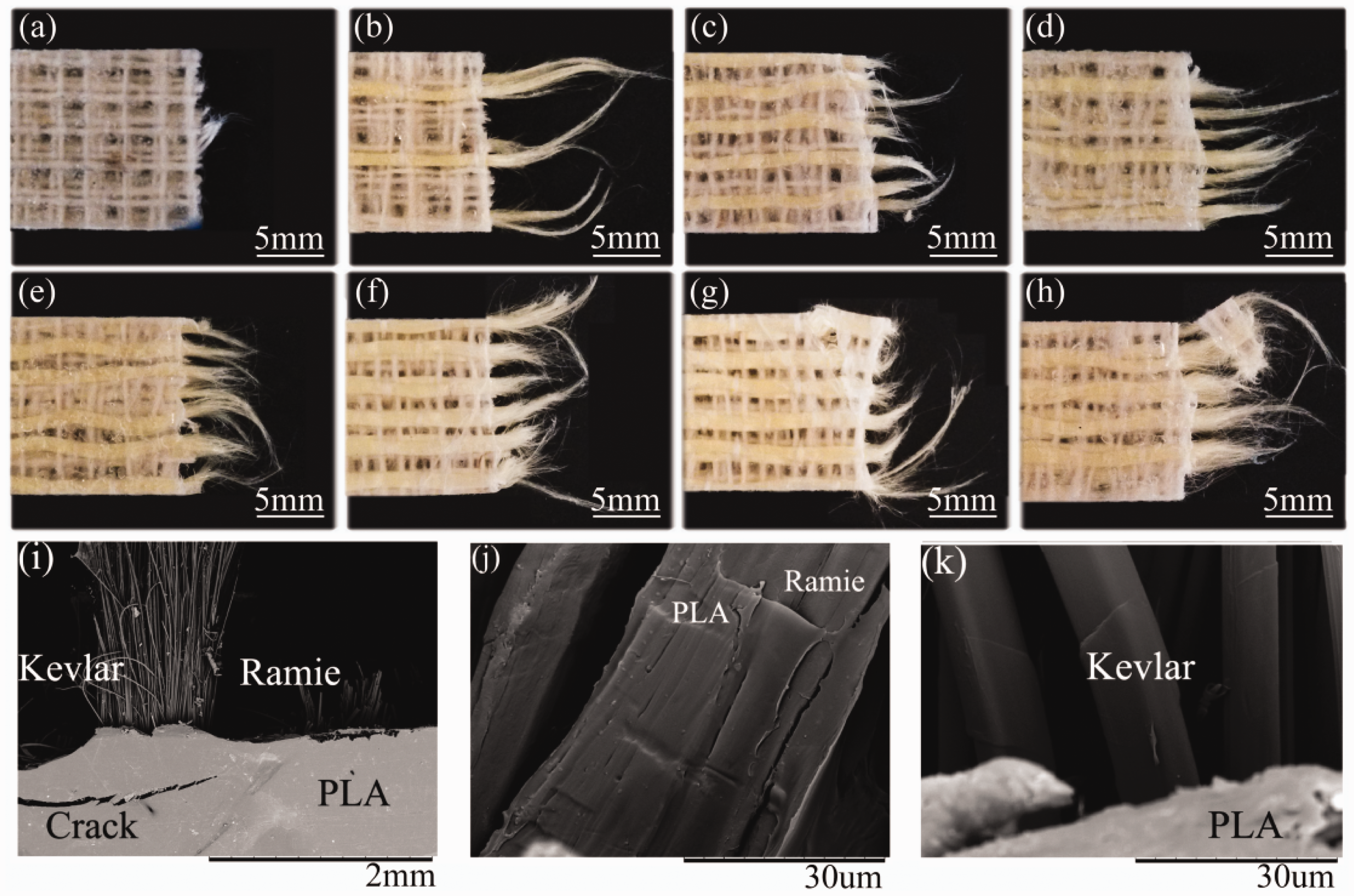
Flexural properties
The typical flexural load–deflection curves of the composites and top views of flexural fractured surfaces of composites are shown in Figures 5 and 6, respectively. After the peak load, the flexural load of RRRRR and HRRRH composites greatly decreased with further deflection, since failure occurred in the ramie yarns in the fifth weft layer of the reinforcements as shown in Figure 6(i). While for the composites with Kevlar yarns in the weft surface of the reinforcement, the flexural load reached the highest point and then decreased little with the increase of deflection. It was considered that matrix fracture and interfacial debonding occurred at the peak load in the composites reinforced by fabrics with Kevlar yarn surface, instead of catastrophic failure of the composites, as illustrated in Figure 6.
Typical flexural load–deflection curves of composites. Top views of flexural fractured surfaces of composites: (a) RRRRR (b) HRRRH, (c) KRRRK, (d) HHHHH, (e) KRKRK, (f) KHRHK, (g) KKRKK, and (h) KKKKK composites and SEM images of flexural fractured surfaces of HRRRH composites at the crack: (i) ramie yarns and (j) Kevlar yarns.

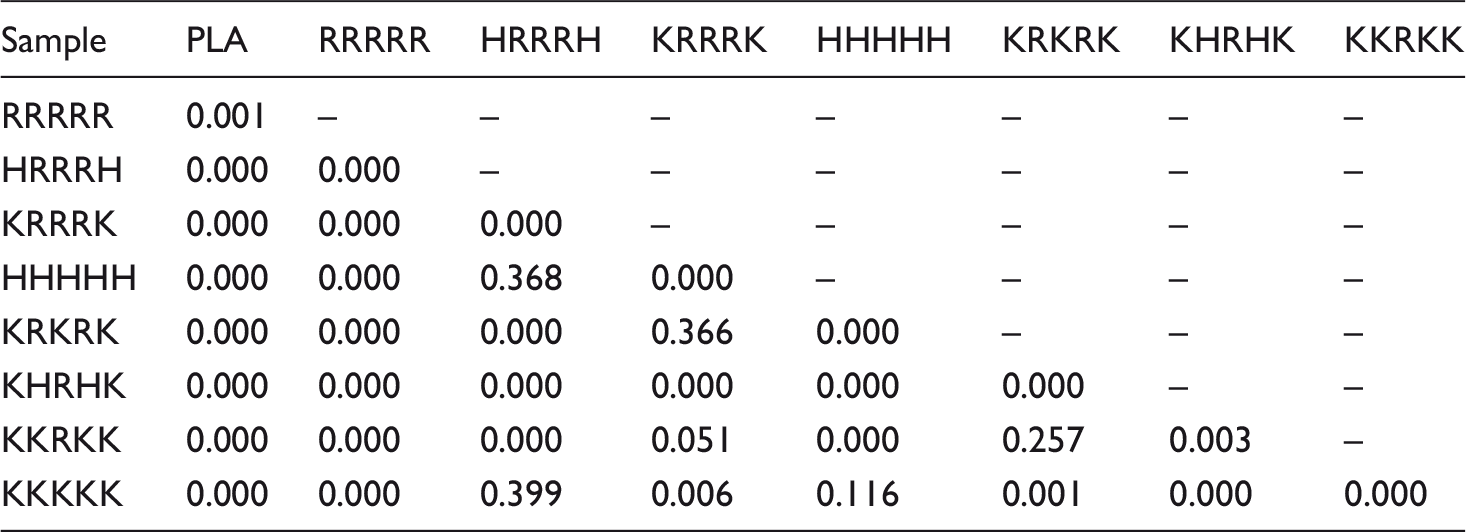
The effects of Kevlar volume fraction and fabric structures on the flexural strength and modulus of ramie/Kevlar hybrid composites are shown in Figure 7. Results of statistical analysis in the flexural strength and modulus are shown in Tables 7 and 8, respectively.
Effects of Kevlar volume fraction and fabrics structures on the flexural properties of composites: (a) flexural strength and (b) flexural modulus (different letters labeled above the columns show the means having significant difference with p < 0.05). P value for comparison in flexural strength. Note: The p value in this table was rounded off to three significant figures. P value for comparison in flexural modulus. Note: The p value in this table was rounded off to three significant figures.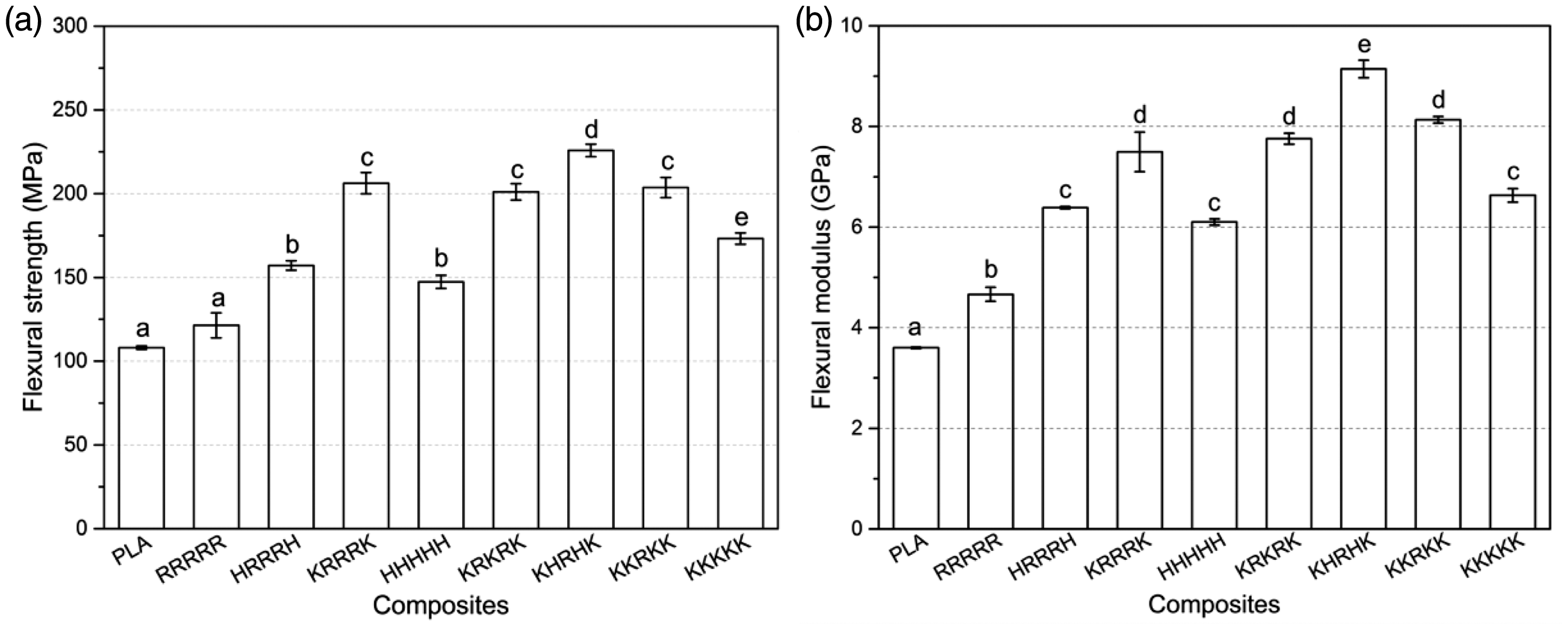

With the reinforcement of 3D ramie fabrics, the flexural strength of RRRRR composites increased to 121.4 MPa by an improvement of 12% compared to that of pure PLA. With the incorporation of Kevlar yarns, the flexural strength of hybrid composites greatly increased. In three-point flexural conditions, the strain of the symmetrical composite is considered as the largest in the bottom reinforcement layer which stands tensile deformation and the smallest in the neutral layer. Thus the stiff Kevlar yarns added in the surface layers would lead to the greatest improvement in the flexural strength.
For the reinforcement with hybrid yarns in the surfaces, there is no significant difference between the flexural strength of HRRRH composites and that of HHHHH composites (as the p value, being about 0.168, is larger than 0.05), since the surface weft layers of both reinforcements were the same with a repeating unit of one ramie yarn and one Kevlar yarn as illustrated in Figure 1(c) and (e). However, with the addition of Kevlar yarns in the second layers in HHHHH reinforcements, no large decrease in flexural load appeared with further deflection after the peak load as shown in Figure 5.
For the reinforcement with Kevlar yarns on the surfaces (as shown in Figures 1(d), (f) and (h)), the flexural strengths of KRRRK KRKRK and KKRKK composites also showed no significant difference, but were much larger than those of the composites reinforced by fabrics with surfaces of hybrid yarns and even larger than that of KKKKK composites. As it was stated before that interfacial debonding was one of main failure modes of composites with Kevlar yarn surface and the interfacial adhesion between Kevlar and PLA was poorer than that between ramie and PLA, the existence of ramie yarns in the inner weft layers would benefit the flexural strength of the corresponding composites. In addition, the KHRHK composites exhibited the largest flexural strength of 225.8 MPa among all the composites, with an improvement of 86% compared to the RRRRR composites. In the KHRHK reinforcement, the surface weft layers were the Kevlar yarns, which contributed most significantly to the flexural strength of the corresponding composites. Meanwhile, the second outer weft layers of the KHRHK reinforcement were composed of the repeating units of one ramie yarn and one Kevlar yarn; the former ensured better adhesion to the PLA matrix and the later could still contribute to the flexural strength of the corresponding composites. Therefore a synergistic effect to improve the composite flexural strength was generated and the highest flexural strength was achieved by the KHRHK reinforcement.
As shown in Figure 7(b), the effects of Kevlar volume fraction and fabric structures on the flexural moduli were found to be similar to those on the flexural strength. Compared to the pure PLA, the flexural modulus of the RRRRR composite increased from 3.6 to 4.7 GPa. There was no significant difference between the flexural modulus of HRRRH and that of HHHHH composites, owing to the same surface layers of hybrid yarns in the reinforcements. The flexural modulus of KKKKK composites was significantly lower than those of KRRRK, KRKRK, KHRHK and KKRKK composites. This might be due to insufficient utilization of the tensile modulus of Kevlar yarns in the surface layers since the KKKKK fabric was thinner with inferior interfacial properties between Kevlar and PLA matrix compared to that between ramie and PLA matrix. In addition, the KHRHK composites exhibited the largest flexural modulus of 9.1 GPa with an increase of 96% due to the thicker KHRHK fabric and better interfacial properties. Thus the KHRHK fabric, with Kevlar yarns in the surface layers and hybrid yarns in the second outer layers, was considered to be the best in terms of flexural properties.
Impact properties
As is widely known, impact strength gives important information about overall material toughness, and is strictly related to both the fiber–matrix interfacial adhesion and the properties of matrix and fibers.
Figure 8 shows the variation of composite impact strength with the Kevlar volume fraction and fabric structures. Results of statistical analysis in the impact strength are shown in Table 9. No statistical difference in impact strength was observed between RRRRR composites and pure PLA, as the p value, being about 0.582, was larger than 0.05. This might be due to the fact that the inherent crack would be easy to propagate and initiate the composite failure in the RRRRR composites with low volume fraction of ramie and existence of voids. With the incorporation of Kevlar yarns, the impact strength of the composites improved and tended to level off. No statistical difference was found among the impact strength of KHRHK, KKRKK, and KKKKK composites. Thus the KHRHK composites exhibited comparable impact strength and cost advantage over the KKKKK composites and was considered as the best in terms of impact properties.
Effects of Kevlar volume fraction and fabric structures on the impact strength of hybrid composites (different letters labeled above the columns show the means having significant difference with p < 0.05). P value for comparison in impact strength. Note: The p value in this table was rounded off to three significant figures.

The top views of typical impact fractured surfaces of the composites are illustrated in Figure 9. Kevlar at a low content could only change the crack propagation path as shown in Figure 9(b) for HRRRH composites, while with the further addition of Kevlar yarns, the impact fracture modes of KRRRK composites changed from complete break to partial break with fiber breakage, fiber pullout, and matrix fracture on the one side and matrix stress whitening on the other side (as shown in Figure 9(c)). For the samples with more Kevlar yarns, no obvious fiber breakage was observed (as shown in Figure 9(d) to (h)) and the impact energy was dissipated by the combination of the matrix deformation and interfacial debonding.
Top views of impact fractured surfaces of composites: (a) RRRRR (b) HRRRH, (c) KRRRK, (d) HHHHH, (e) KRKRK, (f) KHRHK, (g) KKRKK, and (h) KKKKK composites; SEM images of KRRRK composites: (i) upper side, (j) down side, and (k) enlarged image.
Conclusions
The present study dealt with the investigation on the effects of Kevlar volume fraction and fabric structures on the mechanical properties of PLA composites reinforced by 3D ramie/Kevlar hybrid orthogonal fabrics with four warp layers and five weft layers. The study revealed that with the increase of the volume fraction of Kevlar, the tensile strength and modulus of hybrid composites were enhanced. The flexural strength and modulus of hybrid composites were predominantly dependent on the Kevlar yarn properties in the first and second outer layers. The KHRHK composite had the highest flexural strength and modulus with an improvement of 86% and 96%, respectively, compared to the RRRRR composites. As the Kevlar volume fraction increased, the impact strength increased and then leveled off due to poor interfacial adhesion between Kevlar and PLA. The KHRHK composites exhibited comparable impact strength to the KKKKK composites. In addition, the flexural and impact failure modes of the composites with high Kevlar volume fraction were mainly matrix deformation and crack as well as interfacial debonding. In the further study, the modification on interface between ramie/Kevlar and PLA would be considered.
Footnotes
Declaration of Conflicting Interests
The author(s) declared no potential conflicts of interest with respect to the research, authorship, and/or publication of this article.
Funding
The author(s) disclosed receipt of the following financial support for the research, authorship, and/or publication of this article: This work was supported by the National Natural Science Foundation of China (Grant No.50803010), the Natural Science Foundation of Shanghai (Grant No. 14ZR1400100), and the Fundamental Research Funds for the Central Universities (Grant No. 2232015D3-03).