




Abstract
A novel radar absorbing material was developed on nonwoven fabric using BaFe12O19/multi-walled carbon nanotube, which was synthesized by combustive sol–gel technique. The functional carboxylated multi-walled carbon nanotube was utilized in silicon matrix and printed on fabric surface to enhance the intensity and band width of wave absorption. The crystalline structure, morphology, and magnetic properties were characterized by X-ray diffraction, field emission scanning electron microscope, and vibrating sample magnetometer. The maximum reflection loss of nanoparticles was measured about −7 dB on 9.5 GHz. Moreover, the maximum absorption in X band was close to −38.45 dB in 10.5 GHz at the thickness of 1.5 mm with bandwidth of 2.6 GHz. Moreover, in Ku band, the maximum absorption for BaFe12O19/multi-walled carbon nanotube sample with thickness of 1.5 mm was reported as −31.38 dB, which was recorded on 15.9 GHz with 3.2 GHz bandwidth. Interestingly, the fabric coated with bare BaFe12O19 nanoparticle exhibits a maximum absorption of −3.5 dB at 9.7 GHz, which is lower compared to the absorption value of −17.8 dB at 9.8 GHZ for the fabric coated with BaFe12O19/multi-walled carbon nanotube. However, in Ku band, the fabric coated with BaFe12O19 nanoparticles shows lower value of −2.4 dB compared to X band in 17.6 GHz. In comparison, for composite nanoparticles coated sample, a nearly similar maximum value of −17.6 dB was recorded on 16.7 GHz with band width of 2.2 GHz. Results indicate appreciable maximum absorption value of more than 90% in X and Ku band, which can be attributed to presence of carbon structure in composite material.
Keywords
Introduction
Progressing in clothing system with improvement in intrinsic properties of reaction against electromagnetic waves by applying a thin coating is one of the solutions to protect from dangerous effects of microwaves and also for camouflaging purposes. In recent years, several materials have been developed in coatings based on formulations of radar absorbing materials on metal, fabrics, substrates, composites, and foams [1–4].
Radar absorbing materials feature two loss mechanisms to attenuate the incident electromagnetic wave: magnetic loss and dielectric loss. The former is achieved by using a magnetic material while the latter is made possible through a dielectric material.
In recent decades, among magnetic materials, barium hexaferrite has played a major role in the family of ferrimagnets because of its unique properties such as high saturation magnetization, high crystal magnetic anisotropy, organic chemical stability, and high Curie temperature [5–7]. In order to produce very fine particles of barium hexaferrite with high homogeneity, some chemical methods such as co-precipitation, hydrothermal, microemulsion, sol–gel, etc., has been used. Among these methods, sol–gel is a suitable method for synthesizing magnetic nanoparticles. In the sol–gel process, the size and shape of grains are controlled during the conversion of sol to gel. The advantages of this method is the preparation of nanoparticles in a controlled manner in accordance with the selected experimental conditions leading to good control of particle size, microstructure, and homogeneity of products [8–11].
In relation to the second mechanism, carbon nanotubes as dielectric materials exhibit strong and wideband absorption capability, possibility of thin coating on substrates and suitability of physicochemical properties [12,13].
There are not many researches on microwave absorption of industrial textiles. In a study conducted on radar absorbent textiles, a paste of silver-polymer has been applied on a frequency selective surface (FSS). However, a few researches have been conducted based on composite layers of CNTs, conducting polymers including silver paste on a frequency selective surface (FSS). In general, they represents an increase in conductivity and decrease in transmission loss value [14–17]. Sano et al. have obtained efficient absorptive layers in the 60 GHz range. The results showed that the absorption coefficient of 95% might be achieved for sheets with 5 mm thickness [18]. In a study on electromagnetic wave absorbing textiles, coatings are performed on cotton fabrics by Ni-Zn ferrite and black carbon (carbon acetylene) in the polyurethane solution. With increasing concentration of ferrite in the solution, the coating shows more conductivity and less surface resistance and impedance that results in 40% absorption, 20% transmission, and 40% reflection in X and Ku frequency bands [19].
Fabrics coated with composite nanoparticles of magnetic ferrite and carbon nanotubes could be used to camouflage, reduce cross-sectional area and protect humans against dangerous radiation of the microwaves [13]. But there has been little attention to composite of magnetic ferrite with carbon nanotubes (ferrite-carbon) in the form of a thin protective layer on the surface of the fabric. In a suitable form, it could conceal and protect troops and equipments from adversary’s radar detection devices operating in broad frequency range and also as an apparel to protect human beings from harmful electromagnetic waves [20–22].
In the present work, an attempt has been made to prepare thin coatings on polyester fabrics with nanocomposites of carbon nanotubes/BaFe12O19 ferrite nanoparticles in Silicon matrix. Then the structural and electromagnetic properties of the coating were surveyed at X and Ku frequency bands.
Experimental procedure
Materials
To produce nanoparticles, barium hexaferrite, barium nitrate (Ba(NO3)2, 99.9%), iron-nitrate (Fe (NO3)3.9H2O, 99.9%), citric acid (C6H8O7) and ammonia (NH4OH, 27%, 99.9%) were purchased from MERCK Chemicals and use as received with no further purification. Carboxylated carbon nanotubes with 95% purity, 10–20 diameter, and 30 µm length were provided by Neutrino company.
Non-woven fabric polyester-polypropylene with 0.2 mm thickness and weight of 100 g/m2 besides silicon (mold making, BISIL 4514) were bought from the local market.
Synthesis of BaFe12O19 nanoparticles
In this research, nanoparticles of pure barium hexaferrite (BaFe12O19) were synthesized by sol–gel combustion. According to the Ba:Fe stoichiometric ratio of 1 to 12, solutions of metal salts including barium nitrate and iron nitrate were separately prepared for production of barium ferrite. Then the solutions were mixed by magnetic stirrer at the temperature of 50℃. Then citric acid was added to the suspension so that the molar ratio of total sales and citric acid were constantly considered 1:1. Finally, the pH of the solution was adjusted to 9 by using 5% solution of ammonia. These solutions were slowly evaporated at 80℃ till thoroughly converted to a viscous wet gel and then the viscous residue was heated at 200℃ to get dried gel. The gel was preheated to 400℃ for 1 h to decompose the organic precursor. Finally, the obtained powder is calcined at 1100℃ for 1 h with the heating rate of 10℃/min.
Preparation of BaFe12O19/multi-walled carbon nanotube (MWCNT) nanocomposites
First 0.3 g of functionalized MWCNTs (10 wt% of ferrite content) is ultrasonically dispersed (Pw: 60 W, pulse: 5 s/1 s, time: 30 min) in 30 cc distilled water. Subsequently, 3 g of BaFe12O19 nanoparticles were added to the solution and were placed under ultrasonic for 60 min; then the solution was dried by magnetic stirring at 80℃. At last, the dried sample was heated at 500℃ for 1 h in Ar atmosphere, so that BaFe12O19/MWCNT nanocomposite particles were formed.
Preparation of microwave absorber fabric
For coating on textile, composite nanoparticles were added to silicon and its hardener by 40% weight ratio under ultrasonic agitation (Pw: 60 W, pulse: 5 s/1 s, time: 5 min). Then the prepared paste was coated on the fabric surface with the dimensions of 3 × 3 cm2 using a coating knife and horizontally rotating rollers. After applying the paste on the fabric, the sample was pressed under one-pound weight to burst potential bubbles and to fully penetrate the paste into the fabric.
Characterization
X-ray diffraction (XRD) was done using a PW1800 Philips diffractometer with Cu Kα radiation (0.15418 nm) and performing in 40 kV and 30 mA in the range of 10–70°. To study the morphology of the synthesized composite nanoparticles and coated fabric, a field emission scanning electron microscope (FESEM-Hitachi S4160) was used. Elemental analysis was done using an energy-dispersive spectroscopy (EDS) detector attached to the FESEM.
In order to study the magnetic properties of synthesized samples, magnetic properties were measured at room temperature in the field +10,000 to −10,000 Oe and at 25 Hz frequency by a vibrating sample magnetometer (VSM-MDK 4120).
To study the electromagnetic properties of the specimens, nanocomposites of 40% nanoparticles dispersed in silicone, were prepared according to X (8–12.4 GHz) and Ku (12.4–18 GHz) band waveguide dimensions (25 × 10 × 5 mm3 and 15 × 7 × 5 mm3, respectively). Then complex permittivity (ɛ = ɛ′ − iɛ″) and permeability (μ = μ′ − iμ″) were measured by vector network analyzer (VNA-Agilent E8362A).
Finally, single layer MA samples were made with different thickness between 1 and 5 mm and the reflection loss (RL) of them were measured at the X (8–12.4 GHz) and Ku (12.4–18 GHz) bands using an Agilent 8510C.
Results and discussion
XRD analysis
Figure 1 illustrates the XRD patterns of BaFe12O19 and BaFe12O19/MWCNT nanoparticles. In the spectrum of nanoparticles, magnetic nanoparticle peaks at angles of 2θ = 17.94, 32.29, 34.20, 35.60, 37.12, 40.42, 42.40, 56.59 and 63.06 had exhibit perfect match with respective crystalline planes (101), (102), (107), (114), (108), (203), (205), (1011), (206), (217), (2011) and (220), which according to 007-0276 standard card of BaFe12O19. This confirms the formation of BaFe12O19 single-phase crystalline nanoparticles with hexagonal structure. The mean size of BaFe12O19 crystallites is equal to 14.1 nm using Scherer formula.
XRD patterns of BaFe12O19 nanoparticles and BaFe12O19/MWCNT nanocomposite particles.
In the spectrum of composite nanoparticles, the peak matched the (001-0640) standard card in the region 2θ = 26. In this spectrum, due to mixing of carbon nanotubes with magnetic nanoparticles by the weight ratio of 1:9 and the hexagonal crystal structure of magnetic nanoparticles, the peak of carbon nanotubes is less severe. The diffraction peak at 2θ = 26 is estimated to be the (002) plane of CNTs, which confirms that some CNTs still exist after the surface modification step. In short, the above results reveal the formation of BaFe12O19/MWCNT nanocomposites. The result shows that carbon nanotubes have been decorated well by magnetic nanoparticles.
Scanning electron microscopy (SEM)
Figure 2 indicates micrographs of BaFe12O19 nanoparticles, nanocomposite particles, and coated fabrics. The particle morphology (Figure 2(a) and (b)) is rod shape with the average grain size about 40 to 70 nm. In Figure 2(c) and (d) for BaFe12O19/MWCNT nanocomposite particles, BaFe12O19 phases are distinguished as flaky agglomerates of nanoparticles on which CNTs are dispersed resulting in a two-phase composite.
FE-SEM images of the samples: (a,b) BaFe12O19 nanoparticles, (c,d) BaFe12O19/MWCNT nanocomposite particles, (e) non-woven fabric coated by nanocomposite particles, and (f) EDS spectrum of fabric coated by nanocomposites.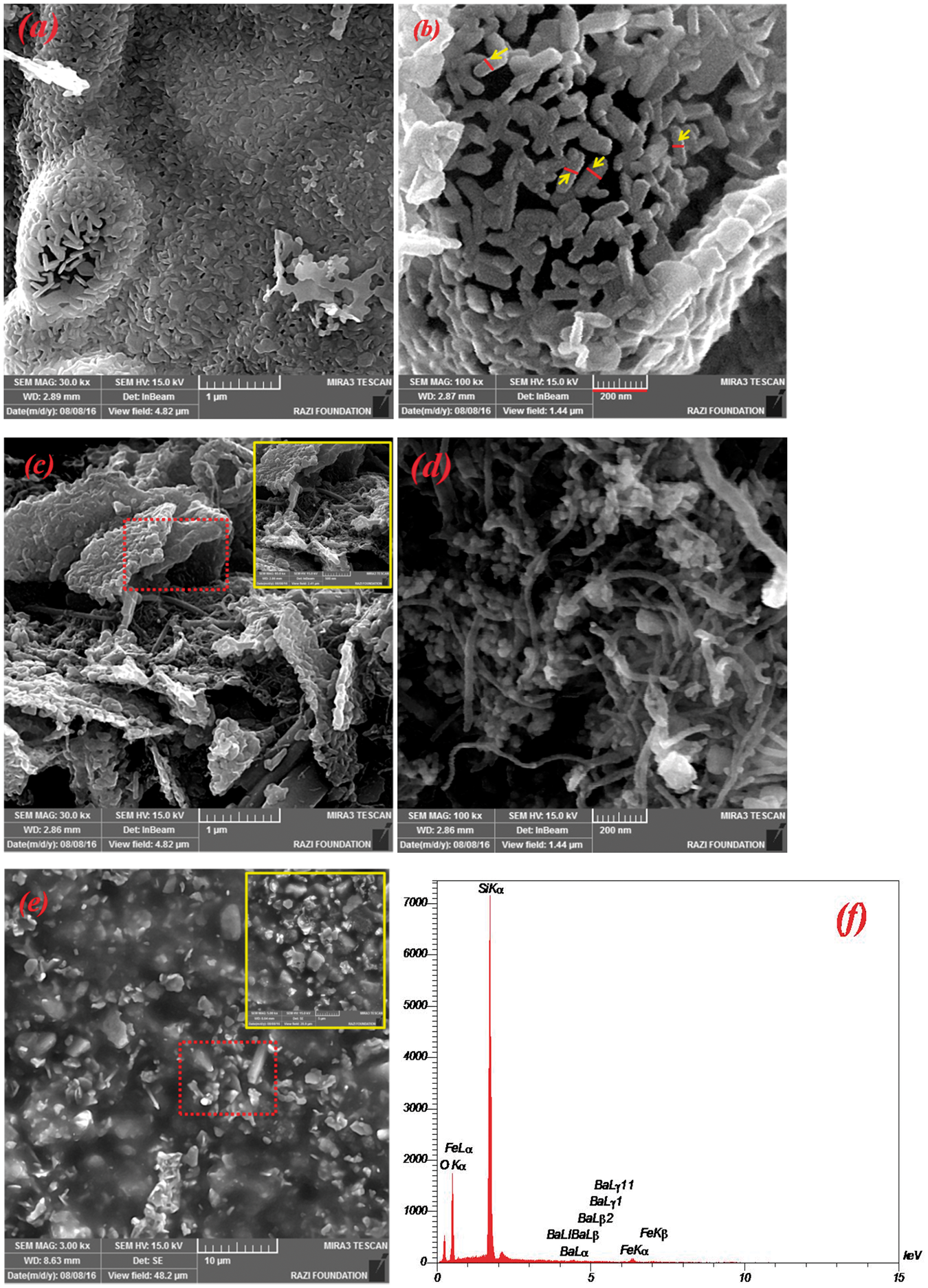
Figure 2(e) shows SEM images of non-woven textile coated by nanocomposites. The micrograph shows a uniform coating of nanocomposite particles applied on textile. The uniform distribution of nanocomposite particles is evident in the micrographs, which provides uniform microwave properties in the samples.
Elements and contents were measured by chemical analysis method (EDS). Fe, Ba, O, C, and Si peaks in the energy-dispersive spectrum shown in Figure 2(f) confirm the formation of non-woven textile coated by BaFe12O19/MWCNT.
Magnetic properties
Figure 3(a) shows the hysteresis loop of BaFe12O19 magnetic nanoparticles which indicate that they have a perfect single domain structures, as this range of particle size is much less than the critical grain size value (460 nm) reported for the barium hexaferrite [23].
Coercivity of magnetic nanoparticles is highly dependent on some factors such as crystalline magnetic anisotropy, micro-strains, intraocular reactions, temperature, size, and shape of nanoparticles. The calculated amount of the saturation magnetization (Ms) was 55 emu/g, the residual magnetization (Mr) was 33 emu/g and finally the coercive field (HC) was 2800 Oe. This high value of coercive field is due to the strong anisotropy along the c axis in hexagonal structure of barium hexaferrite. According to the large area of hysteresis loops, the sample could be classified as a hard magnetic material. The amount of saturation magnetization and dehydrogenation is lower compared to theoretical amounts for single crystal of barium hexaferrite (Ms = 72 emu/g and HC = 6700 Oe) [24].
Hysteresis loop: (a) BaFe12O19 nanoparticles and (b) BaFe12O19/MWCNT nanocomposite particles.
The amount of magnetic parameters of synthesized samples.

Dynamic electromagnetic properties
Complex magnetic permeability (μ = μ′ − iμ″) and complex electric permittivity (ɛ = ɛ′ − iɛ″) are fundamental factors in determining the electromagnetic properties. For studying the electromagnetic properties at high frequencies in the GHz range, it is necessary to measure the complex values of those parameters with frequency, which is the base of analyzing properties. The real parts of complex permittivity and permeability represent the storage capability of electric and magnetic energy. The imaginary parts symbolize the loss of electric and magnetic fields.
Changes in complex permittivity and permeability as functions of frequency in X and Ku bands are shown in Figure 4(a) and (c), for silicon matrix containing 40 wt% of nanoparticles.
Frequency dependence of electromagnetic parameters for BaFe12O19 nanoparticles: (a) ɛ′, ɛ″, μ′, μ″, (b) tan (δɛ), tan (δμ) in X band, (c) ɛ′, ɛ″, μ′, μ″, and (d) tan (δɛ), tan (δμ) in Ku band.
As seen from figures, the amount of real (ɛ′) and imaginary (ɛ″) parts of the complex permittivity (ɛ = ɛ′ − iɛ″) for BaFe12O19 nanoparticle is increased slowly from 2.7 at 2 GHz to 3 at 18 GHz and is constant (about 0.3) between 2 and 18 GHz.
The
From the electron theory, it is known that
The real (
Figure 4(b) and (d) indicates the loss tangents of the magnetic nanocomposite nanoparticles. In fact, the loss tangents are derived by dividing the imaginary part to real part for each of the parameters of complex permittivity (tan (δ μ ) = μ″/μ′) and complex permeability (tan (δ ɛ ) = ɛ″/ɛ′). Indeed, these two parameters show the amount of dissipative material. By comparing dielectric and magnetic loss tangents, it can be seen that both parameters indicate little change with increasing frequency and are almost constant in the whole range of 2–18 GHz. So that, dielectric loss tangent and magnetic loss tangent have been varied, respectively, around 0 and 0.15 and with increasing frequency in the Ku band, dielectric loss tangent reduced to −0.003. The results show that the amounts of dielectric loss are lower than magnetic loss.
Figure 5(a) and (c) indicates the complex permittivity and permeability for 40 wt.% of BaFe12O19/MWCNT nanocomposites in the silicon matrix in X and Ku bands.
Frequency dependence of electromagnetic parameters for BaFe12O19/MWCNT nanocomposites: (a) ɛ′, ɛ″, μ′, μ″, (b) tan (δɛ), tan (δμ) in X band, (c) ɛ′, ɛ″, μ′, μ″, and (d) tan (δɛ), tan (δμ) in Ku band.
As it can be seen in Figure 5(a) and (c) significant increases have been occurred in both real and imaginary parts of permittivity via carbon composite with nanoparticles. In BaFe12O19/MWCNT nanocomposites, interfacial polarization of space charges at nanocomposites interface produces a nanoscale capacitor leading to an enhancement in the real part of permittivity. Also for BaFe12O19/MWCNT nanocomposites, the value of ɛ″ is higher than that of BaFe12O19 nanoparticles (Figure 4(a) and (c)).
But the values of
Figure 5(b) and (d) shows the dielectric and magnetic loss tangent of BaFe12O19/MWCNT nanocomposites. The values of dielectric loss tangent (δ ɛ ) of BaFe12O19/MWCNT nanocomposites are higher than BaFe12O19 nanoparticles, while the magnetic loss tangent (δ μ ) values of BaFe12O19/MWCNT nanocomposites are lower than BaFe12O19 nanoparticles. By increasing frequency from 8.2 to 18 GHz, for BaFe12O19/MWCNT nanocomposites, the curves show the maximal tan (δɛ) and tan (δμ) are 0.2 and 0.007, respectively, which constant almost with increasing the frequency. On the other hand, the amounts of the electric loss are higher than magnetic loss, which show the dominance of the dielectric loss mechanism due to the presence of the carbon in nanocomposites. It suggests that microwave absorption enhancement of BaFe12O19/MWCNT nanocomposites results mainly from dielectric loss and BaFe12O19n nanoparticles is mainly from magnetic loss.
One of the main functionalities of BaFe12O19/MWCNT nanocomposites is their application as efficient electromagnetic wave absorbers specifically in the microwave region. There are various magnetic and dielectric loss mechanisms, which lead to dissipation of the electromagnetic wave. The magnetic loss is mainly due to ferromagnetic resonance, magnetic hysteresis, eddy current loss, and domain-wall displacement, which advance the imaginary part (μ″) of complex permeability [26,27].
Dielectric loss mechanisms include electronic, ionic or orientation relaxations, which cause increasing the imaginary part (ɛ″) of complex permittivity [28]. In the case of BaFe12O19/MWCNT nanocomposite, it is possible to incorporate both dielectric and magnetic materials as nanocomposites to achieve high values of dielectric and magnetic losses at the same time.
Furthermore, some mechanisms like interfacial polarization of space charges only activate when the material features a nanoscale layered structure [29]. In this case, the redistribution of charges at the magnetic–dielectric interface dissipates a significant amount of energy.
As it is observed in Figure 6(a) and (c), the amount of complex permittivity in the X band has arrived in the amount of 5.7 and 0.57 for real and imaginary permittivity and in the Ku band has arrived in the amount of 5.7 and 0.68. The amount of parameters is constant by increasing frequency to 18 GHz.
Frequency dependence of electromagnetic parameters for coated fabric with BaFe12O19/MWCNT nanocomposite: (a) ɛ′, ɛ″, μ′, μ″, (b) tan (δɛ), tan (δμ) in X band, (c) ɛ′, ɛ″, μ′, μ″, and (d) tan (δɛ), tan (δμ) in Ku band.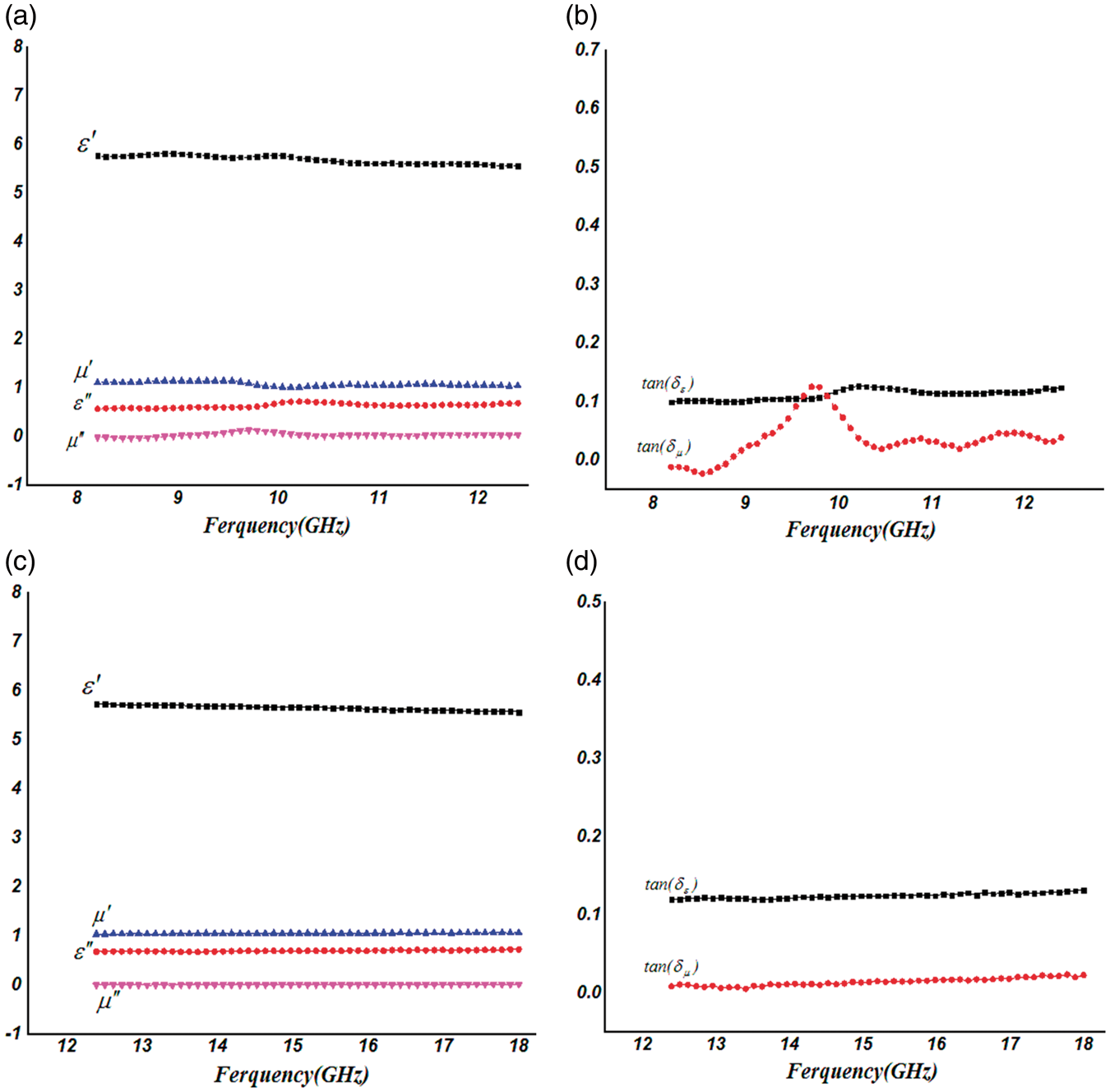
As shown in Figure 6(a) and (c), the amount of real and imaginary permittivity in the X and Ku band compared to nanocomposite has decreased. But real and imaginary part of permeability compared to nanocomposite has nearly been identical.
Figure 6(b) is the magnetic loss tangent (tan (δμ)) for fabric coated with BaFe12O19/MWCNT nanocomposite. For coated fabric, there is a resonance peak at 9.8 GHz and is the main magnetic loss mechanism in the frequency range of experiment.
The tan (δɛ) of fabric coated higher than that of BaFe12O19 nanoparticles and lower than that BaFe12O19/MWCNT nanocomposites, while the tan (δμ) value of fabric coated is lower than that of BaFe12O19 nanoparticles. For fabric coated, the plot shows the maximal tan (δɛ) is constant almost with increasing the frequency.
Therefore, the main absorbing mechanism of MWCNT is dielectric loss, while BaFe12O19 nanoparticles are magnetic loss absorbent.
Reflection Loss (RL)
The amount of the RLs of the single layer electromagnetic wave absorbent material with a thickness (d) under perpendicular incidence is determined according to the transmission line theory by the following equation [30]:


Here Z0 is the intrinsic impedance of free space, Zin is the input impedance when the electromagnetic wave incidence is normal to the absorber/free space interface,
Figure 7(a) and (b) shows variation of RL versus frequency in range of 8–12 and 12–18 GHz for BaFe12O19/MWCNT nanocomposite and MWCNT and BaFe12O19 nanoparticles. In all samples, thickness of samples was equal and fixed with 2.5 mm. The results show that nanoparticles have the highest RL of −7 dB in 9.5 GHz frequency. BaFe12O19/MWCNT nanocomposites −30.5 dB in 10 GHz frequency and 2.3 GHz bandwidth have the absorbent over −10 dB. The bandwidth is defined as the frequency range in which the RL is less than −10 dB. This means that more than 90% of the microwave energy is attenuated. As it is observed, due to the presence of carbon in the structure of nanocomposites, the amount of absorption has increased extraordinarily.
Reflection loss of the BaFe12O19 nanoparticles, BaFe12O19/ MWCNT nanocomposites and MWCNT in (a) X and (b) Ku bands.
Figure 8(a) and (b) shows the RL of the absorbent sample of BaFe12O19/MWCNT nanocomposites with different thickness in X and Ku band. In X-band, the maximum absorbent amount is about −38.45 dB at 10.5 GHz with the 1.5 mm thickness and 2.6 GHz bandwidth. By reducing the thickness up to 1.5 mm in nanocomposites, the amount of absorption has increased. But in 1 mm thickness, the absorption −28.8 dB at 11.6 GHz is thinner than other thicknesses. In Figure 8(b), the maximum RL is in the 1.5 mm thickness, which is equal to −31.38 dB at 15.9 GHz with 3.2 GHz bandwidths in Ku-band. By reducing the absorbent thickness, the maximum absorption has moved to more frequency that the reason can be the change in capacitance of absorbent sample. On one hand, the presence of 10 wt% MWCNTs with a hollow structure as a player has increased the quality of nanoparticles, thus increasing the electrical properties of composite in the presence of carbon nanotubes enhances the maximum absorption and bandwidth of wave absorption.
Reflection loss of BaFe12O19/MWCNT nanocomposites at various thicknesses in (a) X and (b) Ku band.
To further investigate the microwave absorption properties of the coated fabric by BaFe12O19 nanoparticles and BaFe12O19/MWCNT nanocomposite RL were calculated as shown in Figure 9(a) and (b). The effect of carbon on the electromagnetic wave absorption properties is clearly seen from the figure. In coated fabric with nanoparticles, the maximum absorption in 9.7 GHz is about −3.5 dB and for nanocomposite in 9.8 GHz is about −17.8 dB with 1.8 GHz bandwidth of absorption that is more than −10 dB in X band.
Reflection loss of fabric coated by BaFe12O19 nanoparticles and BaFe12O19/MWCNT nanocomposite on the fabric substrate in (a) X and (b) Ku band.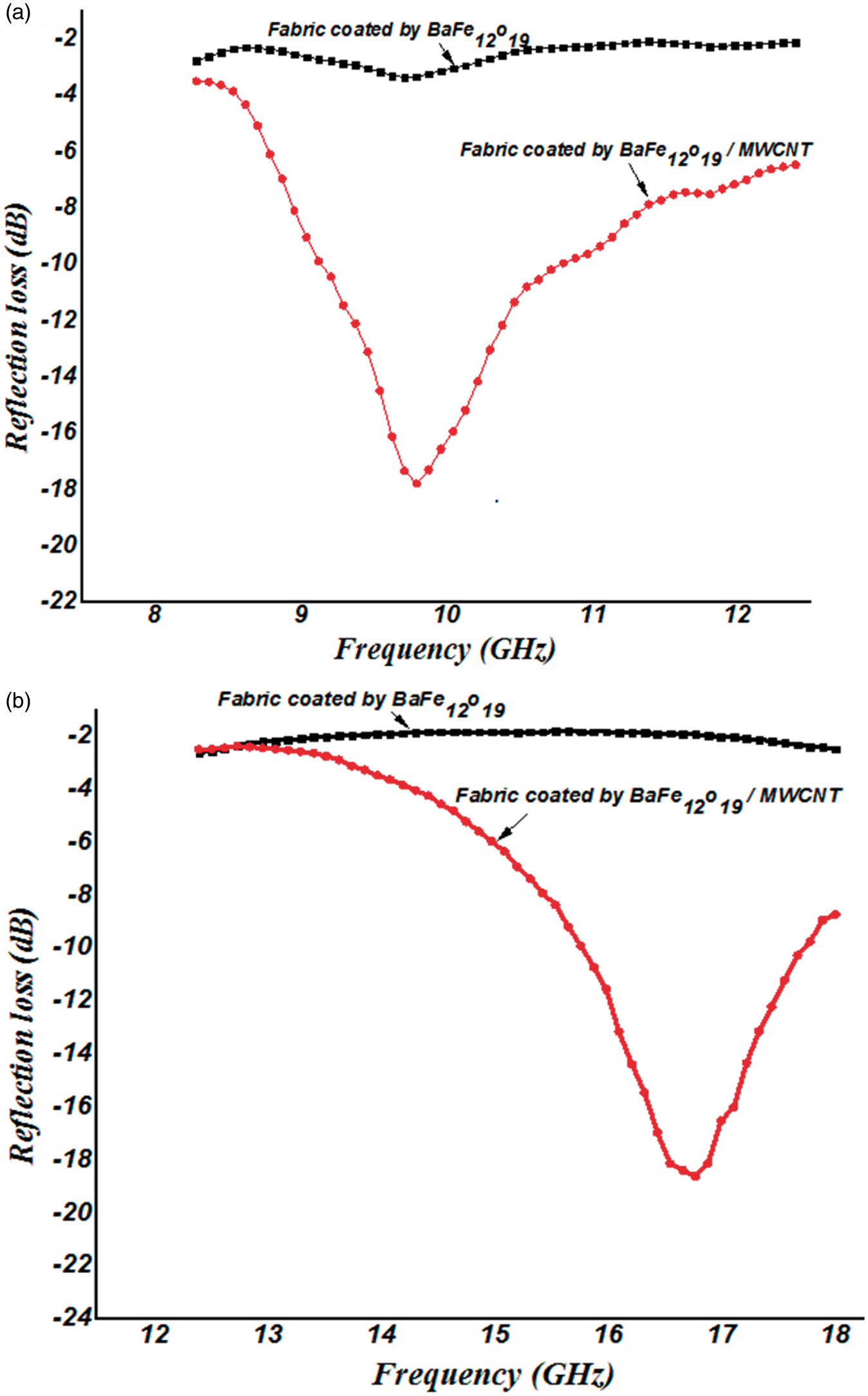
In Ku band, the fabric coated by BaFe12O19 nanoparticles has had the maximum absorption in 17.6 GHz that is about −2.4 dB and for nanocomposite in 16.7 GHz is about −17.6 dB with 2.2 GHz bandwidth of absorption, which is more than −10 dB in X band with the maximum absorption.
Coating on textile based on magnetic/conducting nanoparticles creates electromagnetic wave protective fabric, which is heavier in weight, made on multilayer principle and for narrow frequency band only. However, light multilayered dielectric materials absorb with good quality, but are bulky and cannot be used due to our gassing behavior [31–33].
The microwave absorbing behavior of ferrite can be further improved by adding a little bit of carbon black (acetylene black) to introduce permittivity property in addition to permeability in the absorber material. Also, coating of polyurethaneres in composite (resin, carbon black, and Ni–Zn ferrite ratio: 49:1:50 wt%) on aluminum flat plate has provided 60% absorption in X-band [33].
Cotton fabrics coated with polyaniline have offered 48% absorption at 6–14 GHz frequency. The sheath–core bi-component fibers with ferrite/bronze filler have shown effective radar absorption. A tuned response to high frequency electromagnetic radiation at microwave frequency has been observed in woven fabrics prepared by ferrite filled fibers [33,34].
In comparison with other studies, in current investigation is as a single layer with nanocomposites in a silicon substrate with high absorbance and more bandwidth that is narrow. The existence of carbon and magnetic ferrite are main and effective parameters of absorption in structures of covered absorber.
The results show that the sample coated by BaFe12O19/MWCNT nanocomposite in X and Ku bands has had the maximum absorption and the ability of wave absorption has increased, which is due to the presence of carbon in the structure of composite nanoparticles.
Conclusion
The fabric coated by magnetic ferrite composite and carbon nanotubes are used to camouflage, reduce the cross-sectional area to absorb radar waves and protect humans against dangerous microwave radiation. Magnetic nanoparticles due to their potential have extensive capability as absorbers of electromagnetic waves. One of the best strategies to achieve powerful absorbers of electromagnetic waves is simultaneous use of both magnetic and dielectric material in absorbent structure. In this study, the above strategy is done on the fabric by using magnetic material of barium hexaferrite with carbon in the form of graphite, which has huge dielectric properties. According to the diffraction analysis, the X-ray of nanoparticles with the appropriate crystalline size and shape is formed on the carbon nanotubes. In reviewing the pictures of FESEM, uniform distribution of nanoparticles has been observed on the surface of carbon nanotubes and coated fabric by composite nanoparticles. According to manometer of vibrating sample, prepared nanocomposites have had acceptable magnetic behavior and the presence of 10 wt% of carbon nanotubes compared to magnetic nanoparticles has synthesized soft magnetic nanocomposites by electrical properties. In studying the wave absorption, composite nanoparticles and the fabric coated by it in a very proper range have had significant absorption and carbon nanotubes has strengthened in absorption of electromagnetic waves. The presence of carbon nanotubes with nanoparticles has increased the maximum amount of wave absorption and absorbent bandwidth on the fabric. As well as composite with magnetic properties and conductivity can be produced by carbon nanotubes that are completely appropriate for wave absorption.
Footnotes
Declaration of Conflicting Interests
The author(s) declared no potential conflicts of interest with respect to the research, authorship, and/or publication of this article.
Funding
The author(s) received no financial support for the research, authorship, and/or publication of this article.