




Abstract
Owing to the high cost of synthetic aramid fibers and the necessity for environmentally friendly alternatives, a portion of aramid was replaced by plain woven kenaf fiber, with different lay arrangements and thicknesses. The obtained hybrid composites with aramid and kenaf fibers were used to produce prototypes of army helmet shells. A hybrid composite material was produced using a hot press technique and comprises 19 layers of plain woven kenaf and aramid of various configurations and alternation. The behavior of this composite material on a quasi-static penetration test was studied and was found positive in terms of maximum load carried, energy absorbed in impact, and damage mechanisms. Consequently, a helmet armour was developed that was less costly and more readily available and that which could also be produced by reducing the potential harmful effects of petroleum products, without compromising the ballistic-resistant capability of the material.
Keywords
Introduction
The global market for personal protection systems itself is worth 300–400 million Euros per year [1], with annual growth rates of more than 5%. Ballistic helmet shell type Personnel Armour System Ground Troops (PASGT) is a standard infantry combat wear in the US military that has changed relatively little since the 1970s. The shell is a one-piece structure composed of multiple layers of Kevlar ballistic fiber (at least 19 layers) reinforced phenolic polyvinyl butyral-phenolic (PVB) resin. The primary goal of the PASGT helmet shell is to protect the soldier from a variety of prevailing threats by limiting the perforation of fragments or knife through the helmet [2]. Kevlar fibers are among the high-performance fibers used as the reinforcement in many high-velocity impact applications in protecting against projectiles and fragments [3]. Thermoplastic composite materials play the crucial role of dissipating energy due to various interlaminar damage mechanisms such as high delamination resistance and transverse shear failures, and are critical in determining the impact properties of composites in ballistic applications. In 2012, Erkendirci and Haque [4] carried out experiments to determine the quasi-static penetration resistance of a glass/ high-density polyethylene (HDPE) composite systems with varying thicknesses. They concluded that matrix fracture and fiber sliding failures were the main mechanisms in quasi-static tests, for thick-walled panels. Further research on optimizing the layered configurations with the geometry and manufacturing process of the carbon-reinforced ultra-high molecular weight polyethylene (UHMWPE) was carried out by Winkelmann et al. [5]. Considerably higher ductility and an average penetration resistance force were experienced in these composites. However, these materials raise practical issues such as high cost and the potential for harmful effects during manufacturing, including eye, skin, and respiratory irritation [6]. Thus, there is an urgent need to develop an alternative material such that the dependency towards synthetic materials will be reduced. Therefore, hybridization of natural fibers with synthetic fibers to form a hybrid composite is an alternative for the creation of a new material with combined advantages.
In recent years due to renewable issues, environmental concerns, and the financial problems of synthetic fibers, the development of high-performance engineering products made from natural resources is increasing all over the world. Many researchers have been encouraged to develop new hybrid composites with natural fibers to reduce the dependency towards the ballistic resistance component. Natural fibers have been used in many industrial applications intensely because of their energy dissipation capabilities and damage tolerance. Kenaf (Hibiscus cannabinus L.) bast fiber is the most suitable natural fiber for hybridization with Kevlar using the analytical hierarchy process (AHP) [7]. This has the highest priority among 13 natural fiber alternatives [8]. Furthermore, kenaf flexibility is one of the important technical characteristics, which allow it to resist impact forces. Hybridization of kenaf and synthetic fibers has several advantages as it reduces dependency on petroleum, which is the source of synthetic fibers [9].
A few attempts have been made to study the response of natural/synthetic reinforced thermoplastic/thermoset composites under quasi-static conditions [10]. Recently, experimental works have been reported on the quasi-static response of the natural fiber composites. The first serious discussions and analyses were carried out in 2004 by Mahdi et al. [11], who evaluated the potential of using hybrid and nonhybrid oil palm and coir fibers reinforced polyester. It was concluded that the panel geometry has the greatest effect in increasing the utmost energy absorption and the lifetime rupture. In 2012, Meredith et al. [12] performed experiments on the potential of using jute, flax, and hemp fibers in structural applications. It was concluded that the thickness of the natural composites has a great effect on their impact properties—high thickness led to improved energy absorption, which had comparable impact properties with chopped strand E-glass composite. More recently, quasi-static penetration properties of non-woven kenaf fiber/Kevlar-reinforced epoxy hybrid have been experimentally investigated by Yahaya et al. [13], for ballistic armour spall-liner application. They concluded that the maximum force to initiate penetration, absorbed penetration energy, and maximum load were enhanced using one layer of kenaf yarn between two layers of Kevlar.
This work focuses on the potential for kenaf fibers to replace Kevlar fibers for future environmentally friendly energy absorption structures with a focus on PASGT helmet shell. Identifying the proper configuration of woven kenaf fiber, PVB film, and reinforcement architecture under quasi-static penetration condition is the goal of this study, to evaluate the energy-dissipating capacity and damage mechanisms.
Materials and methods
Materials
Two types of woven fabrics were used: plain woven kenaf (not coated) and Heracron® aramid fibers double-side coated with 12% weight PVB phenolic, as shown in Figure 1. PVB film was used between the kenaf layers to bond the layers together. Table 1 shows the physical characteristics of plain woven kenaf [14], supplied by ZKK Sdn Bhd, Malaysia. PVB-phenolic is a member of vinyl polymers with the addition of 5% phenolic, always used to manufacture traditional PASGT helmets because of its low cost, easy fabrication, long lasting, and good mechanical and chemical properties [15]. PVB film is one of the most popular interlayers used for laminated safety glass, commonly used in the automotive and architectural fields bonded between two panels of glass. The polymer interlayer of PVB is tough and ductile, mostly used for applications that require strong binding, adhesion to many surfaces, toughness, and flexibility. A very good bonding is observed between the aramid and kenaf fibers, and the stress redistribution from the PVB film to the fibers takes place through its bond/interphase.
Plain woven (a) Heracron® aramid coated with PVB-phenolic, (b) Kenaf fiber (not coated), (c) PVB film. Physical and mechanical properties of materials (technical sheet).
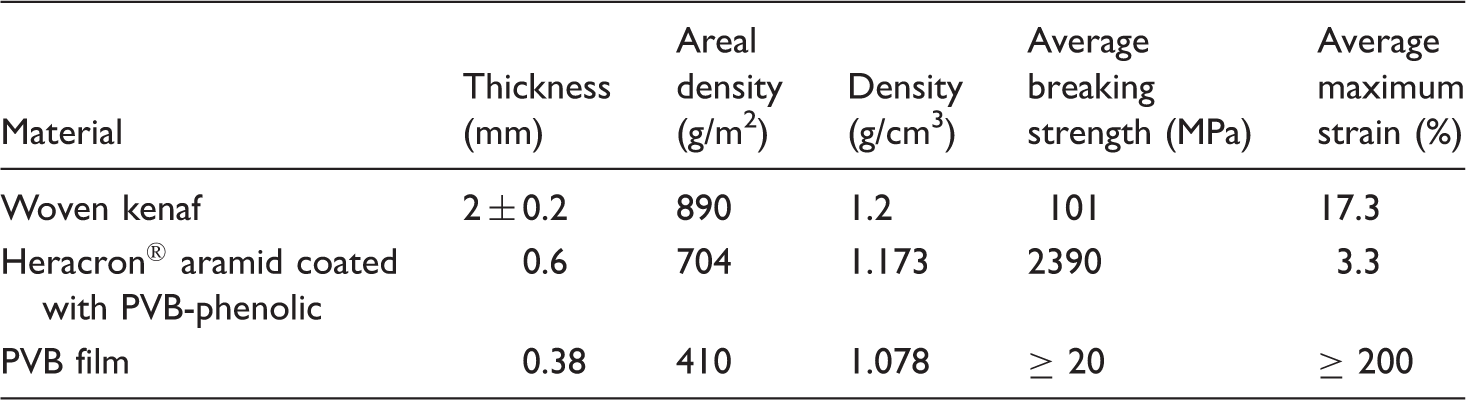
A high level of environmental awareness and its delicate balance represents a pillar of natural corporate culture to construct systems with a very low environmental impact. Kenaf fibers and PVB have adopted an environmentally friendly corporate policy for reducing greenhouse gas emissions, and introduced innovative solutions for the sustainable, more responsible use of natural resources. However, researchers are still continuously embarking on the possibility of using natural fibers due to their disadvantage, which could be decreased by hybridizing with synthetic fibers.
The hot hydraulic press technique was used to fabricate hybrid laminates of different kenaf fiber weight contents with PVB film and Heracron® aramid fabric coated with a PVB-phenolic film, as shown in Figure 2. Table 2 illustrates the various configuration layers and stacking sequence of the hybrids laminates. In order to reduce the number of aramid layers and to identify the effect of layering sequence, plain woven kenaf layers were placed in 12 different locations. Studies are also carried out on 19 layers of aramid/PVB-phenolic composite and plain woven kenaf/PVB composite for the purpose of comparison.
The hybrid composite specimens prepared using the hot press technique. Specifications of the laminated hybrid composites.

Figure 3 illustrates an example of fabricating hybrid H5 and H5A. Eleven Kevlar layers, 8 kenaf layers, and 9 PVB film layers were all cut to identical size (150 × 150 mm2 sheets) and then arranged according to their stacking order. To fabricate a square flat laminated hybrid H5 panel, 11 coated Kevlar/PVB phenolic layers were arranged together and then the PVB film layers were stacked between 8 woven kenaf layers. While in hybrid H5A, the 11 coated Kevlar layers were stacked alternatively with 8 kenaf and 9 PVB layers. Consequently, H5 and H5A have the same Kevlar, kenaf, and PVB layers number but with a different arrangement. A mold release agent was sprayed on the mold surfaces before any molding process to prevent adhesion as well as to obtain a smooth sample surface. Stacks of 19 layers of different laminates were centered between two stainless-steel molds and hot plates of a compression molding press. Subsequently, the platens were closed, and the hot press plates were heated to 165℃ for 20 min where compression pressure was set to 8 MPa, as shown in Figure 4. Once the temperature of the platens reached 165℃, the compression pressure was increased to 8 MPa and held constant for 15 min. After this compression cycle, the platen temperature was reduced to room temperature (25℃), while the pressure was maintained at 8 MPa until the temperature reached 25℃. Once the platen temperature reached 25℃, the hybrid composite laminates were taken out of the compression molding frame. The dimensions and mass of the hybrid laminates were measured to calculate the density and the areal density of the hybrid materials.
Stacking sequence of hybrids H5 and H5A. Compression molding hot press and temperature profile. (a) Hot press; (b) processing cycle.

Quasi-static penetration test
The quasi-static perforation test was conducted to study the damage evolution and penetration resistance behavior of the hybrid laminates. It was also used to evaluate the effect of hybridization on the energy absorption of hybrid laminated composites under transverse loading without a dynamic effect [4]. The methodology of the quasi-static tests follow the standard D 6264 [16], using a universal testing machine with 100 kN capacity. Figure 5 presents the fixture adapted in the Instron machine during the quasi-static test, which was conducted in the composite laboratory of the Mechanical Engineering Department, Universiti Putra Malaysia. The fixture is composed of a bottom support plate (200 × 200 mm2, 50 mm thick) with a circular hole at the center and a square top cover plate (200 × 200 mm2, 20 mm thick) with a circular hole similar to the support plate. The ratio between the support span and the punch diameter (span-to-punch ratio) was SPR = Ds/Dp =8.0, as shown in Figure 4. A series of quasi-static tests were performed using a surface-hardened steel indenter with hemispherical tip, 9 mm diameter into the face of the hybrid composite plates. The hybrid composite samples (square with a length of 150 mm) were bolted between the cover plate and bottom support plate by four screws, at the four corners. The penetration resistance force–displacement curves were recorded, at a crosshead displacement rate of 1.27 mm/min. Then the energy dissipated was calculated by integrating the area under the curve. This is correlated with the observed damage. Hybrid composite plate specimens were sectioned along the center of penetration using a grinding cutting machine for damage surface observation.
The quasi-static test setup and fully clamped boundary conditions.
Results and discussion
Experiments were performed under quasi-static penetration loading conditions to study the effect of hybridization on the energy absorption of hybrid laminated composites and damage mechanisms. Figure 6 shows the penetration resistance force–displacement curves for the Kevlar 29/PVB-phenolic and kenaf/PVB composites, as well as H1, H2, H3, H4, H5, H6 hybrid composites. Figure 7 presents the penetration resistance force with penetrator displacement curves of Kevlar 29/PVB-phenolic and kenaf/PVB composites as well as H1A, H2A, H3A, H4A, H5A, H6A hybrid composites, where alternative Kevlar layers with kenaf layers were fabricated with different stacking sequences. Figure 8 shows the penetration tests for the same number of Kevlar and kenaf layers but with different configurations, in order to compare the penetration resistance results of each material. Generally, these curves show a bilinear behavior and the line slope changes (increases) as the number of kenaf layers increases, until a maximum load peak.
Penetration force–displacement curves of kenaf, Kevlar composites, and their hybrids. Penetration force–displacement curves of kenaf, Kevlar composites, and their alternative laminated hybrids. Penetration force–displacement curves of each hybrid and its alternative laminate.

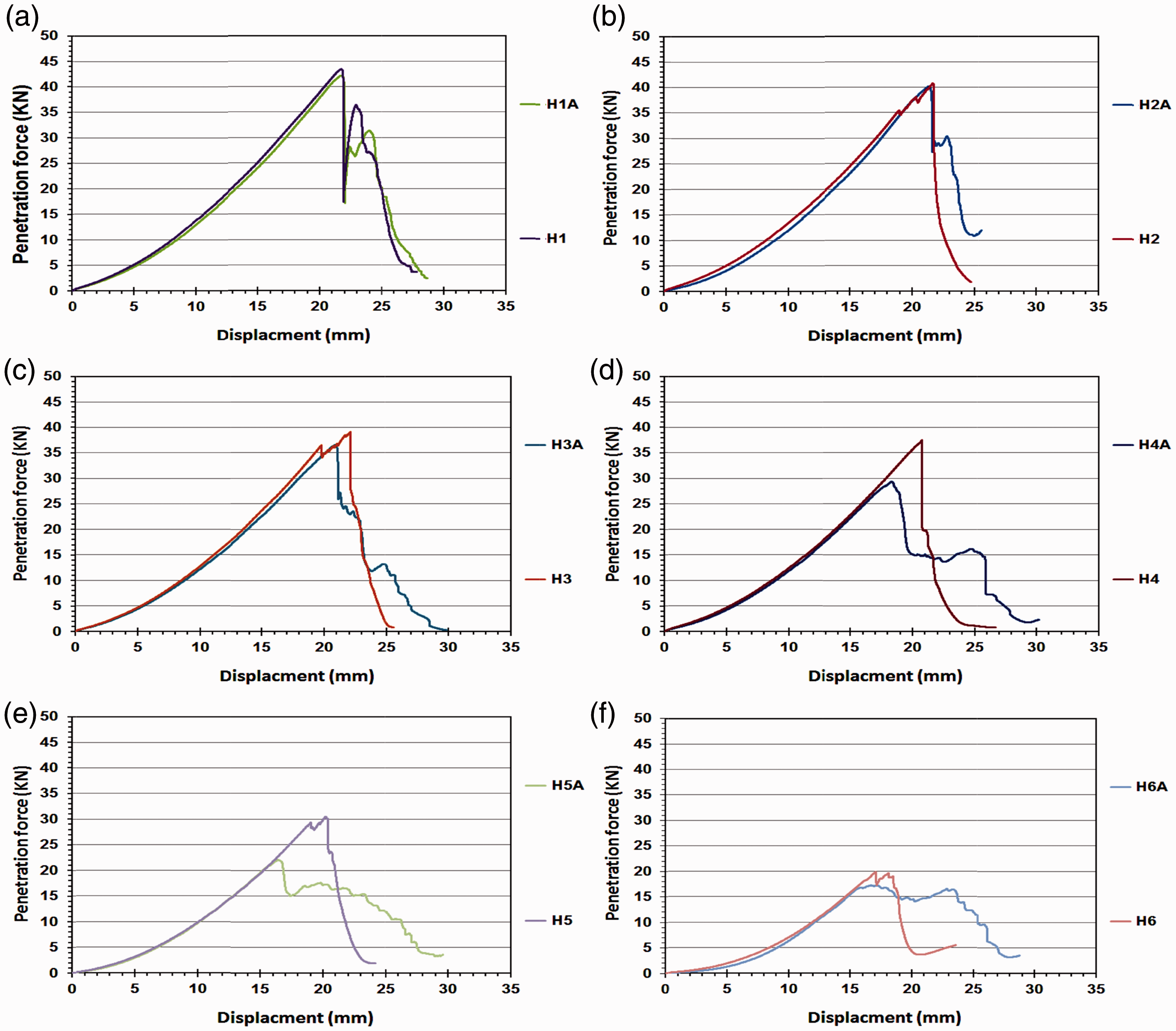
Initially, the penetration occurred at the initial failure on the matrix, then the indenter moved through the thickness of the hybrid composites by pushing the fibers aside, and matrix failure occurred. Then, the force displacement shows a second-linear section up to the maximum force “compression-shear” followed by a perforation region due to progressive force drop, “tension-shear” causing fiber breakage associated with the residual frictional force. H1, H2, H3, H4, H5, and H6 hybrid composite laminates show a load drop behavior in the shape of a “knee”, where delamination occurs. When comparing H1A, H2A, H3A, H4A, H5A, and H6A (alternative hybrids) testing results with their alternate hybrids (H1, H2, H3, H4, H5, H6), different failure zones that are characterized by incremental load was observed, as shown in Figure 7. Furthermore, when the number of kenaf layers increases, the force displacement shows a staircase behavior, which leads to the gradual rupture of the specimens, as shown in Figure 8(e) and (f). Similar behaviors are noted and reported by Deka [17] on the force–displacement curves of glass/polypropylene and carbon/polypropylene laminates. It was observed that the composites exhibited a larger effective displacement for complete penetration because of the visco-elastic-plastic behavior of the polypropylene system.
The maximum penetration load-carrying capacities are found to vary with different hybrid tests, which gradually decrease when the number of kenaf layers increased in general, as shown in Figure 9.
Maximum penetration load of all hybrid composites.
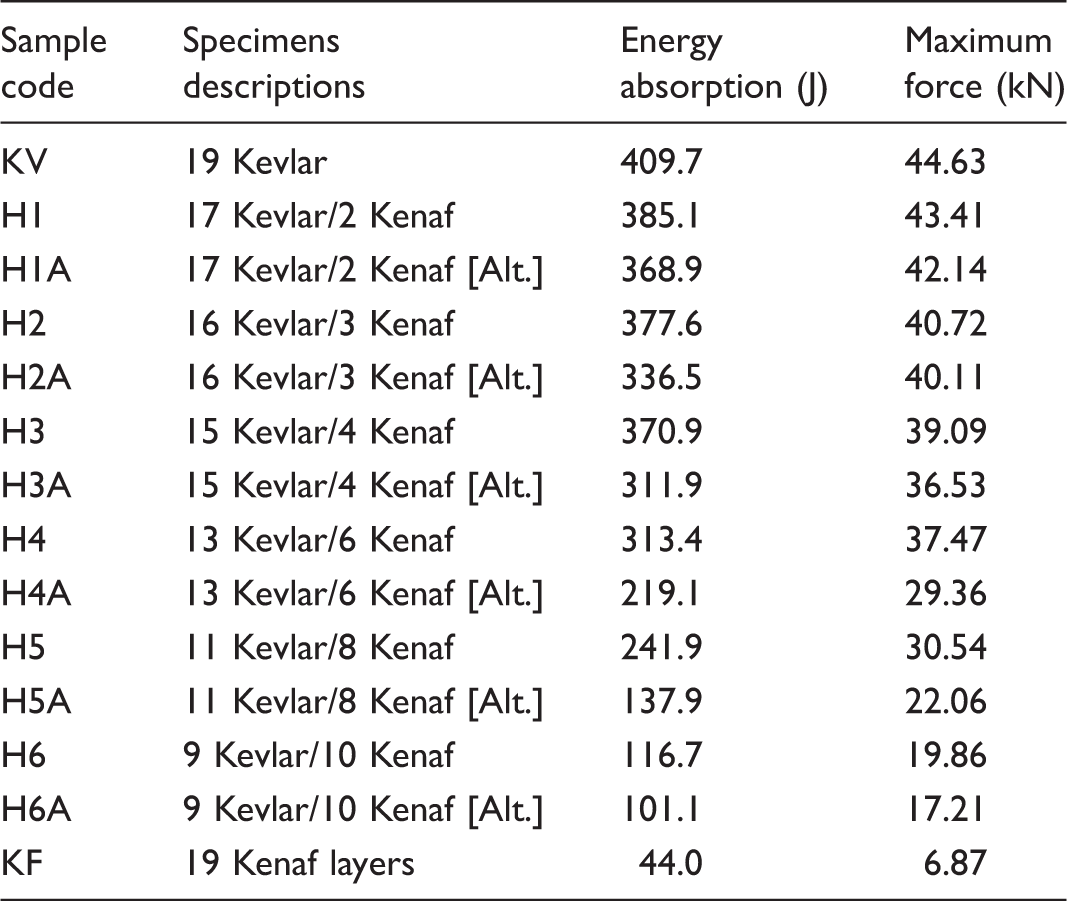
Figure 10 shows the energy absorption during the penetration process as measured by the area under the force–displacement curves in Figures 6 and 7 and these values are listed in Table 3. It is clear that the energy absorption and maximum penetration force of Kevlar composite are higher than all hybrid composites and kenaf composite. Hybrid H1 shows the highest energy absorption, signifying that this hybrid configuration provides a better penetration resistance compared to other hybrid materials. While hybrid H1A, alternate layers of kenaf and Kevlar exhibited less energy absorption compared to the hybrid H1, at the same number of layers. Both bulged out and higher delamination occurred in the interlaminar surface for Kevlar layers alternatively fabricated with kenaf layers. Similar to hybrid H1A, hybrids H2A, H3A, H4A, H5A, and H6A exhibited less energy compared to hybrids H2, H3, H4, H5, and H6. It seems that hybrids with placing woven kenaf together and Kevlar 29 layers separately were able to hinder the propagation of cracks generated more than hybrids with alternate layers of kenaf and Kevlar, for the same hybrid volume and thickness. This is because the natural fibers tend to be coarser and thicker than those of the synthetic fibers, which significantly affects the quality of interfacial adhesion by decreasing the bond strength. This implies that both the effect of interlaminar and interfacial strength between the layers highly decide hybrid properties, most likely due to the presence of more interfaces, as previously suggested [18]. As confirmed by experimental results, the laminate configuration heavily affects the hybrid response, as reported in other studies [19,20]. As reported by Erkendirci and Haque [4], different material surfaces cause more delamination, which alters the magnitude of the friction forces corresponding to the decrease in the energy absorption for the materials. A similar trend was also observed in the ballistic limit and energy absorbed for these laminated composites [21]. It was reported that these hybrid materials showed a similar energy absorption relationship with the increase in the impact velocity. An increase in the energy absorbed by the hybrids was also observed until the ballistic limit of each hybrid. The ballistic limit ranged between 417.8 m/s and 691 m/s [22].
Penetration energy of all hybrid composites. Energy absorption and maximum load of quasi-static tested samples.
In Figure 11, the specific energy at maximum quasi-static force was compared with the energy density for each hybrid. Specific energy absorption was calculated by dividing the total energy absorption by the mass of each hybrid, while the energy density was calculated by dividing the total energy absorption by the density of each hybrid. The results indicate that the specific energy absorption is diminished with increasing the kenaf fibers layers compared to the Kevlar composite. This is due to the difference in the energy absorbed capability and density of the fibers. Among the hybrid composites, H1 recorded the highest specific energy absorption compared to others, reaching 94% of the total energy absorbed by the Kevlar composites. Not much difference was observed in the energy absorbed of H1A hybrid composite, reaching 90% of that of the total Kevlar composites.
Specific energy absorption and energy density of all hybrid composites.
However, for H2 hybrid composite, the energy absorbed at maximum quasi-static penetration force was 92% of the total energy absorbed by the Kevlar composites, which is higher than H1A hybrid composite. This may be attributed to the large coefficient of friction when stacking the same fiber layers, which resists the formation of a complete shear plug and increases the energy absorbed value. The sequence in hybrid laminates plays a critical role in the penetration of the laminates due to different stiffnesses and friction coefficients between the layers, as stated by Al-Kinani [23]. The KF hybrid sample recorded the lowest specific energy absorption due to the low interfacial adhesion of fibers with the matrix as explained by Gama and Gillespie [24], leading to the transverse matrix damage and shear plug formation corresponding to the delamination.
Figure 12 shows the effect of the volume fraction of kenaf and Kevlar contents on the energy absorbed for all hybrid laminated composites. It can be clearly seen that with an increase in the kenaf volume fraction, the energy absorbed decreases. The energy absorbed curve increases with the increment in the Kevlar volume fraction. Overall results in quasi-static tests indicate that approximately 30% volume fraction of both kenaf and Kevlar fibers are more effective in the energy absorbed value.
Energy–fiber volume fraction curves of kenaf and Kevlar hybrid composites.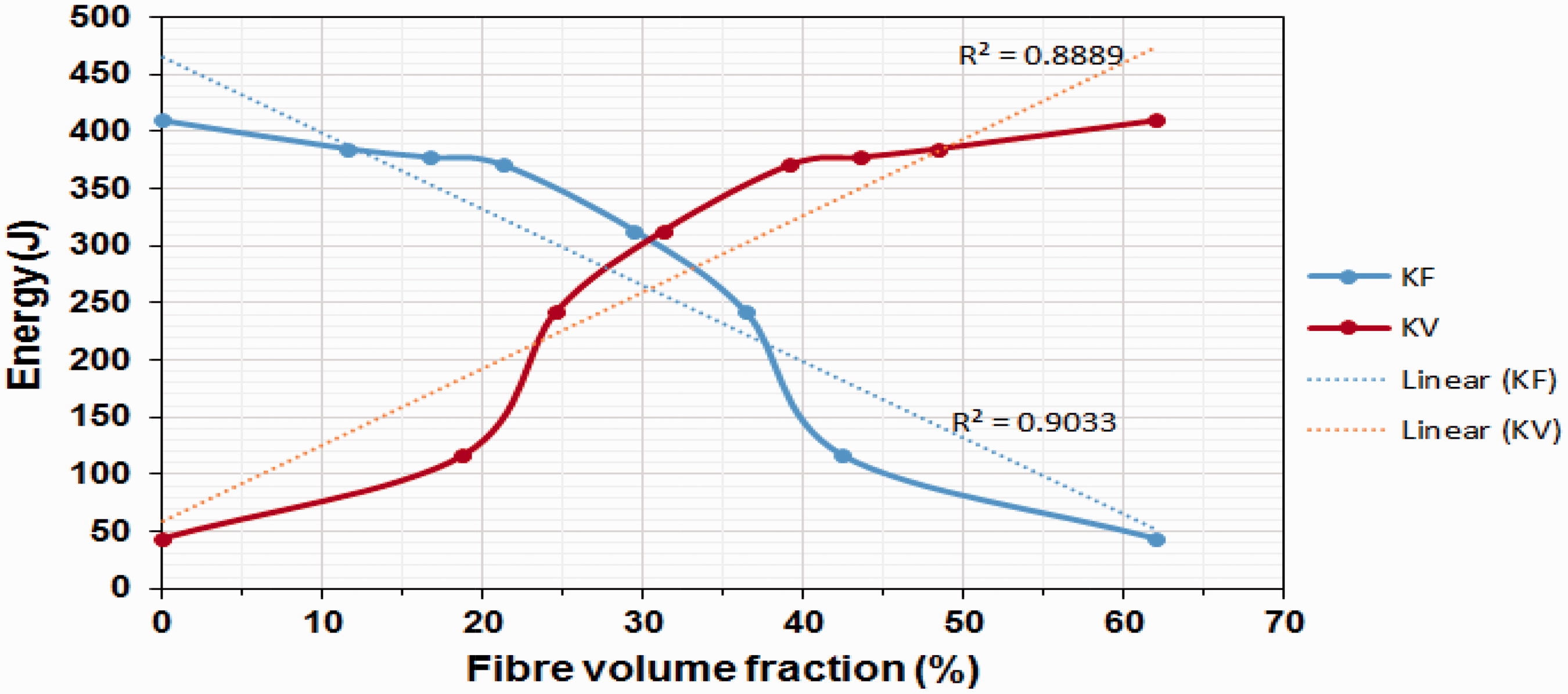
To evaluate the effect of hybridization of the kenaf fiber, percentage changes in the energy (E%) and maximum load (F%) of the hybrid composites were determined using the following equations [23]


Figure 13 shows the effect of the addition of kenaf fiber in the Kevlar composite with reference to the absorbed energy and the maximum penetration load. A significant increase in the absorbing energy and maximum load with the highest values in H6 and H6A was recorded, where the high percentage of kenaf fibers were used.
Percentage changes in energy and maximum load of the hybrid composites.
Damage mechanisms
Post-test examination of selected specimens was performed to analyze the failure mechanisms during the quasi-static tests. Cross-sections of selected samples at the impact region were cut along the thickness direction to observe the damage failure modes after tests. The failures that occurred due to the penetrated loads by quasi-static punch were: fiber shear by compression-shear on the impacted surface (that exhibited a load plateau) and fiber shear by tension-shear on the rear surface (complete perforation of conical penetrator), as shown in Figure 14. The crack propagation in all the hybrids was predominantly driven through the interlaminar regions; therefore, the interphase region appears to have significant effects that influence the overall hybrid properties. Delamination in the region of the punch penetration and fiber breakage due to shear and tension occurred in the interlaminar and intralaminar regions. All the hybrid laminated composites presented similar damage behavior to that of the Kevlar composite, as shown in Figure 14(a). We observed that placing the woven kenaf layers together and Kevlar 29 layers separately is the most effective way for impact resistance, as shown in Figure 14(b). The delamination area is only on the back side of all hybrids where woven kenaf layers alternate with Kevlar 29 fabric layers, as shown in Figure 14(c). This bond strength can be observed from the saturated aramid and kenaf fibers when there is good fiber–matrix interface strength, such as that induced by relatively slow crack growth rates. This means that some PVB matrix is left on the aramid and kenaf fibers, which lead to prevention of the damage growth promotion and premature failure. Under such conditions, the preferential fracture at the fiber–matrix interface will also reduce the degree of matrix deformation. This suggests that separate laminates are more effective in dissipating energy than the alternative fabric in the application of armour. For the kenaf composite, the impact surface was compressed due to plunger punch and an exact plunger shaped cavity was created when full penetration was achieved, as shown in Figure 14(d).
Optical pictures of damaged surface of hybrid composite laminates after quasi-static test, cross-sectional surface, rear surface, and impacted surface: (a) Kevlar composite (KV), (b) hybrid of placing kenaf layers and Kevlar 29 layers separately (H1), (c) hybrid of placing kenaf layers alternately with Kevlar 29 layers (H1A), (d) kenaf composite (KF).
Figure 15 illustrates an example of stacking sequence arrangements of the hybrid H5 and H5A. Bonding surfaces among the interlaminar layers are clearly seen. Similar behavior of other types of hybrid materials has been documented in Pandya’s research paper [25]. The main damage mechanisms in these hybrid materials were: fiber tensile failure and matrix cracking. It is postulated that delamination only starts at an advanced stage of the loading, resulting in a small rhombic region of delamination just before the specimen is perforated. Generally, Kevlar and kenaf fibers rupture as well as matrix fracture were the major failure modes in the high-impact tests, whereas in quasi-static tests the failures were more of matrix fracture and Kevlar and kenaf fibers sliding.
Optical pictures of stacking sequence of: (a) H5 hybrid; (b) H5A hybrid composites.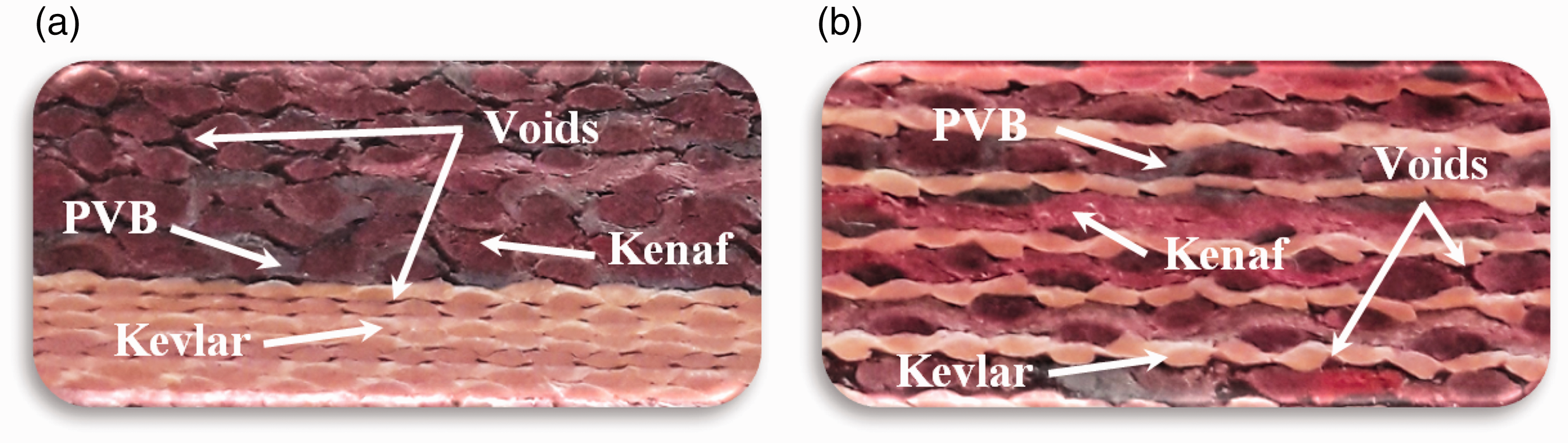
Conclusions
The effects of hybridization and stacking sequence of hybrid composite materials on the energy absorption under quasi-static penetration were investigated. Based on the results, the following specific conclusions were drawn:
All hybrid composites absorbed more penetration energy compared to kenaf/PVB composites. Hybrid composites with two layers of kenaf fibers (H1 and H1A) gave maximum penetration force and impact energy absorption. Kenaf/Kevlar hybridization produced a positive effect in terms of increasing energy absorption and maximum load changes compared to the kenaf composites. All hybrid laminates showed a decrease in the percentage of absorbed energy in comparison with the Kevlar laminates, such as 5% for H1 and 7% for H2, and this effect increased with increasing kenaf content. The tested samples were optically observed and it was found that the failure mechanism followed the form of delaminated area in a conical shape for completely penetrated perforation. Additionally, a punched-out effect was observed on the back of the ply in the case of panels that were partially penetrated, including Kevlar and kenaf fibers breakages, Kevlar and kenaf fibers stretching, shear, Kevlar and kenaf fibers, and matrix rupture and cracking.
This approach of producing hybrid composite materials is expected to develop new composite structures that are less costly and more readily available compared to the conventional helmet material including the reduction in the use and content of the synthetic fibers. This research will open a new and more environmentally friendly alternative in military equipment, aerospace, marine, and civilian structures, which will reduce the use of Kevlar fabric in ballistic laminate composites, and meets the required baseline performance specifications.
Footnotes
Acknowledgements
The authors would like to express their gratitude and sincere appreciation to the Mechanical and Manufacturing Engineering Department and Aerospace Manufacturing Research Centre of the Universiti Putra Malaysia.
Declaration of Conflicting Interests
The author(s) declared no potential conflicts of interest with respect to the research, authorship, and/or publication of this article.
Funding
The author(s) disclosed receipt of the following financial support for the research, authorship, and/or publication of this article: This work was supported by UPM under GP-IPS/2014/9438714 and GP-IPB grants, 9415402. The authors’ appreciation and gratitude also extend to the Ministry of Higher Education & Scientific Research of Iraq and to the Material Engineering Department, College of Engineering, at the University of Mustansiriyah, for scientific assistance and financial support.