




Abstract
Membrane structures are widely used in large span spatial structures due to excellent mechanical behavior and beautiful forms. Mechanical properties of coated fabrics are an important basis of design, analysis, and construction of membrane structures. This paper gives an overview of the research advances in mechanical properties of coated fabrics. First, the basic mechanical indexes of coated fabrics and corresponding test methods are presented. Then, the existing constitutive relations for coated fabrics are discussed. Finally, the effect of environment and other factors on the mechanical properties of coated fabrics are studied. In addition, the future trends on the mechanical behavior of coated fabrics are given, which can be references for design and analysis of coated fabrics in civil engineering.
Introduction
Membrane structure is a new spatial structural system developed in the middle of 20th century, as shown in Figure 1 [1]. It is welcomed by many designers and researchers due to its modern artistic expression and excellent mechanical behavior. Nowadays, a number of researchers have made great progress on the form-finding and pattern cutting analysis, load analysis, and construction analysis [1–5]. However, the research on mechanical properties of membrane materials still fall behind some conventional construction materials, for example, steel and concrete [6–9]. It always leads to more uncertainty in the analysis. Therefore, in current design guides, a total safety factor formed by considering different component factors is always applied to the specified/manufactured strength of membrane materials.
Famous large-span membrane structures.
Research and development of membrane structures are closely related with the growing development of membrane materials [5]. Coated fabrics consist of woven yarns to provide strength, with an impermeable coating to provide waterproofing and stabilize the weave. There are many types of coated woven fabric: glass fibers coated with polytetrafluoroethylene (PTFE), polyesters coated with polyvinylchloride (PVC) or polyvinylidene fluoride (PVDF), glass fibers coated with silicone, and PTFE-coated ePTFE (Tenera). Among them, the first two types are more popular, while their deformation mechanisms are very similar.
Comparisons between coated fabrics and other common materials used in applications.
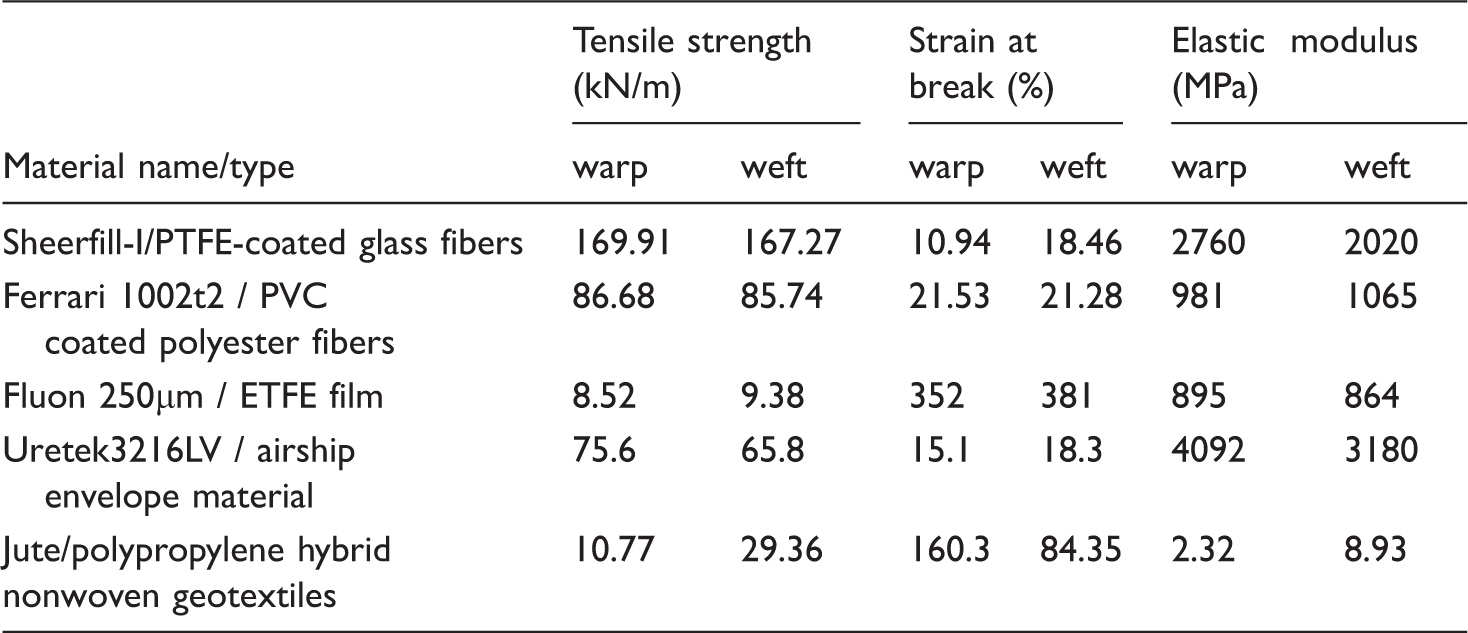
Top coats are lacquered in order to ensure good cleanability, good slip, and processing, and they offer an efficient barrier for plasticiser migration and weather influences. Most liquid lacquer systems for PVC-coated polyester fabrics are made out of acrylics, PVDF/acrylic mixtures, and PVDF. PVF films can also be used and provide a good resistance and the lowest erosion during ageing. Fluoro polymers have a better resistance to UV than acrylics.
To render the fabric lustre and beauty, the PVC is always pigmented, mostly in white [2]. Also the type and concentration of pigment play an important role in the color, UV stability and opacity. As with the plasticisers, pigments may affect the light stability and surface properties as dirt pick-up. PTFE is resistant against the strongest corrosive substances and with anti-adhesive nature. Therefore, PTFE-coated fabrics do exhibit good self-cleaning and water repellent properties. Because of its hydrophobic properties, PTFE is an excellent protection for the textile reinforcement of the membrane, since glass filaments lose their tensile strength in contact with humidity. PTFE is totally resistant to UV and IR-radiation. The choice of compositions always has to make compromises between, for example, optimized weld-ability, optimized weathering resistance and aesthetic performance. For PTFE-coated glass fabrics, the top coat consists of FEP (fluoroethylenepropylene copolymer) to enhance waterproofness, fungal resistance, and weldability due to a lower softening point of FEP than PTFE [1].
There are two main woven methods for coated fabrics used in civil engineering, including plain weave and panama weave. In the plain weave method, warp yarns are tension straight and weft yarns wind alternately around warp yarns. When the woven density is high, the plain woven substrate has high tensile strength, but needs more coating materials and more thickness. The difference between plain weave and panama weave is the number of woven yarns, as shown in Figure 2. More yarns are woven in the panama weave method and the corresponding mechanical properties are always better. Other fabrics like “weft-inserted” fabrics can be obtained by a warp-knitting process which binds warp and weft yarns without crossing the yarns, but they are seldom used in civil engineering [14,15].
Woven methods of yarns in the substrate. (a) Plain weave. (b) Panama weave.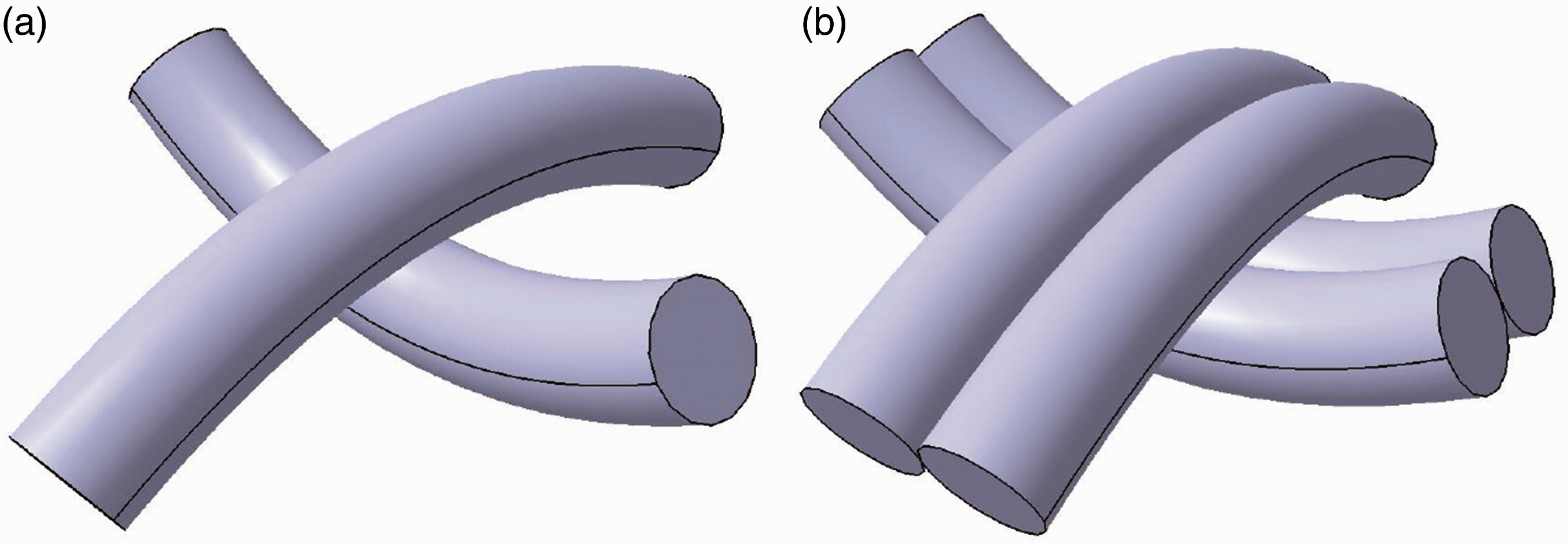
The strength of coated fabrics is mainly determined by the strength of their constitutive yarns. When used externally, uncoated fabrics have short service lives. Coating a fabric gives the following benefits [1]: (a) protecting the yarns against different sources of damage (UV, abrasion, atmosphere); (b) proofing the membrane against rainwater and atmospheric moisture; (c) stabilizing what might otherwise be an unstable fabric geometry; (d) providing material to permit heat-sealed seams; and (e) changing the crimp interchange of substrate and the macro-mechanical behavior, for example, tensile behavior, tear behavior, and stab behavior [16–19].
The mechanical properties of coated fabrics are the basis of design and analysis of membrane structures. It mainly includes basic mechanical properties, constitutive relations, material resistance uncertainty, etc. This paper summarized the research advances of mechanical properties of coated fabrics and proposed further trends in the field of civil engineering, which can provide references for researchers and designers.
Basic mechanical properties and test methods
Research on mechanical properties of building coated fabrics started in the 1980s. Some researchers have put forward some methods to determine the basic indexes of mechanical properties, having already been adopted by industry organization, codes or specifications [20–26]. The basic mechanical indexes of coated fabrics mainly include tensile strength, strain at break, tear strength, elastic modulus, shear modulus, and others, as shown in Figure 3. Those tests are carried out with regard to one common type of PTFE-coated glass fibers (Sheerfill-I) used in the membrane roof of the EXPO Central Axis in Shanghai EXPO 2010 [27]. Those mechanical indexes are obtained according to DG/TJ 08-2019-2007 (Tensile strength and strain at break) [26], DIN 53363 (Tear strength) [23] and MSAJ (MASJ is the abbreviation of Membrane Structures Association of Japan) codes (Elastic modulus, Poisson ratio and Shear modulus) [20–22].
Test method for basic mechanical indexes.
Test standards of tensile strength.

Tear strength seldom appears in the design of membrane structures, although it is a mandatory index for the manufacture of coated fabrics. A lot of disasters showed that most of membrane structures failed due to the propagation of the micro crack under extreme conditions, for example, typhoon or heavy snow. Current test methods include single/double tongue method, center crack method, and trapezoidal method [28]. Among them, the double tongue method (BS 3424) and the trapezoidal method (DIN 53363, ASTM 5733, ASTM 4851 and JIS-L 1096) are mainly applied in the test standards. For the double tongue method, the orientation of crack propagation is unpredictable, while for the center crack method, the test results are largely affected by crack dimensions. Relatively, the trapezoidal tear method is simple and the test results are stable. From above, most of the methods are based on the uniaxial tests, and the biaxial test method may be more appropriate considering the actual stress states. However, there are not specific authoritative methods to obtain the biaxial tear strength, just as shown in the last paragraph. The current biaxial test methods are always used to evaluate the stress intensity factors, seam connections, and crack propagations [30–33].
In the current design specifications, coated fabrics are usually considered as elastic orthotropic. The elastic modulus, Poisson’s ratio, and shear modulus are three main parameters of constitutive equations. The elastic modulus and Poisson's ratio can be determined by the uniaxial tensile test and biaxial tensile test [1,5,34]. The uniaxial elastic modulus based on the uniaxial cyclic tests is always higher than the biaxial elastic modulus, because in the uniaxial tensile tests, the restraint effect of transverse yarns on the longitudinal yarns is weak [35]. The biaxial test method is relatively close to the actual stress state, and can take into account the effects of loading sequence, stress ratio, and others.
There are two main methods to obtain the elastic modulus and Poisson’s ratio, the method of Blum lab and the method of MSAJ [36]. They both use the cruciform specimens, but the corresponding dimensions and loading protocols are different [1]. The specimen used in the Blum Lab method is about 1000 mm × 1000 mm and it is mainly suitable for the anti-Gaussian surface. To determine the elastic modulus, the nonlinear behavior should be linearized, and the constitutive relation should be described by the incremental form [1]. For the method of MSAJ, the dimension of specimen center is about 50 mm × 50 mm and it is suitable for the membrane surface with small curvature or smooth surface [21,22]. The cyclic tensile curves are carried out under different stress ratios and the stress range is 0 to 1/4 of the tensile strength. It should be noted that the cyclic loading should be carried out first, in order to remove the residual strain and make the material linear elastic. The elastic modulus and Poisson’s ratio can be got by the least square method, regarding to the materials after cyclic loading.
The above methods are both based on the assumption of elastic, linear, and orthotropic. However, the coated fabrics are always nonlinear and viscoelastic, and are affected by the loading protocols, especially for the materials without any loading [27]. Some researchers used some techniques to analyze the real response of coated fabrics under different loading protocols; for example, multi-linear approximation method, B-Spline method, and others [37–41]. The effects of specimen size, measurement position, stress ratio, and others on the mechanical properties of the materials are also discussed [28,33]. Besides, some researchers [42] proposed a method of getting the biaxial tensile constants by uniaxial tensile tests and verified it with the test results of GF/PTFE and PVDF1202T.
There are three main methods to obtain the shear modulus, including the biaxial tensile test and in-plane shear test [28,43]. Shear deformation is the dominative deformation mode for woven fabrics in forming and is important for the form-finding and cutting pattern analysis of membrane structures. In the biaxial test method, the strains of three directions (0°, 45°, and 90°) should be measured and it has strict demands on the test equipment. Generally speaking, the in-plane shear test is widely used, due to lower demands on test equipment and simple loading protocol [1]. An international research team composed of some research institutions and corporations summarized and analyzed the current experimental and theoretical methods by way of forming the benchmark. They focused on the effects of shear deformation on mechanical properties of the material by trellis-frame (picture-frame) and bias extension tests, and the discrete and regularization of the data processing is also discussed [43].
Constitutive relations
Complex mechanical properties of coated fabrics make it difficult to get accurate constants for design and analysis. It is necessary to get a simple and accurate constitutive relation to express the complex response under various loading. Recently, research on constitutive relations develops continuously, from the elastic matrix analysis method and mathematical function analysis, to the mechanical model method. Although the model accuracy of constitutive relations has improved significantly, the complexity of material properties still limits its engineering applications.
Coated fabrics are polymer composites and perform significant viscoelastic behavior, which is related with the woven method and coating processing [44]. Different woven methods will lead to different crimp degrees of yarns. For plain wove fabrics, the crimp degree of warp is different from that of weft, which should be considered in the cutting pattern design [45–48]. Meng and Wu [49] and Zhang et al. [50] carried out the uniaxial stress relaxation and creep test of PTFE-coated fabrics under different test conditions and analyzed the variation of the relaxation modulus and creep compliance.
The constitutive relation models of coated fabrics can be divided into two types: the macroscopic models and the microscopic models. As a composite material, its deformation mechanism mainly relies on the microstructure of materials. The constitutive relations are built based on the microstructures of yarns, coatings and the frictions between them [51,52]. As shown in Figure 4, there are many existing microscopic models mainly used in the textile industry to help improve the material performances, including Peirce model [53], Freeston model [54], Testa model [55], hinged truss model [56], space truss model [57], trapezoid truss model [58], grid model [59], Pargana model [60,61], etc. The prediction accuracy is high, but complex expressions limit its applications in the analysis of civil engineering.
Microscopic model.
Compared with microscopic models, the mathematical macroscopic models always have fewer unknown parameters which have no clear physical meanings. The macroscopic models are always based on the assumption of homogeneous anisotropic continuum. The two-dimensional tensile curves or three-dimensional surfaces can be fitted to build a mathematical equation in the form of increment or polynomial. However, the equations may be only applicable to the specific materials. It is difficult to build a unified expression to describe the complex deformation mechanisms of coated fabrics. In the current design and analysis, coated fabric is always considered as linear, elastic and anisotropic, and the above models should be always simplified ahead of the application. The calculation amount of macroscopic models is far lower than the microscopic models. This is also why the macroscopic models are widely used in the analysis [37–39,42,62–65]. Recently, Dinh et al. [66] proposed a new constitutive relation to express the nonlinearity based on the elasto-plastic assumptions. In this model, all the parameters have clear physical meaning and are easy to obtain. The proposed model is then implemented in ABAQUS as a user material subroutine and validated with the data obtained from biaxial tension tests.
The visco-elastic constitutive relations of coated fabrics can be based on the above models by considering the effects of time, temperature, and others [47,59,67–69]. They can be divided into two categories, the linear viscoelastic model, and the nonlinear viscoelastic model. The linear viscoelastic model is always composed of elastic components and viscous components assembled by different ways, for example, Maxwell model, Kelvin model, Burger model, Generalized viscoelastic model, Eying model, three-component model, four-component model, fractional Maxwell model, and fractional order model [49,54,70–73]. Due to different components, the models can be used for predicting the visco-elastic behavior of coated fabrics under different loading protocols. After stress relaxation or creep tests, the materials can be always considered linear [35]. Kato et al. [69] proposed a method based on the biaxial stress relaxation or creep tests to get the elastic constants. In addition, Yu et al. [74] used the theories of potential energy to describe the anisotropic visco-elastic behavior of coated fabrics. However, due to complex components, there are few references about the nonlinear visco-elastic models for coated fabrics.
There are also some microscopic models for the visco-elastic behavior of coated fabrics. Blum [2] used a simplified method to describe the viscoelastic behavior of coated fabrics using the properties of yarns. Kato et al. [75] used the grid models to simulate the visco-inelastic behavior under long-term loading and verified by the experiments. However, increasing the viscous elements in the microscopic equations may lead to too complex compressions, which can hardly be used in the application.
Resistance uncertainty
As polymer composites, the membrane material is viscoelastic and nonlinear, of which mechanical properties are affected by aging, temperature, humidity, and other factors [76]. In the current specifications, Germany DIN4134 is the most comprehensive, and it can consider the effects of biaxial reduction, temperature, long-term loading, pollution and aging, etc. The designers can choose proper influence factors to determine the design strength, according to the engineering background. The reduction factors for high temperature are 1.1–1.25, while the reduction factor for connections is 1.4–1.95 [2]. The IASS design recommendations can consider the influence of three main aspects (uncertainty of material properties, uncertainty of geometry parameters and uncertainty of calculation model) in the resistance uncertainty of membrane structures, and it combines the influence of temperature, ultraviolet radiation, cyclic loading, and creep into a total reduction coefficient, about 2.0–2.4. Chinese CECS 158:2015 combined the influence of environment, load conditions, and others into a total resistance coefficient [1,2]. The effects of environment and loading conditions on material properties are not defined individually, and a total factor that considers the position and loading combination is proposed [25]. Gosling and Bridgens [76] applied the principles of “Eurocode-Basis for Structural Design” (BS EN 1990:2002) to membrane structures and used the mathematical and numerical rigor and consistency in predicting the safety of membrane structures as an explicit function of inherent uncertainty in applied loading, structural form and material properties.
With the improvement of test conditions, many researchers have made a lot of tests regarding to different types of coated fabrics, in which the effects of temperature, cyclic loading, tensile rates, aging, and artificial damage test are considered. There are a lot of references about the effects of temperature on the properties of materials and welds. Generally speaking, with temperature increasing, the tensile strength decreases and the strain at break increases, while the temperature reduction factor and analysis models for different coated fabrics are proposed in the existing references [77–81]. Besides, the single humidity environment has little effect on the material properties, which is mainly related with good water resistance of woven yarns and coatings [28].
Cyclic loading and folding test
In the practical engineering, membrane surface always suffers pretension, stress relaxation, secondary tension, and serviceability loadings. Besides, severe and frequent vibration may appear in the membrane surface under high-speed winds [7,35]. As polymer composites, the effect of loading protocols on material response is significant [1,3,5]. However, current constitutive relations are always got by simple specific tests, and it may lead to large deviations between experiment data and numerical calculations. This phenomenon can be observed in some existing studies [27].
Generally, cyclic loading will change the crimps of coated fabrics and make the material linear-elastic, thus significant material hardening phenomenon can be observed in those tests. In addition, an interesting phenomenon can be observed under high temperature, and the glass fibers perform hardening after cyclic tests, while the polyesters perform softening [35]. Chen et al. [82] proposed the theoretical equations of biaxial elastic modulus and analyzed the effect of stress ratio on biaxial elastic modulus in the cyclic tests. Ambroziak et al. [8,83,84] proposed a method to characterize the mechanical properties of coated fabrics and discussed the relationship between tensile strength and specimen shapes. Zhang et al. [35] found that for plain woven fabrics, cyclic loading can change the crimps of woven structures and the differences between the warp and weft decrease. Additionally, in the low stress phase, the stress–strain curves still perform nonlinear behavior and the tensile strength after limited cycles remains unchanged.
PTFE-coated glass fibers are brittle and their tensile strength may decrease due to folding and unfolding in the transportation and construction. However, there are not specific guidelines about this aspect. By simulating the folding process in the model tests, Zhang et al. [85] found the tensile strength after the folding process decreases significantly and the reduction degree is related with specimen position and folding number. Therefore, the effects of the transportation and construction process on the material strength should be considered in the design of PTFE-coated glass fibers.
Weatherability
As the roof surface, the membrane materials are usually directly exposed in natural environments. The appearance of membrane materials changed and the material strength gradually decreased under application conditions, such as sunlight, temperature, rain erosion, and dusts. It is important for the safety and durability of the membrane structures. Most literatures are about the apparent morphology and fracture strength of coated fabrics by using natural exposure tests and artificial accelerated aging tests. The natural exposure test is the most effective method to measure the weatherability of coated fabrics. Polfus [86] carried out the natural exposure test of PVC coated fabrics in various areas, and found that the material strength is related with light, temperature, humidity, environmental pollution, and so on. Eichert [87] carried out the 10-year outdoor exposure tests in four different areas (Miami, Dormeletto, Ebnit and Wuppertal) and found the air pollution is the main reason that affects the material durability. Farlling et al. [88] proposed a method to assess the durability of roof membrane materials, compared several artificial aging equipment, and introduced the technical details of the thermal analysis method. Toyada and Itoh [89] studied the durability of PVC-coated fabrics and PTFE-coated fabrics and built the relationship between the natural exposure tests and artificial aging tests. Based on the ultraviolet time and intensity, Liu et al. [90] built the relationship between the tensile strength and breaking strain and the ultraviolet time and intensity, and found that the ultraviolet has significant on the material strength and breaking strain and can change the chemical structures of coating by the infrared spectrum analysis.
Generally, the weatherablity of PTFE-coated glass fibers is always better than that of the PVC-coated polyesters [71]. After 20 years of natural exposure, the residual tensile strength of Skytop PTFE-coated glass fibers can achieve about 80% of the material strength without aging [91]. However, with the improvement of coating techniques, the service life of PVC- or PVDF-coated polyesters increases significantly and it can be used in permanent structures or semi-permanent structures. Razak et al. [92] conducted a two-year exposure tests in the tropical environment and found that PVC-coated polyesters processed by special surface treatment can also perform good weatherability, as well as PTFE coating. Furthermore, the mechanical properties in tropical environments degrade significantly compared with the non-tropical environments. Xu [71] proposed a new constitutive model for the creep behavior and built the relationship between the material tensile strength and exposure time, based on a four-year natural exposure tests. Wang et al. [93] found that the top five causes of TMS defects in the tropics are weather, aging, design, construction/installation, and material selection. Weather is a primary cause of TMS defects in the tropics, more so than in other regions, while the UV rays and precipitation place greater strain on the coated fabrics. The corrosion or fatigue in fixings can be used as a significant predictor for the deterioration of roof coatings.
Due to short test time and easy operation ability, most of the current researches are carried out by the artificial accelerating tests [5]. The aging mechanisms of coated fabrics under the interaction of heat and humidity are studied and the life prediction models are also proposed [94]. Tan et al. [95] found that the decrease of material strength under the hot/wet condition is significantly higher than that under the heat condition. Under the hot condition, breaking strain plays an important role in the material failure. While under the hot and wet conditions, breaking stress is the dominant parameter.
From the above discussion it can be found that most of the present studies focus on the environmental factors (UV radiation, humidity, temperature, etc.) on the aging properties of coated fabrics and the tests are always carried out without considering the effect of stress state. However, as polymer composites, the actual stress state can always affect the mechanical and physical properties of coated fabrics, especially for the long-term applications. There are few references about this aspect. Besides, the design specifications may require some minor revisions, due to the fast development of membrane materials, for example, the reduction factor for environment factors.
Furthermore, there are a lot of disasters about the failure of membrane structures due to wind-borne debris. Current studies are always on the in-plane tensile behavior of coated fabrics However, there are few references on the out-plane mechanical properties of coated fabrics under impact. Chen and Chen [96] tested eight fabric specimens subjected to 12 impacts by a 4 kg timber projectile at center and corner locations and discussed the failure modes of PVC-coated polyesters against projectile impact. The effects of projectile velocity, impact location, fabric pretension and boundary condition on the penetration resistance capacity were discussed. It was found that the vulnerability of fabric material subjected to the projectile impact is significantly affected by the pretension force of fabric.
Conclusions
More and more membrane structures made by coated fabrics are built as famous landmarks, due to beautiful architectural forms and excellent artistic expressions. With the development of science and technology, coated fabrics have become one of the most widely used materials in the world. During the past decades, researchers have made a lot of progress on the research and utilization of coated fabrics used in civil engineering. However, there are still some aspects that require further investigation.
There is lack of a simple and accurate test method to obtain the biaxial tensile strength and biaxial tear strength. The current methods can only get the failure strength of biaxial specimens, not the material biaxial strength. Besides, the tear strength should be introduced into the design of membrane structures. The current constitutive relations used in the design are always based on one specific test, which cannot reflect the load-dependent characteristics of coated fabrics. Therefore, an accurate constitutive relation that can reflect the load-dependent characteristics is required. As polymer composites, the interaction of loading and environment may have a significant effect on the mechanical response of coated fabrics. Therefore, it is necessary to study the interaction effect of environment and loading protocols on the mechanical properties of coated fabrics. There are more and more disasters about the failure of membrane structures due to wind-borne debris, especially for the seashore cities. The out-plane mechanical properties of the coated fabrics under impact loading should be studied further.
Footnotes
Declaration of Conflicting Interests
The author(s) declared no potential conflicts of interest with respect to the research, authorship, and/or publication of this article.
Funding
The author(s) disclosed receipt of the following financial support for the research, authorship, and/or publication of this article: This work is supported by the Fundamental Research Funds for the Central Universities (Grant No. 2015XKMS012), and National Natural Science Foundation of China (Grant No. 51678563).