




Abstract
Lead-shielding products, such as lead aprons, are important materials for personal protection of physicians and patients from X-ray (gamma) radiation during medical operations. However, lead has environmental disadvantages such as high toxicity. The aim of this study was to manufacture an environmentally friendly and flexible textile-based radiation shielding material. In this work, 3/1 twill and some cellular woven fabrics were produced with conductive core yarns, and gamma radiation shielding effectiveness of these cellular woven fabrics were investigated and compared with that of the 3/1 twill woven fabric, which are commonly used as uniforms and were not studied previously in any other literature. The effects of weave on the structural characteristics of fabric such as the conductive weft yarn density, fabric thickness, and fullness were analyzed graphically and statistically. It is observed that with indenting and protruding, structure cellular woven fabrics performed better gamma radiation shielding performance than the 3/1 twill woven fabrics. The sample B1, woven with cellular weave 1, has the highest gamma radiation shielding effectiveness, thanks to the highest fabric thickness. In addition, the increase in the conductive core yarn density improved the gamma radiation shielding effectiveness of the woven fabrics.
Keywords
Introduction
Cellular weaves are a group of weaves that are produced by placing weft and warp yarn floats end to end for forming cellular structures, that indent and protrude on the fabric surface. Therefore, the thickness of cellular weaves is greater than the basic weaves. Cellular weaves, which are derived from sateen weaves, are also called sponge weaves because of their soft characteristics. They can be obtained by adding bindings in order to form a diamond shape around the basic bindings of the sateen weave [1].
As a generalized notion, radiation is the propagation of electromagnetic or particle energy – the sections of the radiation concept. However, radiation generally represents different characteristic energies. Different kinds of energies make up the radiation spectrum. People are quite familiar with different types of energies such as visible light, heat, radio waves, ultraviolet waves (UV), and microwaves but not many are aware that they are radiation. All radiation types of electromagnetic energy are made of just electric and magnetic fields but with different frequencies. Visible region is the frontier in the large electromagnetic radiation spectrum. As energy value, under the light, all kinds of radiations cannot damage the matter although they make a specific interaction. After light energy (Figure 1) the radiation has a name: ionizing radiation and nuclear radiation. Electromagnetic waves with upper energy level of UV Radiation that is neighbor of ionizing region on electromagnetic spectrum, can make damage on matter by separating its electrons.
Electromagnetic radiation spectrum [2].
While the frequency increases, the energy of the radiation decreases. The visible region has several eV (electronvolt, 1 eV = 1.6 × E−19 Joule) unit energy but UV region has several keV. An energy of 13.6 eV is needed to separate an electron from the hydrogen atom but the visible and other regions under UV do not have such energy. X-ray regions have energies of several tens of keVs to several MeVs.
Secondly, after the electromagnetic radiation, there is particle radiation that has the complete effect of ionization. These particles come from atomic nuclei of radioactive materials, outer space and scientific facilities. Alpha, beta and neutrons are commonly used and known in many particle types. Particle radiation can be easily shielded. On the other hand, electromagnetic-ionizing radiation cannot be easily stopped. So it is important to care for ionizing radiation in living organisms because it definitely damages the DNA. Although the DNA damages are commonly repaired by the organisms, there are risks of permanent DNA damage. This sentence is not necessary. In practical life, we live in Ionizing Radiation Sea additionally other non-ionizing radiations. Natural earth materials and the sun are main radiation sources for us. Also, humans can face the ionizing radiation artificially by medical applications which include diagnostic and therapy treatments.
The people wants to protect theirselves from all kind of radiation as their radiation knowledge. Although protection of particle radiation is not needed remarkable effort, electromagnetic radiation, also particularly the ionizing region of the electromagnetic spectrum has wide research and job area in radiation protection. Especially, the medical physics deals exclusively on ionizing or nuclear radiation applications. The people that are except radiation workers is named the public in ionizing radiation application. Radiation workers are dependent on protectio protocols with wider tollerence than other people. because their conditions are under regular controls. However, the conditions are not controlled in radiation protection in the practical life of the public. Commercially, there are many products which put forward a protection for radiation shielding. Many of them are useless and out of scientific realities. Yet, it is important to protect the people from ionizing radiation. The mean annual radiation dose that comes from cosmic and terrestrial radiation is 2.4 mSv [3–5] and this value is higher than a single lung Rontgen exposure [6]. Also, radiation workers need continuous protection shielding instead of heavy lead during daily medical jobs out of specific radiation treatments.
User friendly and light wearable fabrics or materials have been always important as the subject of radiation protection from high school projects to specialized scientific researches. Therefore, researchers applied chemical treatments to enhance the gamma radiation shielding effectiveness of fabrics:
Maghrabi et al. [7] coated 100% polyester and nylon plain woven fabrics with bismuth oxide. They found that coated polyester fabrics with over 50% Bi2O3 showed enhanced shielding ability for transmitted X-rays. Aral et al. [8] coated the cotton fabrics with silicone rubber that contains tungsten, bismuth or barium sulfate powders in equal weight fractions. The results showed that at 60% weight ratio, 1.55 mm bismuth-embedded coating could attenuate 90% of X-ray photons at the 100 kV level, while the required thickness of a tungsten-embedded coating was 1.73 mm for the same protection level. Qu et al. [9] fabricated a series of X-ray radiation-resistant fibers via a primarily industrialized wet-spinning trail, and knitted the resultant fibers into fabrics by knitting loom. The X-ray attenuation ratio of the sample tended to increase with increasing barium sulfate content and finally reached a dose of 0.1-mm-thick lead equivalent.
Electromagnetic-ionizing radiation is absorbed in different percentages by different element media. Absorption fraction of radiation incerases while atomic number of absorbing material incerases. Material technology or composition cannot affect the absorption amount but just atomic number or effective atomic number (effective atomic number is defined for mixtures or compounds similar element numbers in nuclear science) of material elements. In consideration of fabric production techniques, technologies and science, radiation-mass interactions are not relevant to them. The mechanism of radiation-matter interactions is dependent on atomic properties of the matter and radiation energy. So the shielding made by lead is popular and indispensable still despite improved technology of humankind because the lead atoms have heavy and wide nuclei independently from macro features of materials. This cannot be ignored to develop radiation shielding materials. The most effective method is to insert a material with heavy atom such as lead or steel into the fabric for significant radioperotection.
The studies in literature have focused on the chemical treatment of plain woven fabrics. However, gamma radiation shielding effectiveness of fabrics woven with conductive core yarns has not yet been investigated. If a fabric is required to be radiation shielded, firstly it should include bigger atomic number material in its pattern. Commonly, fabrics were manufactured with organic or synthetic materials which do not contain bigger atom than themselves. Metals are most suitable matters for radiation protection; hence, in this study fabrics woven with stainless steel core yarns was investigated. Steel consists mostly of iron, and rarely carbon. Carbon fraction determines the type of the steel. Iron has an atomic number of 26. This is almost bigger than the common fabric material atoms. There are bigger atoms than steel but industrial treatments have limitations for all elements. Steel is user friendly to be put into a fabric; it is also economic and non-toxic for an organism. The aim of this study was to investigate the effects of fabric structural parameters, which are weave, conductive weft yarn density, fabric thickness and fullness on gamma radiation shielding effectiveness of the certain cellular woven fabrics, whose thickness are bigger than basic weaves, and to compare this property with those of 3/1 twill woven fabric. In this regard, an experimental study has been carried out and then the effects of the parameters were detected firstly by graphics formed by obtained data and secondly by analysis of variance.
Material and methods
Material
The specifications of yarns.


Weave patterns used in the experiment: (a) 3/1 twill; (b) Cellular weave 1; (c) Cellular weave 2; (d) Cellular weave 3.
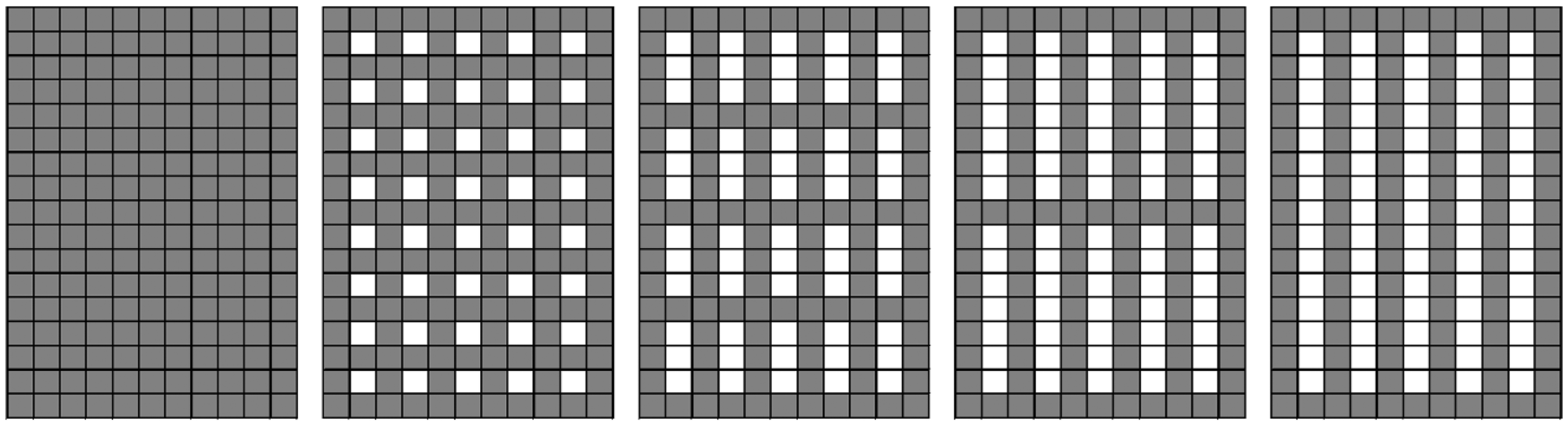
Schematic diagram of open-grid structures formed in the woven fabrics (gray squares: conductive core yarns; white squares: polyester yarns).
The specifications of conductive fabrics.

*C represents the stainless steel/cotton core yarn and P represents the polyester yarn.
Fabric samples have been coded according to their weave pattern, warp and weft densities as in Table 2. The letter and number in each fabric code represent weave patterns and weft yarn arrangement, respectively. The fabric samples are shown in Figures 4 to 7.
3/1 twill weave: (a), (b), (c), (d), (e) fabric samples woven with C; CP 1:1, CP 1:3, CP 1:7, CP 1:15 weft arrangements, respectively. Cellular weave 1: (a), (b), (c), (d), (e) fabric samples woven with C; CP 1:1, CP 1:3, CP 1:7, CP 1:15 weft arrangements, respectively. Cellular weave 2: (a), (b), (c), (d), (e) fabric samples woven with C; CP 1:1, CP 1:3, CP 1:7, CP 1:15 weft arrangements, respectively. Cellular weave 3: (a), (b), (c), (d), (e) fabric samples woven with C; CP 1:1, CP 1:3, CP 1:7, CP 1:15 weft arrangements, respectively.


Method
The thickness of fabrics was measured with a digital thickness gauge meter. Five numbers of the samples were measured.
The fullness of fabrics was calculated by [10]

Radiation absorption measurement of the prepared samples of fabric types was performed using Geiger Muller (GM) gas filled radiation detector in the geometry as shown with Figure 8. GM detector was preferred to radiation measurements because of relatively higher detection efficiency than scintillator or semi conductor detectors. Also, dose studies are commonly based on gas-filled detectors (such as ionization chambers) for all types of radiation particles in dosimetry science.
Illustration of radiation (nuclear) absorption experiment. (1) Initial intensity I0 was counted without a fabric sample in air media. (2) Intensity I was counted while the sample is between detector and source.
Firstly, a background (absence of non-natural radiation source) radiation was counted to correct the main counting. In step one, americium (Am-241) gamma radiation was counted several times to obtain the mean radiation rate in determined time in geometry of Figure 8 while there is no fabric sample between the detector and the source. This mean value represents “I0” initial intensity of radiation beams that reaches the GM detector. In step two, radiation detection-counting was done while each sample is between source and GM detector. This value represents “I” transferred part of gamma radiation by the samples. Transfer and abruption rates of the samples were calculated by fractions of I/I0. Each sample was measured five times.
Am-241 radionuclide was used as the radiation source (point source geometry). Single source energy was used instead of variable energies, because for using different energies the X-ray tube is needed and proper radioprotection shielding is also required during experiment. Despite this situation, Am-241 has gamma energy (Figure 9) in the range of X-ray region and this region is comparable to medical radiation energies.
Decay scheme of Am-241 [11].
While transferred part, T, was calculated from equation (2), absorbed part, A, was calculated from equation (3)


In this method, it is not necessary to calculate the real intensity I0 because I/I0 rate does not change by calculating real (raw) counting rate in unit count/time.
Radiation absorption measurements were evaluated statistically by ANOVA according to the General Linear Model with SPSS 15.0 software package. In order to analyze the effect of weave and conductive weft density, a multivariate analysis was made. Significance degrees (p), which were obtained from ANOVA, were compared with a significance level (α) of 0.05. The effect, whose significance degree was lower than 0.05, was interpreted as statistically important.
Results and discussions
The thickness and transferred intensity of conductive fabrics.

Although the fullness of samples B1–B5 is the highest, the transferred intensity of samples B1–B5 is the lowest. And also, the fullness of samples C1–C5 and D1–D5 is higher than samples A1–A5, transferred intensity of samples C1–C5 and D1–D5 are the lower than that of samples A1–A5.
Moreover, when the density of conductive weft yarn increased, the transferred intensity is increased as expected. The increase in fabric thickness resulted from the increase in conductive yarn density. Because, conductive core yarn has high bending rigidity; thus, the fabric thickness becomes big.
The transferred and absorbed parts of radiation for each fabric are shown in Figure 10. It is observed from Figure 10 that the absorbed part of radiation increased in agreement with fabric thickness, whereas the transferred part of radiation decreased. While the samples B1–B5 have the lowest transferred part of radiation due to their highest fabric thickness, samples A1–A5 have the highest transferred part of radiation due to their lowest fabric thickness. The opposite is valid for the absorbed part of radiation. If the density of conductive core yarn decreased, the transferred part of radiation increased, whereas the absorbed part of radiation decreased, as expected.
Absorption and transferring rates of initial radiation activity from fabric volume.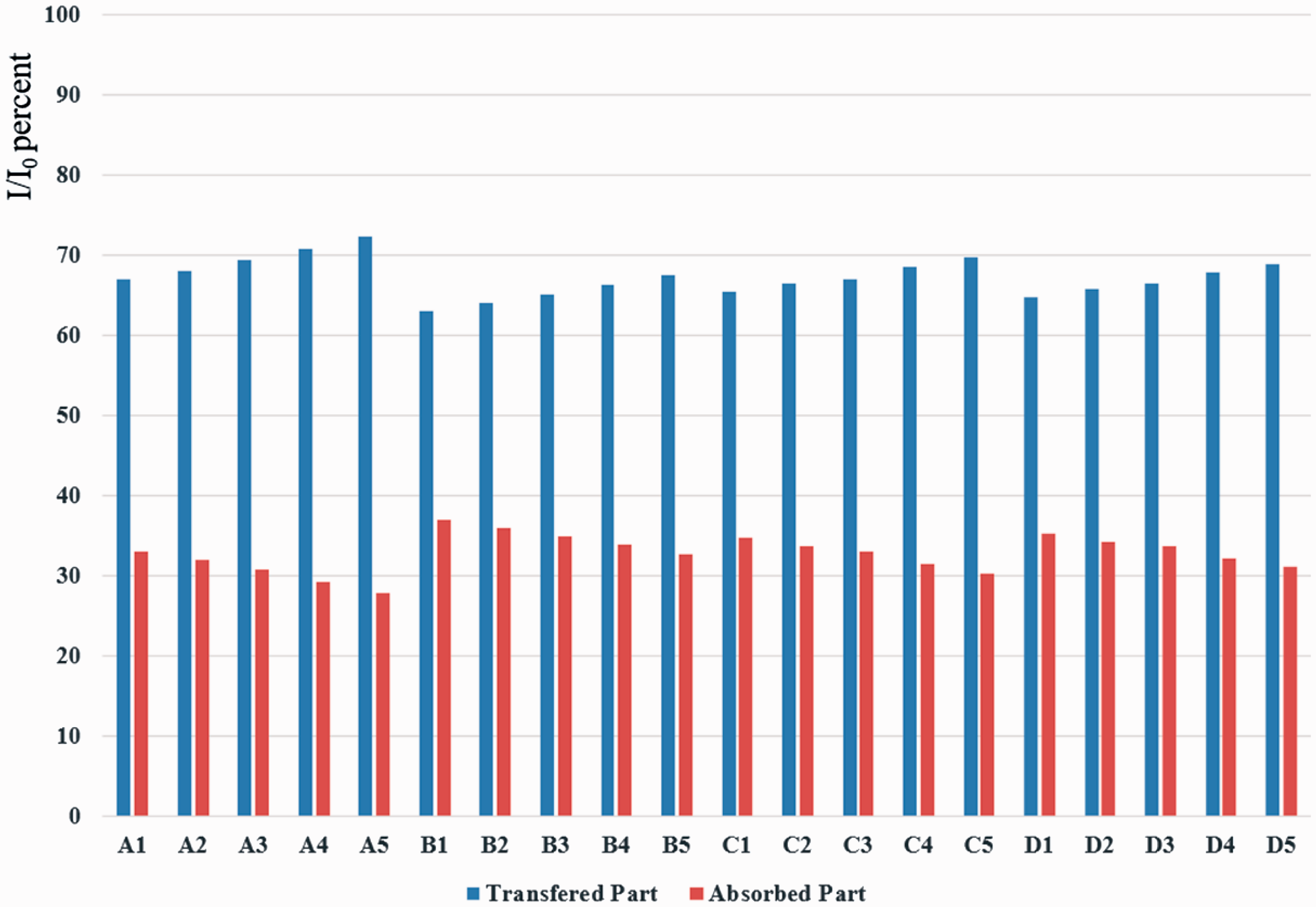
The variance analysis showed that both the effects of weave and conductive weft density on gamma radiation shielding effectiveness of conductive fabrics are statistically significant, getting the p-values of (0.012) and (0.031) respectively.
Conclusion
The main aim of this study was to develop lead-free fabrics for gamma radiation shielding, focusing on the attenuation properties. An experimental study was performed to determine the effects of weave and fabric thickness, which are fabric structural parameters, on the gamma radiation shielding effectiveness of certain cellular woven fabrics in comparison with 3/1 twill woven fabric.
With the indenting and protruding structures, cellular woven fabrics exhibited better gamma radiation shielding efficiency than 3/1 twill woven fabrics. Due to the highest fabric thickness, the sample B1, woven with cellular weave 1, showed the best gamma radiation shielding effectiveness (36.95%). On the other hand, cellular woven fabrics have the highest fullness; however, these fabrics have the highest gamma radiation shielding effectiveness. In addition to this, fabrics woven with cellular weave 2 and 3 have higher fullness than 3/1 twill woven fabrics; however, these fabrics have higher gamma radiation shielding effectiveness than 3/1 twill woven fabrics. When the conductive weft yarn density increased, gamma radiation shielding effectiveness of fabrics would increase. Theoretically, synthetic or organic materials are not affective on remarkable radiation absorption as it was mentioned in the introduction section but the metal components in the yarn composition of the fabric are dominant in the effective radiation shielding. Metal (steel) density in unit surface of the fabric is the deterministic factor for the absorption/transfer fraction.
Footnotes
Declaration of Conflicting Interests
The author(s) declared no potential conflicts of interest with respect to the research, authorship, and/or publication of this article.
Funding
The author(s) received no financial support for the research, authorship, and/or publication of this article.