




Abstract
Conductive polymers with their medium level of conductivity are synthetic materials that can be used as electromagnetic wave absorber. In this work, the effect of aging and washing on the surface resistivity and also the influence of efficient doping and redoping procedure on the dielectric properties and electromagnetic radiation shielding of uniformly polyaniline coated polyester fabric are investigated in the X-band frequency range. They can affect the shielding effectiveness by changing the surface resistivity and dielectric permittivity. It is found that lightweight, flexible, and thin polyaniline-coated polyester fabric sample prepared in 1:1:7 monomer:oxidant:dopant molar ratio and redoped with concentrated HCl vapor shows the highest transmission loss (53–43%) in 8.2–12.4 GHz. Compared to single layer, double and triple layer samples attenuated 71–61% and 83–77% of incident wave, respectively. Absorption was the dominant shielding mechanism. It is also demonstrated that the increment of surface resistivity due to washing of samples is compensated by the redoping process.
Keywords
Introduction
Recently, with the significant growth in the use of modern electronic equipment and worldwide application of wireless communication, electromagnetic interference (EMI) has become one of the main sources of environmental pollution. It caused much attention to protect sensitive electronic systems and human body against EMI and its damages especially by absorption. It can be so harmful for sensitive electronic systems as well as human health [1–4]. Shielding against electromagnetic (EM) field is a common solution for reducing these problems.
Reflection and absorption are the main shielding mechanisms against an incident EM field. Reflection results from the impedance mismatch between free space and shield. This phenomenon depends on the material’s conductivity, dielectric permittivity, and magnetic permeability. In this way, metal plates, metal-coated surfaces, and recent light weight and flexible fabric coated with metal thin films are the best candidates in EMI shielding via reflection [5–8]. But corrosion susceptibility is one of the main limitations of these metallic shields.
On the other hand, incident EM field may attenuate and lose their energy into heat via absorption mechanism. Particularly, radar signatures absorbing materials have gained much interest in military applications by reducing radar signatures and hide desired devices from detection.
Over the past few decades, conductive polymers have gained interest due to their wide range of technological applications in some areas such as sensors [9–12], solar cell [13,16], static dissipation layer, EMI shielding [17–19], etc. Most widely reports from different research groups in EMI shielding published in recent years especially based on conductive polymers and their nanocomposites by using various dielectric and magnetic nanostructures as filler [20–21]. Their results show that in different frequency bands, up to 99% of microwave can be shielded successfully.
In this way, fabrics coated with absorber materials such as conductive polymers bring flexible, lightweight, antistatic, and efficient EMI shield in different frequency ranges [23–30]. Among various types of conductive polymers, polyaniline (PANI) is very interesting [28,32].
Håkansson et al. investigated the rule of dopant and oxidant of polypyrrole (PPy)-coated polyester-lycra pristine fabric and achieved the maximum total shielding of around 86% in 18 GHz [29]. Saini et al. provided the total attenuation of 92% for PPy and 88% for PANI grafted fabric in 8.2–12.4 GHz [31]. Engin and Usta provided about 81% transmission loss for PANI0coated polyester fabric in 2–2.3 GHz [26]. However, variation of surface resistivity, and hence of PANI-coated polyester due to aging and washing, has not been studied previously.
The effect of some synthesis conditions such as etching the substrate before polymerization, temperature, time, monomer to oxidant ratio, and dopant concentration during polymerization and redoping process with different agents after polymerization on the DC surface resistivity of the coated fabrics were investigated in our previous work completely [37]. It was found that in addition to different synthetic conditions that were studied with some research groups, etching the fabric surface before polymerization and redoping after it have significant effect on decreasing the surface resistivity of PANI-coated polyester fabric. The main purpose of this research is to obtain an effective and stable microwave shield so that absorption becomes the dominant shielding mechanism in it.
In the present work, the shielding effect of these flexible, thin, lightweight, and low resistive samples is investigated. The effect of dopant concentration, redoping process, and redoping agent types on the dielectric properties and electromagnetic shielding effectiveness (SE) of PANI-coated fabrics is examined in the X-band (8.2–12.4 GHz) frequency range. In addition, the effect of aging and washing on the surface resistivity of samples is investigated. Redoping process is proposed as a fast and effective method for recovery of samples which have been used for a long time to their initial state. Also, to achieve higher SE, multilayer structures have been studied. Moreover, based on a standard fitting procedure, a simple relation for SE of samples as a function of surface resistivity is obtained.
Experimental procedure
Fabrication of PANI-coated polyester fabric
Hundred percent polyester plain-woven monofilament fabric with 45.5 g m−2 area density and 120 mesh counts (per cm) were used as substrate. It was uniformly coated with PANI via in-situ chemical polymerization method. As reported in our previous study, the coating process contains three main steps: preparation of substrate, polymerization, and redoping process [37].
At first, substrates were washed with distilled water and immersed in 60℃ etching bath which consists of 8 vol% HCl (37%, Merck), 8 vol% H2SO4 (98%, Merck) and 4 vol% H2O2 (Merck) as oxidative agents for 90 s. Then, surface ions and abrasives were removed using 20 vol% H2SO4 solution at 60–70℃ for 30 s.
Uniform coating of PANI over the modified polyester fabric was carried out using in-situ chemical polymerization of aniline (Merck) as monomer and ammonium peroxydisulfate (APS, Merck) as oxidant agent in an ice-water bath (2 ± 1℃) without any stirring. Substrates were soaked in monomer solution (2 ml of aniline in 100 ml aqueous HCl solution) for about 90 min to diffuse monomer to the polyester fibers, before oxidant agent (5 g APS dissolved in 50 ml distilled water) addition. The polymerization time was 6 h in all cases and the monomer:oxidant molar ratio was 1:1 based on the optimized conditions that were obtained in our previous work [37]. To investigate the effect of dopant concentration, HCl dopant to monomer molar ratio of 3, 7, and 9 was applied. Finally, additional surface precipitates were removed by washing PANI-coated fabrics with distilled water.
Finally, concentrated HCl vapor, 1 M HCl and 1 M Toluene 4-sulfonic acid (PTSA) solutions were used as redoping agents. Redoping time was 5 min for concentrated HCl vapor and 24 h for 1 M HCl and 1 M PTSA solutions.
To test washing fastness, the treated samples (5.0 × 7.0 cm2) were immersed in nonionic soap solution of 5 gL−1 concentration with liquid to sample ratio of 50:1 for 45 min at 50℃ according to ISO 105-C01 standard that is a mild washing method. After that, the samples were washed with distilled water and dried at 50℃.
Instrumental analysis and measurements
According to the special structure of fabrics, thickness and surface resistivity of samples should be measured via standard methods. The surface resistivity was measured by using a homemade set-up based on AATCC 76-1995 method [38]. The resistance (R) between two copper electrodes was measured by a digital multimeter and then the surface resistivity (Rs) was calculated using
The thickness of sample was measured by SDL Atlas digital thickness gauge (M034A) according to ASTM D-1777 standard test method (4.14 kPa). Mass per unit area (g m−2) was calculated according to ASTM D-3776. Washing fastness test has been done based on ISO 105-C01 standard. The fastness of PANI-coated thin film against abrasion was determined by SDL Atlas 238-B electronic crock meter, AATCC gray scale and color assessment cabinet based on AATCC 8 standard method.
The surface structure of coated fabrics was examined using TESCAN SEM system.
In order to evaluate the microwave properties, the scattering parameters (S11, S22 and S21, S12) were measured by vector network analyzer (Agilent E8364B) and X-band waveguide (in the frequency range of 8.2–12.4 GHz). The samples were cut appropriately to reach an area of 26.0 × 14.0 mm2. Before each measurement, the set-up was calibrated carefully. All measurements were carried out at room temperature. Each data was an average value of five measurements.
Reflection and transmission coefficients were calculated using measured scattering parameters as R = |S11 (or S22)|2 and T = |S21 (or S12)|2. The absorption coefficient was obtained as A = 1−R−T. The complex permittivity was calculated using experimental scattering parameters S11 and S21 by Nicolson and Ross and Weir technique [40,41].
Results and discussion
The EM shielding effectiveness behavior of a material depends on its conductivity, relative complex permittivity and permeability [39]. Since we have used a nonmagnetic material in this work, permeability is equal to that of free space and it is not an effective parameter in shielding. In these cases, conduction and dielectric loss are two main ways which can cause energy dissipation.
Morphology of coated fabric
The PANI thin film coated on the polyester fabric form a uniform dark green surface. SEM images of coated fabric in Figure 1 show that a thin film of PANI coated on fabric uniformly.
SEM images of (a and b) PANI-coated polyester fabric, (c) pristine polyester surface, (d) scratched coated fiber [37].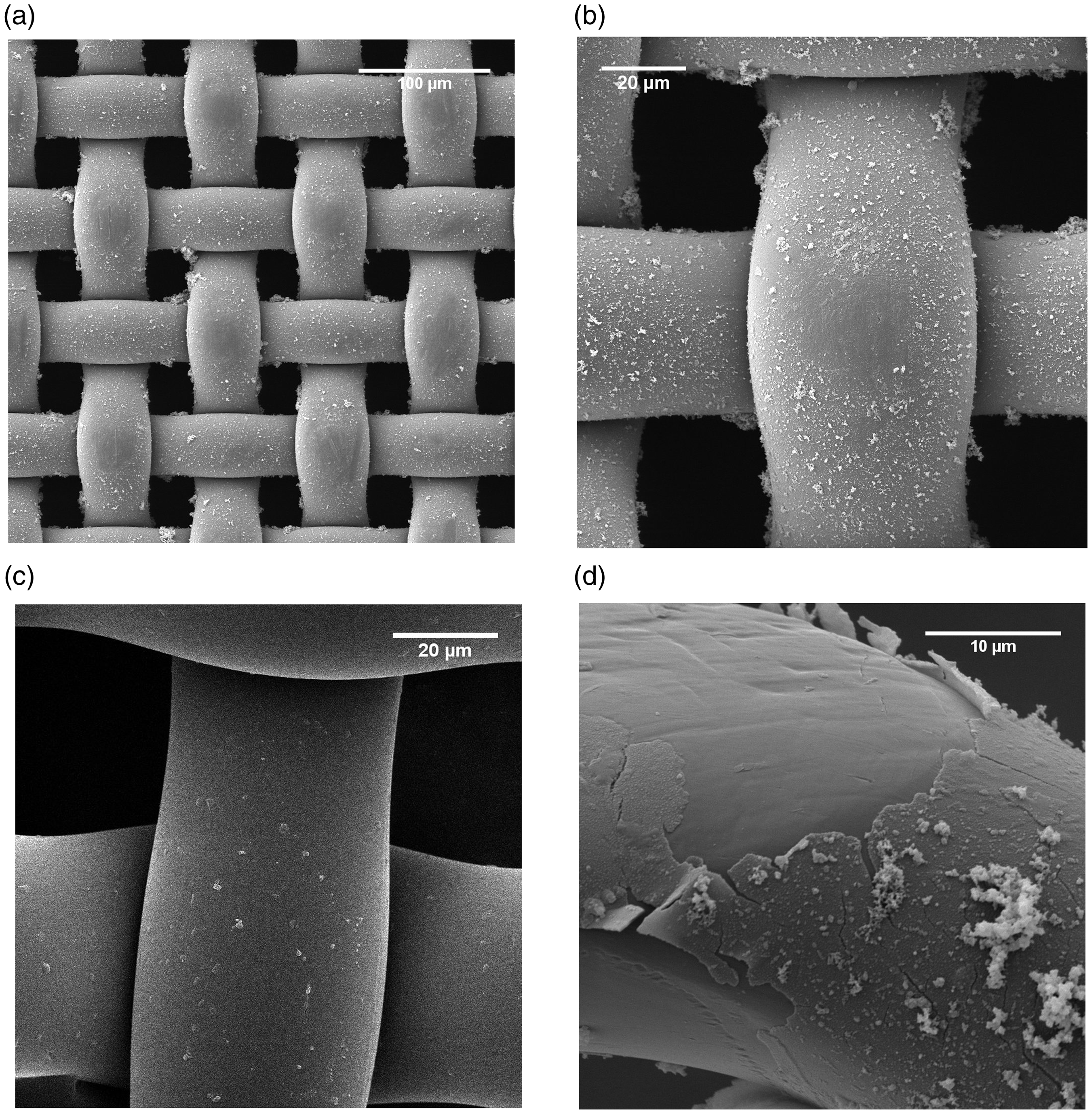
As shown in Figure 1(c), the thickness of PANI thin film coated on substrate is about 1 µm. Also, the average thickness of coated polyester fabric using standard method was 50 µm.
Surface resistivity of coated fabric
Electrical conductivity is one of the important characteristics that mainly determine reflection and absorption of the incident EM wave. Samples with high value of electrical conductivity are good reflectors, while conducting polymers with medium level of conductivity are good microwave absorbers [39].
Redoping process by concentrated HCl vapor is an effective and economical way for fast decrement of surface resistivity. It is motivating to use these as light weight and flexible microwave absorber. As we reported in the previous work, the number of free charges produced along the polymer chain is increased by increasing dopant concentration and redoping process.
Surface resistivity (Rs) of different samples during aging (Ω/sq).

Surface resistivity during washing fastness procedure (Ω/sq).

The effect of washing and abrasion fastness
After the washing fastness test of PANI-coated fabrics, any change in the color of samples was not observed and their fastness was excellent. However, washing increased the surface resistivity of samples. To compensate this increment, all samples were redoped again. The measurements show that the surface resistivity is restored completely by effective redoping process.
As a result of measurement, the fastness against abrasion was between 2 and 3. Therefore, these coated fabrics are suitable for low abrasion applications.
Dielectric properties of PANI-coated fabric
Relative dielectric permittivity (
In conjugated polymers such as polyaniline, two types of charges are presented which contributed to the conduction and polarization of the structure. Polarons and bipolarons are the first type that can move along the polymer chain freely. Bound charges (dipoles) are the second type that causes strong polarization due to their limited mobility [42,43].
Some permanent electric dipoles are created in the structure by effective doping and redoping process which contributed to improving orientational polarization and dielectric constant magnitude. Moreover, the ionic polarization improves by producing some delocalized π-electrons (mobile charges) in the polymer chain via redoping with HCl and PTSA solutions or concentrated HCl vapor as found in our previous study [37]. Hence, different dopant concentrations and redoping process vary both real and imaginary parts of dielectric permittivity. As shown in Figure 2, by increasing the dopant concentration or using the redoping process, the number of free charge carriers in polymer chain and hence the dielectric loss ( Real (
Because electric dipoles cannot reorient themselves with applied field in this frequency range, active polarization mechanism is not seen here [30,39]. As the results show, PANI-coated fabric redoped with PTSA 1M solution possesses higher dielectric constant due to higher permanent electric dipoles.
Compared to the real part of dielectric constant, the imaginary part is frequency dependent and decreases from 8.2 to 12.4 GHz in all cases.
Our results indicate that samples with higher DC conductivity have higher dielectric loss and hence more AC conductivity ( Dielectric loss tangent in the frequency range of 8.2–12.4 GHz.
Shielding effectiveness of PANI coated fabric in X-band
As a result of increment in total conductivity ( Absorption, reflection, and transmission percentages for bare and polyaniline-coated samples with different dopant concentrations. Absorption, reflection and transmission percentages for polyaniline-coated samples with different redoping agents.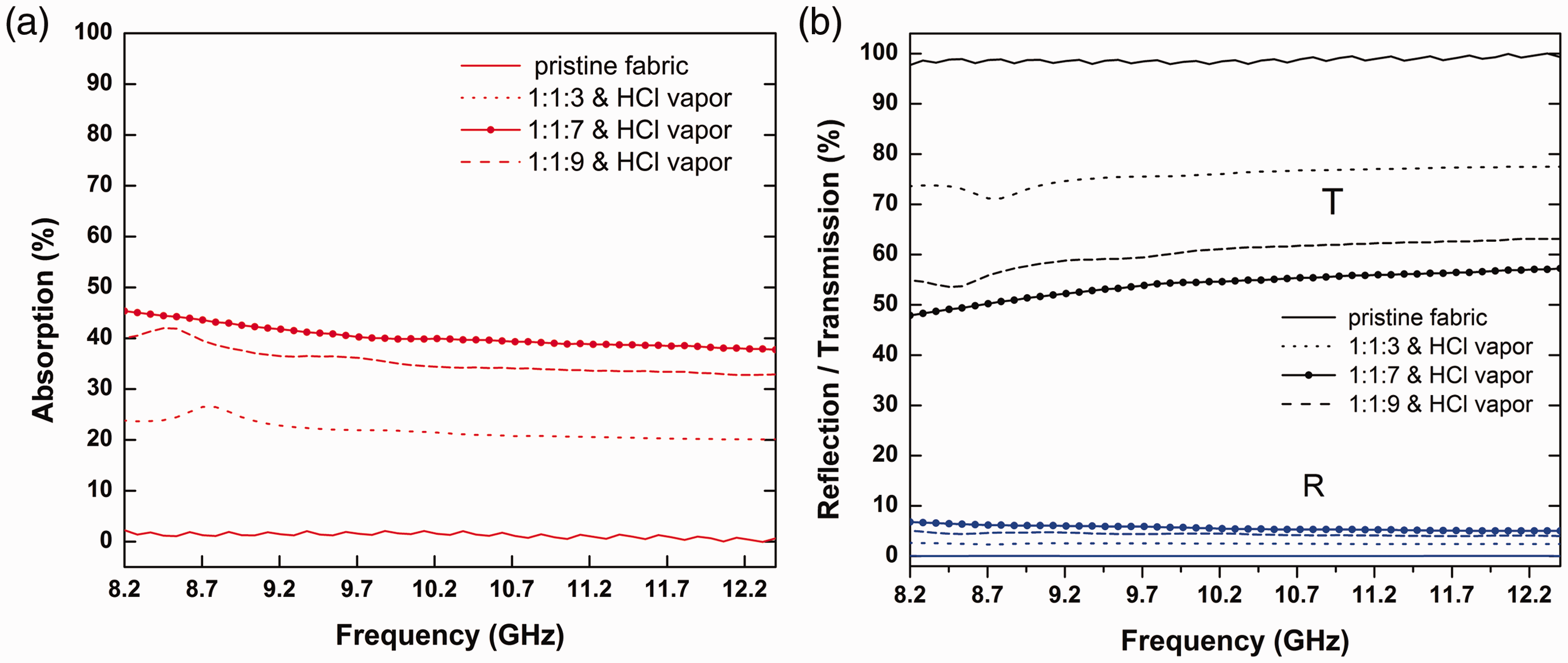

In comparison, for uncoated polyester fabric, the incident wave transmitted completely without any reflection or absorption.
Also as depicted in Figure 5, PANI-coated fabric without redoping does not have significant efficiency in microwave shielding (<15%). Redoping can significantly improve SE of coated fabric especially via absorption by an effective decrement in the surface resistivity and increasing the dielectric loss value. The measurements show that the sample with 1:1:7 monomer:oxidant:dopant molar ratio, that was redoped with concentrated HCl vapor for about 5 min, achieves the highest total transmission loss (53–43%) in the 8.2–12.4 GHz frequency range, compared to the samples that are redoped with HCl and PTSA 1M solutions. The maximum absorption and reflection of the best conductive sample with the thickness of about 50 µm are 45–38% and 8–5% in X-band frequency.
In comparison to previous works, very low thickness fabric and PANI thin film was used here. Furthermore, the area density of these lightweight polyester fabrics (with an open area between fibers) is lower compared to fabrics with twisted and compact structure. Therefore, the SE of single layer is not so much here; however, applying multilayer structure of these samples improved the transmission loss by about 30%.
As shown in Figure 6, the total transmission loss of double and triple layer PANI-coated samples (1:1:7 and concentrated HCl vapor) is 71–61% and 83–77% and the corresponding absorption percentages are 53 and 64, respectively. Higher SE of multilayer structure is mainly due to greater absorption. The results also imply that the shielding effect of coated fabric is improved by increasing the thickness and compactness of its fibers.
Absorption, reflection and transmission percentages of double and triple layer samples.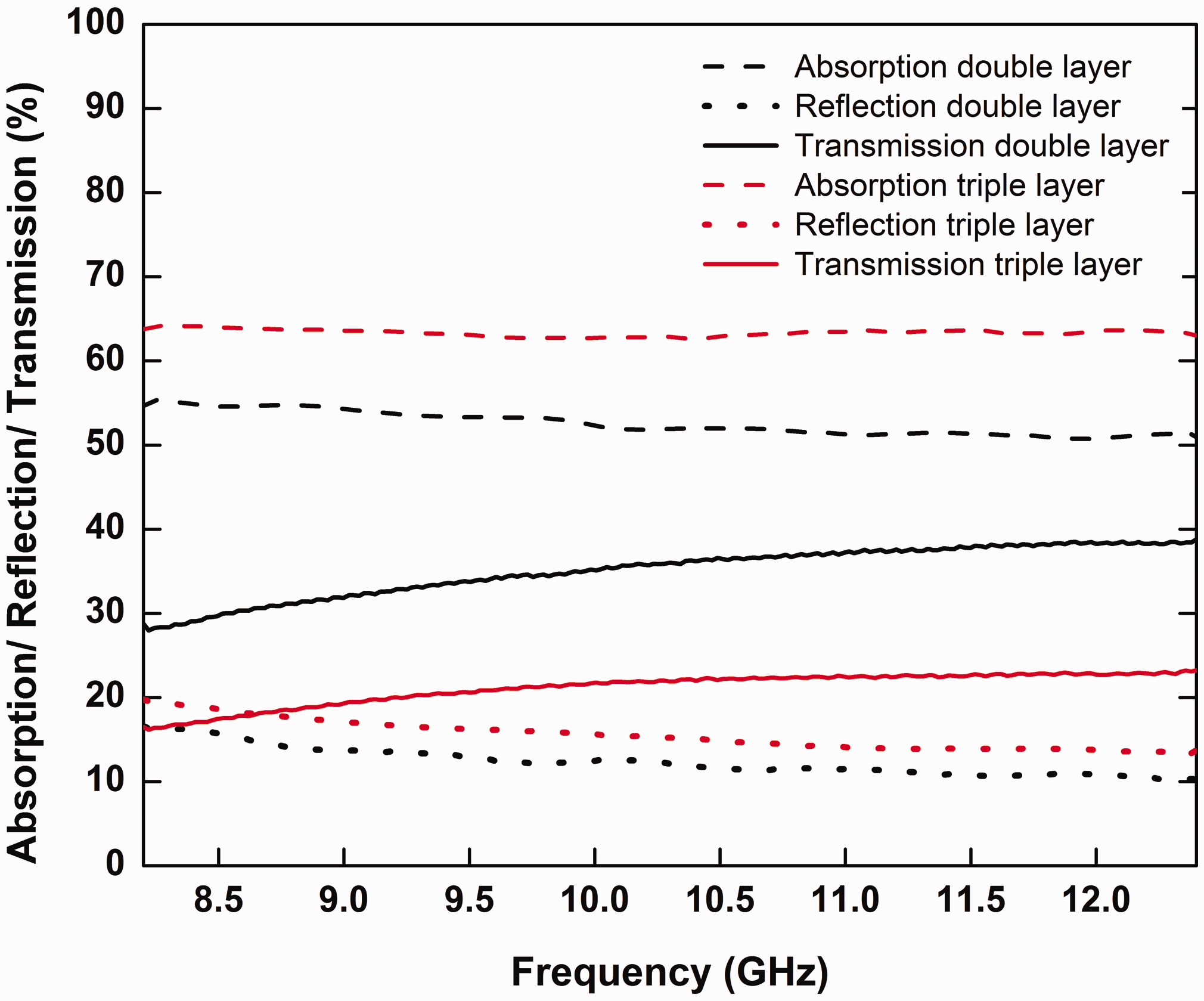
The results show approximately 10% reduction in the total transmission loss for all samples, by increasing the microwave frequency from 8.2 to 12.4 GHz.
The total SE of a material is generally defined as



Here Shielding effectiveness of polyaniline coated fabrics with different surface resistivity and fitted curve at f = 10 GHz.
All of the results are reliable because the microwave tests were carried out 40 days after sample preparation, i.e. when stable conditions achieved.
Conclusion
This research follows our previous study that suggested a simple, fast and effective method to improve the conductivity of PANI-coated polyester fabric. As a result of aging, the surface resistivity becomes nearly stable after an increment during 30 days after coating. It was shown that after mild washing, the surface resistivity can be recovered by repeating the redoping process. It is found that, light weight polyester fabrics coated with a uniform PANI thin film have proper surface resistivity and can be incorporated as shield against EMI. In addition to the significant role of effective doping and redoping process on the surface resistivity, they also improve the dielectric properties and especially dielectric loss magnitude (about 10 times) in the X-band frequency range. The reason is ionic and orientation polarization which produces great number of free charge carriers and permanent electric dipoles in the polymer chain. Also the loss tangent has been increased and a thin and flexible shield (against microwave) for 8.2–12.4 GHz was obtained. By using suitable synthesis method, we achieved light weight, flexible, low cost and antistatic samples with uniform surface with the highest microwave shielding (53–43%) in the 8.2–12.4 GHz frequency range. The medium level of SE due to low PANI-coated thin film and fabric thickness (1 µm and 50 µm) and an open area between fibers has been achieved. Also, double and triple layer samples attenuate 71–61% and 83–77% of the incident field. It is clear from the results that absorption is the dominant mechanism and multilayers of these PANI-coated fabrics can be applied as EMI shield that also reduce the environmental pollution. Moreover, empirical relation for SEtot has similarity with theoretical relation.
Footnotes
Declaration of Conflicting Interests
The author(s) declared no potential conflicts of interest with respect to the research, authorship, and/or publication of this article.
Funding
The author(s) received no financial support for the research, authorship, and/or publication of this article.