




Abstract
Geotextiles primarily provide reinforcement, and their tensile properties can resist stresses and prevent soil structure deformation. Nonwoven geotextiles are also commonly used in railways, roads, soil and water conservation, and therefore their applications are subjected to climatic environments and geographical environments where the geotextiles are used. Therefore, this study recycles and reclaims Kevlar selvages that are then incorporated with polyester fibers and low-melting-point polyester fibers in order to form nonwoven geotextiles. The tensile properties of the geotextiles in relation to various ambient environmental temperatures are examined with the test temperatures being set as 25℃ (control group), 50, 60, 70, and 80℃. Statistical analyses are performed to examine the effects of fiber blending ratios, needle punching depth, and thermal treatments on the tensile properties of the nonwoven geotextiles. The test results indicate that nonthermally treated nonwoven geotextiles have a tensile strength that is significantly increased when the ambient temperature is increased. In contrast, according to the insignificant differences obtained from statistical analyses, the tensile strength of thermally treated samples is independent of the ambient temperatures, indicating that thermal treatment allows for heat setting of the geotextiles. In particular, the thermally treated polyester/low-melting-point polyester/Kevlar nonwoven geotextiles have the maximum tensile strength when they are composed of a blending ratio of 60/20/20 wt% and a needle punching depth of 0.5 cm.
Introduction
Global weather changes cause extreme weather that causes severe damage, including landslides, debris flows, flood hazards, and sediment disasters. The common method is to use engineering methods to encounter disasters, and thereby decrease the damage to lives and properties. Geotextiles are defined as planar products that are made from polymers and are compatible with soil, rocks, land, or other geotechnical engineering materials in order to be a part of a man-made project, structure, or system [1]. Geotextiles include woven fabrics and nonwoven fabrics. In particular, nonwoven geotextiles have efficient production, low production costs, a large range of pore sizes, and satisfactory water permeability, and thus account for the majority of geotextiles. Fibers are processed with carding, laying, and needle punching in order to form nonwoven fabrics.
Nonwoven geotextiles commonly consist of polyester (PET) fibers or polypropylene fibers, the former of which have greater mechanical properties [2]. Three-dimensional crimped hollow PET fibers have satisfactory mechanical properties, chemical resistance, heat resistance, abrasion resistance, and durability. In addition, due to being crimped and three-dimensional, these fibers contribute to a fluffy structure and elasticity that facilitate drainage and filtration of the geotextiles [3]. The incorporation of a proper material design and the use of diverse fibers provide the composites with higher mechanical and physical properties, while excluding the disadvantages of using a single material [4, 5].
In recent years, recycled Kevlar fibers have been used to improve the mechanical properties of nonwoven fabrics as an environmentally friendly measure. The scientific name of Kevlar is p-paraphenylene terephthalamide (PPTA), and Kevlar is characterized by having satisfactory mechanical properties, heat resistance, flameproof properties, chemical resistance, and abrasion resistance [3, 6]. According to the study by Flambard et al. [7], recycled PPTA fibers have comparable shear resistance, abrasion resistance, fire retardance, and heat resistance with new PPTA fibers. In addition, recycled Kevlar fibers have also been commonly used to improve the mechanical properties of nonwoven fabrics, thereby addressing environmental protection concerns. Moreover, the combination of recycled Kevlar has been proven to improve the tensile strength, tearing strength, bursting strength, static puncture resistance, and dynamic puncture resistance [8–11].
Additionally, thermal bonding has been commonly incorporated with the production of nonwoven fabrics, in order to decrease the costs of raw materials and energy [8]. Fibers with different morphologies possess different bonding behaviors. The fibers with high molecular orientation and crystallinity tend to form a weak and brittle bond due to lack of polymer flow. On the other hand, fibers with lower tenacity and higher breaking elongation result in better bonding and higher fabric tensile properties [9]. Low-melting-point PET (LMPET) fibers are modified composite fibers that are composed of a sheath–core structure. The sheath contains PET with lower molecular weight. LMPET fibers form thermal bonding points where the fibers intersected, thereby reinforcing the structure of the composites [10] as well as improving their mechanical properties [11–13].
Nonwoven geotextiles provide functions that include reinforcement, protection, separation, filtration, and drainage [14–16]. Bueno et al. [17] pointed out that nonwoven geotextiles were commonly used as soil reinforcement applications in order to complement the relatively low tensile capacity of soils. In addition, their service life also depends on tensile stresses that were attributed to them, as well as the ambient environmental temperature variations [18]. Environmental factors, including air and soil temperature are dynamic, as they change with days, nights, and seasons. Moreover, these environmental factors are not constantly present in different geographical zones [19]. As global warming becomes severe, the increasing temperature results in numerous extreme climate events [20]. In addition, according to the measurements taken by the central weather bureau in Taiwan, R.O.C., the temperature of a concrete floor is beyond 50℃, while the temperature of tar roads is beyond 60℃ when the air temperature is 31℃. Moreover, the temperature of tar roads is beyond 70℃ when the air temperature is 40℃. In addition, according to the 2003–2009 report of the American Meteorological Society, the highest land surface temperature reaches 70.7℃ as seen in Figure 1 [21].
The highest temperature happening during 2003–2009 [21].
Geotextiles have mechanical properties that are in relation to the variations in temperatures, which thus emphasizes the long-term engineering design [17, 22]. Karademir and Frost [23] state that the tensile properties of geotextiles are crucial for geotechnical engineering designs. In order to simulate the corresponding ambient temperatures for the applications of geotextiles, the ambient temperatures for measuring tensile strength are required to be set within 50–80℃. In the present study, statistical analyses have also been carried out to examine how different parameters like fiber blend ratios, thermal treatment conditions, and needle punching depths are influencing the tensile strength of selected geotextile material.
Experimental
Materials
Specifications and characterizations of materials.

LMPET: low-melting-point polyester; PET: polyester.
Sample preparation
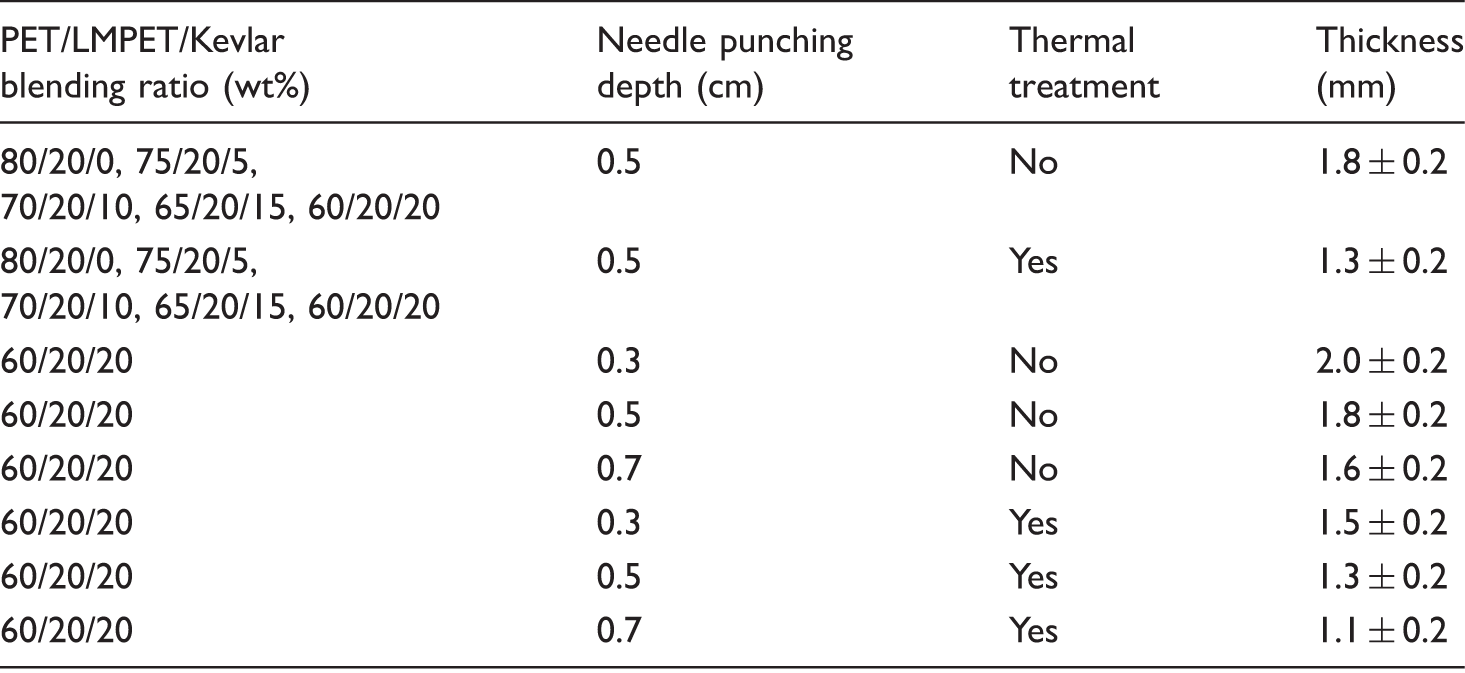
Experimental parameters and thickness of samples.
LMPET: low-melting-point polyester; PET: polyester.
Test method
The tensile strength of nonwoven geotextiles as related to different ambient temperatures has been tested via using an Instron 5566 Universal Tester (Instron, USA) that is equipped with an oven. A Eurotherm 2408 temperature controller (Eurotherm, UK) is used in order to set the ambient temperatures at 50, 60, 70, and 80℃. The control group is tested for tensile strength at a room temperature of 25℃, while the experimental group is tested for tensile strength after they are placed in the oven with the desired ambient temperature for 30 s. The whole set of testers is illustrated in Figure 2. The strength values along the cross machine direction (CD) and machine direction (MD) are both measured. For each sample combination, 10 tests have been conducted.
Tester for tensile strength as related to different ambient temperatures.
Statistical analyses
Designs of statistical analyses.

AT: ambient temperature (℃); BR: PET/LMPET/Kevlar blending ratio (wt%); ND: needle punching depths (cm); TT: application of thermal treatment.
One-way ANOVA is a statistical procedure to compare three groups or more, in terms of the variation in their means. This study uses one-way ANOVA of SPSS statistics software (version 20.0). The alpha (α) level is commonly set as 5% with a confidence interval of 95%. When p<0.05 is sustained, the results indicate significance. For specific analyses of variations between groups that is exemplified by the significant differences in one-way ANOVA, this study then uses the post hoc Scheffe’s test in order to examine between what specified parameters that the significant difference is present.
Results and discussion
Effects of fiber blending ratio and ambient environmental temperatures on tensile strength of nonwoven geotextiles
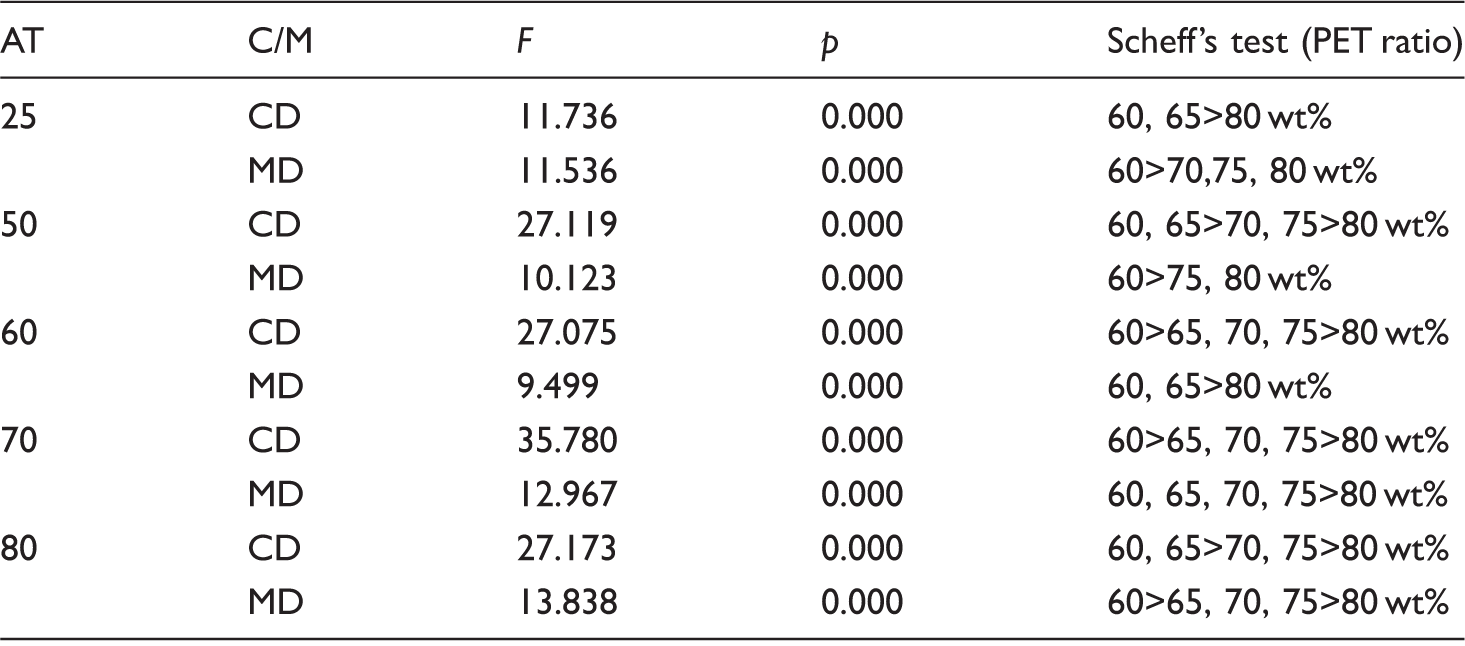
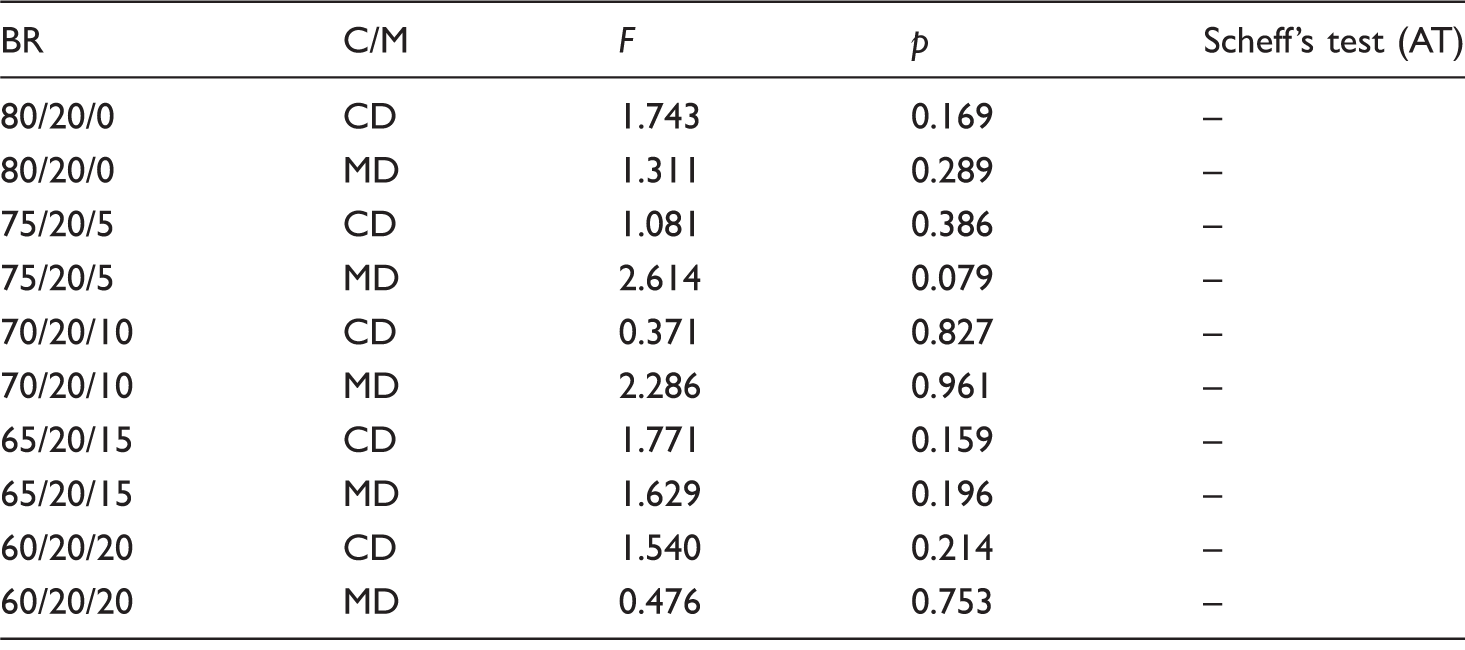
The influence of different blending ratios on the tensile strength of the nonwoven geotextiles as related to different ambient temperatures is examined in this section. LMPET fibers are specified as 20 wt%, while the content of PET fibers (80, 75, 70, 65, 60 wt%) and the content of Kevlar fibers (0, 5, 10, 15, 20 wt%) are varied. Samples are made with a needle punching depth of 0.5 cm and without thermal treatment. Figure 3 indicates that for the nonwoven geotextiles with fiber ratios of 65/20/15 and 60/20/20, the tensile strength is slightly increased as a result of the increasing ambient environmental temperature. According to Table 4, the tensile strength of the geotextiles made with five blending ratios of PET, LMPET, and Kevlar fibers is higher at 70 and 80℃ than the tensile strength of the control group (25℃). The tensile strength of nonwoven geotextiles is compared as related to different parameters means of statistical analyses, and thereby examining the significant difference in tensile strength among different groups of samples. Table 5 indicates that the tensile strength along the CD and along the MD of the nonwoven geotextiles exhibits statistically significant differences, indicating that the tensile strength is subjected to the ambient environmental temperatures. According to the Scheff’s post hoc comparison, regardless of the fiber blending ratios and CD/MD samples, an ambient temperature of 80℃ results in the highest tensile strength of the geotextiles because this temperature is higher than the Tg of the polymer. As a result, polymer transforms into a rubbery state, thereby improving the modulus of the fibers. Moreover, regardless of the control group (25℃) or experimental groups (50, 60, 70, and 80℃), the maximum tensile strength of the geotextiles occurs when they are composed of a fiber blending ratio of 60/20/20 wt%.
Tensile strength along (a) the CD and (b) the MD of nonthermally treated PET/LMPET/Kevlar nonwoven geotextiles. The tensile strength test is performed under different ambient environmental temperatures. Means and standard deviations of nonthermally treated PET/LMPET/Kevlar nonwoven geotextiles in relation to different fiber blending ratios and different ambient temperatures. AT: ambient temperature (℃); BR: PET/LMPET/Kevlar blending ratio (wt%); CD: cross machine direction; MD: machine direction; LMPET: low-melting-point polyester; PET: polyester. aThe CD/MD samples. The one-way ANOVA of the tensile strength of nonthermally treated nonwoven geotextiles with a specified blending ratio related to different ambient temperatures. AT: ambient temperature (℃); BR: PET/LMPET/Kevlar blending ratio (wt%); CD: cross machine direction; MD: machine direction. aF value refers to the variations of means between groups. A high F value shows a large significance between groups, i.e. a small significance within groups. bP values indicate the significant differences from F test, and p<0.05 shows significant differences. cScheff’s test is one method for post hoc comparison, examining the significant differences between groups.


One-way ANOVA results of the tensile strength of nonthermally treated nonwoven geotextiles in relation to different fiber blending ratios under a specified ambient temperature.
AT: ambient temperature (℃); CD: cross machine direction; MD: machine direction; PET: polyester.
Effects of needle punching depths and ambient environmental temperatures on tensile strength of nonwoven geotextiles
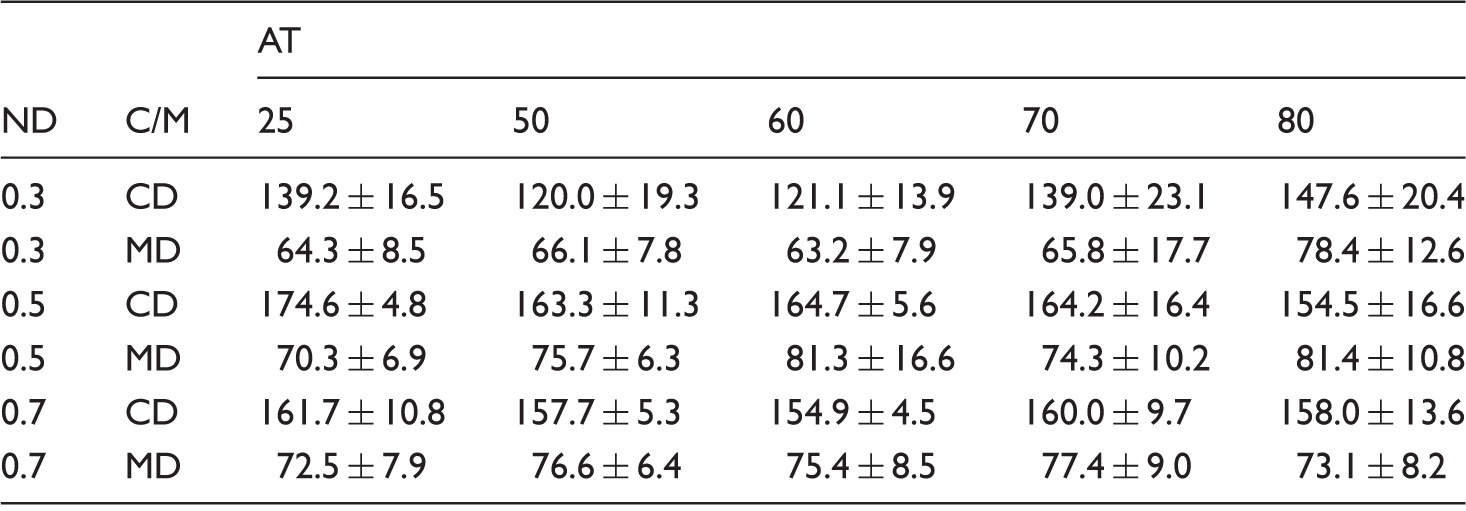
Samples used in this section are nonthermally treated PET/LMPET/Kevlar nonwoven geotextiles that are made with a blending ratio of 60/20/20 wt%. The tensile strength along CD and MD of nonwoven geotextiles, as related to different needle punching depths of 0.3, 0.5, or 0.7 cm and different ambient temperatures, is indicated in Figure 4. For the nonthermally treated nonwoven geotextiles, their tensile strength is also dependent on ambient temperatures, regardless of their needle punching depths, as indicated in Table 7. The tensile strength is then statistically analyzed based on two combinations: (a) specified needle punching depth and different ambient temperatures in Table 8, and (b) specified ambient temperature and different needle punching depths in Table 9.
Tensile strength along (a) the CD and (b) the MD of nonthermally treated PET/LMPET/Kevlar nonwoven geotextiles that are needle punched with various depths. The tensile strength test is performed under different ambient environmental temperatures. Means and standard deviations of nonthermally treated PET/LMPET/Kevlar nonwoven geotextiles in relation to different needle punching depths and different ambient temperatures. AT: ambient temperature (℃); CD: cross machine direction; MD: machine direction; ND: needle punching depths (cm). One-way ANOVA of the tensile strength of nonthermally treated nonwoven geotextiles with a specified needle punching depth, as related to different ambient temperatures. AT: ambient temperature (℃); CD: cross machine direction; MD: machine direction; ND: needle punching depths (cm). One-way ANOVA of the tensile strength of nonthermally treated nonwoven geotextiles with a specified ambient temperature, as related to different needle punching depths. AT: ambient temperature (℃); CD: cross machine direction; MD: machine direction; ND: needle punching depths (cm).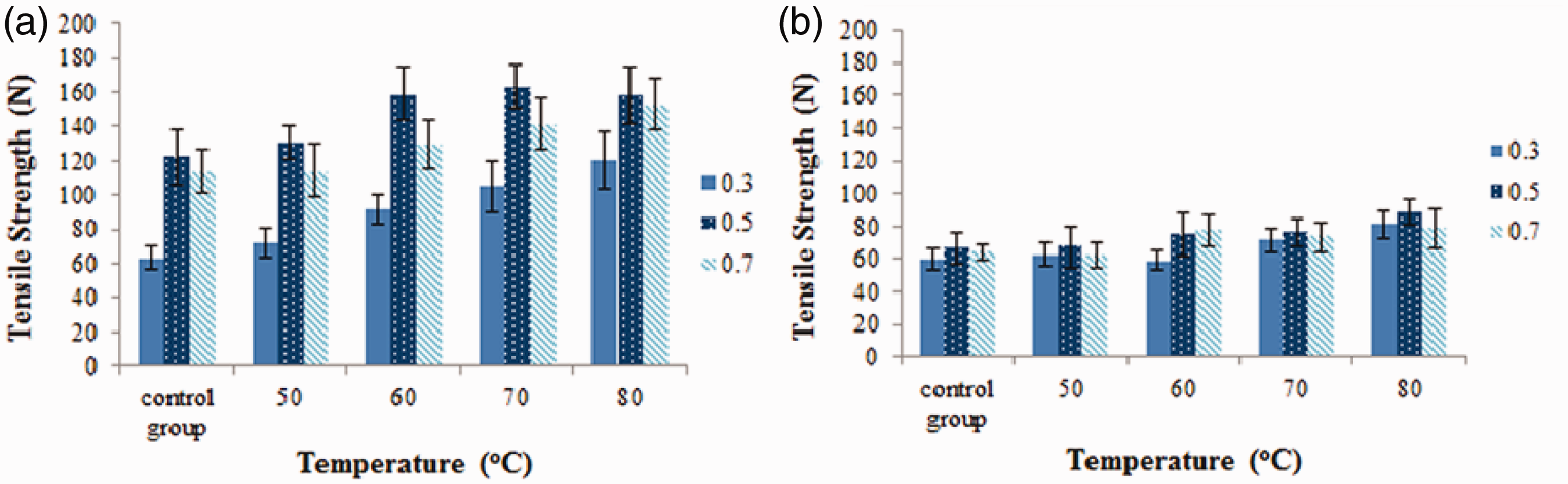
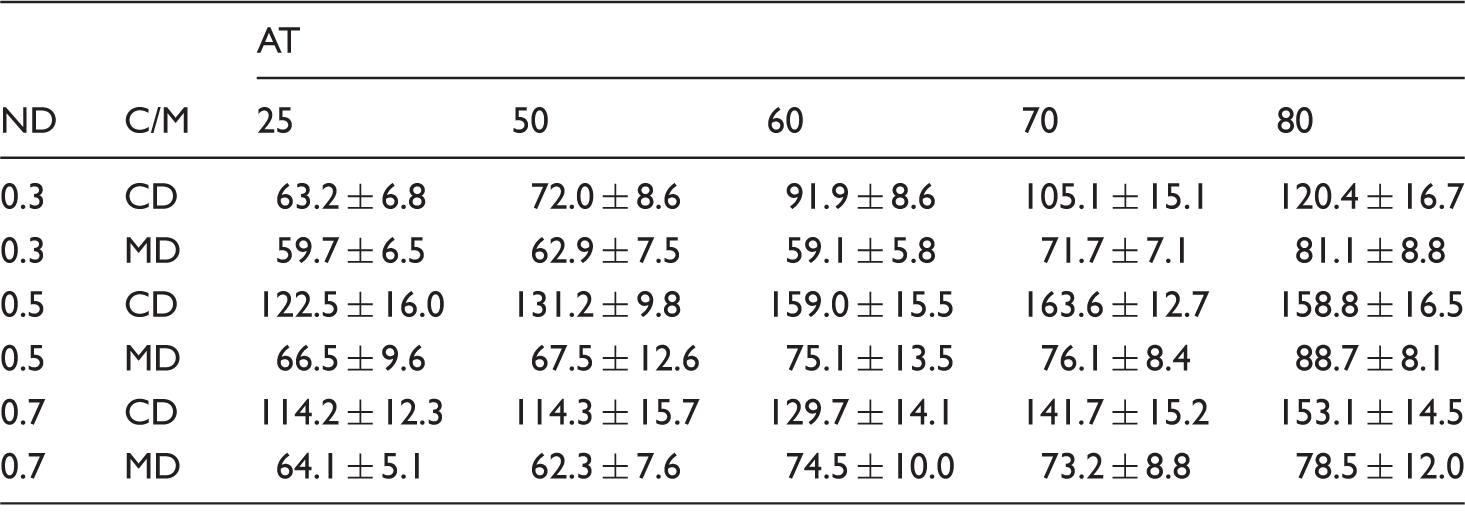


One-way ANOVA analyses in Table 8 indicate significant differences in tensile strength of the geotextiles in relation to different ambient temperatures. Scheff’s test results then show that regardless of the needle punching depths and the directions that the samples are taken (i.e. CD or MD), the maximum tensile strength of the geotextiles is present under an ambient temperature of 80℃. In addition, with a specified ambient temperature, the influences of different needle punching depths on the tensile strength of nonwoven geotextiles are then examined, as indicated in Table 9. The tensile strength along the CD of geotextiles is correlated with the needle punching depths, which is proven by the significant differences in the tensile strength along the CD. A high needle punching depth results in the entanglement between fibers and then provides the geotextiles with a compact structure. When the needle punching depth is increased from 0.5 to 0.7 cm, all of the data indicated in Table 7 trends down. However, not all the geotextiles show a significant difference in their tensile strength according to the statistical analyses. Moreover, for the geotextiles that are made with different needle punching depths, their tensile strength along the MD does not exhibit significant differences. This result is possibly ascribed to the low fiber orientation (i.e. a direction in which the majority of the fibers are aligned inside the geotextiles). With a low fiber orientation along the MD, needle punching depths have a marginal influence on the tensile strength. The majority of fibers are arranged along the CD, which decreases the influence of the needle punching depths.
Effects of thermal treatment conditions and ambient environmental temperatures on tensile strength of nonwoven geotextiles
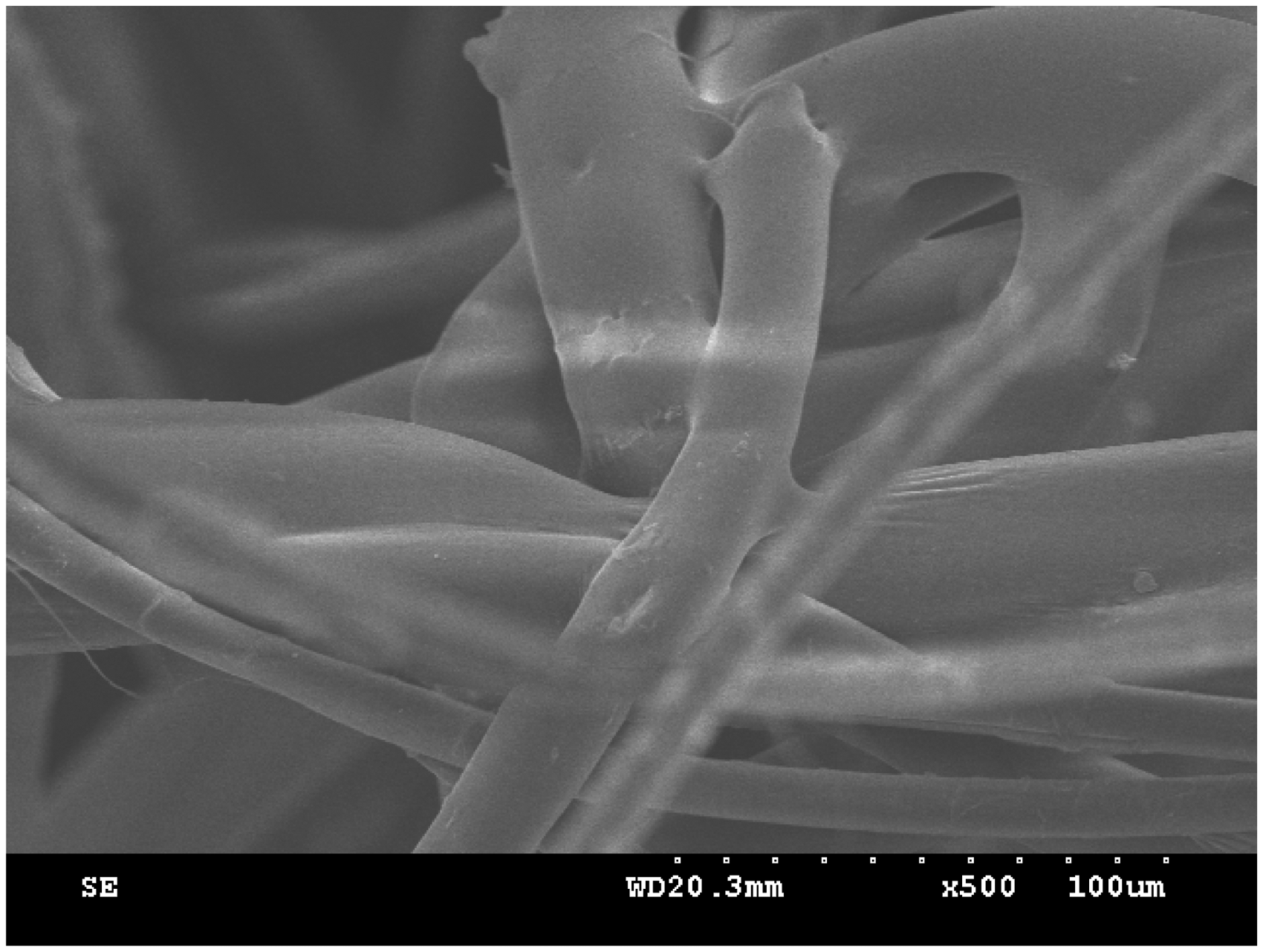
In order to examine the tensile strength of the thermally treated nonwoven geotextiles, as related to different ambient temperatures, tensile strength is examined based on two combinations of (a) a needle punching depth of 0.5 cm and different fiber blending ratios as indicated in Figure 5, and (b) a specified PET/LMPET/Kevlar fiber blending ratio of 60/20/20 wt% and different needle punching depths, as indicated in Figure 6. Similar trends are found in Figures 5 and 6, with their experimental data shown in Tables 10 and 11. Their corresponding one-way ANOVA are indicated in Tables 12 and 13, where there are no significant differences. The Tm of LMPET fibers is 110℃, and the temperature of the hot pressing is 120℃, which allows for the melting of the sheath of LMPET fibers. The formation of thermal bonding points between fibers (Figure 7) thus attains a heat setting. In addition, the nonwoven geotextiles are compressed between upper and lower heating rollers, and the resulting thermal bonding points in turn decrease the size of pores and make the structure compact. Therefore, in comparison to the nonthermally treated geotextiles, the thermal treatment facilitates the stress transmission of the nonwoven geotextiles.
Tensile strength along (a) the CD and (b) the MD of thermally treated PET/LMPET/Kevlar nonwoven geotextiles. The tensile strength test is performed under different ambient environmental temperatures. Tensile strength along (a) the CD and (b) the MD of the thermally treated PET/LMPET/Kevlar nonwoven geotextiles that are needle punched with various depths. The tensile strength test is performed under different ambient environmental temperatures. SEM images (×500) of thermal bonding points of LMPET fibers. Means and standard deviations of thermally treated PET/LMPET/Kevlar nonwoven geotextiles in relation to different fiber blending ratios and different ambient temperatures. AT: ambient temperature (℃); BR: PET/LMPET/Kevlar blending ratio (wt%); CD: cross machine direction; MD: machine direction; ND: needle punching depths (cm). aThe CD/MD samples. Means and standard deviations of thermally treated PET/LMPET/Kevlar nonwoven geotextiles in relation to different needle punching depths and different ambient temperatures. AT: ambient temperature (℃); CD: cross machine direction; MD: machine direction; ND: needle punching depths (cm). One-way ANOVA of the tensile strength of thermally treated nonwoven geotextiles with a specified fiber blending ratio, as related to different ambient temperatures. AT: ambient temperature (℃); BR: PET/LMPET/Kevlar blending ratio (wt%); CD: cross machine direction; MD: machine direction. One-way ANOVA of the tensile strength of thermally treated nonwoven geotextiles with a specified needle punching depth, as related to different ambient temperatures. CD: cross machine direction; MD: machine direction; ND: needle punching depths (cm).



Conclusion
This study successfully creates PET/LMPET/Kevlar nonwoven geotextiles, the tensile strength of which is tested under various ambient environmental temperatures. Nonthermally treated nonwoven geotextiles are made with combinations of five fiber blending ratios and three needle punching depths. An ambient temperature of 80℃ results in the highest tensile strength of the geotextiles because this temperature is higher than the Tg of the polymer. As a result, polymer transforms into a rubbery state, thereby improving the modulus of the fibers. Moreover, regardless of the control group (25℃) or experimental groups (50, 60, 70, and 80℃), the maximum tensile strength of the geotextiles occurs when they are composed of a fiber blending ratio of 60/20/20 wt%. In addition, a needle punching depth of 0.5 cm also results in the maximum tensile strength of geotextiles. Finally, thermal treatment does not cause any statistically significant differences in the tensile strength, as related to different ambient temperatures, indicating that thermal treatment provides the geotextiles with a heat setting. Namely, the LMPET fibers of the nonwoven geotextiles help stabilize the tensile strength of the geotextiles as a result of thermal treatment.
Footnotes
Declaration of Conflicting Interests
The author(s) declared no potential conflicts of interest with respect to the research, authorship, and/or publication of this article.
Funding
The author(s) disclosed receipt of the following financial support for the research, authorship, and/or publication of this article: The authors would especially like to thank Ministry of Science and Technology of Taiwan, for financially supporting this research under Contract MOST 103-2622-E-035-025-CC2.