




Abstract
In this paper, tungsten, bismuth, tin, and copper powders were used as additives in the fabric coating to obtain lead-free and flexible x-ray shielding material. The X-ray attenuation and the flexural properties of the coated fabrics were investigated considering the medical protection requirements. The results showed that tungsten additives in silicone rubber coating had better attenuation ratios than the samples that contain tungsten–tin, bismuth, and tungsten–copper, at same additive volume ratios. Moreover, the increment of tungsten volume ratios in coating blend resulted in higher shielding performance at same effective thicknesses and the lower silicone rubber amount in coating lead to compose thinner and lighter fabrics for equal protection level. In addition to that, the samples with tungsten–tin, bismuth, and tungsten–copper showed remarkable attenuation properties, and the results were found to be coherent with the theoretical values. The flex resistance and the flexural rigidity of the samples with tungsten content were also investigated. The coated fabrics with different powder loadings and thicknesses showed good resistance against repetitive folding; on the other hand, the results showed that the increment of tungsten amount in the coating resulted in stiffer fabrics.
Introduction
The personal protection against harmful effects of scattering X-ray radiation is critical for operators and patients [1]. In the past, the shielding equipment was almost limited to lead; however, in recent years the amount of lead used in products has been reduced to minimize lead’s harmful effects on people and the environment [2]. Therefore, recent studies focus on designing lead-free materials, which attenuates X-rays at equivalent lead shielding, by using alternative radiopaque metals [3]. Moreover, lead shielding equipment (i.e. aprons) is heavy and causes back strain and other orthopaedic problems [4, 5]. Furthermore, the formation of cracks and holes on sheets in shielding equipment is another concern due to folding and incorrect hanging after use, which decreases the protection level dramatically and makes the equipment unusable [6–9].
Polymer composites have become promising candidates for developing materials that can be utilized for protection against photon or particle radiation. Most polymers are transparent to X-rays [10] and recent studies have focused on developing processes that incorporate radiopaque powders into polymer sheets for effective shielding [11]. In studies [12–16], the radiopaque materials such as tungsten, bismuth, tin, copper, etc. were used to form polymer composites as alternatives to lead. In these studies, the lead equivalence and radiation attenuation properties of the lead-free polymer composites were investigated and promising results were presented. For example, in literatures [12] and [13], the X-ray protection behaviour of hydrogenated styrene–butadiene–styrene, copolymer–tungsten powder and epoxy resin–CuO powder composition were presented, respectively. On the other hand, in these studies the physical properties of the materials were not presented and the materials, which were proposed as wearable shields, were not investigated in the perspective of the physical behaviour (e.g. flexural resistance). Therefore, in our study we aimed to develop polymer compositions against X-ray radiation by reinforcing the structure with textile materials with taking into consideration the conditions of usage and clothing behaviour of the materials. For the protective material development process, radiopaque powders (i.e. tungsten, bismuth, tin, copper powders) were used as additives in polymer compositions (with different volume ratios) and were applied on woven fabrics by using the coating technique. The X-ray protection and flexural properties of the materials were investigated with the aim of reaching both adequate protection levels with metal powder additives and satisfying physical properties.
Materials and methods
Samples preparation
The properties of the coating compounds.

The mixture of coating was prepared with blending metal powders and the SR by Heidolph 2041 mechanical mixer. Before the coating process, the blend was degassed in a vacuum chamber under −0.8 bar pressure for 60 min to avoid air bubbling in the coating. The coating of the fabrics was done with knife over roll position technique and one side of the fabrics was coated by using RGK 40 laboratory type knife coating machine from Atac Machine Corporation. The coated fabrics were placed in a heating oven for 15 min at the temperature of 110℃, for curing of the SR blend.
The weight and the volume ratios of metal powders and SR in coating blend, and also the calculated density of the coating are given in Table 1. The coatings of W8-SR, W12-SR, and W20-SR samples were the blends of tungsten powder and SR with 8%, 12%, and 20% tungsten volume ratios, which corresponded to 60%, 70%, and 81% weight ratios, respectively. WSn-SR and WCu-SR correspond to the samples that were coated with the blend of tungsten–tin with SR and tungsten–copper with SR at 70% total additive weight ratio as given in Table 1. Similarly, Bi–SR samples were coated with the bismuth–SR blend, with 60% weight ratio of bismuth (Table 1).
Measurement of X-ray attenuation
The X-ray attenuation abilities of the coated samples were measured at 100 kV tube voltage (RQR8 quality) in accordance with the standard of IEC 61267 [18]. The exposure was set at 10 mA, and the distance between the X-ray tube and the detector was set to 100 cm. The fabric samples were placed between the detector and the X-ray source, at a very close position to the detector. The schematic representation of the measurement set-up is given in Figure 1.
The schematic of measurement set-up.
X-ray attenuation properties of a material are described by exponential attenuation law. The relation between X-ray and matter is given by equation (1) [19]


As can be seen from equation (1), the thickness of the shielding material is a critical parameter which has an effect on shielding ratios; therefore, the thickness of the coating is a notable design parameter for the protective fabrics. In Figure 2, a side view image of a sample (i.e. WCu-SR) which was taken in optical microscope was presented to demonstrate the coated structure. The total thickness (ttotal) of a coated sample is the sum of the base fabric thickness (tf) and the coating thickness (tc) which are representatively shown in Figure 2. However, the actual amount of coating material is not equal to the thickness on fabric surface due to woven fabric construction. The coating material penetrates through the fabric surface and fills in the cavities between yarns (Figure 2), so that the effective thickness of coating should be calculated with the help of an empirical approach. Therefore, equation (4) was proposed to calculate the effective thickness, where the coating density (g/cm3) is the average density of powder–SR blend, whereas the coating weight per unit area (g/cm2) is the difference of the coated and uncoated fabric weights per unit area.
The representative side view of a coated sample.

Measurement of flex resistance and fabric stiffness
The flex resistance measurements of the coated fabrics were done by flexometer method in dry conditions to observe the endurance of the coating, according to ISO 5402-1:2011 [20], and four specimens for each sample group were tested. In each cycle of the device, the samples were subjected to harsh creasing motion, which is focused along the centreline by the moving fold. According to the ISO standard, the samples were observed after each predetermined cycles and the folding process continued until the maximum cycle count (i.e. 250,000 cycles).
The fabric stiffness of the coated fabrics and the base fabric was measured according to ASTM D 1388-08 standard. Four specimens from warp and four specimens from weft directions were cut from each sample and the bending length of specimens were measured. The flexural rigidity was calculated from the measured length by using equation (5) as follows [21]

Results and discussion
X-ray attenuation
The radiation attenuation ratios of W8-SR, W12-SR, W20-SR, WSn-SR, WCu-SR, and Bi-SR samples with different effective thickness values were measured at 100 kV tube voltage and are presented in Figures 3 and 4. By utilizing the experimental data of the samples, a theoretical approach was used to estimate the attenuation abilities of the samples. In doing so, NonLinearModel class of MATLAB was used for non-linear regression [22]. Radiation attenuation model function is known and given by equation (1), and accordingly the curve fitting is achieved by minimizing the sum of squared errors.
The experimental data and model curves of RAR versus effective thickness of W8-SR, WSn-SR, and WCu-SR. The experimental data and model curves of RAR versus effective thickness of W8-SR, W12-SR, W20-SR, and Bi-SR. The theoretical attenuation coefficient (µ) versus photon energy graphics from XCOM database for W, Bi, Sn, Cu, cellulose, and silicone rubber.


The thickness versus RAR values of W8-SR, WSn-SR, and WCu-SR samples, in which the tungsten powder weight ratio is equal to 60%, can be seen in Figure 3. Moreover, the coating of WSn-SR includes 10% of tin powder and WCu-SR includes 10% of copper powder, where the total metal additive weight ratio is 70% for WSn-SR and WCu-SR (Table 1). It may be seen in Figure 3 at the same thickness, WSn-SR reaches higher attenuation levels than WCu-SR and W8-SR samples, whereas W8-SR with 60% tungsten powder weight ratio has the lowest values. In other words, the addition of tin and copper powder in the coating blend at 10% weight ratios resulted in better radiation attenuation performance. Moreover, at 100 kV tube voltage, the tungsten–tin combination is more effective than the tungsten–copper as additives in the textile coating, at the same weight ratio.
In Figure 4, the thickness versus RAR values of W8-SR, W12-SR, W20-SR, and Bi-SR samples are presented. As may be seen in Figure 4, W20-SR with the highest tungsten ratio has higher RAR values at the same thickness, compared to W8-SR and W12-SR with lower tungsten powder ratio in the coating. Therefore, as was expected, the tungsten powder amount in coating affects the attenuation efficiency in a positive way. On the other hand, a comparative study of the W8-SR and Bi-SR samples, having the same additive weight ratio (60%), revealed that bismuth–SR coated sample (Bi–SR) attenuated more than the tungsten-SR coated sample (W8-SR) at the same thickness. To understand this behaviour, the theoretical attenuation coefficients of continuous structures were investigated via XCOM database of NIST [23].
Attenuation coefficient (µ) of a material depends on radiation quality (filtration and energy), and at same energy the higher µ means that the material has ability to attenuate more radiation. To compare the attenuation behaviour of the materials employed in this study, the theoretical µ values were calculated using the XCOM database of NIST [23] for the energy range from 20 keV to 100 keV, since the photon energy distribution of the polychromatic beam mainly ranges in this interval at 100 kV tube voltage (RQR8 quality) with effective energy of 34.1 keV. In Figure 5, µ versus photon energy of the pure form of tungsten (W), bismuth (Bi), tin (Sn), copper (Cu), silicone rubber (SR), and cellulose is given as semi log plots. As it may be seen from the figure, SR and cellulose have very low attenuation coefficients compared to those of the metal ones. Moreover, among the metals, tungsten has the highest µ values, whilst copper has the lowest values around effective energy. According to this data, it is clear that during the interaction between metal-SR coating and X-rays, metal atoms are major attenuators of the radiation energy, and the cotton fabric has nearly no attenuation ability against X-rays within this energy range. In addition to this, the theoretical µ values of W8-SR, W12-SR, W20-SR, WSn-SR, WCu-SR, and Bi-SR coatings were calculated and plotted for the same energy range using XCOM database, considering the weight ratios of the mixtures (Figure 6). As was expected, the mixtures of metal and SR (Figure 6) have lower attenuation coefficients than W, Bi, Sn, and Cu (Figure 5). Furthermore, W20-SR with the weight ratio of 81% tungsten has the highest theoretical µ values in all mixtures for the given energy range. Also, as it may be seen, the experimental results (Figure 3 and 4) were coherent with the data of the XCOM database (Figure 6).
The theoretical attenuation coefficient (µ) versus photon energy graphics from XCOM database for coating mixtures of samples.
It should also be noted that at the same weight ratio (60%), both the calculated µ values (Figure 6) at the effective energy (i.e. 34.1 keV) and the experimental attenuation results (Figure 4) of Bi-SR were higher than W8-SR, even if tungsten has higher µ values than bismuth in pure form (Figure 5). The high density difference between metals powders (Table 1) caused significant variation between the volume ratios despite the fact that the samples had the same weight ratios. For example, the bismuth (d: 9.8 g/cm3) volume ratio in the Bi–SR was approximately 14% whilst the tungsten (d: 19.3 g/cm3) volume ratio was only 8% in W8-SR at the same weight ratios (60%). Therefore, it may be concluded that in polymer blend preparation process, taking the volume ratio into account is a much more convenient approach, when compared to the process based on the weight ratio.
Furthermore, the mean attenuation coefficient (µ) of each sample was calculated by equation (3) using the experimental data, and in Figure 7 the additive volume ratios versus the mean attenuation coefficients are accordingly presented.
Volume ratio (%) versus experimental mean attenuation coefficient of the samples at 100 kV.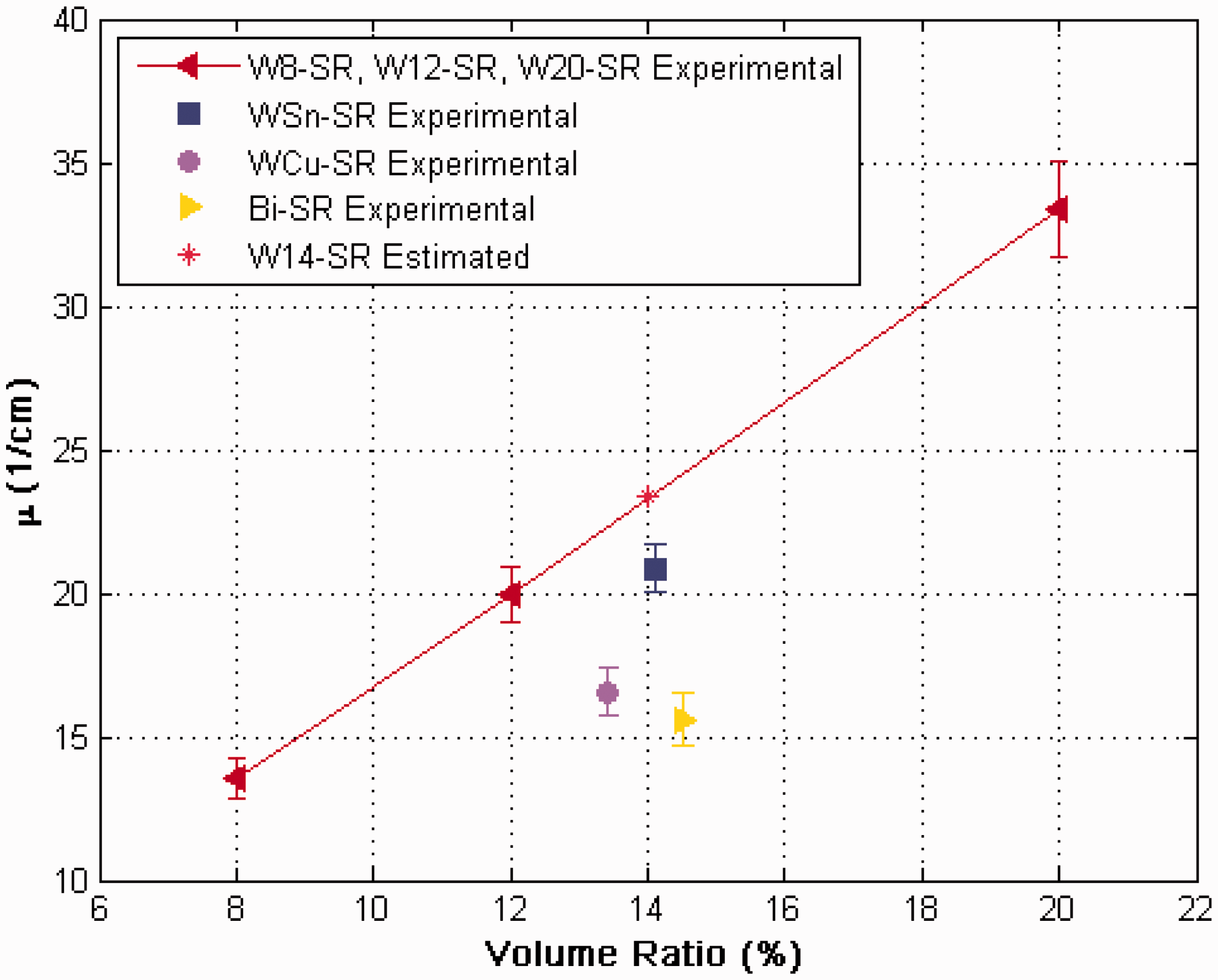
As it is known from equation (1), the material with higher attenuation coefficient (µ) attenuates more radiation, at the same thickness (t). In Figure 7, µ values of W8-SR, W12-SR, and W20-SR showed that increasing the tungsten volume ratios resulted in higher attenuation coefficients. Besides, for the given parameters the behaviour of increment is almost linear in terms of volume ratio. So, µ value of W14-SR at 14% volume ratio was estimated in order to compare it with the experimental values of WSn-SR, WCu-SR, and Bi–SR, which have nearly 14% additive volume ratio. Figure 7 demonstrated that the estimated attenuation coefficient of the coating with 14% tungsten (W14-SR) was higher than the samples with tungsten–tin (WSn-SR), tungsten–copper (WSn-SR), and bismuth (Bi–SR) additives. Also, the mean µ values of Bi–SR and WCu-SR were close and the µ value of WSn-SR was higher than these samples, which can be supported by XCOM data at the effective energy of this radiation quality (Figure 6). However, the experimental µ values of the samples were lower than the µ values evaluated from XCOM database, which theoretically calculates the attenuation coefficients by using the weight ratios. This may be due to the fact that the non-uniformity of the current powder–polymer composites is not taken into account in the theoretical calculations.
With the help of the µ values of the metal powder-SR coating as well as the radiation attenuation law (equation (1)), we also estimated the required coating thicknesses for a certain protection level. According to the personal protection standards, a protective clothing and/or equipment against X-rays employed in medical applications should have the attenuation performance of 90% or higher which means a protective equivalent of not less than 0.25 mm lead for X-rays up to 100 kV [24]. The lead equivalence term is used for the protective materials, which contain lead or non-lead components (e.g. lead-vinyl, bismuth-rubber) to define their radiation attenuation ability in terms of the thickness of pure lead that provides the same attenuation. In our study, 0.35 mm and 0.50 mm lead equivalence is needed to reach 90% and 95% attenuation ratios respectively, for the conditions of the X-ray attenuation measurement standard at 100 kV level. Using the theoretical models, the required thicknesses (treq) for 90% and 95% attenuation ratios were estimated for all the samples, and they are presented in Figures 8 and 9, respectively. In figures, the equivalent thicknesses of lead are also given for the same level of attenuation.
The estimated effective thicknesses of W8-SR, W12-SR, W14-SR, and W20-SR required for 90% and 95% attenuation ratios at 100 kV level. The estimated effective thicknesses of Bi-SR, WCu-SR, WSn-SR, and W14-SR required for 90% and 95% attenuation ratios at 100 kV level.
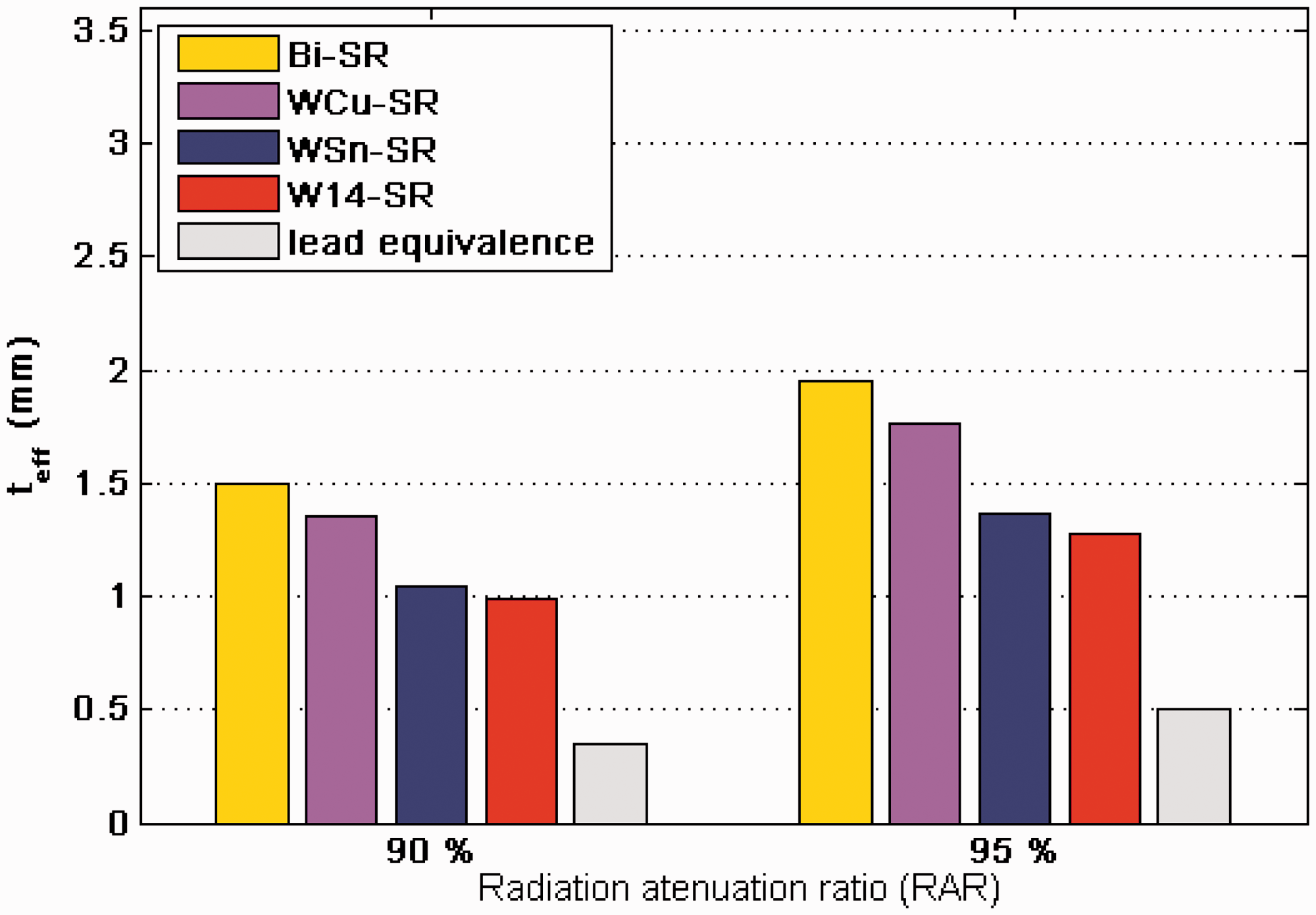
In Figure 8, the estimated thicknesses for 90% and 95% protection ratios of the coatings with tungsten additives at 8% (W8-SR), 12% (W12-SR), 14% (W14-SR), and 20% (W20-SR) volume ratios are given. As it may be seen from the figure, higher amount of tungsten in the coating leads to smaller treq values for the same protection level. For example, to obtain a 90% protection level, 1.73 mm of coating is needed for the blend with 8% tungsten additives (W8-SR), whereas for the same level of X-ray shielding 0.69 mm of coating with 20% tungsten additives (W20-SR) would be satisfactory. This suggests that lowering the ratio of SR amount in a blend causes nearly 60% reduction in thickness, which in turn makes possible to develop thinner (or lighter) fabrics having the required protection level. The estimated required thicknesses of the coatings with Bi-SR, WCu-SR, WSn-SR, and W14-SR are given in Figure 9. From the figure it may be observed that at the same protection level, W14-SR and WSn-SR samples can attenuate the radiation at lower thicknesses, in comparison to Bi–SR and WCu-SR samples at 100 kV tube voltage.
The required thickness and the calculated weights of samples at the required thickness for 90% and 95% attenuation ratios at 100 kV. The required weigths of W8-SR and WCu-SR are higher compared to the other samples, where the required weights for W20-SR and WSn-SR are lower.

Flex resistance and fabric stiffness
The flexural rigidity and flex resistance properties of the samples and base fabric.

The flex resistance tests proceeded until the maximum cycle counts were mentioned in the ISO 5402-1:2011 standard. After the completion of 250,000 cycles, no significant signs of cracking, delamination, and discoloration were observed on the coated surfaces of the fabrics, which indicates that the flex resistance of the samples are adequately good at the given additive volume ratios and coating thicknesses. Moreover, the results show that even at 20% additive volume ratio, tungsten powder-loaded silicone rubber maintains its flexible character. In addition to that, no delamination on coated fabric surface indicates that the interface adhesion between SR-based coating material and the cotton fibres is strong enough to compose X-ray protective fabrics with durability under repeated folding. So it means that, with the given parameters, the cotton fabric and the tungsten-SR composition can be a good candidate to solve the problem of cracking on the shielding equipment due to folding during usage or after use.
The flexural rigidity of each sample in warp and weft direction was calculated by equation (5) and the results are given in Table 3. As it may be seen from Table 3, the flexural rigidity of the base fabric, which is 100% cotton fabric with the weight of 110 g/m2, is low and its weft and warp direction flexural rigidity values are very close. As expected, the rigidity values of the coated fabrics are higher than the uncoated one. The bending lengths and flexural rigidity of the samples increased as the coating on the samples became thicker and heavier (Figure 10). Moreover, a comparison of the rigidity properties of W8-SR, W12-SR, and W20-SR samples revealed that the rigidity values of W20-SR samples with lower SR and higher metal volume ratios are higher than the others. So it may be concluded that the increment of tungsten additive amount in the coating blend results in stiffer fabrics. Besides, as it may be seen from Figure 10, the influence of the thickness on the flexural rigidity of the samples seems to be higher as the samples become thicker.
The flexural rigidity and the bending length values of the samples in warp direction.
In summary, the structures of tungsten powder-silicone rubber with cotton fabric base were composed with the aim of developing polymer compositions with textile reinforcement. The results of the study showed that coated fabrics with tungsten additives at different thicknesses reached the satisfying flex resistance values within the given parameters. The cotton fabric, which does not have significant effect on X-ray protection, provided an opportunity to produce flexible materials with remarkable radiation shielding abilities. Moreover, it should be noted that the rigidity of the fabric increased by the coating thicknesses and the amount of tungsten powder in the coating blend. According to the results of the X-ray attenuation analysis, we also know that coating thicknesses and powder ratio in coating are effective parameters on radiation protection. Therefore, the coating thickness and the composition of the coating can be presented as important parameters to consider the flexural properties of protective garments as well as the X-ray shielding properties.
Conclusion
The results of the present study showed that using radiopaque metal additives in a textile coating and applying the coating by conventional methods can be a promising alternative for designing protective garments that are used in the medical applications for X-ray radiation shielding. The results revealed that the coatings on the samples with the additives of tungsten, bismuth, tin, and copper at certain volume ratios can attenuate remarkable amounts of X-ray where at the same volume ratios, the samples with tungsten additives had better attenuation properties than the coatings with tungsten–tin, bismuth, and tungsten–copper additives. Besides, the coated fabrics at given thickness and additive volume ratios performed satisfactorily under the repetitive folding conditions resulting in sufficient flex resistances properties.
The results also suggested that the amount of the additive in the coating composition and the coating thickness are critical for both X-ray attenuation and the flexural properties. For the same protection level, the required thickness and the weight of the samples with tungsten at 20% volume ratio in the coating composition (i.e. W20-SR-the sample with the highest tungsten volume ratio used in the study) are lower than those of the other compositions. On the other hand, higher tungsten amount in the coating resulted in higher fabric stiffness values. Consequently, it can be stated that the parameters like the volume ratio and the coating thickness should be determined by considering both attenuation and flexural properties to achieve the required protection.
As a conclusion, it can be possible to solve the major problems of the lead aprons by obtaining lead-free, coated fabrics with very good flexibility and reasonable weights for required X-ray protection.
Footnotes
Acknowledgements
The authors wish to express their appreciation to Lale SEN (Poliser PU Synthesis R&D Manager) and Flokser Textile for their help in carrying out the flex resistance test.
Declaration of Conflicting Interests
The author(s) declared no potential conflicts of interest with respect to the research, authorship, and/or publication of this article.
Funding
The author(s) disclosed receipt of the following financial support for the research, authorship, and/or publication of this article: This work was supported by TUBITAK (The Scientific & Technological Research Council of Turkey) under the grant number 112M453 and Istanbul Technical University, BAP project under the grant number 37057.