




Abstract
To estimate the photo-oxidation aging performance of PVC-coated membrane material in atmospheric conditions under tensile stresses, the relationship between physical and mechanical properties under accelerated weathering test and outdoor weathering test is studied with the same cumulative UV radiation energy. And then, both tensile strength and whiteness index were measured and compared to characterize the property change of membrane material after aging under four different tensile stresses (0%, 5%, 10% and 20% of the breaking strength), respectively. In addition, FTIR spectrometry was applied to characterize the chemical components of the samples under different weathering conditions, and the carbonyl index was extracted. The results show that there were significant differences of tensile strength and carbonyl index between two kinds of aging conditions, whereas with the increasing tensile stresses, the whiteness index represented a consistent increasing deviation of accelerated weathering from the outdoor weathering. However, the relationship have been built between both whiteness index and tensile strength retention of accelerated weathering and those of outdoor weathering conditions after a Schwarzschild’s modification. Therefore, the service lifespan of PVC-coated membrane materials can be evaluated by accelerated weathering tests under tensile stresses.
Introduction
PVC-coated membrane materials, as the new flexible textile composite materials, are widely used in many constructions of people’s lives [1]. PVC-coated membrane materials use high-strength fabric as substrate and PVC as the coated surface. However, the performance of PVC-coated membrane materials is severely affected by external factors when they are exposed directly to the atmosphere environment during the long-term service [2,3].
Of the external factors, the ultraviolet irradiation in sunlight is the main factor affecting service performances of materials [4,5]. Simultaneously, PVC-coated membrane materials inevitably exposed to various forms of stresses under the status of long-term tensile stresses [6–8]. The existence of stresses will change physical and chemical structures of the material, accelerate its photo-oxidation aging speed, weaken its strength, shorten its aging time and then severely affect its function and lifetime. In order to predict the service lifetime of the PVC-coated membrane materials, the relationship between the accelerated weathering condition and the outdoor weathering condition under different tensile stresses should be studied. Thomas and Baker [9] exposed samples in both xenon arc test apparatus and outdoors at South Florida, and compared the tensile strength retention of samples. They concluded that the results from accelerated weathering test with xenon-arc lamp could be used to estimate outdoor performance of the material at South Florida, as long as the UV radiation energy was consistent under two kinds of exposure conditions. Yang and Ding [10] provided a possible way to predict weathering performance of polypropylene filaments with the variety of residual strength in both UVA351 test apparatus and outdoors at Shanghai. On the other hand, after aging of the PVC-coated membrane material, its surface color would also change except the mechanical properties. Yang and Qiu [1,11] further conducted to explore the correlation which was established by Schwarzschild’s law under different UV radiation intensities and light sources. Herewith, the whiteness index and the tensile strength of aging samples have been used to characterize the artificially accelerated weathering with the UV lamp under different stresses [12]; however, it is lack of a comparison of the weathering performances of materials between the artificially accelerated weathering and the outdoor weathering.
From the above-mentioned results, the whiteness index and tensile strength can be used to evaluate the outdoor weathering condition and the artificially accelerated weathering condition. However, it is unknown whether the Schwarzschild’s law can be applied to estimate the photo-oxidation aging performance of PVC-coated membrane material under different tensile stresses. Therefore, the present study will conduct the artificially accelerated weathering and outdoor weathering conditions under four kinds of tensile stresses (0%, 5%, 10% and 20% of the breaking strength), respectively, and the potential relationship between artificially accelerated and outdoor weathering tests under different stresses would be built. With the existence of stresses, the service lifespan of PVC-coated membrane materials in atmospheric environment would be evaluated by accelerated weathering tests.
Experiment and methods
Materials
Specifications of PVC-coated membrane material.

Outdoor weathering test
As shown in Figure 1, the PVC-coated membrane materials were exposed to atmospheric conditions in Shanghai. In test, the samples were hung on the metal test platform at an angle 45° to horizontal, and looked south to adequately accept the irradiation of sunlight according to ASTM G113. The samples were divided into four groups. Of four groups, one was not given a tensile stress loading (0%), and the others were loaded by 5%, 10% and 20% of the breaking strength, respectively. The loadings mainly depend on the external load level, which equals to the ratio of constant load and breaking strength [13]. In experiments, the membranes were exposed for 9 months, and it was sampled at intervals of 1 month.
Metal test stand of atmospheric aging and schematic diagram.

UV radiation under outdoor weathering condition.

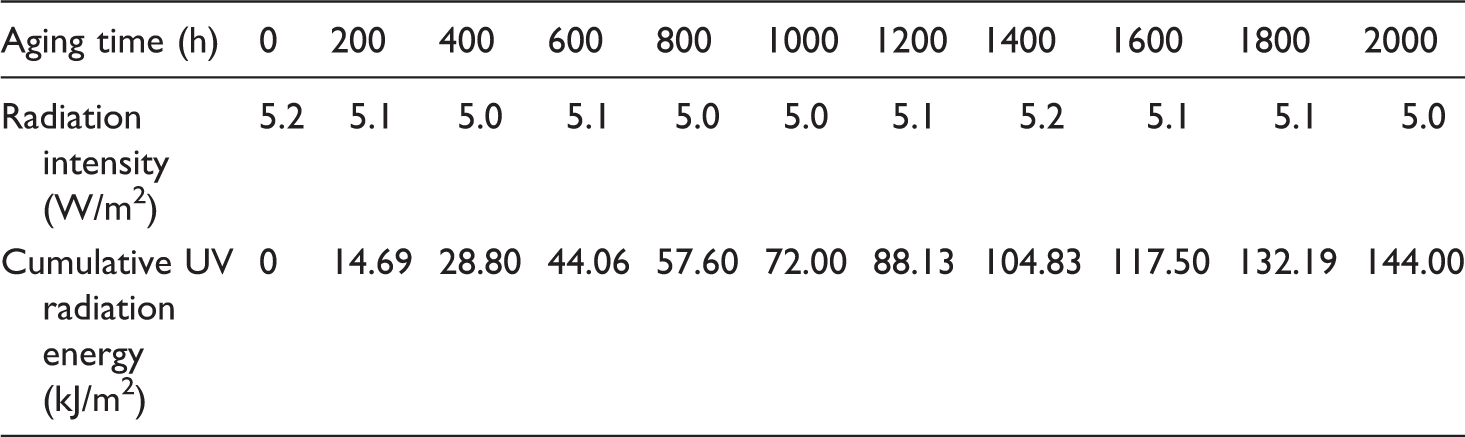
Accelerated weathering test
Cumulative UV radiation under accelerated weathering condition.
Characterization
To study the change of the surface color, the whiteness index during outdoor weathering test and accelerated weathering test was measured by intelligent digital whiteness meter (WSB-3A) following the standard GB/T 5950-2008. To note, as the surface color during accelerated weathering test changed significantly with an increasing aging period, the whiteness meter could not characterize precisely this phenomena, and from the standard ASTM E 313-2005, the whiteness index can be estimated by the yellowness index by Datacolor650 [15].
The tensile strength of the PVC-coated membrane material were tested on an electronic fabric tensile tester (Model YG065 by Nantong Hongda Experiment Instruments Co., Ltd) at an elongation rate of 50 mm/min, following the standard DIN 53352 BS 3424 method6A.
Previous studies discovered that the loss of mechanical performance of PVC-coated membrane material under two different weathering conditions was mainly due to the chemical reactions during photo-oxidation. As the existence of tensile stresses, new products were formed after the reaction including carbonyl and double bonds [16,17]. Therefore, Fourier transform infrared (FTIR) spectrometry (Model NEXUS-670 by American Nicolet Company) in Attenuated Total Reflection (ATR) was used to measure and analyze the weathering degradation products of PVC-coated membrane materials, following the standard GB/T 6040-2002. The sample was determined using 16 scans and 2 cm−1 resolution from 4000 to 400 cm−1.
Analysis method
The reciprocity law hypothesizes that all photo-chemical reaction is only concerned with the total absorption energy or cumulative radiation energy [18–20]. The total absorption energy depends on the product of UV radiation intensity I and radiation time t, and can be written as
In terms of the photo-oxidation tests, the correlation of different weathering methods would be established by reciprocity law of materials with photo-oxidation degradation. Based on reciprocity law, the whiteness index and the tensile breaking strength retention between artificially accelerated weathering and outdoor weathering conditions were compared, respectively. If there existed significant differences, the Schwarzschild’s law, i.e. a power law generalization of the reciprocity law, will be used to obtain better relationship under different weathering conditions in the experiments.
Results and discussion
Morphology and structure
After samples were irradiated on sunlight, their surface morphology was shown in Figure 2. The surface color of samples changes gradually (white-chalky-dark yellow), and the surface crackles of samples deepen with the increase of aging time. In terms of the laminate structure of PVC-coated membrane material, its cracking was probably due to differential contraction of the coating material and the substance. Additionally, some chemical reaction inside materials made the significant changes on the surface of samples, and the FTIR spectrum of original PVC-coated membrane material is shown in Figure 3(a). From Figure 3(a), the plasticizers, i.e. phthalates, in the original PVC-coated sample are indicated at 1720 cm−1 and the filler in PVC, i.e. calcium carbonate, is at about 1425 cm−1, the absorption peak of C-H blending vibration. The absorption peak of C-H blending vibration will stay constant in the FTIR peak of sample during the weathering. And also, it is reported [21] that the absorption peaks for carbonyl and the conjugated double bonds, i.e. two main degradation products membrane material chronically used in atmospheric environment appeared in the range of 1700–1750 cm−1 and 1300–1650 cm−1 or 800–900 cm−1, respectively. However, the carbonyl compounds were observed only at 1720 cm−1 in the infrared spectroscopy in Figure 3(b). Therefore, the carbonyl index is used to character the photo-oxidation of PVC-coated membrane materials.
Surface morphology of samples with different accelerated aging time under 20% stresses. FTIR spectrum of PVC-coated membrane material. (a) Before aging. b) After aging.

Benavides et al. [22] concluded that the carbonyl index was the ratio of the absorbance at 1720 cm−1 to that at 1425 cm−1. In this way, the carbonyl index of the PVC-coated membrane material is calculated and plotted against the cumulative UV radiation energy in Figure 4. As shown in Figure 4, there is a similar trend for carbonyl index of artificially accelerated weathering test to that of outdoor weathering test under four stresses. It is well-known that the PVC degradation firstly generates conjugated double bonds and then the carbonyl groups due to the oxidation of these polyene sequences. Additionally, the plasticizer in PVC layer is also oxidized, and this oxidation also forms carbonyl groups. Therefore, carbonyl index gradually increased during the initial aging. However, with an increase of the total absorption energy, the carbonyl compounds due to the oxidation of the PVC and the plasticizer will generate carbon dioxide and water. In this way, the carbonyl index in Figure 4 did not increase monotonously and even decreased after a certain weathering time. To note, the shifting time becomes shorter with an increasing initial loading. Additionally, the non-monotonous increase of the carbonyl index might be due to the ‘chalking effect’ of the PVC matrix [23]. That is to say, the filler will stay on the surface of the matrix after PVC is decomposed into carbon dioxide and water.
Carbonyl Index of samples under different tensile stresses of breaking strength. (a) 0%. (b) 5%. (c) 10%. (d) 20%.
On the other hand, Figure 4 showed that the carbonyl index of PVC-coated membrane material in outdoor weathering is different from that in artificially accelerated weathering. The reason for this phenomenon in artificially accelerated weathering is that the lasting radiation time of UVB lamp in a day is 22 h, and then stops for 2 h. This irradiation period will accelerate oxidation of PVC-coated membrane material in artificially accelerated weathering. Therefore, the carbonyl index of PVC-coated membrane material in artificially accelerated weathering declined faster. Moreover, although the carbonyl index represents the chemical components of PVC-coated membrane material under two kinds of exposure conditions, it is unclear of the apparent color and the mechanical properties of aging PVC-coated membrane materials. It can be seen from Figure 2 that the photo-oxidation aging of PVC-coated membrane material makes the apparent color change clearly. To further analyse the relationship between two kinds of exposure conditions under different tensile stresses, the apparent color and tensile breaking strength were tested.
Whiteness index
As shown in Figure 5, with a gradual increase of aging level, the whiteness index by color meter decreases, and the trends of the whole aging process keep consistent in both outdoor and artificially accelerated weathering conditions under different tensile stresses. However, the curve slope under outdoor weathering condition drops slowly than that under accelerated weathering condition. It means that whiteness index of PVC-coated membrane material under tensile stresses cannot obey the reciprocity law for accelerated and outdoor weathering condition. It is also illustrated that, with same tensile stress, the aging of PVC-coated membrane material depended on UV radiation intensity, and the photo-oxidation aging rate is not proportional to UV radiation intensity.
Whiteness index of samples under different tensile stresses of breaking strength. (a) 0%. (b) 5%. (c) 10%. (d) 20%.
Tensile breaking strength
The tensile breaking strength retention of samples from artificially accelerated and outdoor weathering conditions is plotted against cumulative UV radiation energy shown in Figure 6. When the cumulative UV radiation energy is 121.17 KJ/m2 under four stresses (0%, 5%, 10% and 20%), the tensile breaking strength retention in outdoor weathering decreases to 89%, 88%, 86%, 83%, respectively; when the aging time is 2000 h, the one in artificially accelerated weathering reduces to 85%, 82%, 80%, 77%. From the curves in Figure 6(a), it is obtained that the tensile strength property of PVC-coated membrane material under two weathering conditions has the same downward trend under no tensile stresses; the existence of stress facilitates the aging of PVC-coated membrane material (Figure 6b and c). As shown in Figure 6(d), when they receive the equal UV radiation energy, the strength difference of the samples between outdoor and accelerated weathering is 5.6% and 7.3% under 20% stresses and 0% stress, respectively. It may be caused by the separation of the PVC-coating near the cracks. In this sense, the tensile stress intensity in use should be strictly controlled to ensure the service lifetime for many materials.
Tensile strength retention of samples under different tensile stresses of breaking strength. (a) 0%. (b) 5%. (c) 10%. (d) 20%.
Generally, tensile properties of aging samples under two weathering conditions with different stresses all decrease, however, those decreases fast in the artificially accelerated weathering. According to the experiment design, the cumulative radiation energy under two weathering conditions keeps same; therefore, the tensile breaking strength could not obey the classic reciprocity law, and the Schwarzschild’s law will be explored.
Since the whiteness index under four tensile stresses as well as the tensile breaking strength retention show consistent and successive difference between two weathering conditions, they in artificially accelerated weathering need to be revised to imitate atmospheric environment.
Schwarzschild modified the reciprocity law by adding the power index p, and the modified formula is expressed as
Thus, the relationship between whiteness index and UV radiation intensity can be fitted by Revising curves. (a)Whiteness index. (b) Tensile strength retention.


Under the assumption of consistent aging level, p is estimated to be 0.87, where 
By analogy to modification for the whiteness index, the equivalence of tensile breaking strength retention between the outdoor and artificially accelerated weathering conditions can be built. Under 20% tensile stresses (Figure 7b), the fitting results of tensile breaking strength retention are


For equations (5) and (6), the goodness of fit are 0.985 and 0.984, respectively. Under the assumption of consistent aging level, the power index p approximately equals to 0.96. Thus, the relationship between the tensile breaking strength retention and the modified UV radiation intensity is fitted as:

Conclusions
This study developed the relationship between the physical and mechanical properties of PVC-coated membrane materials under artificially accelerated weathering and those under outdoor weathering tests, and examined the effect of four tensile stresses (0%, 5%, 10% and 20% of the breaking strength) on the tensile strength, whiteness index and the carbonyl index. The following conclusions have been drawn.
For outdoor weathering and artificially accelerated weathering aging of PVC-coated membrane materials under different tensile stresses, both the whiteness index and the tensile strength retention consistently decrease with an increase of cumulative UV energy, whereas the carbonyl index shows a parabolic change. Considering the effect of initial tensile stresses, the tensile stress intensity in service should be strictly controlled to increase the service lifetime of PVC-coated membrane materials. It is not appropriate for the reciprocity law to directly link the proposed indexes, such as whiteness index, carbonyl index and the tensile strength retention of PVC-coated membrane materials under two kinds of aging conditions. However, a reciprocity relationship exists between the proposed indexes after the Schwarzschild’s law under artificially accelerated weathering and those under outdoor weathering.
Generally, the built relationship provides a method to estimate the outdoor service lifetime of PVC-coated membrane materials by the tested properties under artificially accelerated weathering test.
Footnotes
Acknowledgements
The authors wish to thank Shanghai Shenda Kebond New Materials Co., Ltd., for providing the material for this study.
Declaration of Conflicting Interests
The author(s) declared no potential conflicts of interest with respect to the research, authorship, and/or publication of this article.
Funding
The author(s) disclosed receipt of the following financial support for the research, authorship, and/or publication of this article: This work was supported by ‘the Fundamental Research Funds for the Central Universities’.