




Abstract
The natural fibre composites are potential alternative of glass fibre composites for structural applications, automobile and furniture industry, but these are susceptible to the bacterial attack. The current study aims to investigate the bio-functionality of composites using flax woven fabric reinforcement along with ZnO nanoparticles. The ZnO nanoparticles were synthesised by sol–gel method and added in different fractions to unsaturated polyester resin before impregnation of reinforcement. The composites were fabricated by vacuum bag moulding technique, and bioactivity was tested in terms of antibacterial activity (zone of inhibition). The ZnO nanoparticles imparted bioactivity to the composites even in the lowest amount (0.02% by weight). These bioactive composites will help to lower the risk for fibre degradation and enhance the service life of composite, by restricting the growth of bacteria.
Introduction
Properties of natural fibres and E-glass [4].
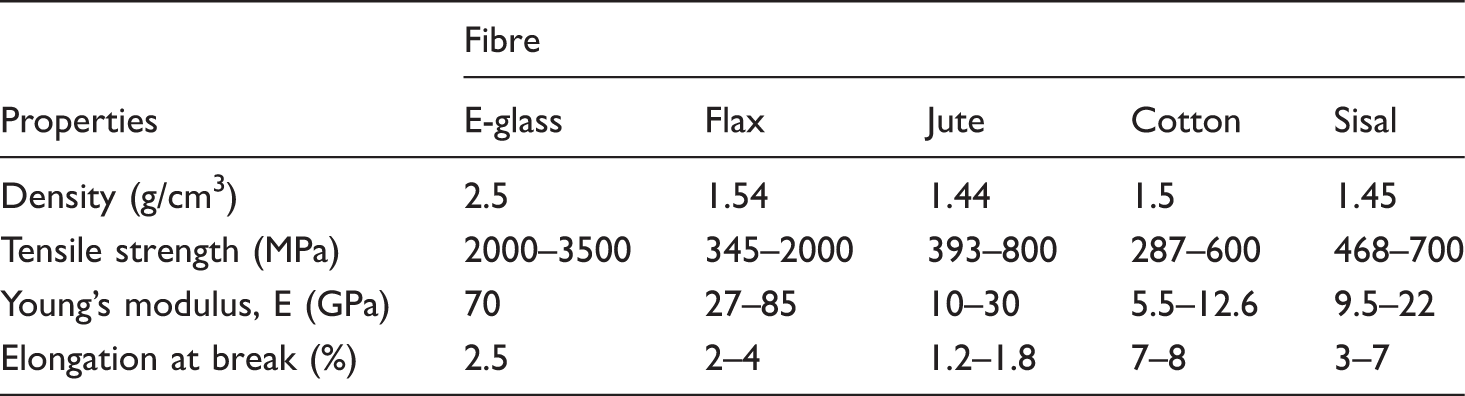
The natural fibre-reinforced composites are attracting more attention owing to increased environmental concerns and decreasing non-renewable resources. Most of the synthetic fibres and resins are petroleum based, while petroleum is a non-renewable resource. This has added to the use of natural fibre to produce polymer-reinforced composites. The natural fibre-reinforced composites are originally aimed at the replacement of glass fibre-reinforced composites. Natural fibres are in most cases cheaper than glass fibres, also giving less health problems, no skin irritations and are not suspected to cause lung cancer [6]. The factor becomes more critical if the end product is used for some structural application, where there are more chances of people to come in contact with them.
Some typical examples include composites based on starch and bamboo fibres, composites based on Monsanto Biopol® and ananas and jute fibres and matrices based on soy proteins in combination with several natural fibres [7]. Hybrid composites have more than one type of fibres incorporated into a single matrix. The possible combinations of hybrid composites include artificial–natural and natural–natural fibre types [8]. The natural fibre-reinforced composites are used in almost every field of life. Some major areas of research in bio-composites include structural applications, automobile and furniture industry. These composites offer massive opportunities as replacement of wood in furniture industry. Bamboo-reinforced composite can be very beneficial as a substitute of wood for the manufacture of furniture and other components [9].
The flax fibre-reinforced composites have automobile and structural applications as door and instrument panels, package trays, glove boxes, arm rests, seat backs, etc. Shah et al. [10] manufactured and compared the mechanical properties of a small wind turbine blade built from flax/polyester and E-glass/polyester. The lower density of flax fibre helped in weight reduction of the blade (10% lighter), satisfying the design and structural integrity requirements for turbine.
With advancements and to meet diverse customer needs, the focus is to fabricate materials having functional properties like electrical, magnetic, optical, antimicrobial, etc. These properties can be achieved by adding nano-fillers (at least one dimension in the nanometer range, i.e. 1–100 nm) to the composite material [11]. The nano-fillers are incorporated in very small amounts (less than 10 wt.%) into the polymer matrix to get functional property [12]. Nanoparticles have reduced size associated with high surface area/volume ratio, which increases as the size of nanoparticles decreases. With decrease in particle size, a large number of constituting atoms can be found on the surface of the particle, which make the particle highly reactive [13]. The importance of zinc oxide (ZnO) nanoparticles is evident from the vast areas of applications like gas sensor, chemical sensor, bio-sensor, cosmetics (UV protection) [14], storage, optical and electrical devices [15], solar cells and drug delivery.
The selection of nanoparticles depends on the desired thermal, mechanical, antibacterial [16] and electrical properties of the composites [17]. The addition of nanosized fillers into the polymer matrices will result into a composite material exhibiting distinct properties, depending on the nano-filler added. However, the homogeneous dispersion of nano-sized particle in the matrix is very difficult, due to strong tendency of nanoparticles to agglomerate [18].
The three main techniques for the incorporation of nano-filler into the polymer matrix are in situ polymerisation, the solvent interaction and melt intercalation process [19]. The major focus of researchers has been on the polymerisation-based techniques, but their applications are limited. The melt mixing of the polymeric matrix with the filler is the most convenient and economical way, but it obtained only a few successful results, due to agglomeration of nano-fillers during blending. Solution mixing is the most common method, overcoming the tendency of nanoparticles to agglomerate. It involves dispersion of nanotubes in a suitable solvent, mixing with the polymer and recovering the composite by precipitation. This technique is applicable to the polymers that can be dissolved or swelled by the solvent [20].
ZnO, as one of the multifunctional inorganic nanoparticles [14], has drawn increasing attention due to its many significant properties like high chemical stability, ultraviolet shielding [21], low dielectric constant, self-cleaning [22], large electromechanical coupling coefficient and high luminous transmittance [20]. Other than these, the ZnO nanoparticles exhibit selective toxicity for pathogens; therefore, it is effective in antibacterial and bactericide function [23], helping to protect from infectious diseases but safe for human beings [24]. The most common methods for the synthesis of ZnO nanoparticles are the sol–gel method (solution method) preferred due to low cost and environment friendly synthesis route [13].
The main factors limiting the bulk scale manufacturing of natural fibre composites are the low strength and water absorption of natural fibres from environment [25]. The absorption of water causes swelling of natural fibres and enhances its susceptibility to microorganisms attack, which leads to deterioration of mechanical properties. The composites degrades faster, losing half of its tensile strength in the time it takes for a glass composite to lose only 10% [26]. A lot of research has been made on the treatment of natural fibres to increase hydrophobicity of fibres and improve the fibre matrix interface, enhancing mechanical properties of the composite.
Natural fibres are not immune to microorganisms, like synthetic fibres, and provide excellent environment for microorganisms to grow owing to their ability to retain moisture. These microorganisms pose a significant danger not only to human health by means of contact transmission but also deteriorate the mechanical properties of composites by degradation of fibres. Therefore, the bioactivity of natural fibre-reinforced composites is desirable for its protection and enhanced service life. The objective of this study was to produce a bioactive flax woven fabric-reinforced composite by the addition of ZnO nanoparticles to provide safety against micro-organisms attack.
Material and methods
The materials used in this study include flax woven fabric (145 ± 5 g/m2), glass fabric (280 g/m2), ZnO nanoparticles and unsaturated polyester resin. The ZnO nanoparticles were selected to impart bioactivity to the composite. The flax yarn having a linear density of 25 tex was used as warp and weft to produce the reinforcement. The sample weaving unit from CCI [27], including sample sizing, warping and weaving machine, was used to weave the reinforcement. It is a rapier weaving machine having a maximum speed of 75 picks per minute and max working width of 20″. The reinforcement had a balanced structure, i.e. having 28 threads/cm along warp and weft using a balanced weave, as shown in Figure 1.
Weave design used in the reinforcement.
ZnO nanoparticles synthesis
The ZnO nanoparticles were synthesised by the sol–gel method. The following quantity of reagents was used for the synthesis of nanoparticles.
Zinc acetate dihydrate, Zn(CH3COO)2: 1.7 g/50 ml Sodium hydroxide, NaOH: 0.7 g/50 ml Methanol, CH3OH: 100 ml
Given quantity of NaOH was dissolved in 100 ml of methanol at a temperature of 60℃ in the round bottom flask with condenser fitted at its top, whole assembly was placed in a water bath being heated on a magnetic heater. This solution was then stored in a beaker. The flask was rinsed with methanol and zinc acetate was added to it along with 100 ml of methanol. On dissolution of zinc acetate in methanol, the NaOH solution was added to it drop wise with continuous stirring. Temperature of this assembly was maintained at 60℃ for 1 h, with a constant stirring speed.
Composite fabrication
List of experiments.

The composite plates were fabricated using the vacuum bag moulding technique. The laminate is sealed in an air tight bagging film, and vacuum is generated inside this film. Atmospheric pressure forces the film down, applying a uniform and even pressure on the surface, thus compressing the laminate. It provides an evenly distributed pressure on the surface, reducing the voids. As discussed earlier, a uniform distribution of nanoparticles in the matrix is the most important factor to get the required functional composites. The main problem arising during fabrication was the agglomeration of the nano-fillers due to high energy forming bulk of ZnO. Precipitation of ZnO nanoparticles from the methanol is achieved by centrifuge. But this causes the agglomeration forming particles having size in micro-meters, so desired properties cannot be achieved. This problem was overcome by mixing the resin (unsaturated polyester) with the ZnO nanoparticles solution in methanol (different concentrations for different samples) during composite fabrication, stirring continuously at a low rate to evaporate the methanol from the solution. The amount of initiator and accelerator added was 0.2% and 2.0%, respectively.
Eight layers of woven flax plies having a stacking sequence of [(0/90)2]S were used to form the laminated composite, under a vacuum pressure of −1 bar. The fibre volume fraction of all the samples was maintained to 40%, and plate size was equal to 200 × 200 mm2. The curing was done at room temperature for 12 h, followed by post curing at 120℃ for 3 h. For comparison of mechanical properties, glass/polyester composite were also made using same stacking sequence, fibre volume fraction and thickness.
Composite testing
The tensile properties of these composite materials were tested using ASTM D3039 to ensure that the addition of nanoparticles has not deteriorated the mechanical properties of the composite. The bioactivity of the developed composites was tested by the zone of inhibition test (AATCC 147) [28]. The zone of inhibition is a clear area of interrupted growth underneath and along sides of the test material, and it indicates the bioactivity of specimen. It is a qualitative test for the bacteriostatic activity by the diffusion of antibacterial agent through agar.
Results and discussion
Figure 2 shows the morphology of flax/unsaturated polyester composite containing ZnO nanoparticles. It can be observed that nanoparticles are uniformly distributed in resin with some aggregates. This validates the mixing method of nanoparticles in the resin that we used in this work.
The SEM image of flax/unsaturated polyester composite (NP30) showing ZnO nanoparticles present uniformly in the matrix.
Mechanical properties
Mechanical characterisation of composites.
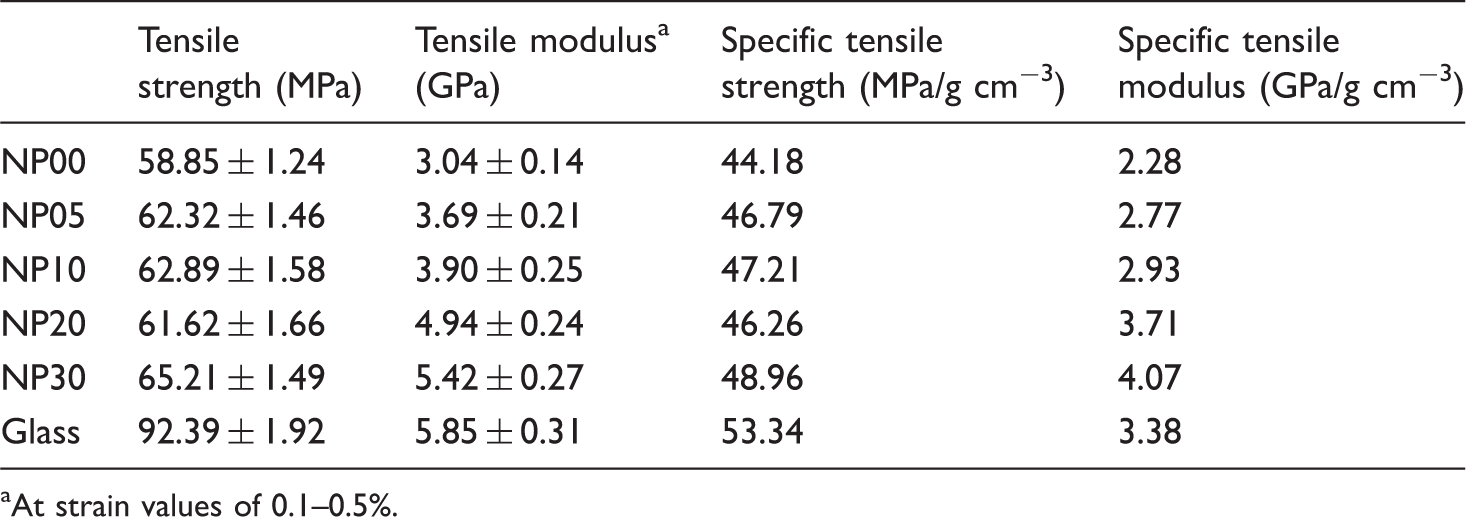
At strain values of 0.1–0.5%.

(a) Composite sample, and (b) curve showing tensile behaviour of composite sample NP00.
From Table 3, it can be observed that the tensile modulus of composite samples is increasing consistently with the increase in the content of the ZnO nanoparticles. This is because of the formation of nano composites comprising ZnO particles and matrix in the resin rich areas resulting into improvement in tensile modulus [29]. In addition to this, the presence of nano-fillers may also affect the electrical and thermal properties [30] of these composites. Therefore, it can be concluded that with the point of view of mechanical properties, the woven flax fibre composite is a potential candidate for the replacement of conventional glass fibre composite.
Bioactivity
The zones of inhibition around composite samples were observed (Figure 4) after 24 h of incubation in dark at 37℃. The test was repeated three times and the average value of zone of inhibition was reported.
Zone of inhibition against E. coli (a) NP05 and (b) NP00.
The unique properties of nanoparticles arise from a variety of attributes, including the similar size of nanoparticles and biomolecules such as proteins and poly-nucleic acids [31]. The antibacterial behaviour of ZnO nanoparticles could be attributed due to the chemical interactions, physical interactions or combination of both:
(a) Chemical interactions can occur between:
cell membrane components and Zn++ ions Zn++ ions and components in the interior of cell (transportation of Zn++ into the cell) cell membrane components and H2O2, generated due to the presence of ZnO particles chemical species generated due to ZnO particles and components in the interior of cell (b) Physical interactions can be as follows:
physical blockage of the transport channels of cell membranes by ZnO particles physical damage to the membrane components by ZnO particles due to abrasion penetration of ZnO particles through cell membrane to interact with interior of the cell direct interaction between ZnO particles and bacterial cell membrane components through electrostatic effect (c) A combination of the physical and chemical interaction as described above [32].
In the present study, the formation of zone of inhibition can only be explained by chemical mechanism. According to this mechanism, the reactive oxygen species (ROS) are generated, which are •OH, H2O2 and O22−. As the bacteria carry negative charge on the surface, the penetration of O22− seems impossible but the hydroxyl radical and hydrogen peroxide can penetrate into the cell membrane which leads to the death of bacteria. Another reason for bacterial growth inhibition can be the release of Zn++ ions in the bacterial culture. As the bacteria have negative charge on their surface, the Zn++ ions adhere on them and modify the membrane structure.
It is quite possible that both ROS and Zn++ play role in antibacterial activity of ZnO. Whatever is the mechanism of bacterial growth inhibition, it justifies the increase in zone of inhibition on increase in quantity of nanoparticles in composite as shown in Figure 5.
Zone of inhibition of flax fabric composites against E. coli and S. aureus.
With the increase in nanoparticles concentration, the generation of ROS and/or Zn++ also increase, which leads to the production of bigger zones of inhibition and they continue to grow bigger. The antibacterial activity of composite samples is higher against S. aureus than E. coli. This difference is due to different resistance of both bacteria against ROS species. The S. aureus carries less negative charge as compared to E. coli. Therefore, the O22−can penetrate easily into the membrane of S. aureus. The Gram-negative bacteria contain an extra outer membrane and the pathogen-associated molecular patterns including lipo-polysaccharide (consisting of lipid A, core polysaccharide and O antigen), porins and particular fragments of peptidoglycan. This structure prevents attachment of ZnO on the surface [33]. The complex structure of Gram-negative bacteria mentioned above also acts as permeability barrier to ROS and prevents their penetration into the membrane.
Conclusion
The current study was aimed to develop bioactive composite using woven flax fabric reinforcement by the addition of ZnO nanoparticles. It was observed that these composites have bioactivity against both Gram-positive and Gram-negative bacteria. The lowest amount of ZnO nanoparticles (0.02%) imparted the bioactivity. The increase in the quantity of nanoparticles increases the zone of inhibition of composites. The bioactivity is advantageous for the protection of natural fibre reinforcement against bacterial attack. Comparing the mechanical properties, the specific tensile properties of produced composite samples were found better than glass fibre composite. Therefore, these may not only proved to be a sustainable alternative to glass fibre composites in structural applications but also have an enhanced service life.
Footnotes
Declaration of Conflicting Interests
The author(s) declared no potential conflicts of interest with respect to the research, authorship, and/or publication of this article.
Funding
The author(s) received no financial support for the research, authorship, and/or publication of this article.