




Abstract
A successful prosthesis has to emulate physiological and biomechanical performances of the native ligament. Today, there is no ideal artificial ligament that simulates the performances of the human anterior cruciate ligament. This work aims to study the impact of the braiding parameters on ligaments mechanical performances. The braiding parameters include yarn count, braid architecture, and machine settings (take-up speed). Two braided architectures were designed: a biaxial quadruple braid and a triaxial quadruple one incorporating elastane. Mechanical properties of these structures were measured and compared to those of the natural ligaments. Elastic recovery under traumatic force was studied in order to compare the elasticity of the manufactured samples. The obtained results showed that the elastic recovery was improved with the incorporation of elastane filaments and prostheses mechanical properties match closely those of the native anterior cruciate ligament. Finally, a response surface methodology was used to predict and optimize the prostheses mechanical properties.
Keywords
Introduction
The anterior cruciate ligament (ACL) is one of the prime knee stabilizers. It provides both an anterior and a rotational stability [1]. ACL ruptures are some of the most common knee injuries seen in sports [2,3]. Currently, most ACL reconstructions are performed with natural grafts such as bone–patellar tendon–bone or hamstrings autograft [1]. However, there has been an interest in the use of synthetic prostheses in order to overcome the disadvantages associated with the natural grafts. Synthetic ligaments may be divided into two categories: prosthetic and augmentation types [4]. The prosthetic type is a permanent device and its performances rely permanently on the characteristics of the implant material, while the augmentation device acts as a scaffold for tissue ingrowth or as mechanical support for autografts. The strength of prosthetic ligaments is higher than that of augmentation devices. Various synthetic ACL grafts have been proposed involving various architectures such as the multilayer braid, knitted and woven ribbons [3,5]. Some of these grafts did not consider any morphological requirements at the basis of the design [6,7]. Potluri et al. [8] reported that braiding is the preferred route for producing artificial ligaments. Prostheses proposed in the last years, have been manufactured from different materials including polyethylene terephtalate (PET), polytetrafluorethylene, polyamide, polyacrilonitrile, and silk [6,9,10]. According to literature, materials used in the prosthetic ligaments responses to the property of the high strength, but did not provide the necessary elasticity. Over time, this lack of elasticity leads to a lengthening of the ligament due to an irrecoverable elongation. Consequently, this increase in the graft dimensions results in knee instability. Many authors highlighted the imperfection of synthetic grafts in the ACL reconstruction [11,12]. According to Cooper et al. [13], these synthetic grafts exhibit excellent short-term results, but the long-term clinical outcome is poor due to mechanical mismatch, poor abrasion resistance, and high incidence of fatigue failures.
The purpose of this paper is to develop braided ACL prostheses by varying the manufacturing parameters such as yarn count, take-up speed of the machine, and architecture of the braid. The effect of these parameters on the prostheses mechanical properties was studied. Prediction models for the mechanical properties were investigated. Finally, an optimization of these properties was performed by referring to those of the natural ACL.
Materials and methods
Samples' manufacturing
Braided architecture was selected because of many reasons [14]. Its load–elongation behavior is similar to that of a natural ligament. It exhibits low modulus during the initial stage, which makes it deformable in the low strain range and permits low tensions in everyday motion. In addition, it exhibits high stiffness and strength for large strains. In fact, all the yarns in a braided structure share the axial load, while only half the yarns (warp) share the axial load in a woven structure. Finally, it offers a network of interconnected pores required for the proliferation of cells [7,14].
We developed braided ACL grafts made of an assembly of four concentric circular braided layers by using a 16-spindle braiding machine “RATERA.” This number of layers was chosen in order to be in the range of the diameter of a natural ACL. According to Duthon et al. [15], the ACL has a mean diameter of 7–12 mm. Two different structures were manufactured. The first structure is a quadruple-braided ACL composed of four layers (Figure 1). The second structure is a triaxial braid; it was designed as the previous one with the incorporation of elastane yarns. This braid consists of three sets of continuous yarns (Figure 2). Two sets are made of PET and interlaced diagonally. The third set is made of eight elastane yarns of Dorlastan® type, added longitudinally for the four layers of the structure. Elastane yarns are delivered from bobbins placed under the braiding machine without any tension. In the braiding zone, elastane is freely guided by the braided structure and its tensioning depends only on the take-up speed of the machine.
Quadruple-braided prosthesis. Schematic representation of a triaxial braid.

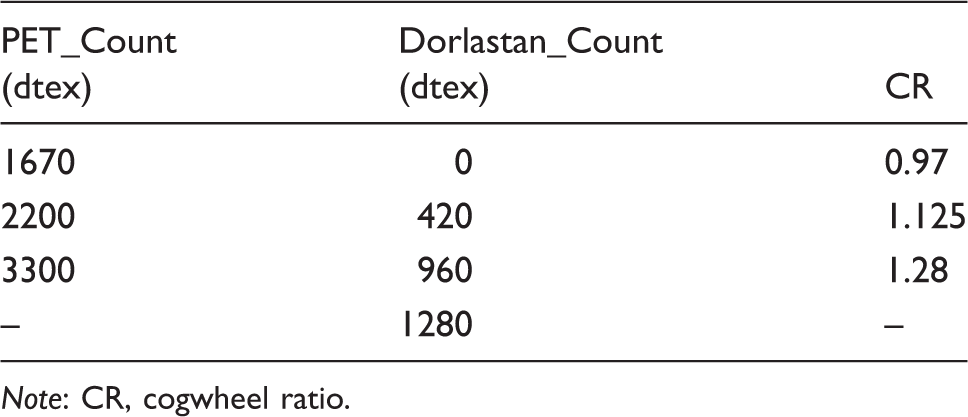
Braiding parameters used for prostheses manufacturing.
Note: CR, cogwheel ratio.
The plan of experiment used during prostheses manufacturing is a full factorial experiment (Table 1). Its design consists of three factors. The factors PET_Count and CR contain three levels, while the Dorlastan_Count contains four levels. Consequently, following this plan, we produced 36 samples. A zero Dorlastan_count corresponds to a biaxial structure.
Mechanical characterization
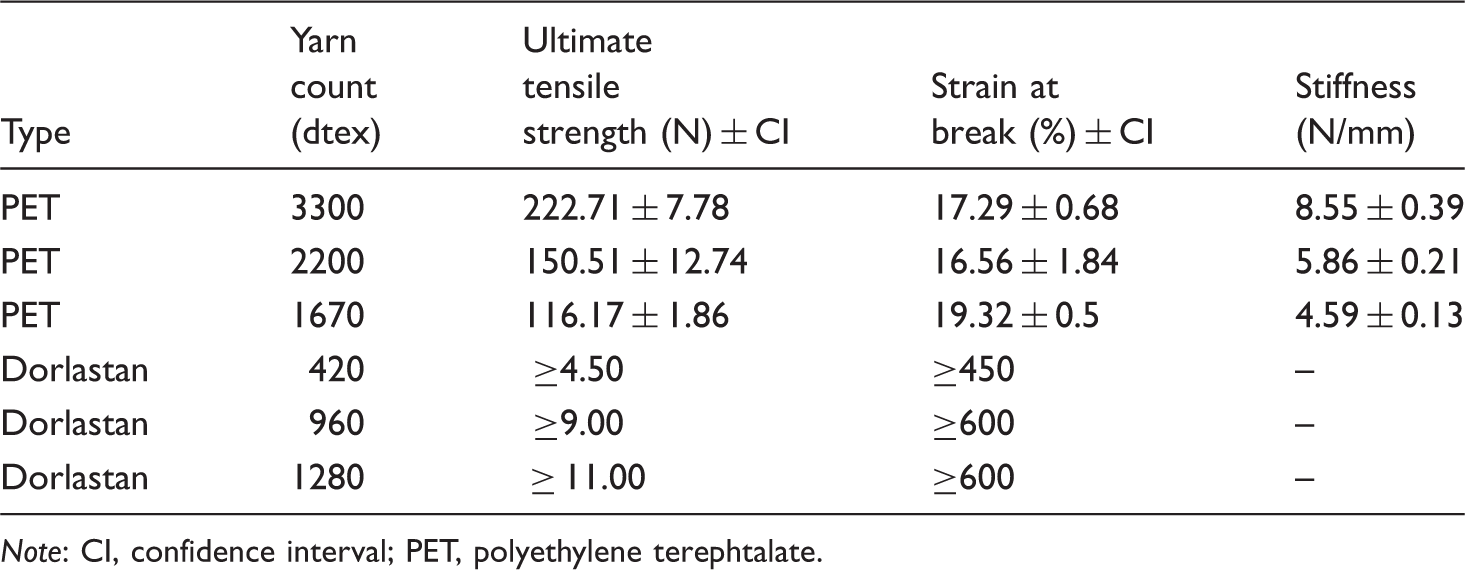
Today, there is no official standard related specifically to prostheses tensile testing condition. Testing parameters were chosen according to the data available in literature. Braids were conditioned in standard atmosphere according to the standard ISO 139:2002. A constant speed gradient dynamometer LR 5K Lloyd with a 5-KN load cell was used to measure the mechanical properties of the graft samples. Artificial prostheses have undergone a longitudinal tensile force till rupture in order to determine the maximum load or ultimate tensile strength (UTS), strain at maximum load and stiffness. The braided samples have 40 mm in length corresponding to the average length of the natural ACL.
Rupture corresponding to ligaments injuries occur quickly, at high strain rates. In literature, fast strain rates were reported by Pioletti et al. to be up to 10%/s [20,21]. Other researchers recommended higher strain rates [22]. In this study, tensile loading till rupture was performed at a strain rate of 20%/s.
In order to assess the elastic performances of the developed ligaments, we performed a loading–unloading test that allows to estimate the prostheses elastic recovery (ER) under a traumatic force. The maximum loading force was of 1600 N, which is close to natural ACL UTS as reported in literature [23–25].

Mechanical properties of the used yarns.
Note: CI, confidence interval; PET, polyethylene terephtalate.
Statistical analysis
Five specimens were tested in each test. Generated histograms in the following section present mechanical properties mean values and error bars present ± the confidence interval.
The JMP SAS software was used to create models for the mechanical properties. To test the significance of each model we tested:
– The correlation coefficient (R2) – The Fisher's test of the model – The significance of each effect (Student's t-test).
Results and discussion
Mechanical properties of developed prostheses
An artificial ACL needs to respond to a number of physiological and biomechanical requirements. The mechanical properties of the natural ACL were investigated by Noyes and Grood and Woo et al. [24,25]. The UTS of the natural ACL of a young person was reported to be in the range of 1730–2160 N. The stiffness was reported to be 182 ± 27 N/mm according to Woo et al. and the strain at the maximum load is between 20% and 30%.
Mechanical properties of the designed prostheses were obtained from the load–strain curves. Some of these curves are presented in Figure 3. The obtained mechanical properties were compared to those of the natural ACL in Figures 4–7. Figure 4 shows that the designed prostheses present a higher strength than the natural ACL. In order to avoid mechanical rupture, it was proved by Freeman et al. [26] that an ACL replacement must have a strength that is similar to or exceeds that of the natural ACL.
Load–strain curves of some developed prostheses. Distribution of the prostheses ultimate tensile strength. Distribution of the prostheses elastic recovery.


From Figure 5, we note that all the biaxial prostheses have a higher stiffness than the natural ACL excepting the third braid manufactured with the following parameters: 1670 as PET count and 1.28 as CR.
Distribution of the prostheses stiffness.
It is quite obvious that the manufactured ligaments incorporating the elastane (triaxial prostheses) present stiffnesses that are closer to those of the native ACL. The structure becomes more elastic with the insertion of elastane filaments disposed longitudinally. According to John et al. [21], achieving normal knee kinematics is more dependent on prosthesis stiffness matching with native ACL than an ultimate strength matching. Stiffness is considered as the most important parameter in the assessment of an artificial ligament because it affects the limit of anterior translation. In fact, increasing the stiffness of the ligament can reduce the limit of anterior tibial translation. Alternatively, reducing its stiffness increases the limit of anterior tibial translation and result in excessive laxity or instability.
As shown in Figures 3 and 6, braids incorporating the elastane have a high elongation, which is due to the elongation of the elastane yarns at low loads. This disadvantage could be easily overcome by the surgeon during the ACL prosthesis implantation by applying a preload. Under a traumatic force, the ER calculated from loading–unloading cycle has been greatly increased with the incorporation of elastane (Figure 7).
Distribution of the prostheses strain at maximum load.
This makes triaxial prostheses incorporating elastane yarns more suitable for ACL reconstruction than biaxial ones because they are able to recover their original length and limit the anterior translation of the tibia [27].
Effect of the manufacturing parameters on the braided prostheses mechanical properties
Figure 8 shows the effect of the variation of each braiding parameter on the prostheses mechanical properties. The UTS property of the braids was changed by the tenacity, which is equal to UTS per count. The PET count is the most influencing parameter on the tenacity. Tenacity is inversely proportional to PET count, whereas UTS is proportional. From Figure 8, we note an important decrease in the tenacity and the stiffness with the incorporation of the Dorlastan. The value of the stiffness drops rapidly when the Dorlastan count passes from 0 to 420 dtex, and continues to decline slowly. Regarding the tenacity, its plot declines by incorporating the Dorlastan, but it grows again by increasing its count. In fact, after incorporating the elastane, we observed an increase in the structure's diameter due to the increase in the braiding angle, as shown in Figure 9. This increase in the braiding angle, which is defined as the angle between the longitudinal axis of the structure and the yarns is due to the shrinkage of the structure caused by the recuperation of the elastane yarns.
Effect of the braiding parameters on the prostheses mechanical properties. Biaxial (a) and triaxial (b) prostheses developed at the same CR (PET 2200 dtex; Dorlastan 420 dtex; CR 0.97; θ1 = 48 °; θ2 = 61 °).

It has been demonstrated by Jedda et al. [5] that an increase of the braid angle leads to a decrease of the stiffness and the UTS. This is due to the fact that when the braiding angle decreases, yarns are more parallel to the axis of the prosthesis and this increases the cohesion between fibers.
As to the increase in the tenacity for the 960 and 1280 Dorlastan counts, it can be explained by the fact that, at the same load, the yarn having a count of 420 dtex presents a higher elongation than the others, as proven in Figure 10. Therefore, at the outlet of the braiding machine, the braid presents a greater shrinkage resulting in a higher braiding angle. Table 3 presents the braiding angle values of different samples developed with 2200 dtex PET yarns. From this table, it is quite obvious that at the same CR, prostheses incorporating the 420 Dorlastan yarn possess the higher braiding angle.
Dorlastan yarns load–strain curves (limit load 1 N). Prostheses braiding angle (PET count: 2200 dtex). Note: PET, polyethylene terephtalate; CR, cogwheel ratio.

Also, the Dorlastan count parameter is the most influential parameter on the prostheses strain and ER. The incorporation of the Dorlastan increases significantly the strain of the structure, while the plot of the ER increases slowly and the maximum of ER is obtained with the 1280 Dorlastan count.
Finally, an increase in the CR results in an increase in the tenacity and the stiffness. Indeed, a rise in the CR corresponds to a decrease in the braiding angle. This is clearly shown in Table 3 and it was also reported by Alpyildiz, who studied the geometry of tubular braids, and Rawal et al., who studied mechanical properties of braided sutures [28,29].
Optimization of the prostheses mechanical properties
The goal of this optimization is to be able to preview manufacturing parameters values permitting to obtain a prosthetic ligament having mechanical properties emulating those of natural ACL.
As proved previously, for all samples, UTS and the strain exceed those of the native ACL.
For this purpose, a modeling of stiffness and ER, which are the most important mechanical properties were performed.
We studied the relationship between each property and braiding parameters (PET count, Dorlastan count, and CR) by using a surface model having the equation (2)

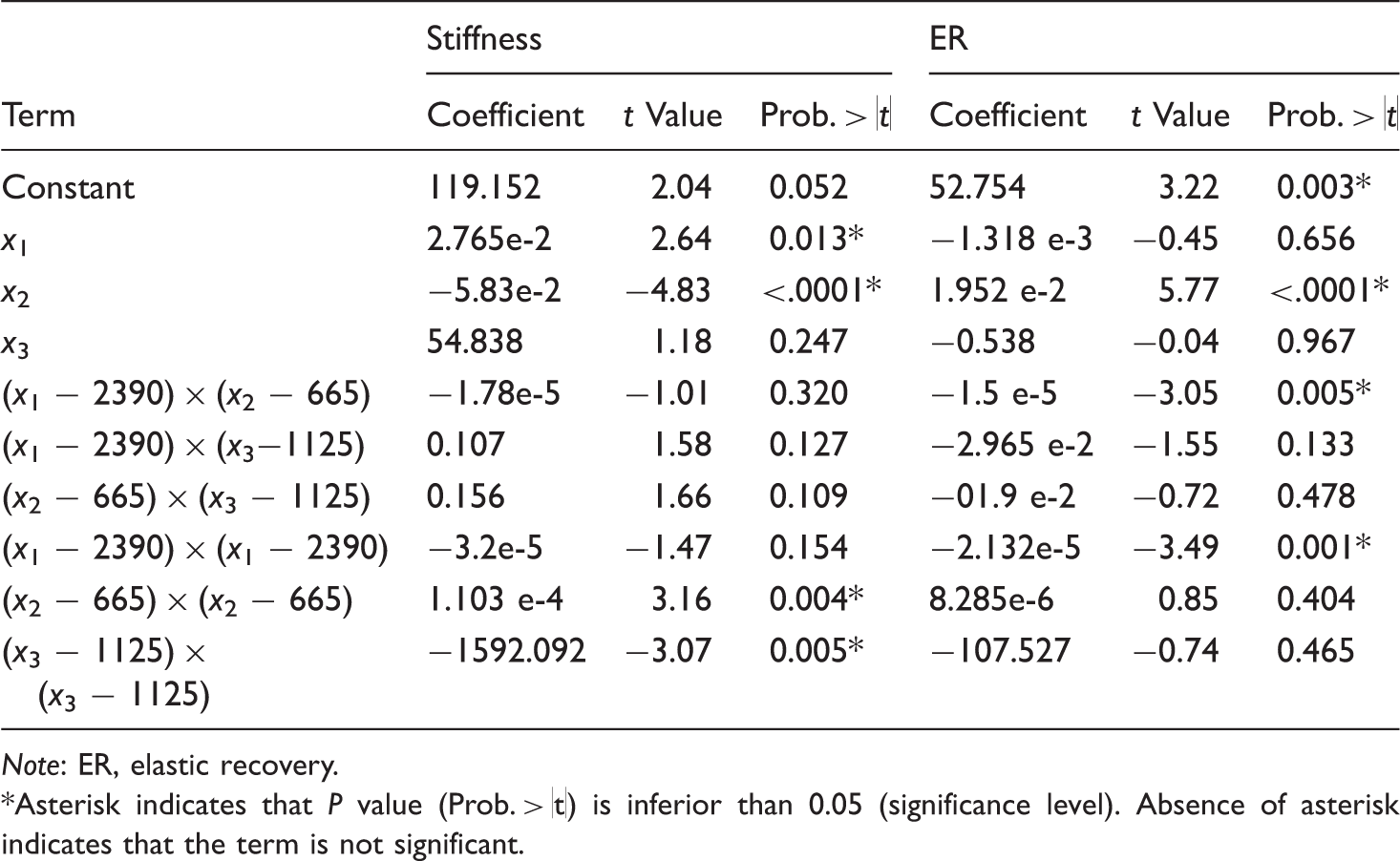
The R2 values are equal to 0.76 and 0.74 corresponding, respectively, to the ER and the stiffness responses. These values show a correlation between the model's responses and the manufacturing parameters.
The analysis of the variance of the quadratic regression model demonstrates that both models were highly significant, as is evident from the Fisher test with high F values that are equal to 21.91 and 13.49 corresponding, respectively, to the ER and the stiffness models. Based on the R2 and F values, the statistical significance of the models is proven.
Output data from the regression analysis.
Note: ER, elastic recovery.
Asterisk indicates that P value (Prob. > |t|) is inferior than 0.05 (significance level). Absence of asterisk indicates that the term is not significant.
Identification of the significant parameters was performed through the Student test. It shows that there are some P values (Prob > |t|), shown in the final column of Table 4, higher than the significance level, and they must be eliminated.
Coefficients estimation of stiffness model.

* term is significant.
Coefficients estimation of ER model.

Note: ER, elastic recovery.
* term is significant.
We used the response surface method to predict manufacturing values allowing to obtain a prosthetic ligament presenting properties, which are close to those of the natural ACL.
Response surface designs are most often used to build models to make predictions. Two-dimensional contour plots or three-dimensional response surfaces could be used. Contours are curves of constant response drawn in the (x
i
, x
j
) plane. However, for a design in k factors, these plots allow to display only two design factors on the plot. All remaining k − 2 factors are held constant. Each contour corresponds to a particular height of the response surface. In our case, the stiffness model presents three factors, whereas the ER model presents two factors. Figure 11 shows the contour plots and the responses' surfaces.
Contour plots and responses surfaces.
The two used design factors are the PET _Count and the Dorlastan_Count, while the CR was kept constant (CR = 1.125) in the stiffness response. In order to determine the combination of predictor variables for which the responses were optimized, we used the following hypotheses:
Stiffness in the range 155–209 N/mm as described previously; (the stiffness was reported to be 182 ± 27 N/mm) High ER (ER > 70%).
The optimal zone is shown noncolored in Figure 11. Optimal developed prosthesis among our manufactured ones with 1.125 CR is the one having 2200 dtex as PET count, 1280 dtex as Dorlastan count. In fact, it is possible to perform other contour plots for any desired CR value.
As mentioned previously, during the study of the effect of the braiding parameters on the mechanical properties, the maximum of ER is obtained with the highest Dorlastan count. This result is also proved by the ER's contour plot since optimal zone is situated at the right side of Figure 11 corresponding to high Dorlastan counts.
Ultimately, surgical fixation of the developed prostheses can be performed with classical techniques such as interference screws or Endo Button fixation. Two tunnels need to be drilled in femur and tibia bones and the ligament is fixed from both ends with the screws. Before prosthesis insertion, the desired dimension needs to be only cut with a hot-cutting device named “electric cutting knife” in order to fix the elastane with PET filaments by melting from the both ends. This method allows a good fixation of the whole structure and elastane filaments interlaced with PET yarns cannot slip.
Conclusion
The aim of this work was to develop an ACL graft whose mechanical properties meet those of natural ACL and ensure reliable mechanical performances.
Prostheses were developed by varying the braiding parameters such as yarn count, CR, and braid's architecture. Two architectures were used: a biaxial and a triaxial one.
Mechanical properties of the prostheses were studied and a loading–unloading test under a traumatic force was performed in order to study the ER of the manufactured prostheses. The study of the effect of the manufacturing parameters proved that Dorlastan count parameter is the most influential one on the prostheses stiffness, strain, and ER. In fact, incorporating Dorlastan yarns induces a rise in the strain and the ER. This is due to the orientation in the longitudinal direction of the elastane yarns. It also causes a decrease in the stiffness and the UTS due to the increase in the braid angle. Ultimately, optimal conditions for manufacturing were proposed by using the quadratic regression models and based on the mechanical properties of the native ACL.
Further work will focus on the effect of the cyclic loading on the mechanical behavior of the manufactured prosthesis in the optimal conditions.
Footnotes
Declaration of Conflicting Interests
The author(s) declared no potential conflicts of interest with respect to the research, authorship, and/or publication of this article.
Funding
The author(s) received no financial support for the research, authorship, and/or publication of this article.