




Abstract
The chemical and physical structure of cyclodextrin makes it attractive for use in flame retardant finishing for improving the functional properties and durability of the finished fabric. The suitability of cyclodextrins for grafting using viable techniques that could be reproduced was studied. The flame retardant diammonium phosphate was applied on cyclodextrin-grafted cotton fabric and grafted cum bonded with 1,2,3,4-butane tetracarboxylic acid fabric. The modified monochlorotriazinyl-β-cyclodextrin gives more percentage of grafting (2.7%) under normal processing conditions used for cotton fabric. The effect of treatments like cyclodextrin grafting and 1,2,3,4-butane tetracarboxylic acid treatment on grafted fabric were analysed for diammonium phosphate flame retardant finishing. The whiteness and loss of strength caused by the cyclodextrin grafting was within acceptable limits and the hand value alteration was very less. The flammability behaviour and durability after 1, 5, 10, 20 and 40 washing cycles were determined. The results reveal that the flame retardant property of cyclodextrin treatment enhances the durability of the fabric from non-durable to semi-durable, whereas the diammonium phosphate treatment on 1,2,3,4-butane tetracarboxylic acid/cyclodextrin-grafted fabric changes the flame retardant from non-durable to durable. The evolution of gases during the burning of untreated and treated samples was analysed and the results show that the cyclodextrin-grafted fabric masks the evolving gases to some extent during burning and also that there was less release of formaldehyde in grafted samples compared with ungrafted diammonium phosphate finished sample.
Keywords
Introduction
Cotton fabric is extremely suitability as a wearing material due to its unique characteristics. However, its flame retardant (FR) property is not good compared with that of fibres like wool and nomex. Textiles differ widely in construction (knitted, woven and nonwoven) and in the chemical nature of fibres. As a result, the flammability of textiles varies noticeably from very flammable to intrinsically FR textiles. In fire accidents involving children, clothing worn by children may ignite, resulting in a very high rate of deaths one of every four or disfiguring burns, especially with ignition of nightwear [1]. The flame spread rate of textiles after ignition is dependent mainly on fabric density and usually lighter fabrics are dangerous than heavier ones [2].
On the other hand, the FR finishing causes reduction in strength, yellowing, undue stiffness, formaldehyde release, loss of flame retardancy during the laundering process and evolving of toxic gases due to pyrolysis [3]. It has been observed that by modifying the cellulosic fibre through coating or bonding with binding agent, these properties of the finished fabric may improve. Application of 1,2,3,4-butane tetracarboxylic acid (BTCA) on cotton/nomex was studied using hydroxy functional organophosphorous oligomer [4]. Blanchard and Garves [5] investigated the applicability of phosphorus-based polycarboxylic acids (PCA) as FR agents for cotton and blends.
The new textile auxiliary cyclodextrin (CD) was found to be suitable in various applications in textile finishing to improve the durability of the fabric and enhance its slow release property. The ability of CD to serve as a host in the formation of solid or liquid phases of compounds by formation of inclusion complex with a large variety of compounds through host–guest complex formation, as shown in (Figure 1), is widely used in various finishes [6].
Host–guest chemistry through inclusion complex formation.
Previously, researchers used CD for a variety of end uses such as for its aroma and for drug release; subsequently, modification of cotton fabric was performed effectively through coating, grafting or bonding with binding agents for improving the functional properties of the finished fabric, especially indoor and outdoor fabrics [7–15]. The use of monochlorotriazinyl-β-cyclodextrin (MCT-β-CD) for producing covalent bonding mechanism for dyeability has been studied previously [16]. The covalent bond formation between MCT-β-CD and –OH group of cellulose is shown in Figure 2.
Covalent bonding mechanism of MCT-β-CD with –OH group of cellulose.
This new type of modification of cotton fabric through cyclodextrin treatment and bonding with BTCA may be a permanent property to the treated material and these chemicals gets assembled on the cotton fabric as shown in Figure 3.
Assembling of CD and BTCA on the cotton fabric.
The temporary FR diammonium phosphate (DAP) is used in the industry for cellulosic material and it causes problems such as loss of strength and whiteness, changes in hand values, reduction in durability and evolution of hazardous gases during burning. After reviewing previously published literature and analysing the problems, we decided to introduce CD and/or BTCA bonding into DAP finishing such that the functional property may undergo a change.
In this study, the suitability of CD was studied among four categories for effective grafting, namely α, β, γ and modified CD; it was found that use of MCT-β-CD was effective for grafting under normal processing conditions used for cotton. DAP was applied on CD-grafted fabric and BTCA/CD-grafted fabric to analyse the various factors. It was found that the durability of flame retardancy was increased for BTCA/CD/DAP combination fabric compared with CD/DAP-treated sample due to the formation of covalent bonding and cross-linking [17]. This new type of modification of CD and bonding is a permanent property to the treated material.
Materials and methods
Materials
To perform CD grafting on 100% cotton fabric, grey plain-woven fabric was purchased from Venkateswara Textiles (Erode, TN, India).This was pretreated as per industrial practices after which it weighed 140 gm and its cloth cover (Kc) was 19.8. In order to find out the suitability of CDs for grafting, three different types of CDs were selected namely α, β and γ and the β-CDs were modified into monochloro triazinyl compounds.All these CDs were supplied along with auxiliaries by Alchemy solutions (Cochin, India) as LR grade. The PCA, BTCA, was also tried as a binding agent along with sodium hypophosphate as catalyst to study its effect on CD-grafted FR cotton fabric. The temporary FR DAP (P2O5, 53%; NH3, 25%; N, 20.8%) was used along with urea to produce the FR finishing on pretreated fabric, CD-grafted sample, BTCA-bound sample and BTCA/CD-grafted sample. The DAP, BTCA and urea were supplied by National Scientific (Erode, TN, India) as LR grade.
Methods
Preparation of MCT-β-CD
MCT-β-CD was prepared by condensation process wherein the cyanuric chloride was condensed with CD in an aqueous medium at 0–5℃ in the presence of sodium hydroxide to give 4-chloro-6-hydroxy-s-triazin-2-yl-β-cyclodextrin sodium salt with a degree of substitution of active Cl, 0.4. This product is a reactive derivative and can be covalently fixed on cellulose. This modified CD can be applied by standard methods like reactive dyeing due to the resemblance in reactive dye structure.
Grafting of CD on cotton
The grafting of cotton fabric with different CDs, namely α, β, γ and modified β-cyclodextrin, was carried out by optimizing the variables such as temperature, concentration, pH, time and material to liquor ratio for producing a higher grafting yield. The grafting percentage is calculated from the difference in weight between the fabrics before and after grafting, and the following equation was used to calculate the grafting percentage

The reproducibility of the grafting was checked using triplicate method.
Details of differently treated samples.

MCT-β-CD: monochlorotriazinyl-β-cyclodextrin; BTCA: 1,2,3,4-butane tetracarboxylic acid; DAP: diammonium phosphate.
Various tests and analyses were carried out to find out the effect of CD treatment on flammability and other properties. The FR behaviour of differently treated samples towards washing was determined as per AATCC 124 test method for 1, 5, 10, 20 and 40 washing cycles.
Physical properties
The weight of fabric was measured according to ASTM D3776-96 and reported in grams per square meter. The crease recovery angles (CRA) were determined according to ISO 2313:1972 test method and reported in degrees (°). Tensile strength testing of samples was determined by using Grab method, as per ISO 13934-2-1999 test method.
Aesthetic properties
The whiteness index was measured with the help of spectrophotometer using Premier colorscan software, according to AATCC 110-2000 test method. The flexural rigidity was tested by using KES-FB2-AUTO-A Pure bending tester and surface roughness was tested using KES-FB4-AUTO-A surface performance tester.
Morphological and chemical analyses
The surface morphological structures of samples were identified using a Cold Field Emission scanning electron microscope (Hitachi S-4700 FE-SEM). Fourier transform infrared analysis was performed on a Bio-Rad FTS-40 FTIR spectrophotometer.
Flammability and thermogravimetry analysis testing
Limiting oxygen index (LOI) is a method to determine the minimum oxygen concentration in an oxygen/nitrogen mixture that will sustain the flame. It is a convenient, reproducible and inexpensive way of determining the tendency of a material to sustain flame. LOI testing was carried out according to ASTM 2863 test method and reported in percentage (%). Vertical flammability test was conducted according to ISO 6940: 2004 test method and the char length and status of burning were reported in order to analyse the FR behaviour.Thermal analysis of the samples was done using thermogravimetry analyzer (TGA V5.1 A DUPONT 2000 model). For every 10% weight loss, the decomposition temperature was measured and analysed accordingly.
Performance testing
The evolution of smoke gas was analysed for differently treated samples to determine the maximum concentration during the test period for CO, CO2, HCl, HCN, HF, HBr, SO2 and NOX. The maximum concentration has been reported in parts per million (ppm), as per ASTM E 800 test method.
The formaldehyde releasing behaviour was determined according to ISO 14184-1:1998 test method and the formaldehyde releasing behaviour for differently treated samples was compared.
Results and discussion
The grafting yield of different CD was analysed using various parameters. The grafting yield increased linearly with increase in CD concentration but beyond 1.6%, the grafting yield was limited and further increase plays no significant role.
Figure 4 shows that α-CD and modified β-cyclodextrin give maximum grafting yield than do the other types under normal conditions (α, 2.7%; β, 0.3%; γ, 0.3% and MCT-β-CD, 2.7%). The maximum percentage of grafting was achieved using modified CD under normal processing conditions of cotton fabric (concentration 1.6%; pH, 11; MLR, 1:10; temperature, 90℃ and time, 40 min); this modified CD is analogous to those of reactive dyes and that may be the reason for higher grafting yield under normal conditions used for cotton.
Percentage of grafting under optimised condition.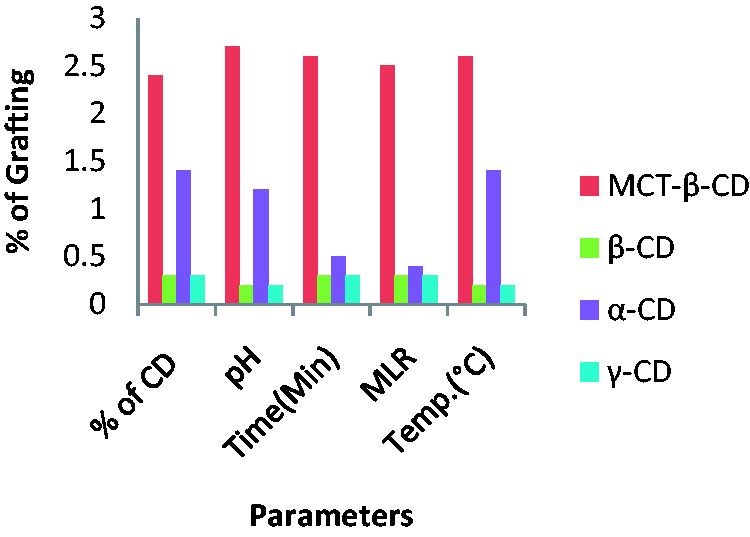
The experimental results presented in Figures 5–9 indicate that there is a remarkable effect on the physical properties of the treated samples. In Figure 4, the reduction in the tensile strength of the fabrics (S2, S5, S6 and S8) is the result of cross-linking of cellulose molecules [18]. However, samples S4 and S7 also lose their strength due to the two factors: acid-catalysed cellulose depolymerisation and cross-linking [19]. The grafted sample shows only negligible fabric strength loss. The maximum strength loss of about 12% takes place in cross-linked sample and FR sample.
Tensile strength of differently treated samples. Whiteness of differently treated samples. Crease recovery angle of differently treated samples. Flexural rigidity of differently treated samples. Surface roughness of differently treated samples.


Observing lower strength loss values in cross-linked fabrics is in accordance with the study by Xu and Li [20], who have used a cross-linking model to explain the reasons for the strength loss values as the formation of intermolecular and intramolecular cross-links reduces the possibility of equalizing the stress distribution that causes a reduction in the capacity to withstand load.
In Figure 6, the CD-grafted sample (S3) shows less changes in whiteness after grafting but samples S6 and S8 show maximum whiteness loss of about 11% and 12%, respectively; this reduction in whiteness is due to the presence of hydroxyl group, which is able to form >C = C< structure by dehydration during a curing process [21,22]. The reduction in whiteness took place as expected for the DAP-treated sample and BTCA-treated samples.
The formation of ester cross-links between cellulosic chains imparts crease resistance in cotton fabrics [23]. The CRA of the samples considerably increased for fabrics S2, S5 and S8 by about 11% due to the formation cross-linking by BTCA with the hydroxyl group of cellulose [24]. This observation is in tune with the findings of Welch and Peters [25] and Yang et al. [26] stating that the presence of hydroxyl groups hinders the cross-linking ability.
The hand value of the samples was measured in terms of flexural rigidity and surface roughness, as shown in Figures 8 and 9. The results reveal that the hand value of the CD-grafted sample (S3) was not affected but the FR finished sample’s roughness increase about 13%, which shows that the FR finished sample becomes little stiff. The results prove that CD treatment is not affecting the hand value of the treated sample.
Flammability and thermogravimetry analysis of the samples
LOI of differently treated samples.

LOI: limiting oxygen index.
The phosphorylation of –OH group of cotton/CD in sample 8 has caused intumescent formulations containing three active ingredients: (a)acid source (e.g. phosphate from DAP), (b) carbonization compound (e.g. starch derivative-CD) and (c) a blowing agent (bonding agent-BTCA). BTCA is able to esterify the hydroxyl groups of both cellulose and CD; however, cross-linked network is formed among BTCA/CD/DAP on cellulose.
Char length of differently treated samples.

CB: completely burned.
Burning time of differently treated samples.

CB: continue burning; SC: slow and suppressed combustion; FR: flame retardant.
Nevertheless, the thermal stability of the differently treated samples was highly evidenced with the help of TGA analysis (Figure 10). The FR behaviour of cotton fabrics can be evaluated through the degradation nature of control and treated samples using thermogravimetry technique [30,31]. The control sample (S1) and β-CD-grafted sample (S2) lose weight drastically due to evaporation of moisture and after 350℃, decomposition starts. Nevertheless, the weight of the FR-finished sample (S3) decreases gradually at 280℃ and when heated above 400℃, the weight loss is minimum compared with the control sample.
TGA: 1, control sample; 2, MCT-β-CD-grafted sample; 3, FR finshed sample; 4, cross-linked and inclusion compound formed sample.
The thermogravimetry graph reveals that the cross-linking and grafting onto cotton fabric followed by treatment with FR chemical (S4) increases the thermal stability of the fabric and hence imparts flame-retarding property.
The gases evolved during burning (Figure 11) and formaldehyde release (Table 5) of the differently treated samples were analysed and the result showed that the gas emitting level is more in the case of FR samples due to the combustible gases generated during burning [31]. The compounds that evolved such as CO, CO2, HCl, HCN, HF, HBr, SO2, NOX and HCHO were determined quantitatively for the differently treated samples and the results showed that the CD-inclusion compound formed samples (S7 and S8) emitted less amount of evolving gases and formaldehyde since CD is capable of masking the evolving gases. Due to this peculiar character of CD, the release of formaldehyde and emission of gases during burning were reduced, minimising their adverse effect on the environment. The free and released formaldehyde is high for samples S4 and S6 due to the presence of N-methylol groups in the FR. The results shown for the fabric treated with CD (S7) or with a combination of BTCA (S8) are in the same range, around 198 ppm, as was expected since CD has masking behaviour and BTCA has no influence on the formaldehyde releasing nature. The remaining samples (S1 to S3 and S5) did not show any detectable range of HCHO release behaviour.
Determination of evolving of gases in differently treated samples. Determination of HCHO release in differently treated samples.

Fourier transform infrared (FTIR) spectroscopic studies were made to confirm the cross-linking reaction and inclusion formation. FTIR analysis spectrum (Figure 12) of control fabric (S1) shows peaks at 3300 cm−1 (intermolecular H-bonding), 2900 cm−1 (CH2 str.), 1840 cm−1 (CH2 bending) and 985 cm−1 (anti-symmetric bridge C–O–C). β-CD-grafted cotton fabric (S2) produces a broad peak between 2800 and 3200 cm−1 that is characteristic of –OH stretching of cellulose and –OH in-plane bending is shifted from 1450–1400 cm−1 to 900–1000 cm−1 since the –OH group of cellulose is linked with CD.FR cotton fabric (S3) shows peaks due to >C = O (980–1100−1) and –N–H (1500–1956 cm−1) and this is evident in the formation of ester groups as described by Huang et al. [32].
FTIR analysis of the samples: 1, control sample; 2, MCT-β-CD-grafted sample; 3, FR finished sample; 4, cross-linked and inclusion compound formed sample. SEM analysis of the samples at 500 × 1, control sample; 2, MCT-β-CD-grafted sample; 3, FR finished sample; 4, cross-linked and inclusion compound formed sample.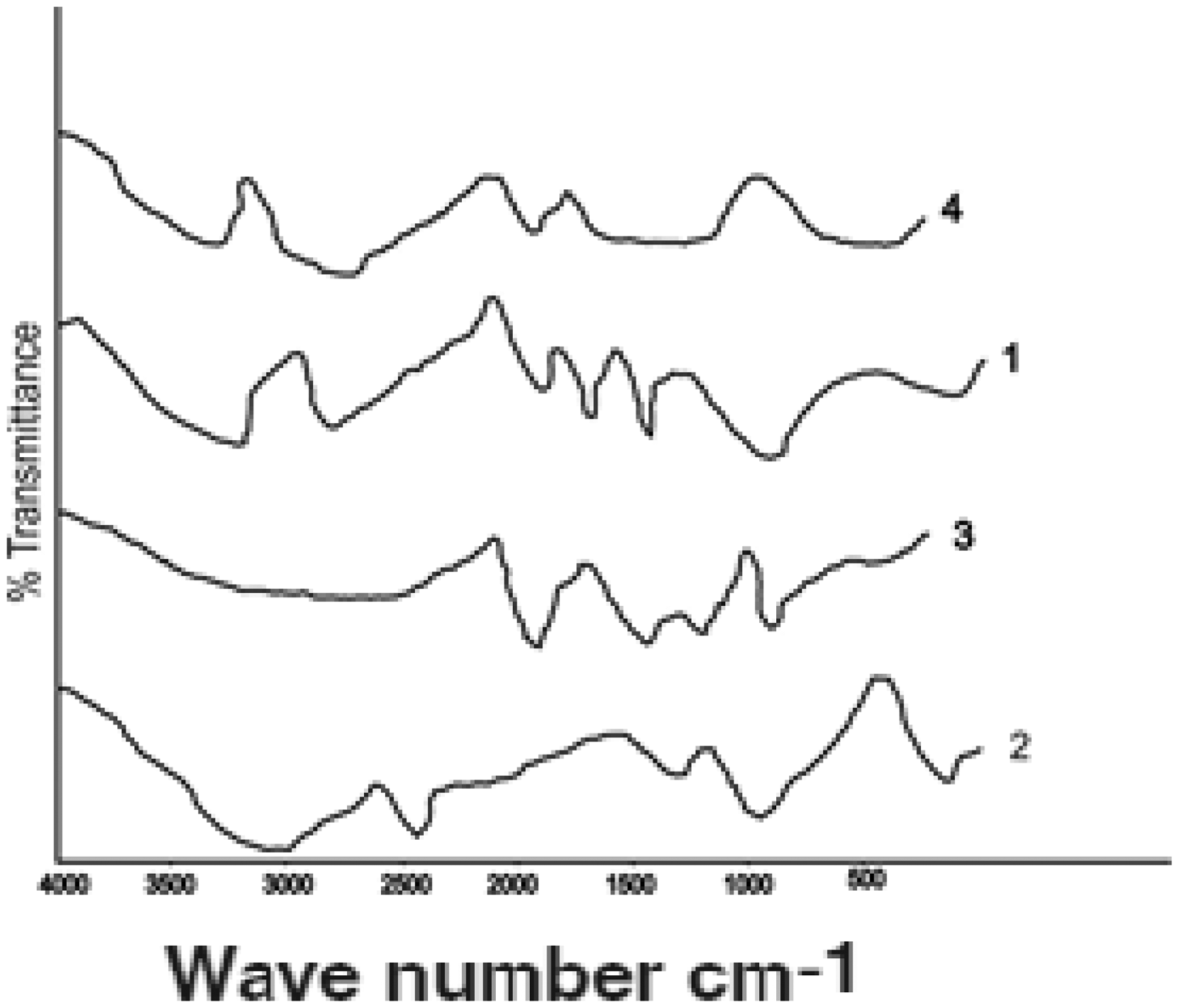

The presence of specific peaks for a particular group in the finished cotton fabric confirms the formation of FR on the fibre. The fabric (4) bands at 2800 cm−1 and 3300 cm−1 caused due to inclusion of FR into β-CD and peaks between 1200 and 1606 cm−1 characteristics of –OH bending, C–O stretching. The peak at 2245 cm−1 corresponds to C–H stretching of CD. The stretching vibration (C = C) of aromatic moiety at 1606 cm−1 proved the inclusion of FR into CD moiety. The band peak between 1200–1400 cm−1 vibrations depicts for presence of phosphates as described by Ferraro & Krishnan [33].
Scanning electron micrographs are envisaged in a deposition of unevenly distributed particles through grafting, cross-linking and inclusion complex formation with FR on cotton fabric surface. The comparative SEM images of controlled sample and treated samples allow the visualization of presence of CD, FR and formed inclusion compound. The inclusion modifies the microscopic aspect of the treated samples. Thus, the inclusion complex and FR deposition combine chemically with the fibre to modify its intrinsic burning behaviour, as described by Chauhan et al. [34]. The comparative SEM images (Figure 13) of control sample (SEM 1) and CD-grafted sample (SEM 2), FR chemical-treated sample (SEM 3) and formed cross-linked and inclusion compound sample (SEM 4) allow the visualization of modified cellulosic fabrics. The inclusion modifies the microscopic aspect of the treated samples.
Conclusions
In this study, a viable method of grafting of MCT-β-CD compound on 100% cotton fabric was achieved. Its reproducibility was checked by triplicate method. Since the MCT-β-CD grafting conditions (1.6% concentration/90℃ /40 min/pH 11) bear a resemblance to normal processing conditions used for cotton fabric, this technique is not affecting the inherent characteristics of cotton fibre. The flammability, physical properties and aesthetic properties of differently treated fabrics (S1 to S8) were analysed and the results show that the newly formulated technique changes the hand value for acceptable quantity only. Ungrafted DAP-applied fabric (S4) exhibits effective flame retardancy up to 10 washing cycles but DAP applied on CD-grafted fabric (S7) showed durability up to 20 washing cycles. The BTCA treatment also influences the durability of DAP finish on CD-grafted fabric (S8) and it exhibits a better flame retardancy than fabric S7 and withstands up to 40 washing cycles. In this study, a semi-durable FR finishing was obtained through inclusion compound formation between CD and DAP (fabric S7) and the durable FR finishing was achieved with the help of BTCA on CD-grafted fabric using DAP (fabric S8), as confirmed using LOI testing and FTIR analysis. The changes of aesthetic value like whiteness, hand value and physical properties by the newly formulated technique are of negligible quantity only, when compared with regular FR finishing. The result reveals that the CD can be effectively used in FR finishing without affecting the hand and physical properties of the fabric. Nevertheless, the evolution of toxic gases during burning and the formaldehyde release in the FR-finished samples were minimised by CD treatment due to the masking behaviour of CD by its cavity. Hence, the grafting of MCT-β-CD is a novel, green route for the production of durable FR finish and it can be effectively used to produce multi-functional properties.
Footnotes
Declaration of Conflicting Interests
The author(s) declared no potential conflicts of interest with respect to the research, authorship, and/or publication of this article.
Funding
The author(s) received no financial support for the research, authorship, and/or publication of this article.