




Abstract
Protective body armors, providing protection against stab threats, have long been in a focus of substantial interest. Lightweight fabric for flexible body armors that satisfy the customized fit, comfort, and protection should be considered. Sharp impact experiments were conducted on single and multilayer fabrics of Kevlar29, Vectran, and Polyester triaxial woven fabrics and compared with polyester woven and knitted fabrics. The experimental results evaluate the energy absorption of the different triaxial woven fabrics for stab resistance. An index was developed to evaluate the capability of fibers to absorb the impact energy which indicated that high fiber tenacity and Young’s modulus and low density lead to high rate of punching resistance force. The present work indicates that Vectran triaxial weave fabrics propose to improve the impact performance when used in developing multilayer fabrics for designing lightweight soft body armor with enhanced stab performance adding flexibility and comfort.
Introduction
Flexible stab-resistant fabrics have been widely used in military and civilian fields; however, numerous efforts have been taken to construct better lightweight soft body armors, such as using high performance fibers. Most of present studies on protective armor are related with the protection against bullets. But recently, the studies on the protection against impact by sharp blade or spike have been studied actively too. It is important to point out that protective clothing is cutting resistant. Resistance to the penetration is one of the most essential parameters considered for estimation of usage properties of the fabrics designed for protection against various types of mechanical impact; moreover, a soft vest should provide comfort for the user, a lightweight, and cost-effectiveness. Nevertheless, current stab resistant clothes have several weak points such as heavy weight, bulky shape, and uncomfortable characteristics [1]. Moreover, without a good customized fit, body armor can become a distraction to the duties of female wearer as she may feel uncomfortable or even pain on some parts, which will obstruct her mobility and leave her life in danger [2]. El Messiry [3] indicates that for protective fabric, spun silk multilayer woven fabrics have higher penetration resistance, providing more comfort in use. Additional fabric layers contributed to the increment of puncture resistance. The number of layers can be selected according to the degree of protection required.
Stab-resistant body armor was placed into two categories, based on the kind of threats it is designed to shield [4]. The first category is designated the “edged blade” class; it shields engineered or high-quality blades. The second category, which is named the “spike” class, protects from the types of improvised weapons commonly found in correctional facilities. Within each of these two categories, there are three levels of protection from low to high based on the energy that would impact the body armor during an attack. Cutting resistance is among the major mechanical properties required in protective clothing [5]. Stab threats can be classified into two categories: punching and cutting. Knife threats are generally more difficult to stop than puncher, since the long cutting edge presents a continuous source of damage initiation during the stab event. The puncture strength is much smaller than both the tensile strength and the biaxial strength of the elastomer membrane. For sharp medical needles, the puncture process occurs gradually and involves cutting, which relates to the fracture energy of the material, whereas the puncture resistance to cylindrical probes relates to the material’s tensile strength and failure strain [5].
In the field of protective clothing, different materials are used to provide cut, tear, and cutting resistance where high levels of stiffness and shear resistance are important. Many researchers [5–11] have shown the cutting resistance of high strength fabrics and also multilayer stitching. Under their investigation were either natural or synthetic fabrics of different weave structure types. These studies detect the capability of increasing in the energy absorption by the use of multilayer compositions, optimizing them for applying into impact-resistant protective fabrics made from natural fibers and their blends. The perforation-threshold energy increased with the areal density [3, 12, 13]. Roylance and Wang [14] established that approximately half of the total energy absorption is stored in the form of strain energy. Strained area is directly associated with the velocity of sound in the material, which is also considered to be the velocity of the longitudinal wave. Consequently, higher Young’s modulus fiber gives higher wave velocity, which leads to a rapid energy absorption rate. As the modulus is decreased, the wave velocity is decreased and the strain is more concentrated in the vicinity of the impact zone. Energy is dissipated through the propagation of two types of wave. The longitudinal wave travels outward along the fiber axis at the sound velocity of the material from the point of impact. This wave also causes the yarn to be stretched and have in-plane movement. Chai and Zhu [15] indicate that the following areas of research have been and still are being pursued in ascending order: (a) contact analysis between the impactor and the composite surfaces, (b) the response of structure after impact, (c) the failure mechanism by impact, (d) the residual property after impact, (e) high-velocity impact analysis, and (f) impact analysis of soft body impactor.
The influence of fabric structure on ballistic performance was studied by Zhou [16]; he pointed out the superiority of plain weave over other fabric structures in the energy absorption and better performance in the case of high areal density region. As the majority of the research works focused on improving the properties of fibers and chemically treating ballistic fabrics, there is little emphasis on employing textile-based technologies. Hossain et al. [17] investigated the response of plain weave E-glass/polyester composites and E-glass/polyester-carbon nanofibers (CNF) composites to low-velocity impact loading. A significant improvement in fiber-reinforced polymeric composite materials can be obtained by incorporating a very small amount of nano fillers in the matrix material. Gong et al. [18] and Kuşhan et al. [19] developed a shear thickening fluid enhanced fabrics. The influence of the shear thickening fluid types on the knife stab and puncture resistance performance was reported, although it was estimated that the knife stab and puncture resistance performance was highly influenced by the interactions between the Shear thickening fluid (STF) particles and the yarns. Scardino and Ko [11] stated that, while the cutting resistance was not directly measured, a relative strength in cutting is often calculated by taking an average value between the cutting and tearing or tensile. Nitinol fibers are used as reinforcement for fabrics made from cotton/nylon and cotton/polyester to give the fabric increased cutting and tear resistance without decreasing the flexibility or comfort of the fabric. The effect of interyarn friction on fabric energy absorption has been studied by several researchers [21–24]. Chai and Zhu [25] give models using numerical method, mathematical method, and experimental investigation of sandwich panels subjected to impact load. For low-velocity impact, the impact response is boundary controlled for large mass impact and can be modeled using quasi-static method.
Numerous weave structures have been used as stab resistance fabrics, nevertheless triaxial fabrics are scarcely investigated. Triaxial weave has basically three sets of yarns as ±bias (±warp) and filling [26–28]. They are interlaced to each other at about 60° angle to form fabric. The interlacement is similar with the traditional fabric which means one set of yarns is above and below to another and repeats through the fabric width and length. Generally, the fabric has large open areas between the interlacements. Dense fabrics can also be produced. However, it may not be woven in a very dense structure compared to the traditional fabrics. It is believed that the friction between warp and weft yarns benefits energy dissipation in woven fabrics. Increasing interyarn friction has the potential to improve fabric ballistic performance without adding to its weight. The triaxial fabric is five to six times as stiff in shear as the equivalent biaxial fabric [11]. Triaxial structures can provide superior performance in applications wherein fabrics are loaded in all or several directions, rather than uniaxial, during product use [29], due to its isotropy maintaining the initial modulus similar in all directions within the fabric plane. Triaxial fabric can offer improved stiffness without added weight or laminate thickness for high-performance structural laminate [30]. El Messiry [31] postulates that protective fabric of silk multilayer woven fabric formed from five layers of silk above and five others below supported by triaxial Kevlar fabric can reach a puncher resistance force of 50 N. According to National Institute of Justice “NIJ” Standard–0115.00, stab resistance protection level strike energies for three protection level varied between 24 and 43 J [32].
Objectives for this work are to investigate possibility to find out lightweight fabric for flexible body armors through: (i) study of energy absorption characteristics of single and multilayer triaxial woven fabrics, (ii) parametric study on triaxial woven fabrics for low speed impact performance, and (iii) analysis of the puncture damage mechanisms.
Materials and methods
Material
In this work several samples were made of the following fabrics with the specifications given in Table 1:
Woven net fabric of high tenacity polyester from cord yarns 2x246 tex, yarn tenacity 38 cN/tex, breaking elongation 3.6%, picks/cm 8, and ends/cm 6.4. Triaxial woven fabrics from different types of fibers. Triaxial pattern is basic with a count of 9 yarns/inch (3.6 yarns/cm) in all three axes:
Para-aramid Kevlar® 29, the yarn counts 167 tex, tenacity 203 cN/tex, and breaking elongation 3.6%. Polyester, the yarn counts 144 tex, tenacity 80 cN/tex, and breaking elongation 14.5%. Vectran® filament, the yarn counts 140 tex, tenacity 233 cN/tex, and breaking elongation 3.8%. Three samples of single jersey knitted fabrics made of textured polyester multifilament of count 20 tex with different percentage of Lycra. Physical properties of different fabrics.

Impact test setup
Dropped weight impact for penetration resistance tests was performed to simulate a knife stab impact on the fabric on a specially designed apparatus, as shown in Figure 1. Dropped weight-impact stab tests are performed based on the NIJ Standard 0115.0 for stab resistance of body armor using knife fixed to the impactor [29]. The primary objective of the test is to identify the maximum load needed to puncture the fabrics.
Sketch of the apparatus principles.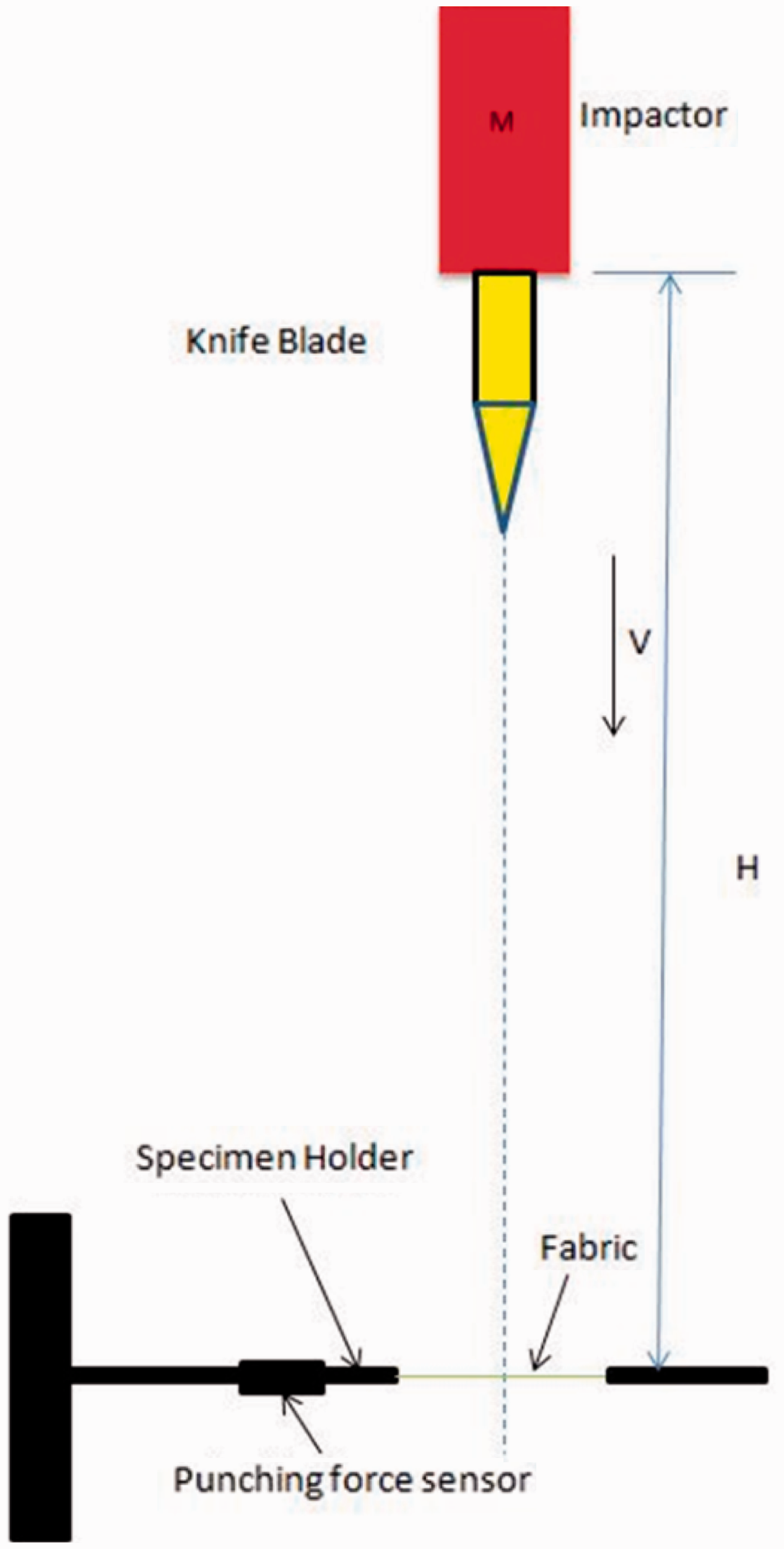
Low velocity falling weight impact test method was employed with a knife blade fixed in the impactor at a height of 600 mm and total impact mass varied between 6 and 18 kg, generating the striking energy of up to 100 J at striking velocity of 3.41 m/s. Circular specimens of radius of 75 mm were cut from the different types of fabrics. The samples striking energy was chosen to fulfill the penetration of the knife blade in a depth of 20 mm. For dropped weight-impact test all single and multilayer specimens were 75 mm in diameter. The sample was placed between two circular clamps with inner diameter of 70 mm. The specimen was firmly clamped with specimen holder, as shown in Figure 1. Cutting force was measured by means of load cell, which has maximum load capacity of 600 N and connected to a load indicator to display the cutting load. The impact velocity could reach 3.5 m/s. The impactor was provided with knife blade probe fixed in the impactor carriage. By changing the mass of the impactor carriage, the striking energy varied up to 100 J. Different impactor weights were applied with constant height “H.” The impactor weight will be changed to get the sufficient striking energy to obtain maximum knife blade penetration of 20 mm.
Results and discussions
Analyses of the penetration mechanisms
Punching mechanism observed in our experimental work indicated the following possible situations:
Case A, Figure 2(a): Knife edge punches the fabric between the threads, hence sufficient space allows it to pass, as in the case of fabric with low density in weft and warp, so that the yarns will move in different directions permitting knife edge to pass through without fiber or yarn damage. Case B, Figure 2(b): Knife edge punches the fabric between the threads without cutting matrix, pushing the yarns aside without cutting it. Case C, Figure 2(c): For tight fabric near the jamming condition, the yarns start to be cut by knife edge. If the strike energy is higher than fabric resisting energy, the knife will pass completely though the fabric. Knife edge perforates the fabric through cutting the yarns in contact area with its blade sharp edge. In this case, part of the energy is absorbed by deformation of the fabric; the other part is absorbed through the cutting of numbers of yarns to allow knife edge to pass through. Case D, Figure 2(d): If knife edge cannot perforate the fabric, as in the case of blunt impactor, the fabric will be deformed causing the yarns to distort and travel with the same speed of the falling impactor. This will form a cone transferring the strain to all other yarns, either in the same direction or in other directions. The failure will take place only if the strain in the yarns reaches the breaking strain. (a) to (d) cases of impactor punching fabric. Example of fabric failure under impact test.


However, the mechanism of failure in the case of fabric punching is different than the ballistic impact; hence the higher interyarns friction will absorb more energy during the ballistic impact [32]. In the case of using sharp knife blade, the high friction will constrain the yarns at the impact to give sufficient resistance, so knife edge can certainly cut it at a low energy. If the target consists of several layers, some energy will be absorbed to overcome the friction between the layers, depending on the fabric-to-fabric friction and the failure of the force inserted by the knife during penetration. This may increase the material resisting force. All the above cases will initiate after the fabric reaches its maximum strain forming a cone development.
Energy balance for fabric punching
The straight way to evaluate the impact performance of a fabric is to calculate its energy absorption. Hence, the kinetic energy Ebefore impact of the impactor before impact will be equal to the sum of the kinetic energy Eabsorbed absorbed by the fabric and kinetic energy Eafter impact of the impactor after impact. Therefore


Kinetic energy absorbed by the fabric Eabsorbed is defined by the following six different components:
ES: Energy to shear the yarns. ED: Energy to deform all other yarns. ET: Energy to tensile failure of directly impacted yarns. EF: Energy to overcome friction between fabric layers. EJ: Energy to overcome friction between blade and yarns. EM: Energy to move the fabric during impact.
Therefore, the total absorbed energy by the fabric is expressed as

In order to increase the absorption energy of the fabric, it is expected evolving each component of the fabric absorption energy, if it is possible, such as use a multilayer fabric “EF,” the yarns with high cutting resistance “ES,” increasing the friction between the blade and the yarns “EJ.” Moreover, the application of fibrous pads, as a friction media, will increase the contact area between the blade and fibers [31]. This will lead to the rise of the energy components “EJ” and “EF.” The use of yarns which can propagate the strain at higher velocity will attain the increase in the resisting energy component “ED” value. These components of the absorbed energy will depend on fabric structure and specifications as well as yarn properties [34].
Effect of the type of woven structures on fabric punching force
The punching force is affected not only by the properties of the material used but also by fabric structure and its specifications [35]. Several investigations have dealt with effect of woven fabric structure when it is subjected to high speed impact and came to the conclusions that high cover factor will increase the available dissipation of strain energy capability by getting more fibers and yarns engaged with a projectile [35–38]. Plain fabric is the most common pattern due to its high interlacing yarn density and dimensional stability; however, it suffers from the fact that the fabric does not start the energy absorption unless fabric is completely decrimped, additionally unbalanced pattern results in the inferior ballistic performance. Higher fabric density increases energy absorption. The mechanism of failure in the case of fabric punching is different from that of ballistic impact as mentioned earlier. In the case of using sharp knife blade to punch, high density fabric is expected to give lower energy absorption. Therefore, it is worthwhile to substitute it with the multilayer structures.
Punching force of triaxial fabric.
The triaxial fabric is different in structure than knitted or woven fabric, as mentioned by several investigators [11, 27–31], it is a completely isotropic fabric made in a weaving process employing three yarns at 60° angles to each other. These fabrics have no stretch or distortion in any direction. With equal sizes and number of yarns in all three directions, the fabric approaches equal strength and stiffness in all directions. The no crimp yarns are easily deformed through slipping over each other in the three directions to allow absorbing more energy and increasing the resisting force for blade penetration. In triaxial fabrics, there are reasons for believing that the impact performances of otherwise identical fabrics would be different for biaxial and triaxial fabrics, although it spread the load more evenly around the zone of impact. In spite of the opening of triaxial fabric as shown in Figure 3, the deformation of the fabric in the case of triaxial weave shows that more yarns are involved in the fabric deformation than for biaxial weave; consequently, the value of EM is higher, aggregating the impact absorption energy.
Figure 4 illustrates specific punching force of the layers as a function of the number of layers for all types of fabrics of specifications given in Table 1. The triaxial fabric shows superior results. Knitted polyester fabrics have equal specific punching force compared with plain woven fabric. This may be due to the higher deformation of knitted fabric under the punching load which increases the energy component of EM. Figure 5 shows the increase in absorption energy EM when Lycra yarn is added by different ratios, the value of punching force is increased, so it can approach value of polyester triaxial fabric. The results signify that the triaxial woven fabrics have higher specific punching force, especially when using high performance fibers.
Specific punching force versus number of fabric layers of different types of weaves. Specific punching force versus number of fabric layers of knitted fabric.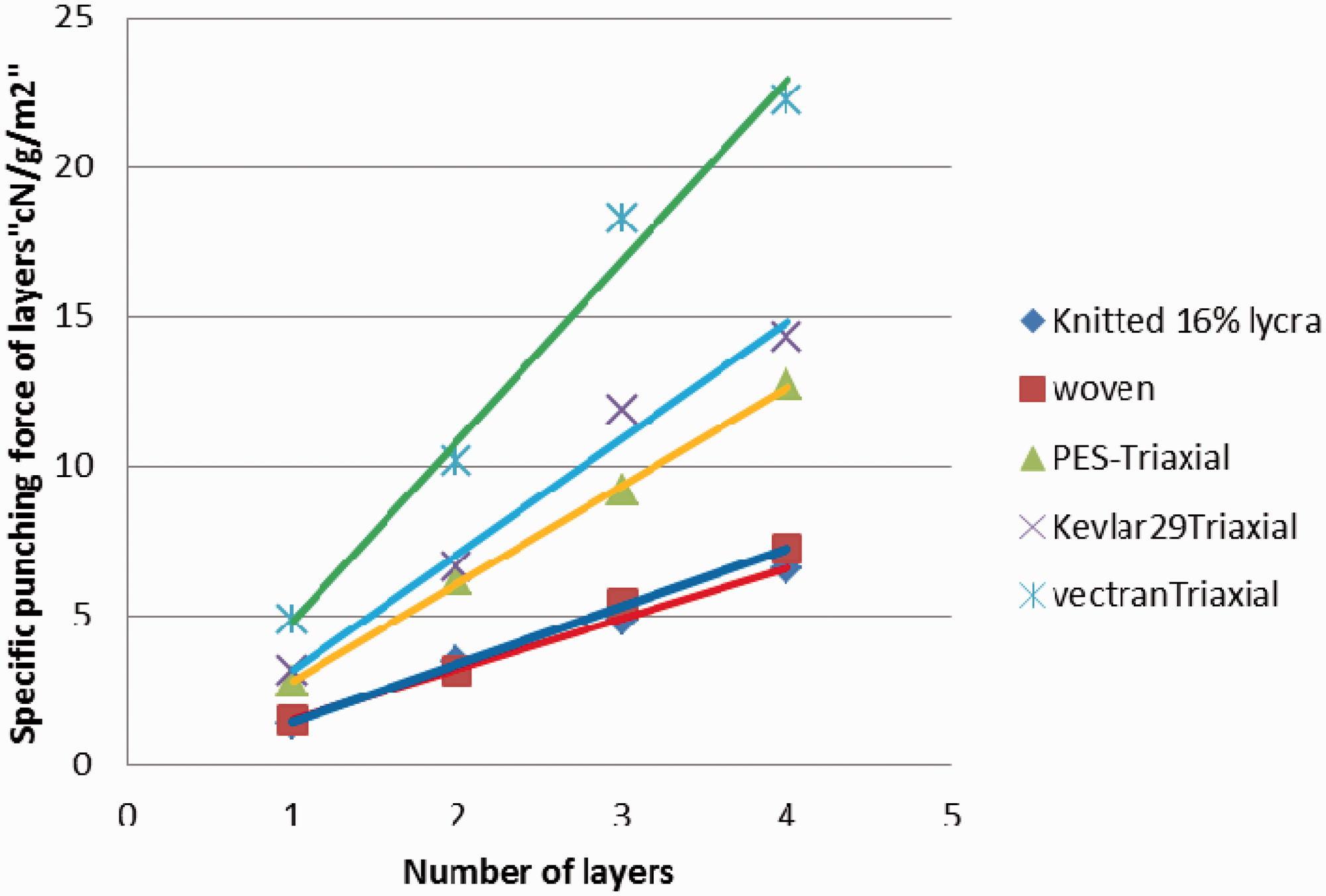

Investigation of the effect of number of layers on triaxial fabric punching force.
Three triaxial woven fabrics of different types of yarns, Polyester, Keveler,29 and Vectran continuous multifilament yarns are tested as single and multilayer samples. Figure 6 expresses simulated diagrams of kinetic energy absorption by the fabrics. Better impact resistance performance has been achieved using higher number of fabric layers, which have been found to facilitate energy dissipation from the impactor.
Single and multilayer fabric deformation.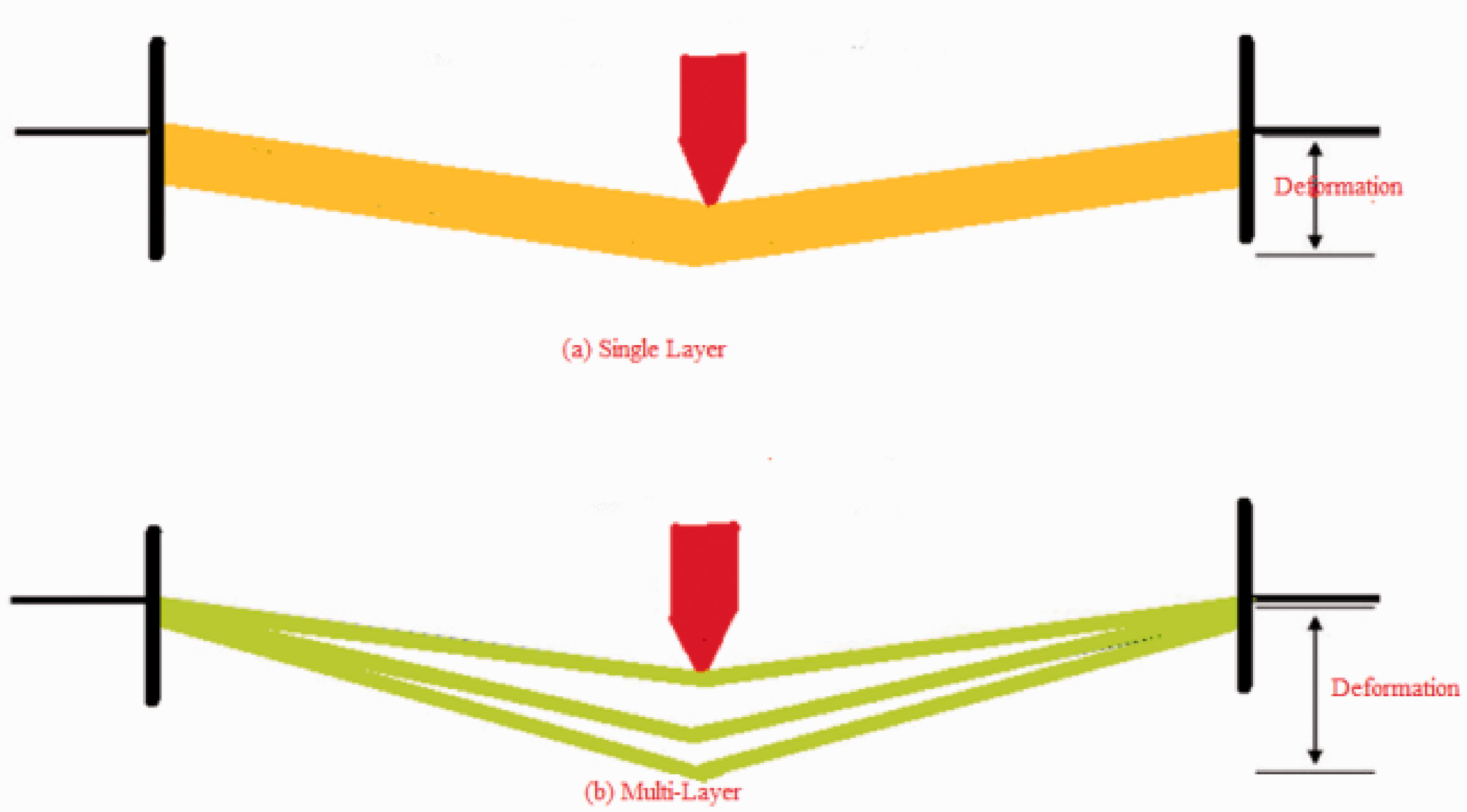
Figure 7 illustrates the effect of number of fabric layers on punching force of three triaxial fabric types, specifying that Vectran triaxial fabric has the highest value of punching force compared to Keveler29 and polyester. This is owing to the fact that the velocity of strain propagation of Vectran fibers is the highest as well as its tenacity shows the highest specific punching force. Coefficient of correlation between punching force and strain velocity is found to be 0.98 and between punching force and fiber tenacity is equal to 0.825.
Punching force versus number of fabric layers.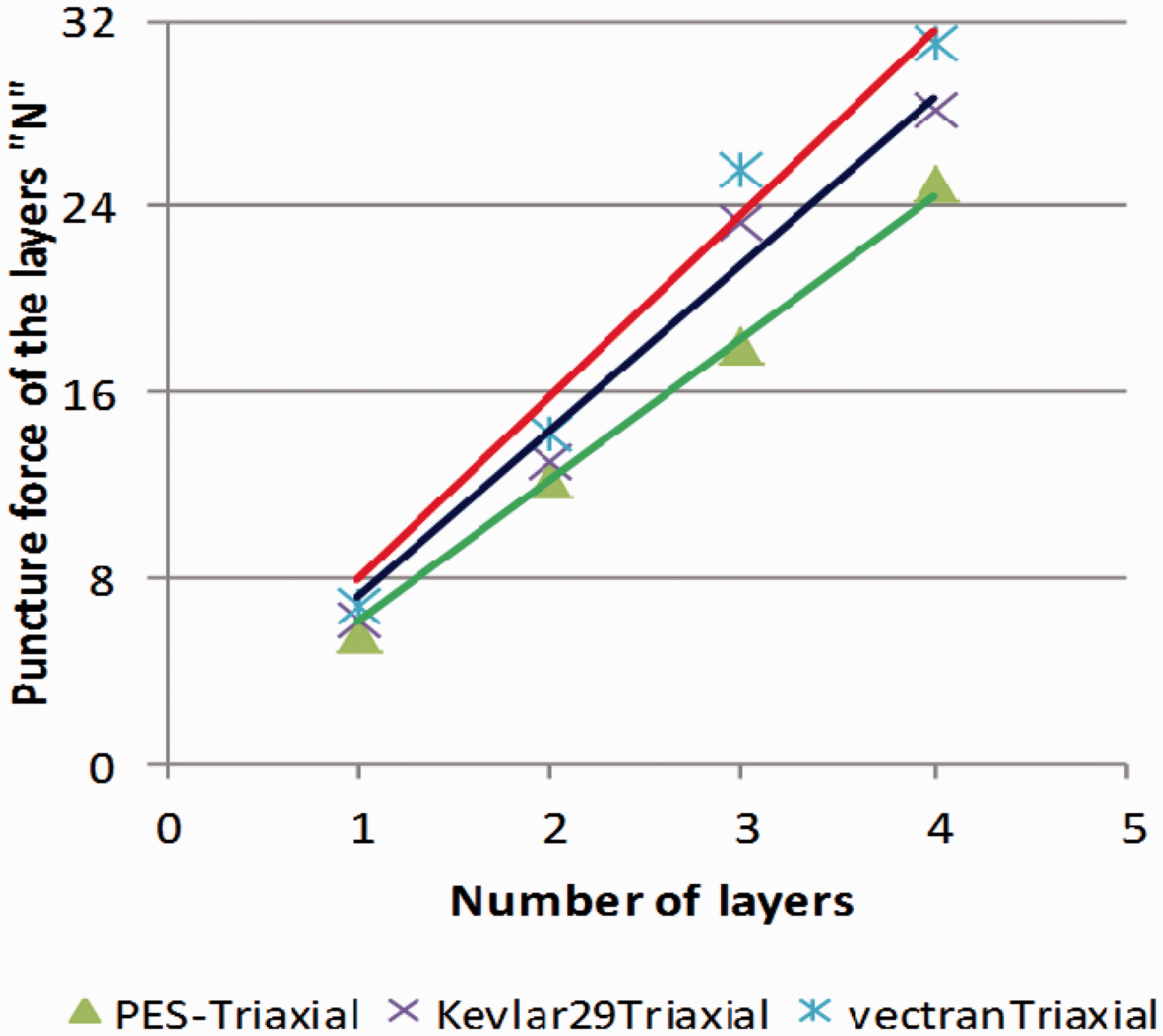
Figure 8 demonstrates that measured specific punching force is higher than calculated one, which may be due to the friction between the layers that increases the absorption energy “EF” [31].
Specific punching force versus number of fabric layers.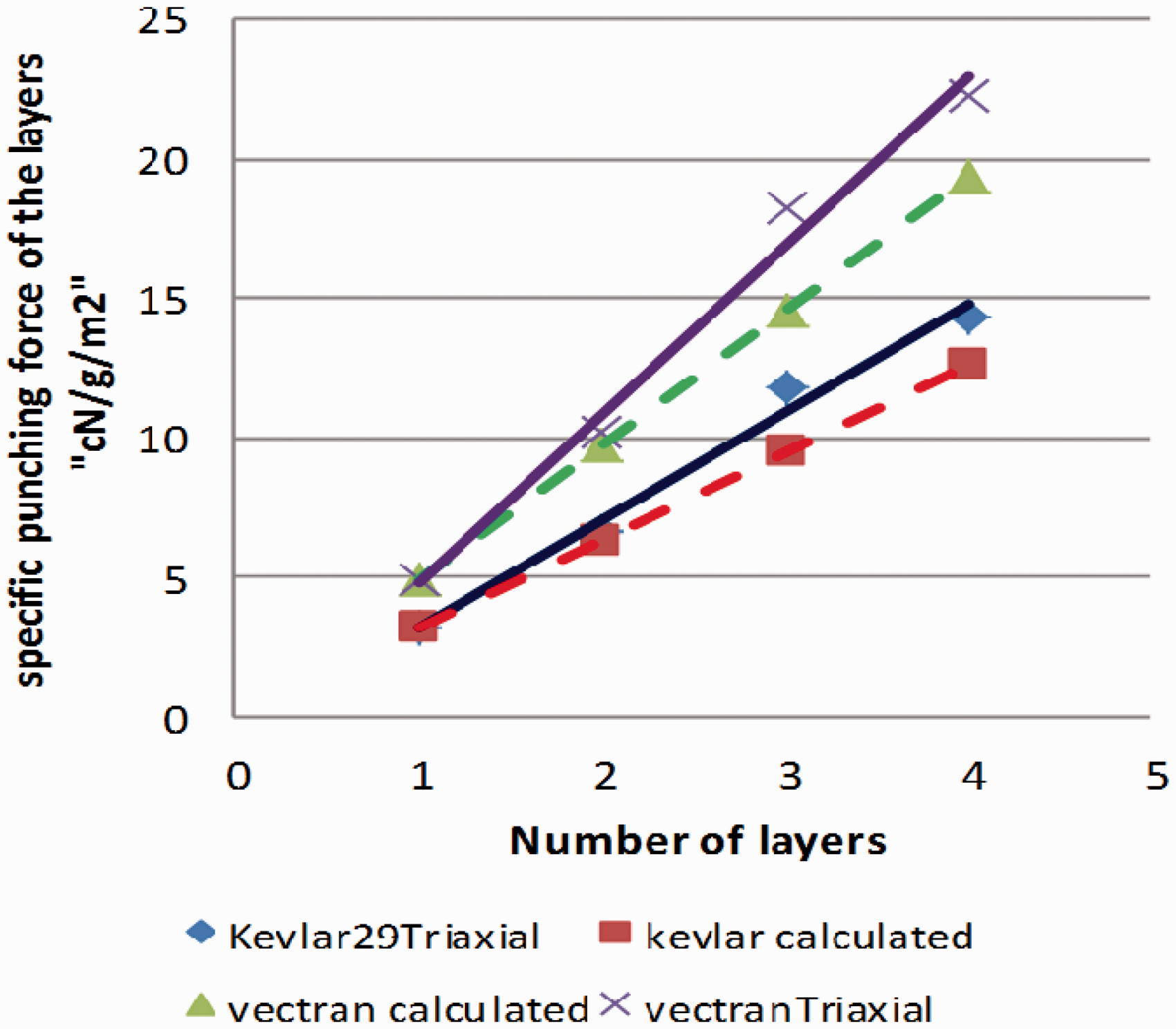
The velocity of strain propagation can be expressed by the following equation [38]

In impact, faster moving longitudinal waves help to scatter the impact energy through the yarns intricate at the impact area [34]. Figures 9 and 10 show the relation between punching force and specific punching force versus strain propagation velocity, which might be considered as one of the most influencing parameters.
Punching force versus strain propagation velocity. Specific punching force versus strain propagation velocity.

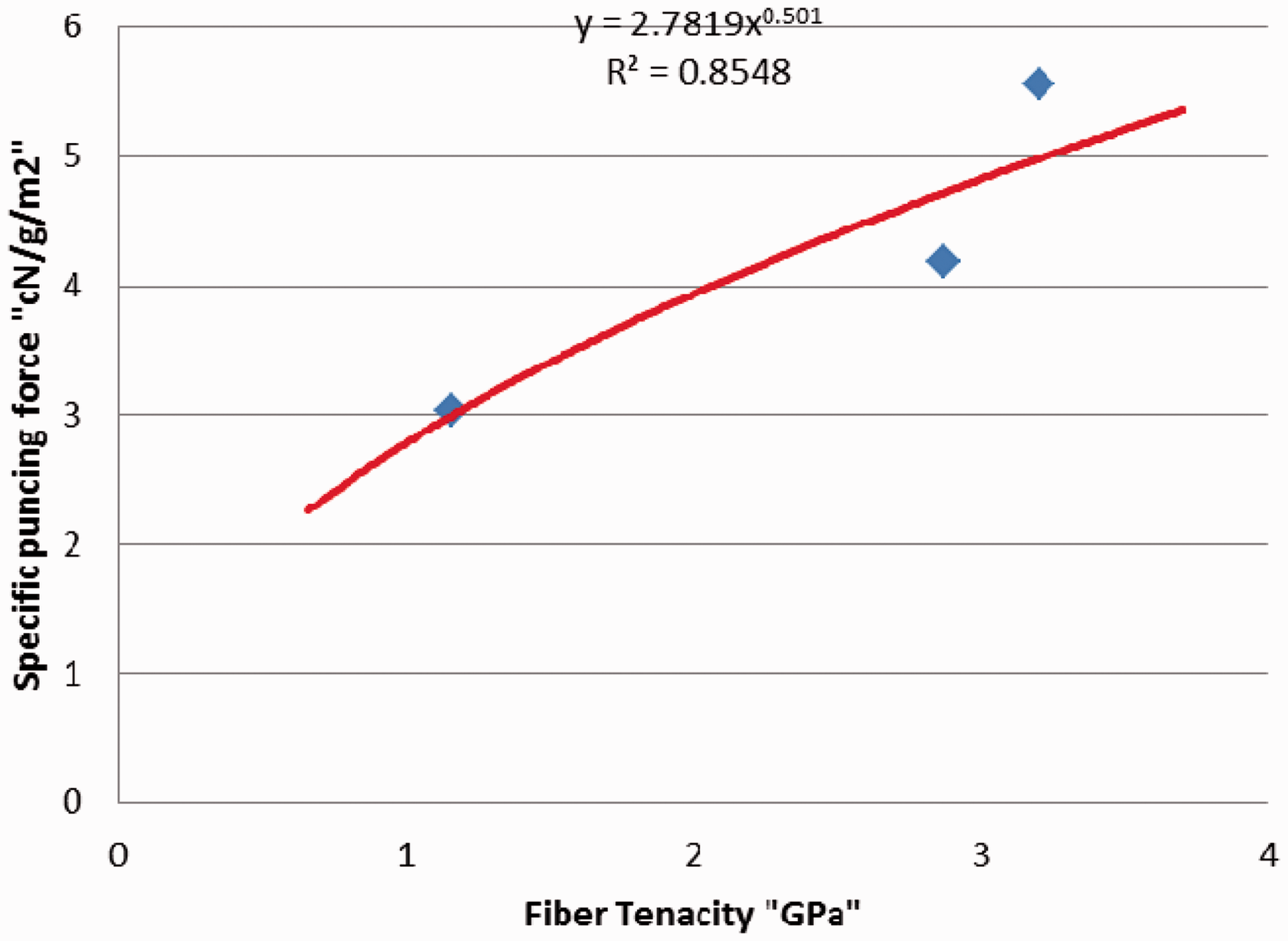
Another factor which affects punching force is fiber tenacity and its impact is illustrated in Figures 11 and 12.
Punching force versus fiber tenacity. Specific punching force versus fiber tenacity.
Evaluation of fiber impact capacity
The specific punching force is a function of strain propagation velocity and fiber tenacity, which is in agreement with the findings of Roylance [38] and Naik and Shrirao [39]. However, research work of Cunniff [40] determined that the fiber property is a function of a number of parameters, denoted by

The value of U indicates the product of fiber specific toughness and strain wave velocity. Cunniff [40] demonstrated that U1/3 may be a major factor that relates ballistic impact performance to fiber mechanical properties, independent of other parameters, such as impacting projectile mass, presented area, or areal density. Moreover, Frissen [41] concluded that high modulus and low fiber density give high longitudinal wave velocities. A higher longitudinal wave velocity gives increased energy absorption since a larger part of the yarns is loaded in tension. Furthermore, he observed that a high longitudinal wave velocity reduces the strain level in the string at a certain impact velocity
Values of “FEACI” index and “U1/3” for different high performance fibers.

Calculated by equation (3).
Calculated by equation (5).
Figure 13 indicates that two indexes in most cases can distinguish the rank of the fibers for their ballistic capabilities. These results contemplate with the findings of Anctil et al. [42]; he proved that there is a correlation between ballistic results and drop mass result for different armor materials.
Value of U⅓ versus “FEACI” for different types of fibers.
The findings of the experimental results confirm that the value of the coefficient of correlation between fiber’s “FEACI” and the punching force for polyester, Kevlar,29 and Vectran samples is found to be 0.985 and can be expressed by the following equation


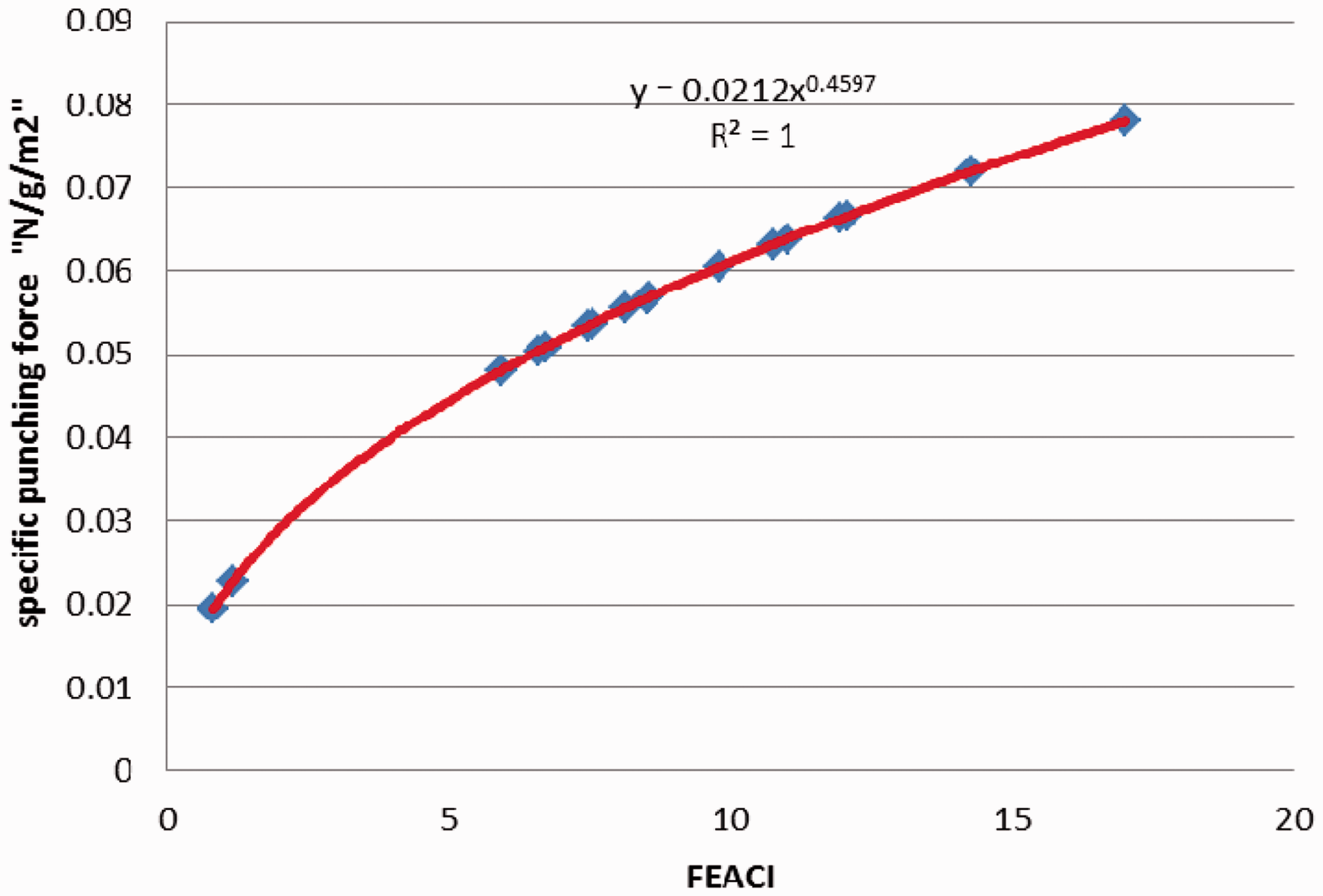
Figures 14 and 15 provide the relation between the predicted punching force and specific punching force for “FEACI” index for all the high performance fibers in Table 2, which points out the soundness of the suggested index in ranking of the different high performance fibers. Fibers with very high modulus, in which the combination of high modulus, high strength, high shear modulus, and relatively low density, enable them to punching resistance fabric applications.
Punching force versus “FEACI.” Specific punching force versus “FEACI.”
Conclusion
The goal of this research was to improve the punching resistance performance of deformable stab-resistant fabrics for body protective clothing at a reduced weight by using triaxial weave fabrics (TWF). The results proved the advantage of TWF over the other types of weave. Through investigation of the punching-resistant mechanism of fabric and low velocity punching-resistant performance test, an index ranking the “FEACI” and its relation with specific punching force was developed. This will help to choose the type of fiber that suits the end use of the protected fabric. The Vectran fiber and its TWF demonstrated higher values of energy absorption of the impactor through more efficiently dissipated energy in fabric, subsequently improving impact resistance properties compared to the other fibers. Multilayer samples appear to provide better protection from punching and TWF fabrics can be reformed to offer enhanced stab resistance.
Footnotes
Acknowledgements
The authors would like to thank Triaxial structures Inc. for providing triaxial fabric used in this work.
Declaration of Conflicting Interests
The author(s) declared no potential conflicts of interest with respect to the research, authorship, and/or publication of this article.
Funding
The author(s) received no financial support for the research, authorship, and/or publication of this article.