




Abstract
In this article, submicron barium sulfate particles, as the radiation-resistant component, were incorporated into regenerated cellulose spinning solution. Then a series of X-ray radiation-resistant fibers were fabricated via a primarily industrialized wet-spinning trail, and the resultant fibers were knitted into fabrics by knitting loom. The morphology and structure of the fibers were studied with the aid of scanning electron micrography, Fourier-transform infrared spectroscopy, and X-ray diffraction. The composite fibers exhibited reasonably good properties, which met the criteria of mechanical requirements of commercial textiles—dry breaking strength and elongation (>1.5 cN/dtex and 26%) and wet breaking strength and elongation (>1.4 cN/dtex and 22%) and permanent laundry-resistant abilities even after being washed 20 times. An effective and feasible X-ray radiation-resistant method, the medical digital X-ray photography system, was proposed to evaluate the radiation resistance of the composite fiber and its fabric. The X-ray attenuation ratio of the sample tended to increase with increasing barium sulfate content and finally reached a dose of a 0.1 mmPb lead equivalent. Therefore, these fibers and fabrics can be utilized as the base materials for X-ray radiation-resistant lightweight apparel and detective surgical yarn.
Keywords
Introduction
X-ray, as a type of electromagnetic energy, is applied in many fields, ranging from computed tomography scans, phase-resolved medical imaging, material surface research to safety checkpoints at airports. Medical scans help doctors and patients to monitor injuries and organ conditions. However, X-rays emits a type of radiation that can be harmful to humans if the intensity is too high or the exposure is too frequent, which may damage human bones, organs, and even alter DNA. In common, high atomic number (Z) materials are capable of attenuating diagnostic X-rays (40–150 kV) conspicuously through photoelectric effect [1]. For this reason, lead is commonly considered as the most effective material for protection against X-ray exposure. Therefore, lead is widely used as structural material in radiological facilities. Protective garments made of high Z materials such as lead, composites of lead or lead oxide impregnated in polymer matrix [2,3], and composites of heavy metals [4–6] have been employed for protection against X-ray exposure during radiological examinations. However, conventional lead aprons are very heavy and made of unbreathable fabric, causing discomfort to wearers; in addition, the toxicity that lead produces is also an environmental concern.
In this manner, the applications of lightweight and lead-free radiological protection are explored, aiding in the development of new materials. Many lead-free protective aprons in use are made up of bismuth [1] or tin [7] or antimony or contain a substantial amount of these materials. Barium sulfate (BaSO4), which is commonly referred to as barite, is widely used as a shading material for X-ray photography because of its positive characteristics—not harmful to humans and strong shielding capability. Kim et. al. [7] manufactured six types of radiation-shielding aprons made from a combination of BaSO4 base and compared with lead equivalent standard. EI-Sarraf and El-Sayed Abdo [8] investigated the radiation attenuation of epoxy/barite and polyester/barite composites. Romero-Ibarra et al. [9] studied the influence of BaSO4 on the physical properties of polyoxymethylene nanocomposites. BaSO4 particles also blended with polyvinyl alcohol [10], thermoplastic polyuurethane [11], and chitosan [12] to form fibers and composites. Based on these research studies, BaSO4 incorporated into polymeric materials to form composites can be used for X-ray shielding instead of lead. As far as we know, BaSO4 particles were commonly coated on fabric surfaces with adhesive, which can usually cause the fabric to become less breathable and lower its laundry-resistance ability.
In this article, we present the X-ray attenuation characteristics of a novel, nonlead-based lightweight polymer composites incorporated with BaSO4 particles. We fabricated regenerated cellulose (viscose) composite fibers with different concentrations of BaSO4 particles as filler materials. The BaSO4-based composite fibers were lightweight, nontoxic, easy to fabricate, cost effective, and they could also be used to coat uneven surfaces. In addition, we applied a novel method to measure X-ray transmission. We obtained sample images through medical digital X-ray photography system (DR) and then utilized gray values [13,14] of the images to characterize the X-ray shielding ability.
Experimental
Materials
Viscose spinning solution (α cellulose content, 8.2 wt%) was kindly donated by CHTC Helon Co. Ltd, (Weifang, China). Submicron sized BaSO4 particles (degree of purity ≥98%, density 4.5 g/cm3) were purchased from Microbari Group Co. Ltd (Guizhou, China), with particle size ranging from 1.0 to 3.0 µm. Sodium dodecyl sulfate (SDS) was employed as dispersant to assist BaSO4 particles to disperse homogenously and was procured from Tianjin Basf Chemical Co., Ltd (Tianjin, China). Distilled water was used throughout in all experiments.
Preparation of viscose/BaSO4 composite fibers
Submicron BaSO4 particles were dispersed into distilled water to form 20% aqueous solution, stirred using a mechanical stirrer at 500 r/min for 2 h and then mixed with SDS as dispersant (10 wt% of BaSO4) and stirred again using a mechanical stirrer at 500 r/min for 2 h to form homogenous dispersion. Then varying amounts of mixed BaSO4 solution (0.0, 0.9, 2.0, and 2.7 l, respectively) was slowly added into the 20 l viscose spinning solution (α cellulose content, 8.2 wt%) and stirred continuously to form a homogeneous mixed solution. The mixture was then filtered, degassed, maturated, and then spun from a 6400-hole (0.06 mm diameter) spinneret into a coagulant solution (ZnSO4 15 g/l, Na2SO4 250 g/l, H2SO4 80 g/l, 40℃) to solidify fibers. The resultant fibers were then treated by stretching, desulfurizing, washing, and oiling process. The entire spinning process is shown in Figure 1. In addition, SDS was the anionic surfactant that was used to disperse the BaSO4 particles homogeneously, and the surfactant molecules were absorbed on the BaSO4 surface. This suspension was then dropped into viscose spinning solution and the macromolecular chains of cellulose were coated on BaSO4 surface to separate the particles individually.
Schematic diagram of the pilot-scale spinning apparatus: (a) dissolution tank of 50 l capacity, (b) filter, (c) storage tank, (d) flow control pump, (e) spinneret, (f) coagulation bath, (g) washing bath and (h) alcohol leaching bath.
Using this wet-spinning route, we prepared four types of viscose/BaSO4 composite fibers (viscose/BaSO4 100/0, 90/10, 80/20, and 75/25). Since higher content (more than 25 wt%) of BaSO4 tended to cause aggregation, making it difficult for even dispersion in the spinning solution, it took considerable effort to prepare a composite fiber with incremental BaSO4 content more than 25 wt% following the above described method. The content of the filler BaSO4 was varied in terms of weight percentage (wt%), which was defined and calculated as follows

According to different weight ratio of Viscose/BaSO4 (100/0, 90/10, 80/20, and 75/25) in the composite fibers, the composite fibers were labeled as Viscose 100 fiber, Viscose 90 fiber, Viscose 80 fiber, and Viscose 75 fiber, respectively. In order to feasible investigate the X-ray shielding properties of the resulting fiber, we pressed the fibers with the same weight, 4 g, into dense circular fiber blocks (2.71 mm thickness, 13.15 mm diameter), using a manual hydraulic jack pressure testing machine at 5 GPa and designated the fibers Viscose 100 block, Viscose 90 block, Viscose 80 block, and Viscose 75 block, respectively. Afterward, the resulting fibers were spun into yarns and weaved to fabrics using a knitting loom and labeled Viscose 100 fabric, Viscose 90 fabric, Viscose 80 fabric, and Viscose 75 fabric, respectively.
Characterization and measurement
Scanning electron microscopy
The morphology of BaSO4 composite fibers was determined using JEOL JSM-840 with operating voltage of 5 kV.
X-ray diffraction
X-ray diffraction (XRD) patterns of viscose/BaSO4 fibers were performed on a D8 Advance X-ray diffractometer equipped with a Cu Ka radiation source (λ = 1.5406 Å) operating at 40 kv and 40 mA in the range of 2θ = 5–60°. The fiber crystallinity Cr (%) was calculated according to equation (2) [15]

Fourier-transform infrared spectroscopy
Fourier-transform infrared (FTIR) spectra of the viscose/BaSO4 composite fibers were recorded using a Nicolet 5700 FT-IR Spectrometer (Thermo Nicolet Corporation, USA) with wave number range of 500–4000 cm−1. Dried composite fibers were ground into powder and mixed with KBr to make discs.
Mechanical property
A study of the breaking tenacity and elongation of the obtained Viscose/BaSO4 composite fibers in dry and wet states were conducted using FAVIMAT Single Fiber Electronic Tensile Strength Tester (Textechno, USA) according to ASTM D3822, with temperature maintained at 20℃ and relative humidity at 65%. The initial gauge length was set at 15 mm and the crosshead speed at 10 mm/min. Each type of fiber was tested 30 times, and the average values were recorded.
Measurement of laundry resistance
Composite fibers weighing 5 g were washed separately (0, 5, 10, 15, and 20 times, 5 min for each wash) and then dried at 80℃ for 3 h, according to ISO 6330-2012. After that, the fibers were kept in a crucible and burned at high temperature (725 ± 25℃) in electric furnaces. Afterward, the residual weight of the crucible and the remaining residue was weighed together. Since BaSO4 did not dissolve at high temperature, the only residue left was BaSO4. The content of residual BaSO4 was defined and calculated as follows

X-ray radiation-resistance measurement
X-ray radiation-resistance abilities of fiber blocks (Viscose 100 block, Viscose 90 block, Viscose 80 block, and Viscose 75 block) and fabrics (Viscose 100 fabric, Viscose 90 fabric, Viscose 80 fabric, and Viscose 75 fabric) were tested using an effective and feasible method. A common medical apparatus, DR, was utilized to scan the samples and project their X-ray images. Three different tube-voltages, 50, 80, and 120 kV, were radiated from an X-ray source, and their corresponding effective energies were 30.5, 43.9, and 66.1 keV, respectively. Meanwhile, the background image without sample was also scanned as the blank sample.
The obtained X-ray images were treated as follows: the images were first transformed into negative edition; then the function “rgb2gray” in MATLAB program was employed to transform the negative edition into gray images and also to extract the corresponding gray matrix. The weighted average gray value of each sample was then statistical calculated from the gray matrix using the weighted average method. Finally, the attenuation ratio of each sample was defined and calculated as follows

Here, we introduced a lead standard parameter—the lead equivalent, a relevant international standard, which was utilized to quantitatively determine and classify the X-ray radiation-resistance properties of our composite fibers. The data of lead equivalent was cited from the study of Kim et al. [7].
Furthermore, in order to investigate the effect of fabric stacking layer on X-ray absorption, all the fabric samples were folded into two layers, three layers, and four layers, respectively.
Results and discussion
Morphological appearances
The scanning electron microscopy (SEM) images of Viscose 100 fiber as the neat viscose fiber and Viscose 75 fiber as the maximum BaSO4 content case are shown in Figure 2. Along the longitudinal direction, both fibers in Figure 2(a) and (b) had relatively uniform diameters (15–20 µm) and their corresponding fracture section in Figure 2(c) and (d) appeared to have some irregular striations, which could be attributed to the coagulation of viscose solution that took place first on the surface and then further delayed coagulation in the interior during the spinning process. Definitely, it was clearly seen that many BaSO4 particles appearing as white points were evenly distributed in the Viscose 75 fiber. The Viscose 75 fiber with high BaSO4 content possessed more white points compared with the Viscose 100 fiber. Therefore, these images indicated that BaSO4 particles were homogenously dispersed in our resulting composite fibers.
The SEM images of composite fibers—the longitudinal-section of: (a) Viscose 100 fiber and (b) Viscose 75 fiber and the fracture-section of: (c) Viscose 100 fiber and (d) Viscose 75 fiber.
FTIR analysis
The FTIR spectra of composite fibers and BaSO4 are shown in Figure 3. Comparing the FTIR spectra of BaSO4 particles of this study with those in the study by Ramaswamy et al. [16], it can been seen that the band centered at 1190–1080 cm−1 and the shoulder at 982 cm−1 were due to the symmetrical vibrations of SO42−. The bands at 609 and 642 cm−1 corresponded to the out of plane bending vibration of SO42−. The absorption peaks that appeared at about 3450 and 2353 cm−1 were due to the stretching and deformation of adsorbed water molecule. In neat viscose fiber, a number of absorption peaks at 3460, 2910, 1650, 1380, and 1080 cm−1 were detected and attributed to OH stretching, CH stretching, OH of water absorbed from cellulose, CH2 symmetric bending, and C–O stretching, respectively. For the composite Viscose 75 fiber, the absorption peaks that appeared at 3450 and 2353 cm−1 became broadened, and some characteristic peaks of SO42− at 1190, 1080, 642, and 609 cm−1 were also detected, which demonstrated the presence of BaSO4 in composite fibers. No other new peak emerged, implying the low interaction between BaSO4 particles and viscose matrix.
FTIR spectrum of the composite fibers and BaSO4 particle.
XRD analysis
XRD patterns of the obtained composite fibers are shown in Figure 4. Generally, neat regenerated cellulose fiber (Viscose 100 fiber) reflected three peaks at 2θ = 12.2°, 20.3°, and 21.8° and were characteristic of the 101, XRD spectrum of the composite fibers and BaSO4 particle.
Mechanical properties
The breaking strength of the resulting fibers in the dry and wet states is shown in Figure 5(a). In the dry and wet states, the tensile strength at break of the composite fibers decreased gradually with the increasing loading of BaSO4. This suggested that the addition of BaSO4 could decrease the mechanical strength of the composites because they cannot form new bonds to connect regenerated cellulose matrix. BaSO4 acted as the impurity that affected the orientation and crystallization of the viscose matrix.
The mechanical properties of the composite fibers: (a) breaking strength and (b) breaking elongation.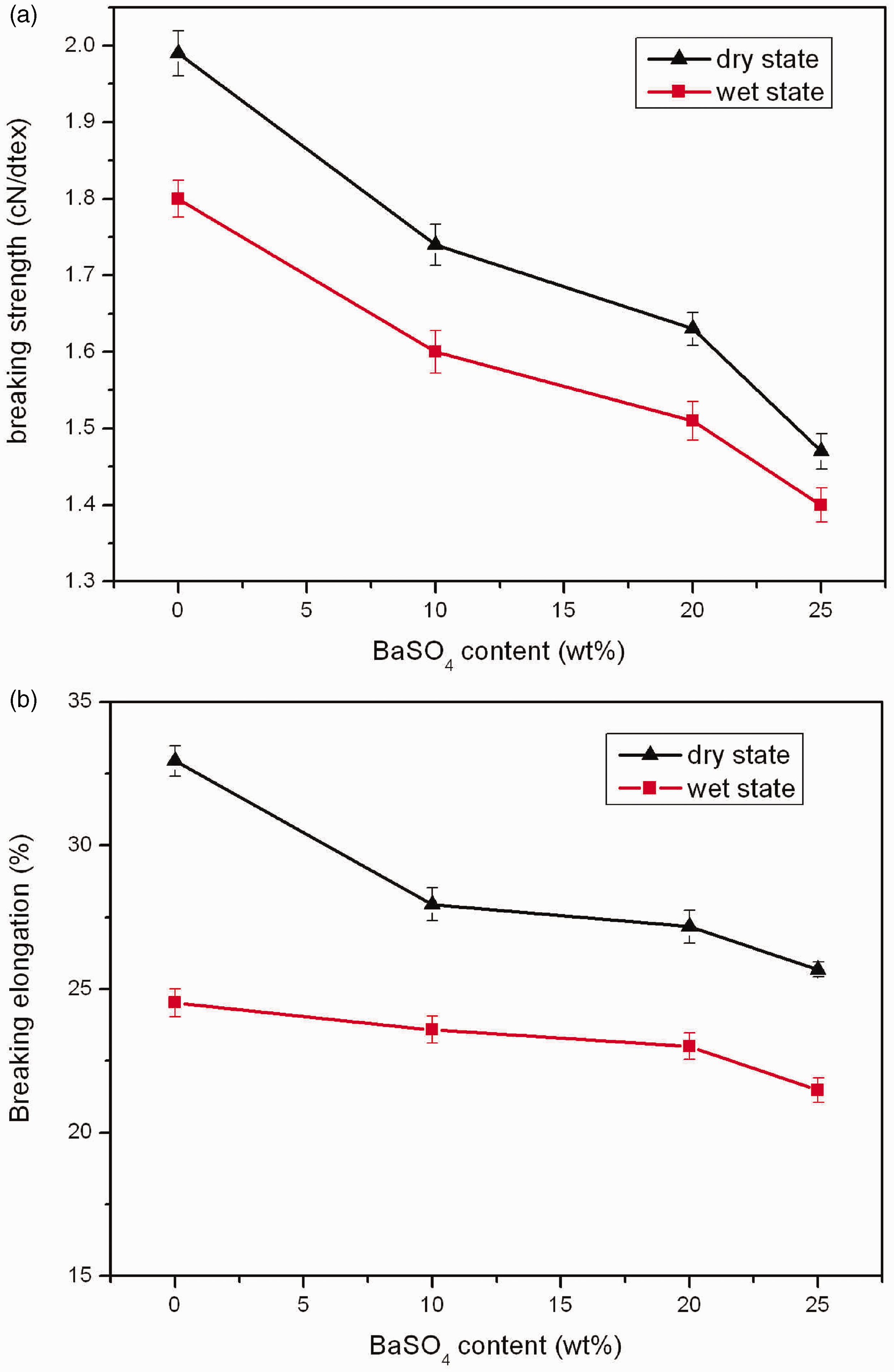
The breaking elongation of the resulting fibers in the dry and wet states is shown in Figure 5(b). The dry and wet breaking elongation also decreased with increasing BaSO4 content in the composite fibers. The mechanical properties of the composite fibers were gradually decreased with the addition of inorganic particles, which was already predicted in the XRD results.
Despite the degeneration in mechanical properties of composite fibers with increasing BaSO4 amount, they are still better than those established by the Chinese National Standard (GB/T 13758-92); even the composite fibers with 25 wt% BaSO4 could express a reasonable result (dry breaking strength and elongation (1.5 cN/dtex and 26%), wet breaking strength and elongation (1.4 cN/dtex and 22%)) indicating that this composite fiber can reach the criteria of mechanical requirements of commercial textiles.
Laundry-resistance analysis
After the composite fibers were washed varying number of times, the contents of the residual BaSO4 are shown in Figure 6. BaSO4 contents in all fibers without washing were lower than the theoretical content because some particles had been filtered during spinning and also some more particles remained in the coagulation bath. With the increasing of the washing time, nearly no BaSO4 particles were rinsed away; the contents of residual BaSO4, as shown in Figure 6, were nearly changed, around 6.1%, 14.9%, and 18.2% for Viscose 90, Viscose 80, and Viscose 75 fibers, respectively, even after washing 20 times. As most of the particles were dispersed embedded in the fiber matrix and have formed steady structures, only the particles located at the fiber surface might be lost. Therefore, the resulting composite fibers have permanent washable performance, which can be applied as perfect wearable fabrics.
The content of residual BaSO4 in composite fibers after different washing times.
X-ray radiation-resistance analysis
The fiber blocks and fabrics were measured by DR to elucidate their X-ray resistance ability. First, the X-ray images of samples with increasing BaSO4 content expressed enhanced dark as shown in Figure 7 and the analogous trend also appeared in Figure 8 with increasing stacking layers. Then, all the weighted average gray values were derived by MATLAB. Afterward, based on equation (4), attenuation ratio of fiber blocks and fabrics could be confirmed and compared with corresponding lead equivalent, as listed in Table 1 (fiber cases) and Table 2 (fabric cases). Under different tube-voltage degrees, the attenuation ratio of X-ray linearly increased with increasing BaSO4 content. And also, with the increasing stacking layer, the attenuation ratio of X-ray increased. Herein, the content of BaSO4 was the key parameter to evaluate the protective ability of our fibers and fabrics. Viscose 75 fibers recorded a dose of a 0.1 mmPb lead equivalent level that can reach the lead-free protective garments criterion.
The X-ray images of Block samples under 50 kV tube-voltage. The X-ray images of Viscose 75 fabric under 50 kV tube-voltage with different stacking layers: (a) two-layer, (b) three-layer and (c) four-layer. The weighted average gray value (Wgv) and attenuation ratio (Ar) and the corresponding lead equivalent (Le) of the composite fiber block. Note: Weighted average gray value of the blank is 122.0. The attenuation ratio (Ar) and the corresponding lead equivalent (Le) of the composite fabric.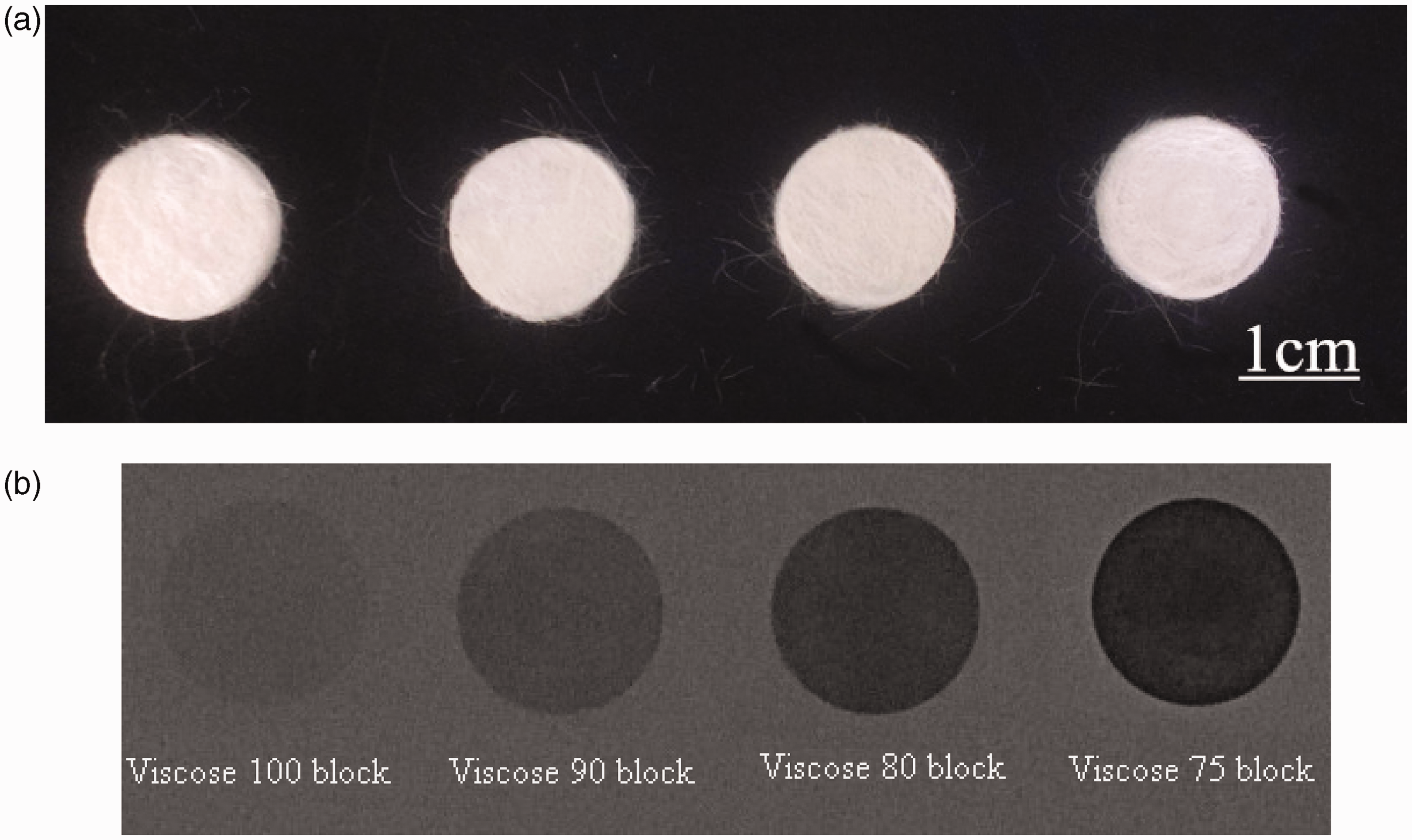


Conclusion
In this article, submicron-sized BaSO4 particles as X-ray absorption fillers were incorporated into the viscose spinning solution to form a series of lead-free composite fibers via a pilot-scale wet spinning route and then fabricated into fabric. The morphology and structure of the composite fibers were observed and characterized by SEM, FTIR, and XRD; the results showed that the BaSO4 particles were evenly dispersed with the help of SDS dispersant. In addition, the mechanical and laundry-resistance properties of the composite fibers with different BaSO4 contents were measured and compared. The composite fibers exhibited reasonably good properties, which met the criteria of mechanical requirements of commercial textiles—dry breaking strength and elongation (>1.5 cN/dtex and 26%), wet breaking strength and elongation (>1.4 cN/dtex and 22%), and permanent laundry-resistance abilities even after being washed 20 times. Furthermore, an effective and feasible measurement utilized to determine the X-ray attenuation ratio of the samples from their X-ray images was proposed. The X-ray attenuation ratio of composite fibers and their fabrics increase linearly with increasing BaSO4 content; as a representative example, both the fiber and fabric with 25 wt% BaSO4 achieved excellent X-ray shielding ability, which was the same as that of a 0.1 mm lead equivalent. Therefore, the viscose/BaSO4 composite fibers can be recommended as a novel lead-free protective fiber with several potential applications in development of X-ray protective garment, detective surgical yarn, endovascular prosthesis, and so forth.
Footnotes
Declaration of Conflicting Interests
The author(s) declared no potential conflicts of interest with respect to the research, authorship, and/or publication of this article.
Funding
The author(s) disclosed receipt of the following financial support for the research, authorship, and/or publication of this article: This study was supported by the Natural Science Foundation of China (grant numbers 51273097 and 51306095) and the Taishan Scholars Construction Engineering of Shandong province.