




Abstract
The aim of this study was to understand the warp and weft directional short beam strength properties of the developed two-dimensional multistitched multilayer E-glass/polyester woven nano composites. The warp and weft directional specific short beam strengths of unstitched structures were lower than those of the multistitched/nano structures. When the amount of nano silica material in the unstitched E-glass/polyester composite structure increased, the warp and weft directional specific short beam strengths of the unstitched/nano structures increased. When the stitching direction increased from two to four directions, the warp and weft directional short beam strengths of all hand-stitched structures slightly increased. In addition, the warp and weft directional short beam strengths of high modulus (stitching yarn Kevlar® 129) lightly and densely machine-stitched structures were slightly higher than those of the low modulus (stitching yarn Nylon 6.6) lightly and densely machine-stitched structures. All composite structures had interlaminar shear failure between layers in their cross-sections, but the interlaminar shear failure in machine-stitched and machine-stitched/nano structures did not propagate to the large areas. The stitching direction, stitching density, stitching yarn, stitching type, and amount of nano materials in the composite structures were identified as important parameters.
Keywords
Introduction
Textile structural composites have been used in various industrial, ballistic, and medical areas due to their high stiffness-to-weight ratio, delamination free, and damage tolerance properties [1–4]. Textile preforms are made by weaving, braiding, knitting, stitching, and nonwoven techniques and they can be chosen generally according to end-use requirements [5].
Stitching in textile composites improved the tensile and flexural properties of the two-dimensional (2D) woven composite through the distribution of the stress among the layers by the load transfer of stitching yarn [6]. It was reported that stitching fiber base composites in the through-thickness direction enhanced the mode I and mode II interlaminar fracture toughness which was experimentally determined by using double cantilever beam and an end-notched flexure test, respectively [7–11]. The critical strain energy release rate increased due to the out-of-directional stitching yarn in the composite structure which prevents the catastrophic delamination [12, 13]. The delamination crack propagation in 2D-stitched woven composites was suppressed by using the high linear density stitching yarns [14]. It was reported that adding a few percent stitching yarn to the out-of-plane direction of the composite improved the thickness direction tensile modulus of the structure [15]. For instance, the effectiveness of stitching to suppress impact-induced delamination can be achieved once the stitch yarn volume fraction is 0.4% [16]. In addition, it was reported that Vectran stitching yarn provides the toughest interlaminar reinforcement [17]. The stitch hole size determined the in-plane and the out-of-plane properties and it depended on the stitching yarn diameter, needle size, and yarn tension during stitching process [18]. It was shown that higher stitch density was better at impeding delamination growth by arresting cracks at closer interval and suppressing crack propagation [19]. The uniform distribution of stitching yarns in the woven composite resulted in the decreasing of the resin-rich region and fiber damage and they eventually increased in-plane tensile, lap shear, flexural, short beam shear, and impact strengths [20]. Contrarily, it was reported that the three-point flexural strength and interlaminar shear strength after repeated impact of two directional stitched E-glass/vinyl ester composite structure were reduced by stitching and stitched induced stress concentration sites [21, 22].
A fiber distortion model is developed to describe the spatial distribution of in-plane fiber misalignment angle and inhomogeneous fiber volume fraction induced by stitching [23]. It was claimed that stiffness properties of the stitched woven composite were not significantly affected by the stitching yarn [24]. The stitching in the through-the-thickness direction increases impact damage tolerance especially at low temperatures. A strong correlation was found between energy absorption and stitching yarn volume fraction in the stitched composite structures [25]. In addition, it was reported that the 2D woven stitched composite showed a significant increase in energy absorption capability under repeated impact [26]. Stitching was effective in increasing the damage resistance against explosive blast loading, and the delamination damage area of the 2D woven stitched composite structure by a projectile impact was slightly reduced [27].
The damage initiation force for three-dimensional (3D) noninterlaced stitched composite was lower than 2D unstitched woven composite due to weak resin-rich regions around the stitch loops [28–30]. Tensile studies performed on 3D orthogonal woven composites revealed that weaving damage was responsible for a significant reduction in tensile strength [31]. It was demonstrated that the mechanical properties such as the tensile and compression stiffness of 3D noncrimped fabric were not degraded by the stitching parameters. But, the tensile and compression strength and the tensile fatigue behavior of 3D noncrimped fabric were reduced as a result of pronounced localized fiber undulations due to stitching [32]. It was found that the in-plane shear strength and modulus of the multiaxis 3D woven carbon composite were higher than that of the 3D orthogonal woven carbon composite. However, the bending strength, bending modulus, and interlaminar shear strength of the multiaxis 3D woven carbon composite were slightly lower than that of the 3D orthogonal woven carbon composite. This was because of the orientations of the ±bias yarns on both surfaces of the multiaxis 3D woven structure [33, 34].
The 2D woven nano clay composite showed not only better stiffness but also an increase of impact resistance and fracture toughness [35]. For instance, the addition of 3 wt.% nano clay on the E-glass/vinyl ester composite increases its tensile properties [36]. On the other hand, the tensile strength and modulus of 2D noncrimp biaxial E-glass/epoxy composites remain unchanged by the addition of 6 wt.% clay contents [37]. The amine functionalized single wall carbon nano tubes incorporated at the fiber/fabric–matrix interfaces of a 2D woven carbon/epoxy composite showed improvement in the tensile strength and stiffness and resistance to tensile–tensile fatigue damage [38]. It was claimed that the well-dispersed coated nano tubes and the processing modification led to enhancement of the interface properties of 2D woven E-glass/vinyl ester composites partly due to Z directional reinforcements [39]. It was also found that nanotubes with amine functional groups have better tensile strength, as compared to those with untreated carbon nano tubes (CNTs) [40]. The modulus increased by adding silicon carbide (SiC) nanoparticles regardless of the dispersion quality, whereas strength was highly sensitive to dispersion quality and increased with the addition of the coupling agent and dispersant. Hence a well-dispersed SiC was required to improve the nanocomposite quality [41]. In addition, the tensile strength of the E-glass/unsaturated isophthalic polyester composite decreased by the increasing of the SiC particle. The reasons were that the weak bonding at the interface between the SiC particles and the matrix, and the particle geometry which resulted in stress concentration in the polyester matrix [42].
The objective of this study was to develop 2D multistitched and multistitched/nano E-glass/polyester structures and to experimentally understand the warp and weft directional short beam strength properties of those structures.
Materials and methods
Two-dimensional unstitched and multistitched multilayer woven E-glass/polyester preform and composite
Specifications of high modulus fiber, matrix, nano, and E-glass woven fabric used for making composite.

Five types of E-glass preform structures were mainly developed: unstitched (T1a–T1c), unstitched/nano (T2a–T2d), hand stitched (T3a–T3i), machine stitched (T4a–T4l), and machine stitched/nano and hand stitched/nano (T5a–T5b). Figure 1 shows the schematic top views of one directional stitching (a1), two directional stitching (a2), four directional stitching (a3), and schematic cross-sectional views of the hand stitching at 0°–90°, ±45° directions (b1, b2), and schematic cross-sectional views of machine stitching at 0°–90°, ±45° directions (b3, b4). The developed unstitched performs included a layered fabric [(0°/90°)]4 (T1a) and oriented layered fabrics as [0/90/±45/±45/0/90] (T1b) and [±45/0/90/0/90/±45] (T1c). The developed machine- and hand-stitched preforms were divided into three subgroups. The first was a layered fabric [(0°/90°)]4 one directionally stitched in the warp (0°) direction. The second was a layered fabric [(0°/90°)]4 two directionally stitched in the warp (0°) and weft (90°) directions. The third was a layered fabric [(0°/90°)]4 four directionally stitched in the warp (0°), weft (90°), and ±bias directions. In machine stitching, lock stitching was used and the stitching density was varied at 2 step/cm (light stitching) and 6 step/cm (dense stitching). The distance between the adjacent stitching lines was 1 cm. The stitching yarns were also varied using fully nylon 6.6 (bobbin and needle yarn) and Kevlar® 129 as the bobbin stitching yarn and nylon 6.6 as the needle stitching yarn. The stitching machine was produced by Brother Industries Ltd, DB2-B736-3TR, Japan. In hand stitching, the stitching density was 1 step/cm. The distance between the adjacent stitching lines was 1 cm. The stitching yarns used were Kevlar® 129, E-glass, and carbon. The properties of the stitching yarns are presented in Table 2. Figure 2 shows some of the 2D unstitched, hand stitched, and machine stitched E-glass preforms.
Schematic views of stitching directions of E-glass preforms. (a1) top view of one direction; (a2) top view of two direction; (a3) top view of four direction stitching schematic; (b1, b2) schematic cross-sectional view of hand stitching at 0° and 90°, and at ±45°; (b3, b4) schematic cross-sectional view of machine stitching at 0° and 90°, and at ±45°. Top view of some E-glass preforms. (a) Four layer unstitched; (b) hand stitched with Kevlar® 129 in four directions; (c) hand stitched with carbon fiber in four directions; (d) densely machine stitched with Kevlar® 129 in four directions; (e) densely machine stitched with nylon 6.6 in four directions. Specifications of stitching yarns. K = 1000 filament at the TOW.


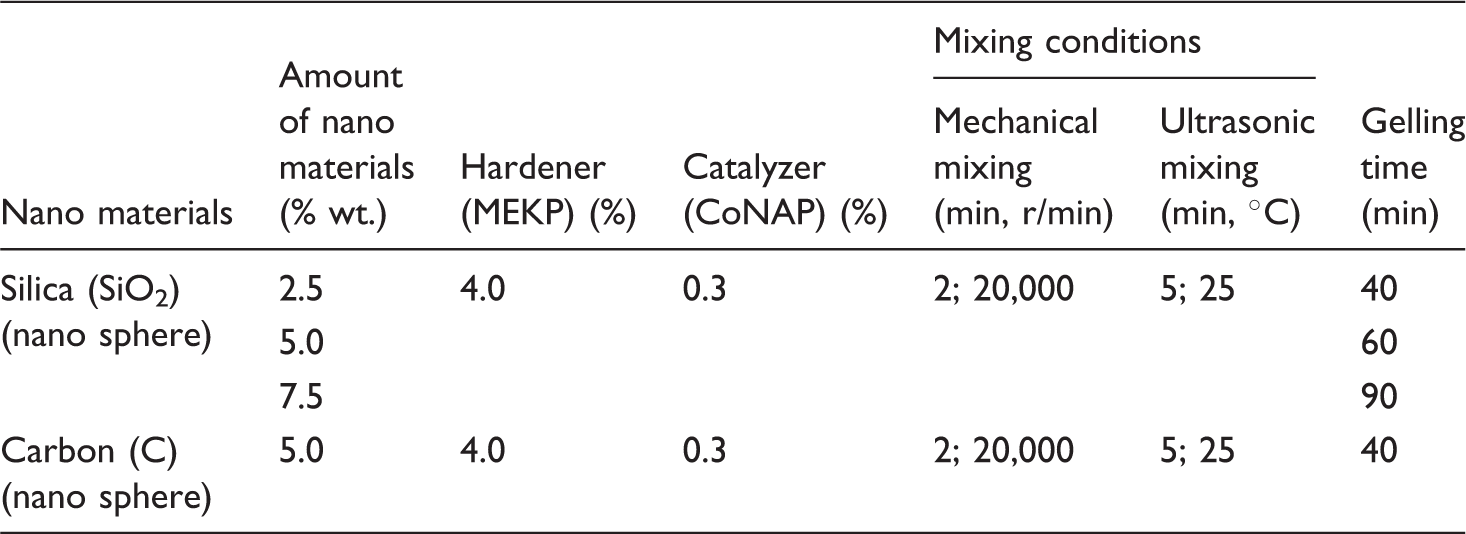
Two-dimensional unstitched and multistitched multilayer woven E-glass/polyester preforms were consolidated to make composites. Vacuum assisted resin transfer molding (VARTM) was used to make composite which is an easy and cost-effective technique to consolidate performs. Dicyclopentadiene-based unsaturated polyester resin (Crystic 703PA, Scott Bader, UK) was used. Methyl ethyl ketone peroxide (MEKP) was used as hardener, 2% by weight of resin to produce neat E-glass/polyester composites. The polyester resin and hardener were mixed homogenously and applied to the preforms under vacuum at 20℃. However, catalyst (Cobalt Naftalat, CoNAP) was also used to produce nano composite structures. Amounts of MEKP and CoNAP by weight of resin and mixing conditions are given in Table 3. Nano materials were mixed first by a mechanical stirrer (IKA-T25 Digital Ultra Turrax, IKA® Werke GmbH & Co. KG) in which mixing was gradually carried out starting from 3000 to 20,000 r/min, stay 2 min, then from 20,000 to 3000 r/min. Later on, mixing was continued in ultrasonic bath, 5 min at 25℃, to get homogeneous distribution of nano particles in polyester resin. After that, matrix was vacuumed to get rid of the air bubble, and finally hardener and catalyst were added. This matrix was applied to the preforms under vacuum at 20℃. Figure 3 shows some of the 2D unstitched, multistitched, and multistitched woven E-glass/polyester nano composites.
Two-dimensional woven E-glass/polyester composite structures. (a) Unstitched structure (T1a); (b) unstitched/nano structure (T2b); (c) hand stitched with Kevlar® 129 and carbon structures (T3c, T3i), respectively; (d) machine stitched with Kevlar®129 and nylon 6.6 structures (T4l, T4f), respectively; (e) machine stitched/nano structure (T5a). Mixing conditions of nano materials in polyester resin for VARTM.
The density of the 2D unstitched and multistitched multilayer woven E-glass/polyester composite was determined by ASTM D792-91 [45]. The composite volume fraction and void content were also determined by ASTM D3171-99 [46] and ASTM D2734-91 [47], respectively. Before the short beam test, the stitching area of the composite sample was examined by a scanning electron microscope (LEO 440® model, UK).
Short beam test
The short beam test of the composite structures was performed on a Shimadzu AG-XD 50 (Japan) tester equipped with Trapezium® software based on ASTM D2344-00 [48]. The short beam testing speed was 1.0 mm/min. The test dimensions were considered as 25(width) × 20(length) mm. The L/d (support span length/thickness) ratio was 4/1. The short beam load applied to each sample was the warp (0°) and weft (90°) directions, respectively. The short beam strength and specific short beam strength were calculated based on the following relations


The warp and weft directional short beam test was repeated three times due to limited test coupons. Figure 4 shows the testing instrument and test samples at warp direction. After the short beam load was applied to the sample, the cross-section of the structures was examined by an optical microscope (Olympus SZ61, Japan). Based on this examination, the failure modes under the short beam load for each structure were identified. In addition, relative humidity and temperature of the testing laboratory were 60 ± 5% and 22 ± 1℃.
Short beam strength test instrument and test samples. (a) Full view of testing instrument; (b) fixed test sample between support span before testing; (c) schematic view of short beam test fixture; (d) fixed test sample between support span after testing; (e) unstitched/nano structure (T2b); (f) machine-stitched structure (T4l); (g) machine stitched/nano structure (T5a).
Results and discussion
Density and fiber volume fraction results
Density and fiber volume fraction results of various developed composite structures.

The density, total fiber volume fraction, and the void content results indicated that partly stitching and partly VARTM process caused a local misalignment and uneven fiber–matrix nano placement in the structure as shown in Figure 5. The stitching caused a local misalignment and uneven fiber placement during needle piercing to the preform structure. In addition, when the stitching directions in the structure increased, the stitching yarn volume fraction (Vsfw) increased depending on the stitching density and yarn types. However, the total volume fraction (Vtfw) of the structures did not increase proportionally due to the stitching. It can be considered that the stitching parameters in the developed composite structures were stitching direction, stitching density, and stitching yarn type.
SEM photos of 2D woven E-glass/polyester composite structures at 0° (warp direction). (a) Unstitched structure (T1a); (b) unstitched/nano structure (T2b); (c) hand-stitched structure (T3i); (d) machine-stitched structure (T4l); (e) machine stitched/nano structure (T5a).
Short beam results
The warp and weft directional short beam test results on various developed unstitched and multistitched composite structures are presented in Table 5. Figure 6(a) to (d) shows some of the load-displacement curves of 2D woven E glass/polyester unstitched, unstitched/nano, machine stitched, and machine stitched/nano composite structures on warp direction. Figure 7 shows the short beam strength and the specific short beam strength of 2D woven E-glass/polyester unstitched, unstitched/nano, machine stitched/nano, and hand stitched/nano composite structures. Figures 8 and 9 show the short beam strength and the specific short beam strength of 2D woven E-glass/polyester hand-stitched and machine-stitched composite structures, respectively.
Some of the load–displacement curves of 2D woven E-glass/polyester composite structures on warp direction. (a) Unstitched structure (T1a); (b) unstitched/nano structure (T2b); (c) machine-stitched structure (T4l); (d) machine stitched/nano structure (T5a). Short beam strength and specific short beam strength of 2D woven E-glass/polyester unstitched, unstitched/nano, and stitched/nano composite structures. Short beam strength and specific short beam strength of 2D woven E-glass/polyester hand-stitched composite structures. Short beam strength and specific short beam strength of 2D woven E-glass/polyester machine-stitched composite structures. Warp and weft directional short beam strength results of various developed composite structures.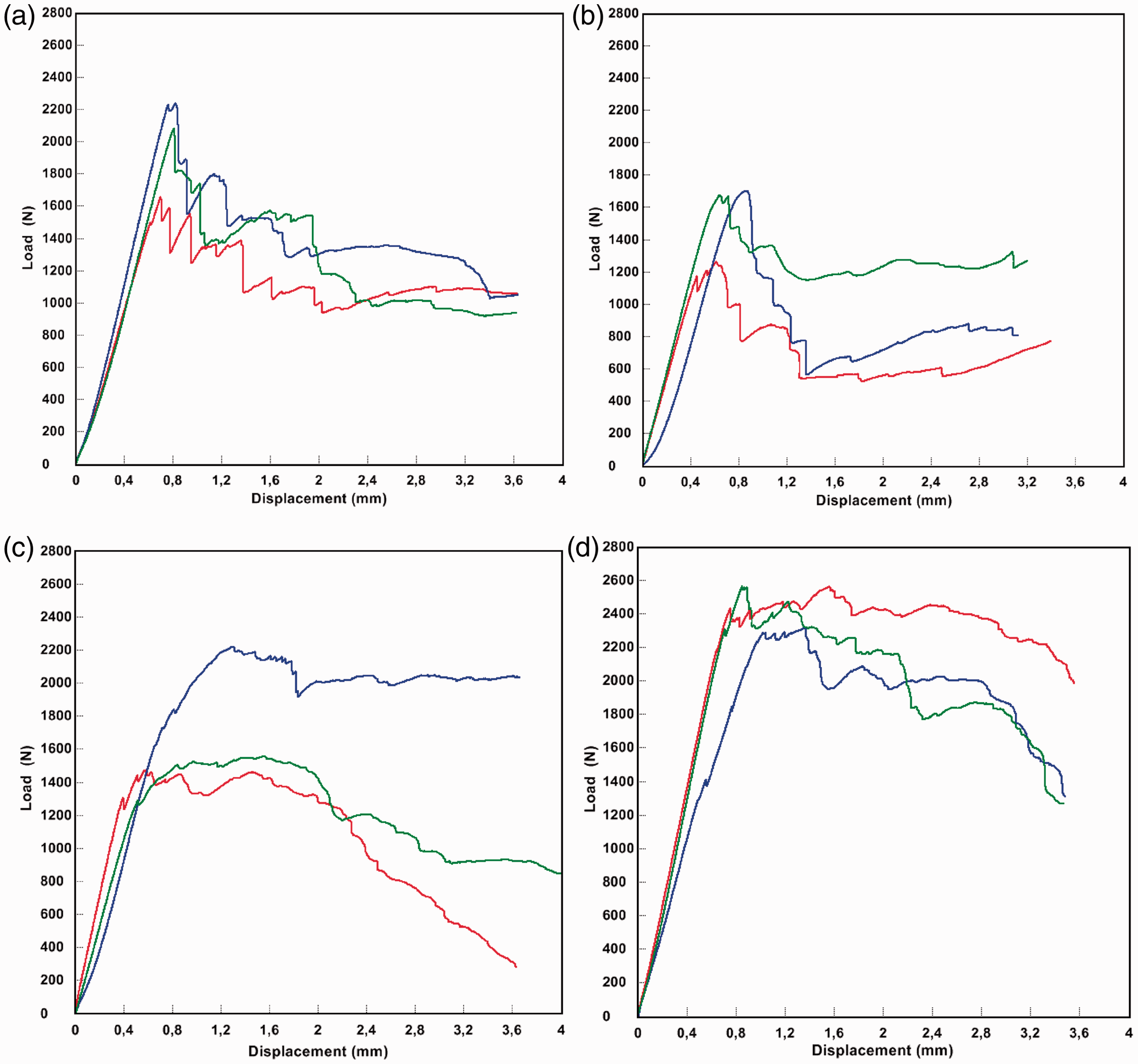


As seen in Figure 7 and Table 5, the warp and weft directional short beam strengths of the 2D unstitched (T1a–T1c) woven E-glass/polyester composite structures varied from 23.60 to 17.47 MPa and from 20.51 to 15.67 MPa, respectively. The warp and weft directional short beam strengths of the 2D unstitched/nano (T2a–T2d) woven E-glass/polyester composite structures varied from 23.05 to 16.94 MPa and from 20.05 to 15.59 MPa, respectively. The warp and weft directional short beam strengths of the 2D stitched/nano (T5a–T5b) woven E-glass/polyester composite structures varied from 23.21 to 21.88 MPa and from 19.54 to 18.30 MPa, respectively. It was found that the specific short beam strengths of all unstitched, unstitched/nano, and multistitched/nano structures were proportional to their warp and weft directional short beam strengths. The warp and weft directional specific short beam strengths of unstitched structures (T1a–T1c) were lower than those of the multistitched/nano structures (T5a–T5b) but higher than those of unstitched/nano (T2a–T2d) exept T2c. In addition, the short beam strength of T1a was higher than those of T1b and T1c. When the nano silica material in the unstitched E-glass/polyester composite structure increased from 2.5 to 7.5 wt.%, the warp and weft directional specific short beam strengths of the T2a–T2c structures increased. Also, it was found that there was a slight difference between the warp and weft directional specific short beam strengths. Generally, the warp directional specific short beam strengths of the composite structures were higher than those of the weft.
As seen in Figure 8 and Table 5, the warp and weft directional short beam strengths of the 2D hand-stitched (T3a–T3-i) woven E-glass/polyester composite structures varied from 25.40 to 13.86 MPa and from 24.71 to 15.05 MPa, respectively. It was found that the specific short beam strengths of all hand-stitched structures were proportional to their warp and weft directional short beam strengths. The warp and weft directional short beam strengths of the T3b were higher than those of the remaining hand-stitched structures. This indicated that two directional Kevlar® 129 hand-stitched composite structures showed a better short beam strength performance compared to the four directional carbon, Kevlar® 129 and E-glass hand-stitched composite structures. In addition, when the stitching directions increased from two to four directions, the warp and weft directional short beam strengths of all hand-stitched structures slightly increased. It was also found that there was a slight difference between warp and weft directional short beam strengths.
As seen in Figure 9 and Table 5, the warp and weft directional short beam strengths of the 2D machine-stitched (T4a–T4l) woven E-glass/polyester composite structures varied from 19.91 to 17.16 MPa and from 20.79 to 14.87 MPa, respectively. It was found that the specific short beam strengths of all machine-stitched structures were proportional to their warp and weft directional short beam strengths. In low modulus (stitching yarn Nylon 6.6) lightly and densely stitched structures, the warp and weft directional short beam strengths of the T4d–T4f were slightly higher than those of the T4a–T4c. In high modulus (stitching yarn Kevlar® 129) lightly and densely stitched structures, the warp and weft directional short beam strengths of the T4g–T4i were almost the same with those of the T4j–T4l. It was found that the warp and weft directional short beam strengths of densely stitched structures (T4d–T4f) were slightly higher than those of the lightly stitched structures (T4a–T4c). In addition, the warp and weft directional short beam strengths of high modulus (stitching yarn Kevlar® 129) lightly and densely stitched structures were slightly higher than those of the low modulus (stitching yarn Nylon 6.6) lightly and densely stitched structures. When the stitching directions increased, the warp and weft directional short beam strengths of low (stitching yarn Nylon 6.6) and high modulus (stitching yarn Kevlar® 129) lightly and densely stitched structures slightly decreased due to some filament breakages during stitching. Also, it was found that there was a slight difference between warp and weft directional short beam strengths.
Failure results after short beam test
Some of the failure results on various developed 2D woven E-glass/polyester unstitched, unstitched/nano, multistitched, and multistitched/nano composite structures after warp and weft directional short beam test were investigated. Figure 10 shows the cross-sectional views of unstitched and unstitched/nano 2D E-glass/polyester woven composites after warp and weft directional short beam load was applied. Figure 11 shows the cross-sectional views of hand-stitched and hand-stitched/nano 2D E-glass/polyester woven composites after warp and weft directional short beam load was applied. Figure 12 shows the cross-sectional views of machine-stitched and machine-stitched/nano 2D E-glass/polyester woven composites after warp and weft directional short beam load was applied.
Cross-sectional (microscopic photos at ×6.7 magnification) views of unstitched and unstitched/nano 2D E-glass/polyester woven composites after short beam strength test at warp and weft directions. Cross-sectional (microscopic photos at ×6.7 magnification) views of hand-stitched and hand-stitched/nano 2D E-glass/polyester woven composites after short beam strength test at warp and weft directions. Cross-sectional (microscopic photos at ×6.7 magnification) views of machine-stitched and machine-stitched/nano 2D E-glass/polyester woven composites after short beam strength test at warp and weft directions.


As seen in Figure 10, the failure of warp and weft directional 2D unstitched (T1a–T1c) and unstitched/nano (T2a–T2d) woven E-glass/polyester composite structures was observed as a form of major matrix breakages, and partial or total fiber breakages on their top (applied three-point bending load side) and bottom surfaces. The failure of warp and weft directional 2D unstitched/nano silica woven E-glass/polyester composite structures showed more brittle behavior compared to the unstitched structures. In addition, the unstitched and unstitched/nano composites had interlaminar shear failure between layers in their cross-sections and the failure was propagated to the large areas. Also, it was observed that there is a flexure failure in the top surface of structure as a form of compression and in the bottom surface as a form of tension.
As seen in Figure 11, the failure of warp and weft directional 2D hand-stitched (T3a–T3i) and hand-stitched/nano (T5b) woven E-glass/polyester composite structures was observed as a form of major matrix breakages, and partial and complete filaments and yarn (tow) breakages in their top and bottom surfaces. In addition, the hand-stitched and hand-stitched/nano composites had interlaminar shear failure between layers in their cross-sections. Also, it was observed that there is a flexure failure on the top surface of structure as a form of compression and at the bottom surface as a form of tension.
As seen in Figure 12, the failure of warp and weft directional 2D machine-stitched (T4a–T4l) and machine-stitched/nano (T5a) woven E-glass/polyester composite structures was observed as a form of major matrix breakages, and partial and complete filaments and yarn (tow) breakages on their surfaces. In addition, the machine-stitched and machine-stitched/nano composites had interlaminar shear failure between layers in their cross-sections but the failure did not propagate to the large areas. The interlaminar shear failure occurred around the stitching yarn regions at a small area. Also, there is a flexure failure on the top surface of structure as a form of compression and at the bottom surface as a form of tension in where the intra-yarn openings were observed.
Conclusions
Multistitched and multistitched/nano E-glass/polyester biaxial woven composites were developed. Two-dimensional unstitched and unstitched/nano E-glass/polyester woven composites were used for comparison purposes. They were tested against the warp and weft directional short beam test.
The warp and weft directional specific short beam strengths of unstitched structures were lower than those of the multistitched/nano structures. When the nano silica material in the unstitched E-glass/polyester composite structure increased, the warp and weft directional specific short beam strengths of the unstitched/nano structures increased. When the stitching directions increased from two to four directions, the warp and weft directional short beam strengths of all hand-stitched structures slightly increased. However, when the stitching directions increased the warp and weft directional short beam strengths of low (stitching yarn Nylon 6.6) and high modulus (stitching yarn Kevlar® 129) lightly and densely machine-stitched structures slightly decreased due to stitching. In addition, the warp and weft directional short beam strengths of high modulus (stitching yarn Kevlar® 129) lightly and densely machine-stitched structures were slightly higher than those of the low modulus (stitching yarn Nylon 6.6) lightly and densely machine-stitched structures The results indicated that the stitching direction, stitching density, stitching yarn, stitching type, and amount of nano materials in the composite structures were important parameters.
The failure of warp and weft directional 2D unstitched, unstitched/nano, hand-stitched, and machine-stitched woven E-glass/polyester composite structures was observed as a form of major matrix breakages, and partial or total fiber breakages on their top and bottom surfaces. In addition, all composite structures had interlaminar shear failure between layers in their cross-sections, but the interlaminar shear failure in machine-stitched and machine-stitched/nano structures did not propagate to the large areas.
Footnotes
Acknowledgements
This work was partly supported by Erciyes University Scientific Research Unit (EUBAP) under contract number EUBAPFBD-10-3383. The authors would like to thank the Scientific Research Department of Erciyes University for this invaluable support. The authors also would like to thank Erciyes University Technology Research and Application Center (TAUM) for the mechanical testing of the composite materials. In addition, the authors would like to thank Prof. Dr Mustafa Guden for allowing the use of composite lab facilities in IYTE for this project.
Funding
This research received no specific grant from any funding agency in the public, commercial, or not-for-profit sectors.