




Abstract
The aim of this research is to improve the dyeability and antibacterial activity of silk fabric using natural fungal extract. The natural fungal pigment is extracted from the thermophilic fungi-basedspecies, namely Thermomyces, purified and characterized using Fourier transform infrared spectra, and subjected for the dyeing process. An experiment using Box and Behnken is designed with three levels and three variables using pH, temperature, and time as independent variables and with wash fastness, rubbing fastness, light fastness, and bacterial reduction (%) as dependent variables, and the conditions are optimized. Regression equations are obtained to analyze the fastness properties and bacterial reduction (%), and the optimum process parameters are identified. The result shows that the optimum conditions for dyeing the silk fabric by fungal pigmentation is 2% owm at 60℃ for 30 min, maintaining a pH of 3.
Introduction
The worldwide demand for colorants of natural origin, especially yellow or red pigments, is rapidly increasing in food, cosmetic, and textile sectors [1,2]. Several research projects have so far been carried out to evaluate the techno-economic feasibility of today’s alternative dye crops. Among the species examined, common madder (Rubia tinctorum L) and woad (Isatis tinctoria L) proved to be quite interesting sources of red (alizarin) and yellow (luteolin) dyes, respectively, either for their agronomic characteristics or dyeing properties [3,4]. In fact, all three natural dyes were extensively exploited until the commercial success of their synthetic analogs.
It is possible to extract natural pigments from two major sources: plants and microorganisms. The problem associated with the extraction of natural pigments from plants is the basic instability against various sources like light, pH, heat and low water solubility, and the scarcity. The microorganisms are of great interest due to the stability and availability. The benefits also include easy and fast growth in cheap culture medium, independence from weather conditions, and colors of different shades. Thus, microbial pigment production is now one of the emerging fields of research to demonstrate the potential for various industrial applications. Further, some natural colorants have commercial potential for use as antioxidants. The industry is now able to produce some microbial pigments for applications in food, cosmetics, or textiles. In nature, color-rich and pigment-producing microorganisms are quite common. They produce various pigments like carotenoids, melanins, flavins, quinines, prodigiosins, and more specifically monascins, violacein, or indigo.
To overcome this limitation, it has been suggested that other biological sources be exploited, such as fungi (both molds and yeasts), bacteria, algae, and plant cultures, since appropriate selection, mutation, or genetic engineering techniques are likely to significantly improve the pigment production yields with respect to wild organisms [5,6]. The dyeing potential and antifungal activity of the fungal pigment produced by Thermomyces have not been investigated so far for textile applications. The fungal pigments have been traditionally used for manufacturing food colorants, fermented foods, and beverages [7,8]. It is also applied in medical therapy to promote blood circulation and proper cholesterol levels, prevent gastric and intestinal disorders, stimulate digestion, etc. [9,10]. The several pigments produced by Thermomyces are oligoketides and subdivided into three groups: rubropunctain and monascorubrin are orange pigments, presenting different side chains on the ozolactone ring [11]. Their two azoto analogs are the red pigments rubropunctamine and monascorubramine, with their reduced forms being the yellow pigments monascin and ankaflavin [12]. Among the eukaryotic organisms, only a few species of fungi have the ability to thrive at temperatures between 45 and 55℃. Since thermophilic-based fungi can be operated at moderate degrees of temperature and their habitats are nonexotic, they have not received much publicity and attention so far. A three-factor, three-level Box–Behnken design is used to derive a second-order polynomial equation and construct contour plots to predict responses [13]. Hence, this research is aimed to evaluate the dyeing potential and microbe-resistant characteristics of pigment extracted from the thermophilic-based fungi species namely “Thermomyces.”
Materials and methods
Fabric selection
The material selection is carried on a trial and error run and based on the suitability characteristics, bleached plain weave of 100% silk fabric with the following constructional specifications was used for the research work.
100% silk: count 60s Ne with 124 ends/inch, 94 picks/inch and 68 gsm were used.
Extraction of fungal pigment
The extracellular pigment-producing fungi Thermomyces is isolated from soil. The fungal cultures are inoculated onto potato dextrose broth and incubated at 35℃ for five to seven days; the supernatant is filtered through filter paper. The pigmented broth is taken to a clean glass Petri plate and placed under hot air (40℃) in a dust-free chamber. The plate is covered with a thin muslin cloth to avoid dust contamination. After 8 h of drying, the broth is reduced to one-third of its original volume as shown in Figure 1. The condensed broth is lyophilized, and the powered pigment was stored at 4℃.
Sample of extracted pigment.
Coloration
Various synthetic mordants, like stannous chloride, alum, and ferrous sulfate, and natural mordants, like myrobolan and neem oil, are identified for the process of coloring silk fabric. Considering eco-friendliness and cost-effective characteristics, the natural mordant myrobolan is chosen for dyeing. As pre-mordanting (on chrome) method of silk fabric is preferred for this type of mordant frequently, silk fabric samples are treated with myrobolan before dyeing with extracted pigment. The fabric sample is treated with the myrobolan solution (2–5 g owm) at 30℃ for 20 min. After mordanting, the fabric sample is well squeezed and immersed into the dye bath containing Material to Liquor Ratio (MLR) 1:20 at 30℃ for 20 min at a pH of 3. After dyeing, the sample is dried at 60℃ for 20 min.
Details of various levels of process parameters.

Statistical analysis
The traditional approach for developing a formulation is to change one variable at a time. By this method, it is difficult to develop an optimized formulation, as the method reveals nothing about the interactions among the variables. Hence, a Box and Behnken statistical design with three factors, three levels, and 15 runs is selected for the optimization study. The method has the advantage of being rotatable, which means that the fitted model estimates the response with equal precision at all points in a factor space that are equidistant from the center. A quadratic polynomial was used to analyze the relationship between each response and the three independent variables as follows:

Testing
The color fastness properties of the samples are assessed using AATCC standards—washing (AATCC Test Method 61-2009), rubbing/crocking (AATCC Test Method 8-2007), and light (AATCC Test Method 16-2004). The dyed samples are analyzed for the spectral K/S values determined by a Minolta 508 spectrophotometer with Macbeth Match View software (X-Rite, USA) in D65 daylight.
Determination of antibacterial activity (AATCC 100-1993)
Swatches of treated and untreated materials are qualitatively assessed by agar diffusion method. Those showing activity are evaluated quantitatively. Treated and control samples are inoculated with test organisms. After inoculation, the bacteria are eluted from the swatches by shaking in known amounts of neutralizing solution. The number of bacteria present in this liquid is determined, and the percentage reduction by the treated specimen is calculated. The bacterial counts are reported as per the number of bacteria per sample (swatches in jar) and not as the number of bacteria per ml of neutralizing solution. “0” counts at 100 dilution is reported as “less than 100.” The percentage reduction (R) of bacteria by the specimen treatments is calculated using the formula:

Results and discussion
Effect of process parameters on fastness and bacterial reduction (%) of silk fabric.

Regression and F-ratio for various properties.

X1: Temperature (℃); X2: Time (min), and X3: pH.
Effect of process parameters on wash fastness
Figure 2(a) to (c) represents the various contour plots of the wash fastness ratings for the fabric specimen versus temperature, time, and pH. The wash fastness rating gradually decreases with increase in temperature and pH but increases with increase in time, reaching a maximum rating of 5.0 between 30℃ and pH 3.0. Optimized wash fastness rating is observed at temperature of 30℃, pH of 3.0, and 40 min.The results infer that even after washing the dye, affinity on the silk fabric is found to be improved as the substantivity characteristics of the natural fungal pigment influences the fabric properties.
Influence of (a) time and pH, (b) temperature and pH, (c) time and temperature.
Effect of process parameters on rubbing fastness
Figure 3(a) to (c) represents the various contour plots of the rubbing fastness ratings for the fabric specimen versus temperature, time, and pH. The rubbing fastness rating is found to follow a decrement trend initially with respect to increase in temperature and pH but later increases with increase in time, reaching a maximum rating of 5.0 between 30℃ and pH 3.0. This signifies that there is no direct linear relationship among the selected independent variables. Optimized rubbing fastness rating is observed at temperature of 30℃, pH of 3.0, and 40 min. The reason might be due to the reactivity and fixation levels of the natural fungal pigment on to the fabric specimen.
Influence of (a) time and temperature, (b) time and pH, (c) temperature and pH.
Effect of process parameters on light fastness
Figure 4(a) to (c) represents the various contour plots of the light fastness ratings for the fabric specimen versus temperature, time, and pH. The light fastness rating decreases with increase in temperature and pH but increases with increase in time. From the response surface graphs, the maximum light fastness rating of 5.0 is found between 30℃ and pH 3.0. All the contour plots for a high value of light fastness ratings is found to be nonlinear. Optimized light fastness rating is observed at temperature of 30℃, pH of 3.0, and 40 min.
Influence of (a) time and temperature, (b) temperature and pH, (c) time and pH.
Effect of process parameters on antibacterial activity
Contour plot shown in Figure 5(a) to (c) represents antibacterial reduction (%) of the fabric specimen versus temperature, time, and pH. Here, the antibacterial reduction (%) decreases with increase in temperature and pH but increases with increase in time. A high value of antibacterial efficacy can be obtained maximum to a certain level of all three independent variables, but above all this increase in the level of independent variables leads to a decrease in the antibacterial efficacy. Optimized values are observed at temperature of 60℃, pH of 3.0, and 40 min. The results infer that natural mordant and pigment influences the pathogenic bacterial reduction.
Influence of (a) time and temperature, (b) temperature and pH, (c) time and pH.
Characterization of fungal-treated specimen
In Figure 6(a) and (b), the Fourier transform infrared (FTIR) spectra of the pigment extract are determined in a wide range of wave numbers and the % transmittance is recorded. FTIR analysis is carried out using Thermos Fisher Scientific. The IR spectrum of treated silk fabric shows broad band at 2849.63 cm−1 and relatively sharp band at 1688.49 cm−1 compared to the untreated silk fabric. This wave number absorbance indicates the presence of functional groups N–H and C = O and leads to the formation of peptide linkage which brings the affinity for the fungal pigment to the silk fabric which is clearly identified in the FTIR spectra of treated specimen compared to the untreated specimen.
(a) FTIR spectra of untreated silk fabric and (b) FTIR spectra of fungal-treated silk fabric.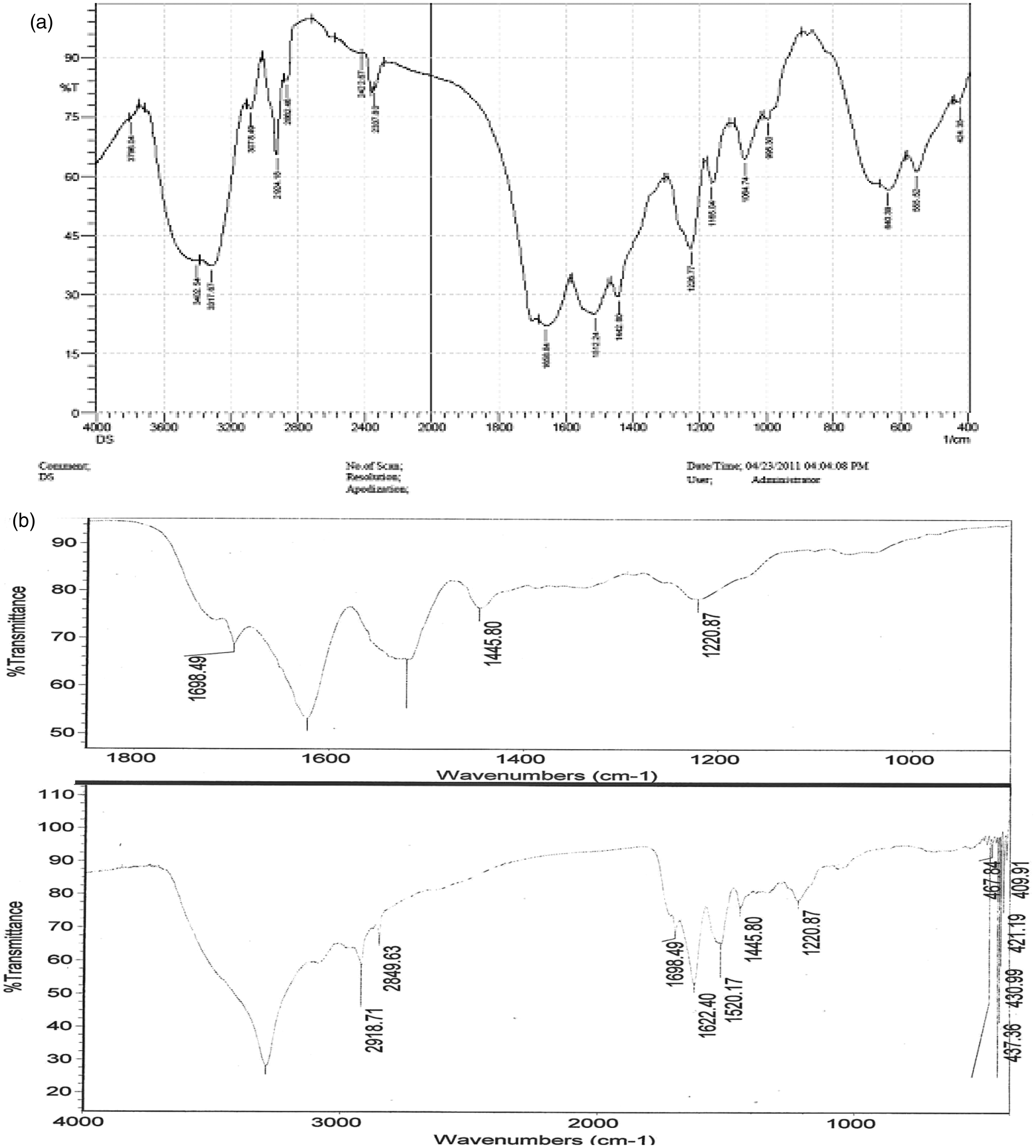
SEM analysis
Since the silk sample is subjected to natural fungal pigmentation, it is necessary to analyze the sample for scanning electron microscope test. From Figure 7, it is inferred that the surface of the silk fabric has been modified after the treatment with the fungal extract resulting in significant dye uptake.
SEM analysis of silk fabric.
Conclusion
The silk fabric is subjected to coloration using the natural fungal extract obtained from Thermomyces, and the effect of coloring behavior, fastness results, and antibacterial activity are analyzed. The results are examined for coloring the protein fabric specimen at 2% on weight of the fabric, and the process parameters like pH, temperature, and time duration are varied for silk fabric and the results are optimized. The optimum condition for coloration and antibacterial finishing of silk fabric using natural fungal extract is 60℃ for 30 min, maintaining a pH of 3. The analysis infers that there is a considerable improvement in dye fixation levels of natural fungal-extracted pigment and antibacterial efficacy on silk fabric. Since the approach is eco-friendly in nature and as it possesses inherent antibacterial activity and coloring behavior, the process has a wide scope to be applied as suitable antimicrobial agents in human health and hospital applications. Hence, a textile woven or nonwoven product using natural fungal extract can be developed and characterized for healthcare applications.
Footnotes
Funding
This research received no specific grant from any funding agency in the public, commercial, or not-for-profit sectors.