




Abstract
Thermal-resistant coatings, based on polysilazane and polysiloxane polymers, were applied onto the glass fiber rovings with the dip-coating method. The coated glass fibers were characterized by performing different experiments to evaluate the effect of coatings on thermomechanical and topographical properties of glass fiber. The effect of temperature on the mechanical properties of the coated rovings were studied and compared with the uncoated rovings. Thermogravimetric analysis was carried out to investigate the thermal stability of coated samples. Scanning electron microscopy and energy-dispersive X-ray analyses were performed to evaluate the surface topographical characteristics of the glass fiber rovings. These analyses showed the changes in surface morphological properties due to modification of glass fiber by coating treatment. The results of tensile testing indicated that thermal-resistant coatings enhanced up to 60% tensile strength and 20% stiffness of uncoated glass fiber roving. Thermomechanical study up to 500℃ revealed that polysiloxane coating on glass fiber showed better performance than polysilazane polymeric coating.
Introduction
High-performance continuous filaments, such as carbon fibers and glass fibers (GFs), are frequently used as reinforcement of composites due to their high mechanical strength and lightweight. In general, GFs have good adhesion property with the resin and ability to be easily processed using conventional processes (melt spinning, drawing, and sizing of glass roving by impregnation process) and equipments. The specific strength and stiffness (E-modulus) of GFs are higher than conventional materials such as steel and aluminium [1–3]. For these reasons, GFs became very attractive materials of composites for many industrial applications. Compared to steel and aluminium, the applications of textile reinforced composites in automotive industry offers a great potential for fuel consumption and CO2−emissions reduction in terms of body weight [4].
In addition, alkali-resistant glass and carbon fibers are widely utilized in construction industry for concrete reinforcement. However, the surface defects cause inferior mechanical properties of reinforcing fibers [5]. It can be improved by coating the surface of fibers or filaments with polymer. The polymer coating modifies the surface of the filaments, improves the friction/adhesion within the rovings, as well as enhances the adhesion between the textile and reinforced concrete [5–9]. GFs are used with the greatest practical importance in the area of fiber-reinforced plastics (FRP). The high temperature behavior of FRP is the subject of numerous investigations [10,11]. Mouritz and Mathys [12] investigated the fire resistance of glass fiber reinforced plastic (GFRP) with polyester matrix and found that the fire resistance can be improved by applying appropriate coating.
One of the major problems with GFs is that they do not maintain their theoretical strength after manufacturing. The tensile strength of GFs decreases due to the pre-existing surface defects or surface flaws. This strength reduction depends on the depth of damage cracks and the radius of curvature of crack tips [2,13]. By applying suitable coatings over the GF surface, the strength reduction can be significantly minimized. Coatings used today are multifunctional, e.g. they provide protection of GF surfaces from extreme environmental attack, improvement of thermomechanical properties as well as abrasion resistance. Therefore, fiber-coating technology has to be developed with respect to solving problems related to fiber adhesion/friction, strength, thermomechanical as well as thermal properties [13–15]. The mechanical properties of fiber-reinforced composites depend on the stability of the interfacial region between the matrix and fiber surfaces [16,17]. DiBenedetto [18] presented a concept of bulk matrix/siloxane/GF interphase and suggested that the siloxane can form a rigid, tough, water-resistant interpenetrating polymer network as a transition zone between the bulk matrix and the glass reinforcement. However, GF also reduces its strength drastically and losses the adhesion between fiber surfaces and matrix because of the corrosion mechanism in the presence of humid conditions or water [3,18].
The investigations on the use of liquid phase polymer coatings for textiles strengthen increasingly to achieve new functional properties on bulk materials. Recently, polysiloxane and polysilazane polymers have been intensively studied for thermal, oxidation, corrosion-resistant coatings in ceramic or metal matrix composite materials [1,3,19–21]. At high temperatures (above 500℃), both pre-ceramic polymers become cross-linked by thermal, chemical or photochemical treatment and are converted into SiCN and SiCO ceramic layers [22–24]. These polymeric coatings also offer a great potential for providing an improved thermomechanical and interfacial adhesion properties of reinforcing fibers in the high-performance fiber-reinforced composite materials [25].
The safeguarding and enhancement of existing textile properties, the formation of new material properties, and the protection of materials from extreme environmental attack are the most important reasons for the coating of textiles. Contrary to the moderate growth of conventional textiles, functional high-grade textiles show over-proportional market growth. Functional coatings of textile material enable considerable improvements in performance and durability for technical textiles, e.g., composite, in automotive, protective textiles, railroad and aviation engineering, in construction and for home textiles [26–29]. Polysiloxane and polysilazane coatings on glass filament rovings will enable new advantageous function of their high temperature application. The main goal of this research work is to investigate the effect of thermal-resistant coatings on thermomechanical and topographical properties of GF. In order to fulfill this objective, coating was applied on substrates by means of impregnation or padding method and the samples were characterized to assess the coating performance. The specific application areas of such coated GF rovings are concrete reinforcement in construction industry, protective textiles and other textile-reinforced composite materials.
Experimental
Materials
Glass filament roving
Cem-FIL® alkali-resistant direct glass filament roving LTR ARC 640 5325 (supplied by Saint-Gobain IVW Cem-FIL GmbH, Düsseldorf, Germany) was utilized as the substrate for coating in this study. The fineness of the roving was 640 tex with diameter of 14 µm (single filament) and 1600 filaments in each roving. The density of the roving was 2.73 g/cm2 and it has high chemical resistivity. The received glass roving was pre-treated with silane-based surface compatibilizer to protect the filament from damage during manufacturing and processing as well as to ensure proper bonding between GF and matrix materials and was used as raw state.
Coating polymers
List of polymers used for coating of glass filament roving.

Solvent
Acetic acid ester (ethyl acetate) supplied by Biesterfeld, Germany was used as the solvent. It is a clear, colorless, and low viscosity organic solvent available in liquid form.
Coating process of glass roving
Formulations and process parameters for coatings.

GF: glass fiber.
The general chemical structure and possible conversion steps of polysilazane polymer coating are represented elsewhere [22]. The mechanism of polysiloxane resin coating is shown in Figure 1. During curing, polysiloxane polymers were cross-linked to each other and formed a siloxane (Si–O–Si) film on the GF surface.
Mechanism of coating with polysiloxane.
Scanning electron microscopy and energy dispersive X-ray analysis
The assessment of the change in surface topography of coated samples was analyzed by scanning electron microscopy (SEM), type Zeiss DSM Gemini 982, Germany. The samples were sputtered with gold and palladium to achieve the required electrical conductivity. The reflection of X-ray with different energy and frequency from different elements on the surface was the initiator of sample surface concentration (element mapping). A silicon crystal was working as X-ray detector in this analysis.
Optical microscopy
The cross-sectional pictures of uncoated and coated glass filament rovings were taken by optical microscope Axiotech 100 (Zeiss, Jena, Germany).
Mechanical properties
The tensile strength of the coated and uncoated glass filament rovings was measured to evaluate the coating effect on the mechanical properties of the roving. The test was performed according to the standard test method ISO 3341 at 20℃ ± 2℃ temperature and 65% ± 2% relative humidity using Zwick tensile testing machine, Germany, type Z 100. Additional elements of the equipment were special return clamps, external strain measuring equipment and infrared (IR) heating equipment with vacuum system to introduce thermal stress on roving (Figure 2). The stress–strain behavior was observed by testXpert® software. The test was carried out at room temperature 20℃ ± 2℃ and under thermal stress at 300℃, 400℃, and 500℃, respectively. The sample was heated with an IR heater at 20℃/min and the temperature was monitored by a sensor. A test sample was clamped vertically with upper and lower clamp, using the initial load of 0.5 cN/tex, predetermined speed of 200 mm/min and stretched until the breaking point of the loaded sample. The results were expressed in Newton (N) for the breaking force, strength in Newton per square millimeter (N/mm2), E-modulus in gigapascal (GPa) and the elongation in percent using the testXpert® software. Five sets of experiments were performed in order to get consistency and accuracy of the results.
Design of the tensile test of glass filament roving (ITM, TU Dresden).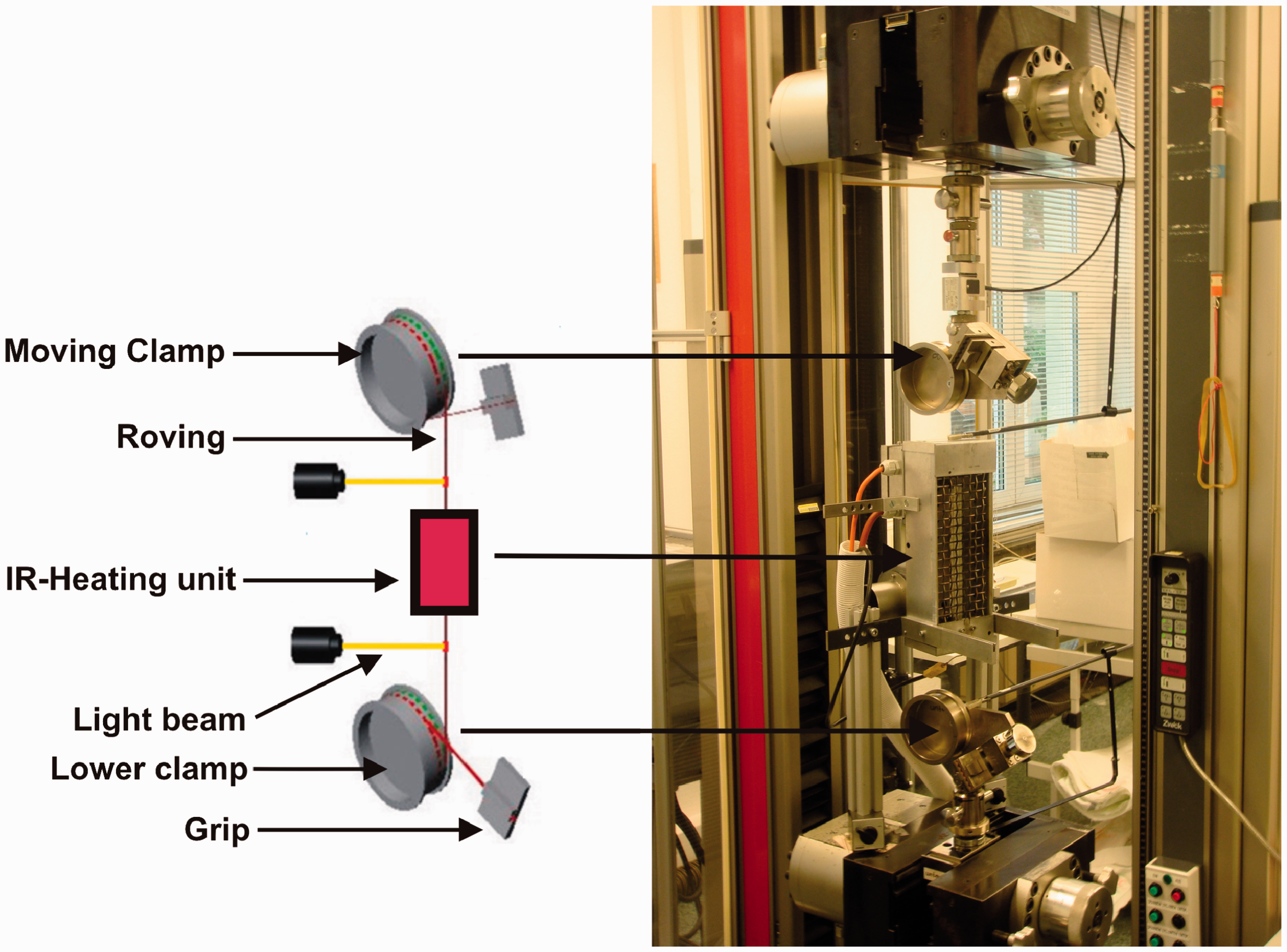
Thermogravimetric analysis
Thermogravimetric analysis (TGA) was performed to investigate the thermal stability of samples in air atmosphere. TGA was carried out using a TA instrument Q500 (Eschborn, Germany) within a temperature range of 30–900℃, air flow rate of 50 mL/min, and 40℃/min heating rate.
Results and discussion
Mechanical properties
Data of tensile testing of coated and uncoated GF rovings.

GF: glass fiber; CV: coefficient of variation.
It is apparent from Figure 3 that all coating polymers enhance tensile strength of GF roving approximately 45–70% at room temperature. It was observed that the tensile strength increases by approximately 70% at room temperature for coated sample C4 compared to uncoated GF. The increase of tensile strength of coated sample C1, C2, and C3 were about 45%, 55%, and 50% respectively in comparison to uncoated GF sample at 20℃. This increased strength at room temperature (20℃) may be attributed to the individual filaments bonding to each other in a polymer matrix and as a result GF roving acts as a single filament and reduces the filaments defects during testing. In addition, coating improves the filament microfriction/adhesion within the roving. The uncoated GF retain their original strength at 300℃ and 400℃. On the other hand, uncoated GF loses its strength drastically after thermal-tensile load at 500℃ and the strength loss amounted more than 80% at this temperature.
Tensile strength comparison of coated and uncoated glass fiber (GF) rovings at different temperatures.
Similar trend in strength improvement was observed for all the coated samples at 300℃. The coated samples gain 35% to 60% additional tensile strength at this temperature. Although sample C4 shows the best result up to 400℃, it retains 65% tensile strength at 500℃ relative to uncoated GF at room temperature. The strength loss tendency of sample C4 is relatively slower than others. The coated samples C1, C2, and C3 lost correspondingly 60%, 50%, and 45% of uncoated GF roving strength at 500℃. The enhancement of thermomechanical properties might be due to the surface healing, improvement of filament–filament adhesion and thermal barrier effect by polysilazane and polysiloxane coatings. From the learning so far, it can be concluded that polysiloxane-coated GF rovings show better stability than polysilazane-coated rovings at high temperatures. These results may be attributed to the fact that phenyl-methyl polysiloxane and methyl silicone resin are cross-linked to each other during heating at high temperatures and form a three-dimensional (–Si–O–Si–) matrix which is more thermally stable than a polysilazane resin (–Si–N–Si–) matrix.
Despite, uncoated GF showed thermal stability up to 900℃ under TGA (Figure 4), the mechanical properties drastically reduced from 500℃. The radical loss of mechanical properties from 500℃ may be due to the structural change of GF. The tensile strength of coated samples increased at 300℃ then reduced with an increase in temperature. It occurred due to the thermal decomposition of the sizing and organic part of polymeric coating. The main purpose of the GF coating with heat-resistant polymers was to enhance the mechanical, thermomechanical properties of continuous GF rovings. After the investigation of tensile and thermal-tensile properties of GF roving, it has been found that the tensile strength significantly increased up to 400℃ and retained about 60% strength of original GF roving at 500℃ due to polysilazane and polysiloxane coatings. This can be highly beneficial from the continuous fiber reinforcement in composite structure viewpoint, especially in terms of mechanical and thermomechanical stress improvements.
TGA graphs of uncoated and coated glass filament (GF) rovings.
Thermogravimetric analysis
Thermal stability of coated glass filament rovings was evaluated by TGA. TGA traces of uncoated and coated samples are reproduced in Figure 4. The uncoated and coated samples C1 and C2 showed thermal stability up to 900℃. The weight loss began from 350℃ for uncoated glass roving. It lost about 1% weight up to 500℃ which occurred due to decomposition of surface compatibilizer. On the other hand, polysilazane-coated sample C1 lost about 1.3% weight till 900℃, which proved good thermal resistivity of this sample. This loss has occurred due to the decomposition of the polymeric part as well as volatile oligomers of coating materials. Up to 400℃, the weight losses were approximately 1%, 1.7%, and 2% for polysiloxane-coated samples C2, C3, and C4, respectively. At this stage, thermal degradation of polysiloxane can be explained due to the decomposition of volatile organic products. Drastic thermal degradation i.e. weight loss of phenyl-methyl polysiloxane coated samples C3 and C4 has been found between 400℃ and 500℃, which occurred due to the random scission of polymer chain. The structure and composition of the polymer residue changed as the thermal degradation progressed for polysiloxane-coated samples, resulting in pure SiO2 above 600℃ [30]. It is clearly seen from the TGA graphs that polysilazane and methyl silicone resin coated samples C1 and C2 yield higher ceramic content than phenyl-methyl polysiloxane coated samples C3 and C4. But, the sample C4 showed better thermomechanical properties up to 500℃ compared to sample C1 (Figure 3). This may be attributed to the better cross linking of phenyl-methyl polysiloxane at high temperature and then it converted to three-dimensional (–Si–O–Si–) matrix on GF surface.
SEM, EDX and optical Microscopy
The effect of polysilazane and polysiloxane coatings on topographical properties of GFs was investigated by SEM. SEM images of uncoated and coated glass filament rovings showed changes in the surface characteristics.
Figure 5(a) shows the scanning electron micrograph of uncoated GF roving, which represents a smooth and inhomogeneous surface. There were no obvious grooves and ruts on the surface. The surface compatibilizers aggregates are clearly visible on the surface of the sample. The application of surface compatibilizers on glass filaments roving was done during production.
SEM examples of: (A) uncoated glass filament roving; (B) coated glass filament rovings with C1; (C) C2; (D) C3; and (E) C4.
GF roving coated with polysilazane (sample C1) shows different surface characteristics compared to original glass roving (Figure 5(b)). This coated glass revealed smooth and inhomogeneous surface with thin coating layer. The glass filaments adhere together due to the coating. Some coating or surface compatibilizers unevenly aggregate on the surface of glass filaments which may be related to the re-deposition of partially dissolved surface compatibilizers during coating as well as inhomogeneous cross linking of polysilazane polymer. The methyl silicon resin coated sample (sample C2) shows regular and smooth surfaces under the scanning electron micrograph (Figure 5(c)). The deposited coating layer seems to be thin and the individual filaments within the roving are strongly attached to each other. The evenly deposited coating might be the result of the uniform cross linking of methyl silicon resin type polysiloxane polymer on the substrate.
Figure 5(d) and (e) shows the scanning electron micrographs of phenyl-methyl polysiloxane coated GF roving (samples C3 and C4). It was clearly observed that the surface looked uniform and smooth with aggregation of minor particles which may be due to the re-deposition of surface compatibilizers as well as uneven distribution of polymers in the coating solution. The sample C3 exhibits thinner film layer formation compared to sample C4 (Figure 5(d) and (e)), which is associated with the amount of polymers applied (Table 2). The individual filaments are strongly bridged together in both samples due to the coating i.e. the covalent bond between glass filament surface and polysiloxane polymer. From the studies, it can be concluded that the polysiloxane coatings showed better surface topographical properties in comparison to polysilazane coating. These coatings could be used to modify inter-phase properties by minimizing the surface defects of GF, and hence the durability of GF might be improved by barrier coatings with polysilazane and polysiloxane polymers.
EDX data of coated and uncoated GF rovings.

EDX: energy-dispersive X-ray; GF: glass fiber.
The revealing of the elements concerns mainly the coatings in case of coated sample. This is the reason why the content of silicon is lower than the value obtained in coated sample compared to uncoated GF. Unusually, the concentration of Si slightly increased for the coated sample C1 during EDX analysis. This may be due to the aggregation of silicon particles from coating polymer during treatment i.e. the defective coating. It can be derived from the EDX analysis that the variations of atomic concentrations reflect differences in the chemical nature of coated and uncoated GFs. The interfacial properties between GF and bulk matrix could be significantly improved by incorporation of thin film of polysilazane and polysiloxane polymers on the GF surface.
Figure 6(a) shows the cross section of uncoated glass filament. The filaments are discretely aligned in the roving and they are not bridged together. In contrast, the individual filaments are strongly bridged to each other within the roving in case of the coated glass filament roving which is clearly seen from the optical microscope analysis (Figure 6(b) to (e)). There are few cavities found in coated sample C2 (Figure 6(c)). The distribution of polymeric coatings is relatively uniform within the cross section of coated samples C1, C3, and C4.
Cross-sectional views of: (a) uncoated glass filament roving; (b) coated glass filament rovings with C1; (c) C2; (d) C3; and (e) C4.
Conclusion
The results from the studies indicate that the tensile, thermal-tensile as well as topographical properties of GF can be significantly improved by polysiloxane and polysilazane heat-resistant coatings. The coated GF can meet the requirements for end use properties of fiber-reinforced composites. SEM and EDX results distinguished differences in the morphological properties and the chemical compositions of the surfaces of the coated and uncoated samples. At room temperature, the tensile strength of all coated GF rovings was greatly increased by the enhancement of strength up to 70% compared to uncoated GF strength. Tensile testing under thermal stress proved that polysiloxane and poylizane coatings substantially improved the thermomechanical properties of GF. At 500℃ coated GF samples retain about 45% to 65% strength, whereas the uncoated GF lost more than 80% tensile strength at this temperature. From the stress–strain data of coated and uncoated GF, it is clearly revealed that thermal-resistant coatings not only increased the tensile strength, but also considerably improved the elastic modulus i.e. the stiffness of GF roving. The results of TGA showed that thermal stability of polysilazane and methyl silicone resin coated samples is higher than the phenyl-methyl polysiloxane coated samples.
Overall, it can be concluded that coatings with polysiloxane polymers on GF showed improvements in thermo-mechanical properties compared to polysilazane coating. This polysiloxane would be highly potential polymer for continuous GF fiber coating for a wide range of composite and architecture market. The applicability of such coatings for the textile-reinforced concrete and fire resistance textiles should be investigated in future studies.
Footnotes
Acknowledgements
We gratefully acknowledge Clariant GmbH, Evonic Tego Chemie GmbH, Wacker Chemie AG for supplying coating polymers.
Funding
This study was funded by the German Research Foundation under the project SFB 528 TP D6.