




Abstract
Compression stockings are one of the best known therapies for venous disorders. This treatment is efficient as long as the stockings are worn by the patient. In order for them to be worn, they will have to fit the patient, in terms of comfort and appearance. The aim of this work is to develop a measurement technique adapted to stretchable textile items to evaluate stockings transparency. Our approach is to measure some of the colorimetric parameters of the stocking. Five commercial compression stockings claimed by the suppliers as supposed to present special transparency characteristics have been analyzed and compared. In order to compare stockings of different colours, a “transparency value” has been set. The developed method can help designing more transparent stockings which may be better “accepted” by patients.
Introduction
Today, compression therapy is the only non-medicinal treatment for chronic venous disease recognized and having showed its efficiency. The mechanical pressure that it exercises on lower limbs reduces the calibre of veins and restores a correct functioning.
Compression stockings are medical devices distributed in four classes according to the pressure which they exercise. In all, 22 million people are concerned by venous disease in France. Among them, 62% are women [1].
As no standards are suggested for transparency measurement of textile fabrics, the aim of this work is to develop a measurement technique adapted to stretchable textile items such as stockings, tights or socks.
This article presents a review of the need for new method to characterize the transparency of compression stockings: the need for transparent compression stockings; the characterization of such stockings; the existing measurement methods. The article then describes the development of the measurement method along with the analysis of the results.
Need for transparent compression stocking
Blood circulation is assured by the heart in the entire body through veins and arteries, each of which have a specific role. Arteries supply the blood rich in oxygen and nutriments to all our body tissues, while veins bring back the low-oxygen blood towards the heart and lungs. Unlike the arteries, veins are not designed to propel blood. In a standing position, the blood tends to “fall” to the extremities. Four mechanisms facilitate the venous return, i.e. the crushing of the plantar, the venous sole, the valvular system and the calf which acts as a muscular pump. A venous insufficiency leads to a pressure increase in veins and to different pathologies. A vein dilatation induces valvular incontinence; venous extravasation causes plasma loss and a slow-down in blood circulation causes coagulation and clot formation.
External compression therapy has been used for a long time as a treatment for venous and lymphatic disorders, such as vein thrombosis, venous insufficiency, dermatitis or lymph-oedema. A compressive treatment’s function is to tighten the veins diameter in order to narrow veins, and therefore to restore valvular competence, to reduce or suppress venous reflux and to accelerate venous flow. The treatment may also decrease oedema by counter-pressure effect shifting lymph into the venous compartment [1]. Compression may be achieved by different ways. Among them, compression stockings are one of the best. Their efficiency is directly linked to the mechanical action of the stockings e.g. the level of pressure onto the leg [2,3]. This treatment is obviously efficient as long as the patient wears the stockings.
The problem is that compression stockings connote “old age”. Pregnant women and young seniors, who represent 30% of the users, wish compression stockings conjugate therapeutic efficiency, comfort and aestheticism [4]. In other terms, compression stockings have to look like classical stockings. This is the reason why manufacturers try to develop more and more attractive – therefore more transparent – compression stockings.
Stockings’ characteristics
The structure of a compression stocking is a circular knitting made of courses of crimped bicomponent yarn (stitch yarn) and inlay courses containing elastane yarn (inlaid yarn), which give the compression properties (Figure 1).
Compression stocking structure.
The stocking is knitted on a single-bed circular machine. Four knitting elements are used to knit the different parts of the stocking. The toe tip is knitted in jersey. The leg and the foot are knitted in inlaid jersey. The heel is in jersey with widening and narrowing. The top of thigh and the sole are in inlaid jersey in addition with a reinforcement yarn. The end of the foot is closed by looping. An elastic band is finally sewn on the top of the thigh (stay-up hose) [5].
The inlaid yarn used in the stocking assumes the compression function due to its elasticity. Yet the diameter of this inlaid yarn is much higher than the diameter of the stitch yarn and is thus most visible. As the therapeutic effect must be preserved, it is not possible to reduce the diameter of the inlaid yarn to obtain a more transparent stocking. To answer the problem of transparency, the inlaid yarn usually used is replaced by a yarn constituted by translucent materials to make it more discreet [6].
Stockings are classified according to their compression class and their structural parameters (count, number of yarns per cm and percentage of elongation).
Compression class
Compression class and corresponding pressure.

Compression pressure is measured by the manufacturer according to the French standard (NF standard G 30-102, part B: indirect measurement method of small medical equipment – corsetry) [10].
Structural parameters
Following parameters are measured on stockings.
Stitch yarn and inlaid yarn count
The knitting’s characteristics are determined according to the French standard IN 1049: fabrics – constitution – method of analysis. Material used consists of a carriage running between two rails on an inclined support graduated in millimeters. The yarn to be measured is maintained between two tongs and subjected to a pre-tension applied, thanks to loads fixed on the carriage (Figure 2).
Pre-tension carriage.
A 5 × 5 cm square is cut in the stocking. The yarns are separated from the structure and weight. A rough count is calculated according to the following equation:
Number of inlaid yarns per cm and of stitch yarns per cm before and after elongation

The stocking is laid on a table. Using a pick counter, the number of stitch yarns and inlaid yarns held in 1 cm is counted. In Figure 3, the number of stitch yarns per cm is 3.
Knitting structure of the resting stocking.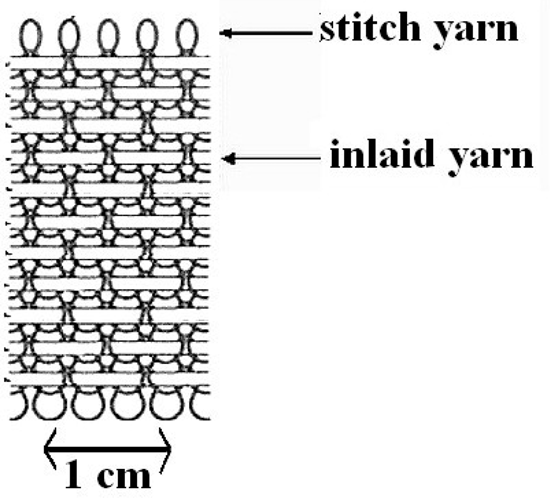
The stocking is then put on a Hohenstein leg (Figure 4) to simulate wearing. The Hohenstein is a standard, idealised, round leg made of wood [11]. They reproduce sizes from 1 to 5.
Wooden Hohenstein legs.
The stitch yarns are counted again using the pick counter. As compared to Figure 4, the number of stitch yarns is now of 2 per cm (Figure 5).
Percentage of elongation in length and width Knitting structure of the stretched stocking.

The measurement method used to evaluate percentage of elongation is similar to the method described above.
The resting stocking’s dimensions are first measured. The stocking is then put on a Hohenstein leg and the dimensions measured again. The percentage of elongation is given by the ratio between initial dimension and stretched dimension (Figure 6).
Measurement method of the percentage of elongation in length and width.
Transparency measurement
The most important point in terms of visual appearance for a compression stocking is its transparency. This characteristic actually gives the compression stocking a similar aspect to “classical” stockings. Transparency is difficult to assess due to different facts:
– the lack of standards – a graduated compression is applied to different segment of the leg – two stockings of the same colour (for example black) have different colorimetric parameters – the colour of the skin affects the perception of transparency
The objective is thus to develop a method allowing to compare transparency of different stockings while avoiding these factors.
Existing method
A bibliographical study was led at first. Only one method developed to measure stockings transparency could be found.
This method – called “Method and system for measuring the transparency of a stretchable textile article such as stockings, tights or a sock” – is patented [12]. The developed approach consists in stretching a stocking on a tensile machine, and then carrying out a spectral analysis of the luminous transmitted flux, thanks to a spectrophotometer apparatus. A digital transparency value is obtained from the spectral transmission characteristic (Figure 7).
Scheme of the measurement device.
This method consists in observing through the stocking. The advantage is that the skin factor does not affect measurement. On the other hand, the measurement is not achieved in realistic conditions, i.e. the stocking is not stretched as if it was worn. Moreover, the colour of the stocking tested can affect measurement. A black stocking absorbs more of the luminous flux than a nude one. It seems necessary to develop a more realistic measurement method.
Developed method
Our approach is to measure some of the colorimetric parameters of the stocking in most realistic conditions. For that purpose, reflective spectral characteristics of the incident light are measured in different conditions and are then used to calculate a digital transparency value. Measurements are done, thanks to DATACOLOR microflash V4.0 spectrocolorimeter. D65 illuminant and specular included is selected for measurement conditions.
The first step was to choose the part of the leg to perform measurement. To be transparent, the stocking has to be stretched. The ankle area was therefore not selected. The calf and the thigh are the two areas where the stocking is the most stretched. We chose to measure the transparency on the top of the calf because this area remains visible on the dressed person while the thigh is not.
A deep black coloured stripe of fabric is placed on the back of the calf, where maximum contour is crossed by the back central line. A stocking is then placed on the wooden leg and a spectral analysis of the reflected luminous flux is done in order to obtain a spectral reflection characteristic. The same measurement is repeated with a white-coloured stripe of paper (Figure 8). This method enables to suppress the skin colour factor.
Hohenstein leg with white stripe.
Colorimetric values of black and white stripes.
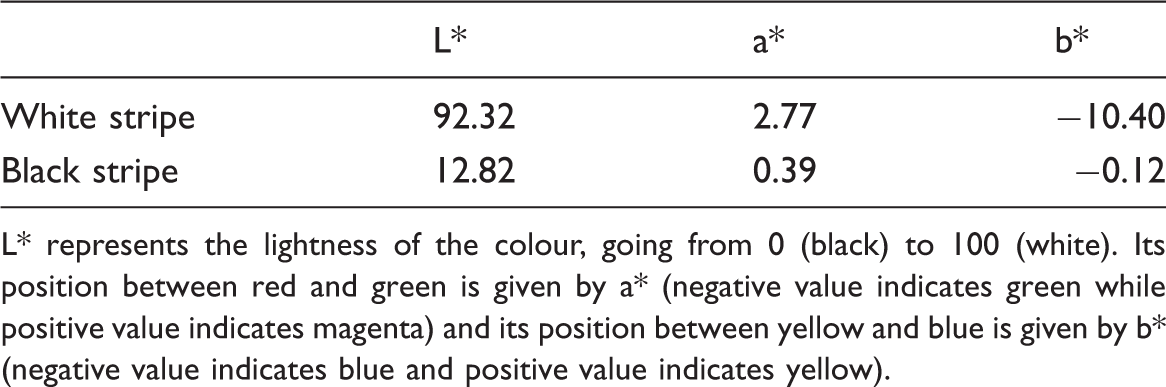
L* represents the lightness of the colour, going from 0 (black) to 100 (white). Its position between red and green is given by a* (negative value indicates green while positive value indicates magenta) and its position between yellow and blue is given by b* (negative value indicates blue and positive value indicates yellow).
Figure 9(a) and (b) present the reflectance curves of the coloured stripes used compared with the white and the black references.
(a) Reflectance curve of the white stripe compared with white reference. (b) Reflectance curve of the black stripe compared with black reference.
The white stripe is not a perfect white. The increase from wave length 400 nm to 450 nm could be due to a whitener. In fact, such a molecule absorbs the ultraviolet radiations between 300 and 400 nm and re-emits this energy by fluorescence between 400 and 500 nm.
The black stripe is not a perfect black. In fact, the curve is increasing after 650 nm, which means that the red colour is not absorbed.
Results
Studied stockings
Five commercial stockings of the market have been compared, thanks to the proposed method. The chosen stockings are claimed by the suppliers as supposed to present special transparency characteristics. In fact, stockings D and E belong to a product range supposed to be more transparent; stockings A, B and C were specially designed with variation of construction supposed to improve transparency as explained in the part “Stockings’ Characteristics”.
Stockings characteristics.

Visual perception of transparency
To have comparison elements, the transparency of the five stockings has been subjectively assessed by textile experts.
The Laboratory of textile physics and mechanics (LPMT) has worked on sensory evaluation for years and has developed a specific method applied to textiles [13]. The evaluation panel is composed of 10 trained members [14].
The five stockings were put on Hohenstein legs with the white stripe in order to facilitate comparison. The transparency has been evaluated in terms of visual perception by raging the 5 stockings from more transparent to less transparent.
The 10 experts have classified the stockings as follows: A, B, C, D, E; A being the most transparent and E the least.
Transparency measurement
The reflectance curve of the five stockings (Figures 10 and 11) have been recorded as well as their colorimetric values in the CIE XYZ and CIE L*a*b* colour spaces.
Reflectance curves with black stripe. Reflectance curves with white stripe.

Figure 10 shows that reflectance of stockings A, B, D and E is similar to reflectance of black stripe. We can assume that the colour of the stocking C differs from the four others.
Figure 11 shows that the stockings can be divided in two groups of reflectance with the white stripe, a group A, B, C and a group D, E. The group A, B, C has a higher reflectance, which could be due to a higher transparency.
The colorimetric parameters are detailed in Table 4 where:
– L* is the lightness of the colour – a* indicates the position between green and red – b* indicates the position between yellow and blue – Y is the luminance – X and Z are roughly red and blue – x and y represents the chromaticity Colorimetric values of the different stockings.

Analysis
Different methods have been tested to analyse the obtained results and to evaluate the stockings transparency from the measured colorimetric values. They are described below.
Colour evaluation
The principle is to “check” the colour of the stocking placed on the leg. To do this, the formula used to evaluate the whiteness has been modified to evaluate the blackness. The reference used is the black stripe previously described.
The whiteness index is given by formula 3 where (xn,yn) is the chromaticity coordinate of the perfect diffuser (reference white).

To evaluate the blackness, (xn,yn) has been replaced by the chromaticity coordinate of the black reference. The calculated index values should enable to classify the stockings from the blackest to the least black and thus of the least transparent to the most transparent.
Blackness index of the different stockings.

Using the blackness index, the stockings are classified as follows: B, A, D, C, E, stocking B being the most transparent. This classification is different from the visual perception. In fact, the drawback of the method is that the chromaticity is considered in the formula.
We can conclude that the blackness index can only be used if the stockings are exactly of the same colour.
Colour variation compared with reference
The colour difference method of the colour measurement committee (CMC) is a model using two parameters l and c, typically expressed as CMC(l:c). Commonly used values for acceptability are CMC(2:1).
The colour difference, or ΔE, between a sample colour L2a2b2 and a reference colour L1a1b1 is given by formula 4:

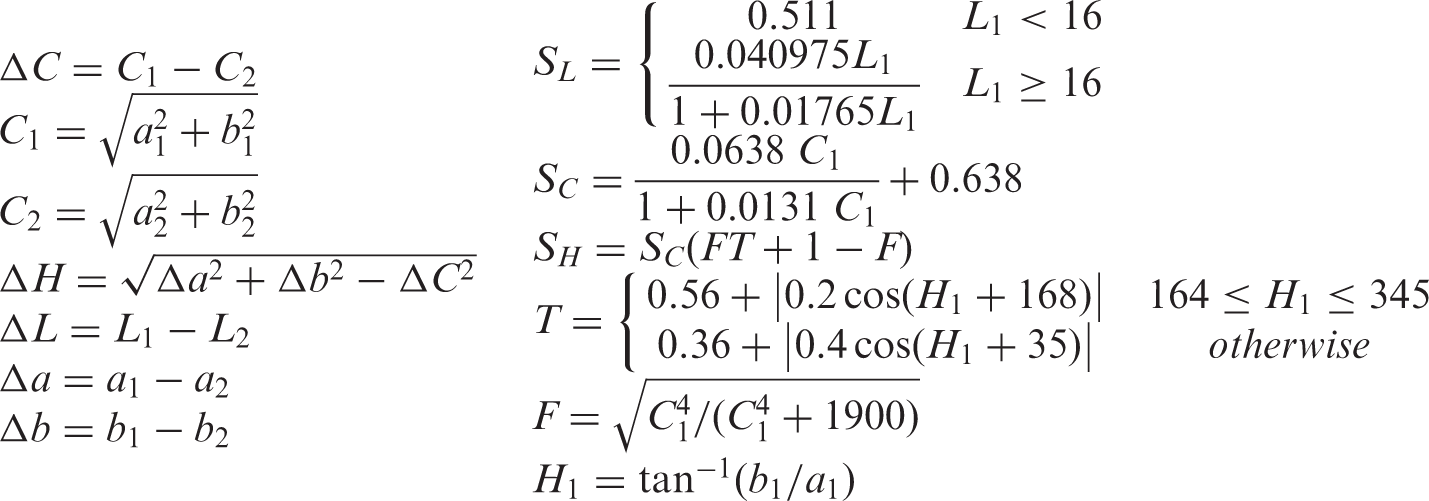
DeltaECMC (2:1) of the different stockings.

We can say that if the DeltaECMC is low, it means that the measured stocking colour is close to the colour of the reference. We can thus deduct that the stocking should be more transparent.
Using the DeltaECMC, the stockings are classified as follows: A, B, D, E, C, stocking A being the most transparent.
This classification is also different from the visual perception and different from the result obtained with the blackness index. In fact, the colour of the stocking is also taken into account, which means that the method can only be used if the stockings have the same colour.
Luminance ratio
The first two methods take into account the colour of the stockings. In order to avoid the colour factor, a transparency value has been calculated according to equation (5), where 
Transparency results.

These results show that the stockings A, B and C are more transparent than the other ones. This classification is the same as the visual perception of the stockings.
Conclusions
Requirements of compression stockings are mainly based on clinical effectiveness and acceptance of the patient. Transparency is one of the key factors for acceptance; it is difficult to assess since there is no standard or method for that purpose.
A new method based on colorimetric measurement of stocking in realistic condition was proposed and then applied on some commercial black compressive stockings. It was obtained that the stockings could be ranked according to a transparency value and that the obtained results were in accordance with the subjective assessments of the textile experts.
The method is adapted to coloured stockings and can help to develop more transparent stockings, considering that a compromise between structural parameters has to be found to obtain transparent stockings without loss of their compressive properties.
Footnotes
Funding
This research received no specific grant from any funding agency in the public, commercial, or not-for-profit sectors.