




Abstract
Energy absorption capacity is of great importance in engineering applications such as bumpers, helmets and packaging. Textile-made composites have attracted world's attention due to their high energy absorption and lightweight. This study aims at evaluating energy absorption capability of composites reinforced by three-dimensional-weft knitted fabrics. To achieve this purpose, weft knitted fabrics with different structures and surface densities were prepared from nylon yarns. Having washed the fabrics, their shapes have changed to three-dimensional ones using a thermoforming process and specific casting. Three-dimensional fabrics were first covered by epoxy resin and then laid in a bed of poly vinyl chloride foam in order to improve their energy absorption capacities. Quasi-static pressure and dynamic pendulum impact tests were carried out for samples. The results were analyzed by the Minitab software and optimal sample was determined.
Introduction
Energy absorption capacity is one of the important aspects in choosing materials for various engineering applications such as automotive bumper parts, helmets, construction areas and packing of fragile goods. Energy absorbent materials have to be capable of bearing plastic deformation as the main mechanism of energy absorption, while light weight in this material is highly regarded. Although the use of composites reinforced with two-dimensional textiles (multilayer) has a long history; nowadays, it is restricted in many construction applications because of manufacturing problems including cost and time consuming of the hand layup and poor mechanical properties of pre-impregnated layers. For instance, layers drape really weakly and results in failure of modeling complex shapes. Another major mechanical problem is the low separation layers resistance in multi-layers [1].
Three-dimensional (3D) knitted fabrics were developed by Verpoest and colleagues [2] in early 1990s as reinforcement for polymer composites. Phillips and colleagues [3] also reported that reinforced composites have higher energy absorption capacity and lower flexural and compressive strength compared to conventional sandwich polymer ones. Yu et al. [4] studied energy absorption characteristics of 3D grid-dome structure under quasi-static and impact pressures. Grid-dome structures are the 2D fabrics with different structures such as woven, knitted, braided and nonwoven, which formed 3D shapes by various geometric shapes and during thermo-forming operation. Yu et al. [4–6] presented a theoretical model to study the quasi-static and dynamic behavior of grid-domed textile composites. Also, Xue et al. [7–9] reviewed and amended the forms used in 3D cellular grid-dome structures and reported that the truncated cone cells because of the more deformation have more energy absorption. With a unique combination of high-energy absorption capacity and light weight, these composites have the high potential in energy absorber panels in automotive door, safety helmets, protective packaging and so on.
Zarandi and Youssef [10] proposed two arrangements of flat dome cellular composite panel as an energy absorbing device in arm rest of vehicle door inner Panel.
Yoo [11] studied energy absorption in polymeric composites reinforced by oval box energy-absorbing structures, made of woven fabrics. The results showed that these composites yield good energy absorption capacity beside having smooth and constant stress–strain curves; similar to the ideal energy absorbers.
In this study, 3D grid-dome composites made of weft knitted fabrics were used to reinforce poly vinyl chloride (PVC) foam. Moreover, the effect of various geometric parameters such as type of created cells (snobs), density of cells and density of knitted fabric on energy absorption of the desired structure was also investigated. Finally, optimized parameters for maximum energy absorption were determined using Taguchi method.
Optimization of process parameters is the key step in the Taguchi method (developed by Genichi Taguchi) to achieve high quality without increasing cost. This is because optimization of process parameters can improve quality and the optimal process parameters obtained from the Taguchi method are insensitive to the variation of environmental conditions and other noise factors. Basically, classical process parameter design is complex and not easy to use [12]. Additionally, Taguchi's method for experimental design is straightforward and easy to apply to many engineering situations, making it a powerful yet simple tool.
A large number of experiments have to be carried out when the number of the process parameters increases. To solve this task, the Taguchi method uses a special design of orthogonal arrays to study the entire process parameter space with only a small number of experiments. Using an orthogonal array to design the experiment could help the designers to study the influence of multiple controllable factors on the average of quality characteristics and the variations in a fast and economic way, while using a signal-to-noise (S/N) ratio to analyze the experimental data could help the designers of the product or the manufacturer to easily find out the optimal parametric combinations.
A loss function is then defined to calculate the deviation between the experimental value and the desired value. Taguchi recommends the use of the loss function to measure the deviation of the quality characteristic from the desired value. The value of the overall loss function is further transformed into an S/N ratio. The S/N ratio for each level of process parameters is computed based on the S/N analysis. A larger S/N ratio corresponds to a better quality characteristic. Therefore, the optimal level of the process parameters is the level with the highest S/N ratio. Furthermore, a statistical analysis of variance (ANOVA) is performed to see which process parameters are statistically significant. The optimal combination of the process parameters can then be predicted [12].
Experimental
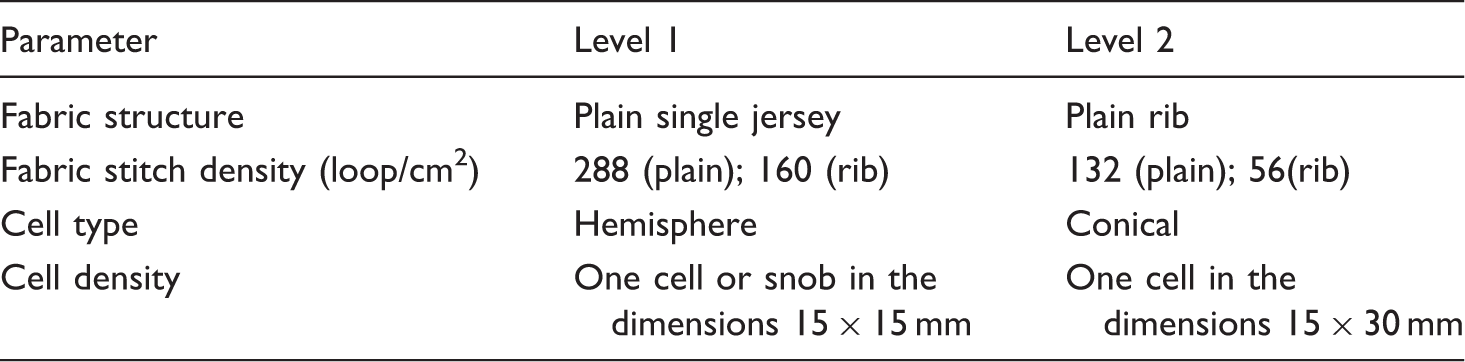
Since thermoformed textiles are used in the cellular grid-dome structure, they should be made of thermoplastic fibers. Weft knitted fabrics are the best candidates in textile cellular grid-dome composites due to their excellent flexibility, drape properties. To achieve the best mechanical properties of composite, processing parameters such as geometric features of the 3D fabrics are essential. This study aims at examining and optimizing the influence of parameters such as created cell type or snobs, cell density, density and structure of fabric on the energy absorption capacity.
Fabric preparation
Plain single jersey weft knitted and plain rib double jersey with different surface densities were produced from 150 denier textured multi-filament nylon yarn on a single jersey circular knitting machine (Falmac, E24 and 16 inch diameter) and double jersey Circular knitting machine (Mayer & Cie, E18 and 30 inches in diameter). Before measurements were taken, the samples were conditioned for 24 h in a standard atmosphere. Wale and course count per 100 cm of fabric was measured and then converted to wale and course count per centimeter.
Technical specifications of weft knitted fabrics.

In order to relax the weft knitted fabrics and remove the remaining oil on samples, the fabrics were washed in a domestic washer at 40℃ for 30 min with commercial detergent and tumble dried at 70℃ for 15 min in a dryer after they had been dry relaxed. This procedure was repeated three times.
Composite preparation
Using a specific mold, 3D shape was formed during thermoforming process at the temperature of 180℃ in 5 min. To investigate the effect of geometry on fabric snobs, caused by thermoforming process, two different geometries were used as follows:
A truncated conical geometry shape with 10 and 5 mm for the bottom and top diameter and a height of 7 mm; Hemispherical geometry shape with a diameter 10 mm.
At a certain surface of samples, distance between two adjacent cells or geometrical shape must be designed so that all cells are uniformly distributed in the sample. To examine the effect of cell or geometrical shapes density, two density types, a cell per dimensions 15 × 15 mm and a cell per 15 × 30 mm, were used. To achieve an ideal energy absorbing panel, following steps should be done. First of all, 3D fabric was coated with epoxy resin (Figure 1) and placed in the specific mold, after that polymeric PVC resin was injected into both fabric sides. Next, the composite samples were placed in the oven to be cured in the specified time and temperature. Finally, composite samples with PVC flexible matrix reinforced by weft knitted 3D fabrics were obtained. Figure 2 shows a lateral view of the prepared composite. This composite sample is 160 mm long, 30 mm wide with 20 mm thick. The size of composite was the same for all used knitted fabrics.
Resin coated three-dimensional (3D)-knitted fabric with truncated conical geometry shape. Lateral view of the prepared composite reinforced by the fabric.

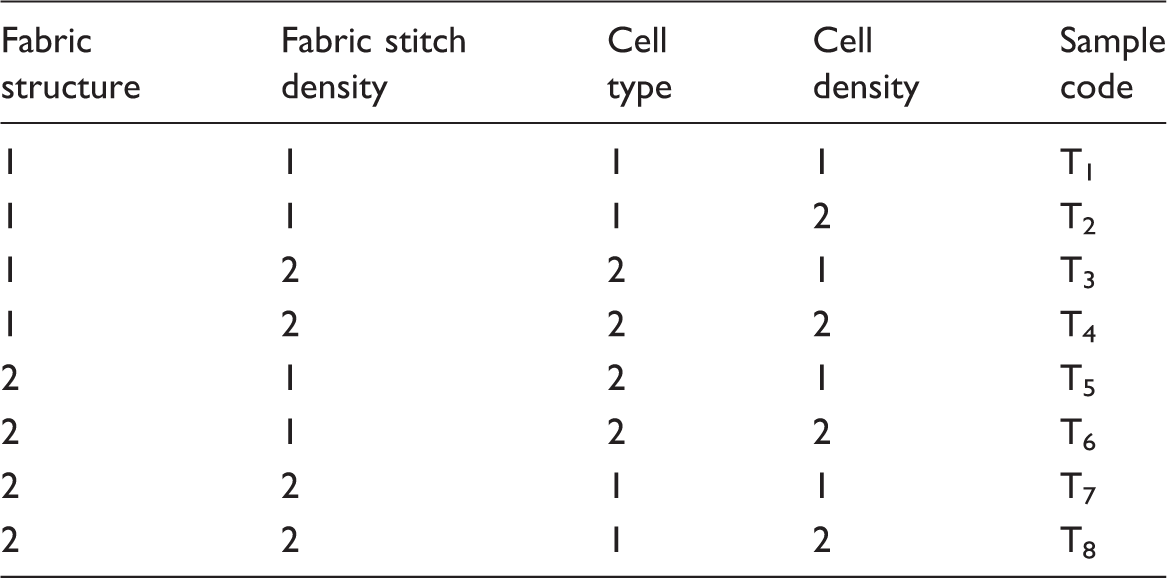
It is clear that a non-reinforced sample of PVC resin was prepared as the control sample. Samples were prepared based on the L8 Taguchi experimental design method. In this design of experimental method, various factors such as the geometry of 3D cells, the density of cells per unit area, type of knitted fabric and loop density were studied.
Design of experiments
Taguchi array (L8) used for design of experiment.
Levels of controllable factors.
Minitab software [13] was used to determine the parameters effect on mechanical properties of prepared composites as well as optimizing them for better results. Also, the results obtained from experimental tests of optimized composite samples were compared with a PVC-foam without any reinforcement.
Three readings (corresponding to the three replications) are recorded for each experimental condition in Taguchi technique, the variation of the response is also examined using an appropriately chosen S/N ratio. Broadly speaking, the S/N ratio is the ratio of the mean (signal) to the standard deviation (noise). Generally, three standard S/N equations are widely used to classify the objective function as: ‘larger the better’, ‘smaller the better’ or ‘nominal the best’. However, regardless of the type of performance characteristic, a larger S/N ratio is always desirable.
Lateral pressure force and absorbed energy belong to the larger-the-better quality characteristics. The loss function of the larger-the-better quality characteristics can be expressed as [12]:


Experimental tests
The produced samples were tested under quasi-static compression tests and dynamic pendulum impact tests. In case of slow impact speed, loading is very similar to Quasi-static loading process. Usually because of two reasons, research on the impact behavior of composites begins with the Quasi-static loading test. First, the necessary adjustments for the quasi-static test are easier than the impact test. Second, observation of the detailed deformation in this quasi-static is much easier. Quasi-static test was operated with the use of the flat jaw on the Zwick. The test speed was set to 5 mm/min. Each sample was tested three times and the average of the maximum force required to compress the size of 10 mm samples was calculated. Also, the average of force-displacement curves was reported.
Charpy pendulum impact test with a hammer of 15 joules was responsible to study energy absorption of composite samples (Figure 3). The impact toughness of the sample is determined by measuring the energy absorbed in the fracture of the specimen. This is simply obtained by noting the height at which the pendulum is released and the height to which the pendulum swings after it has struck the specimen. The height of the pendulum times the weight of the pendulum (w) produces the potential energy and the difference in potential energy of the pendulum at the start (m) and the end of the test (n) is equal to the absorbed energy (equation 3).
Pendulum impact machine, Charpy method.

Each sample was tested three times and the average of the absorbed energy of samples was calculated.
Results and discussion
Mean and coefficient of variation in lateral pressure test.

Results of the tests of lateral pressure
Response table for the lateral pressure test.

According to Taguchi’s method, our study is a larger-the-better analysis: that is, the higher the compressive force the better. A level average analysis was adopted to identify the strongest effects and determine the best factor levels for reinforced composites that absorb considerable amount of energy. The empirical relationships between compressive force and the controllable factors were analyzed using Minitab [13] software. Moreover, we determined the optimum conditions.
This analysis is based on combining the data associated with each level for each factor. The difference between the highest and lowest average response measures the effect of that factor on compressive force. The greatest value of this difference is related to the strongest effect of that particular factor. The results are given in Table 5. According to the level average analysis, factor fabric structure shows the strongest effect with a delta of 10.528 on compressive force. Factor (cell density) is second with a delta of 2.291 and is followed by factors cell structure and loop density with delta of 0.335 and 0.078.
The influence of the 3D cell structures will be less than that of the cell density. It also becomes clear when the optimal level of the composite sample, which with Level 2 of fabric structure (rib structure), Level 1 of loop density (160 loops in square centimeters), Level 2 of the cell structure (conical shape) and Level 1 of cell density (a cell in the dimensions 15 × 15 mm), is prepared, it generated highest pressure force during the pressure test, which naturally will be more favorable sample than others. Among the above samples, the composite sample (T5) has optimal conditions to achieve maximum compression force in the pressure test.
In the quasi-static lateral pressure tests or impact with large deformation, composite cell was deformed. The energy-absorbing devices should utilize the in-elastic deformation as its major energy-absorbing mechanism [14–16]. The large deformation mechanisms of these hemispherical topped grid-domed composites under quasi-static compression causes to absorb energy. Figure 4 shows the large plastic deformation of a truncated hemispherical shell before and after applying the quasi-static lateral pressure.
Plastic deformation of a truncated hemispherical shell (a) before deformation (b) after deformation.
Compression test results indicate that the fabric with rib structure absorbs more impact energy rather than a plain single jersey structure. Loops in rib structure, laid in alternation mode in the fabric, move easily and change their shapes which will lead to energy absorption. Accordingly, the rib structure will be essentially the ideal structure for energy absorption. The results show that the effect of the loop density on energy absorption is not that significant. Fabric deformation resistance and pressure distribution are remarkably influenced by cell structure or 3D shapes. In other words, the structure of fabric cell plays an important role in deformation resistance and fabric pressure distribution. The results suggest that the truncated cone to the hemisphere has a higher energy absorption capacity, which confirms the results of Yu et al. [5].
Cell density is defined as the number of cells per unit area. Test results show that an increase in cell density leads to a higher compressive force. Increasing the number of cells causes the compressive force to be distributed on larger number of cells. Therefore, greater compressive force will be required in order to create deformation on cells, which results in achieving the desired compressive strain. Compression force comparison between optimum composite and PVC foam was done with the aim of surveying the effect of the 3D fabric on the compressive properties. Based on the Taguchi table, sample T5 has optimal conditions for energy absorption among the other samples. Figure 5 shows diagram of the pressure test on the mentioned composite sample and the PVC foam.
Compression force-displacement curve of poly vinyl chloride (PVC) foam and PVC foam reinforced (T5).
Using 3D fabrics for reinforcing PVC foam leads to higher required compressive force as well as higher toughness. One-way ANOVA [13] was used to determine the significant difference between toughness of PVC samples and reinforced PVC by 3D fabrics. Test results confirmed the significant effect of composites reinforced by 3D fabrics on energy absorption.
Results of the pendulum impact test
Response table for pendulum impact test.

According to Table 6, factor cell density shows the strongest effect on compressive force. Factor (fabric structure) is second and followed by factors cell structure and loop density.
Test results show that the rib fabric structure with high density hemisphere cell structure provides the optimum sample. The results also note that a rib structure is more desirable than a simple single jersey structure for energy absorption, which is ascribed to the mechanism of static pressure. Moreover, the increase in cell density on fabric structure will increase the energy absorption. In the impact test, a rapid and sudden loading on the sample occurs. Since the applied force will not cause cell deformation, energy absorption mechanism would be justified through the power distribution at the cell surface. The more 3D cell density on fabric surface, the more distribution is done on the reinforced surface. Thus, increase of cell density enhances the energy absorption. Unlike quasi-static compression test in which the structure of a truncated conical geometry shape was introduced as optimized one, the results of this test state that the spherical structure will absorb more energy. That is because of better power distribution in hemisphere shapes rather than truncated conical ones [8]. This effect can also be seen in the safety helmets, which have spherical shape. Therefore, fabrics with spherical forms are more likely to absorb energy. Hence, more energy absorption can be observed in composites reinforced by spherical 3D fabrics. The growth of the loop density has created more favorable results for energy absorption. The development of absorbed energy results from increased stitch density. However, these parameters have little effect on energy absorption in comparison to other investigated parameters.
Impact test comparison between prepared composite and PVC foam
Composite sample with optimized conditions in impact tests was compared to PVC foam one to investigate the effect of 3D fabric on impact properties of prepared composite. Based on Taguchi table, sample T7 has absorbed the highest energy among other samples. Figure 6 shows the results of the impact test of mentioned composite sample and the PVC foam. One-way ANOVA test was used for pendulum impact significant differences between PVC sample and PVC reinforced by 3D fabrics.
The amount of absorbed energy for the sample with the highest absorption rate and poly vinyl chloride (PVC) foam.
Conclusion
In this project, energy absorption capacity of PVC composites reinforced by grid-dome weft knitted fabric was analyzed. In this study, the influence of parameters such as cell type or snob, cell density, fabric structure and loop density on the energy absorption capacity at low and high speed was examined and optimized.
The results report that the fabric structure has the maximum amount of influence and loop density has the lowest one on the force required to compress the sample. Furthermore, 3D cell structure parameter has lower influence than the cell density. The composite sample which was produced with rib structure, higher-loop density (160 loops in cm2), truncated cone cells and higher cell density (one cell in surface of 15 × 15 mm) results the maximum compressive force during static pressure test, that will be obviously more favorable sample than others.
Pendulum impact test results also show that rib structure with high stitch density and hemispherical cell structure with high cell density gives the optimum sample. Cell density has the maximum influence and loop density has the minimum influence on the energy absorption in a pendulum impact test. The influence of fabric structure will be lower than the cell density.
The results reveal that using a 3D fabric has significant effect on mechanical properties as well as energy absorption of PVC-foam.
Footnotes
Funding
This research received no specific grant from any funding agency in the public, commercial, or not-for-profit sectors.