




Abstract
S band region of electromagnetic spectra is used in versatile applications as in multimedia and communication. Electromagnetic interference makes several electrical, economic, and biological adverse effects. Flexible electromagnetic interference shield from polyaniline-TiO2 hybrid coated cotton fabric was developed and shielding efficiency of coated fabric was calculated in S band region using cavity perturbation technique. The polyaniline-TiO2 hybrid coating was done by one-pot method involving in-situ polymerization. The shielding effectiveness due to reflection, absorption, and multiple reflections were estimated and compared for coated fabrics with different polyaniline: TiO2 ratios. The hybrid coated cotton fabrics had durable electrical conductivity and strength, with good electromagnetic interference shielding in S band region.
Introduction
Beyond their protective and aesthetic functions, clothes, as our second skin, have the potential to acquire an additional functionality. Multifunctional fabrics with electrical conductivity, commonly referred as electronic textiles (e-textiles), enable the realization of easy-to-use, non-invasive, fashionable, and wearable smart materials. Textile materials are made electrically conductive by incorporating conducting fillers, metal yarns, or by conducting polymer coatings. There is a wide range of applications for electrically conductive fabrics and electromagnetic interference (EMI) shielding is an important one among them. Myriad of investigations are being carried out for enhancing and exploring better EMI shields. This interest in EMI shielding materials increased due to their potential applications in wireless data communication, local area network, satellite television, and heating systems [1,2]. The EMI problems include several electrical, economic, and biological adverse effects [3–5]. These unwanted radiations can interfere with simple household appliances and can generate disastrous results in large scale. The interference also leads to wastage of energy and thereby economic loss. When a high-frequency electromagnetic wave enters a human body, it vibrates molecules to give out heat. The network of veins within high-risk organs such as the eyes could be weakened because this heat cannot be easily dissipated. Moreover, it could increase the possibility of leukemia and other cancers. There is also increasing concern that EMI adversely affects the operation of biological devices such as pacemakers [6]. Most of the EMI ranges in radio waves and microwaves of electromagnetic spectrum, which are used for communication and telecasting.
Metalized fabrics with electrical conductivity were prepared by various groups and studied for EMI shielding [7–12]. Their fundamental disadvantage of such materials is weight. The drapability and aesthetic qualities of such fabrics are also highly compromised. Organic conducting polymers (OCPs) replaced metals and have been coated on textile substrates for making flexible EMI shields. OCPs are chosen as suitable materials for EMI shielding [13] because of their tunable conductivity, high strength to weight ratio, corrosion resistance, and low cost. Polyaniline (PANI), polypyrrole (PPY), and PEDOT coated textile materials have been explored to get effective shielding within different but specific range of frequencies [14–19].
Since the shielding efficiency (SE) changes with frequency, no material is ideal for shielding the whole range of radio waves or microwaves. Several researchers have developed conducting textile materials suitable of specific range of frequencies. Dhawan and Trivedi grafted PANI on surfaces of fabrics and measured their EMI SE using the coaxial transmission line method in the frequency range of 1000 kHz to 1 GHz [20]. A SE of 16–18 decibel (dB) was showed at higher frequencies (0.1 MHz to 1 GHz) and more than 40 dB at lower frequencies [21,22]. The microwave absorption studies of the conducting fabrics in X-band (8.2–12.4 GHz) showed absorption-dominated total shielding effectiveness (SE) in the range 11.3 to 11.7 dB and 9.2 to 9.6 dB for fabrics grafted with PPY and PANI, respectively [23]. But no studies have been reported yet on the S band EMI SE of electrically conductive fabrics. This may be due to the difficulty in measuring the SE of textile materials in the region of S band. The S band corresponds to frequencies of 2–4 GHz. The important application of the S band is in satellite communication. It is also used in wireless networking devices, multimedia applications, and home-based consumer electronics. The commonly used method for determining EMI shielding, ASTM-4935-D, covers only up to a frequency of 1.5 GHz and hence cannot be applied for S band region [24,25]. The EMI SE of a material is the contribution by its electromagnetic parameters (complex permeability and permittivity). For non-magnetic materials, complex permeability can be neglected and complex permittivity or its dielectric properties contribute to the EMI shielding [26]. Thus, by determining the dielectric properties, EMI shielding can be calculated and is adopted in this study. The cavity perturbation technique using vector network analyzer (VNA) and rectangular cavity, which is non-destructive and simple [27], is employed for this. Shaw and Windle had already employed a similar technique to obtain dielectric properties of textile samples [28]. Das et al. reported the use of VNA with a coaxial transmission line for measuring EMI shielding of textile fabrics [29].
PANI when composited with inorganic compounds was found to posses enhanced EMI shielding properties. Shacklette and coworkers were the first to report the EMI shielding with PANI composites [30]. PANI-TiO2 composites are found to have increased dielectric than pristine PANI. EMI shielding studies on PANI-TiO2 composites at 10 GHz showed an increased efficiency of −31 dB [31]. Hence in the present study, PANI-TiO2 hybrid was chosen and cotton fabric coated with the hybrid was tested for EMI shielding in S band region.
Experiment
Coating of fabric
Aniline (E-Merck) was distilled before use. Camphor sulphonic acid (CSA) (Sigma Aldrich) was used as dopant without further purification. Ammonium persulphate (APS) (Merck) as the oxidant and titanium tetrachloride (Loba) as TiO2 precursor were used as received. Woven cotton fabric of 80s count (SITRA, Coimbatore, India) was used as base fabric. It was desized and scoured following conventional procedure.
The fabric coatings were done by in-situ polymerisation of aniline adsorbed on TiO2 colloids. This colloid was prepared according to reported procedure [32] by taking TiCl4 and aniline in acetic acid media and processing at 80℃ for 4 h. Fabric was placed above this colloid just as to immerse with the help of two concentric rings and impregnated with the colloid by stirring in a magnetic stirrer for 1 h. Polymerization was initiated by adding APS along with CSA. Stirring was continued for 2 h for complete polymerization. The molar ratio of oxidant and dopant with respect to monomer was 1:1:0.5. The concentrations of TiCl4 was changed in order to obtain coated cotton with PANI-TiO2 hybrid of different ratios and designated as Cx, where x (0, 0.1, 0.2, 0.3, 0.4, 1) is the ratio of TiO2 with respect to PANI.
Characterisation
Surface morphologies of coated and uncoated fabrics were observed by scanning electron microscopy (SEM, Hitachi). Electrical conductivity of fabric was characterised by electrochemical impedance spectroscopy (EIS, Autolab) and two-probe method. The EIS experiments were performed by sandwiching fabric sample between two symmetrical stainless steel electrodes in AUTOLAB electrochemical impedance bridge with FRA software. The frequency scan was done from 10 mHz to 1 MHz with 0.1 V amplitude. Electrical conductivity measured by a two-probe method was also expressed as the specific volume conductivity (S/cm). Specific volume conductivity (σ) of the rectangular specimen was obtained from the measured resistance (R) between two ends of the specimen using the equation σ = l/R × A, where A and l are the cross-sectional area of the end of the specimen and the distance between two ends, respectively. The effect of atmospheric ageing on electrical conductivity was also assessed.
Test fabric was abraded using fabric abrasion tester (ARK precision instruments Co, Chennai) following ASTM D4966-10. Number of abrasion cycles the fabric can withstand without tearing was taken as the token of its mechanical strength. The stiffness of hybrid coated fabric was assessed by fabric stiffness tester following ASTM D 1388 and compared with PANI coated fabric.
Textile test samples were cut into thin ribbons and volume was calculated prior to the determination of EMI SE. With the help of a vector network analyzer (VNA) (2–4 GHz, Rohde & Schwarz-ZVB4) complex permittivity in S band region was determined through cavity perturbation technique. Rectangular cavity of dimensions l = 3.4 cm × 7.2 cm × 30.8 cm with a narrow line slot to insert the textile test samples was fabricated. The experimental set-up and a schematic diagram of cavity is given in Figure 1. Calibration was performed by the method of through-open-short-match (TOSM) before carrying out the measurements. The microwave cavity was perturbed at different frequencies corresponding to different TE10n modes. The cavity perturbation technique is based on the change in the resonant frequency and quality factor of the cavity due to the insertion of a sample into it at the electric field maximum [33,34]. From the shift in resonant frequency and quality factor, complex dielectric permittivity can be calculated [35,36]. The real part of complex permittivity Vector network analyzer (VNA) analyzer with cavity. The insight shows the schematic diagram of cavity.

Imaginary part of complex permittivity is calculated from the relation given below:

The loss tangent is given by tan δ = loss current/charging current =
For a transverse electromagnetic wave propagating into a sample with negligible magnetic interaction, the SE of the sample is expressed as equation given below


Results and discussion
Electrical conductivity of hybrid coated fabrics
PANI-TiO2 hybrid coating on cotton fabric made it greenish blue in colour. The SEM image of native and coated cotton is given in Figure 2. It shows uniform covering of cotton fibres with the hybrid. The electrical conductivity studies show that hybrid coating makes the fabric electrically conductive, but not more than that with pristine PANI. The bode plot showing the results of EIS is given in Figure 3. The real impedance decreased with frequency for all samples. This can be conferred to decrease in relaxation process or polarisation mechanisms. The conductivity obtained was in the range from 10−3 to 10−5 S/cm. This range of conductivity is similar to the reported conductivity (10–275 KΩ) for PANI-ZnO composite coated PET fabric [38]. The electrical conductivity of pristine PANI coated cotton (C0) was greater than that of hybrid coated cotton fabric. In the case of hybrids, CSA doping is partially prevented by the release of HCl from TiCl4. The mechanism is detailed elsewhere [32]. This makes the hybrid coated fabric less conductive than pristine PANI coated fabric. The Table 1 shows the electrical conductivity of coated fabrics with different ratios of TiO2. The conductivity of hybrid coated fabrics was in the order Scanning electron microscopy (SEM) image of native and hybrid coated fabric. Bode plot for coated cotton fabrics. Electrical conductivity of hybrid coated cotton fabrics.


Atmospheric ageing
The electrical conductivity of coated fabrics was monitored over a period of 1 week. The conductivity loss in the case of hybrid coated cotton fabrics were very low, while pristine PANI coated fabric lost most of its conductivity within the observed time period (Figure 4). This loss may be due to the degradation mechanisms as discussed by Travers’s research group [40,41]. Three main mechanisms described by them were dedoping, oxidation, and chemical cross-linking. Pristine PANI is prone to degradation by all these mechanisms and the conductivity of pristine PANI coated fabric decays rapidly. In the case of hybrid coated fabrics, the effect of dedoping may be less significant as the initial amount of dopant is low. The ordered configuration of the hybrid can reduce the O2 diffusion and thereby reduce the conductivity loss by oxidation. Hence, the occurrence of conductivity degradation may be low in hybrids.
Effect of ageing on electrical conductivity: (a) polyaniline (PANI) coated cotton fabric, (b) hybrid coated cotton fabric, (c) hybrid coated fabric after ageing, and (d) PANI-coated fabric after ageing.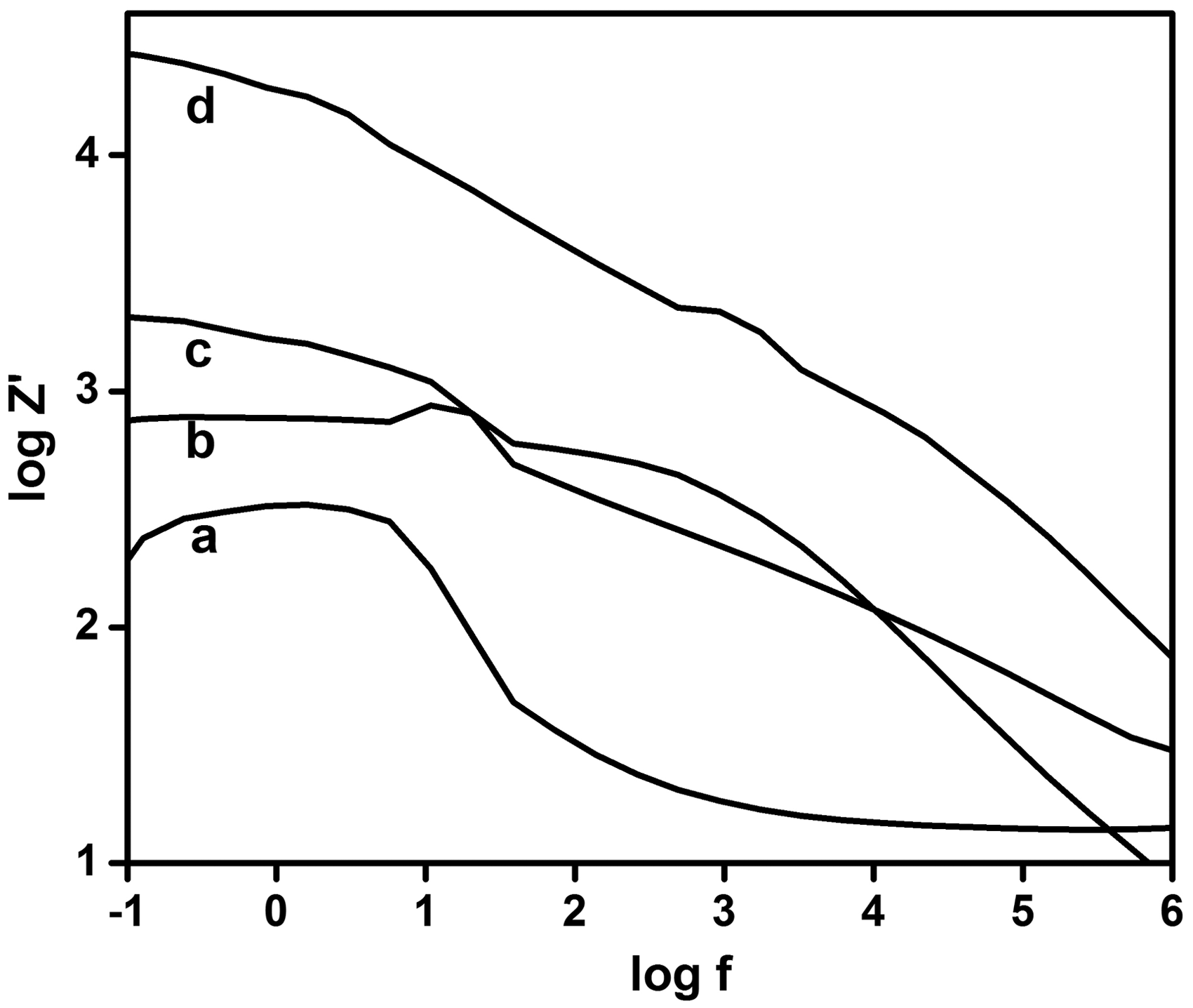
Mechanical strength
Percentage weight loss due to 50 abrasions.

The number of abrasion cycles that each fabric could withstand without tearing is also given in Table 2. The hybrid coated fabrics was strong enough to withstand more than 200 cycles. This showed that there is only small loss in strength for hybrid coated fabric when compared to uncoated cotton fabric (it withstands 300 cycles). The stiffness of the cotton fabric increased 20% on PANI coating, while only 7% with hybrid coating (C0.3). Thus, the fabric with hybrid coating has more strength and flexibility than PANI coated fabric.
Dielectric properties
The dielectric properties of native fabrics, pristine PANI coated fabric, and PANI-TiO2 hybrid coated fabric were studied and EMI SE was calculated. The change in Real part of permittivity Imaginary part of permittivity 

EMI shielding properties
The EMI shielding is by three mechanisms: (1) the first is reflection of the wave from the shield and this SE is represented as SEr. This occurs when the constituents of the shield work as an antenna and reflect the incident wave [42]. (2) The second phenomenon of EMI shielding is absorption (SEa) of the wave into the shield as it passes through the shield. Absorption in an EM shield transforms EM energy into thermal energy. (c) The third is due to the re-reflections, i.e. the multiple reflections (SEm) of the waves at various surfaces or interfaces in the shield. This is neglected when the shielding due to absorption is higher than 15 dB. SE in dB is a measure of the reduction of EMI at a specific frequency achieved by a shield, such as a coating. EMI SE can be derived from complex permeability and permittivity. Thus, the total EMI SE is the sum of shielding due to reflection, absorption, and multiple reflections. The effectiveness of shielding by each mechanism is calculated from the complex permittivity values. EMI shielding due to reflection for coated cotton fabrics is given in Figure 7. It decreased with TiO2 content and was independent of frequency. The reflection shielding was the major contributory for EMI shielding for the coated fabrics. Figure 8 shows SE of coated cotton by absorption. It was very low showing that these coated fabrics could not be used as microwave absorbers. SEa decreased with frequency, showing that there exist some slow relaxation processes, which fail to respond at increased frequency. The shielding due to multiple reflections (SEm) was also relevant as the SEa is very low. This is given in Figure 9. The interfaces present in coated fabric as explained earlier contribute to this SEm.
Shielding efficiency by reflection for coated cotton fabric. Shielding efficiency by absorption for coated cotton fabric. Shielding efficiency by multiple reflection for coated cotton fabric.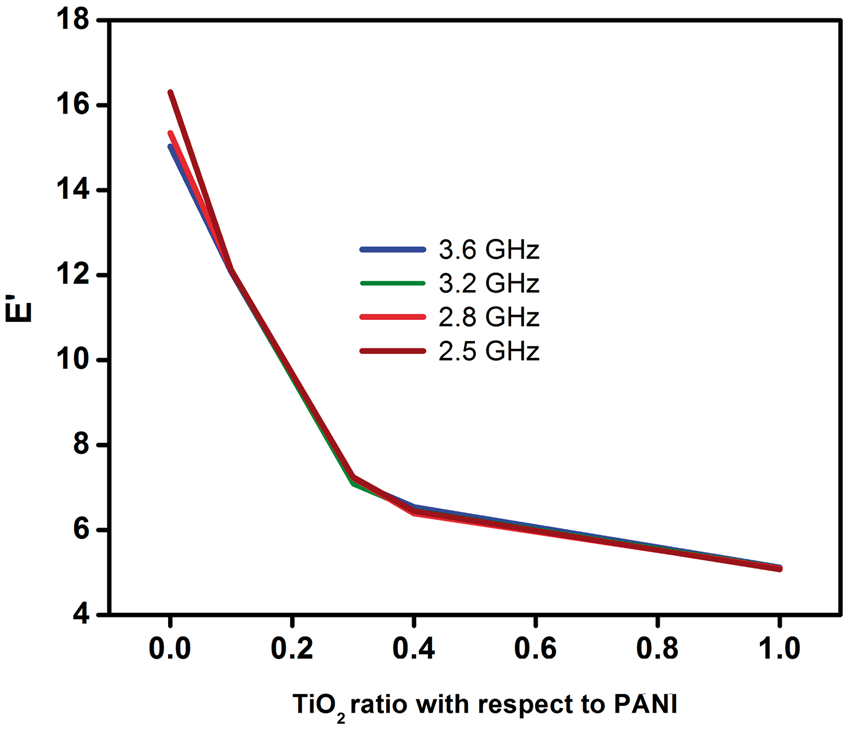


The total SE of coated cotton is given (Figure 10). On adding TiO2, The EMI SE decreases. This may be due to the lower electrical conductivity of the hybrid [13]. As the target value of the EMI SE needed for commercial applications is around 20 dB, it is evident that all these fabrics can work as efficient shields [43].
Total shielding efficiency for coated cotton fabric.
Conclusion
PANI-TiO2 hybrid coated fabrics were studied for understanding their aptness as flexible EMI shields. The hybrid coated cotton fabric was better than PANI-coated cotton fabric in terms of strength, flexibility, and retention of electrical conductivity. The EMI SE of the hybrid coated fabrics in S band region was sufficient for making it good candidate for shielding. EMI shielding by reflection was prominent in all cases. The shielding was consistent in the range of frequency studied.
Footnotes
Acknowledgement
The technical advice given by Dr Vijutha Sunny, Visiting scientist, IGCAR, Kalpakam, and Mr K Feroz babu, SRF, CECRI, Karaikudi, is acknowledged.
Funding
A part of this work was carried out with the financial assistance of UGC New Delhi through a project.