




Abstract
The objective of this paper is to propose an artificial neural network model to predict the dimensional properties of a weft-knitted double cardigan structure made from 100% cotton ring spun yarns. Through experimental study, various U-values (K-constants of derivative knitted structures) were established for the given structure. The factors investigated were yarn count, structural-cell stitch length, course and wale density and stitch density in different relaxation states. A predictive model of artificial neural network was developed with experimental results. Further, the artificial neural network model was compared with U-values established using test set of inputs. The prediction of the dimensional properties produced by the neural network model proved to be highly reliable (R2 > 0.98).
Introduction
Knitted fabrics have been extensively used in readymade apparel owing to its higher level of comfort. The Double-Cardigan structure, produced in circular knitting, is widely preferred in winter garments due to its high elastic and thermal properties. At the same time, the great disadvantage of the weft-knitted fabrics is its dimensional instability. Therefore, to understand how the problem of shrinkage can be overcome, the hosiery industries have first to decide on a reliable and reproducible method for bringing all fabrics to an equivalent state of relaxation for comparison. This will then become the reference state for all measurements and comparisons.
Munden [1] showed that, in the minimum energy state, the dimensions of plain knitted wool fabrics were dependent only upon loop length. Further, the experimental studies of Munden [2] have indicated that the densities of course and wale and the loop length can be related by K-constants as follows:




Knapton et al. [4] found that both the dry and wet relaxed states of the plain knit loop shape were unpredictable and that the K-values in these states were dependent upon certain fabric and machine variables. They suggested some form of fabric agitation and tumble-drying to allow the loops to attain the minimum energy state. This state was defined as ‘fully-relaxed’. Knapton et al. [5] introduced a new term, called ‘Structural Knitted Cell’ (SKC) which is the length of yarn occupied in a repeating unit of structure. Further, the work of Wolfaardt and Knapton [6] introduced a three-dimensional loop model based on the same principle introduced by Munden but modified with certain assumptions related to the geometrical configuration of the knitted stitch.




The effective loop length in this case is the length of yarn in one SKC which is defined as the structural-cell stitch length (SCSL or ℓ u ).
Values of ‘U’ and ‘K’ for 1X1 cotton rib structure.

Artificial neural network (ANN) is a useful and powerful tool that can be used in the textile industry for forecasting of characteristics of textile materials, classification and defect analysis, identification, process optimization and planning. Murrells et al. [11] proposed a neural network model for predicting spirality in 100% cotton single jersey fabric produced with conventional and modified ring spun yarns. Saravana kumar and Sampath [12] studied the dimensional properties of 1X1 rib fabric, made with cotton yarn, using ANN system. Performance prediction of spliced cotton yarns was estimated by Cheng and Lam [13] using a regression model and also a neural network model. As per their analytical results, the neural network model showed a more accurate prediction than the regression model.
Bhattacharjee and Kothari [14] reported a study on the predictability of the steady-state and transient thermal properties of fabrics using a feed forward, back propagation ANN system. Behera and Goyal [15] described a method of applying ANNs for predicting the performance parameters of airbag fabrics. Xu et al [16] studied a neural network method of analyzing the cross-sectional images of a wool/silk-blended yarn and obtained good predictions. The advantage of neural networks is the ability of representing complex relationships and their ability to learn these relationships directly from the data being modeled.
This paper deals with an experimental study involving the dimensional constants of double cardigan weft-knitted fabrics. ANNs are also successfully applied to predict the dimensional parameters and the results are compared with the experimental ones.
Experimental
Details of yarn and fabric samples
In this work, 16 samples, in total, were developed to cover possible range of double cardigan fabric (Figure 1) in circular knitting. Four commonly used yarn linear densities of cotton were selected (24, 30, 34 and 40 Ne). The fabrics were produced with four levels of tightness factor (K) for each count, ranging from 14 to 18, and all the samples were knitted on a 24-inch diameter and 18-gauge circular double jersey knitting machine. The run-in ratio of all the samples was fixed at the ‘optimum’ (1.42 : 1) level, as stable dimensions depend on this parameter, with a constant take-down tension being maintained all the time. The knitted samples were subjected to a relaxation treatment to bring them to the ‘fully relaxed state’ using the STARFISH procedure [8].
Double cardigan structure.
Testing and relaxation treatment
The SCSL (or ℓ
u
) of the samples was estimated from the average of 100 loops at each feed and the number of loops in the structural cell. The course and wale densities were measured as per ASTM D 3887 and the areal density (g/m2) of the samples was measured as per ASTM D 3776. Also, the dimensional parameters of the samples were measured in three different relaxation states as mentioned below.
Dry relaxed (DR): The knitted fabric is placed in a standard atmosphere of 25° ± 2°C and RH of 65% for 24 h. Wet relaxed (WR): The fabric is soaked in water for 12 h at a temperature of 30°C. Then the material is hydro-extracted, dried flat in an oven at 60°C and conditioned in the standard atmosphere for 24 h. Fully relaxed (FR): This is also called the ‘Reference State’ of the fabric. The fabric is subjected to a 60°C wash, rinse and spin followed by tumble drying at 70°C until dry. Four more cycles of rinsing and tumble drying are then carried out, after which the fabric is conditioned in the standard atmosphere for 24 h.
The structural tightness factor (K) is determined by the following equation suggested by Wolfaardt and Knapton [6].
Experimental results.

DR: dry-relaxed; FR: fully-relaxed; SCSL; structural-cell stitch length; WR: Wet relaxed.
Test set.
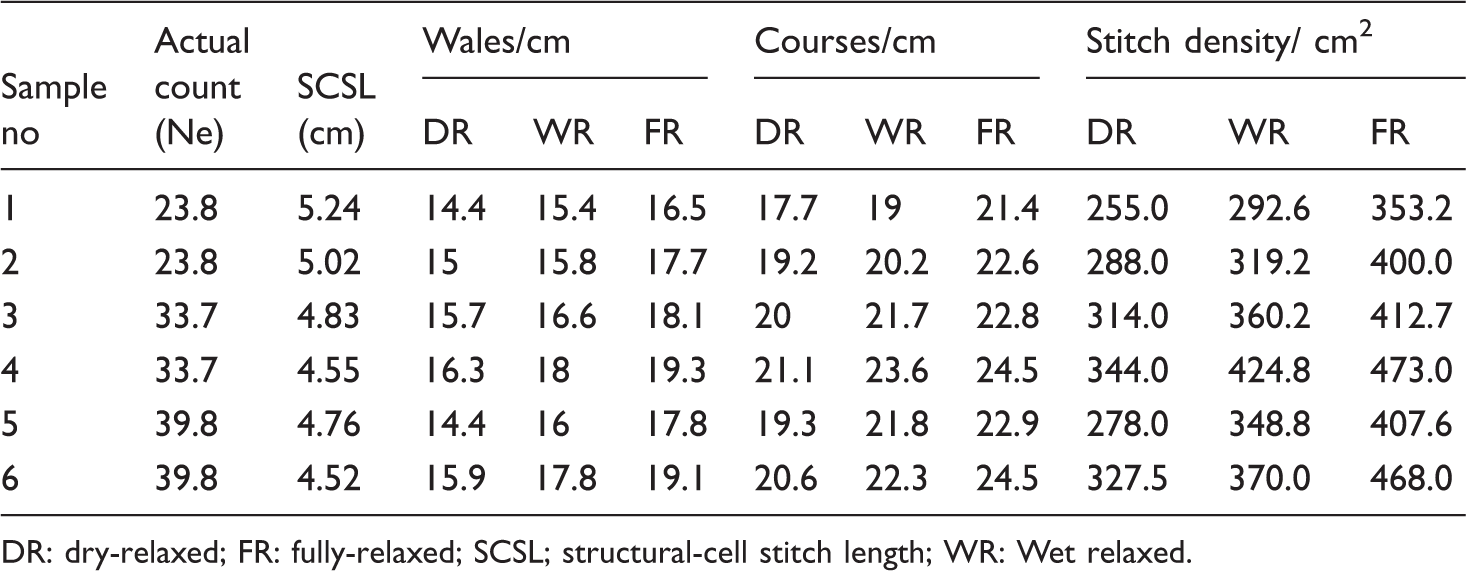
DR: dry-relaxed; FR: fully-relaxed; SCSL; structural-cell stitch length; WR: Wet relaxed.
ANN model
ANN design
ANNs are computational networks that attempt to simulate, in a gross manner, the networks of nerve cells (neurons) of the biological (human or animal) central nervous system. The feed-forward back-propagation training method is chosen for study as the prediction is expected to be made from known input and output experimental data. The mean square error (MSE) is calculated from the difference between the target (actual) output and the network simulated output.

In developing the neural network model, various network structures were tried with one hidden layer. A systematic experiment with varying numbers of neurons was conducted to establish the optimal number of neurons required in the hidden layer as in studies made by Murrels et al. [11]. The Levenberg-Marquardt algorithm was chosen as the training function being the fast and effective method for small volume of input data. The transfer functions used were tan-sigmoid and pure linear in the hidden and output layers of the network, respectively. The neural network tool box of MATLAB was used throughout the study.
ANN training
In the present study, the yarn linear density (Ne) and loop length (SCSL) are the input parameters. The network (Figure 2) consisted of one hidden layer. The input layer had two input nodes (equal to input parameters) and the output layer had nine nodes. The number of neurons in the hidden layer was 20. This optimized number was established by training the neural network system with various numbers of neurons and obtaining the least MSE values (Figure 3).
Architecture of neural network. Mean square error (MSE) values for various neurons in hidden layer.

The performance of a trained neural network can be measured by the errors in the training, validation and test sets. The developed network system with 20 neurons in one hidden layer gave the best prediction results with an MSE of 0.848 and R2 value of 0.99. The learning consisted of 126 epochs for the network. In the test set, six samples were considered covering the possible range of yarn counts and tightness factor, and the results of wales/cm, courses/cm and stitch density/cm2 were obtained for the three relaxation states.
Results and discussion
Dimensional properties of double cardigan fabrics
Regression equations and correlation coefficients.

In the graphs of C
u
against the reciprocal of ℓ
u
for the dry, wet and fully relaxed states (Figure 4), C
u
increases linearly with a decrease in SCSL or an increase in fabric tightness and is largely independent of machine parameters. At the same SCSL Uc increases with the degree of relaxation.
Relation between courses/cm and the reciprocal of structural-cell stitch length (SCSL).
In Figure 5, W
u
has been plotted against the reciprocal of ℓ
u
for the dry, wet and fully relaxed states, respectively. As can be seen, the wale density increases linearly with a decrease in ℓ
u
and the degree of relaxation. During the relaxation treatment, the linear shrinkage depends on K; as K increases, the area shrinkage decreases.
Relation between wales/cm and the reciprocal of structural-cell stitch length (SCSL).
The stitch density (Figure 6) increases linearly with a decrease in ℓ
u
2
and the degree of relaxation. This clearly indicates the consolidation of the structure as the fabric is relaxed.
Relation between stitch density and the reciprocal of structural-cell stitch length (SCSL).
U-values for various relaxation states

Predicting performance
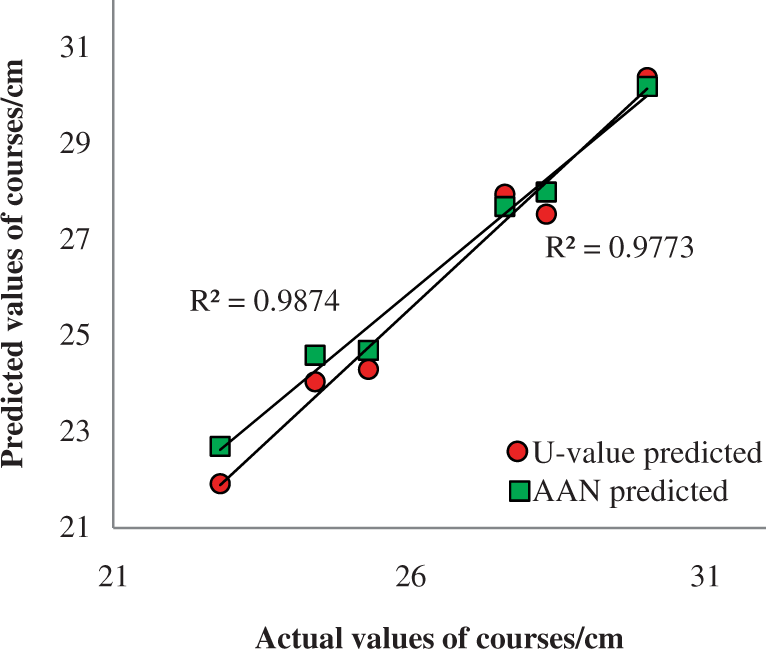
The dimensional parameters (U-values) predicted from the regression equations and neural network, respectively, were compared with the actual values, and it was found that the neural network model produced a better predictive performance than the regression equations (see Figures 7 to 9).
Predicted and actual wales/cm (fully relaxed state). Predicted and actual courses/cm (fully relaxed state). Predicted and actual stitch density (fully relaxed state).

Comparison of performance of prediction models for the fully relaxed state
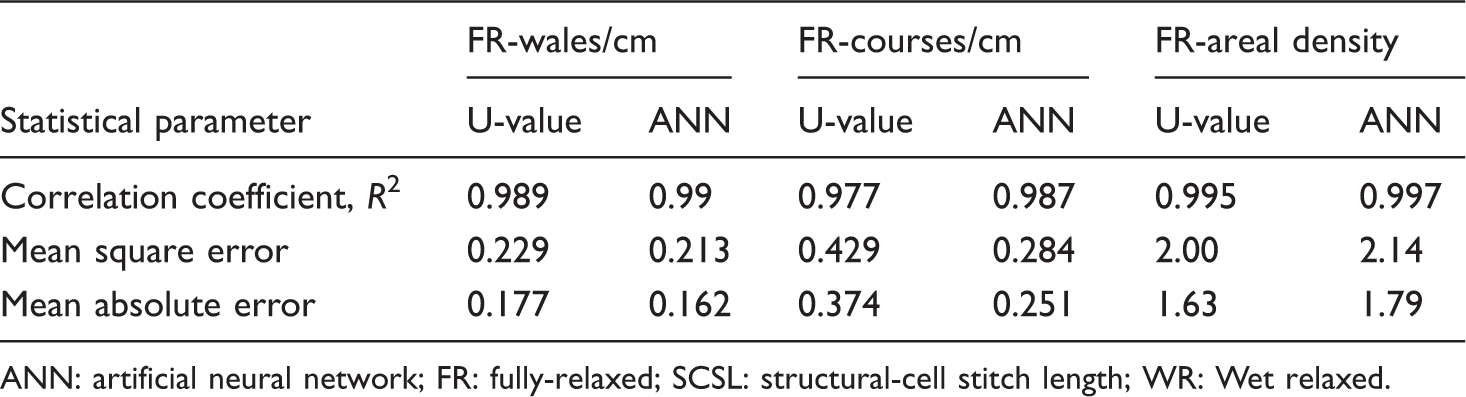
ANN: artificial neural network; FR: fully-relaxed; SCSL: structural-cell stitch length; WR: Wet relaxed.
The correlation coefficients (R2) between the actual and predicted values were generally high, with the neural network model giving slightly higher values than the regression model (U-values). This order of predictive ability was also confirmed by the MSE and mean absolute error, both the resulting errors being lower for the neural network.
Conclusions
ANN and regression analysis systems were used to study the dimensional parameters of 16 double cardigan knitted fabrics comprising four yarn counts each at four different stitch lengths. A relatively good agreement was achieved between the predicted and the measured fabric dimensional properties, with a high correlation coefficient for all three stages of fabric relaxation, i.e., dry relaxed, wet relaxed and fully relaxed. The hosiery industry can use the newly established U-values for the prediction and reproduction of double cardigan knitted fabrics. The finishing targets of such knitted fabrics and U-values can be given as input in the empirical equations in order to derive the required stitch length. The study showed that ANNs can also be used to predict the dimensional properties of weft-knitted fabrics.
Footnotes
Funding
This research received no specific grant from any funding agency in the public, commercial, or not-for-profit sectors.
Acknowledgement
The authors are indebted to Mr. S. Vigneshwaran, student of Master of Fashion Management course in National Institute of Fashion Technology, Bengaluru for his valuable contribution in the neural network analysis and computer programs.