




Abstract
The aim of this study was to understand the crimp extension stage of yarn, being pulled out of fabric. Polyester woven fabrics were used to conduct the pull-out tests. Yarn pull-out crimp extension depends on sample dimensions, fabric density, fabric weave, crimp ratio and the number of pulled ends in the fabric. Results showed that multiple and single yarn pull-out crimp extensions of long samples were higher than those of short samples, and the multiple yarn pull-out crimp extension was higher than that of the single-yarn pull-out force, and the crimp extensions in fabrics were proportional to their crimp ratios. Satin fabric weave showed high weft directional single and multiple pull-out crimp extension compared to plain and ribs fabric weaves. The developed regression model may be helpful for the design of multifunctional fabrics in technical textile applications.
Keywords
Introduction
Yarn-to-yarn or yarn-to-metal friction depends on yarn linear density, twist and type of surfactant treatments. However, some studies stated that friction was primarily the result of intermolecular and electrostatic forces [1,2]. Yarn pull-out force consists of two main parts. The first part includes decrimping and extension of the pull-out yarn itself and displacements of yarns that lie orthogonal to the pull-out direction, that is, the localized shear of the fabric. The second part of the pull-out force is involved overcoming the initial adhesion at the crossovers, that is, the static friction and thereafter the friction of ruptured junctions, the kinetic friction [3]. Another study revealed that inter-filament friction on certain deformation characteristics of weaves was important and that interfacial friction directly influenced yarn and weave stiffness [4]. A study was carried out on the factors involved when a single yarn, freed at one end, was progressively pulled from the weave. As the pull-out force increased, the fabric distorted and the pull-out yarn extended at a critical force and the crossover junctions ruptured [5].
Yarn interaction at the warp and weft crossing points of a tensioned fabric is an important aspect of the mechanical properties of the fabric. In another study, it was demonstrated that the nature of the stick-slip motion of the dynamic frictional force of a pulled-out yarn was periodic and depended on yarn spacing in the fabric structure [6]. The pull-out test was developed as a method of providing useful information about fabric tearing, its ability to absorb energy in ballistic applications, the finishing efficiency, bending and shearing hysteresis of the fabric and its frictional behaviour [7]. Yarn pull-out from woven fabric was modelled, and it was claimed that the maximum pull-out load was related to yarn geometry and yarn mechanical properties and the corresponding fabric density. In addition, it was found that yarn pull-out depends on fabric weave structure and yarn types [8]. Another study showed that yarn pull-out forces depended on fabric density, fabric sample dimensions and the number of pulled ends in the fabric. Multiple yarn pull-out force was higher than single yarn pull-out force. Single and multiple yarn pull-out forces in tight para-aramid fabric were higher than those of loose para-aramid fabric. Yarn crimp extension in para-aramid fabrics depended on crimp ratio in the fabrics and fabric density. High crimp ratio fabrics showed high yarn crimp extension compared to that of the low crimp ratio fabrics. Long fabric samples also showed high yarn crimp extension compared to that of the short fabrics [9].
On the other hand, fabric-to-metal surface and fabric-to-fabric frictional characteristics have been examined. It has been observed that normal load and frictional forces follow a logarithmic relationship. Fabric-to-metal friction was found to be less sensitive to fabric morphology and rubbing direction, whereas fabric-to-fabric friction was highly sensitive and affected by fibre type, yarn composition, yarn and fabric structure and crimp ratio [10].
The aim of this study was to understand the crimp extension stage of the pull-out on the textured polyester plain, ribs and satin fabric weaves, and to present data generated by the developed yarn pull-out test.
Materials and methods
Polyester woven fabrics
Specifications of polyester woven fabrics.
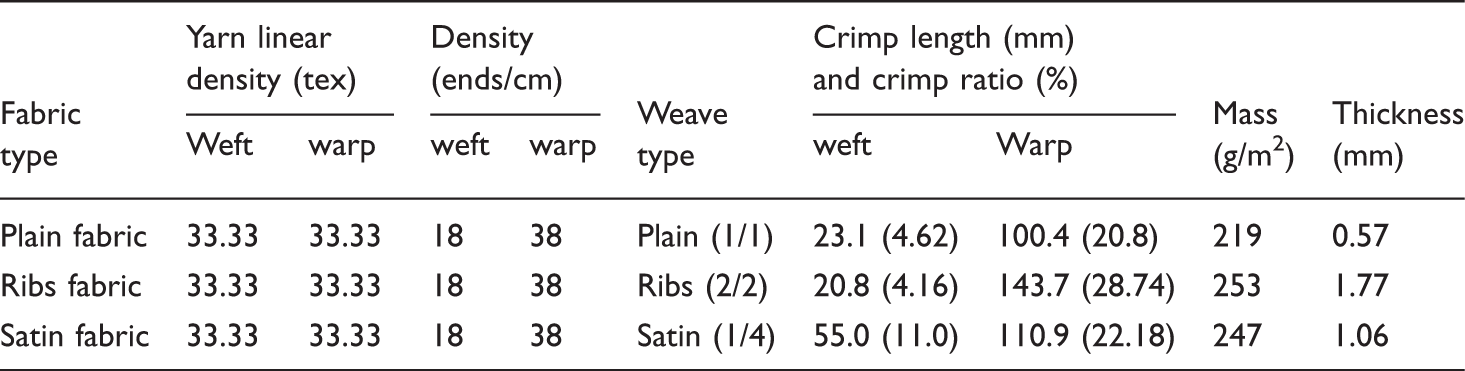
The number of interlacements for the equivalent unit cell of each fabric was calculated and plain fabric (warp 20, weft 20, and total 40) has 20, 20 and 40 interlacements to warp, weft and total, respectively. The ribs fabric (warp 10, weft 20, and total 30) has 10, 20 and 30 interlacements to warp, weft and total, respectively. The satin fabric (warp 8, weft 8, and total 16) has 8, 8 and 16 interlacements to warp, weft and total, respectively. Crimp measurement was performed using a Tautex digital instrument (James H. Heal Co., UK) according to ISO 7211-3. Fabric thickness measurement was performed using an R&B cloth thickness tester (James H. Heal Co., UK) according to ISO 5084. Fabric weight measurement was performed based on ISO 6348.
Pull-out tests
Pull-out tests were conducted to determine the yarn-to-yarn friction over and under the crossing areas in the fabric structure. The developed fixture consisted of a base plate to hold the testing instrument; a sliding frame to adjust the position of the yarn end to be pulled from the testing instrument; a fabric holder to apply the required pressure to each of the fabric sample sides that are parallel with the thread to be pulled via a metal plate [11,12]. Figure 1 shows the fixture with fabric sample and the pull-out test carried out in the testing instrument. The testing instrument used was the Instron 4411 and the testing speed was 100 mm/min.
Fabric samples and pull-out fixture for fabric samples (left); pull-out fixture with fabric on the tensile testing instruments (right).
The fabric sample dimensions for the pull-out tests were as follows: fabric widths 110, 210 and 360 mm and each fabric width has three different fabric lengths as 250, 350 and 450 mm for the total sample dimension, and fabric widths 50, 150 and 300 mm and each fabric width has three different fabric lengths as 100, 200 and 300 mm for the sample dimension in the fixture. The pull-out direction was in both the warp and weft directions of the fabrics. The frayed yarn length in the sample was 150 mm and the total edge length holding the sample in the fixture edge was 60 mm. An individual yarn end from the frayed edge was clamped by the Instron 4411 pull head. Figure 2 shows the single (1) and multiple (2, 3, 4 and 5) yarn pull-out tests. Schematic views of the sample before and after pull-out tests are shown in Figure 3. In the pull-out test, fabric pull-out force, crimp extension and fabric displacement were measured. In this paper, only the fabrics’ crimp extensions are presented. The crimp extension was defined as ‘yarn length that is received under the applied tensile load on a single yarn end in the fabric structure due to interlacement.’
Single polyester fabric after pull-out test; one yarn was pulled out (a); two yarns were pulled out (b); three yarns were pulled out (c); four yarns were pulled out (d); five yarns were pulled out (e) and multiple yarns were pulled out during testing (f). Schematic views of the fabric and yarn positions measured during pull-out test; fabric position before pull-out test(left), fabric position during pull-out test (right) [13].

Statistical modeling
The pull-out crimp extensions of warp and weft directional polyester plain, ribs and satin fabrics were evaluated for single (1 yarn) and multiple yarns (2, 3, 4 and 5 yarns). Both single and multiple yarns, the pull-out properties of three different fabric widths (50, 150 and 300 mm) and lengths (100, 200 and 300 mm) were considered. ‘Design Expert’ software was used for statistical investigation and the factorial design was carried out [14]. The best models for each fabric type were obtained and the corresponding regression equations and regression curves were fitted. The test results of the related fabrics were entered into the software for the analysis of the factorial design. The statistical parameters of polyester fabrics are presented in Table 2. The analysis of variance (ANOVA) tables for each fabric types were obtained and are presented in Tables 3 and 4 for the warp and weft directional crimp extensions, respectively. Here, the p values of models smaller than 0.05 are considered to be significant. The ANOVA table also indicates the significant interactions between fabric dimensions and pull-out forms. The term ‘A’ in these tables indicates fabric width, ‘B’ represents fabric length and ‘C’ specifies the number of yarn ends. A, B and C are independent parameters, whereas the warp and weft directional crimp extensions are dependent parameters. The term ‘model’ is the sum of the model terms in the ANOVA table and ‘pure error’ represents error in the model. In addition, ‘corrected total’ (cor. total) is the sum of model and pure error. The regression equations were also developed by considering the ANOVA table. A normality test (normal distribution test) was also applied on the data obtained from the pull-out test. The results of two of them are demonstrated in Figure 4. In general, probability plotting is a graphical technique for determining whether sample data conform to a hypothesized distribution based on a subjective visual examination of the data. The assessment is very simple. From the data, which are scattered around the normality line as shown in Figure 4, we can see that they conform to normal distribution. In addition, transformation of the response variables was conducted during statistical analysis of yarn pull-out crimp extension. The purpose of the transformation of response variables was stabilizing the variance of response and improving the fit of model to the experimental data [14]. Hence, the prediction performance of the generated models has been increased.
Normality test for pull-out crimp extension of weft directional ribs (a) and satin (b) fabric. Statistical parameters of polyester fabrics. Analysis of variance (ANOVA) tables of warp directional yarn pull-out properties of polyester woven fabrics. Analysis of variance (ANOVA) tables of weft directional yarn pull-out properties of polyester woven fabrics.


Results and discussion
Yarn pull-out result
The measured values of yarn pull-out crimp extension are presented in Table 5. Figure 5 shows the yarn pull-out force-displacement curves for each corresponding crossing between the warp and weft in the fabric during the pulling of the warp yarn.
Yarn pull-out force-displacement curves with fabric displacement and crimp extension regions, the point of max pull-out force and slip-stick region in the plain polyester fabric. (Sample width: 150 mm. length: 100 mm). Pull-out crimp extension test results from various sample sizes of polyester woven fabrics to warp and weft direction.

A single yarn pull-out test on fabrics was observed, and based on the results, the pull-out curve was defined, as shown in Figure 5. When the pull-out curve reaches the maximum pull-out force point where the yarn is still pulled from the end of the fabric, the curve has fabric displacement and crimp extension regions. The fabric displacement region is where fabric displacement is at its maximum. The crimp extension region is where maximum pull-out force occurs. These two regions are also called the static friction. When the yarn is pulled through all the crossing points in the fabric, this region is called the kinetic region where the curve has one maximum and one minimum for each corresponding two crossing points. Each minimum and maximum region in the curve is called the slip-stick region; where the warp passes over or under the filling is described as the stick motion whereas where the warp passes between the two pick sections is described as the slip motion. It was also observed that filament breakages occurred during multiple and single yarn pull-out test. Filament breakages in the multiple yarn pull-out tests were higher than those of the single yarn end pull-out test.
Warp directional yarn pull-out crimp extension
The regression equations (1) and (2) for determining warp directional yarn pull-out crimp extension [YPCE-Wr] in polyester ribs (R) and satin (S) woven fabrics are presented below. The yarn pull-out crimp extension-fabric length curves for 50 and 300 mm ribs and satin fabric widths are seen in Figures 6 and 7, respectively. In Figures, the dots represent the mean of the actual data whereas the other symbols represent the regression fit.
Relationship between pull-out crimp extension and fabric length for 50 mm (a) and 300 mm (b) fabric width in warp directional ribs fabric. Relationship between pull-out crimp extension and fabric length for 50 mm (a) and 300 mm (b) fabric width in warp directional satin fabric.

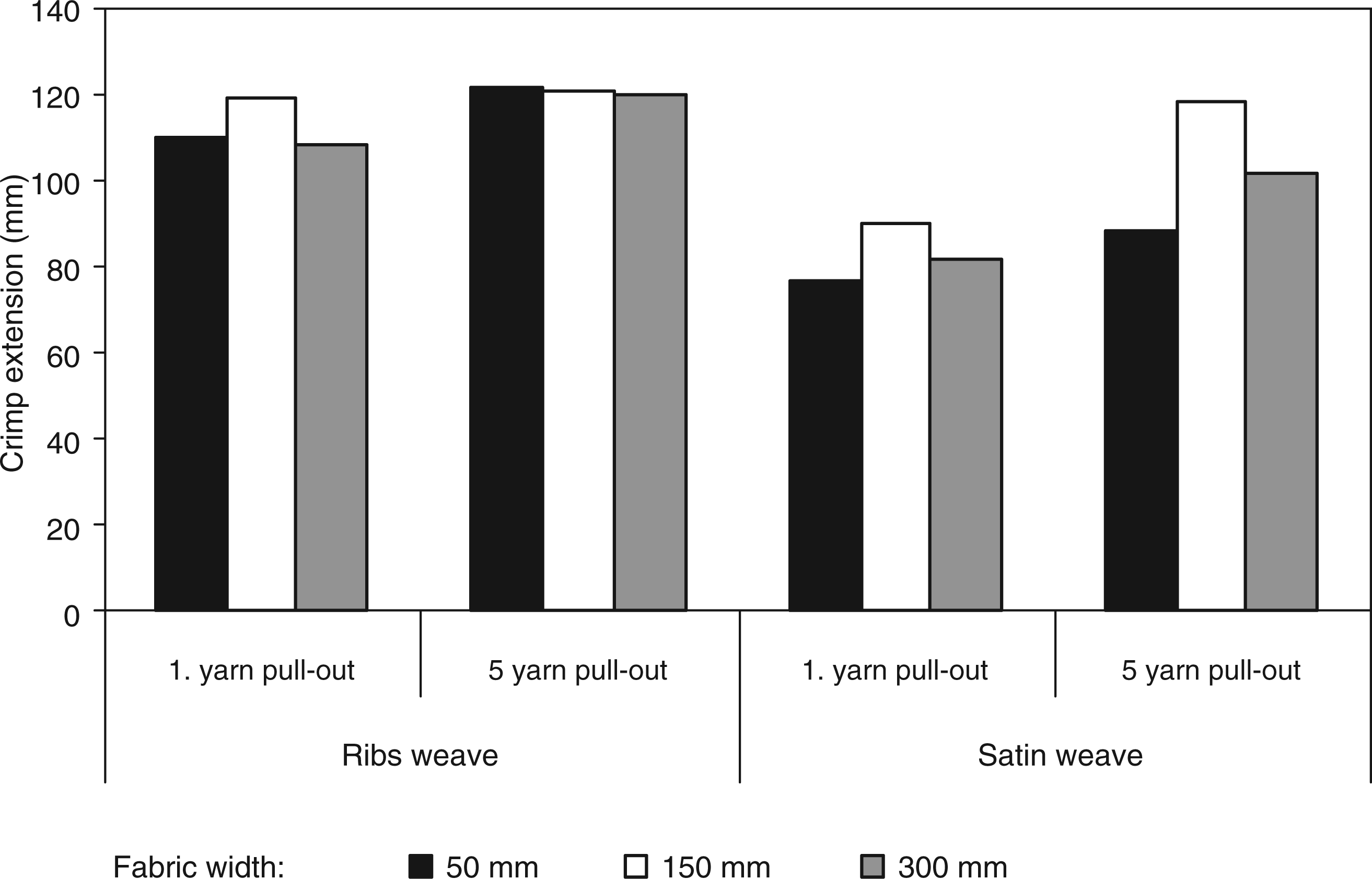
The multiple and single yarn pull-out crimp extensions of 50 and 300 mm ribs and satin fabric widths increased when the fabric length increased. The multiple pull-out crimp extensions of 50 and 300 mm ribs and satin fabric widths were higher than those of the single yarn pull-out crimp extension. Hence, fabric lengths considerably affected the pull-out crimp extension of 50 and 300 mm ribs and satin fabric widths due to the increasing number of crossing points. In addition, it was observed that warp directional crimp extensions (mm) in the ribs and satin fabrics were proportional to their crimp ratios (%). The amount of pull-out crimp extension generated from multiple and single yarn pull-out was not linearly proportional with regard to the pulled ends. This was because nonlinear intra-yarn and yarn-crossing frictions occurred in the in-plane and out-of plane regions of the fabric. On the other hand, as seen in ANOVA table, no significant relation in warp directional multiple and single yarn pull-out of ribs weave was found between the pull-out crimp extension and various fabric widths. But, a significant relation was found in satin weave. When the fabric width increased, the multiple and single yarns pull-out crimp extensions of satin weave increased. This is clearly shown in Figure 8.
Relationships between warp directional yarn pull-out crimp extension and fabric weave for various fabric width of polyester fabric (fabric length: 100 mm). Relationship between pull-out crimp extension and fabric length for 50 mm (a) and 300 mm (b) fabric width in weft directional plain fabric.


Weft directional yarn pull-out crimp extension
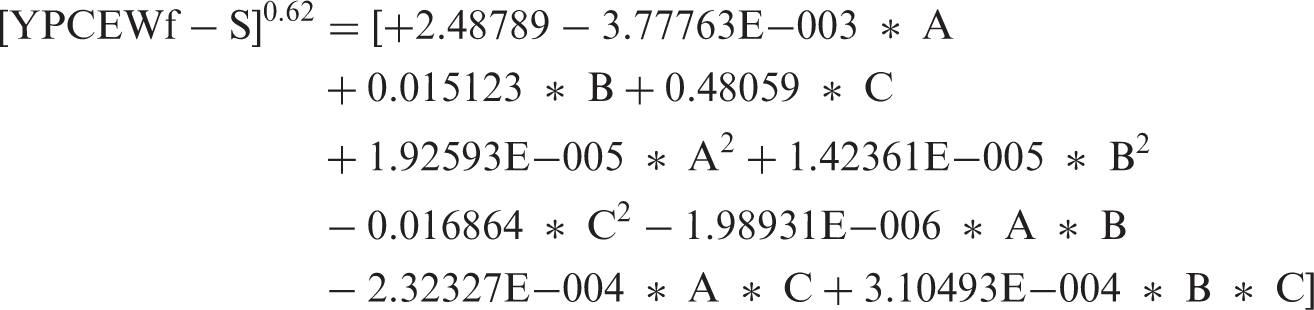
The regression equations (3)–(5) for determining weft directional yarn pull-out crimp extension [YPCE-Wf] in polyester plain (P), ribs (R) and satin (S) woven fabrics are presented below. The yarn pull-out crimp extension-fabric length curves for 50 and 300 mm plain, ribs and satin fabric widths are seen in Figures 9, 10 and 11, respectively. In Figures, the dots represent the mean of the actual data, whereas the other symbols represent the regression fit.
Relationship between pull-out crimp extension and fabric length for 50 mm (a) and 300 mm (b) fabric width in weft directional ribs fabric. Relationship between pull-out crimp extension and fabric length for 50 mm (a) and 300 mm (b) fabric width in weft directional satin fabric.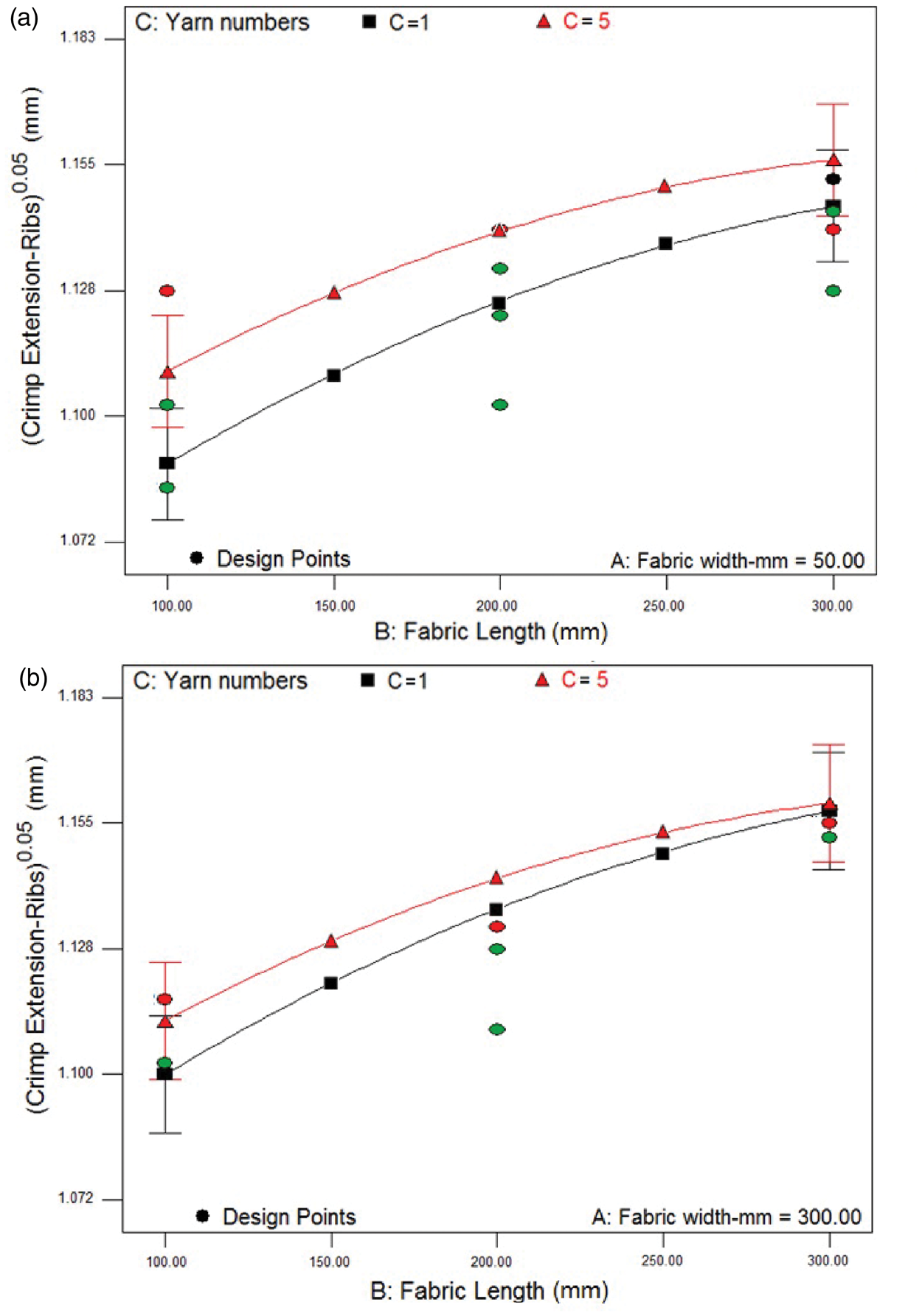

The multiple and single yarn pull-out crimp extensions of 50 and 300 mm plain, ribs and satin fabric widths increased when the fabric length increased. The multiple yarns pull-out crimp extensions of 50 and 300 mm plain, ribs and satin fabric widths were higher than those of the single yarn pull-out crimp extensions. Hence, fabric lengths considerably affected the pull-out force of 50 and 300 mm plain, ribs and satin fabric widths due to the increasing number of crossing points. In addition, it was observed that weft directional crimp extensions (mm) in the plain, ribs and satin fabrics were proportional to their weft directional crimp ratios (%). The amount of pull-out crimp extensions generated from multiple and single yarn was not linearly proportionate with regard to the pulled ends. This was because nonlinear intra-yarn and yarn-crossing frictions occurred in the in-plane and out-of plane regions of the fabric. On the other hand, as seen in ANOVA table, no significant relation in weft directional multiple and single yarn pull-out of plain and ribs weaves was found between pull-out crimp extensions and various fabric widths. But, a significant relation was found in satin weave. When the fabric width increased, the multiple yarn pull-out crimp extension of satin weave slightly increased. This is clearly shown in Figure 12.
Relationships between weft directional yarn pull-out crimp extension and fabric weave for various fabric width of polyester fabric (fabric length: 100 mm).

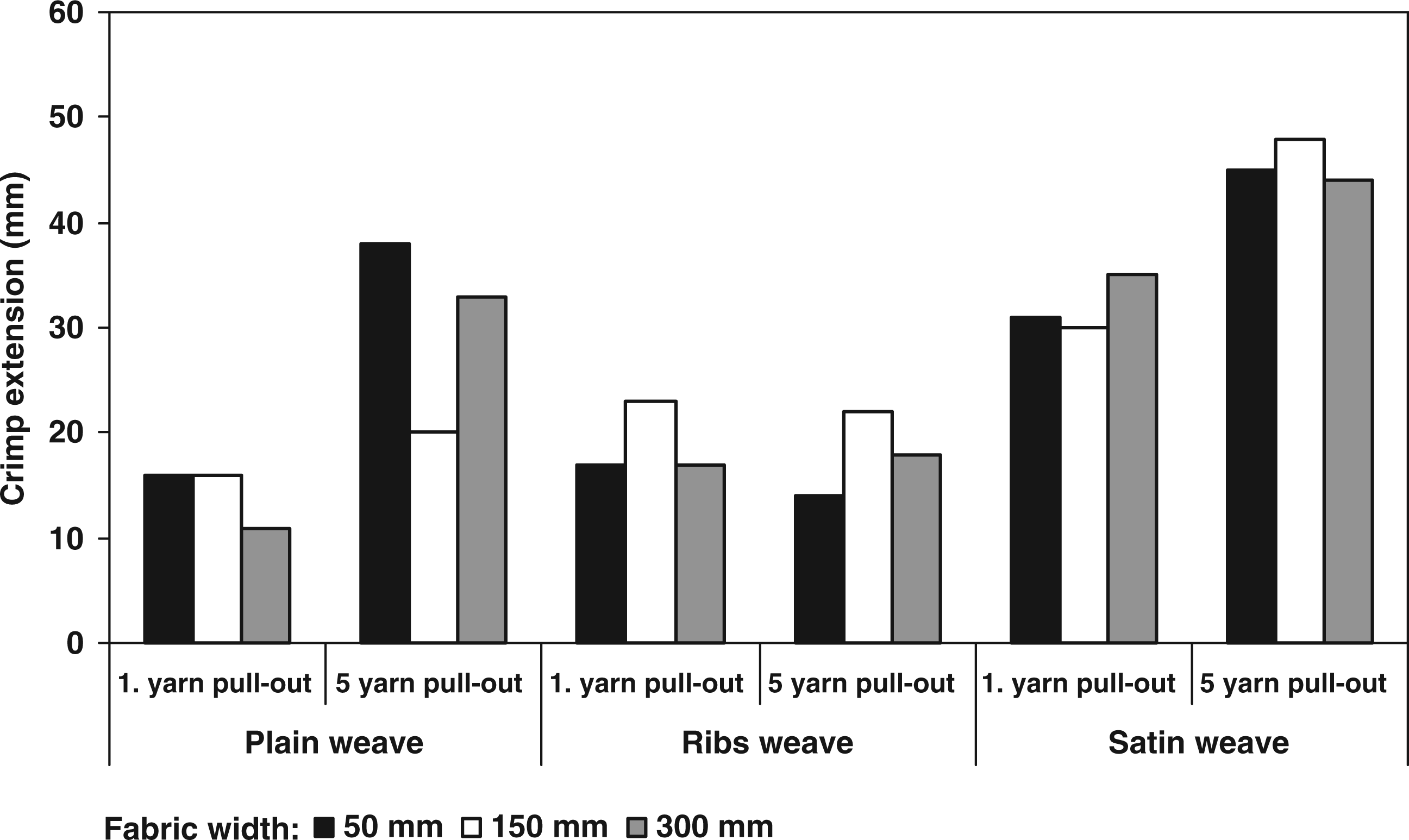
The warp directional single and multiple yarn pull-out crimp extensions of ribs and satin fabrics were higher than the weft directional single and multiple yarn pull-out crimp extensions of ribs and satin fabrics due to the high fabric density (ends/cm) in warp direction. In addition, the warp and weft directional single and multiple yarn pull-out crimp extensions of plain, ribs and satin fabrics were proportional to their warp and weft directional crimp ratios. The warp and weft directional single and multiple yarn pull-out crimp extensions of fabric increased when the sample length increased due to the high number of crossings in long samples. Also, the warp and weft directional single and multiple yarn pull-out crimp extensions of satin fabrics are higher than those of plain and ribs fabrics due to the warp and weft directional crimp ratios.
Conclusion
Single and multiple yarn pull-out tests were performed in order to understand the pull-out crimp extension on the textured polyester plain, ribs and satin fabrics. Data were generated from single and multiple yarn ends pull-out tests.
Single and multiple pull-out crimp extensions depended on sample dimensions, fabric density, fabric weave, directional crimp ratios and the number of pulled yarn ends. Long fabric sample showed high single and multiple pull-out crimp extension compared to that of short fabric sample. Fabric which has high directional crimp ratio showed high directional single and multiple pull-out crimp extensions compared to that of low directional crimp ratio fabric. Ribs fabric weave showed high warp directional single and multiple pull-out crimp extensions compared to satin fabric weaves. Satin fabric weave showed high weft directional single and multiple pull-out crimp extensions compared to plain and ribs fabric weaves. In addition, the multiple yarn ends pull-out test in all fabrics showed high pull-out crimp extensions compared to those of the single yarn end pull-out tests.
The results showed that fabric dimensions, crimp ratio and the number of pulled ends affected the fabric pull-out crimp extension properties and that the regression model could be used in this study as a viable and reliable tool. This research could be valuable for development of multifunctional fabrics in technical textile applications.
Footnotes
Acknowledgements
This work was partially supported by Erciyes University`s Scientific Research Unit (EUBAP), contract number EUBAP-FBA-10-2882. The authors thank the Scientific Research Department of Erciyes University for this invaluable support. Authors also thank Research Associate Mahmut Korkmaz for the support during preparation of the manuscript.
Funding
This research received no specific grant from any funding agency in the public, commercial, or not-for-profit sectors.