




Abstract
In the present work, chitosan was applied on to the braided silk sutures at three different concentrations and the effects of chitosan coating on the characteristics of braided silk suture were explored. The frictional characteristics of BSS were studied by determining the dynamic coefficient of friction at various normal loads and sliding speeds. At higher normal loads and sliding speeds, both the chitosan coated and uncoated braided silk suture showed lower value of dynamic coefficient of friction. Furthermore, for all the tested normal loads and sliding speeds the chitosan coated braided silk suture showed lower value of dynamic coefficient of friction than the untreated BSS. Instron tensile tester was used to measure the tenacity and knot strength. The result showed that the tenacity and knot strength of braided silk suture increases with the increase in chitosan concentration. The scanning electron microscopy reveals the uniform deposition of chitosan on to the surface of the braided silk suture. The antimicrobial activity of chitosan coated braided silk suture against Escherichia coli and Staphylococcus aureus were evaluated using agar diffusion method (SN 195920) and shake flask method (AATCC 100). The braided silk suture treated with higher chitosan concentration exhibits excellent antimicrobial activity against both the bacteria.
Introduction
Sutures are textile biomaterial devices used to ligate blood vessels and proximate tissues together [1]. Sutures are broadly categorized according to the type of material (natural, synthetic) from which they are made, the permanence of the material (absorbable or nonabsorbable) and the construction process (braided, monofilament) used. Ideal suture materials should satisfy several requirements. They should have high tensile strength, but lose strength at the same rate as the tissue gains strength and should be easy to handle and form secured knots. They should be biologically inert and should not promote infection. It should also be inexpensive. Till date, no single suture possesses all these attributes. Therefore, compromises must be made in selecting a suture material. It is the practitioner’s task to weigh the advantages and disadvantages of the available suture materials [1,2].
Silk from the silkworm Bombyx mori has been used as biomedical suture material for centuries. This reflects the high biocompatibility of silk, despite silk being a foreign protein to mammals. As a substrate, silk protein is good for mammalian cell adhesion and proliferation. Recent studies reported the use of silk in oral administration. The excellent biocompatibility and functionality of silk has led to the development of various biomedical devices [3,4]. As a suture, silk is still popular in ocular, neural and cardiovascular surgery, but has also been used in a variety of other tissues in the body. Silk’s knot strength, frictional characteristics and ability to lay low to the tissue surface make it a popular suture in cardiovascular applications, where bland tissue reactions are desirable for the coherence of the sutured structures [5,6].
The silk sutures are usually coated with wax or silicone to enhance the material properties and reduce fraying. On the other hand, coated sutures may provoke inflammatory tissue reactions if the pieces of the coating flake off and migrate into surrounding tissues. To reduce this problem, coating should have an affinity for suture filaments. It has been reported that the elimination of wax coating significantly diminished the high thrombotic response to silk [5]. Therefore, an innovative coating material is needed to improve the frictional characteristics of silk sutures. Furthermore, silk is a natural protein fiber and easily prone to microbial infection [7–9]. The use of antimicrobial sutures is expected to provide protection from wound infection. Several approaches have been reported in developing antimicrobial sutures. Recently, the incorporation of chitosan (Figure 1) on the surface of sutures is one of the approaches adopted to impart antimicrobial activity to sutures. The application of chitosan coating to a suture material has a benefit of smoothing suture surface, combating bacterial colonization and enhancing certain other properties [10,11].
The molecular structure of chitosan.
Chitosan is the deacetylated derivative of chitin, which is the main component of the shells of crustaceans such as shrimps, crabs and lobsters. Chitosan has been found to inhibit the growth of microbes in a large body of work that has been reported by several researchers [12,13]. The antimicrobial mechanism is not clear but is generally accepted that the primary amine groups provide positive charges which interact with negatively charged residues on the surface of microbes. Such interaction causes extensive changes in the cell surface and cell permeability, leading to leakage of intracellular substances. The antimicrobial ability, coupled with its nontoxicity, biodegradability and biocompatibility is facilitating chitosan’s emerging applications in biomaterials engineering [12,13]. In order to impart antimicrobial activity, chitosan was successfully applied on to various suture materials, namely polylactic acid sutures [10], polypropylene sutures [14], polyester sutures [15] and cotton sutures [16]. Even though several attempts have been made to use chitosan polymer as antimicrobial agent, its use along with silk suture has been limited.
Frictional properties of textile materials are normally measured over a range of applied normal loads and sliding speed. A large number of studies have been carried out on the frictional properties of textile fiber assemblies. The effect of applied normal loads and sliding speed on the frictional characteristics of woven and nonwoven wipes was investigated by Das et al. [17]. In another study, Das et al. [18] have explored the frictional characteristics of woven suiting and shirting fabrics. Ramkumar et al. [19] have studied the effect of applied normal loads and sliding speed on the frictional characteristics of needle punched nonwoven fabrics. A very few literature is available with respect to the frictional properties of chitosan-treated textiles [20,21]. Bhuvana et al. [20] investigated the frictional properties of chitosan-treated wool fabrics. In another study, Jeong et al. [21] characterized the frictional properties of chitosan-treated wool fabrics using the Kawabata evaluation system.
To the author’s best knowledge, there is no published data available on the frictional properties of chitosan coated suture materials. In the present work, chitosan was applied on to the braided silk suture (BSS) at three different concentrations. The effects of chitosan treatment on the frictional, tensile and antimicrobial characteristics of BSS were studied.
Materials and methods
Materials
B. mori silk filaments were used as starting materials for the study. Chitosan polymer (degree of deacetylation 0.82, viscosity 300 cps) was supplied by Otto chemicals, India. All other chemicals were analytical grade and used as received.
Degumming
Raw silk filaments were treated in an aqueous solution of 0.1% (w/v) Na2CO3 at 98–100°C for 30 min to remove sericin. This is for the reason that sericin can elicit undesirable immune response after implantation in the human body [22]. Degummed silk filaments were subsequently washed with copious water to remove Na2CO3.
Braiding of silk
We manufactured BSS composed of 16 silk yarns having a count of 124 tex by using a SEMCO circular braiding machine normally used to produce braided structures. A regular (1/1) braid was constructed with multifilament yarns placed on a circular braiding machine with a 16 carrier arrangement. The circular braiding machine uses the sequential motion of the carriers to interlace the 16 yarns, and a simple circular braid is then obtained.
Coating with chitosan
Chitosan solutions of concentrations 1%, 2% and 3% (w/v) were prepared in 2.0% (v/v) aqueous acetic acid by stirring the dispersion for 1 h at 60°C. The BSS were then treated in chitosan solutions of different concentrations for 24 h at room temperature. After chitosan coating, the BSS were washed three times with 0.1 M NaOH solution and with deionized water in order to remove the contained acetic acid in the chitosan film [10]. The BSS were subsequently padded and cured in the curing chamber at 100°C for 10 min.
Measurement of frictional properties
In the present study, frictional measurements were carried out using an indigenously designed and developed friction tester. The details of the instrument and testing procedure have been explained in an earlier article [23]. The BSS were tested for frictional properties at different normal loads such as 50, 100 and 150 g at a constant sliding speed of 100 mm/min. The BSS were also tested for frictional properties at different sliding speed such as 50, 100 and 150 mm/min at a constant normal load of 100 g. The friction coefficient considered in the study is dynamic friction coefficient.
Measurement of tensile and knot properties
The tenacity and knot properties were measured using Instron tensile tester. The BSS were tested for tenacity and knot strength at a gauge length of 150 mm and extension rate of 200 mm/min [24]. In the knot strength measurement, knot was formed with surgeons knot method as described elsewhere [25].
Antimicrobial activity evaluation
Agar diffusion method (SN 195920). The antimicrobial activities of untreated and chitosan-treated BSS have been evaluated using agar diffusion method. Treated and untreated BSS were placed in intimate contact with AATCC bacteriostasis agar, which was previously inoculated with a day culture (slant cultures) of the test organisms such as Staphylococcus aureus and Escherichia coli. The evaluation was made on the basis of absence or presence of an effect on bacteria in the contact zone under the specimen and the possible formation of a zone of inhibition around the test specimen.
Shake flask method (AATCC 100). Specimens of the test material were shaken in a known concentration of bacterial suspension and the reduction in bacterial activity in standard time was measured. The efficiency of the antimicrobial treatment was determined by comparing the reduction in bacterial concentration of the treated sample with that of control sample expressed as a percentage reduction in standard time. S. aureus (ATCC 6538) was used as a representative gram-positive organism and E. coli (ATCC 11230) was used as a representative gram-negative organism. The bacterial counts were reported as the number of bacteria per sample not as a number of bacteria per ml of neutralizing solution. “0” counts at 10° dilution was reported as “less than 100.” The percentage reduction of bacteria by the specimen treatments was calculated using the following formula:

B = number of bacteria recovered from the inoculated treated test specimen swatches in the jar immediately after inoculation (at “0” contact time). The percentage reduction of bacteria by the specimen treatment against each test organism was reported.
Scanning electron microscope
The surface characteristics of BSS were studied using a JSM 6390, scanning electron microscope, after coating them with silver.
Results and discussions
Frictional properties
A frictional force produced by a suture during passage through tissue is an important consideration. Surgeons prefer a suture which can pass smoothly through tissue. Sutures with a high coefficient of friction are more difficult to pass through tissue because of tissue drag and cause a greater degree of tissue injury. Hence, it is important to know the frictional properties of suture materials [26]. According to Zurek and Frydrych [27] and Gupta [28], the common form of characterizing the frictional properties of yarns and filaments is the coefficient of friction. It has been reported that the coefficient of friction is mainly dependent on parameters such as normal force, speed of testing and characteristics of the materials [29].
Figure 2 shows the effect of normal load on dynamic frictional coefficient of chitosan-treated and untreated BSS. From Figure 2, it can be observed that for both chitosan-treated and untreated BSS there is decrease in the coefficient of friction as the normal load ranges from 50 to 150 g. The similar trend has been observed by Das et al. [17] in case of woven and nonwoven wipes and Kothari et al. [18] in case of woven cotton fabrics, respectively. The relationship between the frictional force and normal load is found to be logarithmic, as was found by Wilson [30].
Effect of normal load on friction of braided silk suture (BSS) at different chitosan concentration.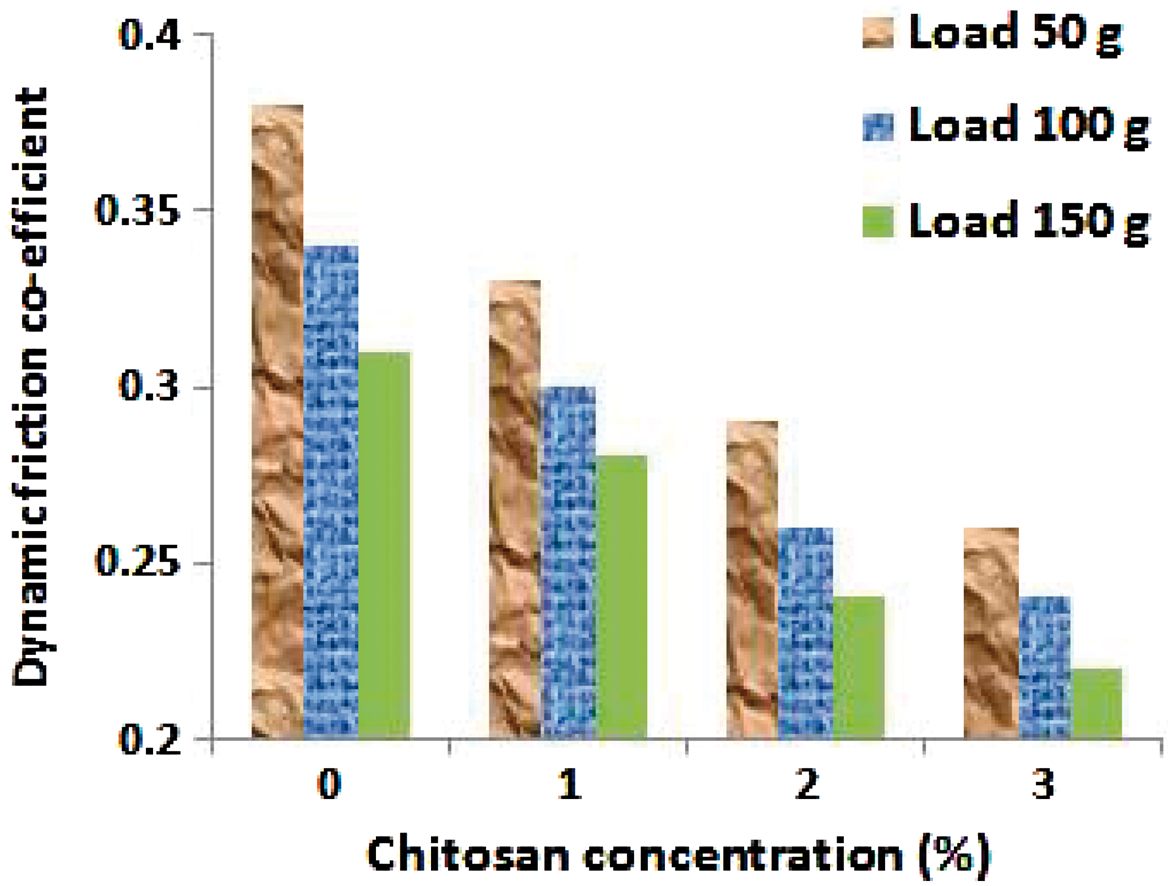
The relationship is,

This relation can be explained using adhesion theory of friction. According to this theory, with the increase in the normal pressure, there will be a reduction in the true area of contact. Here, the relation between changes in the normal load to change in the real area of contact is nonlinear, causing reduction in the dynamic coefficient of friction value with the increase in the normal load. This may also be explained due to the bending of the surface fibers toward the fiber bulk, lateral compression of the fibrous mass at the higher pressure, that is, flattening of the structure, the surface becomes more regular and there is a more uniform distribution of the load resulting in reduction of friction values.
It can also be observed from Figure 2 that for the chitosan-treated sample there is lower coefficient of friction and for the chitosan-untreated sample there is higher coefficient of friction for all the normal loads. This may be due to the uniform film formation of chitosan on the surface of the chitosan-treated BSS. This is in agreement with the studies carried out by other researchers [20,21]. The scanning electron microscope (SEM) micrographs of the chitosan-treated fabrics and untreated BSS are shown in Figure 3. The photographs reveal the uniform deposition of chitosan on the surface of the treated BSS.
Scanning electron microscope (SEM) photographs (a) chitosan untreated sample (b) 3% chitosan-treated sample.
From Figure 4, it can be observed that there is decrease in the coefficient of friction as the sliding speed ranges from 50 to 150 mm/min. For studying the effect of speed on friction, a constant normal load 100 g is used. As there is increase in the traverse speed there is decrease in time of contact between sliding members. Frictional characteristics are time dependent. At higher speed of sliding there is, there will be less number of actual contact points. So, the bonds at the junction points are broken easily resulting in less frictional coefficient [17]. It can also be observed from Figure 4 that for the chitosan-treated BSS there is lower coefficient of friction and for the chitosan-untreated BSS there is higher coefficient of friction for all the sliding speed. The reason for the same has been explained earlier.
Effect of sliding speed on friction of braided silk suture (BSS) at different chitosan concentration.
Tensile and knot properties
Tensile properties of sutures are important for the practitioner making a knot. If the material is too weak and the knotting force is stronger than tensile strength of suture material, suture can easily break while tightening the knot. Therefore, it is essential to know the tensile properties of sutures [2]. Figure 5 shows the tenacity and knot strength of chitosan coated and uncoated BSS. From Figure 5, it can be observed that there is a marginal increase in the tenacity as the chitosan concentration ranges from 1 to 3%. This may be due to the better binding of fibers in the BSS by the chitosan thereby offering better resistance to the axial load. These results are correlated with the previously published data [21,31]. It can also be observed from Figure 5 that for the treated BSS there is a marginal increase in the knot strength as the chitosan concentration ranges from 1 to 3% than the untreated BSS. This may be owing to the fact that the treated BSS have lower coefficient of friction value than the untreated BSS, therefore during knot construction the knot region is not easily weakened as in the case of treated BSS.
Effect of chitosan concentration of tenacity and knot strength.
Furthermore, it is observed that for the untreated and all the treated BSS, the knot strength is lower than the tenacity (Figure 5). These observations are consistent with other reports of the knot being the weakest part of any suture when subjected to tension [25,32]. The failure of strands occurred at the knot rather than along the suture strand, indicating the knot itself causes an area of high stress concentration. Several factors may contribute to failure occurring at the knot rather than along the suture. First, breakage at the knot may be caused by forces being oriented at the knot at an acute angle to the suture axis. Second, the suture yarn in the knot region may be weakened during knot construction and during loading. Third, tightening of the knot and the friction between yarns in the knot may contribute to the failure [25].
Antimicrobial activity
Bacterial species are capable of colonizing different surfaces and proliferating on them, forming adherent biofilms. This could represent a major problem for implantable suture material. Experimental and clinical data indicate that most wound infections begin around material left within the wound, and that the incidence of late suture complications are directly related to the degree of contamination at the time of material placement. Measures for reducing the risk of surgical site infections include surgical technique, appropriate antimicrobial agent, adjunctive strategies for reducing wound contamination and promoting wound healing [8].
In this study, chitosan was used as an antimicrobial agent to provide protection against various microorganisms. Chitosan has been found to inhibit the growth of microbes in a large body of work that has been reported by several researchers [12,13]. Chitosan is a very attractive material because it exhibits various promising biological activities such as antimicrobial activity, biocompatibility, low toxicity, complete biodegradability hemostatic activity, scar preventability and acceleration of wound healing [12,13]. The antimicrobial efficiencies of both the chitosan-treated and untreated BSS were assessed using agar diffusion method and shake flask method. The gram positive S. aureus (ATCC 6538) and the gram-negative E. coli (ATCC 11230) were used as test microorganisms because they are the major cause of cross infection in hospitals. S. aureus is the most frequently evaluated species. It causes skin and tissue infections, septicemia, endocarditis and meningitis. E. coli is a popular test organism and is resistant to common antimicrobial agents. It causes urinary tract and wound infections, common in gastrointestinal tract and accounts for 25% of hospital infections [33].
Effect of chitosan concentration on antimicrobial activity of braided silk suture (BSS).
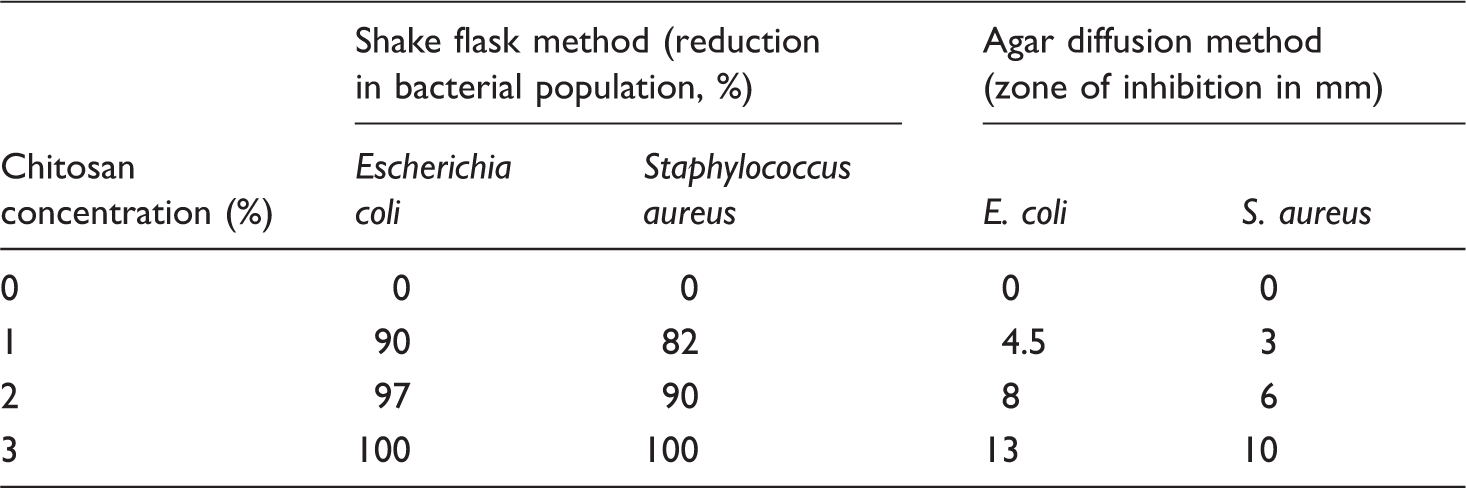
The microbial reduction percentage for untreated and chitosan -treated BSS against E. coli and S. aureus determined by shake flask method is presented in the Table 1. It is generally agreed that the bacterial reduction rates of at least 99% are needed to retard the exponential growth of most microorganisms [35]. The Table 1 shows that microbial reduction is better at higher chitosan concentration against both bacteria. Furthermore, chitosan is more effective against gram-negative bacterium than gram-positive bacterium. The reason for the same has been explained earlier.
Conclusions
BSS were fabricated using a circular braiding machine. BSS were subsequently treated with chitosan and the effects of chitosan on the characteristics of BSS were explored. The frictional properties of BSS were studied by determining the dynamic coefficient of friction at various normal loads and sliding speeds. Both the chitosan coated and uncoated BSS tested at higher normal load and sliding speed showed lower value of dynamic coefficient of friction. Furthermore, for all the tested normal loads and sliding speeds, the chitosan coated BSS showed lower value of dynamic coefficient of friction than the untreated one. Instron tensile tester was used to measure the tenacity and knot strength. The result showed that the tenacity and knot strength of BSS increases with the increase in chitosan concentration. The SEM reveals the uniform deposition of chitosan on to the surface of the BSS. The antimicrobial activity of chitosan coated BSS against E. coli and S. aureus were evaluated using agar diffusion method (SN 195920) and shake flask method (AATCC 100). The BSS with higher chitosan concentration exhibits excellent antimicrobial activity against both the bacteria.
Footnotes
Funding
This project is not supported by any funding agencies.