




Abstract
In the process of use, upholstery of soft furniture undergoes continuous deformation. This results in puckering of upholstery, change of its initial shape, whereas longer usage of upholstery leads to deterioration thereof. For investigation, an original testing bench of soft furniture has been applied. After inducing transverse resonant oscillations in soft pieces of furniture, stress in upholstery of soft pieces of furniture and stress distribution over the plane have been assessed. Variation of the value of the load simulating the tensioning defect of upholstery allows determining an adequate change in stress of upholstery. Under the action of the load, the following uneven changes in stresses have been established irrespective of the initial condition of stresses in soft pieces: some places demonstrate decrease of stresses, whereas other ones show increase thereof up to a few times. It has been illustrated that variation of the position of the additional load in respect of the investigation point leads to ‘accentuation’ of stresses in the close area. The methodology and equipment presented may be employed to assess the assembling quality of soft furniture in the process of manufacture and use.
Introduction
Soft furniture of different purpose intended for sleep, work, and rest that accompanies at different stages of a human life shall both feature the optimum design and preserve all the structural properties in the process of use [1]. Appropriate match between the shape of a soft piece of furniture and individual parts of a human body is also very important. A human body, however, acts as a load in respect of a piece of furniture, therefore, distribution of body pressure over the surface of a piece of furniture resulting in more even distribution of the load is significant.
It is more important for the covers of various seats. Woven seat cover is one of the important contributors of technical textile in an automobile. Technical textile also is widely used in manufacturing of preferred seating – theatre, cinema, auditorium seating, and so on [2,3]. One of the main characteristics of covers is flexibility and stretchability. The sensing seat is used for human authentication where a seat is available to the human subject. The sensing cover consists of a pjezoresistive network printed on to a cotton Lycra fabric [4,5].
One of the main performances of soft furniture is dynamic fatigue leading to change in elasticity of soft pieces, as well as to signs of upholstery puckering and deterioration. In this case, during assessment of the quality of soft furniture, furniture components such as upholstery, foam, and so on, an allowable number of load cycles are established under the action of the cyclic load [6]. Application of oscillations represents one of the aforementioned testing fields. An elasticity module and suppression ratio of furniture components are established employing oscillations [7,8]. Oscillations are widely applied for assessment of elastically plastic properties of foam, rubber, and latex. For examination of material performances, the Kelvin-Voigt mechanical model is used [9–11].
Determination of dependence between the load and stress is important. A vibration stand is utilized for assessment of elastically plastic properties of foam. After inducing oscillations of a cubiform foam test sample, rigidity (elasticity module) thereof and Poisson’s ratio are assessed [10,11].
The mechanical properties of textiles are important both from the point of view their processing in a technological process and their use in the form of final products. The investigation of dynamic properties of textiles by vibrations is presented [12]. The results of experiments show the dependence of elongation on the exciting force and the different dynamic properties of textiles in process of elongation.
The investigations of tensile properties of the woven fabric are analyzed [13].The test specimens were exposed to uniaxial tensile loading. It is demonstrated that the mechanical model of fabric can produce tensile diagrams of quite good accuracy.
Technical fabrics are useful in architectural structures. Also, they are useful to protect huge gatherings of people. Technical fabrics have generally anisotropic properties, even when the warp and weft are made from the same thread.
The article [14] presents the results of experiments on the technical fabric ‘Panama’ carried out with the purpose of identification of inelastic properties of warp and weft. Uniaxial tension test have been performed on a special stand. Investigation results show that despite of the same density of threads for the warp and weft, the elongation and modulus of elasticity in both directions are different.
Dynamic investigation of soft furniture and other materials with evaluation of elasticity and plasticity thereof may be carried out by applying impacts to them. This allows estimating dynamic behavior of materials; during investigation, a dynamic elasticity module, amount of the energy absorbed, the maximum deformation, and so on are established [15].
Due to errors of upholstery assembling, fastening, and so on, anisotropy of stresses in soft pieces of furniture may be observed. During testing or use of furniture, first of all, upholstery defects are mostly demonstrated by the areas that feature the greatest stresses.
The objective of the article is to assess deformation and stresses in upholstery of soft furniture through application of resonant oscillations.
Methodology
In general, it is possible to study the soft part of furniture as a system with distributed parameters. The following mechanical model is provided for the selected area representation of the surface deformation specific to the soft part (Figure 1).
The mechanical model for the soft part: m – masses of elements, c – rigidity coefficients, k – damping coefficients, and F – loading.
When one of the elements undergoes loading, depending on the values of rigidity and damping parameters, in addition to the loading direction, it also moves vertically in terms of rotation center (Figure 1). The system of two degrees of freedom can be used for the representation of such element where an elastic relationship is specific to element motions (Figure 2).
The mechanical model for the soft furniture element: m, I – element mass and moment of inertia; 2L – element length; c1, c2, k1, k2 – equivalent rigidity and damping coefficients; x, θ – generalized coordinates; where –––- – position of an oscillating element with declination angle θ, - - - - – horizontal position of an oscillating element.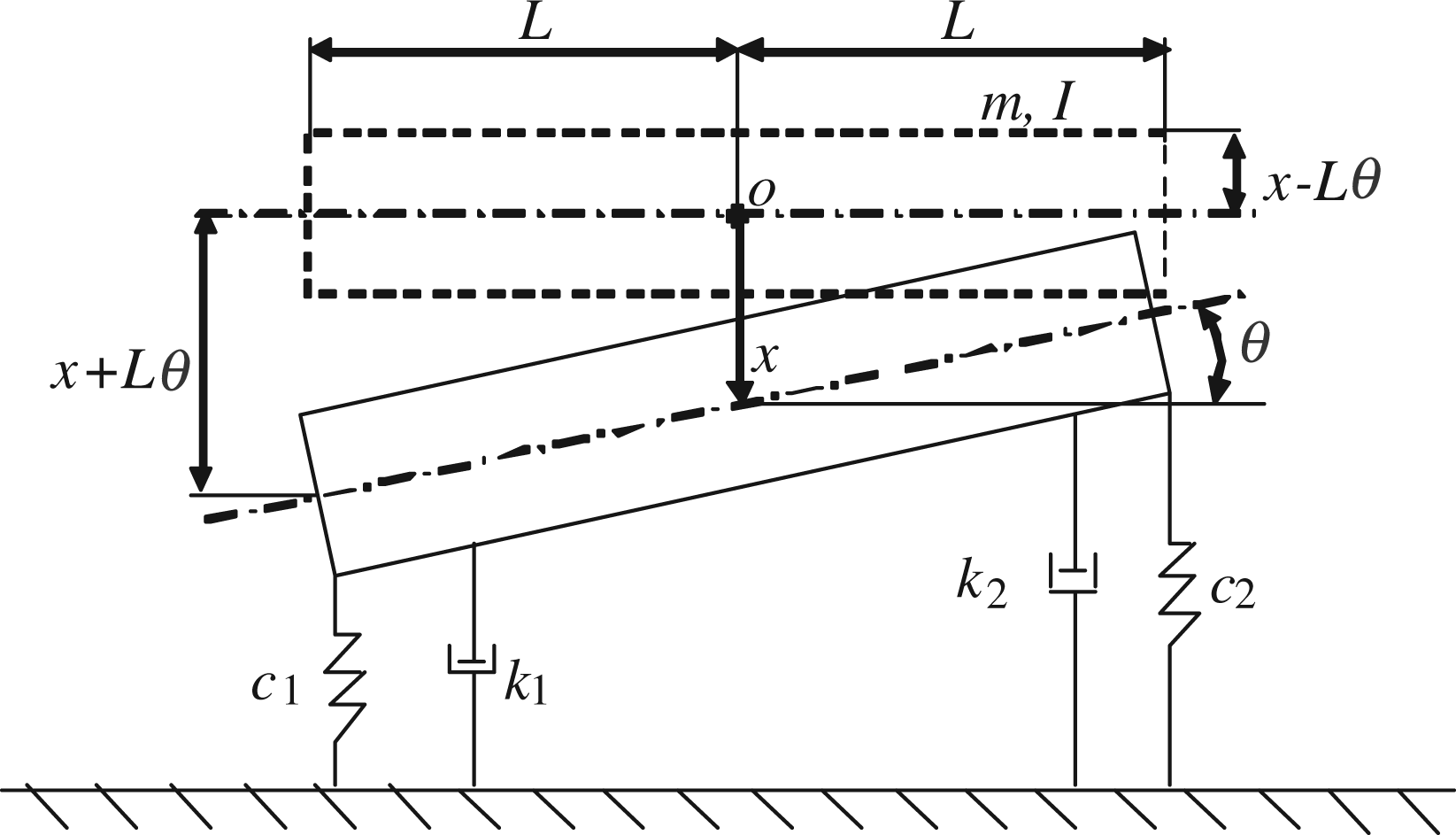
Equations for the free oscillations specific to the element [16] are:

Without assessing damping and having arranged mathematically:

After solving these equations (2), the following expression in relation to the frequencies of free oscillations specific to the element is obtained:

Soft pieces of furniture are deformed by tensioning the covering upholstery, thereby changing the rigidity thereof. After inducing oscillations of such furniture component, the value of resonant frequency thereof would characterize the degree of areal deformation (stress).
A special stand together with a selected measuring instrument is used for furniture tests (Figure 3).
The general view and scheme of the measuring stand: 1 – furniture, 2 – seat part of furniture, 3 – vibrator, 4 –vibrosensor, 5 – electrical signal generator, 6 – vibrometer, 7 – frequency meter, and 8 – oscillograph.
An acoustic vibrator (3) controlled by the electrical signal generator (5) excites vibrations in the seat part (2) of furniture (1). The vibrosensor (4) fixed to the seat part (2) senses its vibrations that are measured by the vibrometer (6). Altering the frequency of generator (5) allows recording the resonant vibrations of the seat part, whose frequency is established with the frequency meter (7). The shape of vibrations can be observed on the oscillograph (8) screen.
To increase measurement sensitivity, oscillation acceleration has been measured (m/s2). The amplitude of resonant oscillations may be changed within a wide range bringing an oscillator nearer to or moving it away from the measurement area in upholstery. During measurements, an error has not exceeded 0.5%.
By introducing two circles with R1 = 227 mm and R2 = 132 mm radii (the selected circles of 227 mm and 132 mm correspond to the central and peripheral areas of the seat cushion of a piece of furniture, respectively), as well as a certain number of their diameters, the surface of the seat part is divided into separate zones (Figure 4).
A piece of furniture (a) and the split scheme for its seat part (b), 1–24 – measurement points of vibrations, A – stabilizing load, B – load simulating a defect, and R1, R2 – circle radii.
At the intersections of a furniture circle and diameters, a vibration sensor is attached; in this area, an oscillator is installed and measurements are carried out.
For investigation, one furniture frame and five seat cushions of individual armchairs have been used. The seat part undergoes initial deformation by using stabilization load (14.7 N) in the central segment.
During variation of the value of the additional load B hung at the front part of an article (in the area of Point 25, Figure 4) from 1.96 to 25.48 N, respectively, an upholstery defect was simulated.
Later, during variation of the position of the additional load in respect of the measurement point (in respect of Points 1, 4, 7, 10, 13, 16, 19, and 22), an upholstery defect in this area was ‘accentuated’ (Figure 5).
Position of the load in respect of the point.
Results of analysis
For investigation, soft armchairs with a removable seat cushion have been used. The seat cushion consists of a 120 mm thick foam layer, the top whereof is covered with a 2 mm thick fleece coating. This set has sewn cotton upholstery cover closed with a zipper on the back.
A longitudinal direction of a seat cushion piece tallies with the direction of weft.
Basic characteristics of furniture upholstery

Figure 6 shows the diagram of the resonant frequency distribution in the seat part. It can be observed that there is uneven resonant frequency (stress) distribution in the seat part. In the circle with radius R1, the least value of frequency can be noticed in the front and rear (toward the backrest) zone of the seat part. The resonant frequency range in these zones is between 24.3 and 32.5 Hz.
The graph of resonant frequency distribution in the seat part (▴ – in circle with radius, R1, ♦– in circle with radius, R2, and 1–48 – measurement points of vibrations).
The greatest values of resonant frequency can be detected on the sides of the seat part (Points 30, 31, 32, 33 and 42, 43, 44) with the frequency value increasing from 32.0 to 37.9 Hz on one side and up to 36.1–38.2 Hz on the other side.
Similar frequency distribution has also been observed for the central area of the seat cushion (in the circle with radius R2).
Uneven distribution of resonant frequency has obviously been caused by stress anisotropy of the seat cushion. This fact may be related to different size of upholstery pieces, different seam width, different size of a foam layer and cover, and so on.
In the center of the seat cushion, variation of the value of additional load B results in uneven distribution of stresses (Figure 7). At some points of the minor circle, stresses increase (correlation ratio at Point 1 and Point 2 is 0.99 and 0.72, respectively). Other points (5–7 and 19, 20) of the present circle have demonstrated an opposite effect, that is, significantly reduced stresses.
Stress distribution law at the investigation points of the seat cushion in the minor circle, R2 (a) and major circle, R1 (b) During variation of the value of hung load B.
After tensioning upholstery this way, the points found at a moderate distance from the tensioning place have shown inconsiderable waves. Due to this reason, stresses at Points 5–7 and 19, 20 have decreased compared to the situation when no load B was applied (with the load at Point 7, resonant frequency has decreased from 29.5 to 27.3 Hz, whereas the opposite point, that is Point 19, has also demonstrated the decreasing resonant frequency, that is from 29.0 to 24.4 Hz). The aforementioned illustrates that increase of the load at one point of the article causes growth of stresses, whereas at another point the opposite effect is observed, that is decrease of stresses.
Analysis of stress distribution in the major circle (at Points 25–48) has demonstrated that increase of the load resulted in growth of stresses at the points located close to the load, that is, at Points 25, 26 and 47, 48 (correlation ratio ranged from 0.76 to 0.98). In this case, the greatest increase of resonant frequency has been obtained at Point 25 (increased up to 2.2 times).
Values of resonant frequencies at Points 1, 4, 7, 10, 13, 16, 19, and 22

Variation of the position of the load with respect to the Points 1, 4, 7, 10, 13, 16, 19, and 22 has been established (Table 2) to result in different values of resonant frequencies.
Some cases obviously demonstrate increase of stresses close to the measurement point when the load is applied, whereas other ones show decrease of stresses. The results presented illustrate that resonant frequency has increased in all cases (from 1.1 to 35%) at Points 1, 4, and 22 (the position thereof in respect of the seat cushion of a piece of furniture is such as the seat cushion is not limited by the support of an soft piece of furniture) independent of the position of the load with respect to the point.
At other points (7 and 19), a different tendency has been observed. When an investigation point is in the line intersecting the stabilization load simulating a defect (A2, Figure 5) stresses at this point increase. When the position of the load is located in another place (A1, A3, Figure 5) smaller stresses are observed compared to the situation when no load is applied in the area of the measurement point. Exclusion has been demonstrated at Point 13: here, stresses decreased, although the position of the load was the same as at Points 7 and 19.
The coefficient of variation was from 1% to 4.9%.
The aforementioned demonstrates that distribution of stress values is influenced both by the structure of the components of the seat cushion of a soft piece of furniture and the design of furniture, that is, the fact that some areas of the seat cushion are located close to the support, whereas other ones have no contact with the support, and so on.
Thus, the method and equipment presented enable to assess stresses in the surface layer (upholstery) of soft furniture and distribution laws thereof. The aforesaid is especially important for evaluating the quality of furniture in the process of manufacture and use, as well as for forecasting the service life thereof.
Conclusions
Resonant frequency of transverse oscillations in upholstery of soft furniture has been demonstrated to match adequately the present stress of upholstery. Stress distribution in upholstery of the seat cushion of a piece of furniture has been generally established to be uneven in all directions of the plane. Simulation of the tensioning defect of upholstery applying the load has demonstrated to result in increase of the value of resonant frequency at the respective measurement points up to 2.2 times. ‘Accentuation’ of stress of upholstery with respect to the measurement point applying the additional load has been established to lead to uneven variation of the resonant frequency value in different directions of the upholstery plane, that is, some directions have demonstrated increase by the value of up to 35%, whereas other ones have shown decrease of the value down to 4%.