




Abstract
Antibacterial textiles with improved efficacy and durability were produced by incorporation of the monoterpene thymol into β-cyclodextrin-grafted organic cotton. Grafting of β-cyclodextrin on fabric was done with citric acid as crosslinker in the presence of sodium hypophosphite by fixing at 150°C for 10 min. UV-Visible and FTIR spectral studies of β-cyclodextrin, β-cyclodextrin-grafted fabric, ungrafted fabric, thymol, and thymol-loaded fabric confirmed the inclusion of thymol on grafted fabric. Thymol was recovered from ungrafted and grafted fabric by extraction with ethanol and it was quantified by performing high-performance liquid chromatography (HPLC) analysis and its level was remarkably higher in grafted fabric. Thymol-loaded ungrafted and grafted fabrics were tested against Escherichia coli and Staphylococcus aureus by agar diffusion method and inhibition was more pronounced in E. coli. Inclusion of antibacterial agent into grafted fabric showed enhanced inhibition effect with durability after 10 cycles of washing, while it was not retained in ungrafted fabric. Grafting of cyclodextrin on fabric and inclusion of thymol into their cavity produced a durable antibacterial textile.
Introduction
Cotton cellulose has excellent properties such as higher water absorbency, comfortable to wear, and easy to dye. The conventional cultivation of cotton leads to massive environmental and health problems [1]. Organic cotton grown and processed without toxic chemicals has its various end uses, ranging from personal care items to home furnishings, garments of all kinds and kids wear. Organic cotton is an eco-friendly textile and there is no significant difference in properties compared to conventional cotton [2].
Cotton textiles offer an ideal environment for microbial growth, because it provides nutrients and other factors necessary for the growth of microorganism. Some earlier work in antimicrobial textiles has been briefly reviewed by Purwar and Joshi and Williams et al. [3,4]. Many antimicrobial agents used in the textile industry are known from the foodstuff and cosmetic sources. Antimicrobial finishing of textiles can be done by several methods, of which inclusion of antibacterial compounds onto β-cyclodextrin (β-CD) grafted fabric are the most effective and durable finishing, because of the special features of β-CD. It produces long-lasting biocide action as compared to those fabrics that had directly been treated with antibacterial agents for the purpose of imparting biocidal action [5,6].

β-CD is the most accessible, the lowest priced, and generally the most useful compound created from the enzymatic degradation of starch and it is also called Schardinger’s dextrin [7,8]. Cyclodextrins are torus-shaped cyclic oligosaccharides made of six, seven, and eight glycosidic units linked by α (1, 4) bonds into a ring in the most common forms called α-, β-, and γ- respectively. They can entrap a vast number of lipophilic compounds into their hydrophobic cavity depending on their size and molecular structure. In the last decades, cyclodextrins have been used extensively in cosmetics, food, pharmaceutical, and textile industry. In recent years, researchers such as Buschmann, Hara et al., Martel et al., and Yong have prepared fragrant fabrics and gained desirable results [9–12]. Polycarboxylic acids can crosslink cotton fabric in the presence of alkali metal salts of phosphorus-containing acids such as sodium dihydrogen phosphate and sodium hypophosphite [13,14]. Cyclodextrin-crosslinked wool fabric has also been investigated [15]. In addition to cyclodextrin, its derivative monochlorotrizinyl β-CD was used for the preparation of aroma and antimicrobial finished cotton fabrics [16–18].
Citric acid (CA) has been chosen in grafting β-CD on cotton, instead of butane tetracarboxylic acid (BTCA), because it is less expensive, nontoxic, and eco-friendly compound. Antibacterial activity of silver (I) ion-loaded β-CD -grafted cotton fabric using CA and sodium dihydrogen phosphate has been reported [19]. Thymol, a major essential oil component present in oregano and thyme, has pronounced antibacterial activity toward gram-positive and gram-negative bacteria and also a safer, nontoxic, high-efficiency antibacterial compound. Antibacterial activities of thymol against gram-positive and gram-negative bacteria and the minimum inhibitory concentration (MIC) have been reported as 5 mg/mL [20].
In the current study antibacterial finish was given to organic cotton by grafting of β-CD and inclusion of thymol into cyclodextrin cavity. β-CD is grafted using CA as crosslinker and sodium hypophosphite (SHP) as catalyst. UV-visible and FTIR spectral studies confirmed the presence of β-CD inclusion complex of thymol on organic cotton. High-performance liquid chromatography (HPLC) analysis has been used to estimate the concentration of thymol on thymol-loaded ungrafted fabric (F2) and thymol-loaded β-CD grafted fabric (F4). Antibacterial efficiency of fabrics was evaluated by agar diffusion test against gram-negative (Escherichia coli) and gram-positive (Staphylococcus aureus) bacteria, and their washing durability was also studied. It was inferred that loading of thymol on β-CD-grafted fabric produced the most effective durable antibacterial textile with pleasant fragrance.
Experimental
Materials
Plain bleached knitted organic cotton was purchased from Tirupur textile Industries, India. β-CD, thymol, CA, ethanol, and sodium hypophosphite were purchased from HiMedia, India. Double distilled deionized water was used for cyclodextrin concerned work.
Grafting of β-CD on organic cotton
Plain knitted fabric has higher porosity in its fabric and yarn structure, which influences chemical treatment due to its higher permeability. Therefore, plain knitted organic cotton was chosen for grafting of cyclodextrin. It has been done with CA as crosslinker using sodium hypophosphite as catalyst [19]. The fabric was grafted with β-CD by optimizing the variants such as concentration of β-CD, concentration of CA, concentration of SHP, temperature, and time to produce higher grafting yield. Concentration of β-CD [(A1) 0.2, 0.4, 0.6, 0.8 and 1.0%] was raised by keeping other parameters (CA – 0.2%, SHP – 0.15%, Temperature – 150°C, and Time – 10 min) constant and then concentration of CA [(A2) 0.05, 0.1, 0.15,0.2 and 0.25%] was increased by fixing the β-CD concentration as 0.8%, and other parameters as in previous step. SHP concentration was varied [(A3) 0.05, 0.1, 0.15, 0.2 and 0.25%] by keeping concentration of β-CD and CA as 0.8% and 0.2%, respectively, followed by curing at 150°C for 10 min. The fabric immersed in a bath containing 0.8% – β-CD, 0.2% – CA, and 0.15% – SHP was cured in different temperatures [(A4) 110°C, 130°C, 150°C, 170°C and 190°C] for 10 min. Time of treatment was increased [(A5) 3, 6, 9, 12 and15 min] by maintaining the other optimized variants as constant to get better yield without damaging the fabric.
After optimization, fabric was grafted with β-CD by immersing a weighed quantity of fabric in solution containing 0.8% β-CD, 0.2% CA and 0.15 % sodium hypophosphite with MLR 1:10 for 30 min. Finally, the fabric was squeezed and dried at 80°C and fixed at 150°C for 10 min to graft cyclodextrin. The weight percentage is calculated from the weight difference between the ungrafted and grafted fabric. Grafting was done in triplicate in order to check the reproducibility of result.

Loading of thymol on ungrafted and β-CD grafted fabric
A weighed quantity of ungrafted fabric (F1) β-CD grafted fabric (F3) was equilibrated separately in double distilled deionized water for 24 h. The swollen fabric was squeezed and immersed separately in ethanol/water (70:30) mixture containing 5% thymol (MLR 1:10) and stirred for 2 h at 40°C. Samples were roll squeezed and washed three times with ethanol/water (40:60) solution and several times in running tap water to remove unloaded thymol from the fabric and dried to get thymol loaded ungrafted fabric (F2) and thymol loaded β-CD grafted fabric (F4).
Extraction of loaded thymol from fabric
Fabric specimens (F2 and F4) of specified size (4 × 4 cm) were weighed and cut into small pieces, then extracted with fresh ethanol (10 mL) at 70°C for three times under stirring in a magnetic stirrer for 15 min. The total extract (30 mL) was condensed to less volume (15 mL). A portion of this extract from each of the sample was subjected to analytical HPLC and the concentration of thymol was quantitatively determined. Loading of thymol and the extraction of loaded compound and HPLC characterization was done based on the earlier reports on literature [17].
Antibacterial studies on thymol loaded fabrics
The antibacterial property of fabric was qualitatively determined by agar diffusion test mentioned in literature [21]. The antibacterial activity of ungrafted fabric (F1), thymol-loaded ungrafted fabric (F2), β-CD grafted fabric (F3), and thymol-loaded β-CD grafted fabric (F4) are tested for bacteria E. coli (gram-negative ATCC 10536) and S. aureus (gram-positive ATCC 11632) by qualitative measurement by Kirby Bauer disc diffusion test. Fabric samples of each type are cut into small piece (5 × 5 mm) and spread over the center of nutrient agar plate inoculated with bacterial cells for intimate contact of the fabric. The plates are then incubated at 37°C for 24 h. The antibacterial effect was evaluated from inhibition developed around the fabric. The durability of antibacterial agent was investigated by performing the same test after ten cycles of washing with 2 gpl of soap at 60°C for 20 min.
Characterization techniques
UV-Visible Spectrophotometer [Perkin-Elmer make model Lambda 35 (Range 190–1100 nm)] was used to confirm the loading of thymol on fabric. FTIR studies [Perkin Elmer make Model Spectrum RX1 (Range 4000 cm−1–400 cm−1) were done by making KBr pellets with respective samples.
HPLC studies were done for quantitative evaluation of thymol on fabric. Shimadzu Japan make Reversed phase HPLC with ODS – C18 (4.6 mm ID × 25 cm) as main column and a guard column of Shim-Pack G-ODS (4 mm ID × 1 cm) with variable wavelength UV–Visible detector set at 254 nm was used. Data acquisition and processing were accomplished using a personal computer with spinchrome software. Elution was done with 100% methanol alone at flow rate of 1 mL per minute. Chromatography was performed at room temperature and thymol was identified from their respective peak obtained by running a co-chromatography with authentic standard. Quantification was done from their respective peak areas using internal standardization method.
Results and discussion
Evaluation of β-CD grafting yield
Crosslinking of organic cotton and β-CD was done by the crosslinker CA in presence of catalyst sodium hypophosphite at high curing temperature. Figure 1 shows schematic representation of the reaction mechanism. CA undergoes dehydration on heating in presence of SHP to give five-member cyclic anhydride, which produces ester linkage with hydroxyl group of cellulose. Subsequently, the neighboring carboxylic acid groups on adjacent carbon atom undergo dehydration to form cyclic anhydride. Now, the second cyclic anhydride cleaves to form ester more preferentially with primary alcoholic group of β-CD. Figure 2 (a)–(e) represents the grafting yield for variation of parameters such as β-CD, CA, SHP, temperature, and time.
Schematic representation of the reaction involved in β-cyclodextrin grafting on organic cotton. Effect of parameters (a) concentration of β-cyclodextrin (β-CD), (b) concentration of citric acid, (c) concentration of SHP, (d) temperature, and (e) time on grafting.

Grafting yield (%) increases linearly with the increase of β-CD concentration, but beyond 0.8% concentration a limiting value is attained. It shows that a limiting concentration of β-CD (0.8%) is sufficient and further increase plays no significant role, because primary alcoholic groups of cellulose and β-CD are competitively involved in esterification with CA.
When the concentration of CA increased, yield of grafting increases up to 0.2%, thereafter it slowly decreases. It has been reported by Yang and collaborators that the steric hindrance of polycarboxylic acid reduces accessibility of cellulosic hydroxyl groups and reducing the amount of crosslinked product but at the same time increasing the untreated anhydride intermediate on the cellulosic particles [22]. Hence, higher concentration of CA not much influences the esterification process. In addition, yellowing of fabric takes place because oxidation occurs in cellulosic hydroxyl group at higher concentration of CA. This is the indication of adverse impact on the tensile strength of fabric [14].
SHP plays a vital role in crosslinking of cellulose, CA, and β-CD. Esterification without SHP is impossible. It influences crosslinking up to 0.15% thereafter; there is no significant increase in the yield.
Temperature plays an inevitable role in crosslinking of β-CD, since the primary step of cyclic anhydride formation is initiated by heat. According to Yang, the ester formation increases as the temperature increases from 110°C to 200°C [23]. The anhydride formation first increases and then starts to level off at 150°C once the product is formed. Hence, to prevent damage of fabric at higher temperature, an optimum temperature of 150°C is sufficient enough for better yield.
Time of treatment influences the curing and fixation process. Hence, for every 3 min raise (3–15 min), there is notable improvement in grafting yield. Long duration of treatment at higher temperature produces damage to fabric. Therefore, an optimum duration of 10 min is enough for better curing at 150°C.
UV-visible and FTIR spectrum analysis
Figure 3 represents the UV-visible spectrum of organic cotton (A), β-CD grafted organic cotton (B), thymol (C), thymol-loaded organic cotton (D), and thymol-loaded β-CD-grafted organic cotton (E). Organic cotton (A) and β-CD grafted fabric (B) does not show any absorption between the region 200 and 300 nm. Thymol (C) (5% alcoholic solution) and thymol-loaded organic cotton (D) shows absorption maximum at 272 nm, which is characteristic peak of π–π* transition and also due to the auxochrome phenolic -OH group. Thymol-loaded β-CD grafted organic cotton (E) shows absorption peak characteristic of thymol at 276 nm with slight bathochromic shift due to more hydrophobic environment faced during inclusion complex formation with β-CD.
UV-visible spectrum of organic cotton (A), β-cyclodextrin (β-CD) grafted organic cotton (B), Thymol (C), thymol-loaded organic cotton (D), and thymol-loaded β-CD grafted organic cotton (E).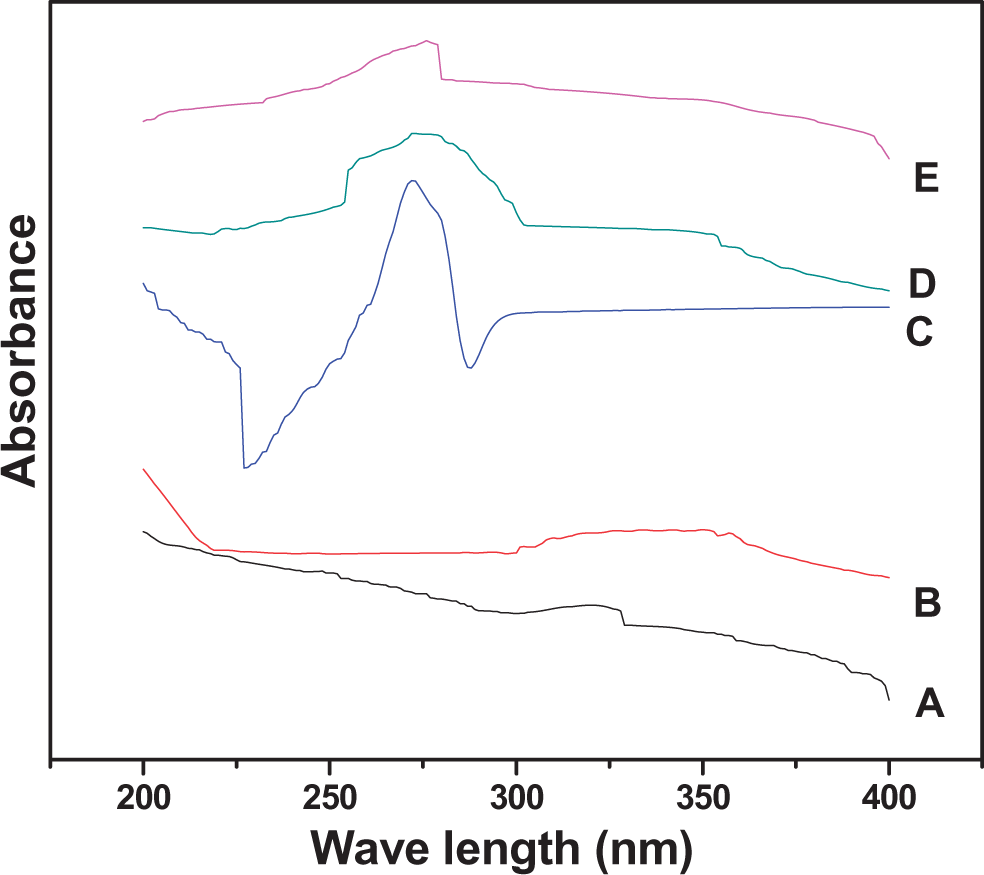
Figure 4 gives the FTIR spectrum for organic cotton (A), β-CD (B), β-CD grafted organic cotton (C), thymol (D), and thymol-loaded β-CD grafted organic cotton (E). Spectrum of organic cotton (A) shows a broad peak for -OH stretching of cellulosic hydroxyl group in the range 3300–3500 cm−1 and a complex band in the range 1000–1420 cm−1 due to -OH in plane bending of cotton. Asymmetric stretching of C-H is observed at 2890 cm−1 and a sharp peak of -OH bending of cellulosic fabric occurs at 1630 cm−1. Spectrum of β-CD (B) depicts peaks characteristic of -OH stretching at 3347 cm−1 and strong complexed band at 1025, 1103, 1178, 1360, and 1420 cm−1 is characteristic of C-O stretching and -OH in plane bending vibration of β-CD.
FTIR spectrum for organic cotton (A), β-cyclodextrin (β-CD) (B), β-CD grafted organic cotton (C), thymol (D), and thymol loaded β-CD grafted organic cotton (E).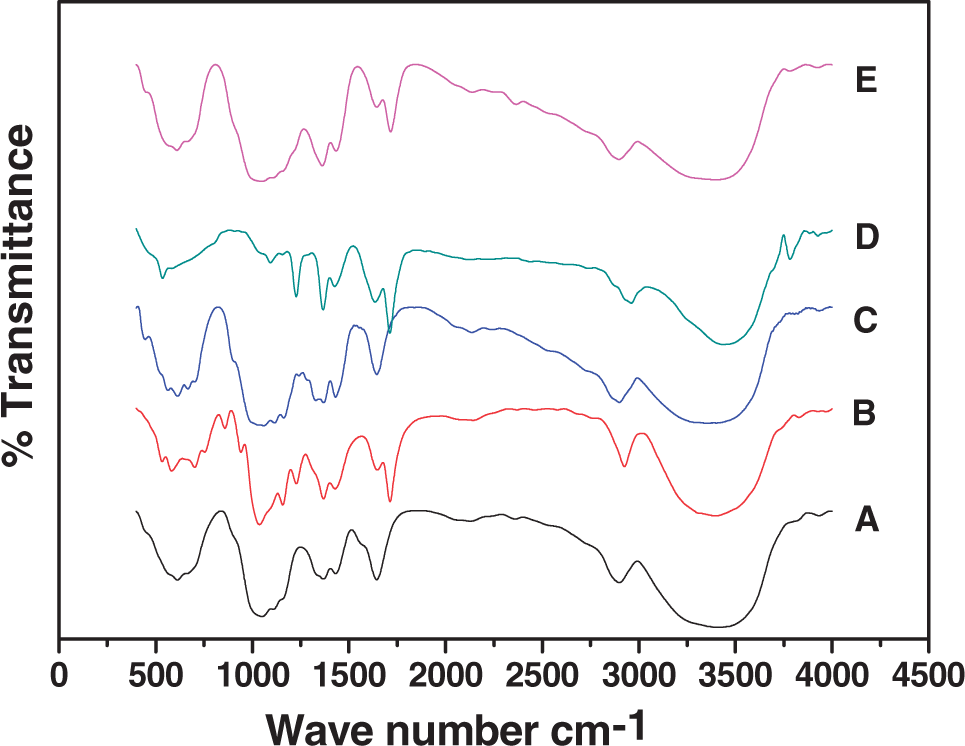
β-CD grafted cotton (C) produces a broad peak between 3300 and 3500 cm−1 characteristic of -OH stretching of cellulose and carboxylic acid group of CA involved in crosslinking and -OH in plane bending is shifted from 1000–1420 cm−1 to 1000–1200 cm−1 due to the attachment of cyclodextrin with the -OH group of cellulose. Thymol spectra (D) show a band at 3392 cm1 corresponding to phenolic -OH stretching involving hydrogen bonding. Aromatic character of thymol is exhibited by C=C stretching of benzene ring at 1625 cm−1, respectively. A peak at 1360 cm−1 and 1222 cm−1 corresponds to -OH bending and C-O stretching of phenolic group. Thymol-loaded β-CD grafted fabric (E) spectra depicts phenolic -OH band at 3300 cm−1 due to inclusion of thymol into β-CD and peaks characteristic of -OH bending, C-O stretching between 1000 and 1420 cm−1. The peak at 2873 cm−1 corresponds to C-H stretching of cyclodextrin. The stretching vibration (C=C) of aromatic moiety in thymol occurring at 1627 cm−1, respectively, proved the inclusion of thymol into cyclodextrin moiety.
Determination of thymol content on fabric by HPLC analysis
Thymol entrapped on specimen fabrics (F2 and F4) was quantitatively determined from their respective peak areas and response factor arrived from internal standardization method. A suitable method for extraction of thymol from fabric was examined by extracting with different solvents such as ethanol, methanol, and acetonitrile by extraction with respective solvents under magnetic stirring for 10 min around 60–70°C and by soxhlet methods. Ethanolic extraction of thymol was cheap and effective while comparing the other two solvents and less than 10% of thymol remains in the fabric as determined by soxhlet method. The concentration of thymol in ungrafted fabric (F2) and β-CD grafted fabric (F4) was 0.018% (w/w) and 0.403% (w/w), respectively. Ungrafted fabric has very low thymol content, due to removal of absorbed thymol during washing of fabric. Grafted fabric has a vast number of toroid-shaped cavity to entrap thymol, which was retained strongly even during repeated washing of fabric.
Antibacterial properties of fabrics
Antibacterial efficiency of fabrics was evaluated from their zone of inhibition values. The area immediately in and around the fabric without bacterial growth is called zone of inhibition. If the antibacterial agents are covalently bonded to fabric, there is no zone of inhibition, because it was prevented from diffusion into the agar. Thymol is capable to destroy both gram-positive and gram-negative bacterial cells. The growth of E. coli is more inhibited than that of S. aureus due to the easy penetration of thymol into cell wall of E. coli. Figure 5 (a)–(h) shows the antibacterial activity of fabrics. The ungrafted fabric (F1) has no zone of inhibition, but β-CD grafted fabric (F3) shows inhibition zone of size 12 mm and 10 mm against E. coli and S. aureus respectively . The crosslinker CA present in the fabric is responsible for the antibacterial activity of fabric F3. While comparing the zone of inhibition of thymol-loaded ungrafted fabric (F2) with thymol-loaded β-CD grafted fabric (F4), the latter produces higher efficiency both in unwashed and washed (10 cycles of washing) condition. Zone of inhibition of specimen fabrics F2 and F4 toward gram-negative (E. coli) and gram-positive (S. aureus) bacteria are depicted in Table 1. When the fabrics F2 and F4 are subjected to 10 cycles of washing, inhibition effect decreases to a minimum in ungrafted fabric, but it is strongly retained in grafted fabric. The presence of thymol onto β-CD cavity in grafted fabric prevents its removal during washing process. But in ungrafted fabric, thymol is not present in secluded form and also it is just absorbed; therefore, it can be easily washed away during repeated washing process. Hence, inclusion of thymol on β-CD grafted fabric produces the most satisfactory level of inhibition in unwashed and washed fabrics.
Antibacterial activity of (a, b) ungrafted fabrics (F1), (c, d) thymol loaded ungrafted fabric (F2), (e, f) β-cyclodextrin (β-CD) grafted fabric (F3), and (g, h) thymol-loaded β-CD grafted fabric (F4) against E. coli and S. aureus. Antibacterial effect of fabrics against Gram (−ve) and Gram (+ve) bacteria UW: unwashed fabric, W: washed fabric.

Summary
In this study, a durable antibacterial textile compatible with skin and the environment was produced by incorporation of nontoxic thymol into β-CD grafted organic cotton. Cyclodextrin was grafted to fabric using CA as crosslinker. Thymol was loaded on ungrafted and grafted fabric UV-visible and FTIR spectral studies proved the presence of β-CD and thymol on fabric. In order to evaluate the thymol content on fabric, thymol was extracted with alcohol and subjected to HPLC analysis. The higher thymol content in grafted fabric (F4) obviously indicates that grafting of β-CD provides enormous cavities for accommodating thymol. Antibacterial effect of fabrics (F1, F2, F3, and F4) toward bacteria E. coli and S. aureus was inferred from the zone of inhibition developed on fabrics. Ungrafted fabric did not exhibit antibacterial property, but β-CD grafted fabric (F3) showed minimum inhibition. Further, thymol-loaded β-CD grafted fabric (F4) showed more inhibition than thymol-loaded ungrafted fabric. Thymol showed more inhibition toward gram-negative bacteria E. coli. Durability of the antibacterial property was assessed for fabrics F2 and F4 after 10 cycles of washing. Ungrafted fabric loses their durability to inhibition, but grafted fabric (F4) retained the inhibition effect since entrapped thymol in β-CD cannot be excluded from the inclusion complex during washing. Hence, loading of thymol on β-CD grafted organic cotton is an eco-friendly, economically driven, novel greener route for the production durable antibacterial textile.