




Abstract
Clothing comfort is an important aspect for any garment used for sportswear and leisurewear. Every human being sweats during different kinds of activities. An important feature of any fabric is how it transports this water out of the body surface so as to make the wearer feel comfortable. Hence, wetting and wicking properties are critical aspects during wearing of clothes. Polyester micro-fibers have twin characteristics of durability and comfort. The usage of continuous filament micro-denier polyester yarn for sportswear and leisurewear clothing has a practical significance in clothing comfort. In this study, polyester filament yarn were taken and made into single jersey knitted fabrics. Five different fabrics were made from 150 denier polyester yarns constituting different number of filaments, namely, 34 filaments, 48 filaments, 108 filaments, 144 filaments, and 288 filaments. Moisture management finish was applied to the five types of single jersey knitted fabrics and the effect of filament fineness on comfort characteristics of moisture management finished polyester knitted fabrics was analyzed to achieve suitability for making sportswear. From the tests, it was observed that the fabric containing 108 filaments in yarn gives better wetting, higher wicking, and optimum moisture vapor transmission. A new test method was introduced to find out the transverse wicking behavior of the fabrics. Filament fineness and surface area of yarn play a vital role in deciding the comfort characteristics of the fabric, as also moisture management finish treatment which enhances it.
Keywords
Introduction
Filament fineness represents an essential and significant influencing factor on the wear comfort of a textile fabric. The lower fineness of micro-fibers proves to be physiologically advantageous, especially in wear situations where heavy and copious perspiration exists. In these circumstances, the micro-fiber textiles show better moisture transport and ensure better moisture control than the other construction parameters of comparative fineness above one denier in the micro-climate near the skin. The reason for the better physiological isolation of the micro-fiber textiles in these wear situations can be attributed to the higher absorption potential of the fiber surface occasioned by the fiber fineness as well as better capillary effect during the transport of liquid perspiration. Micro-polyester filament yarn is light weight and so fine that many fibers can be packed together very tightly. The space between yarns is porous enough to breathe and wick moisture away from body. Moisture management property is an important aspect of any fabric meant for apparel, which decides the comfort level of that fabric. Moisture management refers to the controlled movement of water vapor and perspiration from the surface of the skin to the atmosphere through the fabric. This can be achieved through fabric construction or by adding a chemical finish to a fabric. The former technique involves creating capillaries by using denier differential with the help of micro-denier and non-micro-denier fibers with hydrophobic or hydrophilic surfaces. The application of moisture management finish to polyester knitted fabrics made from lower denier filament yarns has the double advantage of absorbing and evaporating the body sweat at a faster rate thereby making the wearer feel comfortable.
Staples and Shaffer [1] stated that the smaller capillaries may create sufficient drag to slow down the rise in liquid height by comparing (capillary size) the packing coefficient of normal ring and compact yarns. Ito and Muraoka [2] reported that water transport is suppressed as the number of fibers in the yarn decreases. The mechanisms of water transport for an isolated single fiber differs from water sorption in a fiber bundle or assembled fibers where capillary spaces exist.
According to Chattopadhyay and Chauhan [3] there must be an optimum capillary size that will cause fastest entry of water into the yarn pores. Larger than optimum pores will also slow down entry due to low capillary pressure. Hence, both too small and too large pores are detrimental to quick wicking. The slowing down of height rise with time for any yarn can be ascribed to the gravity action of the water column within the capillary, which acts against the capillary pressure.
Hsieh et al. [4] reported that, in the case of fibrous structures, woven, nonwoven, or knitted fabrics, a distribution of pore sizes along any planar direction is expected. Wicking rate and liquid transported in a fabric depend on these pore sizes and their size distribution. Fangueiro et al. [5] stated that the wicking behavior of fabrics is mainly determined by the effective capillary pore distribution and pathways as well as surface tension. Pause [6] explained that the movement of water vapor depends on the micro-porous structure of the particular material considerably and this movement can therefore be modified by any operation that brings about a change in this structure.
According to Mecheels [7] water vapor transmission property of a fabric is essentially the property of inter yarn pore air. Fiber type and composition can vary the water vapor transmission rate which is influenced by inter yarn pore size and thickness of the fabric. Hatch et al. [8] from their research work have shown that knits made with finer diameter polyester fibers had the highest water vapor transmission rate. Hohberg [9] stated that the moisture management could be done on polyester material using amino silicone which could render hydrophobic fibers into hydrophilic. For better clothing comfort, the rate of evaporation should be as close to the wicking rate as possible.
It was observed that fiber fineness and capillary pore size of yarns plays a major role in determining the moisture transmission characteristics of a fabric. Also, the surface finishing imparted to fabrics influences wearer comfort.
In our earlier work [10] the effect of stitch length and knit structure such as single jersey, airtex and honeycomb structure on comfort characteristics of moisture management finished (MMF) knitted fabric which includes wicking, wetting, water absorbency, moisture vapor transmission and air permeability have been analyzed. The comparison between the comfort characteristics of moisture management finished fabrics and unfinished fabrics was studied.
In the present study, the effect of filament fineness on comfort characteristics of moisture management finished polyester knitted fabrics was analyzed. The comfort characteristics of five different 150 denier polyester filament yarns containing 34, 48, 108,144, and 288 filaments were studied with respect to wetting, vertical wicking, transverse wicking, and moisture vapor transmission.
Materials and methods
In this study five different polyester continuous filament yarns of 150 denier supplied by the same manufacturer from the same lot. It contained 34 filaments (4.4 denier per filament), 48 filaments (3.13 denier per filament), 108 filaments (1.39 denier per filament), 144 filaments (1.04 denier per filament), and 288 filaments (0.52 denier per filament) were selected.
The polyester filament yarns were knitted on a circular knitting machine of 28 gage with speed of 30 rpm to produce five different fabrics of single jersey structure containing 2.9 mm stitch length.
The polyester knitted fabrics were hot washed and bleached. The five fabric samples were treated with a wetting agent consisting of a synergetic blend of ethoxylated alcohol (a fatty alcohol, ethylene oxide, and propylene oxide) at 2% concentration for half an hour at 60–70°C temperature and dried in a stentering machine at 140°C. These fabrics were treated for moisture management finish with a chemical combination of Amino Silicone Polyether Copolymer (ASPC) and Hydrophilic Polymer (HP) in the ratio of 1:2 with pH value of 5.5 at 60–70°C temperature. The samples were treated in the finishing bath and padded using a padding mangle. Then it was dried and cured in a stenter at 160–170°C.
Characterization of products
The fabrics were tested to assess the comfort characteristics such as wetting (sinking method), vertical wicking (BS 3424), transverse wicking, and moisture vapor transfer (ASTM E 96 cup method). Ten samples were tested for each test and the average values were discussed. Analysis of variance statistical tool was used to study the effect.
The wetting characteristics of the fabrics were evaluated by measuring the time required for a piece of fabric to sink completely from the surface layer of distilled water in a beaker. Ten fabric samples were tested. Each fabric sample of 3 cm × 3 cm was taken and dropped from a standard height and the time taken to sink the specimen completely in water was noted [11].
To evaluate the wicking characteristics of the fabric, a strip of 20 cm × 2 cm test fabric was suspended vertically with its lower end (2 cm) immersed in a reservoir of distilled water. In this method the vertical movement of water by capillary action was observed for every minute (for wicking rate which is used to evaluate the sweating transfer rate from the body to fabric) and after 30 min (for wicking height which is to assess the saturated level of sweat transfer) [11]. The wicking tests were conducted with 10 samples each for wale wise and course wise directions separately.
Analysis of transverse wicking characteristics of the fabric is more important than longitudinal wicking because the perspiration (sweat) transfer from skin involves its movement through the lateral direction of the fabric. It is the water transfer through the thickness of the fabric. Two methods have been developed for evaluating transverse wicking behavior of the fabrics.
Area covered by one drop of water: It is the ability of the fabric to transfer the water by spreading action. It helps to measure the lateral wicking area on fabrics while avoiding directional effect. A total of 10 samples were tested. Each fabric sample of 10 cm diameter was mounted on an embroidery frame. A burette is placed 6 mm above the surface of the fabric. One mL of water was allowed to fall from the burette and the area spread on the fabric was measured. This was done by placing a graph sheet beneath the fabric surface and tracing the boundary of the water spread area by using a pin as illustrated in Figure 1.
Determination of water spreading area on the fabrics: (a) determination of transverse wicking of fabric (front view), (b) determination of transverse wicking of fabric (plan view), (c) marking of water spreading area using pin, (d) pin marking impression on graph sheet (graph sheet placed below the fabric), (e) darkening of pin marks using pen.
Saturation method: Similar to earlier method, ten fabric samples each measuring 20 cm diameter were mounted on an embroidery frame. For every 3 s, 1 mL of water was allowed to fall on the sample from a standard height of 6 mm through a burette. The drops of water falling on the fabric were continuously absorbed by the sample. When the sample could not absorb any more water, the excess water droplets fell down through the fabric. This is called the saturation point. The time taken to reach saturation point was noted and the area spread was also measured using a graph sheet similar to the earlier test as shown in Figure 1.
Moisture vapor transmission (MVT) was determined by measuring the reduction in height and weight of water in cups. Water was poured into cups up to 6 cm from base level. The cups were marked for every half millimeter. A total of 10 samples were tested. Each fabric sample was placed tightly on top of the cups where the water, the air above the water and the room environment are at the same temperature and pressure. After 48 h the level of water decreased in the cups and the reduction in height of water was noted down. Then the fabrics were taken out and the cups with water were weighed in an electronic balance and the reduced weight was noted down. The moisture vapor transmission is the difference between the initial and the final height and weight of water in the cups after 48 h [11].
Results and discussion
In order to study the effect of filament fineness on comfort characteristics such as wetting, vertical wicking, transverse wicking, and moisture vapor transfer of moisture management finished polyester knitted fabrics, five different fabrics containing 150 denier polyester yarns were used and denoted as 34FF, 48FF, 108FF, 144FF, and 288FF.
Fabric geometrical characteristics
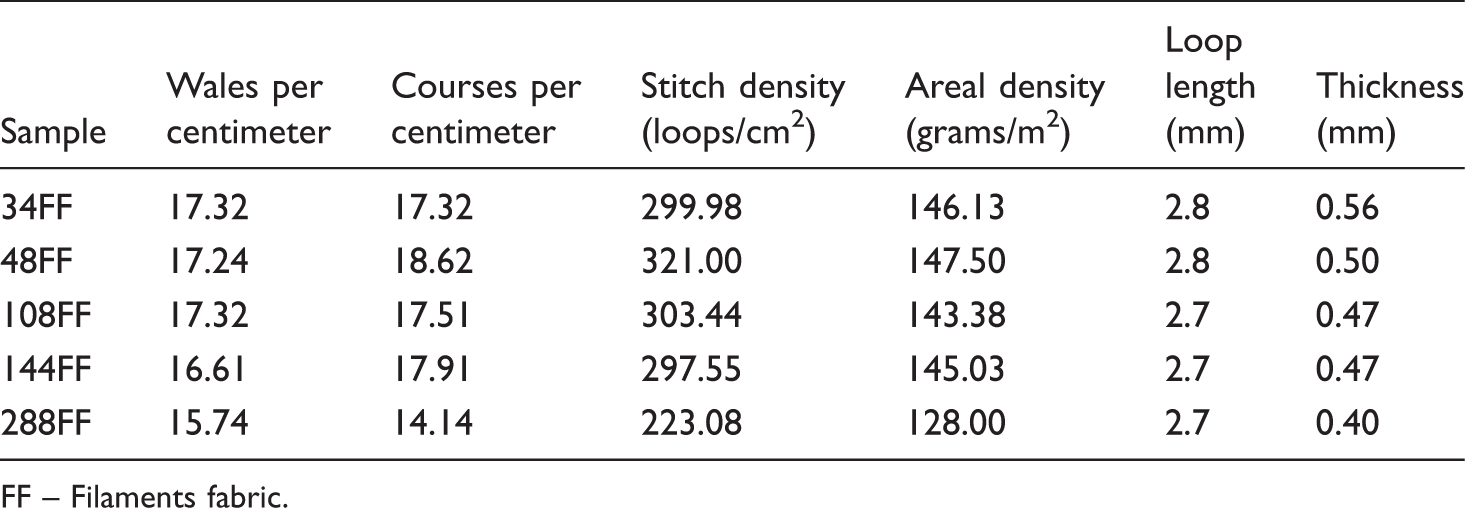
FF – Filaments fabric.
Water transmission characteristics


Scanning electron microscope images of MMF-treated polyester knitted fabrics: (a) 150 denier polyester fabric with 34 filaments, (b) 150 denier polyester fabric with 48 filaments, (c) 150 denier with polyester fabric 108 filaments, (d) 150 denier polyester fabric with 144 filaments, (e) 150 denier polyester fabric with 288 filaments.
Analysis of wetting characteristics
The ability of the fabric to sink completely in water was tested and analyzed. From Figure 3 (and Table 2), it is seen that 108 filaments fabric show quicker sinking time. As the number of filaments increases (144FF and 288FF) or decreases (34FF and 48FF) the time taken to sink the fabric is more. The reason is when inter fiber space is too small or too large it will slow down the water entry. Among the selected fabrics, 108 filaments may be the optimum inter fiber space that causes fastest entry of water into yarn pores. Effect of filament fineness on wetting behavior of fabrics is significant at 95% confidence level. (Fcalculated > Ftabulated: p-value 6.24E-06)
Wetting of MMF polyester knitted fabrics. Note: X-axis: different filaments fabrics. Y-axis: sinking time in seconds.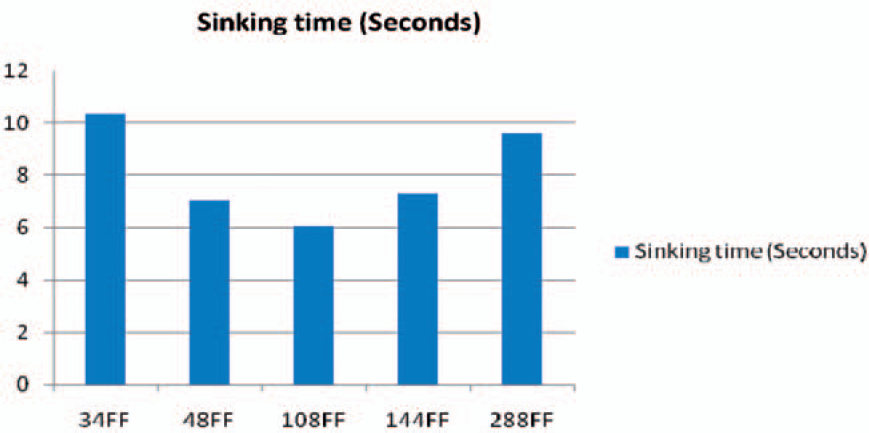
Analysis of wicking characteristics
Water transmission characteristics – longitudinal wicking rate
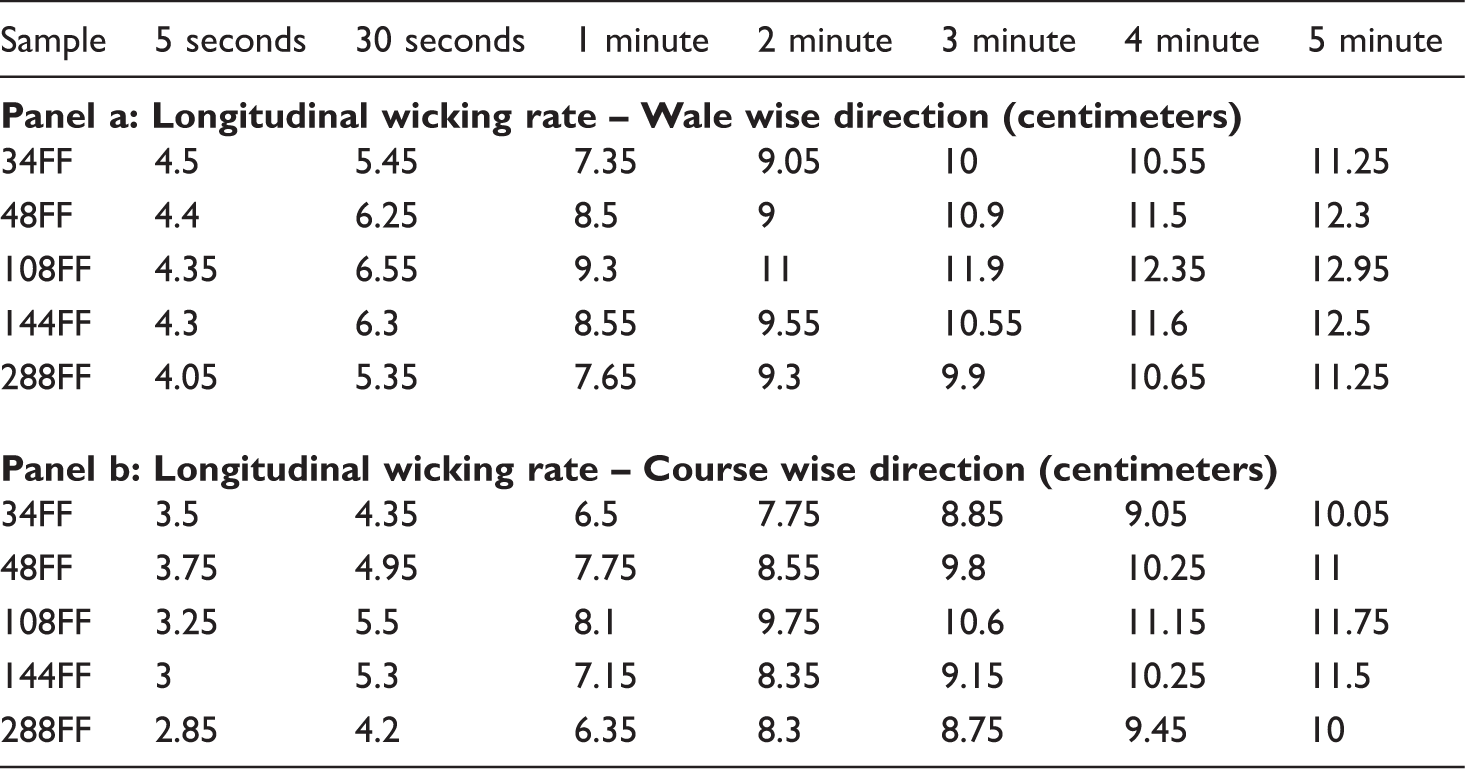

Wicking rate of MMF polyester knitted fabrics: (a) wale wise direction, (b) course wise direction. Note: X-axis: wicking time in 5 seconds, 30 seconds, 1 minute, 2minutes, 3 minutes, 4 minutes, and 5 minutes. Y-axis: wicking length in centimeters for five different fabrics.
From the Figure 5 (and Table 2), it was observed that the wicking height of the fabric (after 30 minutes) have increased from 34 filaments fabric to 108 filaments fabric and then decreases for 144 filaments fabric and 288 filaments fabric. The same trend was found in both the directions. Wicking height in wale wise direction was 10–16% higher than that of course wise direction for all five samples.
Wicking height (after 30 minutes). Note: X-axis: five different fabrics. Y-axis: wicking height in centimeters for wale wise and course wise direction.
The results of wicking height (after 30 minutes) have shown the same trend as the wicking rate (from 5 seconds to 5 minutes). But it was clearly seen that wicking height increases at faster rate up to 5 minutes and the speed of capillary flow slowed down after 5 minutes up to 30 minutes. It was observed that 75% of the total increasing wicking height is from 5 seconds to 5 minutes for all selected fabrics.
Analysis of transverse wicking characteristics
The ability of the fabric to absorb one drop of water by spreading action were tested and shown in Figure 6 (and Table 2). It is inferred that when the filament fineness (or the number of filaments) increases, the water spreading area also increases from 34 filament fabric to 288 filament fabric. The 288 filament fabric has 20% higher water spreading area than that of other selected fabrics. Transverse wicking is a unique phenomenon with respect to water transfer behavior of fabrics, since it has no directional effect. When the area spread was more the evaporation of the fabric was also more. Finer the filaments, larger the area spread and quicker the moisture evaporation.
Area of water spread on the fabrics. Note: X-axis: five different fabrics. Y-axis: water spreading area for 1 mL of water in square centimeters.
From the Figure 7 (and Table 2), the water spreading area (to reach saturation) has increased from 34 filament fabric to 288 filament fabric though they differ in fabric geometry. Finer filaments in the fabric have higher surface tension which helps to hold the water droplet and transfer it in the lateral direction against gravitational force. When filament fineness was more, it showed higher water absorbency. This is due to more inter-fibre space due to which the water spreads well in parallel. This also indicates that finer the filaments, higher is the water holding capacity of the fabrics. The advantage of these assessments is that since transverse wicking being multi-directional, it eliminates the directional effect. When the time taken to reach saturation point is more correspondingly the area spread is also more.
Area spread and time taken to reach saturation point. Note: X-axis: five different fabrics. Y-axis: area covered to reach saturation in square centimeters and time taken to reach saturation in seconds.
Analysis of moisture vapor transfer behavior
The moisture vapor moving through a fabric were tested and shown in Figure 8 (and Table 2). The 34 filaments fabric and 48 filaments fabric shows 24%–31% lower moisture vapor transfer than that of 108 filaments fabric, 144 filaments fabric, and 288 filaments fabric with respect to height loss and weight loss. The finer denier fabrics such as 108 filaments fabric, 144 filaments fabric, and 288 filaments fabric gives higher MVT due to lower areal density and fabric thickness than that of coarser denier fabrics.
Moisture vapor transfer of the fabrics. Note: X-axis: five different fabrics. Y-axis: moisture vapor transmission for height and weight loss in percentage.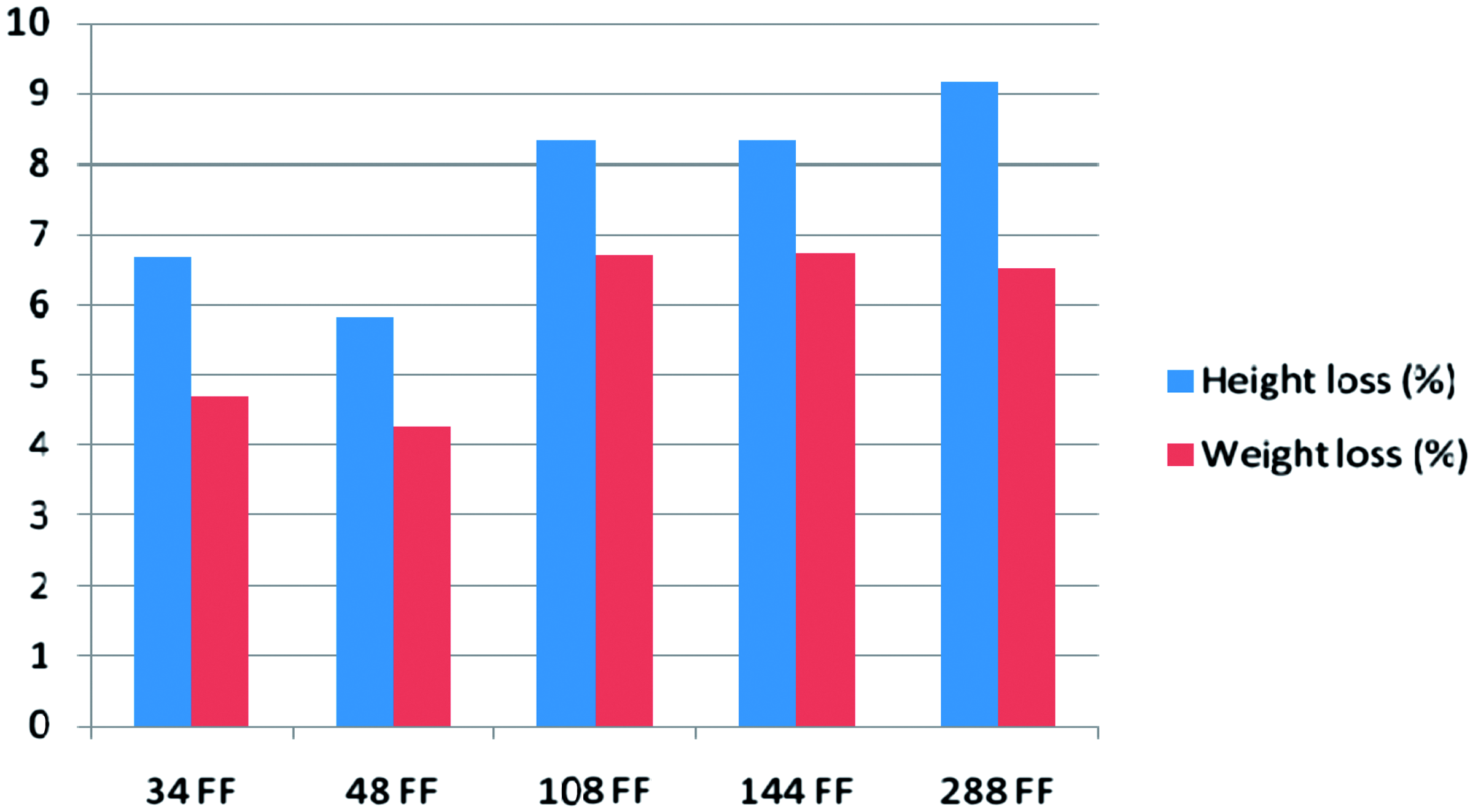
Conclusions
This research work mainly focuses to study the effect of filament fineness on comfort characteristics of MMF-treated polyester knitted fabrics to achieve suitability for making sportswear. In order to study the comfort characteristics of the fabrics wetting, vertical wicking and moisture vapor transfer were analyzed. A new test method was introduced to measure the water spreading area on the fabric, in order to find out the transverse wicking behavior of the fabrics.
It was observed that in the wetting test, 108 filaments fabric takes least time to sink in water. When the filament fineness in the fabric increases, wicking rate and wicking height first increases and then decreases. The yarn containing 108 filaments in the fabric shows higher wicking rate and wicking height. The wicking rate and wicking height increases with time for all fabrics. In moisture vapor transfer test, 108 filaments, 144 filaments, and 288 filaments fabrics evaporate more moisture than 34 filaments and 48 filaments fabrics. It was observed that 108 filaments fabric had shown better results in wetting and vertical wicking tests. In transverse wicking, when the filament fineness increases the area of water spread increases and correspondingly the time taken to reach saturation point also increases. The yarn containing 288 filaments in the fabric shows the highest water spreading area. Comparing all selected fabrics, it was seen that 108 filaments fabric had given the optimum level of comfort to achieve suitability for making sportswear. It is concluded that the filament fineness and the number of filaments in the yarn play a vital role in determining the comfort characteristics of the micro-denier polyester knitted fabric as also moisture management treatment which improves it.
Footnotes
Acknowledgement
We thank the management of K.S. Rangasamy College of Technology, Tiruchengode and PSG Polytechnic College, Coimbatore for providing necessary facilities for the research work.