



Abstract
This study explores fictional web series as a disruptive alternative to traditional television industry gatekeeping systems, offering actor/producers unprecedented pathways to creative agency and entrepreneurial career development. This research documents how practitioners, industry bodies, broadcasters, and audiences define “successful” web series, examining how “value” is generated beyond traditional economic metrics. Drawing on semi-structured interviews with a cross-section of Australian screen industry representatives, it applies an “entrepreneuring as emancipation” framework to reconceptualize the industrial significance of web series as vehicles for challenging established hierarchies. Finally, it analyzes how the low-budget format enables actor/producers to develop entrepreneurial identities through digital platforms while maintaining full control over creative, productive, and dissemination processes. By examining web series as tools that prioritize non-economic metrics of success, this study reveals impactful forms of career advancement, demonstrating how web series continue to transform screen industries through democratized content creation and distribution for actor/producers globally.
Keywords
Introduction
The mainstream television production industry has long operated through a hierarchical system of gatekeepers that creates significant barriers for actors and producers seeking to establish sustainable careers (Roussel 2017). Traditional pathways to success remain heavily dependent on opportunities mediated by agents, casting directors, and network executives, leaving creative professionals with limited agency over their career trajectories. These gatekeepers collectively exert power and control over the process of regulating access for film and television content (Perren 2013), with broadcast networks and streaming platforms serving as particularly influential cultural intermediaries who control access to elite roles and determine who succeeds in the industry. Contemporary research confirms that these long-standing patterns persist in digital media environments, where algorithmic curating and platform-mediated access continue to shape content visibility and creator success (Pantic and Ziek 2025). Twenty years ago, gatekeepers maintained barriers that made it unthinkable for independent or emerging creators to distribute entire series internationally. The centralized nature of television production, combined with high production costs and restricted distribution channels, effectively excluded most aspiring creators from participating in the industry, except in subordinate roles. This system concentrated creative and economic power within established networks, limiting diversity of voices and innovative formats.
Web series, which typically feature short episodes distributed for free via platforms such as YouTube, Facebook, Instagram, and TikTok, occupy a unique space between traditional television formats and what Cunningham and Craig (2019) have termed “social media entertainment.” The emergence of web series represents a significant disruption to these traditional industry structures, offering a new career pathway that promotes creative agency and entrepreneurship (Horst et al. 2020; Walzer 2017). Since the mid-2000s, advances in digital technology and the proliferation of online video and social media platforms have facilitated profound implications for structural change across the screen industry, including web series production and distribution. Digital media technologies have fundamentally transformed entrepreneurial processes and outcomes, enabling creators to develop their identities and ventures through new forms of strategic communication (Nambisan 2017). The contemporary creator economy, valued at over $250 billion globally as of 2024, demonstrates the economic significance of this transformation, with independent creators increasingly building sustainable web series content, as well as other content-first businesses around their expertise (Edeling and Wies 2024; Grand View Research 2024).
Recent research on web series demonstrates that these productions offer significant value through audience engagement metrics that extend beyond traditional viewing patterns (Burkholder et al. 2021), while creators increasingly embrace entrepreneurial motives that challenge industry status quo through what Zboralska (2017) terms “entrepreneuring as emancipation.” This evolution has been further accelerated by the transformation of viewing habits through streaming platforms such as Netflix, Amazon Prime, Disney+, and Apple TV+, which have redefined how audiences consume and interact with screen content (Edmond et al. 2024; Ellingsen 2014). Independent creators now have access to affordable production and distribution tools that enable full control over creative, productive, and dissemination processes, constituting an essential difference from traditional industry practices (Montoya-Bermúdez and Soto-Sanfiel 2023). Research into the career sustainability of web series producers reveals that these creators develop distinct pathways that extend beyond traditional metrics of success (Ryan et al. 2024), while web series development specifically promotes creative entrepreneurship through new forms of writer-producer collaboration (Ellingsen and Taylor 2019).
To extend former scholarship in the emerging media domain, this article considers the career benefits for cast and crew involved in web series productions, as well as the screen industry more broadly in regards to the unearthing of skilling new talent. The concept of “industrial value” is employed, adapted from the “total value framework” proposed by Turnbull and McCutcheon (2024). This approach provides a more comprehensive framework to measure the overall worth and role of web series in ways that have yet to be fully explored. This study narrows the focus further by investigating how industrial value transcends traditional markers of success from a first-hand perspective, as well as from a broad cross-section of Australian screen industry players. As demonstrated in previous studies (Montoya-Bermúdez and Soto-Sanfiel 2023; Zboralska 2017), local market developments can indeed resonate globally. Actor/producers can forge unique artistic voices, operating outside mainstream, studio-endorsed productions (Ellingsen and Taylor 2019). On a national scale, diversity and representation are increased exponentially when artist-led, episodic productions are given a platform and opportunity to grow an audience and demonstrate a demand for niche content (Leder 2021).
While interviewee responses in this study were varied, reflecting the wide-ranging approaches and attitudes toward the web series format, they illustrate a clear picture about the need to drill down deeper into the industrial value aspect of the total value framework.
The authors thus argue that web series provide an unprecedented opportunity for actor/producers to break down the limitations and confines imposed by legacy media constructs and become their own agents of change. Whilst the term “low-budget” covers a whole range of budgets, for the purposes of this article, it covers any budget up to the Screen Australia funding program cut-off of “under $1.5 million per hour” (Screen Australia n.d.). This article makes several significant theoretical and methodological innovations that distinguish it from previous studies. While earlier work has examined web series primarily as “entry tickets” to mainstream media or as sources of “added value” for creators (Christian 2020; Monaghan 2017; Tofler and Batty 2017), the present study reframes this understanding by demonstrating how web series bypass and disrupt traditional industry gatekeeping structures and career paths.
Literature Review
Scholarship on web series as a format and independent television industry sector is limited and covered thoroughly elsewhere. Web series first emerged in the 1990s and have changed significantly with the evolution of digital technology and the proliferation of online video and social media platforms. They typically occupy a space between traditional TV, streaming formats and social media entertainment. Web series generally have short episodes and are largely distributed for free via social media platforms – although some legacy broadcasters, like SBS and ABC in Australia, have commissioned and acquired short-form series for their respective on-demand platforms.
Indeed, YouTube has provided a platform for a “class of content creators who may be able to exercise a higher level of control over their career prospects than previous models of professionalizing talent” (Cunningham 2015, 276), and the “increasing scale of networked distribution has opened a space for experimentation” (Christian 2020, 459). On the flip side, the proliferation of streaming platforms has contributed to the upsurge of digital content saturation, as echoed in the industry trade press (IOM 2019; Proulx 2022; Wallenstein 2017). The resulting new screen ecosystem has a “virtually frictionless, near-global reach” (Cunningham 2015, 275), which “seems to signify a limitless way of distributing and consuming media content” (Spilker and Colbjørnsen 2020, 2). As a result, content creators are compelled to become increasingly innovative and resourceful across all facets of production, from concept creation to distribution, in their bid to find an audience and/or attract the attention of the wider screen industry (Aharoni 2023; Jansová and Elavsky 2023).
There is ongoing debate and contention around whether web series are a legitimate format or merely a stepping stone to “professional” traditional media formats such as television series and feature films (Ellingsen and Taylor 2019; Ryan et al. 2024). A 2015 report on career pathways within the Australian screen industry identified the employment of a do-it-yourself approach by “making short films, web series, or even low-budget features” as one of three “key portals” for practitioners to gain the skills and capabilities necessary to enter the industry (Rossiter and Alcaraz 2015, 15). Meanwhile, actors essentially relinquish control over their careers and artistic outputs by waiting for directors and producers to cast them. For most actors, the onus is on them to manage their careers. Not doing so substantially decreases one’s chance of forging a sustainable career (Leder 2021; Ryan et al. 2024; Tofler 2017).
The ramifications of relinquishing complete control over your career path are considerable on mental health, artistic output, and financial independence. Ellingsen and Taylor (2019) track the progress and experiences of two Australian actor/writer/producer teams (Kate McCartney and Kate McLennan of The Katering Show, and Tawni Bryant and Jerome Velinsky of Method) who have successfully bypassed traditional industry gatekeepers by using the web series format as a means of elevating their career and creative prospects. Ryan et al. (2024) take a more longitudinal and quantitve approach, mapping the career trajectories and sustainability of twenty-six web series creators between 2011 and 2020 from the point of their first publicly funded web series. Both studies provide revealing insights into the potential of the web series format, particularly in the publicly funded subsection of productions. These studies focus on the career progression of creators toward their “professionalized” pursuits within legacy media as well as screen-agency-funded productions.
As web series proliferate and become more widely consumed, their perceived value and role within Australia’s screen ecology has shifted. Indeed, an interesting development that could significantly impact the perceived value of web series on a global scale is its application in advertising models, and the emergence of branded web series, as a marketing strategy to build brand engagement (Aharoni and Roth-Cohen 2024; Santy and Anwar 2021). The appeal of this format to advertisers being a “lack of network constraints,” making it easier to create “a more personalized and engaging viewing experience” for target audiences (Aharoni and Roth-Cohen 2024, 6).
As Tofler and Batty (2017) observe, web series have facilitated new opportunities for developing and pitching projects, as well as generating a robust attractiveness for audiences – as if they were a proof-of-concept “pilot” on their own. For creators who desire to build a career in the mainstream television industry, pursuing web series can prove to prospective producers and distributors that a popular series has a successful profile. This emphasis on the assumption that creators seek to transition to television, is illuminating; a reflection of a commonly held mindset that web series exist merely as a transitional format that will eventually lead to bigger and better opportunities. This is applicable in a global context, and reflected in a case study of the transition of the Australian web series Starting From. . .Now from YouTube to broadcast television. Author Monaghan concludes by asking whether crossover productions such as this “assert the validity of web series as a unique form of screen media? [Or whether they] merely present the web series as a training ground for ‘more serious’ and culturally valuable productions?” (2017, 89).
Amid the available literature, Turnbull and McCutcheon’s (2024) total value framework offers a far more holistic method than traditional means of measuring value in legacy media, such as television or box office ratings. This framework maps the value of web series across four dimensions: industrial, economic, cultural and social (Burkholder et al. 2021, 253). It is derived from proposals by O’Brien (2010) and Allan et al. (2013) for observing the total economic value of culture that “accrues to producers, users and potential users, and to society as a whole” (Turnbull and McCutcheon 2017, 59). This article departs from this earlier scholarship by focusing specifically on the industrial value of web series for actor/producers: How do creators and industry professionals view the role of web series within an actor/producer’s career trajectory? Whilst the format is often used as a stepping stone or a calling card to future “professional” creative endeavors such as long-format television series or feature films, its greater industrial value is far more complex and wide-reaching than that.
Job security, industry recognition, access to audiences, skills progression, and career sustainability, are just some of the potential elements that either contribute to the rise of industrial value or stem from it. Ryan et al. (2024) examine whether web series are pathways to career sustainability and whether they are general calling cards for practitioners to evolve their careers. As they observe, there is limited discussion about career sustainability within existing web series scholarship, notwithstanding its broader linkages to labor precarity across the mainstream production industry. Ryan et al. (2024, 15) propose that, “Web series supported financially at the federal level by Screen Australia could be viewed as a productive, liminal, market-tested training ground situated between YouTube/SME and television.” This builds on Zboralska’s (2017) study, which found that the opportunity for practitioners to operate in an autonomous manner makes web series an ideal format for those wishing to exercise creative entrepreneurship. However, Ryan, Healy and Cunningham’s study is limited to creators who have gained highly competitive government funding for their series through Screen Australia’s Online and Multiplatform grants, which sets these creators apart from the significantly larger cohort of emerging Australian web series creators who are independently funded. A prerequisite of receiving government production funding is that all cast and crew are paid industry standard rates. This inflates budgets to an unattainable level for most emerging, independent producers who do not have the benefit of state or federal funding support. Consequently, cast and crew who take part in unfunded productions are often working for nominal or no fees, with the experience, credits or showreel material being the main drawcards. This gap in proper remuneration highlights the importance of identifying the extent to which web series deliver industrial value for creators, cast and crew relevant to web series creators across the globe, regardless of differing funding infrastructures.
Caldwell’s (2016) scathing assessment of the widespread practice of free labor, suggests that unpaid “spec work” has ceased to be the exception and now arguably permeates the screen industry as a whole. Indeed, as described by the respondents in this study, there are known risks and opportunity costs, including personal perplexities owing to limited resources. Managing and navigating the opportunities and pitfalls of independent screen production that are inherent in the conditions brought on by scarcity of funding is key to developing a flourishing practitioner’s career. Although adequate financial compensation is critical for any practitioner seeking to forge a sustainable, long-term professional career, industrial value can be manifested in many other ways, including somewhat intangible benefits such as a platform for self-expression and artistic freedom, independence, and peer recognition and audience appreciation. Whilst these benefits do not necessarily lead to tangible career outcomes, they perform the fundamental role of fueling a sense of purpose and momentum, which is crucial to sustainable career longevity. This article builds on the abovementioned studies by examining the broader industrial value a web series provides for actor/producers. It does so by lending a unique practitioner-based perspective on an emergent form that is reshaping and upending what it means to be a working performer and producer in Australia’s screen industry, what stories are being created, consumed and greenlit, and how audiences are engaging with and accessing content. Therein lie lessons for industry stakeholders in a broader Global context.
Method
This study is grounded in contemporary media industry scholarship. It addresses three key research questions. First, how do practitioners, industry bodies, mainstream broadcasters, and audiences define what is a “successful” web series, and how does this new media generate interest within, and value for each of these agents? Second, how do Australian screen industry representatives reconceptualize the significance of a web series in the contemporary streaming era? Third, how is the low-budget web series format being utilized by actor/producers to develop, shape and drive their artistic voices, audiences, and career trajectories? To answer these questions, it utilizes findings from 18 in-depth interviews conducted between March and December 2020 – with a range of Australian actor/producers, content creators and industry experts. Hitherto, links between these key industry thought-leaders and the scholarship across the television and new media domain have been largely overlooked.
Interviews are widely regarded as a powerful method for eliciting rich, nuanced accounts of participants’ experiences, perspectives, and meanings (Rubin and Rubin 2005), as they enable researchers to explore complex and context-dependent phenomena in depth, while allowing participants to frame issues in their own terms (Brinkmann 2022). Semi-structured interviews in particular strike a balance between comparability across cases and flexibility to follow emergent topics, making them suited to our focus on how diverse industry stakeholders define “success” and perceive the industrial value of web series.
The present study uses a combination of thematic, framework, and inductive content analysis to capture how industry professionals think about web series and their careers. Interview data was analyzed using NVivo 12 software, with all transcripts imported and coded inductively through an iterative process. Initial codes were refined and organized into broader themes using the software’s hierarchical coding structure. NVivo’s query and visualization tools facilitated pattern identification and examination of relationships between themes, which allowed key trends to emerge naturally from the interviews. This conventional process enabled us to examine established industry concepts, facilitating systematic organization of insights about professional practices. Utilizing these analytical methods ensured comprehensive understanding of participants’ experiences while staying true to the language and concepts they use in their professional work. In so doing, we have documented both factual accounts and the subjective rationales, motivations, and creative strategies that underpin practitioners’ work in this evolving media form.
The interviewees are divided equally into three groups, ensuring a balanced and broad range of industry perspectives from “key agents” as described by Döringer (2021). Formal human ethics approval was obtained from the authors’ host institution, and informed consent was obtained from each participant, granting permission for their names, backgrounds, and responses to be used as a collaborative tool for advancing knowledge in the field of television and new media. As shown in Table 1, the cohort investigated in this study represents a diverse cross-section of viewpoints. Whilst industry representatives were purposefully selected for their experience and positions at the top of their respective fields, web series producers were chosen from a broader pool to represent a more diverse cross-section. Selected producers have encountered varying degrees of success with their productions and are at different stages in their careers, from emerging to established. The gender mix and age range in each group varies: group one consists of four women and two men aged between their 20s and 40s; group two includes three men and three women aged between their 30s and 50s; and group three has five women and one man aged between their 20s and 50s.
List of Interviewees.
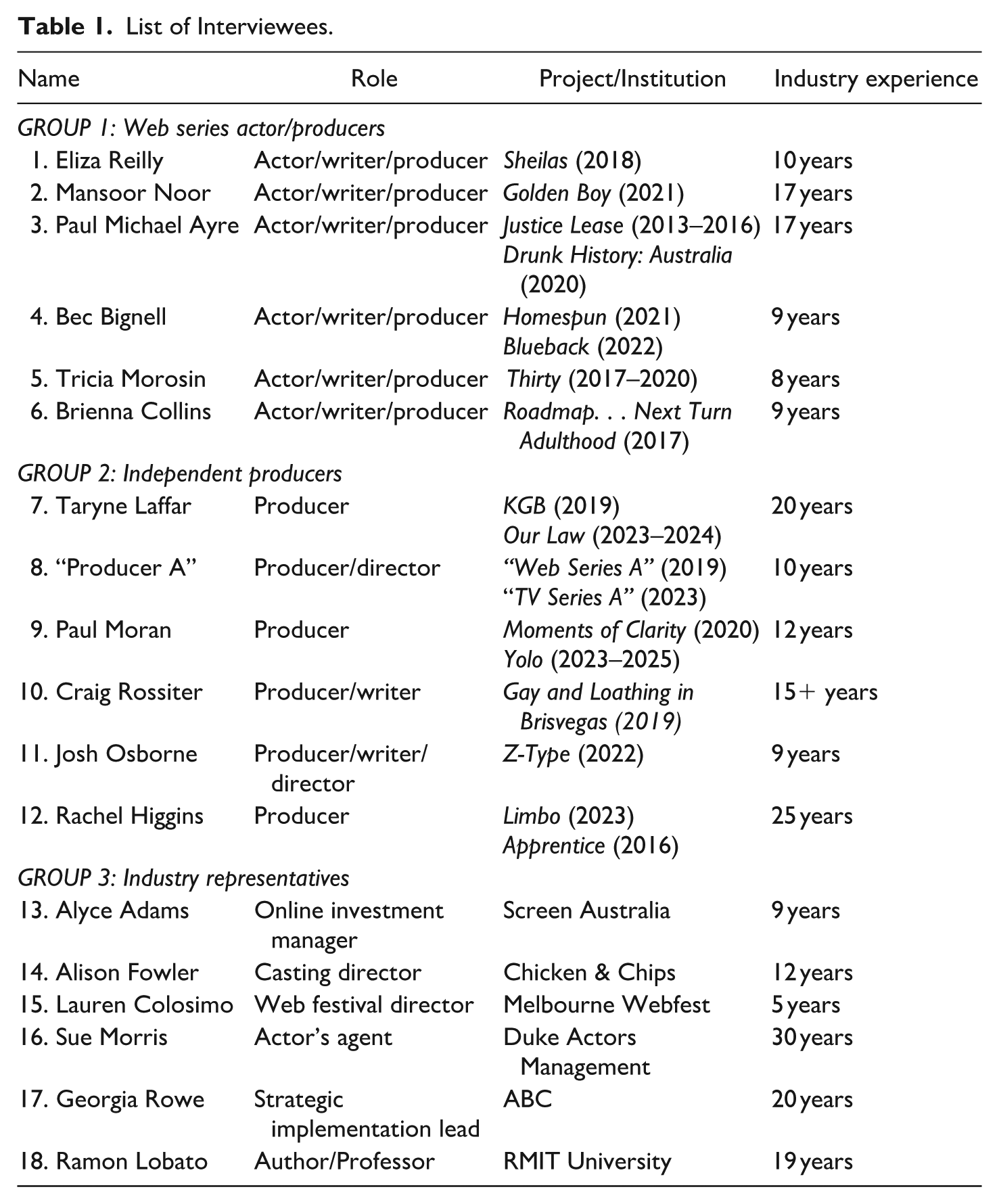
Interviewees reflected on the creative production process, their motivations for creating a web series, and their views on the roles web series play in the artistic and professional growth of practitioners within the broader industry. Interviews were conducted via video calls, averaging forty-nine minutes and based on the three key research questions, which formed the basis of a more in-depth discussion. All interviews were transcribed verbatim and analyzed using reflexive thematic analysis, as outlined by Braun and Clarke (2019). This is a widely used and flexible method for identifying patterns of meaning across varied perspectives, enabling explicit and underlying themes on creative labor, careers, and production culture to be aggregated (e.g., applied in Caldwell 2020; Ellingsen and Taylor 2019; Morgan et al. 2013; O’Meara 2025). The results have uncovered new findings in the grossly understudied topic of industrial value for Australian web series practitioners.
Methodologically, we advocate a systematic examination of non-economic value metrics in web series success, addressing a significant gap in previous research that has largely focused on economic measures such as audience numbers, monetization, and industry recognition. By prioritizing creative agency, career sustainability, and entrepreneurial identity development, our study reveals deeper and more impactful sources of professional development that have been overlooked in traditional considerations of actors’ career trajectories.
Findings
The present study demonstrates how the success of a web series is intrinsically tied to the creator’s reasons for producing it in the first place. Hence, it is near-impossible to identify a measure of their “degrees of success,” as this is subject to their individual and arbitrary metrics. Nonetheless, our stakeholder analysis, which documents how practitioners, industry bodies, broadcasters, and audiences define “successful” web series, provides a more complete understanding of how different agents derive different types of value from these productions, moving beyond the individual creator focus of previous studies. Whilst the notion that web series are simply a stepping stone to bigger and better projects remains widespread, there is a growing consensus within this narrowly focused scholarly discourse and amongst the screen industry that the format offers greater inherent value. This industrial value reflects the opportunity for actor/producers to emancipate themselves from the historical confines of mainstream industry gatekeeping.
Research findings are used to propose an industrial value model for actor/producers, which categorizes minimal and aspirational production goals across four key themes – as pictured in Figure 1: core drivers, production takeaways, creative long-term goals and career long-term goals. In doing so, a creator is able to define and track their personal metrics for success, and maximize the industrial value afforded by web series in a methodical, consistent and informed approach. Research further uncovers four revealing subsets of industrial value inherent in web series that are yet to be further unpacked; there is a more complex spectrum of industrial value that hitherto has not been explored in previous studies. The four subsets of industrial value include: (1) congruous value, which is in harmony with expectations and goals; (2) obscured value, which is not easily perceived or understood and first); (3) acquired value, which one discovers along the way; and (4) collateral value – secondary benefits that are picked up throughout the web series production process. By employing the proposed industrial value model and revealing the four subsets of industrial value, this research demonstrates the significance and potential of web series as a format for use as a tool for creative entrepreneurship as a means of bypassing traditional industry gatekeeping mechanisms.
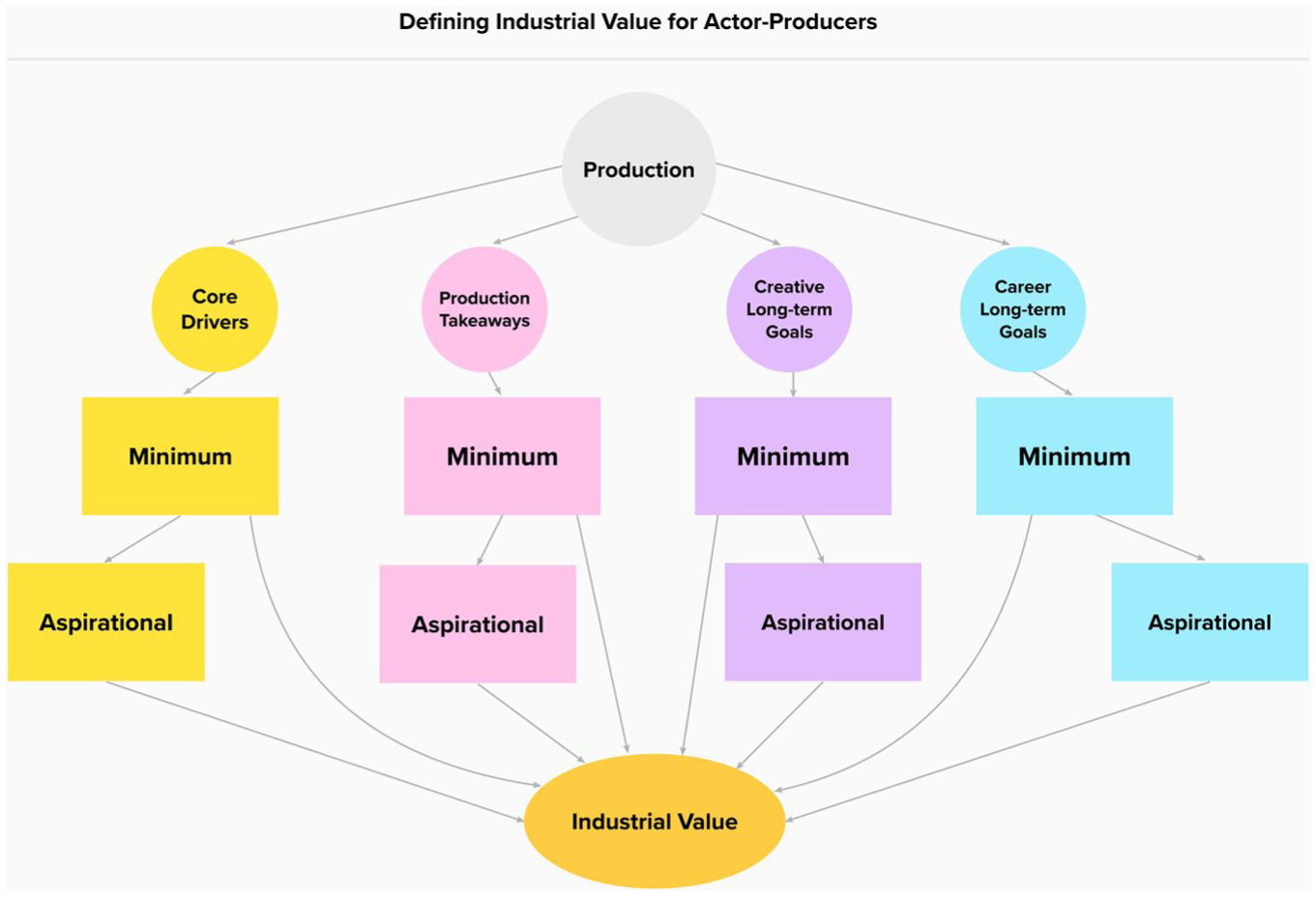
Industrial value model for actor/producers.
Shifting Metrics of Success
What constitutes “success” is not a universally quantifiable, objective concept. Whilst subscriber numbers and episode views have traditionally been the key metrics of success, focus is increasingly also placed on audience engagement (Evans 2019). For Screen Australia’s online commissioning team, “the most successful web series are considered those that tap into a niche audience [and] cut through to a small but passionate fan base” (Burkholder et al. 2021, 255). As Leder (2021, 585–586) suggests, screen creators of diverse backgrounds are afforded the opportunity to produce and develop memorable characters and stories, and to build engaged audiences via web series, which “may then lead to subsequent web or television series funding.”
The present study’s interviews suggest that “success” in the context of independent web series is both more personal and more complex. While some practitioners cite quantifiable achievements – such as audience size, series longevity, industry awards, or network acquisition – others prioritize intangible but equally significant gains, such as creative fulfilment, peer recognition, or the ability to sustain ongoing practice. These findings point directly to the industrial value model for actor/producers introduced below. Rather than treating success as a single measure, the model breaks it into four subsets of industrial value: congruous value – outcomes that align with core goals, obscured value – benefits not immediately visible, acquired value – skills and knowledge gained during production, and collateral value – secondary benefits accrued along the way. By establishing their own path, creators may be able to avoid the kinds of risks that can derail their meta-goals. Systematically working out what professional (or personal) success means lays the foundation on which one can shape an independent web series production strategy that ultimately allows an actor/producer to take back a degree of agency over their career.
A Question of Value
In this theme, “value” refers specifically to the industrial value that independent web series can generate for actor/producers, as conceptualized within Turnbull and McCutcheon’s (2024) total value framework. The value of a web series cannot be deduced purely from its economic performance or any single quantifiable measurement, such as viewer numbers or the production’s industry accolades. Indeed, measuring their value is a far more complex venture involving consideration of a broad range of factors. In this section, interviewees’ definitions of success are interpreted through this lens, linking personal reflections to specific categories of industrial value and, in turn, to the broader emancipatory potential of the format.
Determining what success means to individuals helps to shape and track the progress of a production and, ultimately, a creative career. For independent film producer Josh Osborne, defining the most important measurement of success at the outset is critical: “You are literally running your own race in your own lane” (Josh Osborne, Interview by Sarah de Possesse, April 7, 2020). This clarity aligns with congruous value, where production outcomes are in harmony with the creator’s primary motivations and career direction, enabling them to avoid the risks of comparison and misaligned expectations. Several interviewees admitted they had never consciously defined success before. When prompted, their answers revealed a consistent emphasis on joy, inspiration, and ongoing creative practice over purely financial returns. Actor/producer Tricia Morosin observed: “I have my moneymaking stuff and I don’t tie my artistry with money in that way. So, success for me is just to keep doing stuff. . . they give up” (Tricia Morosin, Interview by Sarah de Possesse, May 22, 2020). Her stance illustrates congruous value grounded in persistence and artistic autonomy – values that the independent web series format is uniquely positioned to support.
For actor/producer Mansoor Noor, success meant producing work that resonates and leads to further opportunities: “I guess success is work that leads to more work” (Mansoor Noor, Interview by Sarah de Possesse May 11, 2020).
Here, congruous value intersects with collateral value, as each project creates new relationships, collaborations, and visibility within the industry. Industry professionals also offered philosophical perspectives. Actors agent Sue Morris spoke of “just enjoying the process,” while casting director Alison Fowler pointed to “pride in projects and the joy they bring.” These interpretations map to obscured value, where benefits – such as professional fulfilment and reputation – may not be immediately measurable but contribute to long-term career sustainability. Producer Bec Bignell noted the challenge of conveying value beyond finances: “Sometimes we just look at the value proposition as financial. . . There needs to be some way that you can value people’s willingness to learn” (Bec Bignell, Interview by Sarah de Possesse, June 9, 2020). Her experience reflects obscured value in the form of leadership skills, resilience, and the ability to foster a mutually beneficial creative environment – all critical for sustaining micro-budget productions, which typify the web series ecosystem.
Other responses demonstrated collateral value in the form of tangible career progression. For example, Brienna Collins described her web series as a deliberate stepping stone: “I got an acting agent out of it. . . I’m able to use it to get producing credits” (Brienna Collins, Interview by Sarah de Possesse, June 5, 2020). These career assets were not guaranteed at the outset but emerged as enduring benefits of the project. Some creators emphasized acquired value through skill-building. Eliza Reilly framed web series not as a career stepping stone but as “a low-risk way to skill” (Eliza Reilly, Interview by Sarah de Possesse, October 11, 2020), highlighting how the format enables experimentation in writing, performance, and production without the high stakes of legacy media. Taken together, these accounts demonstrate that “success” in independent web series is highly individualized yet consistently tied to some combination of the four industrial value subsets. This reinforces the medium’s role in enabling what Zboralska (2017) referred to as “entrepreneuring as emancipation”: granting practitioners the agency to define their own metrics, pursue creative and career goals in parallel, and build sustainable pathways outside the traditional gatekeeping structures of the screen industry.
Lack of sustainable sources of monetization is a commonly cited obstacle for the ability of web series creators to truly use the format as a means of bypassing industry gatekeepers. For Screen Australia’s Alyce Adams, the question of sustainability comes back to creators’ ability to work within their means: “creators need to think of sustainable ways to make the web series, or again come out with a concept that works within your restrictions, and that’s what can actually make a project stand out” (Alyce Adams, Interview by Sarah de Possesse, December 17, 2020). Accordingly, government grants are finite and apportioned to a relatively small pool of successful applicants. For web series to become a sustainable, professionalized alternative to traditional legacy media formats, funding and distribution options would need to expand drastically to ensure widespread access to adequate production budgets. Nevertheless, the opportunity for experimentation and innovation in storytelling is a feature that increasingly entices practitioners, industry professionals and viewers to web series. ABC Strategic Implementation Lead Georgia Rowe agrees with this view of web series as a legitimate format and highlights their capacity to generate a range of related media. She describes the format as one that will continue to evolve, offering substantial room for experimentation. According to Rowe, the associated media that extends from a web series can be seen as “a bundle of possibilities” for telling a story in different ways — with multiple arcs, perspectives, and varying levels of detail or depth (Georgia Rowe, Interview by Sarah de Possesse, September 18, 2020). Rowe’s insights from the perspective of a national broadcaster, an historical industry gatekeeper (Perren 2013; Roussel 2017), are of particular interest to this research. They shed light on the obscured value inherent in web series within an established professional industry institution.
To maintain relevance within the evolving industry, broadcasters are beginning to embrace formats such as web series, creating more avenues for reaching and maintaining audiences. This could work to bolster and further legitimize the format in the future. Yet, as Producer A concedes, despite their positive assessment of web series as a legitimate professional format, they still only chose to produce one as a stepping stone toward their personal career trajectory: A web series is a great way for you to not only show that you can create great content, you can tell slightly longer stories, you can do things episodically, and you can also find an audience and interest (Producer A 2020).
Reflections on how web series are perceived within the industry, and why practitioners choose to create them reveal that there is a lot of progress to be made regarding the format’s reputation and associated professional pathways.
Discussion
Interviews across all three research groups revealed a consensus that the absence of easily accessible funding models and the subsequent lack of sustainability surrounding web series production are the main reasons they are not yet widely regarded as a legitimate, professional format for practitioners to work in on a long-term basis. Accessing government production funding necessitates the employment of industry-standard rates for all cast and crew, which elevates production budgets to a level that is not feasible for most emerging practitioners. For this reason, many interviewed actor/producers conceded that they chose to forgo funding applications, preferring to get their series off the ground out of their own pockets, relying largely on favors from friends and family. The latter approach is not viable over multiple seasons or productions, as favor banks are generally finite, and it certainly is not sustainable as a professional career path. This calls into question how web series can truly represent a form of emancipation, thereby evolving to accommodate career sustainability for practitioners who wish to operate within the independent, entrepreneurial space.
An actor/producer’s personal brand of industrial value can be defined and unpacked using the “industrial value model for actor/producers,” which the authors of this article have created from research findings, as set out below. This model builds on Turnbull and McCutcheon’s Total Value model (2024) and calls on the actor/producer to define their minimum and aspirational production goals across four key themes. The first key theme is a practitioner’s core drivers: principles that speak to their raison d’être; the motivations or fundamental beliefs that drive their creative practice. Second, are production takeaways: outcomes they wish to achieve as a direct result of creating and producing a web series. Third are creative long-term goals: those which align with their long-term creative aspirations, and the way in which the web series production might help reach them. Fourth are career long-term goals: career ambitions are intentionally separated from creative goals, as they require a different mindset and strategic game plan to navigate the obstacles and opportunities of the screen industry.
Both the minimum and aspirational iterations of each of the four key themes in this model illustrated in Figure 1 lead to the delivery of industrial value for the practitioner. Clarifying minimum and aspirational goals for each theme sets up parameters that can shape the production process. Taking the time to define personal core drivers and long-term goals, and to then share them with a potential cast and crew before bringing them on board, may help cultivate a united sense of purpose. It may highlight potential conflicts in cast and crew members’ objectives at the project’s outset. This helps ensure the process enriches careers and creative practice for all involved. Sharing these thoughts and giving cast and crew the opportunity to create their own version of industrial value is particularly beneficial within micro-budget production environments, as there is no universal driver or currency when it comes to industrial value. One is essentially replacing financial compensation with a value proposition that speaks to each person’s creative and career ambitions.
The theoretical benefits of our approach extend beyond descriptive analysis to provide opportunities for contemplating which types of web series are likely be most effective at providing career alternatives. Specifically, those that maximize creator control over production stages have a greater chance of success. Accordingly, Zboralska’s (2017) “entrepreneuring as emancipation” framework explains why certain creators succeed in web series contexts while others struggle. This research fundamentally challenges the “entry ticket” narrative that has reinforced hierarchical thinking in previous studies by demonstrating web series as legitimate professional endpoints that create sustainable careers outside traditional validation systems. Rather than focusing on individual success stories, our study has examined how web series collectively transform industry structures and create new definitions of professional achievement. To us, this opens new spaces for investigating other alternative media formats in the creator economy, non-economic value creation in creative industries, and digital entrepreneurship in traditional sectors.
Regardless of what the future holds for web series and the broader screen industry, the format is, at present, an accessible option for actor/producers seeking to elevate their careers and their creative practices. Whether a stepping stone or a “professional” artifact, a creator’s goals and takeaways can be tracked with the proposed industrial value model. This model is not only a useful tool for helping cultivate a production environment that is mutually beneficial for all cast and crew, regardless of their level of financial remuneration, but it also helps to ensure that the opportunities afforded through the production of a web series are maximized and tracked by creators with a methodical, consistent and informed approach.
The idea of what constitutes “success” for an actor/producer was found to vary significantly between individuals. Success can be measured by anything from financial profits to ongoing work, the simple act of engaging in creative practice, number of views and/or subscribers for online content, festival awards, screen grant funding, or getting on the radar of casting directors. Whilst Turnbull and McCutcheon’s total value framework (2024) provides a helpful overview of a series’ success, for an independent practitioner, attaining industrial value is often the primary reason for creating a web series. Given that there are no universally recognized metrics by which to measure the performance of a web series, an industrial value-led approach suggests that the unique trajectories and focus of individual practitioners dictates the success of their series. This is what we propose to be one’s personal brand of industrial value.
Conclusion
This study set out to understand how web series generate industrial value for actor/producers and reshape career pathways in the Australian screen industry. It explored: (1) how practitioners, industry bodies, broadcasters, and audiences define a “successful” web series; (2) how the format’s significance is viewed within the industry; and (3) how low-budget productions enable creative agency, audience building, and entrepreneurial growth. Importantly, success is defined in diverse ways. While some stakeholders prioritize audience numbers, awards, or network acquisition, others value creative fulfilment, peer recognition, and sustained practice.
Industry perspectives also reveal a persistent tension between viewing web series as stepping stones to mainstream television and recognizing them as a legitimate professional format. Limited access to funding and monetization remains a barrier, yet there is growing acknowledgment of the format’s ability to deliver distinctive creative work and nurture talent. For actor/producers, web series provide a practical means to bypass gatekeeping, maintain creative control, and align projects with personal drivers. This enables them to build skills, credits, and audiences – advancing careers without relying solely on traditional industry pathways.
These findings support the need for a flexible framework – such as the industrial value model proposed here – that incorporates congruous, obscured, acquired, and collateral value. Beyond these findings, the research offers a transferable conceptual tool: the industrial value model for actor/producers. While developed in the Australian context, it can help creators in other sectors articulate goals, measure non-economic outcomes, and design projects that advance both creative and career ambitions. The model’s application suggests broader implications for policy and practice, such as recognizing non-economic value in funding assessments and in how industry bodies evaluate work.
This study examined fictional web series by Australian practitioners. Whilst the interviews were conducted throughout 2020, since then – and especially since COVID, the practitioner respondents have continued to demonstrate evolving manifestations of value and success that embody our new conceptualization of entrepreneurial emancipation. Future research could compare international contexts, explore non-fiction, or apply the model longitudinally. Ultimately, web series let creators define success on their own terms – acquiring skills, building audiences, and shaping careers without traditional gatekeepers. In a legacy-dominated industry, the format offers rare creative autonomy and entrepreneurial opportunity, serving as both a viable endpoint and a catalyst for change.
Footnotes
Declaration of Conflicting Interests
The authors declared no potential conflicts of interest with respect to the research, authorship, and/or publication of this article.
Funding
The authors disclosed receipt of the following financial support for the research, authorship, and/or publication of this article: This research has been conducted with the support of the Australian Government Research Training Program Scholarship.
Ethical Considerations
This project was approved and accredited by the University of Wollongong Human Research Ethics Comittee (reference number 2019/332).
Consent to Participate
As part of the human ethics approval process, research participants provided written consent to be included in this research.
Consent for Publication
As part of the human ethics approval process, research participants provided written consent for included data to be published.
